LEO-NA Walker Constellation Design with Bi-objective Optimisation Approaches
Pith reviewed 2026-06-30 05:30 UTC · model grok-4.3
The pith
Bi-objective optimization produces LEO Walker constellations that increase visible satellites by 42.5% and reduce mean PDOP by 18.9% at fixed deployment cost.
A machine-rendered reading of the paper's core claim, the machinery that carries it, and where it could break.
Core claim
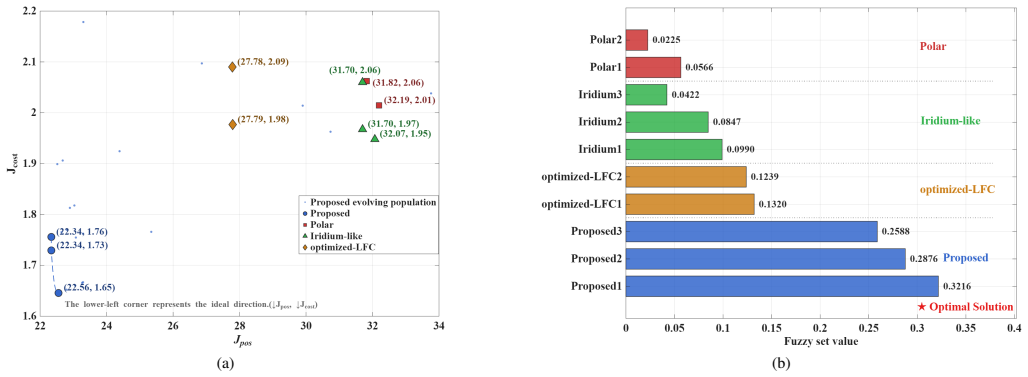
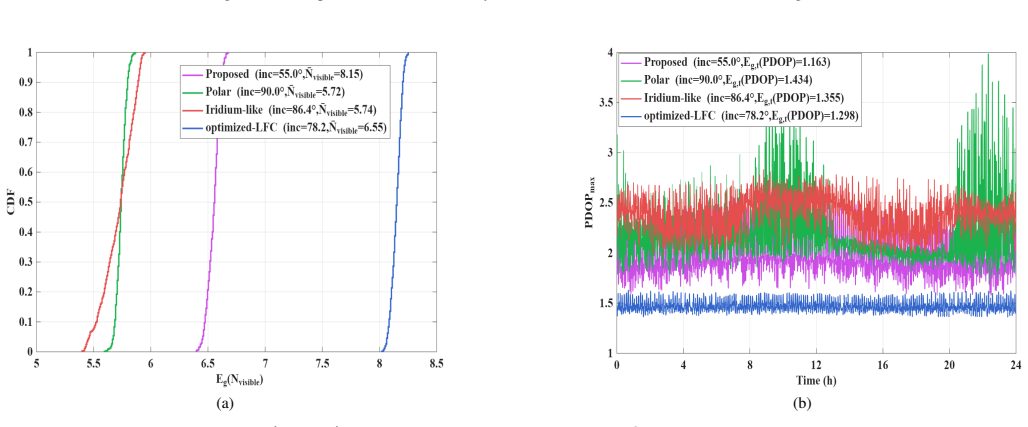
The paper claims that formulating LEO-NA Walker constellation design as a bi-objective problem with cost and performance objectives, solved via NSGA-II, yields designs that improve average visible satellites by 42.5% and 24.4% and reduce mean PDOP by 18.9% and 10.5% compared to representative Polar and optimized-LFC constellations under identical deployment cost, thereby improving service continuity and efficiency.
What carries the argument
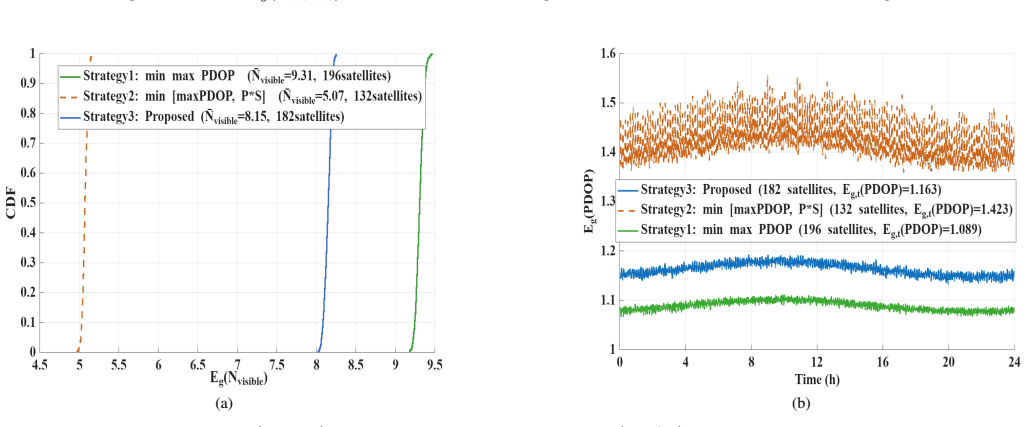
The bi-objective optimization model using NSGA-II, with objectives of constellation cost and navigation performance measured by PDOP tail risk and satellite visibility.
Load-bearing premise
The performance gains hold only if the Polar and optimized-LFC constellations used for comparison are representative and not selected to favor the new designs.
What would settle it
Running the same simulation but replacing the baseline constellations with independently optimized versions under the same cost constraint and finding no statistically significant improvement would falsify the claim.
Figures
read the original abstract
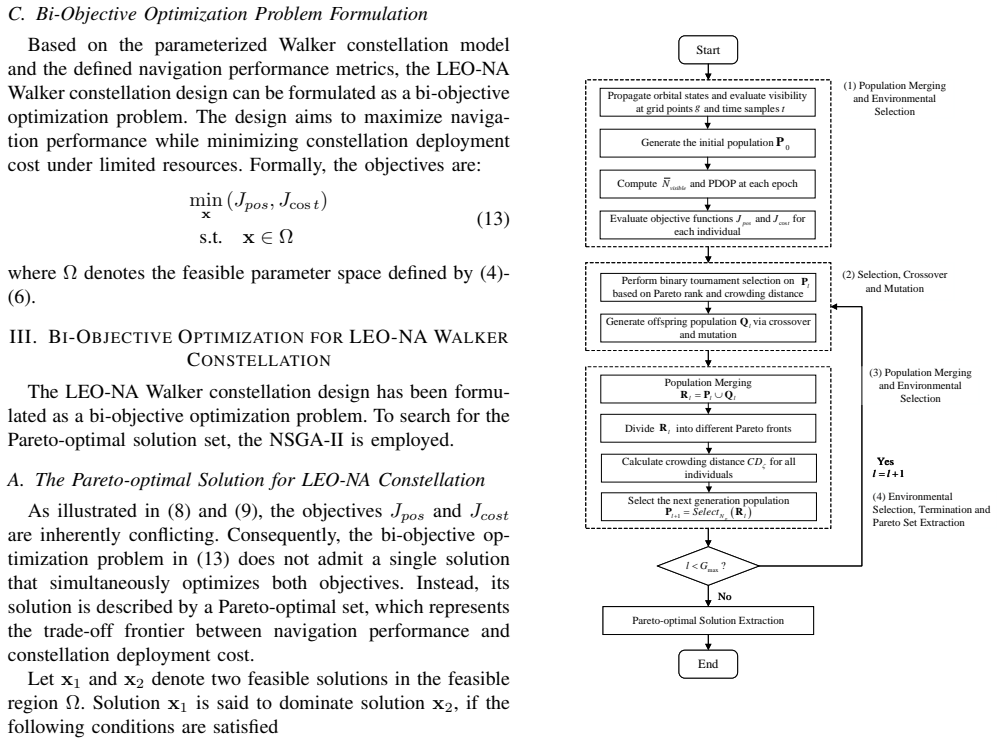
Low Earth Orbit (LEO) constellation design for navigation augmentation (NA) has attracted increasing attention in navigation satellite system studies, yet balancing navigation performance and deployment cost remains a fundamental challenge. To address this issue, this paper proposes a bi-objective optimization framework for LEO Walker constellation design. The problem is formulated as a bi-objective optimization model with constellation cost and positioning accuracy as objectives. In the formulation, PDOP tail risk and satellite visibility are incorporated into the objective formulation to better characterize navigation performance. The Pareto-optimal solution set isobtained using the Non-dominated Sorting Genetic Algorithm II (NSGA-II). Simulation results show that, under the same satellite deployment cost, the proposed LEO-NA Walker constellation improves the average number of visible satellites by 42.5% and 24.4%, and reduces the mean PDOP by 18.9% and 10.5% compared with representative Polar and optimized-LFC constellations, respectively, thereby enhancing service continuity and resource utilization efficiency. These results provide useful guidance for the design and deployment of LEO-NA constellations.
Editorial analysis
A structured set of objections, weighed in public.
Referee Report
Summary. The paper formulates LEO Walker constellation design for navigation augmentation as a bi-objective optimization problem (deployment cost vs. positioning accuracy, with PDOP tail risk and visibility incorporated), solves it via NSGA-II to obtain Pareto fronts, and reports simulation results claiming 42.5%/24.4% gains in average visible satellites and 18.9%/10.5% reductions in mean PDOP versus one representative Polar and one optimized-LFC baseline under matched cost.
Significance. If the baselines prove fair and the simulations reproducible, the bi-objective NSGA-II framework with explicit tail-risk terms supplies a practical method for cost-performance trade-offs in LEO-NA design and could inform constellation planning.
major comments (2)
- [Simulation results] Simulation results section: the headline percentage improvements rest on comparisons to a single 'representative Polar' and a single 'optimized-LFC' constellation; no pre-specified selection protocol, exhaustive enumeration of alternatives, or cost-metric verification is supplied to show these baselines were not chosen post-hoc after inspecting the Pareto front, rendering the deltas load-bearing but unverified.
- [Simulation results] Simulation results section: the reported averages lack any description of Monte Carlo run count, orbital sampling method, statistical error bars, hypothesis tests, or data-exclusion criteria, so the empirical claims cannot be assessed for robustness or replicability.
minor comments (1)
- [Abstract] Abstract: 'isobtained' is missing a space.
Simulated Author's Rebuttal
We thank the referee for the constructive feedback on our manuscript. The comments highlight important aspects of transparency in baseline selection and statistical reporting. We address each point below and commit to revisions that strengthen the simulation results section without altering the core contributions.
read point-by-point responses
-
Referee: [Simulation results] Simulation results section: the headline percentage improvements rest on comparisons to a single 'representative Polar' and a single 'optimized-LFC' constellation; no pre-specified selection protocol, exhaustive enumeration of alternatives, or cost-metric verification is supplied to show these baselines were not chosen post-hoc after inspecting the Pareto front, rendering the deltas load-bearing but unverified.
Authors: We agree that the manuscript does not explicitly document a pre-specified protocol for baseline selection. The Polar constellation is a standard reference configuration drawn from established Walker constellation literature, while the optimized-LFC is taken directly from prior published work on linear frequency constellations. To address the concern, the revised manuscript will include a dedicated subsection detailing the rationale, literature references, and explicit cost-matching verification for these baselines. We will also add results for two additional standard configurations (e.g., a representative Walker-Delta and a random Walker variant) to demonstrate that the reported gains are not sensitive to the specific choice. revision: yes
-
Referee: [Simulation results] Simulation results section: the reported averages lack any description of Monte Carlo run count, orbital sampling method, statistical error bars, hypothesis tests, or data-exclusion criteria, so the empirical claims cannot be assessed for robustness or replicability.
Authors: We acknowledge that the current manuscript omits these methodological details. The simulations rely on deterministic evaluation of PDOP and visibility over a fixed global user grid for each constellation configuration, with no stochastic elements in the core model; however, to improve replicability we will expand the simulation results section to specify the exact number of evaluation points (user locations), the uniform sampling method over latitude/longitude, the inclusion of standard deviation or error bars on reported averages, and confirmation that no data points were excluded. If the referee deems hypothesis testing appropriate, we will add a brief statistical comparison. revision: yes
Circularity Check
No circularity; results are direct outputs of standard NSGA-II optimization on explicit objectives
full rationale
The paper formulates a bi-objective model (cost and PDOP/visibility) and applies the off-the-shelf NSGA-II algorithm to generate Pareto fronts, then reports simulation metrics against separately chosen baseline constellations. No equations, fitted parameters, or self-citations are invoked to derive the reported percentages; the deltas are computed post-simulation from independent runs. Baseline selection is a modeling choice open to critique on fairness grounds but does not constitute circularity under the enumerated patterns, as nothing reduces to its own inputs by construction.
Axiom & Free-Parameter Ledger
Reference graph
Works this paper leans on
-
[1]
Simulation analysis of leo constellation augmented gnss (legnss) zenith troposphere delay and gradients estimation,
P. Zhang, W. Ding, X. Qu, and Y . Yuan, “Simulation analysis of leo constellation augmented gnss (legnss) zenith troposphere delay and gradients estimation,” vol. 61, pp. 1–12, 2023
2023
-
[2]
Lamp: Low-latency dynamic topology for leo satellite constellations,
R. Esswein, Q. Bayer, S. Mergendahl, J. Ruffley, M. Abdelhakim, and R. Cunningham, “Lamp: Low-latency dynamic topology for leo satellite constellations,” pp. 4714–4719, 2025
2025
-
[3]
Inter-satellite routing for leo satellite networks: A gnn and drl integrated approach,
P. Xu, M. Feng, J. Zhou, L. Xiao, P. Xiao, and T. Jiang, “Inter-satellite routing for leo satellite networks: A gnn and drl integrated approach,” pp. 1346–1351, 2024
2024
-
[4]
Low earth orbit satellite networks: Architecture, key technologies, measurement, and open issues,
J. Zheng, T. H. Luan, G. Li, J. Zhao, Z. Yin, N. Cheng, and J. Pan, “Low earth orbit satellite networks: Architecture, key technologies, measurement, and open issues,”IEEE Network, vol. 40, no. 2, pp. 295– 303, 2026
2026
-
[5]
Resource optimization for leo constellation networks: A multi-satellite cooperative coverage design,
X. Ma, H. Zhang, W. Song, Y . Lu, Y . Wu, and V . C. M. Leung, “Resource optimization for leo constellation networks: A multi-satellite cooperative coverage design,”IEEE Transactions on Communications, vol. 73, no. 11, pp. 10 201–10 216, 2025
2025
-
[6]
Leo-based positioning: Foundations, signal design, and receiver enhancements for 6g ntn,
H. K. Dureppagari, C. Saha, H. Krishnamurthy, X. Wang, A. Rico- Alvari˜no, R. M. Buehrer, and H. S. Dhillon, “Leo-based positioning: Foundations, signal design, and receiver enhancements for 6g ntn,”IEEE Communications Magazine, vol. 63, no. 11, pp. 130–137, 2025
2025
-
[7]
Toward wide-area and high- precision positioning with leo constellation augmented ppp-rtk,
X. Li, Y . Yuan, X. Han, X. Li, and Y . Fu, “Toward wide-area and high- precision positioning with leo constellation augmented ppp-rtk,”IEEE Transactions on Instrumentation and Measurement, vol. 73, pp. 1–13, 2024
2024
-
[8]
Fundamentals of leo-based localization,
D.-R. Emenonye, H. S. Dhillon, and R. Michael Buehrer, “Fundamentals of leo-based localization,”IEEE Transactions on Information Theory, vol. 71, no. 7, pp. 5277–5311, 2025
2025
-
[9]
Optimal walker constellation design of leo-based global navigation and augmentation system,
M. Guan, T. Xu, F. Gao, W. Nie, and H. Yang, “Optimal walker constellation design of leo-based global navigation and augmentation system,”Remote Sensing, vol. 12, no. 11, pp. 1845–1866, 2020
2020
-
[10]
Qos-driven satellite constel- lation design for leo satellite internet of things,
M. Ying, X. Chen, Q. Qi, and Z. Zhang, “Qos-driven satellite constel- lation design for leo satellite internet of things,”IEEE Transactions on Wireless Communications, vol. 25, pp. 3610–3625, 2026
2026
-
[11]
Stochastic geometry and dynamical sys- tem analysis of walker satellite constellations,
C.-S. Choi and F. Baccelli, “Stochastic geometry and dynamical sys- tem analysis of walker satellite constellations,”IEEE Transactions on V ehicular Technology, vol. 75, no. 3, pp. 5127–5132, 2026
2026
-
[12]
Gdop-based analysis of suitability of leo constellations for future satellite-based positioning,
R. Morales-Ferre, E. S. Lohan, G. Falco, and E. Falletti, “Gdop-based analysis of suitability of leo constellations for future satellite-based positioning,” pp. 147–152, 2020
2020
-
[13]
Design of agile satellite constellation based on hybrid-resampling particle swarm optimization method,
X. Wang, H. Zhang, S. Bai, and Y . Yue, “Design of agile satellite constellation based on hybrid-resampling particle swarm optimization method,”Acta Astronautica, vol. 178, pp. 595–605, 2021
2021
-
[14]
Leo navigation augmentation constellation design with the multi- objective optimization approaches,
H. Yi, W. Lei, F. Wenju, Z. Haitao, L. Tao, X. Beizhen, and C. Ruizhi, “Leo navigation augmentation constellation design with the multi- objective optimization approaches,”Chinese Journal of Aeronautics, vol. 34, no. 4, pp. 265–278, 2021
2021
-
[15]
Optimization of multi-mission cubesat constellations with a multi-objective genetic algorithm,
S. D. Melaku and H.-D. Kim, “Optimization of multi-mission cubesat constellations with a multi-objective genetic algorithm,”Remote Sensing, vol. 15, no. 6, pp. 1572–1585, 2023
2023
-
[16]
An ape-driven leo satellite constellation design method for passive maritime localization,
L. Yao, C. Xue, B. Deng, S. Li, and J. Wang, “An ape-driven leo satellite constellation design method for passive maritime localization,”IEEE Internet of Things Journal, vol. 13, no. 5, pp. 9096–9111, 2026
2026
-
[17]
Decision-making in a fuzzy environ- ment,
R. E. Bellman and L. A. Zadeh, “Decision-making in a fuzzy environ- ment,”Management science, vol. 17, no. 4, pp. 141–164, 1970
1970
discussion (0)
Sign in with ORCID, Apple, or X to comment. Anyone can read and Pith papers without signing in.