Efficient Numerical Modeling of Near-Field Diffraction in ORIS-Assisted Free-Space Optical Links
Pith reviewed 2026-06-28 16:29 UTC · model grok-4.3
The pith
An FFT-based method evaluates near-field diffraction in ORIS-assisted free-space optical links with accuracy matching Riemann sums but far lower computation time.
A machine-rendered reading of the paper's core claim, the machinery that carries it, and where it could break.
Core claim
The paper establishes that the optical field distribution in near-field ORIS-assisted FSO links can be computed efficiently by reformulating the diffraction integral as a convolution in the spatial-frequency domain and applying the FFT, delivering accuracy comparable to Riemann-sum integration at reduced complexity.
What carries the argument
Reformulation of the near-field propagation integral as a convolution in the spatial-frequency domain, which enables FFT-based evaluation of the optical field.
If this is right
- The FFT approach makes simulation of near-field effects feasible for ORIS-assisted FSO system design.
- Accuracy remains high for the scenarios considered despite the efficiency gain.
- Computational resources needed for fine discretization are avoided.
Where Pith is reading between the lines
- This method could be applied to other near-field optical propagation problems involving surfaces.
- Future work might combine it with machine learning for faster ORIS configuration optimization.
- Validation in experimental setups would confirm its practical utility beyond simulations.
Load-bearing premise
The near-field optical propagation can be accurately represented as a convolution in the spatial-frequency domain with errors limited to those from discretization.
What would settle it
Running both methods on a test case with known analytical solution or very high-resolution reference and finding large discrepancies in the field distribution would disprove the comparable accuracy claim.
Figures
read the original abstract
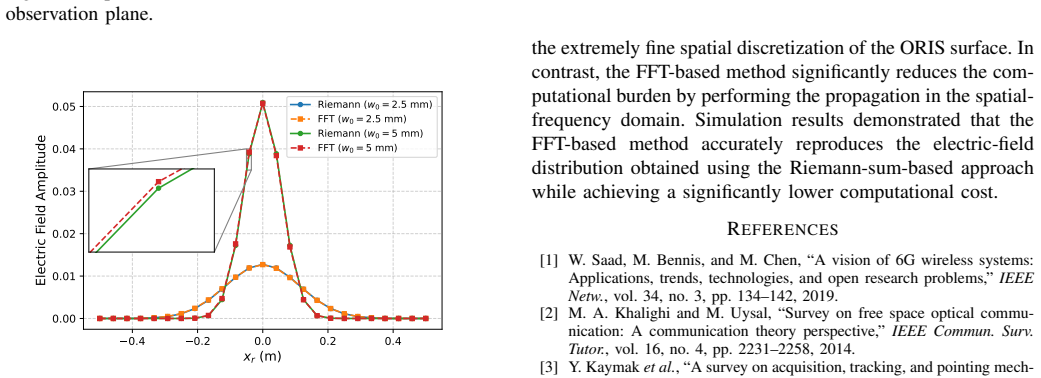
This paper investigates near-field propagation in optical reconfigurable intelligent surface (ORIS)-assisted free-space optical (FSO) communication systems. Unlike conventional far-field scenarios, near-field propagation involves complex diffraction effects that hinder tractable closed-form analysis. To address this issue, a numerical framework for evaluating the optical field distribution of ORIS-assisted FSO links is proposed. Specifically, two numerical approaches are considered: direct Riemann-sum evaluation and a fast Fourier transform (FFT)-based method. Although the Riemann sum approach provides accurate field estimation, it incurs extremely high computational complexity due to the fine spatial discretization of the ORIS surface required at optical wavelengths. To improve computational efficiency, the optical-field calculation is reformulated as a convolution in the spatial-frequency domain, enabling efficient FFT-based propagation analysis. Simulation results demonstrate that the proposed FFT-based method achieves accuracy comparable to that of the Riemann-sum approach while significantly reducing computational complexity.
Editorial analysis
A structured set of objections, weighed in public.
Referee Report
Summary. The paper investigates near-field diffraction effects in ORIS-assisted FSO links, where closed-form analysis is intractable. It proposes two numerical methods for computing the optical field: direct Riemann-sum evaluation of the propagation integral and an FFT-based reformulation of the same integral as a convolution in the spatial-frequency domain. The central claim is that the FFT method delivers accuracy comparable to the Riemann-sum baseline while substantially lowering computational cost due to the fine optical-scale sampling required on the ORIS surface.
Significance. If the claimed numerical equivalence holds with quantified error bounds, the work would supply a practical tool for simulating near-field diffraction in optical RIS systems, enabling tractable performance evaluation of FSO links that would otherwise be limited by the O(N^2) cost of direct double integration over finely discretized apertures.
major comments (2)
- [Abstract] Abstract: the headline assertion that the FFT-based method 'achieves accuracy comparable' to Riemann-sum evaluation is load-bearing for the contribution, yet the provided description supplies neither quantitative error metrics (e.g., relative L2 or phase error), discretization parameters (sampling density, zero-padding size), nor a validation case against an analytic Fresnel or angular-spectrum solution; without these, the equivalence of the two discretizations remains unverified.
- The reformulation as a spatial-frequency convolution (via the convolution theorem) presupposes that the effective aperture function—including the discrete per-element ORIS phase shifts—remains identically sampled and padded for both methods; any mismatch in grid alignment or truncation of the finite ORIS support would introduce aliasing or truncation errors absent from the direct Riemann sum, and no section demonstrates that these errors are controlled or quantified.
Simulated Author's Rebuttal
We thank the referee for the constructive and detailed comments. We address each major comment below and will revise the manuscript to strengthen the validation of the FFT-based method.
read point-by-point responses
-
Referee: [Abstract] Abstract: the headline assertion that the FFT-based method 'achieves accuracy comparable' to Riemann-sum evaluation is load-bearing for the contribution, yet the provided description supplies neither quantitative error metrics (e.g., relative L2 or phase error), discretization parameters (sampling density, zero-padding size), nor a validation case against an analytic Fresnel or angular-spectrum solution; without these, the equivalence of the two discretizations remains unverified.
Authors: We agree that quantitative support is needed to substantiate the accuracy claim. In the revised manuscript we will add relative L2 and phase error metrics between the two methods, specify the sampling density (samples per wavelength) and zero-padding size used in the simulations, and include a validation subsection comparing both numerical approaches against the analytic Fresnel diffraction formula for a reference aperture without ORIS modulation. revision: yes
-
Referee: The reformulation as a spatial-frequency convolution (via the convolution theorem) presupposes that the effective aperture function—including the discrete per-element ORIS phase shifts—remains identically sampled and padded for both methods; any mismatch in grid alignment or truncation of the finite ORIS support would introduce aliasing or truncation errors absent from the direct Riemann sum, and no section demonstrates that these errors are controlled or quantified.
Authors: The methods are constructed to employ the identical spatial sampling grid and padding for the ORIS aperture function. We acknowledge that explicit quantification of residual aliasing and truncation errors is not currently provided. In revision we will add a dedicated paragraph detailing the shared grid alignment, padding strategy, and error bounds obtained by direct comparison of the two implementations across different padding factors. revision: yes
Circularity Check
No circularity: standard convolution-theorem reformulation of the diffraction integral
full rationale
The paper reformulates the near-field optical propagation integral as a convolution in the spatial-frequency domain to enable FFT computation. This step follows directly from the convolution theorem applied to the standard Fresnel or angular-spectrum kernel and does not reduce to a fitted parameter, self-definition, or self-citation chain. The subsequent accuracy comparison is between two independent discretizations (Riemann sum vs. FFT) of the same integral; neither is derived from the other by construction. No load-bearing uniqueness theorems or ansatzes from prior self-work are invoked. The derivation chain remains self-contained against external Fourier-optics benchmarks.
Axiom & Free-Parameter Ledger
axioms (1)
- standard math Convolution theorem of Fourier transforms applies to the spatial integral for optical field propagation
Reference graph
Works this paper leans on
-
[1]
A vision of 6G wireless systems: Applications, trends, technologies, and open research problems,
W. Saad, M. Bennis, and M. Chen, “A vision of 6G wireless systems: Applications, trends, technologies, and open research problems,”IEEE Netw., vol. 34, no. 3, pp. 134–142, 2019
2019
-
[2]
Survey on free space optical commu- nication: A communication theory perspective,
M. A. Khalighi and M. Uysal, “Survey on free space optical commu- nication: A communication theory perspective,”IEEE Commun. Surv. Tutor., vol. 16, no. 4, pp. 2231–2258, 2014
2014
-
[3]
A survey on acquisition, tracking, and pointing mech- anisms for mobile free-space optical communications,
Y . Kaymaket al., “A survey on acquisition, tracking, and pointing mech- anisms for mobile free-space optical communications,”IEEE Commun. Surv. Tutor., vol. 20, no. 2, pp. 1104–1123, 2018
2018
-
[4]
Optical RISs improve the secret key rate of free-space QKD in HAP-to-UA V scenarios,
P. V . Trinh, S. Sugiura, C. Xu, and L. Hanzo, “Optical RISs improve the secret key rate of free-space QKD in HAP-to-UA V scenarios,”IEEE J. Sel. Areas Commun., vol. 43, no. 8, pp. 2747–2764, 2025
2025
-
[5]
Intelligent reflecting surfaces for free space optical communications,
M. Najafi and R. Schober, “Intelligent reflecting surfaces for free space optical communications,” in2019 IEEE Glob. Commun. Conf. (GLOBECOM), pp. 1–7, IEEE, 2019
2019
-
[6]
Intelligent reflecting surface assisted free-space optical communications,
V . Jamaliet al., “Intelligent reflecting surface assisted free-space optical communications,”IEEE Commun. Mag., vol. 59, no. 10, pp. 57–63, 2021
2021
-
[7]
Optical reconfigurable intelligent surfaces aided optical wireless communications: Opportunities, challenges, and trends,
H. Wanget al., “Optical reconfigurable intelligent surfaces aided optical wireless communications: Opportunities, challenges, and trends,”IEEE Wirel. Commun., vol. 30, no. 5, pp. 28–35, 2023
2023
-
[8]
Optical IRSs: Power scaling law, optimal deployment, and comparison with relays,
H. Ajam, M. Najafi, V . Jamali, and R. Schober, “Optical IRSs: Power scaling law, optimal deployment, and comparison with relays,”IEEE Trans. Commun., vol. 72, no. 2, pp. 954–970, 2023
2023
-
[9]
Channel modeling for IRS-assisted FSO systems,
H. Ajam, M. Naja, V . Jamali, and R. Schober, “Channel modeling for IRS-assisted FSO systems,” in2021 IEEE Wirel. Commun. Netw. Conf. (WCNC), pp. 1–7, IEEE, 2021
2021
-
[10]
Introduction to fourier optics, roberts & co,
J. W. Goodman, “Introduction to fourier optics, roberts & co,”Publish- ers, Englewood, Colorado, 2005
2005
-
[11]
Physics-based mod- eling and scalable optimization of large intelligent reflecting surfaces,
M. Najafi, V . Jamali, R. Schober, and H. V . Poor, “Physics-based mod- eling and scalable optimization of large intelligent reflecting surfaces,” IEEE Trans. Commun., vol. 69, no. 4, pp. 2673–2691, 2020
2020
-
[12]
Chan- nel modeling for ORIS-aided HAP-to-UA V FSO communications in the near-field regime,
T. A. Hoang, P. V . Trinh, S. Sugiura, S. Ishihara, and T. V . Pham, “Chan- nel modeling for ORIS-aided HAP-to-UA V FSO communications in the near-field regime,” inProceedings of the IEICE General Conference,
-
[13]
TorchOptics: An open-source Python library for differentiable Fourier optics simulations,
M. J. Filipovich and A. Lvovsky, “TorchOptics: An open-source Python library for differentiable Fourier optics simulations,”arXiv preprint arXiv:2411.18591, 2024
discussion (0)
Sign in with ORCID, Apple, or X to comment. Anyone can read and Pith papers without signing in.