REVIEW 4 major objections 6 minor 37 references
Enhancing Energy and Spectral Efficiency in IoT-Cellular Networks via Active SIM-Equipped LEO Satellites
T0 review · 4 major / 6 minor · reviewed 2026-08-05 · deepseek-v4-flash
Pith's one-line read An active stacked intelligent metasurface (ASIM) mounted on a LEO satellite's solar-panel backplate can lift both spectral and energy efficiency above what active RIS or beyond-diagonal RIS achieve, by processing the wavefront in several tu
desk verdict Solid system concept, but the SINR derivation contradicts the signal model and the hardware comparison is uneven—performance gains as reported don't hold up. read the letter →
The pith
A machine-rendered reading of the paper's core claim, the machinery that carries it, and where it could break.
The reading
What carries the argument
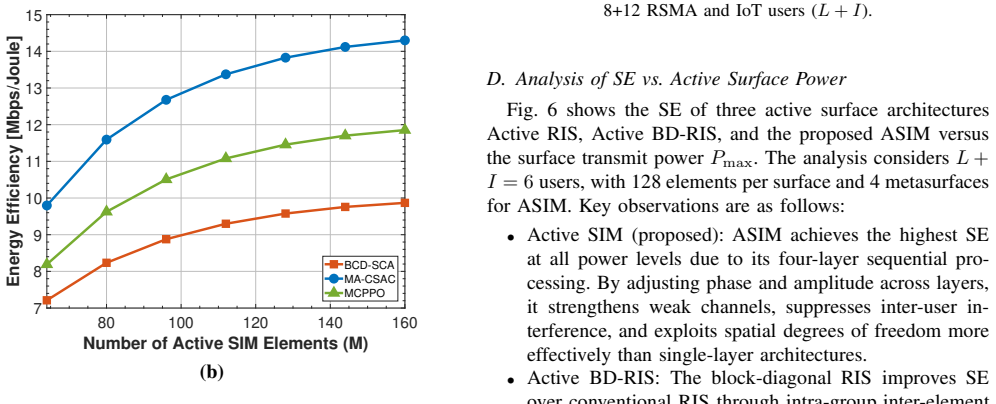
The central object is the ASIM's overall transfer matrix T = ∏_{q=Q}^{1} Φ(q) H(q), where Φ(q) is the diagonal amplitude-and-phase tuning of layer q and H(q) is the inter-layer coupling between surfaces. Because the signal passes through several active layers, each layer's tuning pattern can be adjusted sequentially, which is what produces stronger effective channels and lower inter-user interference. The optimization then tunes the satellite precoder W, the ASIM layers {Φ(q)}, and the backscatter parameters to maximize a weighted sum of throughputs minus power consumption.
What would settle it
The decisive check is to rerun the simulations using only the single shared transfer matrix T described in the signal model, with no separate matrices for the common and private streams; if ASIM no longer beats a single-layer active RIS at equal power, the multi-layer advantage is an artifact of that unmodeled extra freedom. A hardware or full-wave test at 20 GHz with four stacked active layers would settle it directly.
Extended reading notes
Core claim
The central discovery is that multi-layer sequential processing inside an ASIM is a better use of satellite surface power than single-layer active RIS or block-diagonal active RIS. The transfer matrix T = product over layers of diagonal tuning matrices Φ(q) and inter-layer coupling matrices H(q) lets each layer reshape the wavefront, so the composite can strengthen weak channels and cancel interference across users. In the paper's simulations, ASIM achieves higher spectral efficiency than Active RIS and Active BD-RIS at equal surface transmit power, and the best optimization strategy—MA-CSAC—balances energy and spectral efficiency in larger networks. The paper embeds this in a system serving
Load-bearing premise
The optimization depends on the ASIM being able to apply different processing to the common stream and to each private stream simultaneously, but the signal model uses one shared ASIM transfer matrix and the hardware description does not show how the separate per-stream processing would be realized.
Editorial extensions
If this is right
- If the central claim is correct, ASIM-equipped LEO satellites can offer higher spectral efficiency than active RIS or beyond-diagonal RIS at the same surface transmit power.
- Splitting power amplification between the satellite's main amplifier and the ASIM can reduce the power amplifier burden enough that solar harvesting remains a viable energy source.
- RSMA combined with ASIM is more energy-efficient than NOMA combined with ASIM, because common-stream decoding handles interference better in the multi-user setting.
- The choice of optimizer matters: BCD-SCA fits convex, energy-constrained regimes, MA-CSAC fits large dynamic networks, and MCPPO suits fast-deployment scenarios.
Reading between the lines
- A reader should not assume the per-stream processing is physically available: the SINR formulas use separate ASIM matrices for the common and each private stream (Φc, Φl), while the signal model and hardware description contain only one shared transfer matrix T. If the separate matrices are not realizable, the reported gains are optimistic.
- The paper's SE–EE plots assume static channel snapshots per optimization step; LEO satellites sweep across the sky, so a natural extension is to test how fast the ASIM layers and beamformer can be retuned against Doppler and elevation changes.
- Because the whole advantage over active RIS rests on inter-layer coupling matrices H(q), a direct measurement of those near-field couplings in a prototype would turn the architecture's benefit into an engineering quantity rather than a simulation parameter.
Signed reviews
Editorial analysis
A structured set of objections, weighed in public.
Referee Report
Summary. The manuscript studies a LEO satellite downlink in which an active stacked intelligent metasurface (ASIM), integrated on the satellite's solar-panel backplate, serves L RSMA users and I passive IoT backscatter devices. The system model defines a single ASIM transfer matrix T (Eq. 3) and a single output ROut (Eq. 4); the paper then formulates SINR/rate expressions, a joint optimization problem (20), and three solution algorithms (BCD-SCA, MA-CSAC, MCPPO) to maximize weighted spectral/energy efficiency. Simulations compare these algorithms and claim superiority of ASIM over active RIS and active BD-RIS.
Significance. If the modeling were consistent, the paper would address a relevant 6G IoT/satellite integration problem and provide a useful multi-algorithm benchmark. The ASIM concept is interesting and the paper covers relevant prior work; the inclusion of energy harvesting and power-amplifier modelling is a strength, and the comparative evaluation of three optimization approaches is ambitious. However, the central SINR derivation and the optimization objective are not tied to the signal model, so the reported SE/EE improvements are not supported. I cannot recommend publication in its current form.
major comments (4)
- [II-C, Eqs. (8) and (11)] The SINR expressions introduce per-stream ASIM matrices Φ_c and Φ_l that never appear in the system model. From Eqs. (3)-(5), y_Ul = g_l^H T F x + g_l^H nSIM + n_Ul, so the SINR must be computed with one common transfer matrix T, and the ASIM noise contribution is ||g_l||^2 σ_SIM^2. Instead, Eq. (8) uses U_c = g_l^H Φ_c T F w_c and U_l = g_l^H Φ_l T F w_l, and Eq. (11) uses a further Φ_ℓ. These matrices are undefined, are not expressed in terms of Φ(q), and are never constrained. Since R_c,l and R_p,l feed constraints (20g)-(20h) and all numerical results, the objective and algorithms optimize a different system from the one modeled. This is a load-bearing modeling error.
- [Section III, Problem (20) and Eq. (28)] The optimization variables in (20) include ϑ_sat and ϑ_SIM, but Eq. (16) defines these as fixed inverse PA efficiencies (1/η_PA). Treating them as decision variables allows the optimizer to set them to zero (or arbitrarily small) to remove the ϑ_sat P_sat + ϑ_SIM P_SIM terms from P_total. No lower bound or feasibility constraint is imposed. The same variables appear in the DRL action space (28). This can artificially deflate P_total and inflate EE, so the reported EE comparisons are not meaningful.
- [Section VI-D, Fig. 6] The comparison of ASIM versus active RIS/active BD-RIS is not controlled. The text states that the comparison uses 128 elements per surface and 4 metasurfaces for ASIM, so ASIM has 4×128 = 512 active elements, while each baseline uses a single 128-element surface. The horizontal axis is surface transmit power Pmax, but it is not specified whether this is total power or per-element/per-layer power. With 4× the number of active elements, the ASIM has substantially more hardware resources; the observed gain cannot be attributed solely to multi-layer processing or to the proposed algorithm. The claim that ASIM outperforms active RIS/BD-RIS is therefore unsupported. A fair comparison should fix total number of active elements or total power and report per-surface transmit power consistently.
- [Section II-C, Eqs. (9), (12), and (15)] The rate expressions use B log2(1 + γ/B). This is not the Shannon capacity formula, which is B log2(1 + γ); γ is dimensionless, so γ/B has units of 1/Hz and the expression is dimensionally inconsistent. The paper reports rates in bps/Hz, but multiplying by B yields bps. This affects all SE/EE results, including comparisons in Figs. 4-7. Unless the authors define a specific finite-blocklength or bandwidth-normalization convention, the rate model must be corrected.
minor comments (6)
- [Section IV, first paragraph] 'BSD-SCA' should be 'BCD-SCA'.
- [Eq. (20f)] The notation is confusing: the constraint is imposed ∀q, but the second term sums over q=1..Q inside each constraint. If the intent is a per-layer power budget, the sum should not be repeated, and the first term should be the power through the complete ASIM transfer T rather than Φ(q) F W.
- [Eq. (2)] The text says 'k-th metasurface layer' but the index is q; please fix the inconsistency.
- [Fig. 3(b)] The BCD-SCA convergence plot labels an 'Asymptotic Optimum' without defining how it is computed; this should be clarified.
- [Section V-D] Propositions 1-2 are stated for general MDPs; the paper does not verify the Lipschitz and bounded-variance assumptions for the specific reward/cost functions, so the guarantees cannot be directly applied to this system.
- [Table III] The table mixes dBm and mW values without consistent conversion; e.g., Pphs is listed as 7 dBm but the text says 1.5-7.8 mW. Please clarify units.
Circularity Check
SE/EE 'predictions' are partly built into the SINR definitions, the unequal ASIM-vs-RIS benchmark, and the optimization of fixed PA-efficiency constants.
-
self definitional
[Section II-C1, Eqs. (8) and (11)]
"γc,l(t) = σcP^sat_c |Uc|² / (∑_{l=1}^L σlP^sat_l (|Ul|² + |g_l^H Φ_l|² σ²_SIM) + σ²_Ul), where Uc ≜ g_l^H Φ_c T F w_c and Ul ≜ g_l^H Φ_l T F w_l ... γp,l(t) = σlP^sat_l |Ul|² / (∑_{ℓ∈ψ,ℓ≠l} σℓP^sat_ℓ (|Uℓ|² + |g_ℓ^H Φ_ℓ|² σ²_SIM) + σ²_Ul), where Uℓ ≜ g_l^H Φ_ℓ T F w_ℓ"
The signal model (Eqs. 3–5) defines one ASIM transfer matrix T = ∏ Φ(q)H(q) and received signal y_Ul = g_l^H T F x + g_l^H nSIM + n_Ul. No Φ_c or Φ_l is introduced there, and no equation relates them to Φ(q). By putting Φ_c/Φ_l into the SINR definitions, the paper silently assumes per-stream ASIM processing that can shape Uc/Ul and shrink the ASIM-noise term |g_l^H Φ_l|² σ²_SIM. The claimed channel enhancement and interference suppression are therefore present in the definition of the SINR, not derived from optimized variables; the rates in (20) do not follow from the modeled signal.
-
renaming known result
[Section VI-D and Fig. 6]
"The analysis considers L + I = 6 users, with 128 elements per surface and 4 metasurfaces for ASIM. ... Active SIM (proposed): ASIM achieves the highest SE at all power levels due to its four-layer sequential processing. [Fig. 6 caption: Active RIS, Active BD-RIS [22], and ASIM]"
ASIM is configured with Q=4 layers × M=128 elements = 512 active elements, while Active RIS and Active BD-RIS use one 128-element surface. The simulation therefore changes both architecture and element count simultaneously. The higher SE of ASIM is the well-known consequence of more surface elements and more active amplification, relabeled as 'multi-layer sequential processing.' The claimed outperformance is built into the unequal configuration rather than being an independent test of multi-layer processing.
1 more flagged steps
-
fitted input called prediction
[Eqs. (16) and (20a), Section III]
"min_{α,β,Φ(q),W,τ_BD_i,τ_EH_i, ϑ_sat,ϑ_SIM,C_l(t),σ_c,σ_l,η_i} αP_total−β(RSUM(t)+RSR,i(t)) ... P_total = ϑ_satP_sat + ϑ_SIMP_SIM + P_c,sat + P_c,SIM ... ϑ_sat = 1/η^sat_PA and ϑ_SIM = 1/η^SIM_PA represent the inverse of the power amplifier efficiencies."
ϑ_sat and ϑ_SIM are defined as fixed hardware constants (inverse PA efficiencies), but problem (20a) lists them as minimization variables and the DRL action in (28) includes them. Because P_total is linear in these constants, a solver can drive them to zero, making P_total collapse to the circuit terms and inflating the reported EE. The EE 'prediction' is thus an artifact of optimizing fixed inputs, i.e., the result is forced by the formulation rather than by any physical ASIM property.
full rationale
The paper does not rest on a self-citation chain: the reference to [22] is only a baseline, and the BCD-SCA / DRL machinery is standard and independently applicable. However, three construction steps compromise the central performance claims. First, the SINR expressions that define all rates introduce per-stream matrices Φ_c and Φ_l absent from the signal model (Eqs. 3–5); these matrices can encode the claimed channel shaping and interference suppression, so the advantage is assumed in the definition rather than derived from the optimized Φ(q). Second, the ASIM-vs-RIS/BD-RIS comparison gives ASIM four 128-element layers while the baselines have one 128-element surface; the 'multi-layer sequential processing' advantage is the known element-count effect relabeled. Third, the optimization problem lists fixed PA-efficiency constants ϑ_sat and ϑ_SIM as variables, so minimizing P_total can trivially set them to zero and inflate EE. These issues affect the paper's headline SE/EE comparisons, giving a partial circularity score of 6. The purely algorithmic convergence results (Figs. 3–5) are internal and not circular, which prevents a higher score.
Assumptions & free parameters
free parameters (4)
- PA efficiency coefficients vartheta_sat, vartheta_SIM =
unspecified; placed in optimization variables
- Number of ASIM layers Q and elements per layer M =
Q=4, M=128
- Channel estimation error variance sigma_el^2 =
10^-3
- ASIM noise variance sigma_SIM^2 =
reported as -70 dBm in Table III
assumptions (6)
- domain assumption Perfect CSI on satellite-to-ASIM link F due to deterministic geometry
- domain assumption ASIM-to-user channels follow g_l = ghat_l + e_l with Gaussian error
- domain assumption SBD antenna noise is negligible
- domain assumption Energy harvesting of SBDs follows epsilon <= Gamma tau_EH |h_i^H R_Out|^2
- domain assumption Solar power P_harvest follows Eq. (19) with AM0 irradiance, 32% efficiency, and 0.7 eclipse factor
- ad hoc to paper DRL convergence requires reward and costs to be Lipschitz with bounded variance (Assumptions 1-2)
invented entities (1)
-
Per-stream ASIM processing matrices Phi_c and Phi_l
Cite this review
Pith. "Pith review of Enhancing Energy and Spectral Efficiency in IoT-Cellular Networks via Active SIM-Equipped LEO Satellites." pith.science (2026). https://pith.science/paper/BXBISMIA
@misc{pith2026250817149,
  author       = {Pith},
  title        = {Pith review of: Enhancing Energy and Spectral Efficiency in IoT-Cellular Networks via Active SIM-Equipped LEO Satellites},
  year         = {2026},
  howpublished = {\url{https://pith.science/paper/BXBISMIA}},
  note         = {Machine review of arXiv:2508.17149}
}
read the original abstract
This paper investigates a low Earth orbit (LEO) satellite communication system enhanced by an active stacked intelligent metasurface (ASIM), mounted on the backplate of the satellite solar panels to efficiently utilize limited onboard space and reduce the main satellite power amplifier requirements. The system serves multiple ground users via rate-splitting multiple access (RSMA) and IoT devices through a symbiotic radio network. Multi-layer sequential processing in the ASIM improves effective channel gains and suppresses inter-user interference, outperforming active RIS and beyond-diagonal RIS designs. Three optimization approaches are evaluated: block coordinate descent with successive convex approximation (BCD-SCA), model-assisted multi-agent constraint soft actor-critic (MA-CSAC), and multi-constraint proximal policy optimization (MCPPO). Simulation results show that BCD-SCA converges fast and stably in convex scenarios without learning, MCPPO achieves rapid initial convergence with moderate stability, and MA-CSAC attains the highest long-term spectral and energy efficiency in large-scale networks. Energy-spectral efficiency trade-offs are analyzed for different ASIM elements, satellite antennas, and transmit power. Overall, the study demonstrates that integrating multi-layer ASIM with suitable optimization algorithms offers a scalable, energy-efficient, and high-performance solution for next-generation LEO satellite communications.
Figures


Figures from the paper (4 more)



Reference graph
Works this paper leans on
-
[1]
Towards 6G wireless communication networks: Vision, enabling technologies, and new paradigm shifts,
X. Y ou, C.-X. Wang, J. Huang, X. Gao, Z. Zhang, M. Wang, Y . H uang, C. Zhang, Y . Jiang, J. Wang et al., “Towards 6G wireless communication networks: Vision, enabling technologies, and new paradigm shifts,” Science China Information Sciences , vol. 64, pp. 1–74, 2021
work page 2021
-
[2]
IRS-aided WPC Ns: A new optimization framework for dynamic IRS beamforming,
Q. Wu, X. Zhou, W. Chen, J. Li, and X. Zhang, “IRS-aided WPC Ns: A new optimization framework for dynamic IRS beamforming,” IEEE Transactions on Wireless Communications , 2021
work page 2021
-
[3]
Energy optimization for green commu nication in IoT using Harris Hawks Optimization,
K. Dev, P . K. R. Maddikunta, T. R. Gadekallu, S. Bhattacha rya, P . Hegde, and S. Singh, “Energy optimization for green commu nication in IoT using Harris Hawks Optimization,” IEEE Transactions on Green Communications and Networking , vol. 6, no. 2, pp. 685–694, 2022
work page 2022
-
[4]
From 5G to 6G technology: meets energy, Inte rnet- of-Things and Machine Learning: a survey,
M. N. Mahdi, A. R. Ahmad, Q. S. Qassim, H. Natiq, M. A. Subhi , and M. Mahmoud, “From 5G to 6G technology: meets energy, Inte rnet- of-Things and Machine Learning: a survey,” Applied Sciences , vol. 11, no. 17, p. 8117, 2021
work page 2021
-
[5]
6G visions: Mobile Ultra- Broadband, Super Internet-of-Things, and Artificial Intel ligence,
L. Zhang, Y .-C. Liang, and D. Niyato, “6G visions: Mobile Ultra- Broadband, Super Internet-of-Things, and Artificial Intel ligence,” China Communications, vol. 16, no. 8, pp. 1–14, 2019
work page 2019
-
[6]
Ambient Backscatter: Wireless communication out of thin a ir,
V . Liu, A. Parks, V . Talla, S. Gollakota, D. Wetherall, an d J. R. Smith, “Ambient Backscatter: Wireless communication out of thin a ir,” ACM SIGCOMM Computer Communication Review , vol. 43, no. 4, pp. 39–50, 2013
work page 2013
-
[7]
Cooperative Ambient Backscatter communications for green Internet-of-Things,
G. Y ang, Q. Zhang, and Y .-C. Liang, “Cooperative Ambient Backscatter communications for green Internet-of-Things,” IEEE Internet of Things Journal, vol. 5, no. 2, pp. 1116–1130, 2018
work page 2018
-
[8]
Symbi otic Radio: A new communication paradigm for passive Internet of Things,
R. Long, Y .-C. Liang, H. Guo, G. Y ang, and R. Zhang, “Symbi otic Radio: A new communication paradigm for passive Internet of Things,” IEEE Internet of Things Journal , vol. 7, no. 2, pp. 1350–1363, 2020
work page 2020
Show all 37 references
-
[9]
Spectrum sharing for Internet of Things: A survey,
L. Zhang, Y .-C. Liang, and M. Xiao, “Spectrum sharing for Internet of Things: A survey,” IEEE Wireless Communications , vol. 26, no. 3, pp. 132–139, 2018
2018
-
[10]
Symbi otic Radio: Cognitive Backscattering communications for future wirel ess networks,
Y .-C. Liang, Q. Zhang, E. G. Larsson, and G. Y . Li, “Symbi otic Radio: Cognitive Backscattering communications for future wirel ess networks,” IEEE Transactions on Cognitive Communications and Network ing, vol. 6, no. 4, pp. 1242–1255, 2020
2020
-
[11]
Ubiquitous Integrated Sensing and Communications f or massive MIMO LEO satellite systems,
L. Y ou, Y . Zhu, X. Qiang, C. G. Tsinos, W. Wang, X. Gao, and B. Otter- sten, “Ubiquitous Integrated Sensing and Communications f or massive MIMO LEO satellite systems,” arXiv preprint arXiv:2407.05029 , 2024
2024 arXiv
-
[12]
Link budget analysis for LEO sa tellites based on the statistics of the elevation angle,
J. M. Gongora-Torres, C. V argas-Rosales, A. Arag´ on-Z avala, and R. Villalpando-Hernandez, “Link budget analysis for LEO sa tellites based on the statistics of the elevation angle,” IEEE Access , vol. 10, pp. 14 518–14 528, 2022
2022
-
[13]
Intellig ent Reflecting Surface-aided wireless communications: A tutor ial,
Q. Wu, S. Zhang, B. Zheng, C. Y ou, and R. Zhang, “Intellig ent Reflecting Surface-aided wireless communications: A tutor ial,” IEEE Transactions on Communications , vol. 69, no. 5, pp. 3313–3351, 2021
2021
-
[14]
Low-complexity chann el es- timation and passive beamforming for RIS-assisted MIMO sys tems relying on discrete phase shifts,
J. An, C. Xu, L. Gan, and L. Hanzo, “Low-complexity chann el es- timation and passive beamforming for RIS-assisted MIMO sys tems relying on discrete phase shifts,” IEEE Transactions on Communications, vol. 70, no. 2, pp. 1245–1260, 2021
2021
-
[15]
Stacked Intelligent Metasurfaces fo r efficient holographic MIMO communications in 6G,
J. An, C. Xu, D. W. K. Ng, G. C. Alexandropoulos, C. Huang, C. Y uen, and L. Hanzo, “Stacked Intelligent Metasurfaces fo r efficient holographic MIMO communications in 6G,” IEEE Journal on Selected Areas in Communications , vol. 41, no. 8, pp. 2380–2396, 2023
2023
-
[16]
Energy- efficient RIS- assisted satellites for IoT networks,
K. Tekbıyık, G. K. Kurt, and H. Y anikomeroglu, “Energy- efficient RIS- assisted satellites for IoT networks,” IEEE Internet of Things Journal , vol. 9, no. 16, pp. 14 891–14 899, 2021
2021
-
[17]
RIS-assisted energy-efficient LEO satellite commun ications with NOMA,
W. U. Khan, E. Lagunas, A. Mahmood, S. Chatzinotas, and B . Otter- sten, “RIS-assisted energy-efficient LEO satellite commun ications with NOMA,” IEEE Transactions on Green Communications and Network- ing, vol. 8, no. 2, pp. 780–790, 2023
2023
-
[18]
Energy ef fi- ciency design in RIS-assisted satellite–terrestrial inte grated networks with NOMA,
Z. Lv, F. Gong, G. Chen, G. Li, T. Hui, and S. Xu, “Energy ef fi- ciency design in RIS-assisted satellite–terrestrial inte grated networks with NOMA,” IEEE Wireless Communications Letters , vol. 13, no. 7, pp. 1948–1952, 2024
1948
-
[19]
QoS improvement in multi user cellular-Symbiotic Radio ne twork assisted by Active-Star-RIS,
R. S. Y eganeh, M. J. Omidi, F. Zeinali, M. R. Mili, and M. G havami, “QoS improvement in multi user cellular-Symbiotic Radio ne twork assisted by Active-Star-RIS,” IEEE Transactions on Cognitive Commu- nications and Networking , pp. 1–1, 2025
2025
-
[20]
Tra ns- missive RIS-empowered LEO-satellite communications with Hybrid- NOMA under residual hardware impairments,
M. Asif, X. Bao, Z. Ali, A. Ihsan, M. Ahmed, and X. Li, “Tra ns- missive RIS-empowered LEO-satellite communications with Hybrid- NOMA under residual hardware impairments,” IEEE Transactions on Green Communications and Networking , 2024
2024
-
[21]
CR-enabled NOMA integrated Non-Terrestr ial IoT networks with transmissive RIS,
W. U. Khan, Z. Ali, A. Mahmood, E. Lagunas, S. T. Shah, and S. Chatzinotas, “CR-enabled NOMA integrated Non-Terrestr ial IoT networks with transmissive RIS,” arXiv preprint arXiv:2408.15084 , 2024
2024 arXiv
-
[22]
Energy efficient RSMA-ba sed LEO satellite communications assisted by UA V -mounted BD-Acti ve RIS: A DRL approach,
R. S. Y eganeh and H. Behroozi, “Energy efficient RSMA-ba sed LEO satellite communications assisted by UA V -mounted BD-Acti ve RIS: A DRL approach,” arXiv preprint arXiv:2505.04148 , 2025
2025 arXiv
-
[23]
Stacked Int elligent Metasurface enabled LEO satellite communications relying on statistical CSI,
S. Lin, J. An, L. Gan, M. Debbah, and C. Y uen, “Stacked Int elligent Metasurface enabled LEO satellite communications relying on statistical CSI,” IEEE Wireless Communications Letters , vol. 13, no. 5, pp. 1295– 1299, 2024
2024
-
[24]
Stacked Intell igent Metasurfaces-assisted satellite-to-ground communicati on: A path loss perspective,
A. H. Khan, Z. Hussain, and N. U. Hassan, “Stacked Intell igent Metasurfaces-assisted satellite-to-ground communicati on: A path loss perspective,” in 2025 2nd International Conference on Microwave, Antennas & Circuits (ICMAC) , 2025, pp. 1–4
2025
-
[25]
Stacked Intelligent Metasurfaces for Integrat ed Sensing and Communications,
H. Niu, J. An, A. Papazafeiropoulos, L. Gan, S. Chatzino tas, and M. Debbah, “Stacked Intelligent Metasurfaces for Integrat ed Sensing and Communications,” IEEE Wireless Communications Letters , vol. 13, no. 10, pp. 2807–2811, 2024
2024
-
[26]
Cognitive Backscatte r Network: A spectrum sharing paradigm for passive IoT,
H. Guo, R. Long, and Y .-C. Liang, “Cognitive Backscatte r Network: A spectrum sharing paradigm for passive IoT,” IEEE Wireless Communi- cations Letters , vol. 8, no. 5, pp. 1423–1426, 2019
2019
-
[27]
Multi-BD Sym biotic Radio-aided 6G IoT network: Energy consumption optimizati on with QoS constraint approach,
R. S. Y eganeh, M. J. Omidi, and M. Ghavami, “Multi-BD Sym biotic Radio-aided 6G IoT network: Energy consumption optimizati on with QoS constraint approach,” IEEE Transactions on Green Communications and Networking , vol. 7, no. 4, pp. 2067–2080, 2023
-
[28]
The design and optimiza tion of random code assisted Multi-BD Symbiotic Radio system,
S. Han, Y .-C. Liang, and G. Sun, “The design and optimiza tion of random code assisted Multi-BD Symbiotic Radio system,” IEEE Trans- actions on Wireless Communications , vol. 20, no. 8, pp. 5159–5170, 2021
2021
-
[29]
Rate-Sp litting Multiple Access for multi-antenna joint Radar and Communic ations,
C. Xu, B. Clerckx, S. Chen, Y . Mao, and J. Zhang, “Rate-Sp litting Multiple Access for multi-antenna joint Radar and Communic ations,” IEEE Journal of Selected Topics in Signal Processing , vol. 15, no. 6, pp. 1332–1347, 2021
2021
-
[30]
Reconfigurable Intelligent Surfaces for energy ef ficiency in wireless communication,
C. Huang, A. Zappone, G. C. Alexandropoulos, M. Debbah, and C. Y uen, “Reconfigurable Intelligent Surfaces for energy ef ficiency in wireless communication,” IEEE Transactions on Wireless Communica- tions, vol. 18, no. 8, pp. 4157–4170, 2019
2019
-
[31]
Energy-efficient SIM-assisted communications: How many l ayers do we need?
E. Shi, J. Zhang, J. An, M. Di Renzo, B. Ai, and C. Y uen, “Energy-efficient SIM-assisted communications: How many l ayers do we need?” arXiv preprint arXiv:2504.15737 , 2025. [Online]. Available: https://arxiv.org/pdf/2504.15737
2025 arXiv
-
[32]
Active RIS assisted Rate-Splitting Multiple Access network: Spectral and energy efficiency tradeoff,
H. Niu, Z. Lin, K. An, J. Wang, G. Zheng, N. Al-Dhahir, and K.-K. Wong, “Active RIS assisted Rate-Splitting Multiple Access network: Spectral and energy efficiency tradeoff,” IEEE Journal on Selected Areas in Communications , vol. 41, no. 5, pp. 1452–1467, 2023
2023
-
[33]
Solar energy harvesting from Solar Power Satellite,
P . Boddu, B. S. Kumar, K. Ganapathy, T. Suresh, and P . Kir an, “Solar energy harvesting from Solar Power Satellite,” in Proceedings of Inter- national Conference on Sustainable Computing in Science, T echnology and Management (SUSCOM), Amity University Rajasthan, Jaip ur-India, 2019
2019
-
[34]
Space Solar Power orbit de sign and cost analysis,
S. T. Goh and S. A. R. Zekavat, “Space Solar Power orbit de sign and cost analysis,” in 2015 7th International Conference on Recent Advances in Space Technologies (RAST) . IEEE, 2015, pp. 753–758
2015
-
[35]
Constr aint-based Multi-Agent Reinforcement Learning for collaborative tas ks,
X. Shang, T. Xu, I. Karamouzas, and M. Kallmann, “Constr aint-based Multi-Agent Reinforcement Learning for collaborative tas ks,” Computer Animation and Virtual W orlds, vol. 34, no. 3-4, p. e2182, 2023
2023
-
[36]
Prox- imal Policy Optimization algorithms,
J. Schulman, F. Wolski, P . Dhariwal, A. Radford, and O. K limov, “Prox- imal Policy Optimization algorithms,” arXiv preprint arXiv:1707.06347, 2017
2017 arXiv
-
[37]
Constraine d Policy Op- timization,
J. Achiam, D. Held, A. Tamar, and P . Abbeel, “Constraine d Policy Op- timization,” in International Conference on Machine Learning . PMLR, 2017, pp. 22–31
2017
Reviewed August 5, 2026 · model on record in the stance chip above.
Discussion (0). Continue with ORCID to comment.