REVIEW 2 major objections 6 minor 73 references
The $\beta$ Fermi-Pasta-Ulam-Tsingou Recurrence Problem
T0 review · 2 major / 6 minor · reviewed 2026-08-14 · deepseek-v4-flash
Pith's one-line read For the quartic (β) FPUT chain, the rescaled first recurrence time is controlled for large N by the single parameter S = E β (N+1), matching numerics, perturbation theory, and mKdV soliton theory for both signs of β.
desk verdict Convincing scaling study of beta-FPUT recurrence times with real analytic support, but the large-|S| collapse needs a fixed-S multi-N test before it is fully established. read the letter →
The pith
A machine-rendered reading of the paper's core claim, the machinery that carries it, and where it could break.
The reading
What carries the argument
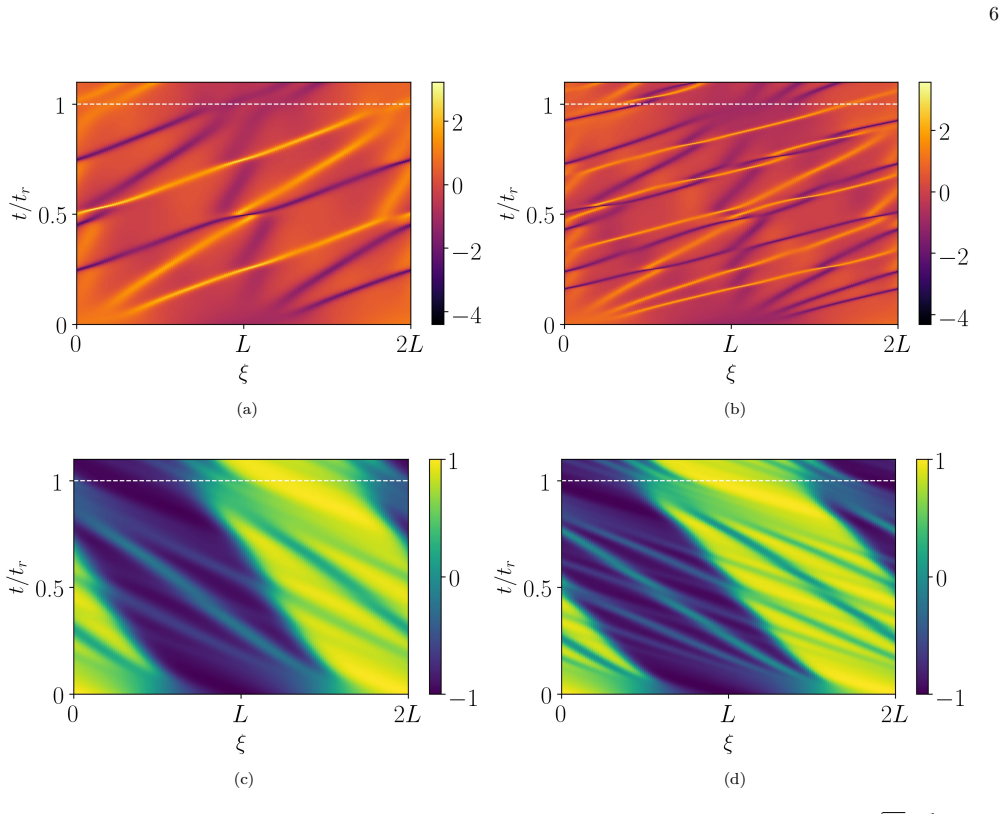
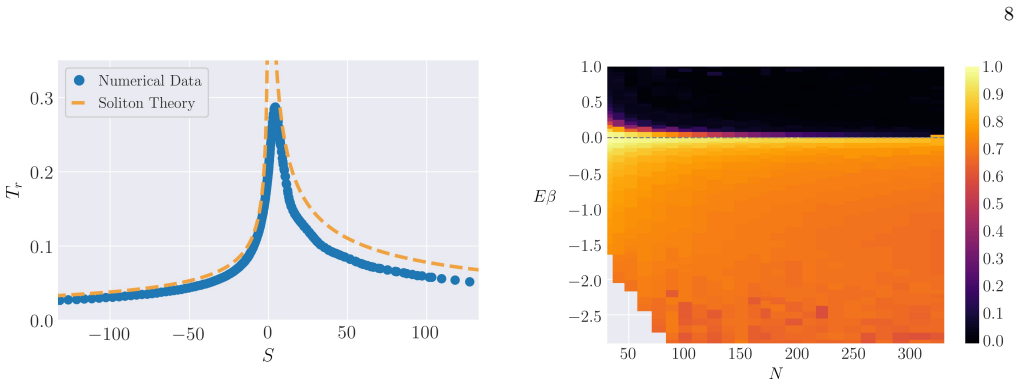
The load-bearing quantity is the dimensionless parameter $S \equiv E\beta(N+1)$, which combines the total energy, the quartic coupling sign and strength, and the number of masses into one control parameter. The analytic work rests on two tools: shifted-frequency perturbation theory, in which nonlinear normal-mode frequencies $\Omega_k$ are computed to second order and the recurrence time is $t_r = 2\pi/(3\Omega_1 - \Omega_3)$, and the continuum mKdV description, in which the first-mode initial condition breaks into soliton-antisoliton pairs; the recurrence time is estimated from the velocity spacing between consecutive solitons through $\tau_r = \frac{b+3}{2}\,\frac{L}{\Delta v}$, with $b = \mathrm{sgn}(\beta)$. For β < 0, kink solutions exist and solitons flip between soliton and antisoliton form when crossing the background, which changes the effective spatial separation appearing in the velocity-spacing estimate and produces the different prefactor.
What would settle it
Track one solitary wave in a numerically integrated β < 0 mKdV solution with cosine initial data: the paper's mechanism predicts the wave changes from soliton to antisoliton when it crosses the background and that the two overlap points at the recurrence are separated by L, not 2L; observing a different crossing behavior or spacing would falsify the prefactor explanation even if the $|S|^{-1/2}$ law survives.
Extended reading notes
Core claim
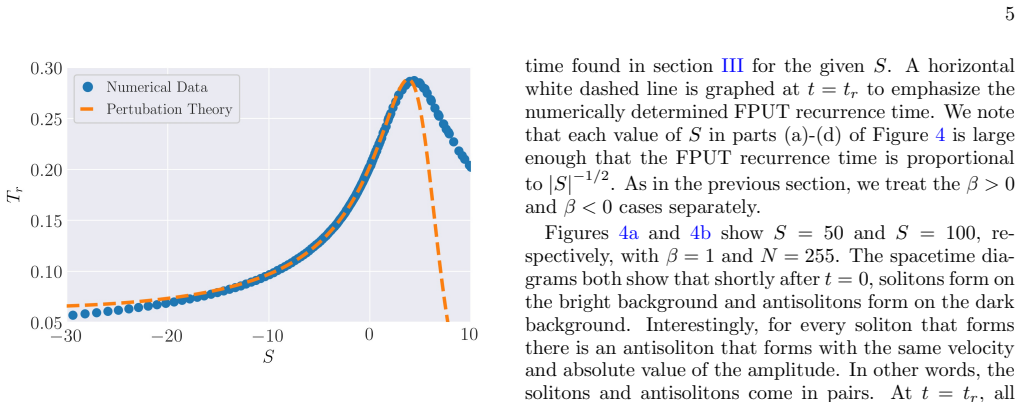
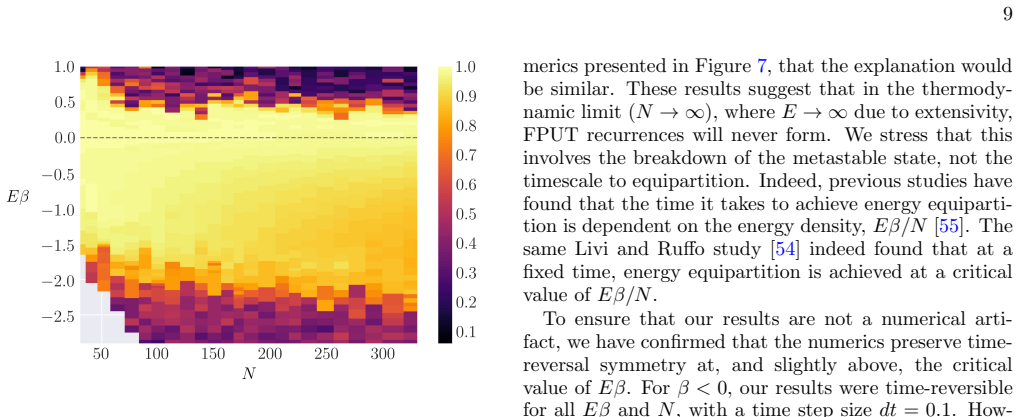
The central discovery is that the first FPUT recurrence time in the β chain is, for large N, fully described by $S \equiv E\beta(N+1)$: the rescaled time $T_r = t_r/(N+1)^3$ is a single function of S for β > 0 and β < 0. Numerically, $T_r$ is linear in S for small $|S|$ with nearly identical positive slope for both signs, reaches a maximum near $S \approx 4.2$, and for large $|S|$ follows $T_r \approx 0.5862\,S^{-1/2}$ for β > 0 and $T_r \approx 0.3078\,|S|^{-1/2}$ for β < 0. The paper reproduces the small-$|S|$ branch with a closed formula from shifted-frequency perturbation theory and the large-$|S|$ branch from soliton velocities in the mKdV continuum limit; the smaller β < 0 prefactor is attributed to soliton-kink interactions that make recurrences occur sooner. The paper also finds that recurrences cease to form beyond critical values $E\beta_c^+ \approx 0.53$ and $E\beta_c^- \approx -2.43$ for large N, which it connects to the breakdown of the metastable state.
Load-bearing premise
The load-bearing assumption is that the β < 0 mKdV background is a traveling kink-antikink and that solitary waves flip their form when crossing it; this identification is inferred from spacetime heat maps rather than from a quantitative scattering calculation, and it is what sets the different β < 0 prefactor.
Editorial extensions
If this is right
- For large N, any experiment or simulation that fixes S should see the same first recurrence time whether the quartic coupling is attractive or repulsive, provided blow-up is avoided; the sign of β enters only through the multiplicative constant at large $|S|$.
- The closed-form small-$|S|$ expression lets one predict recurrence times near the harmonic limit without integrating the lattice, using only S and N.
- The $|S|^{-1/2}$ scaling in the highly nonlinear regime links lattice recurrence to soliton and kink dynamics, so recurrence-time data can be used to probe the soliton content of the mKdV initial condition.
- Beyond a critical value of $E\beta$ that is independent of N for large N, recurrences stop forming; equivalently, in the thermodynamic limit with E growing extensively, recurrences will not occur at all.
Reading between the lines
- The S-collapse suggests the same one-parameter scaling may organize other diagnostics of the β chain, such as energy mixing or higher-order recurrences; the paper only checks the first recurrence.
- Because the paper connects β < 0 dynamics to a one-dimensional Bose gas in the quantum rotor regime, the predicted difference in recurrence prefactors could be tested in ultracold bosons in optical lattices at energies below the blow-up threshold.
- The PT-symmetric harmonic-oscillator structure that appears in the mKdV Schrödinger problem for β > 0 could be used to compute phase-shift corrections; the paper leaves those corrections for future work.
- The existence of recurrences at $|E\beta|$ values almost ten times the energy above which blow-up is possible for β < 0 implies a metastable regime worth studying separately from the blow-up instability; this separation is not explored beyond the empirical threshold.
Signed reviews
Editorial analysis
A structured set of objections, weighed in public.
Referee Report
Summary. The paper studies the first FPUT recurrence time in the β-FPUT chain for both positive and negative β. The central numerical claim is that the rescaled recurrence time T_r = t_r/(N+1)^3 depends, for large N, only on the combination S = Eβ(N+1). For small |S| the authors report a linear behavior with nearly β-independent slope, and for large |S| they report T_r ∝ |S|^{-1/2} with different multiplicative constants for β>0 and β<0. The paper also derives a closed-form small-|S| expression from shifted-frequency perturbation theory (Eq. (19)), studies the mKdV continuum limit numerically, interprets the β<0 case in terms of soliton-kink interactions, and derives the large-|S| power law from soliton velocities (Eqs. (33) and (36)). Additional sections quantify the parameter range in which recurrences exist and discuss the different energy-mixing behavior for the two signs of β.
Significance. If the central scaling claim holds, this is a valuable contribution: it provides a clean one-parameter description of β-FPUT recurrence times analogous to the R-scaling in the α-FPUT chain, and it extends the soliton-based recurrence picture to both signs of β, including the less-studied negative-β case. The paper's analytic small-|S| expression is derived from established perturbation theory rather than fitted to the recurrence data, and the large-|S| exponent is independently obtained from the mKdV soliton spectrum, which is a genuine strength. The authors are also commendably explicit about the ~30% discrepancy between their analytic prefactors and the numerical fits, and about the inferential character of the kink-antikink identification. The main weakness is that the numerical demonstration of the S-only collapse is incomplete precisely in the large-|S| regime where the power law is asserted; this is a load-bearing point for the paper's central claim, though not an internal inconsistency.
major comments (2)
- [Sec. III, Eqs. (13) and (15), Figs. 1 and 2] The central claim that T_r depends only on S for large N is not fully demonstrated in the large-|S| regime where the power-law fits are made. By the paper's own criteria, the β<0 data in the fitted range require the lattice to be 'large,' which Appendix B states requires N > 4|S|-3, and the β>0 data terminate at each N because recurrences cease. Consequently, the high-|S| points that determine fits (13) and (15) are reached only by the largest N, and no two-N comparison at fixed S is reported in that range; the fits are also presented without error bars. Please provide a direct collapse test or equivalent evidence in the fitted regime (e.g., T_r(S) for several N at common S values with S ≳ 30 and S ≲ -12), state the N values and the number of points used in each fit, and report residuals or confidence intervals. This gap concerns evidence rather than internal consistency, and the exponent has independent analytic support, but the 'depends only on S' claim needs this support where it is asserted.
- [Secs. V and VI, Fig. 4, Eq. (26)] The different β<0 prefactor is explained through the assertion that the negative-β mKdV background becomes a traveling kink-antikink, which leads to the recurrence spacing L rather than 2L in Eq. (26). This identification is inferred from the heat maps in Fig. 4 ('given the numerical results, we argue') and is not supported by a quantitative scattering or inverse-scattering calculation. Because Eq. (26) and hence Eq. (36) depend on this spacing choice, the analytic derivation of the β<0 prefactor is conditional on the kink-antikink identification. Please add a quantitative diagnostic (for example, a measurement of the asymptotic background amplitude or of soliton phase shifts in the mKdV simulations), or clearly present Eq. (36) as an ansatz motivated by the observed spacing rather than as a derivation.
minor comments (6)
- [Sec. III, Eqs. (12)-(15)] The thresholds S ≳ 30 and S ≲ -12 are stated without an explicit criterion for what counts as an 'accurate' fit; please specify how these ranges were chosen.
- [Eq. (18)] The last term in the displayed expression is typographically ambiguous: it should be written as a fraction, e.g., 16π^5/(24π^2 - 27S), rather than in a form that reads as two separate terms.
- [Sec. VI, Eq. (29)] The statement that the boundary conditions are 'the same as if the shift were a real number' is terse for the PT-symmetric, non-Hermitian oscillator; a brief justification or reference would help the reader.
- [Appendix D, Eq. (D1)] The parameter φ∞ is used before it is defined; please define it explicitly as the background amplitude and state the sign restrictions that follow from the soliton existence conditions.
- [Sec. VII] The 95% confidence intervals for Eβ_c^+ and Eβ_c^- are reported without describing the fitting or uncertainty procedure; please add a sentence explaining how these intervals were obtained.
- [Figs. 4 and 7] The captions would be more self-contained if they specified the color scale values and the meaning of white regions in the heat maps.
Circularity Check
No circularity: the S-scaling claim is measured directly and independently reproduced by Sholl–Henry perturbation theory and mKdV soliton analysis.
full rationale
The paper's derivation chain is self-contained. The central claim that Tr=tr/(N+1)^3 depends only on S=Eβ(N+1) for large N is an empirical collapse claim, not a renaming: S is constructed from E, β, and N before any recurrence time is measured, and the paper is candid that for β<0 only the largest N satisfy N>4|S|−3 at large |S|, so the large-|S| collapse is a data-coverage statement rather than a tautology. The small-|S| formula, Eq. (19), is obtained by rewriting the Sholl–Henry shifted-frequency perturbation theory [7] in terms of S and N, using Eq. (17) to change variables; it is not fitted to recurrence-time data, and it agrees with the numerical linear fits (Eqs. (12)/(14) versus Eq. (20)) to within the stated accuracy. The large-|S| exponent |S|^{-1/2} is derived from mKdV soliton velocities through the Lax-pair/inverse-scattering formalism, Eqs. (26)–(36), again without fitting recurrence times; the analytic prefactors are 1.33 and 1.27 times the numerical ones, a discrepancy the authors explicitly attribute to the harmonic approximation and neglected phase shifts, which is the opposite of massaging a fit. The only self-citations concern symplectic integrator details and a prior alpha-chain observation [17], neither of which is load-bearing for the beta-chain scaling result. The kink-antikink interpretation of the β<0 mKdV background is inferred from the same numerical heat maps and is used to set the L versus 2L spacing in Eq. (26), but this affects only the semi-quantitative explanation of the already-observed prefactor difference, not the |S|^{-1/2} law; it is a post-hoc interpretation rather than a circular derivation. No prediction reduces by construction to a fitted parameter, and no uniqueness theorem or ansatz is imported from the authors' prior work.
Assumptions & free parameters
free parameters (8)
- beta>0 small-S linear slope =
0.0227
- beta>0 small-S intercept =
0.2024
- beta>0 large-S prefactor =
0.5862
- beta<0 small-S linear slope =
0.0236
- beta<0 small-S intercept =
0.2032
- beta<0 large-S prefactor =
0.3078
- beta>0 critical E times beta_c =
0.53 +/- 0.035
- beta<0 critical E times beta_c =
-2.43 +/- 0.055
assumptions (7)
- domain assumption Shifted-frequency perturbation theory for the beta-FPUT chain is valid to second order in beta and its 1/(N+1)^5 truncation is sufficient for the recurrence time in the nearly linear regime.
- domain assumption The continuum limit of the beta-FPUT chain is the mKdV equation, Eq. (11), with the given initial condition.
- domain assumption The velocities of mKdV solitons are determined by the eigenvalues of the initial-condition Schrodinger operators in Eq. (25).
- ad hoc to paper The initial-condition Schrodinger potentials can be replaced by harmonic oscillators about the relevant extrema.
- ad hoc to paper Soliton and antisoliton phase shifts are negligible for the recurrence time estimate.
- ad hoc to paper For beta<0, the mKdV background is a kink-antikink, making the recurrence spacing L rather than 2L.
- standard math The PT-symmetric harmonic oscillator with an imaginary shift has the same real eigenvalues as the unshifted oscillator.
Cite this review
Pith. "Pith review of The $\beta$ Fermi-Pasta-Ulam-Tsingou Recurrence Problem." pith.science (2026). https://pith.science/paper/BXBZXRDT
@misc{pith2026190800564,
  author       = {Pith},
  title        = {Pith review of: The $\beta$ Fermi-Pasta-Ulam-Tsingou Recurrence Problem},
  year         = {2026},
  howpublished = {\url{https://pith.science/paper/BXBZXRDT}},
  note         = {Machine review of arXiv:1908.00564}
}
abstract
We perform a thorough investigation of the first FPUT recurrence in the $\beta$-FPUT chain for both positive and negative $\beta$. We show numerically that the rescaled FPUT recurrence time $T_{r}=t_{r}/(N+1)^{3}$ depends, for large $N$, only on the parameter $S\equiv E\beta(N+1)$. Our numerics also reveal that for small $\left|S\right|$, $T_{r}$ is linear in $S$ with positive slope for both positive and negative $\beta$. For large $\left|S\right|$, $T_{r}$ is proportional to $\left|S\right|^{-1/2}$ for both positive and negative $\beta$ but with different multiplicative constants. In the continuum limit, the $\beta$-FPUT chain approaches the modified Korteweg-de Vries (mKdV) equation, which we investigate numerically to better understand the FPUT recurrences on the lattice. In the continuum, the recurrence time closely follows the $|S|^{-1/2}$ scaling and can be interpreted in terms of solitons, as in the case of the KdV equation for the $\alpha$ chain. The difference in the multiplicative factors between positive and negative $\beta$ arises from soliton-kink interactions which exist only in the negative $\beta$ case. We complement our numerical results with analytical considerations in the nearly linear regime (small $\left|S\right|$) and in the highly nonlinear regime (large $\left|S\right|$). For the former, we extend previous results using a shifted-frequency perturbation theory and find a closed form for $T_{r}$ which depends only on $S$. In the latter regime, we show that $T_{r}\propto\left| S\right|^{-1/2}$ is predicted by the soliton theory in the continuum limit. We end by discussing the striking differences in the amount of energy mixing as well as the existence of the FPUT recurrences between positive and negative $\beta$ and offer some remarks on the thermodynamic limit.
Figures

Figures from the paper (3 more)

Reference graph
Works this paper leans on
-
[1]
on a log-log plot for theβ-FPUT chain withβ >0. For the largest system size, the data extend over the full range of S shown in the plot. For smaller sizes, the data stop at certain values ofS for reasons discussed in the text. The two dashed lines are numerically generated fits. In the literature, the mKdV equation is called the “fo- cusing” (“defocusing”)...
-
[2]
on a log-log plot for the β-FPUT chain with β < 0. For the largest system size, the data extend over the full range of−S shown in the plot. For smaller sizes, the data stop at certain values of −S for reasons discussed in the text. The two dashed lines are numerically generated fits. recurrence time by (N +1) 3 comes from the perturbative result that in th...
work page 2024
-
[3]
T. P. Weissert, The Genesis of Simulation in Dynamics . Springer-Verlag New York, 1997
work page 1997
-
[4]
Figure 7 is a “heat map” of E(tmax)/E(0) for the same values of Eβ and N as Figure 6. It is clear that for large N there is a critical value of Eβ where re- currences stop forming. Considering 63 ≤ N ≤ 330, for β > 0 this Eβ + c = 0.53±.035 whereas for β < 0, Eβ− c =−2.43±.055 (95% confidence interval). Surpris- ingly, the magnitude of Eβ− c is almost five ...
-
[5]
, (C23) B5,3 = 3(A3,2 + 2A3,3)C5311 4(9Ω2 1− Ω2
-
[6]
Equipartition of Energy for Nonlinear Sys- tems,
J. Ford, “Equipartition of Energy for Nonlinear Sys- tems,” Journal of Mathematical Physics , vol. 2, no. 3, pp. 387–393, 1961
work page 1961
-
[7]
and found a closed form forTr, given in equation (19), which becomes a function of onlyS with an error of order O ( (N + 1)−2) . This expression was found to accurately describe Tr for−12 ≲S ≲ 4. In the highly nonlinear regime (large|S|), our numeri- cal investigations revealed that for bothβ <0 andβ >0, Tr∝| S|−1/2. However, the numerically fitted constan...
-
[8]
, (C24) B5,4 = 3A3,3C5311 4(25Ω2 1− Ω2 5). (C25) We note that in equations (C9-C25), all of the nonlinear frequencies are calculated to first order in β. Appendix D: Solitons in the mKdV equation In section VI, we use the speed of the solitons which form in the continuum to find an approximate expression for the FPUT recurrence time on the lattice. In this ...
Show all 73 references
-
[9]
Studies of Nonlinear Problems, I,
E. Fermi, J. R. Pasta, S. Ulam, and M. Tsingou, “Studies of Nonlinear Problems, I,” Los Alamos Report LA-1940 , 1955
1940
-
[10]
The Fermi-Pasta-Ulam problem: Paradox turns discovery,
J. Ford, “The Fermi-Pasta-Ulam problem: Paradox turns discovery,” Physics Reports, vol. 213, no. 5, pp. 271–310, 1992
1992
-
[11]
The Fermi-Pasta- Ulam problem: Fifty years of progress,
G. P. Berman and F. M. Izrailev, “The Fermi-Pasta- Ulam problem: Fifty years of progress,” Chaos, vol. 15, no. 1, 2005
2005
-
[12]
Gallavotti, ed., The Fermi-Pasta-Ulam Problem: A Status Report
G. Gallavotti, ed., The Fermi-Pasta-Ulam Problem: A Status Report. Springer-Verlag Berlin Heidelberg, 2007
2007
-
[13]
Mechanics and Statistical Mechanics of Non- linear Chains,
M. Toda, “Mechanics and Statistical Mechanics of Non- linear Chains,” Journal of the Physical Society of Japan , vol. 26, Supplement, pp. 235–237, 1969
1969
-
[14]
Recurrence times in cu- bic and quartic Fermi-Pasta-Ulam chains: A shifted- frequency perturbation treatment,
D. S. Sholl and B. I. Henry, “Recurrence times in cu- bic and quartic Fermi-Pasta-Ulam chains: A shifted- frequency perturbation treatment,” Physical Review A , vol. 44, no. 10, pp. 6364–6374, 1991
1991
-
[15]
Interaction of
N. J. Zabusky and M. D. Kruskal, “Interaction of ”Soli- tons” in a Collisionless Plasma and the Recurrence of Initial States,” Physical Review Letters , vol. 15, no. 6, pp. 240–243, 1965
1965
-
[16]
q- breathers and the fermi-pasta-ulam problem,
S. Flach, M. V. Ivanchenko, and O. I. Kanakov, “ q- breathers and the fermi-pasta-ulam problem,”Phys. Rev. Lett., vol. 95, p. 064102, Aug 2005
2005
-
[17]
Energy localization on q-tori, long-term stability, and the interpretation of fermi-pasta-ulam recurrences,
H. Christodoulidi, C. Efthymiopoulos, and T. Boun- tis, “Energy localization on q-tori, long-term stability, and the interpretation of fermi-pasta-ulam recurrences,” Phys. Rev. E , vol. 81, p. 016210, Jan 2010
2010
-
[18]
Phenomena Associated with the Oscil- lations of a Nonlinear Model String,
N. J. Zabusky, “Phenomena Associated with the Oscil- lations of a Nonlinear Model String,” in Mathematical Models in Physical Science , pp. 99–133, 1963
1963
-
[19]
Nonlinear Lattice Dynamics and En- ergy Sharing,
N. J. Zabusky, “Nonlinear Lattice Dynamics and En- ergy Sharing,” Journal of the Physical Society of Japan , vol. 26, Supplement, pp. 196–202, 1969
1969
-
[20]
Electron-phonon interactions and recurrence phenom- ena in one-dimensional systems,
G. Kopidakis, C. M. Soukoulis, and E. N. Economou, “Electron-phonon interactions and recurrence phenom- ena in one-dimensional systems,” Phys. Rev. B , vol. 49, pp. 7036–7039, Mar 1994
1994
-
[21]
Scaling of the recurrence time in the cubic Fermi-Pasta-Ulam lattice,
C. Y. Lin, C. G. Goedde, and S. Lichter, “Scaling of the recurrence time in the cubic Fermi-Pasta-Ulam lattice,” Physics Letters A , vol. 229, no. 6, pp. 367–374, 1997
1997
-
[22]
Explanation of Instabil- ities Observed on a Fermi-Pasta-Ulam Lattice,
C. F. Driscoll and T. M. O’Neil, “Explanation of Instabil- ities Observed on a Fermi-Pasta-Ulam Lattice,” Physical Review Letters, vol. 37, no. 2, pp. 69–72, 1976
1976
-
[23]
Some more observations on the superperiod of the non-linear FPU system,
G. P. Drago and S. Ridella, “Some more observations on the superperiod of the non-linear FPU system,” Physics Letters A, vol. 122, no. 8, pp. 407–412, 1987
1987
-
[24]
Behavior and Break- down of Higher-Order Fermi-Pasta-Ulam-Tsingou Recur- rences,
S. D. Pace and D. K. Campbell, “Behavior and Break- down of Higher-Order Fermi-Pasta-Ulam-Tsingou Recur- rences,” Chaos, vol. 29, no. 2, p. 023132, 2019
2019
-
[25]
Time scale to ergodicity in the Fermi-Pasta-Ulam sys- tem,
J. De Luca, A. J. Lichtenberg, and M. A. Lieberman, “Time scale to ergodicity in the Fermi-Pasta-Ulam sys- tem,” Chaos, vol. 5, no. 1, pp. 283–297, 1995
1995
-
[26]
Quantum damping of Fermi-Pasta- Ulam revivals in ultracold Bose gases,
I. Danshita, R. Hipolito, V. Oganesyan, and A. Polkovnikov, “Quantum damping of Fermi-Pasta- Ulam revivals in ultracold Bose gases,” Progress of Theoretical and Experimental Physics , vol. 2014, no. 4, pp. 1–8, 2014
2014
-
[27]
Nonlinear deep-water waves: theory and exper- iment. Part 2. Evolution of a continuous wave train,
B. M. Lake, H. C. Yuen, H. Rungaldier, and W. E. Fer- guson, “Nonlinear deep-water waves: theory and exper- iment. Part 2. Evolution of a continuous wave train,” Journal of Fluid Mechanics , vol. 83, no. 1, pp. 49–74, 1977
1977
-
[28]
Recurrence for motion of solitons of the BoseEinstein condensate in a dynamic trap,
N. Rosanov, Nikolay and V. Vysotina, Nina, “Recurrence for motion of solitons of the BoseEinstein condensate in a dynamic trap,” Journal of the Optical Society of America B, vol. 32, no. 5, pp. 20–24, 2015
2015
-
[29]
Recurrence of initial state of nonlinear ion waves,
K. Abe and N. Satofuka, “Recurrence of initial state of nonlinear ion waves,” Physics of Fluids , vol. 24, no. 6, pp. 1045–1048, 1981
1981
-
[30]
Holographic Thermalization, Sta- bility of Antide Sitter Space, and the Fermi-Pasta- 14 Ulam Paradox,
V. Balasubramanian, A. Buchel, S. R. Green, L. Lehner, and S. L. Liebling, “Holographic Thermalization, Sta- bility of Antide Sitter Space, and the Fermi-Pasta- 14 Ulam Paradox,” Physical Review Letters, vol. 113, no. 7, p. 071601, 2014
2014
-
[31]
Energy returns in global AdS4,
A. Biasi, B. Craps, and O. Evnin, “Energy returns in global AdS4,” Phys. Rev. D, vol. 100, p. 024008, Jul 2019
2019
-
[32]
Studies on Lattice Solitons by Using Electrical Networks,
R. Hirota and K. Suzuki, “Studies on Lattice Solitons by Using Electrical Networks,” Journal of the Physical Society of Japan, vol. 28, no. 5, pp. 1366–1367, 1970
1970
-
[33]
Experiments on ionacoustic solitary waves,
H. Ikezi, “Experiments on ionacoustic solitary waves,” Physics of Fluids , vol. 16, no. 10, pp. 1668–1675, 1973
1973
-
[34]
High order symplectic integra- tors for perturbed hamiltonian systems,
J. Laskar and P. Robutel, “High order symplectic integra- tors for perturbed hamiltonian systems,” Celestial Me- chanics and Dynamical Astronomy , vol. 80, pp. 39–62, May 2001
2001
-
[35]
Lax pair
and including [37, 43] phase shifts due to soliton- soliton interactions. As seen from the numerics in the 7 previous section, in the highly nonlinear regime of the β-FPUT chain, the recurrence of the initial state in the mKdV equation is also due to the solitons and antisoli-...
-
[36]
Ex- perimental Demonstration of the Fermi-Pasta-Ulam Re- currence in a Modulationally Unstable Optical Wave,
G. Van Simaeys, P. Emplit, and M. Haelterman, “Ex- perimental Demonstration of the Fermi-Pasta-Ulam Re- currence in a Modulationally Unstable Optical Wave,” Physical Review Letters, vol. 87, no. 3, p. 33902, 2001
2001
-
[37]
Spatial recurrence for nonlinear magnetostatic wave excitations,
M. M. Scott, B. A. Kalinikos, and C. E. Patton, “Spatial recurrence for nonlinear magnetostatic wave excitations,” Journal of Applied Physics, vol. 94, no. 9, pp. 5877–5880, 2003
2003
-
[38]
Experimental Observation of Fermi-Pasta-Ulam Recurrence in a Nonlinear Feedback Ring System,
M. Wu and C. E. Patton, “Experimental Observation of Fermi-Pasta-Ulam Recurrence in a Nonlinear Feedback Ring System,” Physical Review Letters , vol. 98, no. 4, p. 047202, 2007
2007
-
[39]
Observation of Fermi-Pasta-Ulam-Tsingou Recurrence and Its Exact Dynamics,
D. Pierangeli, M. Flammini, L. Zhang, G. Marcucci, A. Agranat, P. Grinevich, P. Santini, C. Conti, and E. DelRe, “Observation of Fermi-Pasta-Ulam-Tsingou Recurrence and Its Exact Dynamics,” Physical Review X, vol. 8, no. 4, p. 041017, 2018
2018
-
[40]
Modal coupling in one-dimensional anhar- monic lattices,
D. S. Sholl, “Modal coupling in one-dimensional anhar- monic lattices,” Physics Letters A , vol. 149, no. 5-6, pp. 253–257, 1990
1990
-
[41]
Ablowitz and H
M. Ablowitz and H. Segur, Solitons and the Inverse Scat- tering Transform . Society for Industrial and Applied Mathematics, 1981
1981
-
[42]
Studies of a non-linear lattice,
M. Toda, “Studies of a non-linear lattice,” Physics Re- ports, vol. 18, no. 1, pp. 1–123, 1975
1975
-
[43]
When Is a One-Dimensional Lattice Small?,
C. Y. Lin, S. N. Cho, C. G. Goedde, and S. Lichter, “When Is a One-Dimensional Lattice Small?,” Physical Review Letters, vol. 82, no. 2, pp. 259–262, 1999
1999
-
[44]
The solitons of Zabusky and Kruskal revisited: Perspective in terms of the periodic spectral transform,
A. R. Osborne and L. Bergamasco, “The solitons of Zabusky and Kruskal revisited: Perspective in terms of the periodic spectral transform,” Physica D, vol. 18, no. 1-3, pp. 26–46, 1986
1986
-
[45]
On the KdV soliton formation and discrete spectral analysis,
A. Salupere, G. A. Maugin, J. Engelbrecht, and J. Kalda, “On the KdV soliton formation and discrete spectral analysis,” Wave Motion, vol. 23, no. 1, pp. 49–66, 1996
1996
-
[46]
A Synergetic Approach to Problems of Nonlinear Dispersive Wave Propagation and Inter- action,
N. J. Zabusky, “A Synergetic Approach to Problems of Nonlinear Dispersive Wave Propagation and Inter- action,” in Nonlinear Partial Differential Equations , pp. 223–258, Academic Press, 1967
1967
-
[47]
Generation of finite difference formulas on arbitrarily spaced grids,
B. Fornberg, “Generation of finite difference formulas on arbitrarily spaced grids,” Mathematics of Computation , vol. 51, no. 184, pp. 699–699, 1988
1988
-
[48]
On the relationship between the N-soliton solution of the modified Korteweg-de Vries equation and the KdV equation solution,
T. L. Perelman, A. K. Fridman, and M. M. El’Yashevich, “On the relationship between the N-soliton solution of the modified Korteweg-de Vries equation and the KdV equation solution,” Physics Letters A , vol. 47, no. 4, pp. 321–323, 1974
1974
-
[49]
Soli- tary wave solutions of the MKdV − equation,
L. R. T. Gardner, G. A. Gardner, and T. Geyikli, “Soli- tary wave solutions of the MKdV − equation,” Computer Methods in Applied Mechanics and Engineering, vol. 124, no. 4, pp. 321–333, 1995
1995
-
[50]
Quantitative study of recur- rence in Korteweg de Vries systems,
B. Wedding and D. J¨ ager, “Quantitative study of recur- rence in Korteweg de Vries systems,” Journal of Applied Physics, vol. 53, no. 8, pp. 5377–5381, 1982
1982
-
[51]
Integrals of nonlinear equations of evolution and solitary waves,
P. D. Lax, “Integrals of nonlinear equations of evolution and solitary waves,” Communications on Pure and Ap- plied Mathematics, vol. 21, no. 5, pp. 467–490, 1968
1968
-
[52]
Aktosun, Inverse Scattering Transform and the The- ory of Solitons , pp
T. Aktosun, Inverse Scattering Transform and the The- ory of Solitons , pp. 771–782. New York, NY: Springer New York, 2011
2011
-
[53]
The Exact Solution of the Modified Korteweg-de Vries Equation,
M. Wadati, “The Exact Solution of the Modified Korteweg-de Vries Equation,”Journal of the Physical So- ciety of Japan , vol. 32, no. 6, p. 1681, 1972
1972
-
[54]
G. L. Lamb, Elements of Soliton Theory . Wiley, 1980
1980
-
[55]
Korteweg-de Vries equation and general- izations. I. A remarkable explicit nonlinear transforma- tion,
R. M. Miura, “Korteweg-de Vries equation and general- izations. I. A remarkable explicit nonlinear transforma- tion,” Journal of Mathematical Physics , vol. 9, no. 8, pp. 1202–1204, 1968
1968
-
[56]
Introduction to PT -symmetric quantum theory,
C. M. Bender, “Introduction to PT -symmetric quantum theory,” Contemporary Physics, vol. 46, no. 4, pp. 277– 292, 2005
2005
-
[57]
C. M. Bender, PT Symmetry: In Quantum and Classical Physics. WSPC (Europe), 2019
2019
-
[58]
Construction of Parity-Time Symmetric Po- tential through the Soliton Theory,
M. Wadati, “Construction of Parity-Time Symmetric Po- tential through the Soliton Theory,”Journal of the Phys- ical Society of Japan , vol. 77, no. 7, p. 074005, 2008
2008
-
[59]
PT -symmetric harmonic oscillators,
M. Znojil, “PT -symmetric harmonic oscillators,” Physics Letters A, vol. 259, no. 3-4, pp. 220–223, 1999
1999
-
[60]
Benettin, A
G. Benettin, A. Carati, L. Galgani, and A. Giorgilli, The Fermi Pasta Ulam Problem and the Metastability Perspective, vol. 728 of Lecture Notes in Physics, Berlin Springer Verlag, p. 151. 2008
2008
-
[61]
Livi and S
R. Livi and S. Ruffo, Equipartition Transition and Lyapunov Exponents in Closed Hamiltonian Systems , pp. 113–123. World Scientific Publishing Co, 1992
1992
-
[62]
Double Scaling in the Relaxation Time in the β -Fermi-Pasta-Ulam-Tsingou Model,
Y. V. Lvov and M. Onorato, “Double Scaling in the Relaxation Time in the β -Fermi-Pasta-Ulam-Tsingou Model,” Physical Review Letters , vol. 120, no. 14, p. 144301, 2018
2018
-
[63]
q- breathers in Fermi-Pasta-Ulam chains: Existence, local- ization, and stability,
S. Flach, M. V. Ivanchenko, and O. I. Kanakov, “q- breathers in Fermi-Pasta-Ulam chains: Existence, local- ization, and stability,” Physical Review E, vol. 73, no. 3, pp. 1–14, 2006
2006
-
[64]
Tail resonances of Fermi-Pasta- Ulam q -breathers and their impact on the pathway to equipartition,
T. Penati and S. Flach, “Tail resonances of Fermi-Pasta- Ulam q -breathers and their impact on the pathway to equipartition,” Chaos, vol. 17, no. 2, 2007
2007
-
[65]
Periodic orbits, localization in normal mode space, and the FermiPastaUlam problem,
S. Flach, M. V. Ivanchenko, O. I. Kanakov, and K. G. Mishagin, “Periodic orbits, localization in normal mode space, and the FermiPastaUlam problem,” American Journal of Physics , vol. 76, no. 4, pp. 453–459, 2008
2008
-
[66]
Low- dimensional q-tori in FPU lattices: Dynamics and local- ization properties,
H. Christodoulidi and C. Efthymiopoulos, “Low- dimensional q-tori in FPU lattices: Dynamics and local- ization properties,” Physica D: Nonlinear Phenomena , vol. 261, pp. 92–113, 2013
2013
-
[67]
Equipartition threshold in nonlinear large Hamiltonian systems: The Fermi-Pasta-Ulam model,
R. Livi, M. Pettini, S. Ruffo, M. Sparpaglione, and A. Vulpiani, “Equipartition threshold in nonlinear large Hamiltonian systems: The Fermi-Pasta-Ulam model,” Physical Review A, vol. 31, no. 2, pp. 1039–1045, 1985
1985
-
[68]
Exponentially long times to equipartition in the thermodynamic limit,
L. Berchialla, A. Giorgilli, and S. Paleari, “Exponentially long times to equipartition in the thermodynamic limit,” 15 Physics Letters A , vol. 321, no. 3, pp. 167–172, 2004
2004
-
[69]
Time-Scales to Equiparti- tion in the Fermi-Pasta-Ulam Problem: Finite-Size Ef- fects and Thermodynamic Limit,
G. Benettin and A. Ponno, “Time-Scales to Equiparti- tion in the Fermi-Pasta-Ulam Problem: Finite-Size Ef- fects and Thermodynamic Limit,” Journal of Statistical Physics, vol. 144, no. 4, pp. 793–812, 2011
2011
-
[70]
Intermittent many-body dynamics at equilibrium,
C. Danieli, D. K. Campbell, and S. Flach, “Intermittent many-body dynamics at equilibrium,” Physical Review E, vol. 95, no. 6, pp. 1–5, 2017
2017
-
[71]
Formation of shocklike modified kortewegde vries solitons: Application to double layers,
G. Chanteur and M. Raadu, “Formation of shocklike modified kortewegde vries solitons: Application to double layers,” The Physics of Fluids , vol. 30, no. 9, pp. 2708– 2719, 1987
1987
-
[72]
Algebraic Soliton of the Modified Korteweg- de Vries Equation,
H. Ono, “Algebraic Soliton of the Modified Korteweg- de Vries Equation,” Journal of the Physical Society of Japan, vol. 41, no. 5, pp. 1817–1818, 1976
1976
-
[73]
Solitons of the modified KdV equation,
H. Grosse, “Solitons of the modified KdV equation,” Let- ters in Mathematical Physics , vol. 8, no. 4, pp. 313–319, 1984
1984
Reviewed August 14, 2026 · model on record in the stance chip above.
Discussion (0). Continue with ORCID to comment.