REVIEW 2 major objections 6 minor 45 references
Ribbon concordance and cabling
T0 review · 2 major / 6 minor · reviewed 2026-08-10 · deepseek-v4-flash
Pith's one-line read Cable knots are rigid: if a nontrivial knot admits a ribbon concordance into a (p,q)-cable, the paper proves it must itself be the (p,q)-cable in three broad cases.
desk verdict Promising new obstruction to ribbon concordance with a load-bearing unproved curve-inclusion step; worth refereeing. read the letter →
The pith
A machine-rendered reading of the paper's core claim, the machinery that carries it, and where it could break.
The reading
What carries the argument
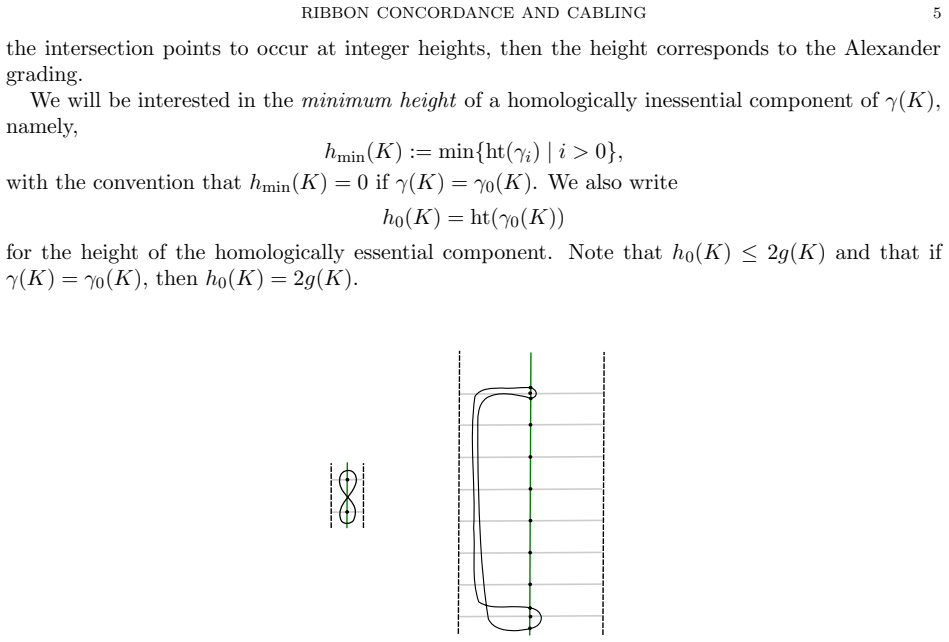
The load-bearing object is $h_{\min}(K)$, the minimum height of a homologically inessential component among the immersed curves $\gamma(K)$ that knot Floer homology associates to a knot in a marked torus; height is the vertical spread of a curve between its highest and lowest intersection levels, and $h_{\min}$ is set to $0$ when no such component exists. The paper proves that $h_{\min}$ is monotone under ribbon concordance ($J \le K$ forces $h_{\min}(J) \ge h_{\min}(K)$ whenever the former is nonzero) and that cabling multiplies it almost linearly: $h_{\min}(K_{p,q}) = p \cdot h_{\min}(K) - p + 1$. Together with the genus detection of knot Floer homology and a lemma showing that connected sums of fibered knots produce $h_{\min} = 2$, these formulas turn a numerical count of curve height into a rigidity machine that rejects non-cable predecessors.
What would settle it
Search for a ribbon concordance $J \le K_{p,q}$ with $J$ not a $(p,q)$-cable, or for a nontrivial $K$ with $K_{q,p} \le K_{p,q}$ and $p \ne q$; finding either would contradict Theorems 1.2 and Conjecture 1.1.
Extended reading notes
Core claim
The central claim is that ribbon concordance into a nontrivial cable is highly rigid: the predecessor inherits the cable structure. Formally, Conjecture 1.1 states that if $p>1$ and a nontrivial knot $J$ satisfies $J \le K_{p,q}$, then $J$ is itself a $(p,q)$-cable, and the paper establishes this in the cases where $J$ is a cable of the same companion (then $J$ is exactly $K_{p,q}$), where $J$ is a torus knot (then $J = T_{p,q}$), and where $J$ has genus one (then $J = T_{p,q}$ and $\{p, |q|\} = \{2,3\}$). The rigidity is forced by two height measurements attached to a knot's immersed-curve invariant: the essential component's height $h_0$, which is invariant under ordinary concordance, and the new minimum inessential height $h_{\min}$, which is monotone under ribbon concordance. The cabling formulas $h_0(K_{p,q}) = p \cdot h_0(K) + (p-1)(|q|-1)$ and $h_{\min}(K_{p,q}) = p \cdot h_{\min}(K) - p + 1$ turn these measurements into obstructions that rule out every alternative predecessor.
Load-bearing premise
The paper assumes, rather than proves, that the ribbon-concordance injection on knot Floer complexes appears in immersed-curve form as a literal inclusion of the predecessor's curve in the target's curve; if that geometric translation fails, $h_{\min}$ monotonicity, and with it the main rigidity theorems, does not follow.
Editorial extensions
If this is right
- If $J \le K_{p,q}$ and $J$ is a cable of $K$, then $J$ is exactly $K_{p,q}$; in particular, a companion knot $K$ cannot ribbon-concord to any of its nontrivial cables.
- A nontrivial ribbon-concordance predecessor of a cable of any fibered knot is prime, so composite knots cannot flow into such cables.
- For a fibered companion with zero simplicial volume, every nontrivial predecessor must itself be a cable, verifying Conjecture 1.1 for that class.
- A genus-one predecessor of a cable must be the trefoil $T_{2,3}$ or its mirror, so no other genus-one knot ribbon-concordes to a cable.
- For any companion with $h_0(K) \ne 0$, the genus of a predecessor $J$ satisfies $g(J) \ge p + g(T_{p,q})$.
Reading between the lines
- If the full conjecture holds, the ribbon-concordance partial order restricts to a partial order on cable parameters: compatibility of a predecessor cable with a target cable is determined by winding number and framing in a way that mirrors concordance but is strictly more rigid.
- The monotonicity of $h_{\min}$ is a promising general obstruction: one could compute $h_{\min}$ for known ribbon-concordance pairs to test whether the asserted geometric inclusion of immersed curves holds in practice, independent of the algebraic proof.
- The same height machinery may apply to iterated cables or general satellites, where the cabling formula would need a replacement for the $p$-scaling rule; a counterexample there would localize how much cable rigidity depends on the linear cabling formula.
Editorial analysis
A structured set of objections, weighed in public.
Referee Report
Summary. The paper studies ribbon concordance to cable knots, proposing a conjecture (Conjecture 1.1) that a nontrivial ribbon-concordance predecessor of a (p,q)-cable must itself be a (p,q)-cable. It proves the conjecture under additional hypotheses: when the predecessor is a cable of the same companion (Theorem 1.2), a torus knot (Theorem 1.9), or a genus-one knot (Theorem 1.10), and it verifies the conjecture for a class of slice companions with zero simplicial volume (Corollaries 1.4 and 1.5). The main technical tool is a new numerical invariant h_min(K), the minimum height of a homologically inessential component in the immersed-curve reformulation of knot Floer homology, together with a claimed monotonicity under ribbon concordance (Proposition 2.3) and a cabling formula (Proposition 2.5). The paper also proves a primeness criterion for fibered knots (Theorem 1.6) and records concordance-classification results for cables in Appendix A.
Significance. If the central monotonicity statement can be established, the paper gives the first systematic evidence for a natural conjecture about the ribbon-concordance order, and h_min is a clean, parameter-free obstruction that may be useful in other problems. The paper is largely self-contained and transparent: the main proofs are explicit, and the authors properly credit the prior knot Floer results (Zemke's injectivity, the cabling formula for immersed curves, the F-summand input for fibered knots) on which they rely. The results include concrete computational examples (Corollary 1.5) and a careful treatment of concordance of cables in the appendix. However, the proof of Proposition 2.3 contains a load-bearing gap: the geometric translation of Zemke's algebraic injection to an inclusion of immersed curves is asserted without proof, and this step is used in Theorems 1.2, 1.3, 1.9, and 1.10. The paper is therefore not yet in publishable form.
major comments (2)
- [Section 2, Proposition 2.3] The proof of monotonicity h_min(J) >= h_min(K) for J <= K rests on the sentence "In terms of immersed curves, this means that γ(J) is a subset of γ(K)." This is an unproved geometric translation of Zemke's injectivity theorem ([Zem19, Theorem 1.7]). Zemke's result is an injective grading-preserving map of filtered knot Floer complexes; it does not formally imply that the associated immersed curves are nested. Since h_min is defined directly from the immersed curves, the inequality requires the stronger statement that every homologically inessential component of γ(J) appears as a component of γ(K). Please provide a proof or a precise reference for this inclusion, or give an alternative argument for the monotonicity of h_min.
- [Section 4, Theorem 1.3] The primeness conclusion depends on the assertion "γ(J) has a homologically inessential component, which implies that both γ(K_{p,q}) and γ(K) also have a homologically inessential component [Zem19, HW23]." The first implication (from J to K_{p,q}) again uses the unproved subset claim from Proposition 2.3; the second (from K_{p,q} to K) is an implicit use of the contrapositive of the cabling formula in Proposition 2.5, which the paper never states. Once Proposition 2.3 is supplied, this argument should be written out explicitly, since it is needed to reach the contradiction h_min(J) >= h_min(K_{p,q}) >= 3.
minor comments (6)
- [Section 5, Theorem 1.9 proof] When applying Proposition A.4 in the proof of Theorem 1.9, the authors should state explicitly that the torus knot J = T_{r,s} is viewed as the (r,s)-cable of the unknot, which is slice. Without this clarification, the hypotheses of Proposition A.4 are not visibly satisfied.
- [Section 2, Remark 2.1] The convention h_min(K)=0 when γ(K)=γ_0(K) creates an ambiguity if an inessential component of height 0 could exist. Please clarify why height-0 inessential components do not occur, or modify the definition to distinguish "no inessential components" from "minimum height 0."
- [Section 2, Lemma 2.2] The proof of Lemma 2.2 is very terse; expanding it would help, since the relationship between the height of a curve component and the span of Alexander gradings of HFK is a central geometric fact used repeatedly in the paper.
- [Section 3, Proposition 3.1] The change-of-basis argument to split off the box {a,b,c,d} as a direct summand is sketched. I recommend spelling out the elimination of incoming arrows in more detail, in particular why the replacements do not introduce new arrows into the box.
- [Section 4, Theorem 1.3] The sentence "implies that both γ(K_{p,q}) and γ(K) also have a homologically inessential component" is misleading: the text should say that an inessential component of γ(J) forces one in γ(K_{p,q}) and hence, by the cabling formula, one in γ(K). The current phrasing invites confusion about the logical order.
- [Title page] The author name is typeset as "JUNGHW AN PARK," which should be "JUNGHWAN PARK."
Circularity Check
No significant circularity: the h_min computations are independent of Conjecture 1.1, though Proposition 2.3 relies on an unproved geometric containment assertion that is a correctness gap rather than a circular reduction.
full rationale
No circular reduction was found. The invariant h_min is defined directly from the existing immersed-curve invariant γ(K), and the two structural results used throughout the paper are derived from external machinery: Proposition 2.3 cites Zemke's ribbon-concordance injectivity theorem, and Proposition 2.5 applies the Hanselman–Watson cabling recipe for immersed curves. No parameter is fitted to the conclusions of Theorems 1.2, 1.3, 1.9, or 1.10, and Conjecture 1.1 is never assumed in the proofs. Self-citations (Hom14, HLP22, HP26) appear only as background, exposition, or a contextual minimality remark in footnote 1; they are not load-bearing for the paper's main rigidity results. The manuscript does contain an explicitly flaggable omitted proof in the proof of Proposition 2.3: it asserts that Zemke's algebraic injectivity means, 'in terms of immersed curves, this means that γ(J) is a subset of γ(K),' but no proof or citation establishes that a graded injective map of knot Floer complexes yields literal containment of the associated decorated immersed curves. This assertion underpins the monotonicity inequality for h_min and hence the contradictions in Theorems 1.2, 1.3, and 1.10. However, this is an unproved implication between established invariants, not a definition, fitted parameter, or self-citation that makes the target conclusion true by construction. Appendix A's concordance facts are proved independently from Levine–Tristram signatures. The score of 1 reflects the unresolved geometric bridge and the presence of non-load-bearing self-citations, not circularity of the derivation chain.
Assumptions & free parameters
assumptions (6)
- standard math The immersed-curve invariant γ(K) of [HRW24] exists and encodes CFK(K)/(UV=0).
- domain assumption Zemke's injectivity theorem: if J ≤ K, the knot Floer complex of J injects into that of K, preserving gradings (Zem19).
- domain assumption Cabling recipe for immersed curves from [HW23]: each component of γ(K) spawns p stretched, shifted copies in γ(K_{p,q}).
- ad hoc to paper A ribbon concordance J ≤ K descends to an inclusion of immersed curves, γ(J) ⊆ γ(K).
- domain assumption For a fibered knot, HFK^- contains an F-summand (derived from [BVV18, Theorem 1.1]).
- domain assumption Monotonicity facts: genus is non-decreasing under ribbon concordance (Zemke), simplicial volume is monotone (AR26), and Alexander polynomials divide under ribbon concordance (Gilmer).
invented entities (1)
-
h_min(K), minimum height invariant
independent evidence
Cite this review
Pith. "Pith review of Ribbon concordance and cabling." pith.science (2026). https://pith.science/paper/BXIVY6GK
@misc{pith2026260806625,
  author       = {Pith},
  title        = {Pith review of: Ribbon concordance and cabling},
  year         = {2026},
  howpublished = {\url{https://pith.science/paper/BXIVY6GK}},
  note         = {Machine review of arXiv:2608.06625}
}
read the original abstract
We study ribbon concordances to cable knots. We formulate a conjecture predicting that any nontrivial knot admitting a ribbon concordance to a (p,q)-cable must itself be a (p,q)-cable. We prove the conjecture when the knot admitting the ribbon concordance is already a cable of the same companion, is a torus knot, or has genus one. We also verify it for a broad class of target cables. The proofs use a minimum-height invariant defined from the immersed-curve formulation of knot Floer homology. This invariant obstructs ribbon concordances and implies that any nontrivial knot admitting a ribbon concordance to a fibered cable knot is prime. We also establish genus bounds for knots admitting ribbon concordances to cable knots.
Figures

Reference graph
Works this paper leans on
- [1]
-
[2]
Gabai, David , TITLE =. J. Differential Geom. , FJOURNAL =. 1983 , NUMBER =
work page 1983
-
[3]
Miyazaki, Katura , TITLE =. Proc. Amer. Math. Soc. , FJOURNAL =. 1998 , NUMBER =. doi:10.1090/S0002-9939-98-04352-4 , URL =
-
[4]
Hedden, Matthew , TITLE =. Geom. Topol. , FJOURNAL =. 2007 , PAGES =. doi:10.2140/gt.2007.11.2277 , URL =
-
[5]
Petkova, Ina , TITLE =. Quantum Topol. , FJOURNAL =. 2013 , NUMBER =. doi:10.4171/QT/43 , URL =
-
[6]
Genus, fiberedness, and of satellite knots with n -twisted generalized. 2024 , bdsk-url-1 =. arXiv , author =:2405.08763 , primaryclass =
arXiv 2024
-
[7]
Friedl, Stefan and Misev, Filip and Zentner, Raphael , TITLE =. Algebr. Geom. Topol. , FJOURNAL =. 2025 , NUMBER =. doi:10.2140/agt.2025.25.245 , URL =
-
[8]
Daemi, Aliakbar and Lidman, Tye and Vela-Vick, David S. and Wong, C.-M. Michael , TITLE =. Adv. Math. , FJOURNAL =. 2022 , PAGES =. doi:10.1016/j.aim.2022.108580 , URL =
arXiv 2022
Show all 45 references
-
[9]
Quantum Topol
Kang, Sungkyung , TITLE =. Quantum Topol. , FJOURNAL =. 2022 , NUMBER =. doi:10.4171/qt/162 , URL =
2022 doi
-
[10]
2025 , bdsk-url-1 =
Ribbon concordance and fibered predecessors , url =. 2025 , bdsk-url-1 =. arXiv , author =:2510.02214 , primaryclass =
2025
-
[11]
Miyazaki, Katura , TITLE =. Trans. Amer. Math. Soc. , FJOURNAL =. 1994 , NUMBER =. doi:10.2307/2154613 , URL =
1994 doi
-
[12]
, TITLE =
Thurston, William P. , TITLE =. Bull. Amer. Math. Soc. (N.S.) , FJOURNAL =. 1982 , NUMBER =. doi:10.1090/S0273-0979-1982-15003-0 , URL =
1982 doi
-
[13]
, TITLE =
Tristram, Andrew G. , TITLE =. Proc. Cambridge Philos. Soc. , FJOURNAL =. 1969 , PAGES =. doi:10.1017/s0305004100044947 , URL =
1969 doi
-
[14]
, TITLE =
Levine, Jerome P. , TITLE =. Comment. Math. Helv. , FJOURNAL =. 1969 , PAGES =. doi:10.1007/BF02564525 , URL =
1969 doi
-
[15]
Acta Math
Schubert, Horst , TITLE =. Acta Math. , FJOURNAL =. 1953 , PAGES =. doi:10.1007/BF02392437 , URL =
1953 doi
-
[16]
Quantum Topol
Cheng, Zhechi and Hedden, Matthew and Sarkar, Sucharit , TITLE =. Quantum Topol. , FJOURNAL =. 2025 , NUMBER =. doi:10.4171/qt/186 , URL =
2025 doi
-
[17]
Selecta Math
Hedden, Matthew and Watson, Liam , TITLE =. Selecta Math. (N.S.) , FJOURNAL =. 2018 , NUMBER =. doi:10.1007/s00029-017-0351-5 , URL =
2018 doi
-
[18]
Agol, Ian , TITLE =. Commun. Am. Math. Soc. , FJOURNAL =. 2022 , PAGES =. doi:10.1090/cams/15 , URL =
2022 doi
-
[19]
2026 , bdsk-url-1 =
Ribbon concordance of fibered knots and compressions of surface homeomorphisms , url =. 2026 , bdsk-url-1 =. arXiv , author =:2603.10884 , primaryclass =
2026
-
[20]
, TITLE =
Baker, Kenneth L. , TITLE =. J. Topol. , FJOURNAL =. 2016 , NUMBER =. doi:10.1112/jtopol/jtv024 , URL =
2016 doi
-
[21]
2026 , bdsk-url-1 =
Ribbon concordance and fibered predecessors,. 2026 , bdsk-url-1 =. arXiv , author =:2602.21109 , primaryclass =
2026
-
[22]
and Vela-Vick, David S
Baldwin, John A. and Vela-Vick, David S. , TITLE =. Algebr. Geom. Topol. , FJOURNAL =. 2018 , NUMBER =. doi:10.2140/agt.2018.18.3669 , URL =
2018 doi
-
[23]
Low-dimensional and symplectic topology , SERIES =
Borodzik, Maciej , TITLE =. Low-dimensional and symplectic topology , SERIES =. 2011 , ISBN =. doi:10.1090/pspum/082/2768651 , URL =
2011 doi
-
[24]
Borodzik, Maciej and Oleszkiewicz, Krzysztof , TITLE =. Bull. Pol. Acad. Sci. Math. , FJOURNAL =. 2010 , NUMBER =. doi:10.4064/ba58-2-7 , URL =
2010 doi
-
[25]
Ghiggini, Paolo , TITLE =. Amer. J. Math. , FJOURNAL =. 2008 , NUMBER =. doi:10.1353/ajm.0.0016 , URL =
2008 doi
-
[26]
, TITLE =
Gilmer, Patrick M. , TITLE =. Topology Appl. , FJOURNAL =. 1984 , NUMBER =. doi:10.1016/0166-8641(84)90016-6 , URL =
1984 doi
-
[27]
, TITLE =
Gordon, Cameron McA. , TITLE =. Math. Ann. , FJOURNAL =. 1981 , NUMBER =. doi:10.1007/BF01458281 , URL =
1981 doi
-
[28]
, TITLE =
Gordon, Cameron McA. , TITLE =. Trans. Amer. Math. Soc. , FJOURNAL =. 1983 , NUMBER =. doi:10.2307/1999046 , URL =
1983 doi
-
[29]
Hanselman, Jonathan and Watson, Liam , TITLE =. Geom. Topol. , FJOURNAL =. 2023 , NUMBER =. doi:10.2140/gt.2023.27.925 , URL =
2023 doi
-
[30]
Hom, Jennifer and Park, JungHwan , TITLE =. Math. Z. , FJOURNAL =. 2026 , NUMBER =. doi:10.1007/s00209-026-04050-3 , URL =
2026 doi
-
[31]
2022 , bdsk-url-1 =
Unknotting number and cabling , url =. 2022 , bdsk-url-1 =. arXiv , author =:2206.04196 , primaryclass =
2022 arXiv
-
[32]
Hom, Jennifer , TITLE =. Comment. Math. Helv. , FJOURNAL =. 2014 , NUMBER =. doi:10.4171/CMH/326 , URL =
2014 doi
-
[33]
Quantum field theory and manifold invariants , SERIES =
Hom, Jennifer , TITLE =. Quantum field theory and manifold invariants , SERIES =. 2021 , ISBN =
2021
-
[34]
and Watson, Liam , TITLE =
Hanselman, Jonathan and Rasmussen, Jacob A. and Watson, Liam , TITLE =. J. Amer. Math. Soc. , FJOURNAL =. 2024 , NUMBER =. doi:10.1090/jams/1029 , URL =
2024 doi
-
[35]
, TITLE =
Kochloukova, Dessislava H. , TITLE =. Comment. Math. Helv. , FJOURNAL =. 2006 , NUMBER =. doi:10.4171/CMH/81 , URL =
2006 doi
-
[36]
and Zemke, Ian , TITLE =
Levine, Adam S. and Zemke, Ian , TITLE =. Bull. Lond. Math. Soc. , FJOURNAL =. 2019 , NUMBER =. doi:10.1112/blms.12303 , URL =
2019 doi
-
[37]
, TITLE =
Litherland, Richard A. , TITLE =. Topology of low-dimensional manifolds (. 1979 , ISBN =
1979
-
[38]
Miyazaki, Katura , TITLE =. J. Knot Theory Ramifications , FJOURNAL =. 2018 , NUMBER =. doi:10.1142/S0218216518710025 , URL =
2018 doi
-
[39]
Myers, Robert , TITLE =. Trans. Amer. Math. Soc. , FJOURNAL =. 1983 , NUMBER =. doi:10.2307/1999315 , URL =
1983 doi
-
[40]
Ozsv\'ath, Peter and Szab\'o, Zolt\'an , TITLE =. Adv. Math. , FJOURNAL =. 2004 , NUMBER =. doi:10.1016/j.aim.2003.05.001 , URL =
2004 doi
-
[41]
Ozsv\'ath, Peter and Szab\'o, Zolt\'an , TITLE =. Geom. Topol. , FJOURNAL =. 2004 , PAGES =. doi:10.2140/gt.2004.8.311 , URL =
2004 doi
-
[42]
, TITLE =
Rasmussen, Jacob A. , TITLE =. 2003 , PAGES =
2003
-
[43]
, TITLE =
Silver, Daniel S. , TITLE =. J. Pure Appl. Algebra , FJOURNAL =. 1992 , NUMBER =. doi:10.1016/0022-4049(92)90013-6 , URL =
1992 doi
-
[44]
and Whitten, Wilbur , TITLE =
Silver, Daniel S. and Whitten, Wilbur , TITLE =. Algebr. Geom. Topol. , FJOURNAL =. 2005 , PAGES =. doi:10.2140/agt.2005.5.1451 , URL =
2005 doi
-
[45]
Zemke, Ian , TITLE =. Ann. of Math. (2) , FJOURNAL =. 2019 , NUMBER =. doi:10.4007/annals.2019.190.3.5 , URL =
2019 doi
Reviewed August 10, 2026 · model on record in the stance chip above.
Discussion (0). Continue with ORCID to comment.