REVIEW 4 major objections 5 minor 5 references
Linking of three triangles in 3-space
T0 review · 4 major / 5 minor · reviewed 2026-08-14 · deepseek-v4-flash
Pith's one-line read A pair of easy invariants — the three pairwise mod-2 linking numbers and a Borromean convex-hull condition — separates the five types of triples of disjoint triangles in 3-space.
desk verdict A promising geometric invariant for distinguishing Borromean triangle linkings, but the invariance proof is too hand-wavy to carry the main claim. read the letter →
The pith
A machine-rendered reading of the paper's core claim, the machinery that carries it, and where it could break.
The reading
What carries the argument
The machinery is combinatorial isotopy generated by elementary moves: replace one triangle ABC by ABC' when the two new triangular faces do not meet any other triangle. The invariants are the pairwise linking coefficient modulo 2, which separates three of the five classes, and the Borromean property, defined as the convex hulls of all three triangles having a common point while, after a cyclic enumeration, each triangle outline intersects the next convex hull in exactly two points. Lemma 5 is the load-bearing reformulation: it rewrites the Borromean property in terms of three outline-hull intersections and one empty intersection, and Lemma 4 then uses this form to show the property survives elementary moves.
What would settle it
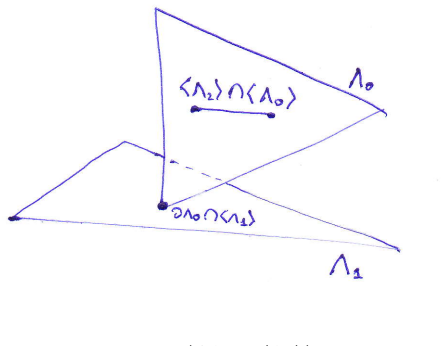
Construct three pairwise disjoint triangles whose convex hulls share a point, with |∂Λ1∩⟨Λ2⟩|=2 and |∂Λ2∩⟨Λ0⟩|=2 and ∂Λ1∩⟨Λ0⟩=∅, but where ∂Λ0 meets ⟨Λ1⟩ in exactly one point instead of two; such an example would contradict Lemma 5 and would leave the invariance of the Borromean property unproved.
Extended reading notes
Core claim
The paper's central claim is that no sequence of elementary moves can connect triples from different bullet points of Conjecture 2. The proof assigns to each triple the multiset of its three pairwise mod-2 linking numbers and, for the one ambiguous pair in which all three numbers vanish, checks whether the triple is Borromean: the convex hulls of the three triangles share a common point and, after a suitable cyclic enumeration, each triangle's outline meets the next triangle's convex hull in exactly two points. Lemma 4 states that the Borromean property is invariant under elementary moves, and Lemma 5 gives an equivalent formulation used in the proof. Since the five listed triples differ in these invariants, they occupy distinct combinatorial isotopy classes.
Load-bearing premise
The proof of invariance depends on the unproved geometric assertion in Lemma 5 that if one outline meets the next triangle's convex hull in two points, then the third outline misses that convex hull entirely; the author states this without derivation, and disjointness of the outlines alone does not imply it.
Editorial extensions
If this is right
- The five classes in Conjecture 2 are pairwise inequivalent, so any complete classification of triples of disjoint triangles must contain at least these five combinatorial isotopy classes.
- All pairwise linking numbers zero does not mean the triple is trivial: the Borromean triple and the triple with pairwise disjoint convex hulls are both pairwise unlinked mod 2 yet are not combinatorially isotopic.
- The Borromean property supplies a computable certificate that a given triple cannot be unlinked by elementary moves; checking it requires only counting outline-hull intersections.
- Because the invariants are mod-2 counts, the same proof shows the five types remain distinct whether the triples are treated as ordered or unordered and whether vertices are labelled.
Reading between the lines
- The same convex-hull intersection counting could be tested on four or more triangles; if the Borromean condition generalizes, it might produce a hierarchy of higher-order linking invariants.
- If the completeness half of Conjecture 2 is eventually proved, the five types would give a complete enumeration of combinatorial isotopy classes, making the classification algorithmically checkable in the sense the author conjectures.
- The unproved geometric implication in Lemma 5 is the place to probe first: if it admits a counterexample, the Borromean property may fail to be invariant under elementary moves, and a different convex-hull condition would be needed.
Signed reviews
Editorial analysis
A structured set of objections, weighed in public.
Referee Report
Summary. The paper defines combinatorial isotopy for triples of pairwise disjoint triangles in 3-space, generated by elementary moves that replace one vertex of a triangle while keeping certain auxiliary convex hulls disjoint from the other triangle outlines. It conjectures that every such triple is combinatorially isotopic to one of five listed types, and it proves Proposition 3, the main result, that triples from different bullet points are not combinatorially isotopic. The proof introduces two invariants: the pairwise mod-2 linking numbers and a Borromean property defined by convex-hull intersections. Lemma 5 gives an equivalent characterization of the Borromean property, and Lemma 4 asserts that this property is preserved by elementary moves. The paper is an elementary alternative to an earlier proof using the Massey-Rolfsen invariant.
Significance. If the proof can be made rigorous, the paper offers a genuinely elementary and easy-to-compute invariant distinguishing the Borromean triple of triangles from a triple with pairwise disjoint convex hulls, and it supports a larger conjectural classification. The strength of the paper is its explicit, parameter-free geometric definitions and its connection to the classical Borromean rings and to Milnor's link-homotopy classification. However, the central invariance proof is currently presented as a sketch with several unsupported geometric assertions, so the significance is conditional on completing those arguments.
major comments (4)
- [Lemma 4, proof, second paragraph] The assertion that 'in all cases where the intersection ∂∆2∩⟨∆0⟩ does not consist of two points ..., ∆P2 is entirely in the interior of τ' is stated without proof. This is load-bearing because it is the only argument establishing |∂∆2∩⟨∆0'⟩|=2, one of the properties required by Lemma 5. A detailed geometric proof is needed, including a treatment of the degenerate case where τ is not a nondegenerate tetrahedron, since an elementary move may pass through such configurations.
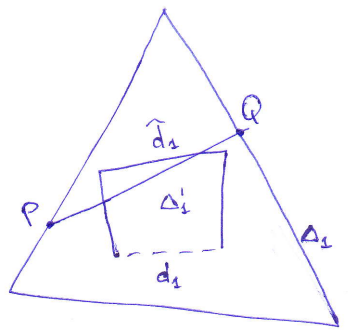
- [Lemma 4, proof, first paragraph] The inference 'The segment PQ intersects d̂1∩⟨∆0⟩, hence PQ∩d̂1⊂⟨∆1⟩. This means that d̂1 is in the interior of the triangle ⟨∆1⟩' is not justified. A single intersection point of PQ with a side of ∆1' does not by itself imply that the entire side d̂1 lies in the interior of ⟨∆1⟩; a convexity or separation argument is missing. The subsequent conclusion that 'the polygon ∆1' is in the interior of ⟨∆1⟩' is even stronger and is not derived from the preceding text.
- [Lemma 4, proof, third paragraph] The sentence 'Then ∂∆2 intersects two sides of ∆2' at two points each' is ambiguous and unproved, and it is unclear how the following conclusions about the faces ⟨ACC'⟩ and ⟨BCC'⟩ not intersecting ⟨∆2⟩ follow. This paragraph is needed to prove ⟨∆0'⟩∩⟨∆1⟩∩⟨∆2⟩≠∅, the remaining Lemma 5 property. As it stands, the proof does not give a verifiable chain of implications.
- [Lemma 5, proof] The step 'Since |∂Λ1∩⟨Λ2⟩|=2, we have ∂Λ2∩⟨Λ1⟩=∅' is asserted without proof. Under a general-position assumption on the two triangle planes, the implication can be justified by a convexity argument, but the paper does not state such an assumption, and the discussion of elementary moves can involve degenerate positions. If this implication fails, the case analysis in Lemma 5 collapses, so this missing justification affects the equivalence that underlies Lemma 4.
minor comments (5)
- [Abstract] The abstract in the arXiv posting says 'Two triples of triangles having pairwise disjoint outlines', while the full text says 'Two triples of pairwise disjoint triangles'. Since 'triangle' is defined as the outline in Section 1, the wording should be made consistent to avoid ambiguity.
- [Section 1, definition of elementary move] The definition of an elementary move requires (⟨ACC′⟩∪⟨BCC′⟩)∩XYZ=∅ for every other triangle XYZ, but it does not explicitly state that the new triangle ABC′ itself is disjoint from the other triangle outlines. The preservation of the disjointness condition should be stated as part of the definition or proved immediately.
- [Section 2, Lemma 4 proof] The notation ∆P2 is introduced as 'the part of ∆2 which is on the same side of the plane containing ∆0 as C′', but this is never made precise. It should be defined as the intersection of the filled triangle ⟨∆2⟩ with the corresponding open half-space, or with the closed half-space, and the distinction matters for the subsequent argument.
- [Conjecture 2] In the coordinates for the Borromean linking, the expressions (−2√5,±1√10,0) should be typeset as ordered pairs with clear delimiters, for example (−2/√5, ±1/√10, 0), to avoid confusion about which coordinate is affected by the sign.
- [Figures] The proof of Lemma 4 relies on Figures 1 and 2, but the captions are not self-contained and the figures are not reproduced in the text. The geometric assertions that refer to the figures should be fully verbalized, since the journal version may not preserve the informal drawings.
Circularity Check
No significant circularity: the Borromean invariant is defined geometrically and proved invariant, with no fitted parameters or self-citation chain.
full rationale
The paper's main claim (Proposition 3) is that the five listed triples are pairwise not combinatorially isotopic. The proof uses two invariants: mod-2 pairwise linking numbers and the Borromean property. Both are defined directly from the geometry of the configurations: the Borromean property is 'the convex hulls of all 3 triangles have a common point, and the triangles can be enumerated ... so that each of the triangles ∆j intersects the convex hull of the next triangle at two points.' There are no fitted parameters, no quantities are renamed as predictions, and no conclusion is assumed in its own definition. The invariance of the Borromean property under elementary moves is argued in Lemma 4 via Lemma 5, a geometric equivalence; even if that argument contains positional claims that are insufficiently justified, that is a correctness gap, not a circularity. The cited references (Skopenkov, Prasolov–Sossinsky, Milnor, Wikipedia) are used for definitions and context, not as the load-bearing justification for Proposition 3. Theorem 1 for two triangles is explicitly 'considered a known result,' but Proposition 3 does not reduce to it: the two-triangle classification does not determine the three-triangle Borromean/non-Borromean distinction. Thus the derivation chain is self-contained in the relevant sense: the invariants are constructed from the configurations and their invariance is claimed by a direct geometric argument, not by definition or by self-citation.
Assumptions & free parameters
assumptions (5)
- standard math Convex hulls in R^3 behave as standard convex polytopes; intersections of a plane with a convex set are convex segments or points.
- domain assumption The mod-2 linking coefficient for two disjoint triangles is invariant under elementary moves and well-defined (from Skopenkov's book).
- domain assumption Elementary moves generate an equivalence relation (combinatorial isotopy) and preserve the pairwise disjointness of triangle outlines.
- domain assumption The triangles under consideration are non-degenerate and their outlines are pairwise disjoint.
- ad hoc to paper The geometric configurations are in general position (e.g., no point lies on an edge of another triangle, intersections are transverse), even though this is not explicitly stated.
Cite this review
Pith. "Pith review of Linking of three triangles in 3-space." pith.science (2026). https://pith.science/paper/BXSTFL2K
@misc{pith2026190803865,
  author       = {Pith},
  title        = {Pith review of: Linking of three triangles in 3-space},
  year         = {2026},
  howpublished = {\url{https://pith.science/paper/BXSTFL2K}},
  note         = {Machine review of arXiv:1908.03865}
}
read the original abstract
Two triples of triangles having pairwise disjoint outlines in 3-space are called combinatorially isotopic if one triple can be obtained from the other by a continuous motion during which the outlines of the triangles remain pairwise disjoint. We conjecture that it can be algorithmically checked if an (ordered or unordered) triple of triangles is combinatorially isotopic to a triple of triangles having pairwise disjoint convex hulls. We also conjecture that any unordered triple of pairwise disjoint triangles in 3-space belongs to one of the 5 types of such triples listed in the paper. We present an elementary proof that triples of different types are not combinatorially isotopic.
Figures
Reference graph
Works this paper leans on
-
[1]
http://www.newton.ac.uk/about/art-artefacts/symbolic-sculptures
- [2]
-
[3]
V. V. Prasolov, A. B. Sossinsky Knots, Links, Braids, and 3-manifolds. Amer. Math. Soc. Publ., Providence, R.I., 1996. Russian version: http://www.mccme.ru/prasolov
work page 1996
- [4]
-
[5]
https://en.wikipedia.org/wiki/Valknut
Reviewed August 14, 2026 · model on record in the stance chip above.
Discussion (0). Continue with ORCID to comment.