REVIEW 4 major objections 5 minor 61 references
Language bubbles in online social networks
T0 review · 4 major / 5 minor · reviewed 2026-08-06 · deepseek-v4-flash
Pith's one-line read This paper claims that communities socially isolated in the Italian Twitter retweet network speak with vocabularies that are both more distant from the mainstream and systematically poorer — a pattern it names 'language bubbles'.
desk verdict Solid network–lexical distance result, but the 'impoverished language' claim is confounded by tweet volume and needs a rarefaction or activity control before it ships. read the letter →
The pith
A machine-rendered reading of the paper's core claim, the machinery that carries it, and where it could break.
The reading
What carries the argument
The named object is the 'language bubble': the joint tendency of retweet-segregated communities to speak increasingly differently from others and with a smaller, simpler vocabulary. The machinery that carries the argument is a paired measurement on the same population: a network distance $D_{cc'}$ built from the influencer co-occurrence projection of the bipartite retweet network (average inverse shortest path with a regularization parameter $\lambda = 1$ bounding it in $[0,1]$), and a lexical distance $\Delta_{cc'}$ given by the Jensen-Shannon divergence between per-user token distributions after deleting the 1,000 most frequent kernel words and validating the remaining user-token links with the maximum-entropy BiWCM (Bipartite Weighted Configuration Model) null model. Three user-level scores — vocabulary size $S_i$, complexity $H_i$ (Shannon entropy), and completeness $J_i$ (one minus the Jensen-Shannon distance to the global distribution) — are averaged within communities and correlated with community segregation $D_c$ and topic fragmentation $D_{\mathrm{topic}}$. Every reported correlation is checked against a null model that rewires the bipartite retweet network while preserving node activity.
What would settle it
Match users from the most and least segregated communities on the number of tweets (or tokens) they produced and recompute vocabulary size, entropy, and completeness; if the negative correlations with segregation collapse under length matching — or if computing completeness against a global distribution that excludes the user's own tokens changes the pattern — the claim that isolated communities develop poorer language fails, leaving only 'different language' behind.
Extended reading notes
Core claim
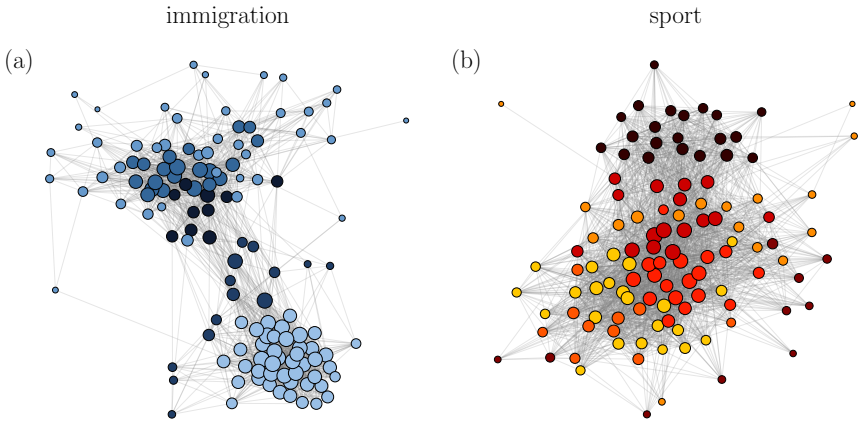
The central claim is that the topology of the retweet network and the lexical properties of what users write are coupled, so that social isolation and linguistic divergence reinforce each other. For each of six topics, the paper computes an inter-community retweet distance (average inverse shortest path between communities in a co-occurrence projection of the bipartite retweet network) and an inter-community lexical distance (average Jensen-Shannon divergence between token distributions), and finds a significant positive correlation in every topic (Spearman $\rho$ from 0.314 to 0.642, with $p < 0.05$ against a rewired-network null model). It then shows that community segregation — a community's average network distance from all other communities — correlates negatively with three per-user lexical scores aggregated at the community level: vocabulary size, the Shannon entropy of the word distribution, and completeness, the closeness of a user's distribution to the global token distribution. The negative correlations are stronger in topics whose networks are more fragmented overall (immigration, vaccines, climate) and weaker, though still significant, in neutral topics (sport, music, cars). The authors read the distance–divergence correlation as the first signature of 'language bubbles' and the segregation–impoverishment correlation as the second: communities that share an audience speak alike, and communities cut off from the network drift into distinct and poorer language.
Load-bearing premise
The three measures of poorer language used here — how many distinct words, how varied the word choices, and how much the vocabulary overlaps the general discourse — all grow with the sheer amount of text a user produced, and the paper compares communities without controlling for that, so a community that simply tweets less would look linguistically poorer even if its language is no less rich; additionally, the overlap measure compares each user to a global vocabulary that includes the user's own words.
Editorial extensions
If this is right
- Communities that share more of their retweeting audience use more similar vocabularies, so audience overlap can serve as a structural proxy for linguistic alignment without reading message content.
- In all six topics, the most isolated communities show lower vocabulary size, lower complexity, and lower completeness, making 'poorer language' a systematic correlate of network segregation.
- The lexical cost of isolation is largest in the most fragmented topics (immigration, vaccines, climate) and present but milder in neutral ones (sport, music, cars).
- The correlations survive a null model that destroys the retweet structure and survive switching community detection from the hierarchical stochastic block model (hSBM) to Louvain, indicating the findings are not artifacts of the partition method.
- The paper does not claim causality: social fragmentation and linguistic narrowing could drive each other in either direction, or co-evolve.
Reading between the lines
- A natural longitudinal test would track community pairs across the 2018–2022 window to see whether network distance and lexical distance drift apart together over time; the paper's cross-sectional design cannot show which side of the correlation moves first.
- The same paired-distance machinery could be applied to ordinary users, other languages, or other platforms; if language bubbles are a general property of fragmented online discourse the pattern should reappear, while a weak or absent pattern would suggest the effect is specific to professional political communication.
- Because completeness is measured against a global distribution that includes the user's own tokens, recomputing it with a leave-one-user-out background is a cheap check on whether the isolation effect is partly self-referential.
- A frequency-based measure cannot see neologisms; counting community-specific coinages per token would test whether isolated niches are genuinely losing expressive range or merely concentrating their vocabulary into distinctive forms.
Editorial analysis
A structured set of objections, weighed in public.
Referee Report
Summary. This paper analyzes a large Italian Twitter corpus (2018–2022) of politicians and news outlets, projected onto retweet co-occurrence networks, with communities detected by hSBM. Two findings are reported: (i) inter-community network distance positively correlates with Jensen-Shannon lexical distance across six topics (Fig. 2), supported by rewiring null models; (ii) community segregation negatively correlates with vocabulary size, entropy, and completeness (Fig. 3), with the strength of the correlation increasing with topic-level fragmentation. The authors interpret these two patterns as evidence for 'language bubbles'—structurally isolated communities developing divergent and impoverished language.
Significance. The first finding is a solid, well-validated empirical regularity: the correlation between retweet-network distance and lexical distance survives a rewiring null model and replicates under Louvain communities. The second finding, however, is not yet established because the lexical metrics S_i, H_i, and J_i are sensitive to text volume, and no activity controls are reported. The conceptual framing of 'language bubbles' is attractive and likely to stimulate follow-up work. The paper is commendable for releasing code, using null models, and testing robustness across clustering methods; the synthetic-text validation in Appendix S3 is good practice, but it holds text length fixed, which is exactly the condition that is violated in the real data.
major comments (4)
- [Section 4.2.3, Eqs. (8)-(10); Section 2.3, Fig. 3] The three lexical metrics are all sample-size dependent. S_i counts distinct validated tokens, which grows with the number of tokens produced; H_i is the plug-in Shannon entropy of an empirical distribution, which is downward-biased for small samples; and J_i = 1 - JSD(r_i || Q), where Q includes the user's own tokens, so a sparse r_i produces a large JSD even for a user whose underlying language is identical to Q. The manuscript reports no per-community token counts and includes no control for text volume. If segregated communities tweet less, the negative correlations in Fig. 3 would appear even without any real difference in underlying lexical richness. The null model in Section 4.2.5 preserves each user's token distribution while randomizing the retweet network, so it cannot remove this real-world association between segregation and activity. The 'impoverished linguistic repertoires' claim therefore needs an activity-matched analysis (e.g., rarefaction, token-count matching, or including per-user token volume as a covariate) before it can be accepted.
- [Section 4.2.4] The 60% subsampling draws users, not tokens, so it does not equalize text volume across communities. The statement that the procedure 'control[s] for noise due to unbalanced or sparse data' addresses the number of users per community, not the number of tokens per user; the sample-size problem for S_i, H_i, and J_i operates at the token level and is untouched by this procedure.
- [Appendix S3] The synthetic validation assigns each user 1,500 tweets and uses corpora of equal length, thereby holding text volume constant across communities. This validates the metrics as measures of complexity under equal sampling effort, but it does not validate them for the unequal-volume setting of the main analysis, where users and communities differ in tweet production. The validation should be repeated with varying numbers of tokens per user to show that the metrics are not dominated by sample size.
- [Section 2.3, Fig. 3(d-f)] The claim that the negative association is 'more pronounced in globally more fragmented environments' rests on Spearman correlations computed at the topic level with only six points and no reported significance test or confidence interval for the rho-vs-D_topic relationship. As presented, the trend could be driven by a single topic; a formal test (e.g., a permutation test across topics or a hierarchical model) is needed to support the claim of a monotonic relationship with topic fragmentation.
minor comments (5)
- [Section 4.2.2] The same symbol w_ij is used for both the similarity weight in Eq. (1) and the transformed distance w_ij = 1 + lambda - w_ij; using distinct notation would avoid confusion.
- [Table S1 caption] The caption says 'four topics' but six datasets are listed; correct the caption.
- [Section 4.1.3] The phrase 'which we call rating9' contains a stray superscript '9'; presumably it should read 'rating' with a footnote marker.
- [Figure 2] The y-axis range (Delta_cc' from about 0.92 to 0.98) is very narrow; reporting standardized effect sizes or the raw JSD range would help readers judge the magnitude of the divergence.
- [Abstract] The use of 'increasingly' may imply a temporal trend that the cross-sectional design cannot support; consider rewording to state that more segregated communities develop more divergent and impoverished repertoires.
Circularity Check
No significant circularity: the correlations are empirical measurements with independent null-model and external-corpus checks; the sample-size sensitivity of the lexical metrics is a validity concern, not a circular reduction.
full rationale
The paper's two headline results are empirical correlations, not derivations that reduce to their inputs. Inter-community network distance D_cc' (Eq. 3) is computed from the retweet co-occurrence projection, while inter-community lexical distance Delta_cc' (Eq. 7) is computed from user token distributions; the two quantities are not related by construction, and no fitted parameter is renamed as a prediction. The Fig. 3 metrics S_i, H_i, and J_i (Eqs. 8-10) are defined at the user level and then correlated with community segregation D_c; although S_i, H_i, and J_i are sample-size sensitive and J_i compares each user to a global distribution Q that includes that user's own tokens, this is a statistical-validity or confounding concern, not a circular step: the observed negative correlations are not mathematically forced by the definitions of these metrics and D_c. The null model in Sec. 4.2.5 rewires the bipartite retweet network and recomputes the full pipeline, giving a genuine independent benchmark, and Appendix S3 validates the lexical metrics against external text corpora of varying complexity with null distributions. Self-citations appear (ref. 40 for kernel-lexicon estimation, ref. 50 for BiWCM), but they are not load-bearing uniqueness arguments: the kernel-lexicon concept rests on external references (refs. 39, 53-56) and the BiWCM is a standard maximum-entropy method with general references (ref. 51). No equation in the paper is equivalent to another by construction, and no central claim is justified solely by a self-citation. Therefore the paper is not circular; it may have measurement limitations, but those are outside the circularity definition used here.
Assumptions & free parameters
free parameters (4)
- lambda (distance regularization) =
1
- kernel lexicon size =
1000 tokens
- subsampling fraction =
60%
- minimum retweet count for data collection =
20 retweets
assumptions (6)
- domain assumption Retweets represent endorsement
- domain assumption Co-occurrence projection preserves meaningful similarity between influencers
- domain assumption hSBM and Louvain community partitions capture discourse communities
- domain assumption The 583 monitored accounts represent 95% of online news engagement
- ad hoc to paper The kernel lexicon can be approximated by the 1000 most frequent tokens
- standard math JSD and Shannon entropy capture language complexity
Cite this review
Pith. "Pith review of Language bubbles in online social networks." pith.science (2026). https://pith.science/paper/BXTKTS24
@misc{pith2026250713068,
  author       = {Pith},
  title        = {Pith review of: Language bubbles in online social networks},
  year         = {2026},
  howpublished = {\url{https://pith.science/paper/BXTKTS24}},
  note         = {Machine review of arXiv:2507.13068}
}
read the original abstract
Social media platforms have become essential spaces for public discourse. While political polarisation and limited communication across different groups are widely acknowledged, the connection between social network fragmentation and the language features and quality used by various communities has received insufficient attention. This study aims to fill this gap by examining the social structure and linguistic richness of the Italian debate on Twitter/X. We analyse tweets and retweets from Italian politicians and news outlets between 2018 and 2022, characterising the retweet network and evaluating the language used within different communities through various lexical metrics. Our analysis uncovers two systematic patterns: communities closer in the network tend to use more similar vocabulary, while isolated communities consistently demonstrate lower lexical diversity and richness. Together, these patterns illustrate what we call ``language bubbles''. These findings indicate that socially isolated communities interact less with others and develop distinct and poorer linguistic profiles, highlighting a structural link between social fragmentation and linguistic divergence.
Figures


Reference graph
Works this paper leans on
-
[1]
Bakshy, E., Rosenn, I., Marlow, C. & Adamic, L. The role of social networks in information diffusion. In Pro- 11/20 ceedings of the 21st international conference on World Wide Web, 519–528 (2012)
work page 2012
-
[2]
Guille, A., Hacid, H., Favre, C. & Zighed, D. A. Informa- tion diffusion in online social networks: A survey. ACM Sigmod Rec. 42, 17–28 (2013)
work page 2013
-
[3]
Pariser, E. The filter bubble: How the new personalized web is changing what we read and how we think (The Penguin Press, 2011)
work page 2011
-
[4]
The rise of the network society (John wiley & sons, 2011)
Castells, M. The rise of the network society (John wiley & sons, 2011)
work page 2011
-
[5]
Lerman, K. & Ghosh, R. Information contagion: An empirical study of the spread of news on digg and twit- ter social networks. In Proceedings of the international AAAI conference on web and social media, vol. 4, 90–97 (2010)
work page 2010
- [6]
-
[7]
Bisgin, H., Agarwal, N. & Xu, X. A study of homophily on social media. World Wide Web15, 213–232 (2012)
work page 2012
-
[8]
de Arruda, H. F. et al. Modelling how social network algorithms can influence opinion polarization. Inf. Sci. 588, 265–278 (2022)
work page 2022
Show all 61 references
-
[9]
& De Marzo, G
Bellina, A., Castellano, C., Pineau, P., Iannelli, G. & De Marzo, G. Effect of collaborative-filtering-based rec- ommendation algorithms on opinion polarization. Phys. Rev. E 108, 054304 (2023)
2023
-
[11]
M., Thorson, E
Budak, C., Nyhan, B., Rothschild, D. M., Thorson, E. & Watts, D. J. Misunderstanding the harms of online misinformation. Nature 630, 45–53, DOI: 10.1038/ s41586-024-07417-w (2024)
2024
-
[12]
Conover, M. et al. Political polarization on twitter. In Proceedings of the international aaai conference on web and social media, vol. 5, 89–96 (2011)
2011
-
[13]
Flamino, J. et al. Political polarization of news media and influencers on twitter in the 2016 and 2020 us presidential elections. Nat. Hum. Behav. 7, 904–916 (2023)
2023
-
[14]
& Mathioudakis, M
Garimella, K., De Francisci Morales, G., Gionis, A. & Mathioudakis, M. Political discourse on social media: Echo chambers, gatekeepers, and the price of biparti- sanship. In Proceedings of the 2018 world wide web conference, 913–922 (2018)
2018
-
[15]
T., Nagler, J., Tucker, J
Barberá, P., Jost, J. T., Nagler, J., Tucker, J. A. & Bon- neau, R. Tweeting from left to right: Is online political communication more than an echo chamber? Psychol. science 26, 1531–1542 (2015)
2015
-
[16]
& Starnini, M
Cinelli, M., De Francisci Morales, G., Galeazzi, A., Quat- trociocchi, W. & Starnini, M. The echo chamber effect on social media. Proc. Natl. Acad. Sci. 118, e2023301118 (2021)
2021
-
[17]
Sunstein, C. R. Going to extremes: How like minds unite and divide (Oxford University Press, 2009)
2009
-
[18]
& Bearman, P
Baldassarri, D. & Bearman, P. Dynamics of political po- larization. Am. sociological review 72, 784–811 (2007)
2007
-
[19]
& Rao, J
Flaxman, S., Goel, S. & Rao, J. M. Filter bubbles, echo chambers, and online news consumption. Public opinion quarterly 80, 298–320 (2016)
2016
-
[20]
& Scala, A
Brugnoli, E., Cinelli, M., Quattrociocchi, W. & Scala, A. Recursive patterns in online echo chambers. Sci. Reports 9, 20118 (2019)
2019
-
[21]
& Petrocchi, M
Pratelli, M., Saracco, F. & Petrocchi, M. Entropy-based detection of twitter echo chambers. PNAS Nexus 3, DOI: 10.1093/pnasnexus/pgae177 (2024)
2024 doi
-
[22]
Cinelli, M. et al. Selective exposure shapes the facebook news diet. PLOS ONE 15, 1–17, DOI: 10.1371/journal. pone.0229129 (2020)
2020 doi
-
[23]
& Hale, S
Yasseri, T., Margetts, H., John, P. & Hale, S. Political turbulence: How social media shape collective action (Princeton University Press, 2016)
2016
-
[24]
Bennett, W. L. & Segerberg, A. The logic of connec- tive action: Digital media and the personalization of contentious politics (Cambridge University Press, 2013)
2013
-
[25]
& Goethals, B
Michiels, L., Leysen, J., Smets, A. & Goethals, B. What are filter bubbles really? a review of the conceptual and empirical work. In Adjunct proceedings of the 30th ACM conference on user modeling, adaptation and personal- ization, 274–279 (2022)
2022
-
[26]
Filter bubble: myth or reality? Internet Policy Rev
Bruns, A. Filter bubble: myth or reality? Internet Policy Rev. 8, DOI: 10.14763/2019.4.1426 (2019)
2019 doi
-
[27]
Kitchens, B., Johnson, S. L. & Gray, P. Understanding echo chambers and filter bubbles: The impact of social media on diversification and partisan shifts in news con- sumption. MIS quarterly 44 (2020)
2020
-
[28]
Piao, J., Liu, J., Zhang, F., Su, J. & Li, Y . Human–ai adaptive dynamics drives the emergence of information cocoons. Nat. Mach. Intell. 5, 1214–1224, DOI: 10.1038/ s42256-023-00731-4 (2023)
2023
-
[29]
& Rho, E
Ding, X., Horning, M. & Rho, E. H. Same words, differ- ent meanings: Semantic polarization in broadcast media language forecasts polarity in online public discourse. In Proceedings of the International AAAI Conference on Web and Social Media, vol. 17, 161–172 (2023)
2023
-
[30]
Di Marco, N. et al. Patterns of linguistic simplification on social media platforms over time. Proc. Natl. Acad. Sci. 121, e2412105121, DOI: 10.1073/pnas.2412105121 (2024). 12/20
2024 doi
-
[31]
& Cuskley, C
Karjus, A. & Cuskley, C. Evolving linguistic divergence on polarizing social media. Humanit. Soc. Sci. Commun. 11, 1–14 (2024)
2024
-
[32]
Bail, C. A. et al. Exposure to opposing views on so- cial media can increase political polarization. Proc. Natl. Acad. Sci. 115, 9216–9221, DOI: 10.1073/pnas. 1804840115 (2018)
2018 doi
-
[33]
& Westwood, S
Iyengar, S. & Westwood, S. J. Fear and loathing across party lines: New evidence on group polarization. Am. journal political science 59, 690–707 (2015)
2015
-
[34]
& Saracco, F
Caldarelli, G., De Nicola, R., Petrocchi, M., Pratelli, M. & Saracco, F. Flow of online misinformation during the peak of the covid-19 pandemic in italy. EPJ data science 10, 34 (2021)
2021
-
[35]
Brugnoli, E., Gravino, P., Sardo, D. R. L., Loreto, V . & Prevedello, G. Fine-grained clustering of social media: How moral triggers drive preferences and consensus. In ICAART (3), 1405–1412 (2024)
2024
-
[36]
Peixoto, T. P. Hierarchical block structures and high- resolution model selection in large networks. Phys. Rev. X 4, 011047 (2014)
2014
-
[37]
Peixoto, T. P. Nonparametric bayesian inference of the microcanonical stochastic block model. Phys. Rev. E 95, 012317 (2017)
2017
-
[38]
Cover, T. M. Elements of information theory (John Wiley & Sons, 1999)
1999
-
[39]
Cancho, R. F. I. & Solé, R. V . The small world of human language. Proc. Royal Soc. London. Ser. B: Biol. Sci.268, 2261–2265 (2001)
2001
-
[40]
& Servedio, V
Bellina, A. & Servedio, V . D. Cognitive limits shape language statistics. arXiv preprint arXiv:2503.17512 (2025)
2025 arXiv
-
[41]
D., Guillaume, J.-L., Lambiotte, R
Blondel, V . D., Guillaume, J.-L., Lambiotte, R. & Lefeb- vre, E. Fast unfolding of communities in large networks. J. statistical mechanics: theory experiment 2008, P10008 (2008)
2008
-
[42]
& Piotrowski, R
Köhler, R., Altmann, G. & Piotrowski, R. G.Quantitative linguistik/quantitative linguistics: Ein internationales handbuch/An international handbook, vol. 27 (Walter de Gruyter, 2008)
2008
-
[43]
Shannon, C. E. A mathematical theory of communication. The Bell system technical journal 27, 379–423 (1948)
1948
-
[44]
Semantic drift in conversations
Liberman, K. Semantic drift in conversations. Hum. Stud. 35, 263–277 (2012)
2012
-
[45]
Di Bona, G. et al. The dynamics of higher-order novelties. Nat. Commun. 16, 393 (2025)
2025
-
[46]
Social impact report 2021 (2022)
NewsguardTech.com. Social impact report 2021 (2022). Available from https://www. newsguardtech.com/wp-content/uploads/2022/01/ NewsGuard-Social-Impact-Report-1.21.22.pdf (accessed Nov 27, 2023)
2022
-
[47]
& Lo Sardo, D
Brugnoli, E. & Lo Sardo, D. R. Community-based stance detection. In Dell’Orletta, F., Lenci, A., Montemagni, S. & Sprugnoli, R. (eds.) Proceedings of the 10th Italian Conference on Computational Linguistic (CLiC-it 2024), 98–105 (Pisa, Italy, 2024)
2024
-
[48]
& Toivonen, H
Zhou, F., Mahler, S. & Toivonen, H. Simplification of Networks by Edge Pruning , 179–198 (Springer Berlin Heidelberg, Berlin, Heidelberg, 2012)
2012
-
[49]
& Bird, S
Loper, E. & Bird, S. NLTK: the natural language toolkit. CoRR cs.CL/0205028 (2002)
2002
-
[50]
& Saracco, F
Bruno, M., Mazzilli, D., Patelli, A., Squartini, T. & Saracco, F. Inferring comparative advantage via entropy maximization. J. Physics: Complex. 4, 045011 (2023)
2023
-
[51]
Cimini, G. et al. The statistical physics of real-world networks. Nat. Rev. Phys. 1, 58–71, DOI: 10.1038/ s42254-018-0002-6 (2018)
2018
-
[52]
Peixoto, T. P. Model selection and hypothesis testing for large-scale network models with overlapping groups. Phys. Rev. X 5, 011033 (2015)
2015
-
[53]
Montemurro, M. A. Beyond the zipf–mandelbrot law in quantitative linguistics. Phys. A: Stat. Mech. its Appl. 300, 567–578 (2001)
2001
-
[54]
& Cocho, G
Li, W., Miramontes, P. & Cocho, G. Fitting ranked lin- guistic data with two-parameter functions. Entropy 12, 1743–1764 (2010)
2010
-
[55]
Zipf, G. K. The psycho-biology of language: An intro- duction to dynamic philology (Routledge, 2013)
2013
-
[56]
& Solé, R
Ferrer i Cancho, R. & Solé, R. V . Two regimes in the fre- quency of words and the origins of complex lexicons: Zipf’s law revisited. J. Quant. Linguist. 8, 165–173 (2001)
2001
-
[57]
& Altmann, E
Gerlach, M. & Altmann, E. G. Scaling laws and fluctua- tions in the statistics of word frequencies. New J. Phys. 16, 113010 (2014)
2014
-
[58]
& Callies, M
Lozano, C., Díaz-Negrillo, A. & Callies, M. Designing and compiling a learner corpus of written and spoken narratives: Corefl. What´s a Narrat. 21–46 (2020)
2020
-
[59]
CODE – Coupling Opinion Dynamics with Epidemics
Hart, M. Project gutenberg (2004). (Accessed in June 2024). URL http://www.gutenberg.org/. Acknowledgements This work has been partially supported by the Horizon Eu- rope V ALAW AI project (grant agreement number 101070930). G.D.B. acknowledges support of the French Agence Nat...
2004
-
[60]
We consider this corpus a benchmark for low linguistic complexity
Learners: a corpus built from the COREFL (Corpus of English as a Foreign Language) dataset 58, composed of texts written by non-native English speakers. We consider this corpus a benchmark for low linguistic complexity
-
[61]
Frank Baum, and Aesop’s Fables
Simple: a corpus assembled by combining three classic children’s books with intentionally simple and accessible language: Grimm’s Fairy Talesby the Brothers Grimm, The Wizard of Oz by L. Frank Baum, and Aesop’s Fables. All texts were retrieved from Project Gutenberg59. This co...
-
[62]
These texts were also obtained from Project Gutenberg59
Complex: a corpus composed of three literary works known for their lexical and syntactic complexity: Ulysses by James Joyce, The Sonnets by William Shakespeare, and The Iliad by Homer (in English translation). These texts were also obtained from Project Gutenberg59. This corpu...
Reviewed August 6, 2026 · model on record in the stance chip above.
Discussion (0). Sign in to comment.