Tracing grain growth in the forming prestellar core L1506C with 3D modeling of Herschel, IRAM, and CFHT observations
Pith reviewed 2026-07-03 09:24 UTC · model grok-4.3
The pith
Grain growth begins in prestellar cores before gravitational collapse starts.
A machine-rendered reading of the paper's core claim, the machinery that carries it, and where it could break.
Core claim
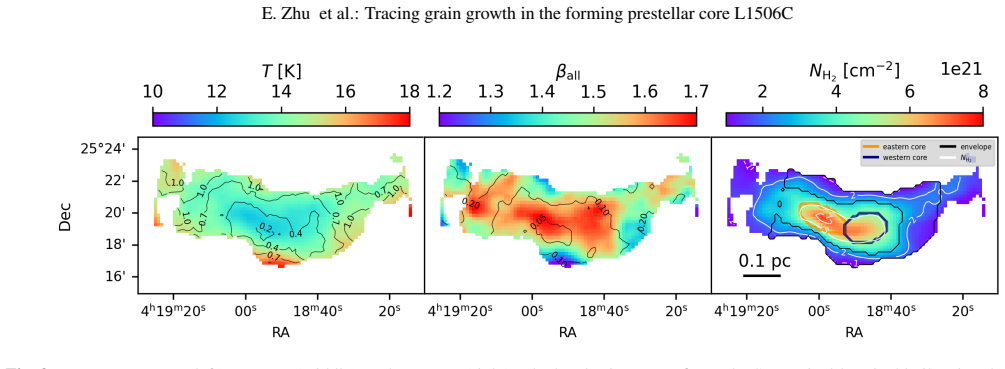
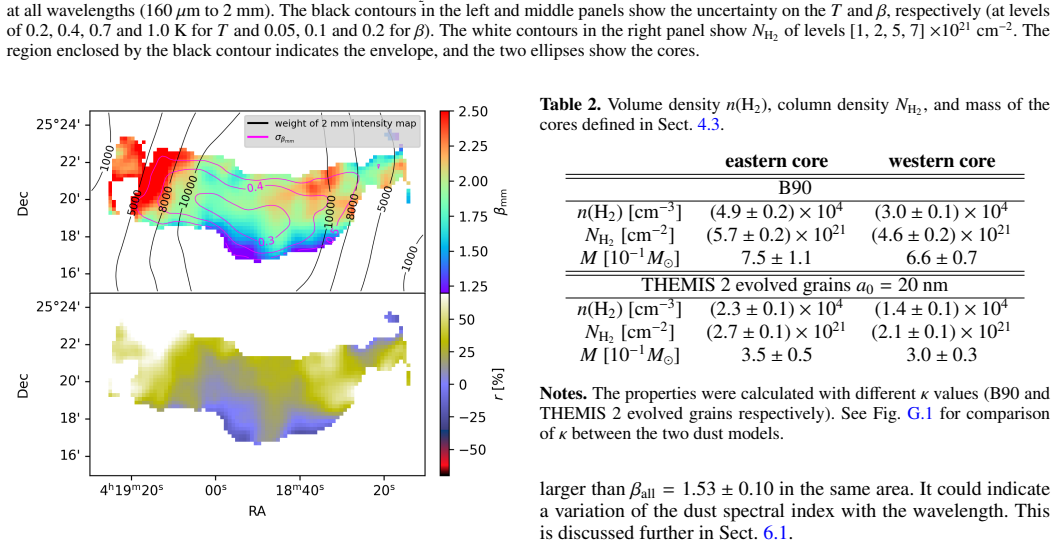
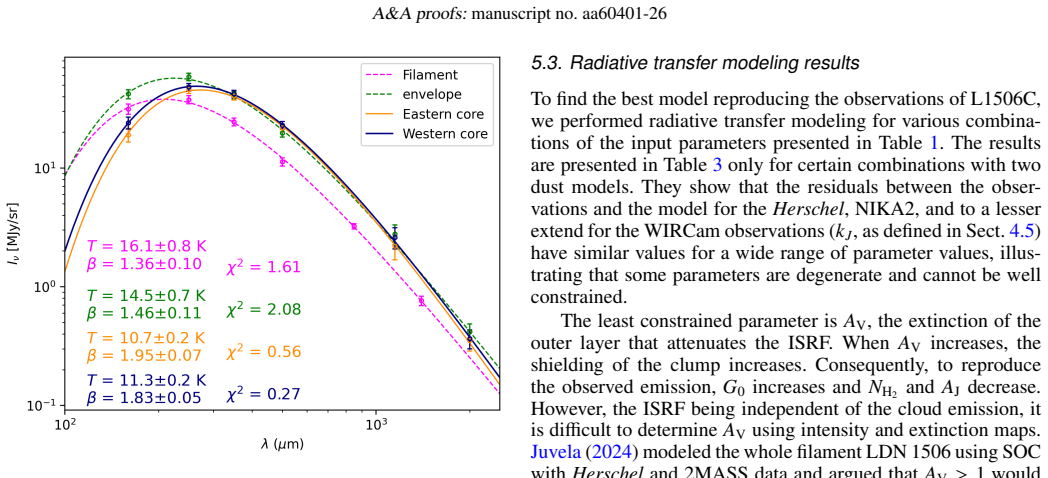
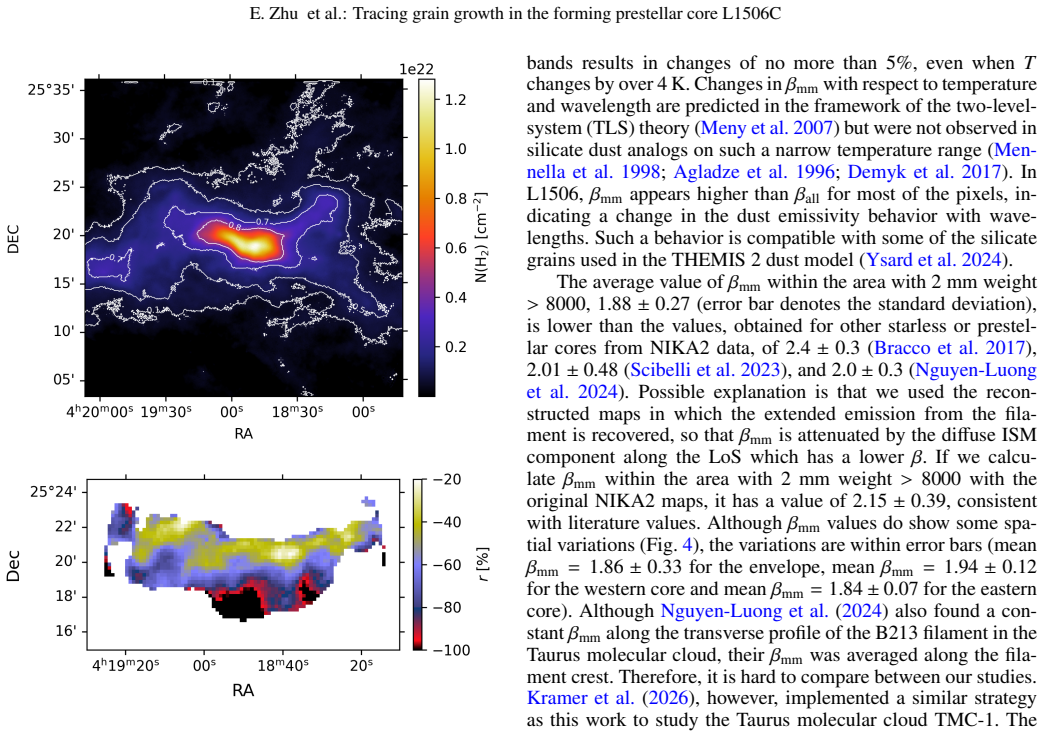
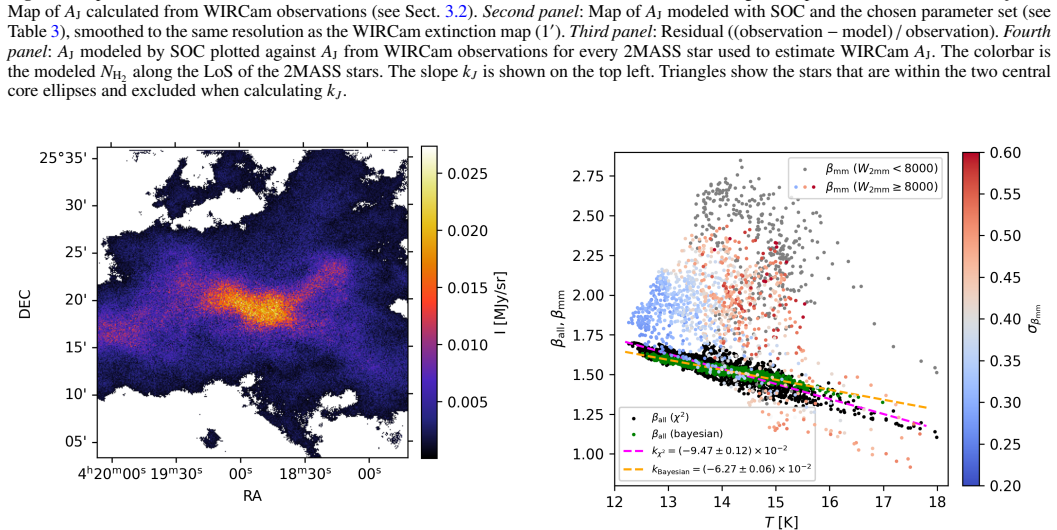
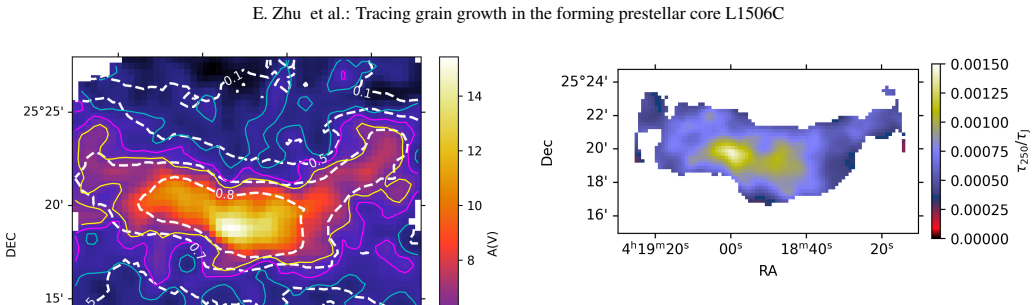
The modeling of L1506C reveals that grains more evolved than those in the diffuse interstellar medium are needed to reproduce the observations of the densest part of the core. This demonstrates that grain growth already occurs at a very early stage of star formation, even before the onset of gravitational collapse. The dust color temperature and emissivity spectral index exhibit a clear anti-correlation, and the core is fragmented into two low-density cores with masses smaller than their Jeans masses.
What carries the argument
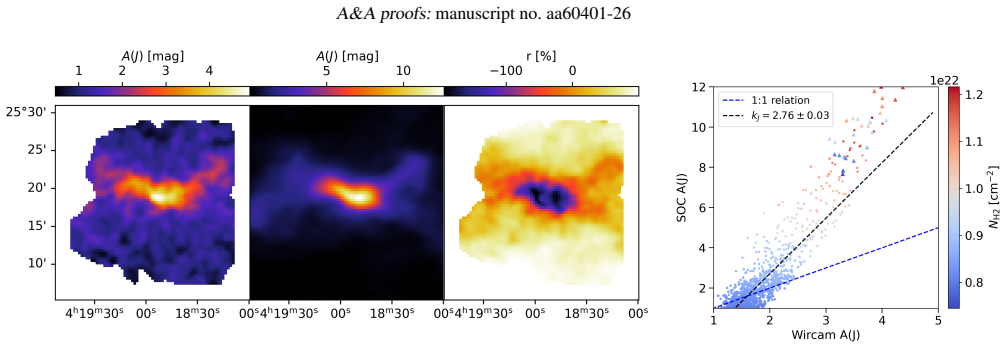
Three-dimensional radiative transfer with the SOC code and THEMIS 2 dust model, applied to spectral energy distributions built from Herschel, IRAM-NIKA2, and extinction data from CFHT and Spitzer.
If this is right
- Grain properties must be adjusted for denser regions when inferring prestellar core characteristics from thermal dust emission.
- The anti-correlation between dust color temperature and emissivity spectral index signals changes in grain properties.
- Fragmentation into sub-Jeans mass cores occurs in L1506C.
- Grain evolution precedes the gravitational collapse phase in star formation.
Where Pith is reading between the lines
- Similar 3D modeling applied to other Taurus cores could test whether early grain growth is widespread.
- Dust models used for interpreting molecular-cloud observations may need systematic updates to include evolved grains at low densities.
- High-resolution polarization or millimeter observations could directly check the predicted grain-size distribution inside L1506C.
Load-bearing premise
The THEMIS 2 dust model combined with the SOC 3D radiative transfer code accurately reproduces real dust properties in this environment without major systematic biases from the fitting procedure or observational constraints.
What would settle it
A successful fit of the same data using only standard diffuse-ISM grain properties, or the absence of any anti-correlation between color temperature and emissivity index in the maps.
Figures

read the original abstract
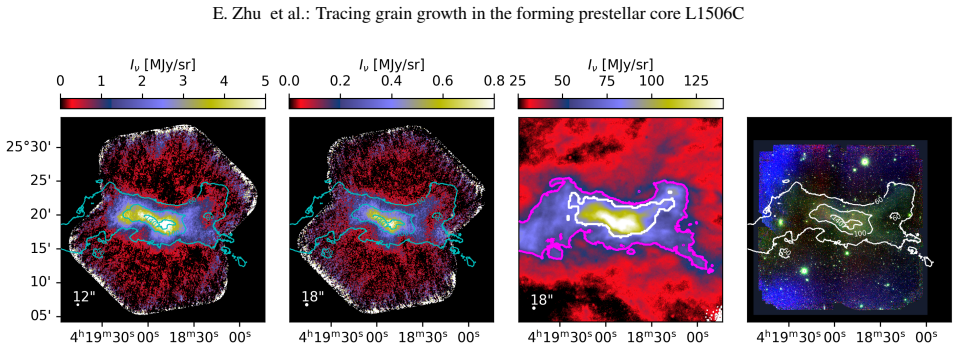
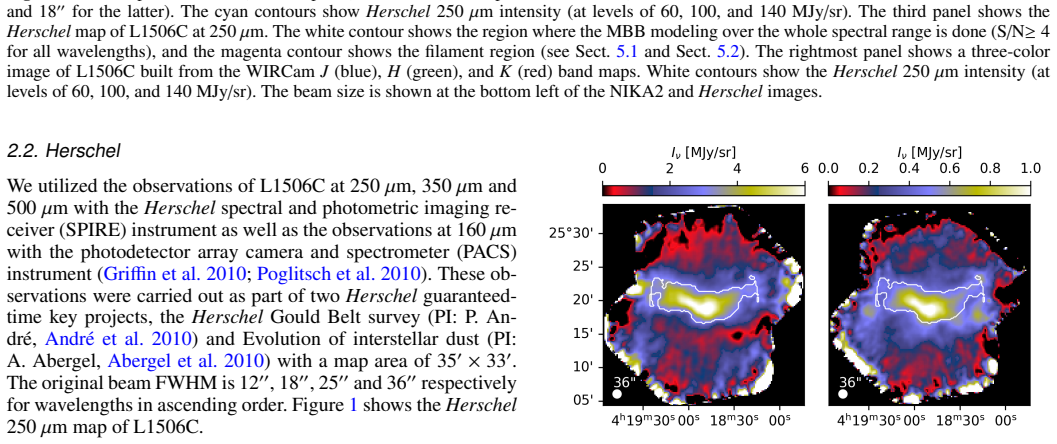
In the early phases of star formation, properties of prestellar cores are commonly inferred from observations of thermal dust emission and thus depend on dust properties, which must be carefully characterized. Our target, L1506C, is part of the filament L1506 in the Taurus molecular cloud. The spectral energy distributions over the whole spectral range (from 160 {\mu}m to 2 mm), built from Herschel PACS and SPIRE and IRAM-NIKA2 data, have been fitted with a modified blackbody. These data were also modelled using the 3D radiative transfer code SOC and the latest THEMIS 2 dust model using extinction observations from WIRCam at CFHT and from Spitzer as additional constraints. The MBB modeling reveals that L1506C is fragmented into two low density cores with masses smaller than their Jeans masses. The dust color temperature and the emissivity spectral index show clear anti-correlation and change in grain properties. Grains more evolved than the diffuse interstellar medium are needed to model the densest part showing that grain growth already occurs at very early stage of star formation, even before the onset of gravitational collapse.
Editorial analysis
A structured set of objections, weighed in public.
Referee Report
Summary. The paper analyzes multi-wavelength observations (Herschel PACS/SPIRE, IRAM-NIKA2, CFHT WIRCam, Spitzer) of the prestellar core L1506C in the Taurus filament L1506. Modified blackbody (MBB) fits to the SEDs from 160 μm to 2 mm are combined with 3D radiative transfer modeling using the SOC code and THEMIS 2 dust model, with extinction maps providing additional constraints on the density structure. The central claims are that L1506C fragments into two low-mass cores below their Jeans masses and that the densest regions require dust grains more evolved than the diffuse ISM, implying grain growth occurs prior to gravitational collapse.
Significance. If the 3D modeling robustly shows that standard THEMIS 2 diffuse-ISM grain properties cannot match the observed SEDs once the density/temperature structure is fixed by extinction data, the result would be significant for star-formation studies: it would demonstrate that grain evolution begins at the prestellar stage. The combination of 3D RT with independent extinction constraints is a methodological strength that could help address known MBB degeneracies such as the T–β anti-correlation.
major comments (2)
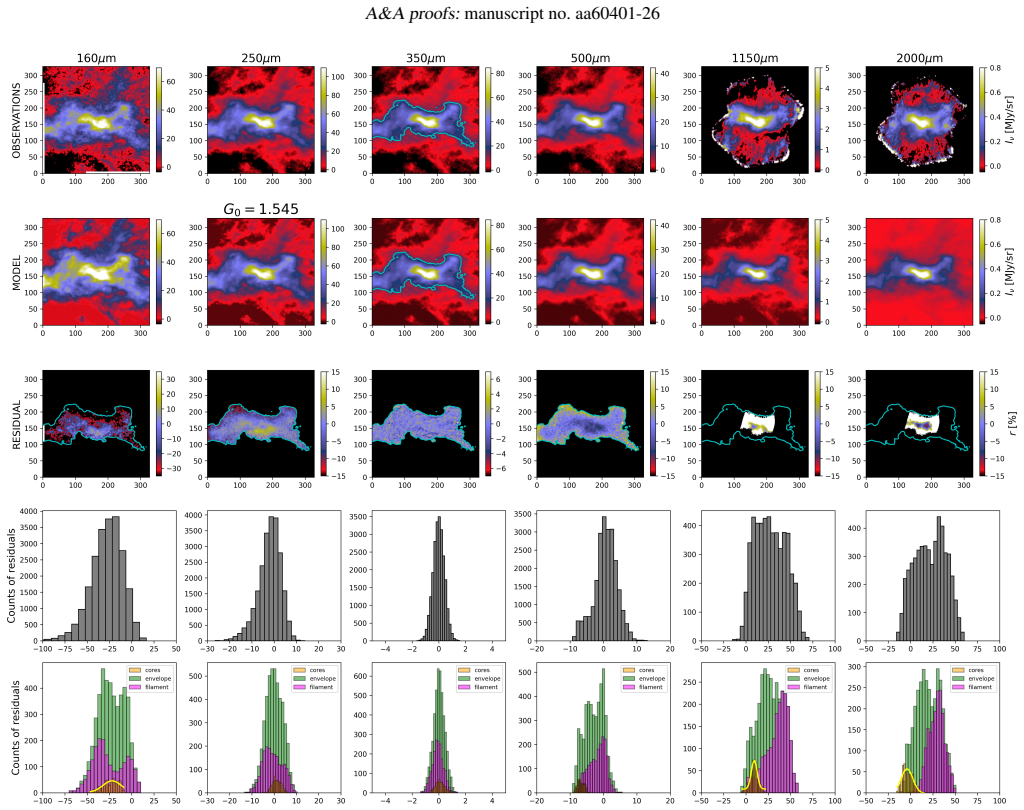
- [3D radiative transfer modeling section] 3D radiative transfer modeling section: The central claim that evolved grains are required rests on showing that the standard THEMIS 2 diffuse-ISM parameters fail to reproduce the Herschel+IRAM SEDs in the densest regions when the 3D density profile is constrained by CFHT/Spitzer extinction. The manuscript must supply quantitative evidence (e.g., reduced χ² or residual maps) for both the standard and adjusted-grain models; without this, trade-offs between grain emissivity, local density, or line-of-sight temperature mixing cannot be ruled out.
- [MBB fitting and results] MBB fitting and results: The reported T–β anti-correlation and change in grain properties must be shown to survive after the 3D modeling step; the manuscript should demonstrate that the 3D RT breaks the known degeneracies (temperature mixing, optical-depth effects) rather than inheriting them from the MBB fits.
minor comments (1)
- [Abstract] Abstract: The phrase 'from 160 {μ}m to 2 mm' contains unrendered LaTeX that should be corrected for clarity.
Simulated Author's Rebuttal
We thank the referee for their constructive comments, which highlight important aspects for strengthening the quantitative support of our claims. We address each major comment below and will revise the manuscript to incorporate the requested evidence and clarifications.
read point-by-point responses
-
Referee: [3D radiative transfer modeling section] 3D radiative transfer modeling section: The central claim that evolved grains are required rests on showing that the standard THEMIS 2 diffuse-ISM parameters fail to reproduce the Herschel+IRAM SEDs in the densest regions when the 3D density profile is constrained by CFHT/Spitzer extinction. The manuscript must supply quantitative evidence (e.g., reduced χ² or residual maps) for both the standard and adjusted-grain models; without this, trade-offs between grain emissivity, local density, or line-of-sight temperature mixing cannot be ruled out.
Authors: We agree that quantitative metrics are necessary to robustly demonstrate the failure of the standard model and the improvement with evolved grains. In the revised manuscript, we will add tables of reduced χ² values for both the standard THEMIS 2 diffuse-ISM parameters and the adjusted-grain models across the core regions. We will also include residual maps (observed minus modeled flux) at key wavelengths to illustrate the spatial distribution of discrepancies and confirm that alternatives like density adjustments or temperature mixing do not resolve the fits. revision: yes
-
Referee: [MBB fitting and results] MBB fitting and results: The reported T–β anti-correlation and change in grain properties must be shown to survive after the 3D modeling step; the manuscript should demonstrate that the 3D RT breaks the known degeneracies (temperature mixing, optical-depth effects) rather than inheriting them from the MBB fits.
Authors: The 3D RT modeling fixes the density structure independently via extinction maps, which is intended to address MBB degeneracies. We will expand the discussion in the revised manuscript with a direct comparison of grain property results from MBB versus 3D RT, including how the requirement for evolved grains in the densest regions holds after the 3D step. This will explicitly show that the 3D approach mitigates temperature mixing and optical-depth effects, rather than simply inheriting the MBB trends. revision: yes
Circularity Check
No significant circularity detected
full rationale
The provided abstract and context describe standard MBB fitting of SEDs followed by 3D RT modeling with SOC and THEMIS 2, constrained by independent extinction maps from CFHT and Spitzer. The claim that evolved grains are required rests on the failure of diffuse-ISM grain properties to reproduce the densest SEDs under the fitted 3D structure. No equations, self-citations, or parameter adjustments are quoted that reduce any reported prediction or result to its own inputs by construction. The derivation chain uses external observational constraints and appears self-contained.
Axiom & Free-Parameter Ledger
free parameters (1)
- THEMIS 2 dust parameters
axioms (1)
- domain assumption THEMIS 2 dust model is suitable for prestellar core conditions
Reference graph
Works this paper leans on
-
[1]
Interpreting millimeter emission from IMEGIN galaxies NGC 2146 and NGC 2976. , keywords =. doi:10.1051/0004-6361/202449738 , archivePrefix =. 2410.09827 , primaryClass =
-
[2]
A Survey for Circumstellar Disks around Young Stellar Objects. , keywords =. doi:10.1086/115385 , adsurl =
-
[3]
A New Optical Extinction Law and Distance Estimate for the Taurus-Auriga Molecular Cloud. , keywords =. doi:10.1086/117200 , adsurl =
-
[4]
Inferring the dust emission at submillimeter and millimeter wavelengths using neural networks. , keywords =. doi:10.1051/0004-6361/202451422 , archivePrefix =. 2410.10263 , primaryClass =
-
[5]
MAMBO Mapping of Spitzer c2d Small Clouds and Cores
MAMBO mapping of Spitzer c2d small clouds and cores. , keywords =. doi:10.1051/0004-6361:200809481 , archivePrefix =. 0805.4205 , primaryClass =
work page internal anchor Pith review Pith/arXiv arXiv doi:10.1051/0004-6361:200809481
-
[6]
Dark gas in the solar neighnorhood from extinction data
Dark gas in the solar neighborhood from extinction data. , keywords =. doi:10.1051/0004-6361/201118740 , archivePrefix =. 1205.3384 , primaryClass =
work page internal anchor Pith review Pith/arXiv arXiv doi:10.1051/0004-6361/201118740
-
[7]
The Herschel-PACS photometer calibration: Point-source flux calibration for scan maps
The Herschel-PACS photometer calibration. Point-source flux calibration for scan maps. Experimental Astronomy , keywords =. doi:10.1007/s10686-013-9352-3 , archivePrefix =. 1309.6099 , primaryClass =
work page internal anchor Pith review Pith/arXiv arXiv doi:10.1007/s10686-013-9352-3
-
[8]
I., Schawinski, K., Kaviraj, S., et al
Physical conditions of the interstellar medium of high-redshift, strongly lensed submillimetre galaxies from the Herschel-ATLAS. , keywords =. doi:10.1111/j.1365-2966.2011.18959.x , archivePrefix =. 1105.3924 , primaryClass =
-
[9]
Calibration and performance of the NIKA2 camera at the IRAM 30-m Telescope. , keywords =. doi:10.1051/0004-6361/201936220 , archivePrefix =. 1910.02038 , primaryClass =
-
[10]
The stratification of ISM properties in the edge-on galaxy NGC 891 revealed by NIKA2. , keywords =. doi:10.1051/0004-6361/202347020 , archivePrefix =. 2309.08403 , primaryClass =
-
[11]
Galactic cold cores: Herschel study of first Planck detections. , keywords =. doi:10.1051/0004-6361/201014619 , adsurl =
-
[12]
Scanamorphos: a map-making software for Herschel and similar scanning bolometer arrays
Scanamorphos: A Map-making Software for Herschel and Similar Scanning Bolometer Arrays. , keywords =. doi:10.1086/673310 , archivePrefix =. 1205.2576 , primaryClass =
work page internal anchor Pith review Pith/arXiv arXiv doi:10.1086/673310
-
[13]
mm Universe @ NIKA2 - Observing the mm Universe with the NIKA2 Camera , year = 2020, series =
NIKA2 mapping and cross-instrument SED extraction of extended sources with Scanamorphos. mm Universe @ NIKA2 - Observing the mm Universe with the NIKA2 Camera , year = 2020, series =. doi:10.1051/epjconf/202022800024 , archivePrefix =. 1911.03192 , primaryClass =
-
[14]
mm Universe 2023 - Observing the Universe at mm Wavelengths , year = 2024, series =
Constraining millimeter dust emission in nearby galaxies with NIKA2: The case of NGC2146 and NGC2976. mm Universe 2023 - Observing the Universe at mm Wavelengths , year = 2024, series =. doi:10.1051/epjconf/202429300016 , archivePrefix =. 2310.03428 , primaryClass =
-
[15]
Planck early results. I. The Planck mission. , keywords =. doi:10.1051/0004-6361/201116464 , archivePrefix =. 1101.2022 , primaryClass =
work page internal anchor Pith review Pith/arXiv arXiv doi:10.1051/0004-6361/201116464 2022
-
[16]
SOC program for dust continuum radiative transfer
SOC program for dust continuum radiative transfer. , keywords =. doi:10.1051/0004-6361/201834354 , archivePrefix =. 1812.06632 , primaryClass =
work page internal anchor Pith review Pith/arXiv arXiv doi:10.1051/0004-6361/201834354
-
[17]
, keywords =
Interstellar radiation field and dust temperatures in the diffuse interstellar medium and in giant molecular clouds. , keywords =
-
[18]
THEMIS 2.0: A self-consistent model for dust extinction, emission, and polarisation. , keywords =. doi:10.1051/0004-6361/202348391 , archivePrefix =. 2401.07739 , primaryClass =
-
[19]
The global dust SED: Tracing the nature and evolution of dust with DustEM
The global dust SED: tracing the nature and evolution of dust with DustEM. , keywords =. doi:10.1051/0004-6361/201015292 , archivePrefix =. 1010.2769 , primaryClass =
work page internal anchor Pith review Pith/arXiv arXiv doi:10.1051/0004-6361/201015292
-
[20]
Variation in dust properties in a dense filament of the Taurus molecular complex (L1506)
Variation in dust properties in a dense filament of the Taurus molecular complex (L1506). , keywords =. doi:10.1051/0004-6361/201322066 , archivePrefix =. 1309.6489 , primaryClass =
work page internal anchor Pith review Pith/arXiv arXiv doi:10.1051/0004-6361/201322066
-
[21]
From filamentary clouds to prestellar cores to the stellar IMF: Initial highlights from the Herschel Gould Belt Survey. , keywords =. doi:10.1051/0004-6361/201014666 , archivePrefix =. 1005.2618 , primaryClass =
work page internal anchor Pith review Pith/arXiv arXiv doi:10.1051/0004-6361/201014666
-
[22]
First results in the photodissociation regions of NGC 7023
Evolution of interstellar dust with Herschel. First results in the photodissociation regions of NGC 7023. , keywords =. doi:10.1051/0004-6361/201014643 , adsurl =
-
[23]
The Herschel-SPIRE instrument and its in-flight performance
The Herschel-SPIRE instrument and its in-flight performance. , keywords =. doi:10.1051/0004-6361/201014519 , archivePrefix =. 1005.5123 , primaryClass =
work page internal anchor Pith review Pith/arXiv arXiv doi:10.1051/0004-6361/201014519
-
[24]
The Photodetector Array Camera and Spectrometer (PACS) on the Herschel Space Observatory
The Photodetector Array Camera and Spectrometer (PACS) on the Herschel Space Observatory. , keywords =. doi:10.1051/0004-6361/201014535 , archivePrefix =. 1005.1487 , primaryClass =
work page internal anchor Pith review Pith/arXiv arXiv doi:10.1051/0004-6361/201014535
-
[25]
Galactic cold cores. VI. Dust opacity spectral index. , keywords =. doi:10.1051/0004-6361/201425269 , archivePrefix =. 1509.08023 , primaryClass =
work page internal anchor Pith review Pith/arXiv arXiv doi:10.1051/0004-6361/201425269
-
[26]
Galactic cold cores. V. Dust opacity. , archivePrefix = "arXiv", eprint =. doi:10.1051/0004-6361/201423788 , adsurl =
-
[27]
The Effect of Line of Sight Temperature Variation and Noise on Dust Continuum Observations
The Effect of Line-of-Sight Temperature Variation and Noise on Dust Continuum Observations. , keywords =. doi:10.1088/0004-637X/696/2/2234 , archivePrefix =. 0902.3477 , primaryClass =
work page internal anchor Pith review Pith/arXiv arXiv doi:10.1088/0004-637x/696/2/2234
-
[28]
Modelling the dust emission from dense interstellar clouds: disentangling the effects of radiative transfer and dust properties. , keywords =. doi:10.1051/0004-6361/201118420 , archivePrefix =. 1202.5966 , primaryClass =
work page internal anchor Pith review Pith/arXiv arXiv doi:10.1051/0004-6361/201118420
-
[29]
Inverse temperature dependence of the dust submillimeter spectral index
Inverse temperature dependence of the dust submillimeter spectral index. , keywords =. doi:10.1051/0004-6361:20030575 , archivePrefix =. astro-ph/0304253 , primaryClass =
work page internal anchor Pith review Pith/arXiv arXiv doi:10.1051/0004-6361:20030575
-
[30]
Submillimetre point sources from the Archeops experiment: Very Cold Clumps in the Galactic Plane
Submillimetre point sources from the Archeops experiment: very cold clumps in the Galactic plane. , keywords =. doi:10.1051/0004-6361:20078701 , archivePrefix =. 0801.4502 , primaryClass =
work page internal anchor Pith review Pith/arXiv arXiv doi:10.1051/0004-6361:20078701
-
[31]
The degeneracy between dust colour temperature and spectral index. Comparison of methods for estimating the (T) relation. , keywords =. doi:10.1051/0004-6361/201220910 , archivePrefix =. 1305.2130 , primaryClass =
work page internal anchor Pith review Pith/arXiv arXiv doi:10.1051/0004-6361/201220910
-
[32]
Steinacker, J. and Pagani, L. and Bacmann, A. and Guieu, S. , year=. Direct evidence of dust growth in L183 from mid-infrared light scattering , volume=. doi:10.1051/0004-6361/200912835 , journal=
-
[33]
L1506: a prestellar core in the making
L1506: a prestellar core in the making. , keywords =. doi:10.1051/0004-6361/200912859 , archivePrefix =. 0912.1193 , primaryClass =
work page internal anchor Pith review Pith/arXiv arXiv doi:10.1051/0004-6361/200912859
-
[34]
Mantle formation, coagulation, and the origin of cloud/core shine. II. Comparison with observations. , keywords =. doi:10.1051/0004-6361/201527487 , archivePrefix =. 1602.00541 , primaryClass =
work page internal anchor Pith review Pith/arXiv arXiv doi:10.1051/0004-6361/201527487
-
[36]
The evolution of amorphous hydrocarbons in the ISM: dust modelling from a new vantage point
The evolution of amorphous hydrocarbons in the ISM: dust modelling from a new vantage point. , keywords =. doi:10.1051/0004-6361/201321686 , archivePrefix =. 1411.6293 , primaryClass =
work page internal anchor Pith review Pith/arXiv arXiv doi:10.1051/0004-6361/201321686
-
[37]
Modelling the dust emission of a filament in the Taurus molecular cloud. , keywords =. doi:10.1051/0004-6361/202347710 , archivePrefix =. 2310.20585 , primaryClass =
-
[38]
Characterizing interstellar filaments with Herschel in IC5146
Characterizing interstellar filaments with Herschel in IC 5146. , keywords =. doi:10.1051/0004-6361/201116596 , archivePrefix =. 1103.0201 , primaryClass =
work page internal anchor Pith review Pith/arXiv arXiv doi:10.1051/0004-6361/201116596
-
[39]
Characterizing the properties of nearby molecular filaments observed with Herschel
Characterizing the properties of nearby molecular filaments observed with Herschel. , keywords =. doi:10.1051/0004-6361/201832725 , archivePrefix =. 1810.00721 , primaryClass =
work page internal anchor Pith review Pith/arXiv arXiv doi:10.1051/0004-6361/201832725
-
[40]
The typical width of Herschel filaments. , keywords =. doi:10.1051/0004-6361/202244541 , archivePrefix =. 2210.04736 , primaryClass =
-
[41]
Planck early results. XXV. Thermal dust in nearby molecular clouds. , keywords =. doi:10.1051/0004-6361/201116483 , archivePrefix =. 1101.2037 , primaryClass =
work page internal anchor Pith review Pith/arXiv arXiv doi:10.1051/0004-6361/201116483 2037
-
[42]
Far-infrared to millimeter astrophysical dust emission. I. A model based on physical properties of amorphous solids. , keywords =. doi:10.1051/0004-6361:20065771 , archivePrefix =. astro-ph/0701226 , primaryClass =
work page internal anchor Pith review Pith/arXiv arXiv doi:10.1051/0004-6361:20065771
-
[43]
Temperature Dependence of the Absorption Coefficient of Cosmic Analog Grains in the Wavelength Range 20 Microns to 2 Millimeters. , keywords =. doi:10.1086/305415 , adsurl =
-
[44]
Low temperature FIR and submm mass absorption coefficient of interstellar silicate dust analogues
Low-temperature FIR and submillimetre mass absorption coefficient of interstellar silicate dust analogues. , keywords =. doi:10.1051/0004-6361/201116945 , archivePrefix =. 1109.2758 , primaryClass =
work page internal anchor Pith review Pith/arXiv arXiv doi:10.1051/0004-6361/201116945
-
[45]
Low temperature MIR to submillimeter mass absorption coefficient of interstellar dust analogues. I. Mg-rich glassy silicates. , keywords =. doi:10.1051/0004-6361/201629711 , archivePrefix =. 1701.07225 , primaryClass =
work page internal anchor Pith review Pith/arXiv arXiv doi:10.1051/0004-6361/201629711
-
[46]
Low-temperature MIR to submillimeter mass absorption coefficient of interstellar dust analogues. II. Mg and Fe-rich amorphous silicates. , keywords =. doi:10.1051/0004-6361/201730944 , archivePrefix =. 1706.09801 , primaryClass =
work page internal anchor Pith review Pith/arXiv arXiv doi:10.1051/0004-6361/201730944
-
[47]
Evolution of dust properties in an interstellar filament. , keywords =. doi:10.1051/0004-6361:20021309 , adsurl =
-
[48]
Changes Of Dust Opacity With Density in the Orion A Molecular Cloud
Changes of Dust Opacity with Density in the Orion A Molecular Cloud. , keywords =. doi:10.1088/0004-637X/763/1/55 , archivePrefix =. 1211.6475 , primaryClass =
work page internal anchor Pith review Pith/arXiv arXiv doi:10.1088/0004-637x/763/1/55
-
[49]
M. S. Klamkin , title =. The American Mathematical Monthly , volume =. 1971 , publisher =. doi:10.1080/00029890.1971.11992746 , URL =
-
[50]
Planck 2013 results. XI. All-sky model of thermal dust emission. , keywords =. doi:10.1051/0004-6361/201323195 , archivePrefix =. 1312.1300 , primaryClass =
work page internal anchor Pith review Pith/arXiv arXiv doi:10.1051/0004-6361/201323195 2013
-
[51]
From small dust to micron-sized aggregates: The influence of structure and composition on the dust optical properties. , keywords =. doi:10.1051/0004-6361/202554575 , archivePrefix =. 2504.20578 , primaryClass =
-
[52]
Andersen, M. and Thi, W.-F. and Steinacker, J. and Tothill, N. , year=. A common column density threshold for scattering at 3.6μm and water-ice in molecular clouds , volume=. doi:10.1051/0004-6361/201424011 , journal=
-
[53]
Coreshine in L1506C - Evidence for a primitive big-grain component or indication for a turbulent core history?. , keywords =. doi:10.1051/0004-6361/201322117 , archivePrefix =. 1403.3650 , primaryClass =
work page internal anchor Pith review Pith/arXiv arXiv doi:10.1051/0004-6361/201322117
-
[54]
Planck early results. XXV. Thermal dust in nearby molecular clouds. , archivePrefix = "arXiv", eprint =
-
[55]
Planck early results. XXIII. The Galactic cold core population revealed by the first all-sky survey. , archivePrefix = "arXiv", eprint =
-
[56]
Planck intermediate results. XVII. Emission of dust in the diffuse interstellar medium from the far-infrared to microwave frequencies. , keywords =. doi:10.1051/0004-6361/201323270 , archivePrefix =. 1312.5446 , primaryClass =
work page internal anchor Pith review Pith/arXiv arXiv doi:10.1051/0004-6361/201323270
-
[57]
Laboratory Results on Millimeter-Wave Absorption in Silicate Grain Materials at Cryogenic Temperatures. , keywords =. doi:10.1086/177217 , adsurl =
-
[58]
, keywords =
Dust opacities for protostellar cores. , keywords =
-
[59]
, archivePrefix = "arXiv", eprint =
Dust evolution in the transition towards the denser ISM: impact on dust temperature, opacity, and spectral index. , archivePrefix = "arXiv", eprint =. doi:10.1051/0004-6361/201525646 , adsurl =
-
[60]
Dust coagulation processes as constrained by far-infrared observations. , keywords =. doi:10.1051/0004-6361/201218975 , adsurl =
-
[61]
Dust emission, extinction, and scattering in LDN 1642. , keywords =. doi:10.1051/0004-6361/202038611 , archivePrefix =. 2009.12614 , primaryClass =
-
[62]
Low dust emissivities and radial variations in the envelopes of Class 0 protostars: possible signature of early grain growth. , keywords =. doi:10.1051/0004-6361/201936342 , archivePrefix =. 1910.04652 , primaryClass =
-
[63]
A (sub)millimetre study of dense cores in Orion B9
A (sub)millimetre study of dense cores in Orion B9. , keywords =. doi:10.1051/0004-6361/201117849 , archivePrefix =. 1112.5053 , primaryClass =
work page internal anchor Pith review Pith/arXiv arXiv doi:10.1051/0004-6361/201117849
-
[64]
Evidence for Large Grains in the Star-forming Filament OMC-2/3
Evidence for large grains in the star-forming filament OMC 2/3. , keywords =. doi:10.1093/mnras/stu1596 , archivePrefix =. 1408.5429 , primaryClass =
work page internal anchor Pith review Pith/arXiv arXiv doi:10.1093/mnras/stu1596
-
[65]
Multiwavelength analysis for interferometric (sub-)mm observations of protoplanetary disks. Radial constraints on the dust properties and the disk structure. , keywords =. doi:10.1051/0004-6361/201527423 , archivePrefix =. 1512.05679 , primaryClass =
work page internal anchor Pith review Pith/arXiv arXiv doi:10.1051/0004-6361/201527423
-
[66]
The optical properties of dust: the effects of composition, size, and structure
The optical properties of dust: the effects of composition, size, and structure. , keywords =. doi:10.1051/0004-6361/201833386 , archivePrefix =. 1806.05420 , primaryClass =
work page internal anchor Pith review Pith/arXiv arXiv doi:10.1051/0004-6361/201833386
-
[67]
From grains to pebbles: the influence of size distribution and chemical composition on dust emission properties. , keywords =. doi:10.1051/0004-6361/201936089 , archivePrefix =. 1909.05015 , primaryClass =
-
[68]
mm Universe 2023 - Observing the Universe at mm Wavelengths , year = 2024, series =
NIKA2 observations of starless cores in Taurus and Perseus. mm Universe 2023 - Observing the Universe at mm Wavelengths , year = 2024, series =. doi:10.1051/epjconf/202429300027 , archivePrefix =. 2310.01044 , primaryClass =
-
[69]
Mapping the interstellar dust with near-infrared observations: An optimized multi-band technique
Mapping the interstellar dust with near-infrared observations: An optimized multi-band technique. , keywords =. doi:10.1051/0004-6361:20011099 , archivePrefix =. astro-ph/0109135 , primaryClass =
work page internal anchor Pith review Pith/arXiv arXiv doi:10.1051/0004-6361:20011099
-
[70]
The Taurus Spitzer Survey: New Candidate Taurus Members Selected Using Sensitive Mid-Infrared Photometry. , keywords =. doi:10.1088/0067-0049/186/2/259 , archivePrefix =. 0911.3176 , primaryClass =
work page internal anchor Pith review Pith/arXiv arXiv doi:10.1088/0067-0049/186/2/259
-
[71]
Probing changes of dust properties along a chain of solar-type prestellar and protostellar cores in Taurus with NIKA. , keywords =. doi:10.1051/0004-6361/201731117 , archivePrefix =. 1706.08407 , primaryClass =
work page internal anchor Pith review Pith/arXiv arXiv doi:10.1051/0004-6361/201731117
-
[72]
mm Universe 2023 - Observing the Universe at mm Wavelengths , year = 2024, series =
NIKA2 observations of dust grain evolution from star-forming filament to T-Tauri disk: Preliminary results from NIKA2 observations of the Taurus B211/B213 filament. mm Universe 2023 - Observing the Universe at mm Wavelengths , year = 2024, series =. doi:10.1051/epjconf/202429300035 , archivePrefix =. 2310.16526 , primaryClass =
-
[73]
3D radiative transfer modelling and virial analysis of starless cores in the B10 region of the Taurus molecular cloud. , keywords =. doi:10.1093/mnras/stad827 , archivePrefix =. 2303.09574 , primaryClass =
-
[74]
A NIKA view of two star-forming infrared dark clouds: Dust emissivity variations and mass concentration. , keywords =. doi:10.1051/0004-6361/201732258 , archivePrefix =. 1801.09801 , primaryClass =
work page internal anchor Pith review Pith/arXiv arXiv doi:10.1051/0004-6361/201732258
-
[75]
Comparison of environmental trends in H I gas mass fraction and specific star formation rate
Molecular line contamination in the SCUBA-2 450 and 850 m continuum data. , keywords =. doi:10.1111/j.1365-2966.2012.21140.x , archivePrefix =. 1204.6180 , primaryClass =
-
[76]
Ground-based Instrumentation for Astronomy , year = 2004, editor =
WIRCam: the infrared wide-field camera for the Canada-France-Hawaii Telescope. Ground-based Instrumentation for Astronomy , year = 2004, editor =. doi:10.1117/12.551097 , adsurl =
-
[77]
Adam, R. and Adane, A. and Ade, P. A. R. and André, P. and Andrianasolo, A. and Aussel, H. and Beelen, A. and Benoît, A. and Bideaud, A. and Billot, N. and Bourrion, O. and Bracco, A. and Calvo, M. and Catalano, A. and Coiffard, G. and Comis, B. and De Petris, M. and Désert, F.-X. and Doyle, S. and Driessen, E. F. C. and Evans, R. and Goupy, J. and Kramer...
-
[78]
Calvo, M. and Benoît, A. and Catalano, A. and Goupy, J. and Monfardini, A. and Ponthieu, N. and Barria, E. and Bres, G. and Grollier, M. and Garde, G. and Leggeri, J.-P. and Pont, G. and Triqueneaux, S. and Adam, R. and Bourrion, O. and Macías-Pérez, J.-F. and Rebolo, M. and Ritacco, A. and Scordilis, J.-P. and Tourres, D. and Adane, A. and Coiffard, G. a...
-
[79]
Bourrion, O. and Benoit, A. and Bouly, J.L. and Bouvier, J. and Bosson, G. and Calvo, M. and Catalano, A. and Goupy, J. and Li, C. and Macías-Pérez, J.F. and Monfardini, A. and Tourres, D. and Ponchant, N. and Vescovi, C. , year=. NIKEL_AMC: readout electronics for the NIKA2 experiment , volume=. Journal of Instrumentation , publisher=. doi:10.1088/1748-0...
-
[80]
Dust emission and extinction in the Orion OMC-3 cloud. , keywords =. doi:10.1051/0004-6361/202555541 , archivePrefix =. 2512.13202 , primaryClass =
-
[81]
Scattering from dust in molecular clouds: Constraining the dust grain size distribution through near-infrared cloudshine and infrared coreshine. , keywords =. doi:10.1051/0004-6361/201322102 , archivePrefix =. 1310.7105 , primaryClass =
work page internal anchor Pith review Pith/arXiv arXiv doi:10.1051/0004-6361/201322102
discussion (0)
Sign in with ORCID, Apple, or X to comment. Anyone can read and Pith papers without signing in.