REVIEW 3 major objections 4 minor 29 references
Drift, stabilizing and destabilizing for a Patlak-Keller-Segel system with the short-wavelength external signal
T0 review · 3 major / 4 minor · reviewed 2026-08-14 · deepseek-v4-flash
Pith's one-line read For a prey-taxis system driven by a short-wavelength signal, the paper shows that the wave speed alone decides whether increasing amplitude stabilizes or destabilizes the pattern.
desk verdict Genuinely new homogenization result for PKS with short-wave signals, with clean explicit formulas and a plausible threshold mechanism, but the headline claim about exact short-wavelength patterns is only established for the homogenized slow-mode system, not for the original PDE. read the letter →
The pith
A machine-rendered reading of the paper's core claim, the machinery that carries it, and where it could break.
The reading
What carries the argument
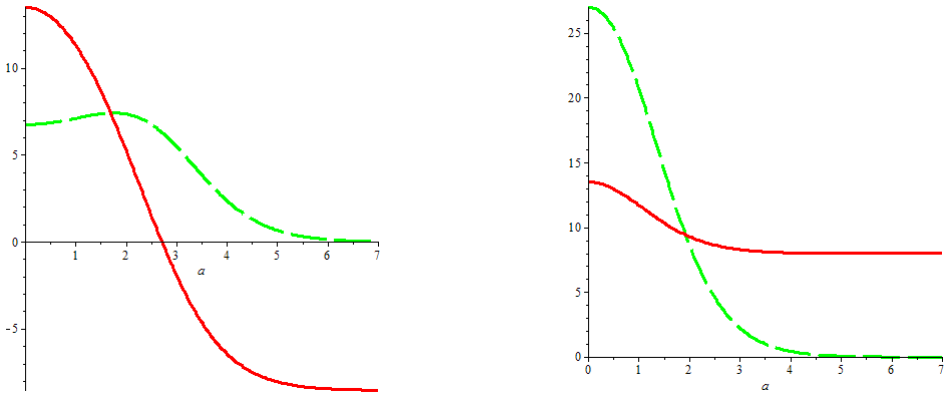
The machinery is the homogenization expansion of the inertial Patlak–Keller–Segel system in fast variables $\xi=\omega x$, $\tau=\omega t$, producing cell problems for the short-wave velocity $\tilde u_0$ and the periodic density factor $P$, and closing on homogenized mean-field equations. The drift operator $V(\tilde f)$ maps the mean predator velocity to the averaged short-wave flux $\langle \tilde u_0 P\rangle$; its derivative at zero gives the effective motility factor $1+V'(\tilde f)$, and its value at zero gives the residual drift $v_e$. For travelling waves the drift is expressed through the integral $\Gamma_+$ via the formula $v = c - \nu_2/\Gamma_+$, and Laplace asymptotics of $\Gamma_+$ as the amplitude grows supply both the exponential decay of the effective motility and the saturation of the residual drift at the wave speed. The linear stability analysis reduces to a cubic characteristic polynomial whose Hankel minors give the two critical motilities $\kappa_c^\pm$.
What would settle it
Run the exact system (1.4)–(1.6) with $f=A\sin(\omega x-\omega c t)$ for large $\omega$ and parameters with $c>c_*$; if the central claim is right, increasing $A$ beyond the value where $v_e>c_*$ should make a small perturbation of the homogeneous quasi-equilibrium grow, while for $c<c_*$ the same perturbation should decay with a rate set by the exponentially small effective motility. Comparing the computed growth rate to the cubic characteristic polynomial of Section 7.2 would settle the claim.
Extended reading notes
Core claim
The central claim is that a short travelling wave acts on the homogeneous quasi-equilibria through two homogenized quantities—the residual drift $v_e$ and the effective motility $\bar{\kappa}=(1+V'(\tilde f))\kappa$—and that the balance between them is controlled by the wave speed. Stability is decided by comparing $\bar{\kappa}$ with the lower critical curve $\kappa_c^-(v_e,p_e,\beta,\delta)$; this curve becomes negative exactly when $|v_e|$ exceeds $c_* = \sqrt{\nu(q_e+\delta_q\beta)/\beta}$. Since the residual drift approaches the wave speed as the amplitude grows, a wave with $c>c_*$ drives $v_e$ past $c_*$ and makes every eigenmode unstable for sufficiently large amplitude, whereas a wave with $c<c_*$ keeps $\kappa_c^-$ positive while $\bar{\kappa}$ decays exponentially, so amplitude growth stabilizes. The paper states the threshold independently of the amplitude and emphasizes that both the stabilizing and destabilizing effects are exponential in the amplitude.
Load-bearing premise
The paper assumes the formal short-wave expansion gives the exact leading-order dynamics as $\omega\to\infty$ and that stability of the homogenized quasi-equilibrium matches stability of the true short-wavelength pattern; no rigorous error or spectral convergence proof is supplied.
Editorial extensions
If this is right
- For stationary or slow waves ($c<c_*$), sufficiently large amplitude gives absolute stabilization: the effective motility drops below the threshold $\kappa_*$, so no quasi-equilibrium of any density or wavenumber is unstable.
- For fast waves ($c>c_*$), sufficiently large amplitude makes the lower critical motility negative, so every admissible eigenmode is unstable and the stabilizing stability diagram is impossible.
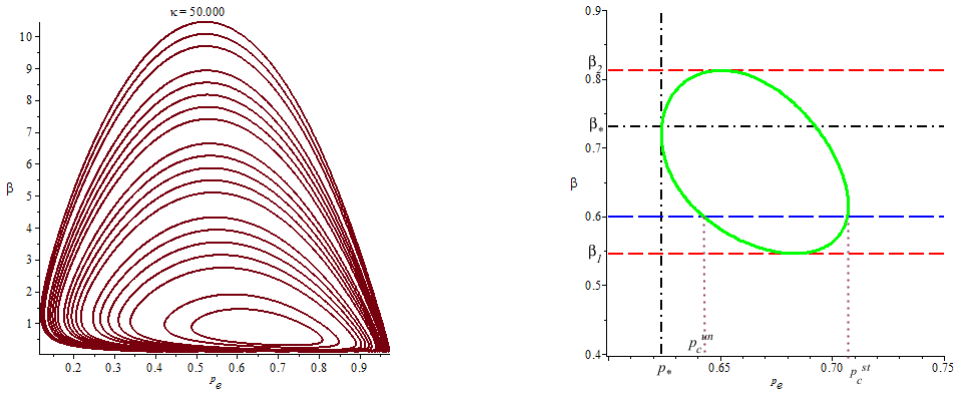
- When destabilization occurs, it begins at the short-wave end of the spectrum: modes with $\beta > \beta_* = q_e\nu/(v_e^2-\nu\delta_q)$ are the first to go unstable.
- The drift breaks reflectional symmetry, splitting the double neutral mode of the homogeneous problem into two simple neutral waves—one upstream and one downstream relative to the drift—and the upstream wave is the stability threshold.
- In the large-amplitude limit the system degenerates to almost neutral waves propagating at nearly the external wave speed, leaving a weakly unstable regime where nonlinear interactions with previously bifurcated waves can occur.
Reading between the lines
- If the formal homogenization can be made rigorous with error estimates, the threshold $c_*$ should be observable in direct numerical simulations of the exact system at large but finite $\omega$: the full periodic dispersion relation should show eigenvalues crossing the imaginary axis near the predicted amplitude.
- The effective-motility formulas define an optimization problem over signal shapes with fixed variance; one could seek wave profiles that maximize or minimize the stabilization effect, a direction the paper itself mentions as open.
- The same drift mechanism should appear in other Patlak–Keller–Segel-type cross-diffusion systems with external short waves; a testable analogue would be a chemotaxis system with an oscillating chemoattractant source, where a similar speed threshold might emerge.
- Standing waves and slowly modulated travelling waves, which the paper lists as future work, would have time-periodic homogenized coefficients; Floquet analysis might reveal a banded version of the threshold rather than a single $c_*$.
Signed reviews
Editorial analysis
A structured set of objections, weighed in public.
Referee Report
Summary. The paper studies a one-dimensional Patlak-Keller-Segel predator-prey system with indirect prey-taxis, driven by an external short-wavelength signal. Using a formal two-scale homogenization expansion (Section 2, Appendix I), the authors derive an effective system for the slow variables, in which the external signal produces a residual drift and a modified effective motility. For the special case of an unmodulated travelling wave, they obtain explicit formulas for the drift and for the effective motility in terms of the signal profile and wave speed. They then define homogeneous quasi-equilibria and perform a linear stability analysis of these states within the homogenized system (Section 4.2, Appendix II). The central claim is that increasing the wave amplitude destabilizes the quasi-equilibria when the wave speed exceeds the threshold c_* in Eq. (4.23), and stabilizes them when the speed is below this threshold, with exponential dependence on amplitude in both cases. The paper presents the algebraic part of the stability analysis in detail, including the critical motilities in Eq. (7.4).
Significance. If the results were rigorously justified, the paper would make a useful contribution to the understanding of external-signal effects in cross-diffusion systems. The explicit threshold in Eq. (4.23), the sign-changing effect of the wave speed, and the exponential motility suppression are concrete and falsifiable predictions that go beyond the existing literature on homogeneous PKS systems. The paper also has strengths in presentation: the comparison with the signal-off case is a natural internal benchmark, the stability algebra in Appendix II is internally consistent, and the closed-form expressions allow direct numerical verification. However, the central claims are currently tied to a formal homogenization step without error bounds or a spectral convergence theorem, so the significance is conditional on closing that gap or on explicitly reframing the claims for the homogenized system only.
major comments (3)
- [Section 2 and Appendix I] The derivation of the homogenized system (2.4)-(2.11) is formal. The text states that the approximation is obtained by an asymptotic expansion, and Appendix I itself describes the derivation as formal and gives no error estimates or convergence results for the remainder terms O(omega^{-1}) in the expansion. This gap is load-bearing because the abstract and Section 4.2 state conclusions about quasi-equilibria of the exact system (1.4)-(1.6), not merely of the homogenized system. Without an estimate showing that solutions of the exact system remain close to solutions of (2.9)-(2.11) for large finite omega, the paper cannot justify transferring stability conclusions from the homogenized equations to the original system. Please either supply such an estimate in suitable norms or explicitly restrict the claims of the paper to the homogenized system and revise the abstract accordingly.
- [Section 4.2] The stability analysis considers only perturbations of the slow variables bar-u, bar-p, bar-q in the homogenized system (4.13)-(4.15). In contrast, a perturbation of an exact short-wavelength travelling-wave pattern solves a linear PDE with coefficients that are periodic in the moving coordinate, so the exact spectral problem has Bloch/Floquet structure. Slow perturbations correspond only to a subset of quasi-momenta; instabilities with non-slow or resonant short-scale modes are not examined. The paper provides no spectral-convergence theorem connecting the exact periodic-coefficient linearized operator to the constant-coefficient operator (4.13)-(4.15). Therefore the statement that for c > c_* increasing amplitude leads to total destabilization and that eigenmodes become unstable 'for every admissible set of the problem parameters' near Eq. (4.23) is not established for the original system. A numerical Floquet computation at finite omega or a rigorous spectral comparison would be needed to close this gap.
- [Section 4.2 and Appendix III] The dichotomy between stabilization and destabilization relies on the limits in Eq. (2.33) and on the exponential decay of the effective motility factor in Eq. (4.24). These results are obtained from the Laplace asymptotics of Eq. (8.4), which assumes that the function s is analytic and has only non-degenerate critical points. The main text, however, states the stabilization/stabilization dichotomy for general unmodulated travelling waves f = A tilde-f(eta) without imposing those hypotheses. Moreover, Eq. (4.24) involves the derivative of Gamma_+ with respect to z, and the asymptotic expansion (8.4) is differentiated without a uniformity statement in z. Please either restrict the claims to the class of profiles covered by Appendix III or supply the additional regularity and uniformity assumptions under which the exponential decay and the limits in Eq. (2.33) hold.
minor comments (4)
- [Section 4.2, Eq. (4.23)] The threshold c_* is called 'independent' in the abstract and in Section 4.2, but the formula (4.23) shows that it depends on the wavenumber beta and on the parameters nu, q_e, and delta_q; it is independent of the amplitude a. Please clarify this qualifier in the text.
- [Section 2, Example 1] The function s in Eq. (2.18) is defined through the right inverse partial_eta^{-1}, but the notation in Eq. (2.17) for exp_+- is hard to parse. A short explanation of the convention would improve readability.
- [Section 4.2] The passage from the exact linearized system (4.1)-(4.3) to the homogenized linearization (4.13)-(4.15) is described in words. Since the equalities are central to the paper, the authors should state explicitly which terms are dropped and why, especially the absence of the diffusion terms delta_p and delta_u in the homogenized problem.
- [Abstract and Section 4.2] The claim that the effect is 'exponential in the amplitude in both cases' is shown only under the analytic-profile assumptions of Appendix III. The abstract should carry the same qualification as the body to avoid overstating the class of signals covered.
Circularity Check
No significant circularity: the stability predictions follow from explicit model equations, with prior results re-derived rather than imported.
full rationale
The paper's central claim is derived on-paper from the stated model. The homogenized system (2.9)-(2.11) is obtained from the exact system (1.4)-(1.6) by an explicit two-scale expansion in Appendix I, and the travelling-wave drift formulas (2.19)-(2.31), the effective motility (4.18) and (4.24), the critical motilities (7.4), and the threshold c* in (4.23) are all computed from model coefficients and the signal profile rather than fitted to any conclusion. No parameter is calibrated against the predicted stability outcome; the comparison with the signal-off case is an internal benchmark, not an input. The homogeneous-equilibrium threshold kappa* is re-derived in Appendix II via the characteristic polynomial (7.1) and formulas (7.2)-(7.3), even though the paper also cites prior work by Govorukhin et al. and Arditi et al. for numerical simulations of the resulting waves; those citations are contextual and not load-bearing. The paper does contain earlier self-citations, notably [5] and [6], but the stability analysis itself does not reduce to them. The formal homogenization and the absence of a rigorous spectral-convergence theorem connecting the homogenized slow stability analysis to the exact Floquet problem is a mathematical rigor limitation, not a circularity: the transfer from homogenized stability to exact short-wavelength pattern stability is an unproved assumption, not a conclusion used as its own input. No equation in the derivation is equivalent to its target by construction, and no fitted input is renamed as a prediction.
Assumptions & free parameters
assumptions (5)
- domain assumption The formal asymptotic expansion (6.4) with truncation (2.4)-(2.11) correctly approximates the dynamics of the exact system (1.4)-(1.6) as omega tends to infinity, and the stability of the homogenized system reflects the stability of the short-wavelength quasi-equilibria.
- standard math The cell problems (2.7)-(2.8) have unique periodic solutions, proven in Appendix I via maximum principles for parabolic operators.
- standard math Routh-Hurwitz criteria for polynomials with complex coefficients correctly count unstable roots for the characteristic polynomials in Appendix II.
- standard math Laplace's method gives the leading-order exponential asymptotics of integrals Gamma_+- as a tends to infinity, with the non-degeneracy assumptions on s stated in Appendix III.
- domain assumption The signal is assumed to have zero mean over fast variables and to produce constant residual drift, so that homogeneous quasi-equilibria (3.2) exist.
Cite this review
Pith. "Pith review of Drift, stabilizing and destabilizing for a Patlak-Keller-Segel system with the short-wavelength external signal." pith.science (2026). https://pith.science/paper/BXXBWNKH
@misc{pith2026190807075,
  author       = {Pith},
  title        = {Pith review of: Drift, stabilizing and destabilizing for a Patlak-Keller-Segel system with the short-wavelength external signal},
  year         = {2026},
  howpublished = {\url{https://pith.science/paper/BXXBWNKH}},
  note         = {Machine review of arXiv:1908.07075}
}
read the original abstract
This article aims at exploring the short-wavelength stabilization and destabilization of the advection-diffusion systems formulated using the Patlak-Keller-Segel cross-diffusion. We study a model of the taxis partly driven by an external signal. We address the general short-wavelength signal using the homogenization technique, and then we give a detailed analysis of the signals emitted as the travelling waves. It turns out that homogenizing produces the drift of species, which is the main translator of the external signal effects, in particular, on the stability issues. We examine the stability of the quasi-equilibria - that is, the simplest short-wavelength patterns fully imposed by the external signal. Comparing the results to the case of switching the signal off allows us to estimate the effect of it. For instance, the effect of the travelling wave turns out to be not single-valued but depending on the wave speed. Namely, there is an independent threshold value such that increasing the amplitude of the wave destabilizes the quasi-equilibria provided that the wave speed is above this value. Otherwise, the same action exerts the opposite effect. It is worth to note that the effect is exponential in the amplitude of the wave in both cases.
Figures

Reference graph
Works this paper leans on
-
[1]
Ivanitskii GR, Medvinskii AB, Tsyganov, MA. (). From the dynamics of population au- towaves generated by living cells to neuroinformatics. Physics-Uspekhi 1994; 37(10): 961
work page 1994
-
[2]
Quasisoliton interaction of pur- suitevasion waves in a predator-prey system.Phys
Tsyganov MA, Brindley J, Holden AV., Biktashev VN. Quasisoliton interaction of pur- suitevasion waves in a predator-prey system.Phys. Rev. Lett. 2003; 91(21): 218102-1-4
work page 2003
-
[3]
Tsyganov MA, Brindley J, Holden AV, Biktashev VN. Soliton-like phenomena in one- dimensional cross-diffusion systems: a predator–prey pursuit and evasion example. Physica D: Nonlinear Phenomena 2004; 197(1-2): 18-33
work page 2004
-
[4]
Half-soliton interaction of population taxis waves in predator-prey systems with pursuit and evasion
Tsyganov MA, Biktashev VN. Half-soliton interaction of population taxis waves in predator-prey systems with pursuit and evasion. Physical Review E 2004 70(3): 031901
work page 2004
-
[5]
Slow taxis in a predator-prey model
Govorukhin V, Morgulis A, Tyutyunov Y. Slow taxis in a predator-prey model. Doklady Mathematics 2000; 61(3): 420-422
work page 2000
-
[6]
Directed movement of preda- tors and the emergence of density-dependence in predator–prey models
Arditi R, Tyutyunov Y, Morgulis A, Govorukhin V, Senina I. Directed movement of preda- tors and the emergence of density-dependence in predator–prey models. Theoretical Pop- ulation Biology 2001; 59(3): 207-221
work page 2001
-
[7]
Chemotaxis- induced spatio-temporal heterogeneity in multi-species host-parasitoid systems
Pearce IG, Chaplain MAJ, · Schofield PG, Anderson ARA, Hubbard SF. Chemotaxis- induced spatio-temporal heterogeneity in multi-species host-parasitoid systems. J. Math. Biol. 2007; 55(3): 365–388
work page 2007
-
[8]
Toward a mathematical theory of Keller-Segel models of pattern formation in biological tissues
Bellomo N,Bellouquid A, Tao Y, Winkler M. Toward a mathematical theory of Keller-Segel models of pattern formation in biological tissues. Math. Models Methods Appl. Sci. 2015; 25(09): 1663-1763
work page 2015
Show all 29 references
-
[9]
Steady states of a predator–prey model with prey-taxis
Li C, Wang X, Shao Y. Steady states of a predator–prey model with prey-taxis. Nonlinear Analysis: Theory, Methods and Applications. 2014. 97: 155-168
2014
-
[10]
Predator–prey model with diffusion and indirect prey-taxis
Tello IJ , Wrzosek D. Predator–prey model with diffusion and indirect prey-taxis. Math. Models Methods Appl. Sci. 2016; 26(11): 2129-2162
2016
-
[11]
Prey-taxis destabilizes homogeneous stationary state in spatial Gause–Kolmogorov-type model for predator–prey system
Tyutyunov Y, Titova L, Senina I. Prey-taxis destabilizes homogeneous stationary state in spatial Gause–Kolmogorov-type model for predator–prey system. Ecological Complexity 2017; 31: 170-180
2017
-
[12]
Time-periodic and stable patterns of a two-competing-species Keller-Segel chemotaxis model: Effect of cellular growth
Wang Q, Yang J, Zhang L. Time-periodic and stable patterns of a two-competing-species Keller-Segel chemotaxis model: Effect of cellular growth. Discrete & Continuous Dynamical Systems - B. 2017; 22(9):3547-3574
2017
-
[13]
Boundedness in a chemotaxis system with indirect signal production and generalized logistic source
Li U, Tao Y. Boundedness in a chemotaxis system with indirect signal production and generalized logistic source. Appl. Math. Letters 2018; 77: 108-113
2018
-
[14]
Homogenization techniques for population dynamics in strongly heterogeneous landscapes
Yurk BP, Cobbold CA. Homogenization techniques for population dynamics in strongly heterogeneous landscapes. Journal of Biological Dynamics 2018; 12(1): 171-193
2018
-
[15]
Boundedness in a Keller–Segel system with external signal production
Black T. Boundedness in a Keller–Segel system with external signal production. Journ. of Math. Analysis Appl. 2017; 446(1): 436-455
2017
-
[16]
& Shen, W
Issa, T.B. & Shen, W. J. Dyn. Diff. Equat. (2018) https://doi.org/10.1007/s10884-018- 9686-7 16
2018 doi
-
[17]
Iooss, G., & Joseph, D. D. (2012). Elementary stability and bifurcation theory. Springer Science & Business Media
2012
-
[18]
I., Afrajmovich, V
Arnold, V. I., Afrajmovich, V. S., Il’yashenko, Y. S., & Shil’nikov, L. P. (2013). Dynamical systems V: bifurcation theory and catastrophe theory (Vol. 5). Springer Science & Business Media
2013
-
[19]
Haragus, M., & Iooss, G. (2010). Local bifurcations, center manifolds, and normal forms in infinite-dimensional dynamical systems. Springer Science & Business Media
2010
-
[20]
The dynamics of vibrations in systems with constraints
Yudovich V. The dynamics of vibrations in systems with constraints. Doklady Physics 1997; 42, 322-325
1997
-
[21]
On vibrodynamics of pendulum and submerged solid
Vladimirov V. On vibrodynamics of pendulum and submerged solid. Journ. of Math. Fluid Mech. 2005; 7 (S3): S397-S412
2005
-
[22]
Two-Timing Hypothesis, Distinguished Limits, Drifts, and Pseudo-Diffusion for Oscillating Flows
Vladimirov V. Two-Timing Hypothesis, Distinguished Limits, Drifts, and Pseudo-Diffusion for Oscillating Flows. Studies in Appl. Math. 2017; 138(3): 269-293
2017
-
[23]
Allaire. G. A brief introduction to homogenization and miscellaneous applications. ESAIM: Proceedings. Vol. 37. EDP Sciences; 2012
2012
-
[24]
Homogenization and two-scale convergence
Allaire G. Homogenization and two-scale convergence. SIAM Journal on Math. Analysis 1992; 23(6): 1482-1518
1992
-
[25]
G. Allaire. Shape optimization by the homogenization method. Vol. 146. Springer Science & Business Media; 2012
2012
-
[26]
& Yudovich, V
Morshneva I. & Yudovich, V. (). Bifurcation of cycles from equilibria of inversion-and rotation-symmetric dynamical systems. Sib. Math. J. 1985, 26(1): 97-104
1985
-
[27]
Cycle-creating bifurcation from a family of equilibria of a dynamical system and its delay, J
Yudovich, V. Cycle-creating bifurcation from a family of equilibria of a dynamical system and its delay, J. Appl. Math. Mech. 1998, 62 (1): 19-29. https://doi.org/10.1016/S0021- 8928(98)00002-1
1998 doi
-
[28]
A strong maximum principle for parabolic equations
Nirenberg L. A strong maximum principle for parabolic equations. Comm. Pure Appl. Math. 1953; 6(2): 167-177
1953
-
[29]
Second order equations of elliptic and parabolic type
Landis EM. Second order equations of elliptic and parabolic type. American Math. Soc.; 1997. 6 Appendix I. Derivation of the asymptotics In this appendix, we derive formally the asymptotic approximation described in Sec. 2. Introducing the fast variables ξ =ωx, τ =ωt into the ...
1997
Reviewed August 14, 2026 · model on record in the stance chip above.
Discussion (0). Continue with ORCID to comment.