REVIEW 2 major objections 6 minor 29 references
Maximal Projection Constants and Extremal Vector Configurations: Some Conjectures and Examples
T0 review · 2 major / 6 minor · reviewed 2026-08-14 · deepseek-v4-flash
Pith's one-line read The paper conjectures that the maximal absolute projection constant equals 16/7 in dimension 6 and 8/3 in dimension 8, attained by the edge midpoints of a regular simplex, and proves a general lower bound of 4(m−2)/(m+1) for every m≥3.
desk verdict A clean examples-and-conjectures note: the proven lower bound via edge-midpoint frames is solid, but the headline exact values in dimensions 6 and 8 rest on undocumented numerical searches and should be treated as well-motivated guesses, not results. read the letter →
The pith
A machine-rendered reading of the paper's core claim, the machinery that carries it, and where it could break.
The reading
What carries the argument
The mechanism carrying the argument is the identity $\lambda_{\mathbb K}(U)=\mu_{\mathbb K}(U)$ for biangular tight frames. A biangular tight frame is a Parseval frame whose pairwise inner-product magnitudes take exactly two values; the equidistribution property fixes the number of large entries in each row, and a Cauchy–Schwarz style row-sum argument shows that the uniform weight vector already maximizes the quadratic form defining $\lambda_{\mathbb K}(U)$. The edge-midpoint configuration $V_m$ enters as an explicit biangular Parseval frame with exactly $m(m+1)/2$ vectors, and computing its row sums gives the value $4(m-2)/(m+1)$. The second mechanism is the spherical-design inequality of Theorem 3.1, which yields the König–Tomczak-Jaegermann upper bounds, together with the sign-matrix reformulation via Seidel matrices, which turns the maximization into one over finite combinatorial sign patterns.
What would settle it
Run a global-optimization search over all Parseval frames $U\in\mathbb R^{6\times 15}$ and $U\in\mathbb R^{8\times 36}$, starting from the explicit edge-midpoint frames; if any such frame has $\lambda_{\mathbb R}(U)>16/7$ or $\lambda_{\mathbb R}(U)>8/3$ respectively, Conjecture 2.1 is false.
Extended reading notes
Core claim
The central discovery is that for biangular tight frames the relative projection constant and the quasimaximal relative projection constant coincide, because the equidistribution property makes every row of the Gram matrix contribute the same weighted sum. Applying this to the $m(m+1)/2$ midpoints of the edges of a regular $m$-simplex, which form a biangular Parseval frame whose inner products take exactly two absolute values, gives $\lambda_{\mathbb R}(V_m)=4(m-2)/(m+1)$ and hence the lower bound $\lambda_{\mathbb R}(m)\ge 4(m-2)/(m+1)$. For $m=6$ and $m=8$ the gap between this value and the best known upper bound is small, and the paper's numerical evidence agrees with equality; the paper therefore conjectures $\lambda_{\mathbb R}(6)=16/7$ and $\lambda_{\mathbb R}(8)=8/3$. A separate thread identifies weighted spherical (2,2)-designs with the smallest possible number of vectors as candidate extremizers in dimensions 4 and 5, where the relevant quantity appears to depend only on the sign matrix of the Gram matrix rather than on the exact inner products.
Load-bearing premise
The conjectured equalities in dimensions 6 and 8 rest on the unproven premise that the numerical searches for $\lambda_{\mathbb R}(6)$ and $\lambda_{\mathbb R}(8)$ found a global maximum, not merely a local one; if some other frame exceeded $16/7$ or $8/3$, the conjectures would fail.
Editorial extensions
If this is right
- If Conjecture 2.1 is correct, $\lambda_{\mathbb R}(6)=16/7$ and $\lambda_{\mathbb R}(8)=8/3$ become the first exact maximal absolute projection constants in these two dimensions.
- The lower bound $\lambda_{\mathbb R}(m)\ge 4(m-2)/(m+1)$ holds in every dimension $m\ge 3$, so the edge-midpoint configuration is always a certified starting point for searching exact values.
- The equality of relative and quasimaximal constants for biangular tight frames means the uniform weighting is optimal for such frames, simplifying numerical tests of extremality.
- If Conjecture 3.1 is correct, then for weighted spherical (2,2)-designs with no orthogonal pair the maximal projection constant can be obtained by maximizing only over Seidel sign matrices, a finite combinatorial problem for each fixed $N$.
- The examples in dimensions 4 and 5 suggest that sign matrices, rather than exact inner products, may be the object that governs extremal projection constants.
Reading between the lines
- The proof of Lemma 2.1 is field-independent, so the same equality should hold for complex biangular tight frames; if a complex analogue of the edge-midpoint frame exists, it would yield analogous lower bounds for $\lambda_{\mathbb C}(m)$.
- The pattern in dimensions 6 and 8 suggests a heuristic: when a real maximal equiangular tight frame is impossible, the extremizer may be the next most symmetric two-distance tight frame with $N=m(m+1)/2$ vectors, singling out the edge-midpoint family as a systematic search space.
- If Conjecture 3.1 transfers to arbitrary $N$, then $\lambda_{\mathbb R}(m)$ could be computed by enumerating Seidel matrices up to a bound related to minimal spherical designs, connecting projection constants to spectral graph theory in a concrete way.
- A natural higher-precision test would be a random-restart optimization over the Stiefel manifold of Parseval frames for $m=6$ and $m=8$; if many independent runs plateau at $16/7$ or $8/3$ and never exceed them, that would strengthen, though not prove, the conjecture.
Signed reviews
Editorial analysis
A structured set of objections, weighed in public.
Referee Report
Summary. This paper studies the maximal absolute projection constant λ_K(m) and candidate extremal configurations. After recalling the frame-theoretic formulations (2) and (9), the authors prove Lemma 2.1, stating that for any biangular Parseval tight frame the relative and quasimaximal constants coincide. They then construct, in Example 2.1, the frame V_m formed by the midpoints of edges of a regular m-simplex, verify that it is a biangular Parseval tight frame, and compute λ_R(V_m)=4(m-2)/(m+1), yielding Corollary 2.1. They conjecture that this lower bound is sharp for m=6 and m=8. Section 3 gives a proof of the known König–Tomczak-Jaegermann upper bound via the spherical (2,2)-design inequality, and discusses weighted spherical (2,2)-designs in R^4 and R^5 whose sign matrices coincide with those of conjectured maximizers, leading to Conjecture 3.1.
Significance. The paper's main proven contribution, Lemma 2.1 and the edge-midpoint frame in Example 2.1, is explicit and verifiable; the computation gives a clean lower bound for λ_R(m). The conjectures are clearly stated and are falsifiable, and the connection between biangular tight frames and quasimaximal constants is a useful structural observation. The proof of Theorem 3.2, once the omitted algebra is supplied, provides a compact route to a known bound. The numerical evidence for Conjecture 2.1 is not documented in detail, so the conjectures should be read as plausible but not strongly established. Overall this is a useful contribution to the study of extremal projection constants, though its main claims are conjectural.
major comments (2)
- [§3, Theorem 3.2, Eq. (8)] The step described as 'Squaring the addends of the left-sided sum and rearranging the latter inequality' is a substantial algebraic manipulation. Let A=Σ t_i t_j |⟨u_i,u_j⟩|²/(‖u_i‖‖u_j‖), B=Σ t_i t_j |⟨u_i,u_j⟩|, and C=Σ t_i t_j ‖u_i‖‖u_j‖. The displayed inequality reads A-2φB+φ²C ≥ (c₂C-2φ²A+φ⁴C)/(1+φ)², and rearranging yields (8). Please write out these intermediate steps; in the current form the proof of Theorem 3.2 cannot be checked without reconstructing this algebra.
- [§2, Conjecture 2.1] The conjecture that λ_R(6)=16/7 and λ_R(8)=8/3 rests on the small gap between λ_R(V_m) and the non-sharp upper bound of Theorem 1.3, and on numerical estimates attributed to Chalmers and to [25]. The numerical searches behind (2) and (9) are not described, and the optimization problems are non-concave, so without details about the algorithms, tolerances, or optimality certificates the reader cannot assess whether these are global maxima. Please either document the numerical evidence or explicitly label Conjecture 2.1 as heuristic.
minor comments (6)
- [§3, Theorem 3.2 proof] The reduction to nonzero columns is too terse: after deleting zero columns, the coefficient vector t should be restricted and renormalized; the displayed inequality with the same t is only valid after this is explained.
- [§3, after Theorem 3.4] The sentence 'A = sgn(U^T U) realizes the maximum in (9)' appears inconsistent with the definition A=I_N+B in (9), since the latter has off-diagonal entries in {0,2}. Please state precisely how the sign matrix is embedded in the Seidel-matrix formulation.
- [Conjecture 3.1] The notation 'U ∈ R^m' is incorrect for a sequence of vectors; also the definition of sgn(U^T U) for vanishing inner products should be stated explicitly.
- [Example 2.1] The combinatorial counts in the displayed sum (how many pairs fall into each of the three categories) would be easier to verify if a short counting argument were included.
- [References] Reference [16] has a typo: 'Small number of vectors,,' should be 'small number of vectors'.
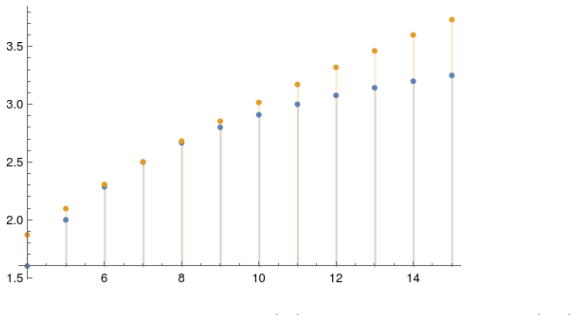
- [Figure 1] The figure needs axis labels, a caption, and a non-color legend; the current 'yellow dots' vs 'blue ones' description is hard to use in print.
Circularity Check
No significant circularity: the proven bounds are self-contained, and the conjectures are explicitly labeled as resting on external numerical searches.
full rationale
The derivation chain in this paper is self-contained where it proves results. Lemma 2.1 establishes equality of the relative and quasimaximal projection constants for biangular tight frames using the external equidistribution result [7] plus a direct inequality; the reverse inequality is immediate from the definitions. Example 2.1 verifies by direct computation that the edge-midpoint frame is biangular Parseval, and Corollary 2.1 follows from the definition of lambda_R(m) as a supremum, not from any fitted parameter. The upper bound of Theorem 1.3 is attributed to the authors' previous paper [11], but it is independently re-proved in this paper in Theorem 3.2 using the external design inequality [16], so the self-citation is not load-bearing. Conjecture 2.1 is explicitly a conjecture supported by external numerical estimates by Chalmers and by [25]; it is not derived from those searches as a theorem, and no fitted input is relabeled as a prediction. The same holds for the spherical-design examples in Section 3, which are presented as evidence and conjectures. No uniqueness theorem from the authors is invoked to force a choice, and no known result is merely renamed as a new contribution. The only weakness, the unverified globality of the numerical searches, is a correctness risk for the conjecture, not a circularity in the paper's reasoning.
Assumptions & free parameters
assumptions (5)
- domain assumption Every biangular tight frame is equidistributed: each row of |U^*U| has the same number of b-entries and c-entries.
- domain assumption The frame optimization formula lambda_K(m,N) equals max over Parseval frames of the weighted average of |U^*U| entries, as stated in Theorem 1.1 from [5].
- domain assumption The weighted spherical design inequality of Theorem 3.1 from [16] holds for all unit vector configurations and nonnegative weights.
- domain assumption The size bounds for weighted spherical designs in Theorem 3.3 from [27] are correct.
- ad hoc to paper The numerical searches cited from Chalmers and [25] are globally exhaustive for lambda_R(6) and lambda_R(8).
Cite this review
Pith. "Pith review of Maximal Projection Constants and Extremal Vector Configurations: Some Conjectures and Examples." pith.science (2026). https://pith.science/paper/BYHHMBD3
@misc{pith2026260808695,
  author       = {Pith},
  title        = {Pith review of: Maximal Projection Constants and Extremal Vector Configurations: Some Conjectures and Examples},
  year         = {2026},
  howpublished = {\url{https://pith.science/paper/BYHHMBD3}},
  note         = {Machine review of arXiv:2608.08695}
}
abstract
Let $\lambda_{\mathbb K}(m)$ denote the maximal absolute projection constant among $m$-dimensional Banach spaces over $\mathbb K=\mathbb R$ or $\mathbb C$. Its exact value is known only in a few cases, and determining it remains a challenging problem. In this note, we investigate several structured vector configurations that naturally arise in this context. We first recall the connection between maximal projection constants and tight frames, then consider biangular tight frames, and show that their relative and quasimaximal projection constants coincide. A particularly interesting example is provided by the midpoints of the edges of a regular simplex, which yield natural lower bounds for $\lambda_{\mathbb R}(m)$. Numerical evidence suggests that these bounds may be sharp in dimensions $6$ and $8$. We also discuss weighted spherical $(2,2)$-designs with a small number of vectors and their connection with maximal projection constants. Examples in dimensions $4$ and $5$ indicate that the sign patterns of their Gram matrices may play an important role. These observations lead us to formulate several conjectures concerning maximal absolute projection constants and the vector configurations associated with them.
Figures
Reference graph
Works this paper leans on
-
[11]
B. Deregowska, B. Lewandowska,A simple proof of the Grünbaum conjec- ture,J. Funct. Anal. 285 (2023), Art no.: 109950
work page 2023
-
[25]
Graph Eigenvalues and Projection Constants
V. Sivashankar, Q. Tang, T. Wakhare,Graph Eigenvalues and Projection Constants,arXiv:2608.02429 (2026), doi: 10.48550/arXiv.2608.02429
work page Pith review arXiv doi:10.48550/arxiv.2608.02429 2026
-
[1]
E.Bannai,E.Bannai,Asurveyonsphericaldesignsandalgebraiccombina- torics on spheres,Eur. J. Comb. 30(6) (2009) 1392–1425
work page 2009
-
[2]
Basso,Computation of maximal projection constants,J
G. Basso,Computation of maximal projection constants,J. Funct. Anal. 277/10 (2019), 3560–3585
work page 2019
-
[3]
B. Bukh, C. Cox,Nearly orthogonal vectors and small antipodal spherical codes,Isr. J. Math. 238, 359–388 (2020). doi: 10.1007/s11856-020-2027-7
-
[4]
B. Chalmers and F. Metcalf,Determination of a minimal projection from C[−1,1]onto the quadratics,Numerical Functional Analysis and Optimiza- tion, 11(1-2), 1-10, 1990
work page 1990
-
[5]
B.L.Chalmers,G.Lewicki,Three-dimensionalsubspaceofℓ (5) ∞ withmaximal projection constant,J. Funct. Anal. 257/2 (2009), 553–592
work page 2009
-
[6]
B. L. Chalmers, G. Lewicki,A proof of the Grünbaum conjecture,Studia Math. 200 (2010), 103–129
work page 2010
Show all 29 references
-
[7]
Casazza, A
P.G. Casazza, A. Farzannia, J.I. Haas, T.T. Tran,Toward the classification of biangularharmonicframes,AppliedandComputationalHarmonicAnalysis, 46(3), 2019, 544-568
2019
-
[8]
Delsarte,Bounds for unrestricted codes, by linear programming,Philips Res
P. Delsarte,Bounds for unrestricted codes, by linear programming,Philips Res. Rep., 27:272–289, 1972
1972
-
[9]
Delsarte, J.M
P. Delsarte, J.M. Goethals, J.J. Seidel,Spherical codes and designs,Geom. Dedic. 6 (3) (1977)
1977
-
[10]
B.Deregowska,M.Fickus,S.Foucart,B.Lewandowska,Onthevalueofthe fifth maximal projection constant,J. Funct. Anal.283/10, (2022)
2022
-
[12]
Deregowska, B
B. Deregowska, B. Lewandowska, G. Lewicki,Minimal projections onto subspaces generated by sign-matrices,J. Approx. Theory 304 (2024)
2024
- [13]
-
[14]
S.Foucart,H.Rauhut,AMathematicalIntroductiontoCompressiveSensing, Birkhäuser, 2013
2013
-
[15]
Foucart, L
S. Foucart, L. Skrzypek,On maximal relative projection constants,J. Math. Anal. Appl. 447/1 (2017), 309–328. Journal of Approximation Theory, 235, 74-91, 2018
2017
-
[16]
Hughes, S
D. Hughes, S. Waldron,Spherical(t, t)−designs with a small number of vectors,, Linear Algebra and its Applications, 608, (2021), 84-106
2021
-
[17]
Notes 10 (1971), 694–696 (English transl.)
I.M.Kadec,M.G.Snobar,CertainfunctionalsontheMinkowskicompactum, Math. Notes 10 (1971), 694–696 (English transl.)
1971
-
[18]
König,Spaces with large projection constants,Isr
H. König,Spaces with large projection constants,Isr. J. Math. 50/3 (1985), 181–188
1985
-
[19]
König, D
H. König, D. Lewis, P.-K. Lin,Finite dimensional projection constants, Studia Mathematica 75/3 (1983), 341–358
1983
-
[20]
König, N
H. König, N. Tomczak-Jaegermann,Norms of minimal projections,J. Funct. Anal. 119/2 (1994), 253–280
1994
-
[21]
Grünbaum,Projection constants,Trans
B. Grünbaum,Projection constants,Trans. Amer. Math. Soc. 95 (1960), 451–465
1960
-
[22]
ParkInteracion energies, lattices, and designsPh.D
J. ParkInteracion energies, lattices, and designsPh.D. Thesis. Georgia In- stitute of Technology, 2020
2020
-
[23]
A.J.Scott,M.Grassl,Symmetricinformationallycompletepositive-operator- valued measures: a new computer study,Journal of Mathematical Physics 51/4 (2010): 042203
2010
-
[24]
P.D.Seymour,T.Zaslavsky,Averagingsets: ageneralizationofmeanvalues and spherical designs,Adv. Math. 52(3), 213–240 (1984)
1984
-
[26]
S.Waldron,ASharpeningoftheWelchBoundsandtheExistenceofRealand ComplexSphericalt–Designs,inIEEETransactionsonInformationTheory, vol. 63, no. 11, pp. 6849-6857, Nov. 2017, doi: 10.1109/TIT.2017.2696020. 15
2017
-
[27]
S.Waldron,Anintroductiontofinitetightframes,AppliedandComputational Harmonic Analysis, Birhauser, 2018
2018
-
[28]
Wojtaszczyk,Banach Spaces for Analysts,Cambridge University Press, Cambridge, 1991
P. Wojtaszczyk,Banach Spaces for Analysts,Cambridge University Press, Cambridge, 1991
1991
-
[29]
Thesis, University of Vienna, 1999
G.Zauner,Quantenredgns: GrundzügeeinernichtkommutativenDesignthe- orie, Ph.D. Thesis, University of Vienna, 1999. 16
1999
Reviewed August 14, 2026 · model on record in the stance chip above.
Discussion (0). Continue with ORCID to comment.