REVIEW 3 major objections 5 minor 1 cited by
From Screen to Space: Evaluating Siemens' Cinematic Reality
T0 review · 3 major / 5 minor · reviewed 2026-08-07 · deepseek-v4-flash
Pith's one-line read Fourteen medical experts rate Siemens' Cinematic Reality on the Apple Vision Pro as good-to-excellent in usability and see its immersive 3D rendering of CT and MRI volumes as a promising aid for surgical planning and education.
desk verdict A careful, reproducible first usability evaluation of Siemens' Cinematic Reality on the Apple Vision Pro; the conclusion overreaches by claiming confirmed interpretive benefit when only perceived usability was measured. read the letter →
The pith
A machine-rendered reading of the paper's core claim, the machinery that carries it, and where it could break.
The reading
What carries the argument
The carrying instrument is the evaluation protocol: the System Usability Scale (a ten-item questionnaire giving a 0-100 score) paired with the ISONORM 9242-110-S (which measures seven ISO 9241-110 interaction principles such as suitability for the task, controllability, and error tolerance) and an open-ended survey. These are applied after experts freely explore two real medical volumes—a portal venous-phase liver CT from the CHAOS dataset and an MRCP scan from the MRCP_DLRecon dataset—rendered through Siemens' Cinematic Reality on the Apple Vision Pro, with eye gaze acting as pointer and finger pinch as selection.
What would settle it
A controlled comparison in which surgeons perform a fixed planning task—for example, identifying portal vein variants or measuring tumor-to-vessel distances—in the Cinematic Reality headset versus standard 2D slice viewing, checking accuracy and time; if the immersive condition shows no improvement, or if the SUS scores from a larger multi-centre sample fall below the good-excellent range, the paper's clinical-potential claim would be weakened.
Extended reading notes
Core claim
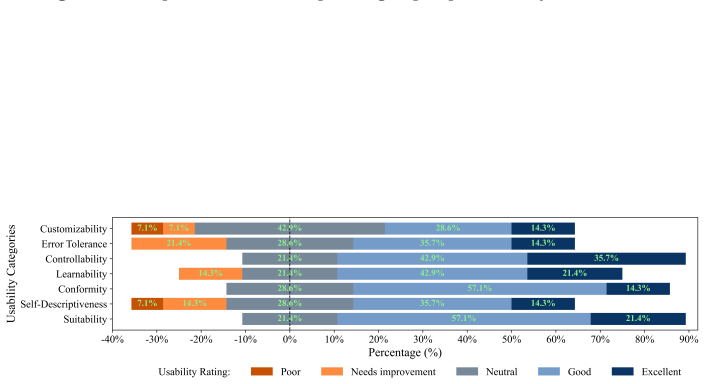
The paper's central claim is that, in the judgement of the participating surgeons and medical experts, immersive 3D cinematic volume rendering on the Apple Vision Pro is usable enough and clinically promising enough to warrant further investigation and trials for surgical planning, education, and intraoperative spatial recall. Evidence comes from a mixed-methods study: a mean SUS score of 77.68 (SD 15.01) and ISONORM 9242-110-S subscale means ranging from 5.19 to 5.81 on a 7-point scale, with the strongest ratings for controllability and suitability for the task. Open-ended responses identified concrete strengths (intuitive eye-tracking and pinch interaction, high-resolution photorealistic rendering, fast patient-specific reconstruction) and equally concrete gaps (lack of segmentation, annotation, measurement tools, and integration with patient records). The study does not claim the system is ready for clinical deployment, but that its feasibility and usability are established well enough to motivate clinical trials.
Load-bearing premise
The conclusion rests on the premise that usability questionnaires and intended-use statements from 14 experts, most from one hospital and with almost no prior headset experience, will match how the system actually performs in real clinical workflow.
Editorial extensions
If this is right
- A mean SUS of 77.68 places the system in the 'good to excellent' band used for digital health applications, supporting progression to formal clinical trials of cinematic 3D rendering in surgical planning.
- Clinician-requested features—segmentation toggles, measurement and annotation tools, and electronic patient-record integration—define a concrete pre-clinical development checklist.
- Setup times under five minutes make pre-operative planning sessions feasible, while participants judged intraoperative use as needing clinical study rather than being ruled out.
- The same expert ratings suggest educational use cases, such as anatomy teaching and patient information, are the nearest-term viable applications.
Reading between the lines
- A direct extension would be a cross-over trial scoring reading accuracy and time on fixed planning tasks against conventional 2D viewing, which would test whether perceived usability translates into measured performance.
- A replication with participants who have regular headset experience, or after repeated sessions, would show how much of the positive impression persists beyond first contact with the device.
- The two uncorrected participants' reports of reduced clarity flag vision-correction support as a factor worth controlling in future evaluations.
Editorial analysis
A structured set of objections, weighed in public.
Referee Report
Summary. This paper reports a usability evaluation of Siemens' Cinematic Reality application on the Apple Vision Pro for cinematic volume rendering of liver CT and MRCP data. Fourteen medical experts (11 surgeons, one assistant, two medical students) used pre-rendered scenes from the CHAOS and MRCP_DLRecon datasets and completed the System Usability Scale, the ISONORM 9242-110-S questionnaire, and an open-ended survey. The paper reports a mean SUS of 77.68, positive ISONORM subscale scores, and qualitative feedback identifying strengths, limitations, and requested features for clinical adoption. The authors conclude that the study 'confirms the potential' of immersive 3D cinematic rendering on the AVP to enhance medical imaging interpretation.
Significance. If read strictly as an early usability assessment, the study has clear value: it applies validated instruments with published norms, uses public medical datasets, reports demographic and vision-correction details, and collects concrete workflow-relevant feature feedback from a clinically relevant population. The strongest contributions are the feasibility data and the feature roadmap for CR on the AVP in hepatobiliary contexts. However, the significance for clinical adoption is limited because no objective interpretation task, no 2D baseline, and no decision-quality metric were measured; the headline conclusion goes beyond what the data can establish.
major comments (3)
- [Section 4 (Conclusion) and Sections 3.2-3.4] The concluding sentence in Section 4 states that the study 'confirms the potential' of immersive 3D cinematic 3DVR on the AVP 'to enhance medical imaging interpretation.' The evidence in Sections 3.2-3.4 consists of self-reported usability scores, ISONORM ratings, and qualitative statements about anticipated use; no participant performed a diagnostic or planning task, no accuracy, time, or decision-quality metric was recorded, and there was no comparator condition. The qualitative data themselves flag that intraoperative and interventional feasibility was 'hard to assess' (Table 2). The data therefore support a statement about perceived usability and anticipated integration, not about actual interpretive benefit. This inferential gap is load-bearing for the paper's central claim; the conclusion should be rephrased to 'supports the potential' with an explicit limitation, or the authors should add an objective task-based comparison to standard 2D reading.
- [Section 2.5 (Procedure) and Section 3.2] The fixed presentation order (CHAOS CT followed by MRCP, then an optional demo) with no baseline condition, combined with only two participants having prior HMD experience, makes it impossible to separate ratings of the CR application from novelty effects or order effects. Since the central claim relies on the high aggregate SUS and ISONORM scores, this design issue is material. Future work should counterbalance display order and include a 2D reading baseline; at minimum, the manuscript should be revised to state this limitation and soften the causal language in the conclusion.
- [Section 3.2 (SUS results)] The reporting of SUS results does not adequately convey spread. The mean of 77.68 and IQR of 63.75-91.25 imply that at least a quarter of the 14 participants scored below the 68 'above average' threshold, and the sample mixes surgeons, an assistant, and students. The text's 'between good and excellent' characterization therefore overstates the consistency of the ratings. The authors should report the full distribution (for example, the proportion of scores below 68, the median, and the range) and temper the aggregate claims accordingly.
minor comments (5)
- [Section 3.2] The notation is inconsistent: 'σ = 77.68 (σ = 15.01)' uses the same symbol for the mean and the standard deviation; use μ and SD instead.
- [Section 3.2] The text says the SUS results are shown in 'Figure 2,' but the SUS scores appear in Figure 3; Figure 2 is the interaction guide.
- [Section 3.3] In the ISONORM list, 'learnability(µ5.5' is missing an equals sign, and the formatting of the statistics is inconsistent across subscales.
- [Section 2.5] The phrase 'doctor assistant' should likely be 'physician assistant' or 'doctor's assistant,' and the capitalized 'T ask' is a typo.
- [Section 2.3] The text 'Python (version 12)' should be corrected to a valid version identifier such as 'Python 3.12'.
Circularity Check
No circularity: the usability scores are measured against external instruments and benchmarks; the only self-citation is motivational and non-load-bearing.
full rationale
This paper is an empirical usability evaluation, not a derivation or fitting exercise. The central quantitative results are SUS (mean 77.68, SD 15.01) and ISONORM 9242-110-S subscale scores gathered from 14 medical experts after hands-on interaction with the system, and these are interpreted against published external benchmarks and ISO 9241-110 principles (e.g., SUS > 68 as above average, and the 'good to excellent' band of 74-85). No parameter is fitted to a subset of the data and then presented as a prediction of a closely related quantity, and no equation is defined in terms of the result it is supposed to establish. The concluding claim that the study 'confirms the potential' of cinematic 3DVR to enhance medical imaging interpretation is a generalization from self-reported usability to clinical benefit; that is a validity and external-support concern, not a circularity concern, because the conclusion is not equivalent by construction to the measured inputs. The only author-overlapping citation is [15] (Egger et al.), used in the introduction to support the statement that the Apple Vision Pro offers superior resolution and computational power; this motivational claim is not load-bearing for the usability measurements or for the main result, and it is not invoked as a uniqueness theorem or as a justification for a modeling ansatz. The datasets (CHAOS and MRCP_DLRecon) are external, and the questionnaire instruments are validated scales with published norms. No circular step can be exhibited, so the score is 0.
Assumptions & free parameters
assumptions (4)
- domain assumption SUS and ISONORM 9241-110-S questionnaires are valid and reliable measures of perceived usability for medical XR applications.
- domain assumption The 14 participants, mostly surgeons from a single hospital with minimal headset experience, are representative of the target clinical users.
- domain assumption Importing the public datasets as-is, with global intensity scaling and no manual transfer function customization, is a fair or realistic usage scenario.
- domain assumption Clinicians' self-reported anticipated integration into workflows predicts actual clinical adoption and benefit.
Cite this review
Pith. "Pith review of From Screen to Space: Evaluating Siemens' Cinematic Reality." pith.science (2026). https://pith.science/paper/BYNO43IB
@misc{pith2026250604972,
  author       = {Pith},
  title        = {Pith review of: From Screen to Space: Evaluating Siemens' Cinematic Reality},
  year         = {2026},
  howpublished = {\url{https://pith.science/paper/BYNO43IB}},
  note         = {Machine review of arXiv:2506.04972}
}
read the original abstract
As one of the first research teams with full access to Siemens' Cinematic Reality, we evaluate its usability and clinical potential for cinematic volume rendering on the Apple Vision Pro. We visualized venous-phase liver computed tomography and magnetic resonance cholangiopancreatography scans from the CHAOS and MRCP\_DLRecon datasets. Fourteen medical experts assessed usability and anticipated clinical integration potential using the System Usability Scale, ISONORM 9242-110-S questionnaire, and an open-ended survey. Their feedback identified feasibility, key usability strengths, and required features to catalyze the adaptation in real-world clinical workflows. The findings provide insights into the potential of immersive cinematic rendering in medical imaging.
Figures


Figures from the paper (2 more)

Forward citations
Cited by 1 Pith paper
-
Hybrid Foveated Path Tracing with Peripheral Gaussians for Immersive Anatomy
A hybrid VR renderer combines foveated volumetric path tracing with a rapidly regenerated Gaussian-splatting periphery for interactive medical anatomy visualization.
Reference graph
Works this paper leans on
-
[15]
Jan Egger et al. “Is the Apple Vision Pro the Ultimate Display? A First PerspectiveandSurveyonEnteringtheWonderlandofPrecisionMedicine”. In:JMIR Serious Games12.1(Sept.2024).Company:JMIRSeriousGames Distributor: JMIR Serious Games Institution: JMIR Serious Games Label: JMIR Serious Games Publisher: JMIR Publications Inc., Toronto, Canada, e52785.doi:10.21...
-
[1]
Extended Reality in Diagnostic Imaging—A Lit- erature Review
Paulina Kukla et al. “Extended Reality in Diagnostic Imaging—A Lit- erature Review”. In:Tomography9.3 (May 2023), pp. 1071–1082.issn: 2379-1381.doi:10.3390/tomography9030088. (Visited on 02/17/2025)
-
[2]
DanielSimõesLopesetal.“Explicitdesignoftransferfunctionsforvolume- rendered images by combining histograms, thumbnails, and sketch-based interaction”.In:The Visual Computer34.12(Dec.2018).Publisher:Springer Science and Business Media LLC, pp. 1713–1723.issn: 0178-2789, 1432- 2315.doi:10.1007/s00371-017-1448-8.url:http://link.springer. com/10.1007/s00371-0...
work page doi:10.1007/s00371-017-1448-8.url:http://link.springer 2018
-
[3]
AugmentedReality:AdvancesinDiagnosticImag- ing
DavidB.Douglasetal.“AugmentedReality:AdvancesinDiagnosticImag- ing”. en. In:Multimodal Technologies and Interaction1.4 (Dec. 2017). Number: 4 Publisher: Multidisciplinary Digital Publishing Institute, p. 29. issn: 2414-4088.doi:10.3390/mti1040029. (Visited on 02/17/2025)
-
[4]
Interactive visualization of 3D medical data
Henry Fuchs, Marc Levoy, and Stephen M Pizer. “Interactive visualization of 3D medical data”. In:Computer22.8 (1989). 14 Luijten et al
work page 1989
-
[5]
State of the art in transfer functions for direct volume rendering
Patric Ljung et al. “State of the art in transfer functions for direct volume rendering”. In:Computer graphics forum. Vol. 35. 3. Wiley Online Library. 2016, pp. 669–691
work page 2016
-
[6]
Volume visualization: a technical overview with a focus on medical applications
Qi Zhang, Roy Eagleson, and Terry M Peters. “Volume visualization: a technical overview with a focus on medical applications”. In:Journal of digital imaging24 (2011), pp. 640–664
work page 2011
-
[7]
AlperHDuranetal.“Theadditionaldiagnosticvalueofthethree-dimensional volume rendering imaging in routine radiology practice”. In:Cureus11.9 (2019)
work page 2019
Show all 30 references
-
[8]
Surgical planning in virtual re- ality: a systematic review
Moritz Queisner and Karl Eisenträger. “Surgical planning in virtual re- ality: a systematic review”. In:Journal of Medical Imaging11.6 (2024), pp. 062603–062603. [9]Cinematic Rendering in medical imaging. Text. last accessed 2025/2/25. url:https : / / www . siemens - healthine...
2024
-
[10]
Exposure render: An interactive photo-realistic volume rendering framework
Thomas Kroes, Frits H Post, and Charl P Botha. “Exposure render: An interactive photo-realistic volume rendering framework”. In:PloS one7.7 (2012), e38586
2012
-
[11]
Interactive volumetric lighting simulating scattering and shadowing
Timo Ropinski, Christian Döring, and Christof Rezk-Salama. “Interactive volumetric lighting simulating scattering and shadowing”. In:2010 ieee pacific visualization symposium (pacificvis). IEEE. 2010, pp. 169–176
2010
-
[12]
Monte carlo volume render- ing
Balázs Csébfalvi and László Szirmay-Kalos. “Monte carlo volume render- ing”. In:IEEE Visualization, 2003. VIS 2003.IEEE. 2003, pp. 449–456
2003
-
[13]
Introducing cinematic rendering: a novel technique for post-processing medical imaging data
Franz A Fellner. “Introducing cinematic rendering: a novel technique for post-processing medical imaging data”. In:Journal of Biomedical Science and Engineering9.3 (2016), pp. 170–175
2016
-
[14]
Cinematic rendering in mixed-reality holograms: a new 3D preoperative planning tool in pediatric heart surgery
Pia Gehrsitz et al. “Cinematic rendering in mixed-reality holograms: a new 3D preoperative planning tool in pediatric heart surgery”. In:Frontiers in Cardiovascular Medicine8 (2021), p. 633611
2021
-
[17]
Depicting surgical anatomy of the porta hepatis in living donor liver transplantation
Paul Kelly et al. “Depicting surgical anatomy of the porta hepatis in living donor liver transplantation”. In:Journal of visualized surgery3 (2017)
2017
-
[18]
Utility of 3D reconstruction of 2D liver computed tomography/magnetic resonance images as a surgical planning tool for residents in liver resection surgery
Caitlin T Yeo et al. “Utility of 3D reconstruction of 2D liver computed tomography/magnetic resonance images as a surgical planning tool for residents in liver resection surgery”. In:Journal of surgical education75.3 (2018), pp. 792–797. From Screen to Space: Evaluating Siemen...
2018
-
[19]
Living donor liver transplantation in adults: vascu- lar variants important in surgical planning for donors and recipients
Nazli Erbay et al. “Living donor liver transplantation in adults: vascu- lar variants important in surgical planning for donors and recipients”. In: American Journal of Roentgenology181.1 (2003), pp. 109–114
2003
-
[20]
CHAOS Challenge - combined (CT-MR) healthy ab- dominal organ segmentation
A. Emre Kavur et al. “CHAOS Challenge - combined (CT-MR) healthy ab- dominal organ segmentation”. In:Medical Image Analysis69 (Apr. 2021), p. 101950.issn: 1361-8415.doi:10.1016/j.media.2020.101950. (Visited on 02/21/2025)
2021
-
[21]
The IEEE Inter- national Symposium on Biomedical Imaging (ISBI), Venice, Italy
Ali Emre Kavur et al.CHAOS - Combined (CT-MR) Healthy Abdominal Organ Segmentation Challenge Data (v1.03) [Data set]. The IEEE Inter- national Symposium on Biomedical Imaging (ISBI), Venice, Italy. Zenodo. Version v1.03. Apr. 2019.url:https : / / doi . org / 10 . 5281 / zenodo...
2019
-
[22]
Deep Learning- Based Accelerated MR Cholangiopancreatography Without Fully-Sampled Data
Jinho Kim, Marcel Dominik Nickel, and Florian Knoll. “Deep Learning- Based Accelerated MR Cholangiopancreatography Without Fully-Sampled Data”. In:NMR in Biomedicine38.3 (2025), e70002
2025
-
[23]
Zenodo.url:https://zenodo.org/records/13912092
Jinho Kim, Dominik Nickel, and Florian Knoll.MRCP_DLRecon (v3) [Data set]. Zenodo.url:https://zenodo.org/records/13912092
-
[24]
SUS: A ’Quick and Dirty’ Usability Scale
john Brooke. “SUS: A ’Quick and Dirty’ Usability Scale”. In:Usability Evaluation In Industry. Num Pages: 6. CRC Press, 1996.isbn: 978-0-429- 15701-1. [25]System Usability Scale (SUS) Questionnaire - Online source by John Brooke. last accessed: 2025/02/18.url:https : / / rickva...
1996
-
[26]
Determining what in- dividual SUS scores mean: Adding an adjective rating scale
Aaron Bangor, Philip Kortum, and James Miller. “Determining what in- dividual SUS scores mean: Adding an adjective rating scale”. In:Journal of usability studies4.3 (2009), pp. 114–123
2009
-
[27]
The System Usability Scale: Past, Present, and Future
James R. Lewis. “The System Usability Scale: Past, Present, and Future”. In:International Journal of Human–Computer Interaction34.7(July2018). Publisher: Taylor & Francis, pp. 577–590.issn: 1044-7318.doi:10.1080/ 10447318.2018.1455307. (Visited on 02/17/2025)
-
[28]
Pages: 265
JochenPrümper.Software-Evaluation Based upon ISO 9241 Part 10.Vol.733. Pages: 265. Jan. 1993.isbn: 978-3-540-57312-8.doi:10 . 1007 / 3 - 540 - 57312-7_74. [29]ISONORM 9241/110-S - Online source by Jochen Prümper. last accessed: 2025/02/21.url:http://www.uselab.tu-berlin.de/wik...
1993
-
[30]
ISO 9241-11 Revised: What Have We Learnt About Usability Since 1998?
Nigel Bevan, James Carter, and Susan Harker. “ISO 9241-11 Revised: What Have We Learnt About Usability Since 1998?” In:Human-Computer Interaction: Design and Evaluation.Ed.byMasaakiKurosu.Cham:Springer International Publishing, 2015, pp. 143–151.isbn: 978-3-319-20901-2.doi: 10...
2020 doi
-
[32]
SystemUsabilityScaleBenchmarkingforDigitalHealth Apps: Meta-analysis
MaciejHyzyetal.“SystemUsabilityScaleBenchmarkingforDigitalHealth Apps: Meta-analysis”. EN. In:JMIR mHealth and uHealth10.8 (Aug. 2022). Company: JMIR mHealth and uHealth Distributor: JMIR mHealth anduHealthInstitution:JMIRmHealthanduHealthLabel:JMIRmHealth and uHealth Publishe...
2022 doi
-
[33]
SUS: a retrospective
John Brooke. “SUS: a retrospective”. In:J. Usability Studies8.2 (Feb. 2013), 29–40
2013
-
[34]
An empirical eval- uation of the system usability scale
Aaron Bangor, Philip T Kortum, and James T Miller. “An empirical eval- uation of the system usability scale”. In:Intl. Journal of Human–Computer Interaction24.6 (2008), pp. 574–594
2008
-
[35]
Perceived usability evalua- tion of educational technology using the System Usability Scale (SUS): A systematic review
Prokopia Vlachogianni and Nikolaos Tselios. “Perceived usability evalua- tion of educational technology using the System Usability Scale (SUS): A systematic review”. In:Journal of Research on Technology in Education 54.3 (2022), pp. 392–409
2022
Reviewed August 7, 2026 · model on record in the stance chip above.
Discussion (0). Sign in to comment.