Monitoring Diameters of Causal Communication Graph with Spatio-Temporal Logic
Pith reviewed 2026-06-26 12:33 UTC · model grok-4.3
The pith
Extending muTGL with a space horizon operator allows encoding reachability and escaping modalities for monitoring causal communication graph diameters.
A machine-rendered reading of the paper's core claim, the machinery that carries it, and where it could break.
Core claim
The space horizon operator extends muTGL to bound distances of communication chains, allowing the encoding of modalities such as reachability or escaping that were unavailable in vanilla muTGL, while enabling deeper entanglement of spatial and temporal properties; a centralized offline monitoring algorithm is provided for the resulting logic and illustrated on Consensus-Based Bundle Algorithm simulations.
What carries the argument
The space horizon operator, which adds bounded-distance constraints on communication chains to the muTGL logic.
If this is right
- Reachability within explicit distance bounds becomes expressible in the logic.
- Escaping modalities from other logics can be encoded directly.
- Deeper combinations of spatial and temporal properties are now possible.
- Centralized offline monitoring applies to diameters of causal communication graphs.
- Analysis of distributed protocols such as task allocation can use the extended properties.
Where Pith is reading between the lines
- The operator could be adapted for decentralized monitoring settings if the central algorithm is distributed.
- Similar distance-bounding techniques might apply to other graph properties in moving-agent protocols beyond task allocation.
- The logic extension invites direct comparison of monitoring cost against vanilla muTGL on the same simulation traces.
Load-bearing premise
The space horizon operator can be added to muTGL without losing the decidability or algorithmic properties needed for the centralized offline monitoring algorithm to remain correct.
What would settle it
A concrete simulation trace of a multi-agent system where the monitoring algorithm reports incorrect satisfaction or violation for a property that requires checking whether communication chain length stays inside a given distance bound.
Figures
read the original abstract
Verification of multi-agent systems requires the ability to check meticulous topological properties when it comes to agents that can move through space in continuous time. This demands a logic with sufficient expressiveness to capture these dynamics. MuTGL logic has interesting properties for expressing entangled space-time properties. However, this logic lacks the expressivity needed to analyse reachability within specific distance bounds, or to track the length or the cost of communication chains: these are fundamental for decentralized monitoring, or graph-theoretic analysis of distributed protocols, where algorithmic complexities often relates with the system's communication graph diameter. We then introduce an extension of muTGL, including a new operator called the space horizon. This addition allows us to bound the distance of communication chains, hence enhancing the logic's expressiveness. We show that this operator allows to encode modalities from other logics, such as reachability or escaping which were not available in vanilla muTGL, while allowing a deeper entanglement of spatial and temporal properties. We provide a centralized offline monitoring algorithm for this logic and illustrate it on several examples on simulations of Consensus-Based Bundle Algorithms, distributed protocols for task allocation.
Editorial analysis
A structured set of objections, weighed in public.
Referee Report
Summary. The paper claims to extend muTGL with a new space horizon operator that bounds distances along communication chains in causal graphs of multi-agent systems. This is asserted to enable encoding of reachability and escaping modalities unavailable in vanilla muTGL, support deeper spatial-temporal entanglement, and admit a centralized offline monitoring algorithm, which is illustrated on simulations of Consensus-Based Bundle Algorithms for task allocation.
Significance. If the operator can be defined so that the monitoring procedure remains correct and terminating, the extension would increase the expressiveness of spatio-temporal logics for diameter and reachability properties relevant to distributed protocols. The work explicitly targets graph-theoretic analysis of communication chains, which is a concrete strength if the algorithmic claims hold.
major comments (2)
- [Abstract] Abstract: the central claim that the space horizon operator 'bounds the distance of communication chains' and 'allows us to encode modalities from other logics, such as reachability or escaping' is unsupported; no syntax, semantics, or reduction to existing muTGL constructs is supplied, which is load-bearing for both the expressiveness and the monitoring-algorithm claims.
- [Abstract] Abstract: the assertion that a 'centralized offline monitoring algorithm for this logic' is provided is not accompanied by any pseudocode, termination argument, or correctness sketch; without these, it is impossible to assess whether the space-horizon addition preserves the algorithmic properties required for the monitoring procedure.
minor comments (1)
- [Abstract] Abstract: 'muTGL' is used without an inline reference or expansion on first use.
Simulated Author's Rebuttal
We thank the referee for the detailed review and for highlighting the need for clearer support of the abstract claims. We address each major comment below. The full manuscript provides the requested syntax, semantics, reductions, pseudocode, termination, and correctness arguments in the body (Sections 3–5); the abstract is a high-level summary. We will revise the abstract for precision while preserving its length.
read point-by-point responses
-
Referee: [Abstract] Abstract: the central claim that the space horizon operator 'bounds the distance of communication chains' and 'allows us to encode modalities from other logics, such as reachability or escaping' is unsupported; no syntax, semantics, or reduction to existing muTGL constructs is supplied, which is load-bearing for both the expressiveness and the monitoring-algorithm claims.
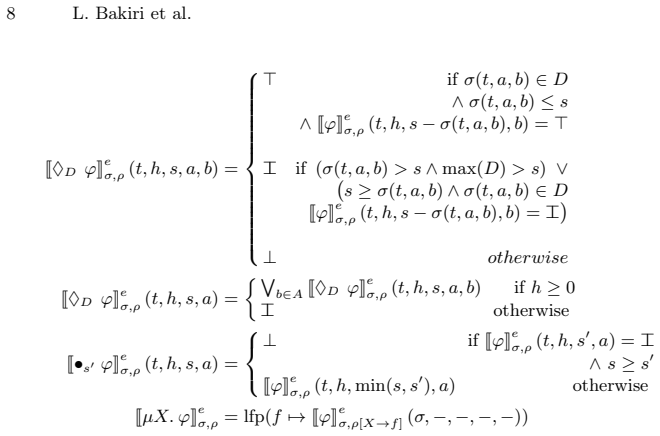
Authors: The abstract summarizes results whose formal details appear in the manuscript. Section 3 introduces the syntax and semantics of the space-horizon operator ⊕_d φ (where d is a distance bound on causal communication paths) and proves that it encodes reachability (◇_d φ) and escaping modalities by direct reduction to existing muTGL constructs. These reductions are used to establish the expressiveness claims. We will revise the abstract to add a parenthetical reference to Section 3 and a one-sentence indication of the reduction. revision: yes
-
Referee: [Abstract] Abstract: the assertion that a 'centralized offline monitoring algorithm for this logic' is provided is not accompanied by any pseudocode, termination argument, or correctness sketch; without these, it is impossible to assess whether the space-horizon addition preserves the algorithmic properties required for the monitoring procedure.
Authors: The abstract again summarizes material developed in the body. Section 4 presents the centralized offline monitoring algorithm as a recursive procedure over the space-time unfolding, supplies the pseudocode, proves termination (by induction on formula size and finite communication diameter), and gives a correctness argument via structural induction that the space-horizon operator preserves the monitoring invariants of muTGL. We will revise the abstract to reference Section 4 explicitly. revision: yes
Circularity Check
No circularity: definitional extension with independent algorithmic claim
full rationale
The paper defines a new 'space horizon' operator as an extension to muTGL, then claims it enables encodings of reachability/escaping modalities and supports a centralized offline monitoring algorithm. No equations, fitted parameters, or self-citations are shown that reduce any claimed result to its own inputs by construction. The contribution is a syntactic and semantic extension whose correctness for monitoring is asserted separately from the definition itself; the derivation chain does not collapse into self-definition or renamed fits. This is the normal case of an honest definitional paper.
Axiom & Free-Parameter Ledger
Reference graph
Works this paper leans on
-
[1]
Alshiekh, M., Bloem, R., Ehlers, R., Könighofer, B., Niekum, S., Topcu, U.: Safe re- inforcement learning via shielding. In: ACM (ed.) Proceedings of the Thirty-Second AAAI Conference on Artificial Intelligence and Thirtieth Innovative Applications of Artificial Intelligence Conference and Eighth AAAI Symposium on Educational Advances in Artificial Intell...
2018
-
[2]
Theoretical Computer Science126(2), 183–235 (1994)
Alur, R., Henzinger, T.A.: A theory of timed automata. Theoretical Computer Science126(2), 183–235 (1994)
1994
-
[3]
Jour- nal of the ACM49(5) (2002)
Alur, R., Henzinger, T.A., Kupferman, O.: Alternating-time temporal logic. Jour- nal of the ACM49(5) (2002)
2002
-
[4]
https://github.com/Lydia- bak/ExtMuTgl-Monitoring (2026), gitHub repository, accessed 2026-06-14
Bakiri, L., Dubut, J., Mover, S.: Extmutgl-monitoring. https://github.com/Lydia- bak/ExtMuTgl-Monitoring (2026), gitHub repository, accessed 2026-06-14
2026
-
[5]
Cambridge University Press (2012)
Bergmann, M.: An Introduction to Many-Valued and Fuzzy Logic: Semantics, Al- gebras, and Derivation Systems. Cambridge University Press (2012)
2012
-
[6]
In: Proceedings of 2008 the IEEE International Conference on Control Applications (2008)
Caicedo-Nunez, C.H., Zefran, M.: Consensus-based rendezvous. In: Proceedings of 2008 the IEEE International Conference on Control Applications (2008)
2008
-
[7]
IEEE Transactions on Robotics25(4), 912–926 (2009)
Choi, H.L., Brunet, L., How, J.P.: Consensus-based decentralized auctions for ro- bust task allocation. IEEE Transactions on Robotics25(4), 912–926 (2009)
2009
-
[8]
Pacific Journal of Mathematics81(1), 43–57 (1979)
Cousot, P., Cousot, R.: Constructive versions of Tarski’s fixed point theorems. Pacific Journal of Mathematics81(1), 43–57 (1979)
1979
-
[9]
Eberhart, C., Haydon, J., Dubut, J., Cetinkaya, A., Pruekprasert, S.: Logic for timed agent network topologies. In: 61st IEEE Conference on Decision and Control, CDC 2022, Cancun, Mexico, December 6-9, 2022. pp. 2870–2877. IEEE (2022). https://doi.org/10.1109/CDC51059.2022.9992550, https://doi.org/10.1109/CDC51059.2022.9992550
-
[10]
In: ACM (ed.) Proceedings of the 18th International Conference on Hybrid Systems: Computation and Control (2015)
Haghighi, I., Jones, A., Kong, Z., Bartocci, E., Gros, R., Belta, C.: SpaTeL: a novel spatial-temporal logic and its applications to networked systems. In: ACM (ed.) Proceedings of the 18th International Conference on Hybrid Systems: Computation and Control (2015)
2015
-
[11]
arXiv preprint arXiv:2409.04230 (2024)
Jang, I.: Space: A python-based simulator for evaluating decentralized multi-robot task allocation algorithms. arXiv preprint arXiv:2409.04230 (2024)
arXiv 2024
-
[12]
https://github.com/inmo-jang/space-simulator (2026), gitHub repository, accessed 2026-06-12
Jang, I.: Space. https://github.com/inmo-jang/space-simulator (2026), gitHub repository, accessed 2026-06-12
2026
-
[13]
Theoretical Computer Science 27(3), 333–354 (1983)
Kozen, D.: Results on the propositionalµ-calculus. Theoretical Computer Science 27(3), 333–354 (1983)
1983
-
[14]
IEEE Journal on Selected Areas in Communica- tions31(4), 766–781 (2013)
LeBlanc, H.J., Zhang, H., Koutsoukos, X., Sundaram, S.: Resilient Asymptotic Consensus in Robust Networks. IEEE Journal on Selected Areas in Communica- tions31(4), 766–781 (2013)
2013
-
[15]
Systems Engineering 1(4), 267–284 (1998)
Maier, M.W.: Architecting principles for systems-of-systems. Systems Engineering 1(4), 267–284 (1998)
1998
-
[16]
Logical Meth- ods in Computer Science14(4) (2018)
Nenzi, L., Bortolussi, L., Ciancia, V., Loreti, M., Massink, M.: Qualitative and Quantitative Monitoring of Spatio-Temporal Properties with SSTL. Logical Meth- ods in Computer Science14(4) (2018)
2018
-
[17]
Logical Methods in Com- puter Science18(1), 4:1–4:30 (2022)
Nenzi, L., Bartocci, E., Bortolussi, L., Loreti, M.: A logic for monitoring dynamic networks of spatially-distributed cyber-physical systems. Logical Methods in Com- puter Science18(1), 4:1–4:30 (2022)
2022
-
[18]
International Journal on Software Tools for Technology Transfer25, 503–517 (2020) 18 L
Nenzi, L., Bartocci, E., Bortolussi, L., Silveti, S., Loreti, M.: MoonLight: a lightweight tool for monitoring spatio-temporal properties. International Journal on Software Tools for Technology Transfer25, 503–517 (2020) 18 L. Bakiri et al
2020
-
[19]
Journal of the ACM27(2), 228–234 (1980)
Pease,M.,Shostak,R.,Lamport,L.:ReachingAgreementinthePresenceofFaults. Journal of the ACM27(2), 228–234 (1980)
1980
-
[20]
Prentice Hall, 2 edn
Rappaport, T.S.: Wireless Communications: Principles and Practice. Prentice Hall, 2 edn. (2002)
2002
-
[21]
IEEE Transactions on Robotics36(4) (2020)
Sahin, Y.E., Nilsson, P., Ozay, N.: Multirobot Coordination With Counting Tem- poral Logics. IEEE Transactions on Robotics36(4) (2020)
2020
-
[22]
In: IEEE (ed.) Proceedings of the 1998 American Control Conference (1998)
Seto, D., Krogh, B., Chutinan, A.: The Simplex architecture for safe online con- trol system upgrades. In: IEEE (ed.) Proceedings of the 1998 American Control Conference (1998)
1998
-
[23]
Tulcan, R.F., Bohrer, R., Montacute, Y., Zhou, K., Kawamoto, Y., Hasuo, I.: Hybrid Spatiotemporal Logic for Automotive Applications: Modeling and Model- Checking (2026), arXiv:2603.24443 Monitoring Diameters of Causal Communication Graph 19 A Full Semantics of Our Extension J⊤Ke ρ (σ, t, h, s) =⊤ JpKρ (σ, t, h, s) = W b∈A p(σ(a, t))ifh≥0 ⊤ ⊥otherwise J¬φK...
arXiv 2026
discussion (0)
Sign in with ORCID, Apple, or X to comment. Anyone can read and Pith papers without signing in.