REVIEW 3 major objections 5 minor 1 cited by
Flame-wall interaction of thermodiffusively unstable hydrogen/air flames -- Part I: Characterization of governing physical phenomena
T0 review · 3 major / 5 minor · reviewed 2026-08-12 · deepseek-v4-flash
Pith's one-line read Thermodiffusively unstable lean hydrogen/air flames quench closer to the wall and drive higher wall heat fluxes than one-dimensional head-on quenching predicts, and the paper traces this to local mixture variation rather than…
desk verdict First 2D DNS of head-on quenching of thermodiffusively unstable lean H2/air flames; the qualitative findings are solid, but the central 'ensemble of 1D HOQs' claim is inferred from correlations rather than directly tested. read the letter →
The pith
A machine-rendered reading of the paper's core claim, the machinery that carries it, and where it could break.
The reading
What carries the argument
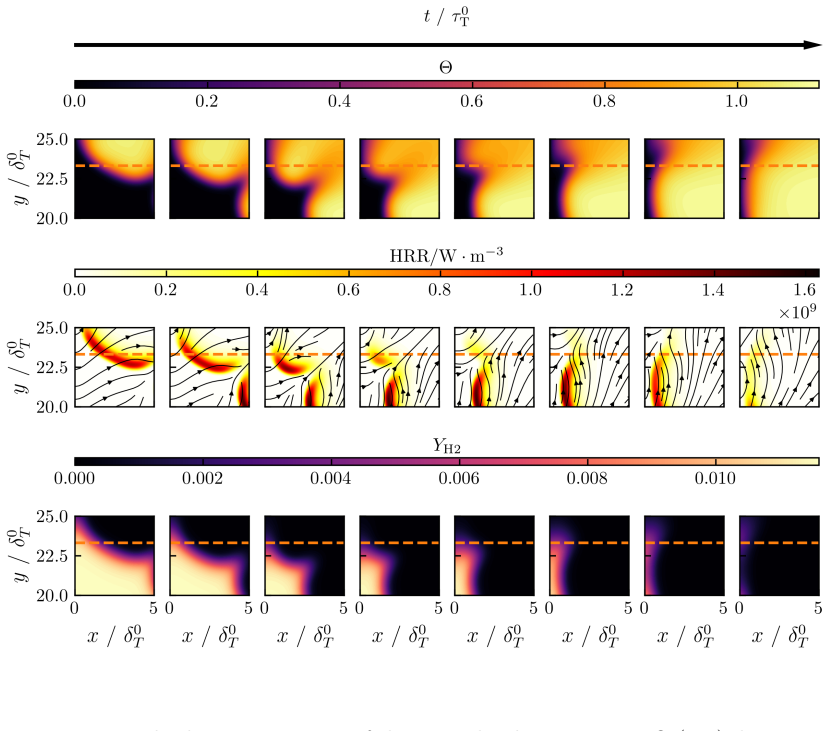
The load-bearing machinery is the one-dimensional head-on-quenching curve as a function of equivalence ratio, used as a reference database, together with a streamline diagnostic that tags each flame segment by the maximum equivalence ratio along the local reaction-progress gradient. The authors separate mixture-composition effects from geometric effects with the reactivity factor $I_0 = (s_c/s_{l,\mathrm{ref}})/(A/L_y)$, where $s_c$ is the consumption speed, $s_{l,\mathrm{ref}}$ the reference laminar flame speed, and $A/L_y$ the normalized flame-surface area. The collapse of the two-dimensional quenching statistics onto the one-dimensional curves at varying φ identifies the local mixture variation, induced by differential and preferential diffusion, as the variable that carries the argument.
What would settle it
Measure, in a controlled lean hydrogen/air flame-wall experiment near φ=0.4, 298 K, and 1 atm, the spatiotemporal wall heat flux and the quenching distance along the wall together with a local equivalence-ratio indicator near quenching. If the wall heat flux and quenching distance do not collapse onto one-dimensional head-on-quenching curves for the corresponding local equivalence ratio, or if they match the one-dimensional values at the global φ, the ensemble representation is wrong.
Extended reading notes
Core claim
The central claim is that the flame-wall interaction of a thermodiffusively unstable lean hydrogen/air flame can be described as an ensemble of one-dimensional head-on quenchings, each at the local equivalence ratio seen by that wall segment. In the two-dimensional simulations at φu=0.4, Tu=298 K, and 1 atm, the quenching Péclet number is lower and the quenching wall heat flux is higher than in the reference one-dimensional head-on quenching, and the scatter in these quantities collapses onto one-dimensional head-on-quenching curves for equivalence ratios roughly between 0.34 and 0.48. The authors show that the local equivalence ratio at one flame thickness from the wall correlates with both quenching distance and heat flux, that the conditioned average wall heat flux follows the one-dimensional case at φ=0.44, and that varying the lateral domain size changes quenching only through the reactivity factor, not through flame-surface area or consumption speed. They conclude that kinematic effects are minor and that the dominant mechanism is enhanced local reactivity from differential and preferential diffusion.
Load-bearing premise
The load-bearing premise is that two-dimensional direct numerical simulation with periodic lateral boundaries, an isothermal inert wall with zero species flux, and 20 grid points per flame thickness faithfully represents the quenching physics, so the conclusions transfer to three-dimensional engines and gas turbines; the only experimental comparison shows qualitative wall-temperature patterns, not measured quenching distances or heat fluxes.
Editorial extensions
If this is right
- Quenching distances and wall heat fluxes for lean hydrogen/air flames cannot be reliably taken from a single one-dimensional head-on quenching at the global equivalence ratio; the instability shifts both systematically.
- Combustion models for flame-wall interaction must carry the full local mixture distribution, not just flame surface area or progress variable, to reproduce thermal loads on walls.
- Flame-surface-area growth and consumption-speed enhancement play only a minor role in determining quenching; the reactivity of the mixture arriving at the wall is what matters.
- Restricting the lateral domain changes quenching statistics only through the reactivity factor, so instability cell-size distributions matter indirectly through their effect on local mixture variation.
- The time history of wall heat flux during quenching is bracketed by one-dimensional head-on quenchings at varying equivalence ratio, so an ensemble of such solutions can serve as a cheap surrogate for the unstable case.
Reading between the lines
- In three dimensions, with hydrodynamic instability and flame-generated turbulence adding strain, the local equivalence-ratio distribution may be broader or shifted, so whether the strict one-dimensional-ensemble collapse survives is an open question this paper does not settle.
- Because hydrogen's high diffusivity lets mixture variations persist near the wall after quenching, a purely local steady mapping from φ to heat flux may miss memory effects in rapidly changing flame-front configurations; this could be tested by comparing predicted and simulated wall heat flux in strongly forced conditions.
- The same reasoning suggests an experimental path: combining spatiotemporal wall-temperature measurements with a local equivalence-ratio marker would turn the qualitative wall-temperature-pattern observation into a direct quantitative test of the predicted heat-flux–φ correlation.
- Part II's parametric sweep across pressure, equivalence ratio, and unburnt temperature will reveal whether the ensemble representation holds beyond φ=0.4, 298 K, and 1 atm or is restricted to the conditions studied here.
Editorial analysis
A structured set of objections, weighed in public.
Referee Report
Summary. This paper presents two-dimensional direct numerical simulations of head-on quenching (HOQ) of a thermodiffusively unstable lean hydrogen/air flame (φu = 0.4, Tu = 298 K, p = 1 atm) in domains of varying lateral width λ = Ly/δ_T between 2 and 100. A freely propagating unstable flame is first generated in a periodic domain and then mapped into a wall-bounded domain with an isothermal inert wall. The authors report that, compared to one-dimensional HOQ at the same nominal conditions, the unstable flame has smaller quenching Peclet numbers and larger quenching wall heat fluxes, and that these changes correlate with local mixture-enrichment-induced reactivity rather than with flame surface area or consumption speed. They conclude that unstable flame-wall interactions can be represented by an ensemble of one-dimensional head-on quenchings at different equivalence ratios, and that local mixture variations associated with differential and preferential diffusion are the dominant governing factor.
Significance. The paper provides a novel, detailed dataset on flame-wall interaction of thermodiffusively unstable H2/air flames, a configuration that is increasingly relevant for lean hydrogen combustion systems. If the proposed mechanism is confirmed, the study has direct implications for flamelet-based modeling of near-wall hydrogen combustion and for the interpretation of experimental wall-temperature patterns such as those of Ojo et al. [35]. Strengths of the work include the use of detailed chemistry with Soret diffusion, a systematic domain-width sweep that varies the instability cell-size distribution, multiple HOQ realizations per configuration, and several complementary analyses (PDFs of quenching quantities, conditionally averaged wall heat flux, and the reactivity factor I0). The main limitation is that the central ensemble-representation claim is inferred from correlations rather than demonstrated by a direct predictive test, and one of the key comparisons uses different conditioning variables for the two-dimensional and one-dimensional data.
major comments (3)
- [§4.2, Fig. 8 (right)] The comparison between the two-dimensional scatter points, colored by the local equivalence ratio at x/δ_T = 1 at the quenching time, and the one-dimensional HOQ markers, parameterized by the unburnt equivalence ratio φu,1D, is not an apples-to-apples comparison. As the paper itself notes in the footnote on page 11, differential diffusion alters the wall-normal equivalence-ratio profile even in one-dimensional HOQs, so the local φ at x/δ_T = 1 in a one-dimensional HOQ is generally different from its φu. Unless the two data sets are represented with the same conditioning observable (for instance, local φ at x/δ_T = 1 for both, or an equivalent unburnt-based quantity for the two-dimensional cases), the apparent collapse in Fig. 8 (right) could be partly coincidental. The authors should provide a comparison that uses the same observable for both data sets, or at least quantify the difference between local and unburnt equivalence ratios for the one-dimensional HOQs.
- [§5 and Novelty and Significance Statement] The statement that unstable flame-wall interactions 'can be represented by an ensemble of one-dimensional head-on quenchings at different equivalence ratios' goes beyond the evidence actually presented. The support consists of correlations (Figs. 8, 9, and 11) and conditional averages, but the paper never constructs such an ensemble from the measured two-dimensional local-φ distribution and then compares the predicted statistics (PDFs of Φq and Peq, their joint distribution, or their temporal evolution) against the two-dimensional DNS. Appendix A documents rare events (lean pockets, double quenching) that are exceptions to the representation, but their frequency and contribution to the overall statistics are not quantified, leaving the 'rare' qualifier unsubstantiated. Please either perform a direct ensemble test using the existing one-dimensional HOQ response functions, or soften the claim throughout the manuscript, including the Abstract and the novelty statement, to phrasing such as 'consistent with' rather than 'can be represented by'.
- [§2.1.1] The grid resolution of 20 grid points per flame thickness is not supported by a grid-convergence study. Because the quantitative conclusions concern near-wall quantities (quenching wall heat flux and quenching distance) that are sensitive to the resolution of the thermal boundary layer and to hydrogen differential diffusion near the wall, a resolution study, or at least a demonstration that the two-dimensional-versus-one-dimensional comparison is independent of resolution, is needed to establish the robustness of the quantitative claims.
minor comments (5)
- [Appendix A.2] The text contains a typographical error: 'realease' should be 'release'.
- [§4.3, Fig. 11 (left)] The statement that there is 'no discernible correlation' between the mean wall heat flux and the consumption speed or surface area is based on visual inspection; a quantitative correlation measure (for example, Pearson's or Spearman's coefficient) would make this claim more rigorous.
- [Article front matter] The paper does not include a data availability statement; given the potential value of the dataset for the community, making the simulation configurations and post-processing scripts available would improve reproducibility.
- [Abstract and Conclusions] The Abstract states that the increased wall heat fluxes 'are caused by' enhanced reactivity, whereas the body of the paper uses 'suggest' and 'seems'; the level of certainty should be harmonized between the Abstract and the conclusions.
- [Fig. 11 caption] The caption of Fig. 11 (right) contains the phrase 'for varying a equivalence ratio', which should read 'for varying equivalence ratio'.
Circularity Check
No significant circularity: the 2D results are compared against independently computed 1D head-on-quenching references, with no fitted parameter forcing the collapse.
full rationale
The central comparison is not circular. The one-dimensional head-on-quenching simulations at varying equivalence ratios are independently computed reference solutions, not outputs derived from the two-dimensional DNS. No parameter is fitted to force the collapse in Figs. 8, 9, or 11; the 2D scatter is colored by the locally extracted equivalence ratio from the 2D simulation, while the 1D markers come from separate simulations at prescribed unburnt equivalence ratios. The reactivity factor I0 is defined from the freely propagating flame's consumption speed and surface area (Eq. 9), not from the quenching wall heat flux, so the correlation between I0 and the mean quenching wall heat flux is not circular. The self-citations in the paper are methodological (solver development, prior freely propagating flame characterization) and are not load-bearing for the claim that unstable flame-wall interaction can be represented by an ensemble of 1D HOQs at different equivalence ratios. The skeptical concern that the ensemble is never explicitly constructed from the 2D local-phi distribution and used to predict quenching statistics is a limitation in validation strength and completeness, not a definitional circularity.
Assumptions & free parameters
free parameters (2)
- initial perturbation amplitude A0 =
0.01 delta_T^0
- domain height multiples lambda =
2, 4, 8, 16, 32, 64, 100
assumptions (5)
- domain assumption The Li et al. 9-species, 19-reaction mechanism accurately represents lean hydrogen/air kinetics and quenching behavior.
- domain assumption Mixture-averaged diffusion with the Soret effect captures the differential diffusion responsible for the instabilities.
- domain assumption Two-dimensional periodic domains with the specified widths capture the statistical behavior of intrinsic instabilities relevant to quenching.
- domain assumption The wall is inert, isothermal at Tu = 298 K, with no-slip velocity and zero species flux.
- domain assumption The open-source OpenFOAM base plus in-house solver modifications is well validated for this regime.
Cite this review
Pith. "Pith review of Flame-wall interaction of thermodiffusively unstable hydrogen/air flames -- Part I: Characterization of governing physical phenomena." pith.science (2026). https://pith.science/paper/BZWIRFNG
@misc{pith2026241117590,
  author       = {Pith},
  title        = {Pith review of: Flame-wall interaction of thermodiffusively unstable hydrogen/air flames -- Part I: Characterization of governing physical phenomena},
  year         = {2026},
  howpublished = {\url{https://pith.science/paper/BZWIRFNG}},
  note         = {Machine review of arXiv:2411.17590}
}
read the original abstract
Hydrogen combustion systems operated under fuel-lean conditions offer great potential for low emissions. However, these operating conditions are also susceptible to intrinsic thermodiffusive combustion instabilities. Even though technical combustors are enclosed by walls that significantly influence the combustion process, intrinsic flame instabilities have mostly been investigated in canonical freely-propagating flame configurations unconfined by walls. This study aims to close this gap by investigating the flame-wall interaction of thermodiffusive unstable hydrogen/air flame through detailed numerical simulations in a two-dimensional head-on quenching configuration. It presents an in-depth qualitative and quantitative analysis of the quenching process, revealing the major impact factors of the instabilities on the quenching characteristics. The thermodiffusive instabilities result in lower quenching distances and increased wall heat fluxes compared to one-dimensional head-on quenching flames under similar operation conditions. The change in quenching characteristics seems not to be driven by kinematic effects. Instead, the increased wall heat fluxes are caused by the enhanced flame reactivity of the unstable flame approaching the wall, which results from mixture variations associated with the instabilities. Overall, the study highlights the importance of studying flame-wall interaction in more complex domains than simple one-dimensional configurations, where such instabilities are inherently suppressed. Further, it emphasizes the need to incorporate local mixture variations induced by intrinsic combustion instabilities in combustion models for flame-wall interactions. In part II of this study, the scope is expanded to gas turbine and internal combustion engine relevant conditions through a parametric study, varying the equivalence ratio, pressure, and unburnt temperature.
Figures


Figures from the paper (12 more)


Forward citations
Cited by 1 Pith paper
-
Flame-wall interaction of thermodiffusively unstable hydrogen/air flames -- Part II: Parametric variations of equivalence ratio, temperature, and pressure
In 2D simulations of hydrogen/air head-on quenching, thermodiffusive instabilities raise mean wall heat flux by up to about threefold and reduce quenching distance, while hydrodynamic instabilities alone have little effect.
Reference graph
Works this paper leans on
-
[35]
A. O. Ojo, A. Padhiary, and B. Peterson. Spatiotemporal surface temperature measurements resolving flame-wall interactions of lean H 2-air and CH 4-air flames using phosphor thermom- etry. Flow. Turbul. Combust. , August 2024. ISSN 1573-1987
work page 2024
-
[1]
A. Dreizler, H. Pitsch, V. Scherer, C. Schulz, and J. Janicka. The role of combustion sci- ence and technology in low and zero impact energy transformation processes. Appl. Energy Combust. Sci. , 7:100040, September 2021. ISSN 2666-352X
work page 2021
-
[2]
Verhelst and T
S. Verhelst and T. Wallner. Hydrogen-fueled internal combustion engines. Prog. Energy Combust. Sci. , 35:490–527, December 2009. ISSN 0360-1285
2009
-
[3]
S. M. Correa. A review of NO x formation under gas-turbine combustion conditions. Combust. Sci. Technol., 87:329–362, January 1993. ISSN 1563-521X
work page 1993
-
[4]
O. Kwon, G. Rozenchan, and C. Law. Cellular instabilities and self-acceleration of outwardly propagating spherical flames. Proc. Combust. Inst., 29:1775–1783, January 2002. ISSN 1540- 7489
work page 2002
-
[5]
C. Bauwens, J. Bergthorson, and S. Dorofeev. Experimental investigation of spherical-flame acceleration in lean hydrogen-air mixtures. Int. J. Hydrogen Energ. , 42:7691–7697, March
-
[6]
D. Fern´ andez-Galisteo, V. N. Kurdyumov, and P. D. Ronney. Analysis of premixed flame propagation between two closely-spaced parallel plates. Combust. Flame , 190:133–145, 2018. ISSN 0010-2180. 20
work page 2018
-
[7]
Creta, P
F. Creta, P. E. Lapenna, R. Lamioni, N. Fogla, and M. Matalon. Propagation of premixed flames in the presence of darrieus–landau and thermal diffusive instabilities. Combust. Flame, 216:256–270, June 2020. ISSN 0010-2180
2020
Show all 47 references
-
[8]
Altantzis, C
C. Altantzis, C. Frouzakis, A. Tomboulides, S. Kerkemeier, and K. Boulouchos. Detailed numerical simulations of intrinsically unstable two-dimensional planar lean premixed hydro- gen/air flames. Proc. Combust. Inst. , 33:1261–1268, 2011. ISSN 1540-7489
2011
-
[9]
Altantzis, C
C. Altantzis, C. E. Frouzakis, A. G. Tomboulides, M. Matalon, and K. Boulouchos. Hydrody- namic and thermodiffusive instability effects on the evolution of laminar planar lean premixed hydrogen flames. J. Fluid Mech. , 700:329–361, May 2012. ISSN 1469-7645
2012
-
[10]
C. E. Frouzakis, N. Fogla, A. G. Tomboulides, C. Altantzis, and M. Matalon. Numerical study of unstable hydrogen/air flames: Shape and propagation speed. Proc. Combust. Inst. , 35:1087–1095, 2015. ISSN 1540-7489
2015
-
[11]
Berger, K
L. Berger, K. Kleinheinz, A. Attili, and H. Pitsch. Characteristic patterns of thermodiffusively unstable premixed lean hydrogen flames. Proc. Combust. Inst. , 37:1879–1886, 2019. ISSN 1540-7489
2019
-
[12]
Attili, R
A. Attili, R. Lamioni, L. Berger, K. Kleinheinz, P. E. Lapenna, H. Pitsch, and F. Creta. The effect of pressure on the hydrodynamic stability limit of premixed flames. Proc. Combust. Inst., 38:1973–1981, 2021. ISSN 1540-7489
1973
-
[13]
Howarth and A
T. Howarth and A. Aspden. An empirical characteristic scaling model for freely-propagating lean premixed hydrogen flames. Combust. Flame , 237:111805, March 2022. ISSN 0010-2180
2022
-
[14]
X. Wen, T. Zirwes, A. Scholtissek, H. B¨ ottler, F. Zhang, H. Bockhorn, and C. Hasse. Flame structure analysis and composition space modeling of thermodiffusively unstable premixed hydrogen flames — Part i: Atmospheric pressure. Combust. Flame , 238:111815, April 2022. ISSN 0010-2180
2022
-
[15]
X. Wen, T. Zirwes, A. Scholtissek, H. B¨ ottler, F. Zhang, H. Bockhorn, and C. Hasse. Flame structure analysis and composition space modeling of thermodiffusively unstable premixed hydrogen flames — Part ii: Elevated pressure. Combust. Flame , 238:111808, April 2022. ISSN 0010-2180
2022
-
[16]
B¨ ottler, D
H. B¨ ottler, D. Kaddar, T. J. P. Karpowski, F. Ferraro, A. Scholtissek, H. Nicolai, and C. Hasse. Can flamelet manifolds capture the interactions of thermo-diffusive instabilities and turbu- lence in lean hydrogen flames?—an a-priori analysis. Int. J. Hydrogen Energ. , 56:139...
2024
-
[17]
Schuh, C
V. Schuh, C. Hasse, and H. Nicolai. An extension of the artificially thickened flame approach for premixed hydrogen flames with intrinsic instabilities. Proc. Combust. Inst. , 40:105673,
-
[18]
H. Pitsch. The transition to sustainable combustion: Hydrogen- and carbon-based future fuels and methods for dealing with their challenges. Proc. Combust. Inst. , 40:105638, 2024. ISSN 1540-7489
2024
-
[19]
Altantzis, C
C. Altantzis, C. E. Frouzakis, A. G. Tomboulides, and K. Boulouchos. Direct numerical simulation of circular expanding premixed flames in a lean quiescent hydrogen-air mixture: Phenomenology and detailed flame front analysis. Combust. Flame , 162:331–344, February
-
[20]
Matalon, C
M. Matalon, C. Cui, and J. K. Bechtold. Hydrodynamic theory of premixed flames: effects of stoichiometry, variable transport coefficients and arbitrary reaction orders. J. Fluid Mech. , 487:179–210, June 2003. ISSN 1469-7645
2003
-
[21]
P. E. Lapenna, R. Lamioni, G. Troiani, and F. Creta. Large scale effects in weakly turbulent premixed flames. Proc. Combust. Inst. , 37:1945–1952, 2019. ISSN 1540-7489
1945
-
[22]
Lulic, A
H. Lulic, A. Breicher, A. Scholtissek, P. E. Lapenna, A. Dreizler, F. Creta, C. Hasse, D. Geyer, and F. Ferraro. On polyhedral structures of lean methane/hydrogen bunsen flames: Combined experimental and numerical analysis. Proc. Combust. Inst. , 39:1977–1986, 2023. ISSN 1540- 7489
1977
-
[23]
Welch, J
C. Welch, J. Erhard, H. Shi, A. Dreizler, and B. B¨ ohm. An experimental investigation of lean hydrogen flame instabilities in spark-ignition engines. Proc. Combust. Inst. , 40:105391, 2024. 21 ISSN 1540-7489
2024
-
[24]
Dreizler and B
A. Dreizler and B. B¨ ohm. Advanced laser diagnostics for an improved understanding of premixed flame-wall interactions. Proc. Combust. Inst. , 35:37–64, 2015. ISSN 1540-7489
2015
-
[25]
J. Lai, M. Klein, and N. Chakraborty. Direct numerical simulation of head-on quenching of statistically planar turbulent premixed methane-air flames using a detailed chemical mecha- nism. Flow. Turbul. Combust. , 101:1073–1091, April 2018. ISSN 1573-1987
2018
-
[26]
Steinhausen, T
M. Steinhausen, T. Zirwes, F. Ferraro, A. Scholtissek, H. Bockhorn, and C. Hasse. Flame- vortex interaction during turbulent side-wall quenching and its implications for flamelet man- ifolds. Proc. Combust. Inst. , 39:2149–2158, 2023. ISSN 1540-7489
2023
-
[27]
Fritz, M
J. Fritz, M. Kr¨ oner, and T. Sattelmayer. Flashback in a swirl burner with cylindrical premixing zone. J. Eng. Gas Turb. Power , 126:276–283, April 2004. ISSN 1528-8919
2004
-
[28]
Dabireau, B
F. Dabireau, B. Cuenot, O. Vermorel, and T. Poinsot. Interaction of flames of H 2 + O2 with inert walls. Combust. Flame , 135:123–133, October 2003. ISSN 0010-2180
2003
-
[29]
Gruber, R
A. Gruber, R. Sankaran, E. R. Hawkes, and J. H. Chen. Turbulent flame–wall interaction: a direct numerical simulation study. J. Fluid Mech. , 658:5–32, August 2010. ISSN 1469-7645
2010
-
[30]
De Nardi, Q
L. De Nardi, Q. Douasbin, O. Vermorel, and T. Poinsot. Infinitely fast heterogeneous catalysis model for premixed hydrogen flame-wall interaction. Combust. Flame , 261:113328, March
-
[31]
R. Mari, B. Cuenot, J.-P. Rocchi, L. Selle, and F. Duchaine. Effect of pressure on hydro- gen/oxygen coupled flame–wall interaction. Combust. Flame , 168:409–419, June 2016. ISSN 0010-2180
2016
-
[32]
D. Zhao, F. E. Hern´ andez P´ erez, C. Guo, H. G. Im, and L. Wang. Near wall effects on the premixed head-on hydrogen/air flame. Combust. Flame , 244:112267, October 2022. ISSN 0010-2180
2022
-
[33]
J. Zhu, T. Zirwes, F. Zhang, Z. Li, Y. Zhang, and J. Pan. Correlation of wall heat loss with quenching distance for premixed H2/air flames during unsteady flame-wall interaction. Chem. Eng. Science, 283:119391, January 2024. ISSN 0009-2509
2024
-
[34]
C. Chi, C. Yu, B. Cuenot, U. Maas, and D. Th´ evenin. Effect of differential diffusion on head-on quenching of premixed NH 3/H2/air flames within turbulent boundary layers. Proc. Combust. Inst. , 40:105276, 2024. ISSN 1540-7489
2024
-
[36]
H. G. Weller, G. Tabor, H. Jasak, and C. Fureby. A tensorial approach to computational continuum mechanics using object-oriented techniques.Comput. Phys., 12:620–631, November
-
[37]
Schneider, M
M. Schneider, M. Steinhausen, H. Nicolai, and C. Hasse. Modeling of effusion cooling air- flame interaction using thermochemical manifolds. Proc. Combust. Inst. , 40:105453, 2024. ISSN 1540-7489
2024
-
[38]
J. Li, Z. Zhao, A. Kazakov, and F. L. Dryer. An updated comprehensive kinetic model of hydrogen combustion. Int. J. Chem. Kinet. , 36:566–575, August 2004. ISSN 1097-4601
2004
-
[39]
R. J. Kee, M. E. Coltrin, P. Glarborg, and H. Zhu. Chemically Reacting Flow: Theory, Modeling, and Simulation . Wiley, September 2017. ISBN 9781119186304
2017
-
[40]
D. G. Goodwin, H. K. Moffat, I. Schoegl, R. L. Speth, and B. W. Weber. Cantera: An object- oriented software toolkit for chemical kinetics, thermodynamics, and transport processes. https://www.cantera.org, 2023. Version 3.0.0
2023
-
[41]
Chapman and T
S. Chapman and T. Cowling. The Mathematical Theory of Non-uniform Gases: An Account of the Kinetic Theory of Viscosity, Thermal Conduction and Diffusion in Gases . Cambridge Mathematical Library. Cambridge University Press, 1990. ISBN 9780521408448
1990
-
[42]
Schlup and G
J. Schlup and G. Blanquart. Validation of a mixture-averaged thermal diffusion model for premixed lean hydrogen flames. Combust. Theor. Model. , 22:264–290, November 2017. ISSN 1741-3559. 22
2017
-
[43]
A. C. Hindmarsh, P. N. Brown, K. E. Grant, S. L. Lee, R. Serban, D. E. Shumaker, and C. S. Woodward. SUNDIALS: Suite of nonlinear and differential/algebraic equation solvers. ACM Transactions on Mathematical Software (TOMS) , 31:363–396, 2005
2005
-
[44]
D. J. Gardner, D. R. Reynolds, C. S. Woodward, and C. J. Balos. Enabling new flexibil- ity in the SUNDIALS suite of nonlinear and differential/algebraic equation solvers. ACM Transactions on Mathematical Software (TOMS) , 2022
2022
-
[45]
K. E. Niemeyer, N. J. Curtis, and C.-J. Sung. pyjac: Analytical jacobian generator for chemical kinetics. Compu. Phys. Commun. , 215:188–203, June 2017. ISSN 0010-4655
2017
-
[46]
Tekg¨ ul, P
B. Tekg¨ ul, P. Peltonen, H. Kahila, O. Kaario, and V. Vuorinen. Dlbfoam: An open-source dynamic load balancing model for fast reacting flow simulations in openfoam. Compu. Phys. Commun., 267:108073, October 2021. ISSN 0010-4655
2021
-
[47]
Poinsot, D
T. Poinsot, D. Haworth, and G. Bruneaux. Direct simulation and modeling of flame-wall interaction for premixed turbulent combustion. Combust. Flame , 95:118–132, October 1993. ISSN 0010-2180. 23
1993
Reviewed August 12, 2026 · model on record in the stance chip above.
Discussion (0). Continue with ORCID to comment.