Centrally concentrated star formation in young clusters II: Jet feedback
Pith reviewed 2026-06-27 06:08 UTC · model grok-4.3
The pith
Protostellar jets lower star formation efficiency and produce cluster structures that better match observations in dense clouds.
A machine-rendered reading of the paper's core claim, the machinery that carries it, and where it could break.
Core claim
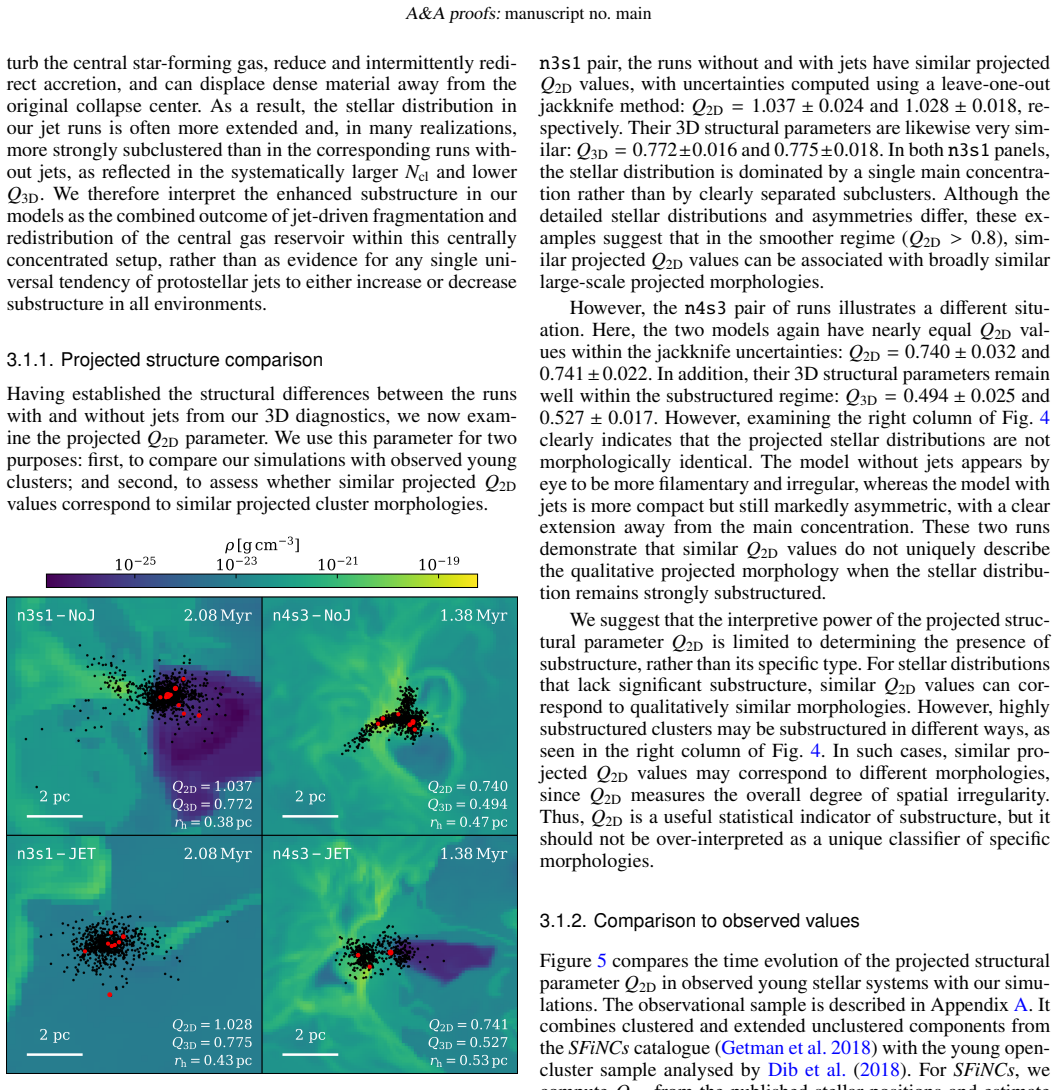
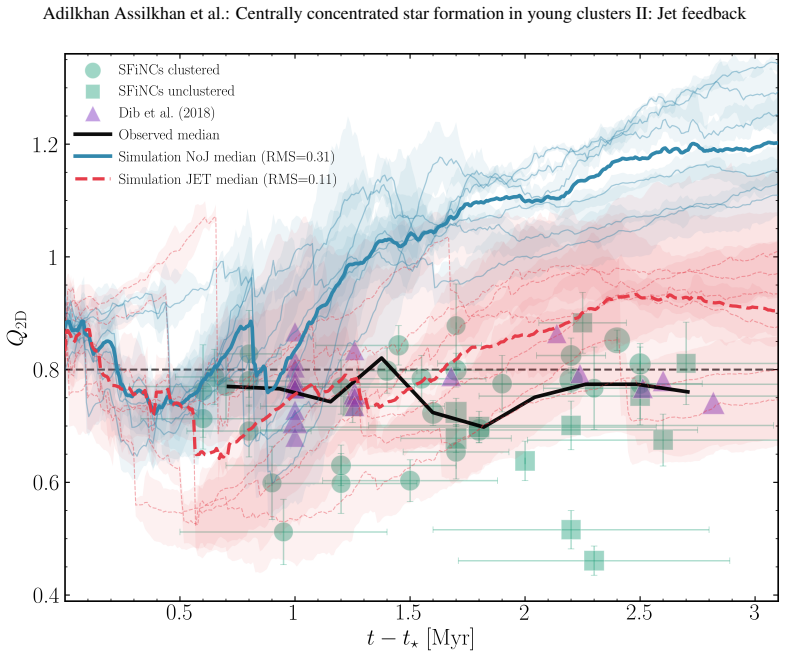
In centrally concentrated initial conditions, runs with jets form stellar systems that better reproduce the observed range of the projected structural parameter Q_2D in young clusters than runs without jets, indicating that protostellar jets are an important early feedback channel even in centrally concentrated clouds that regulates star formation efficiencies and shapes the emerging cluster structure.
What carries the argument
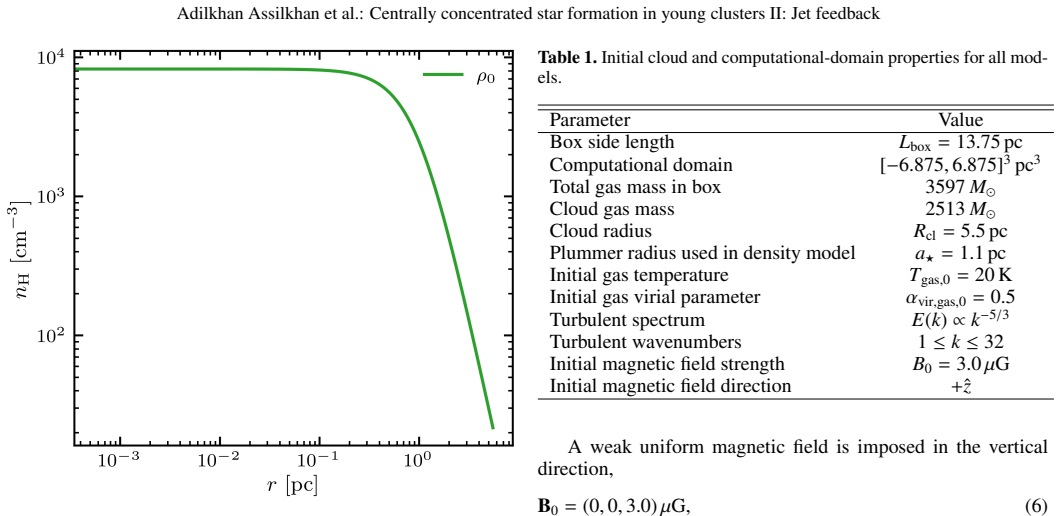
Paired Torch simulations of a 2500-solar-mass centrally concentrated cloud, with and without protostellar jets, compared through global star formation diagnostics and the structural measure Q_2D.
If this is right
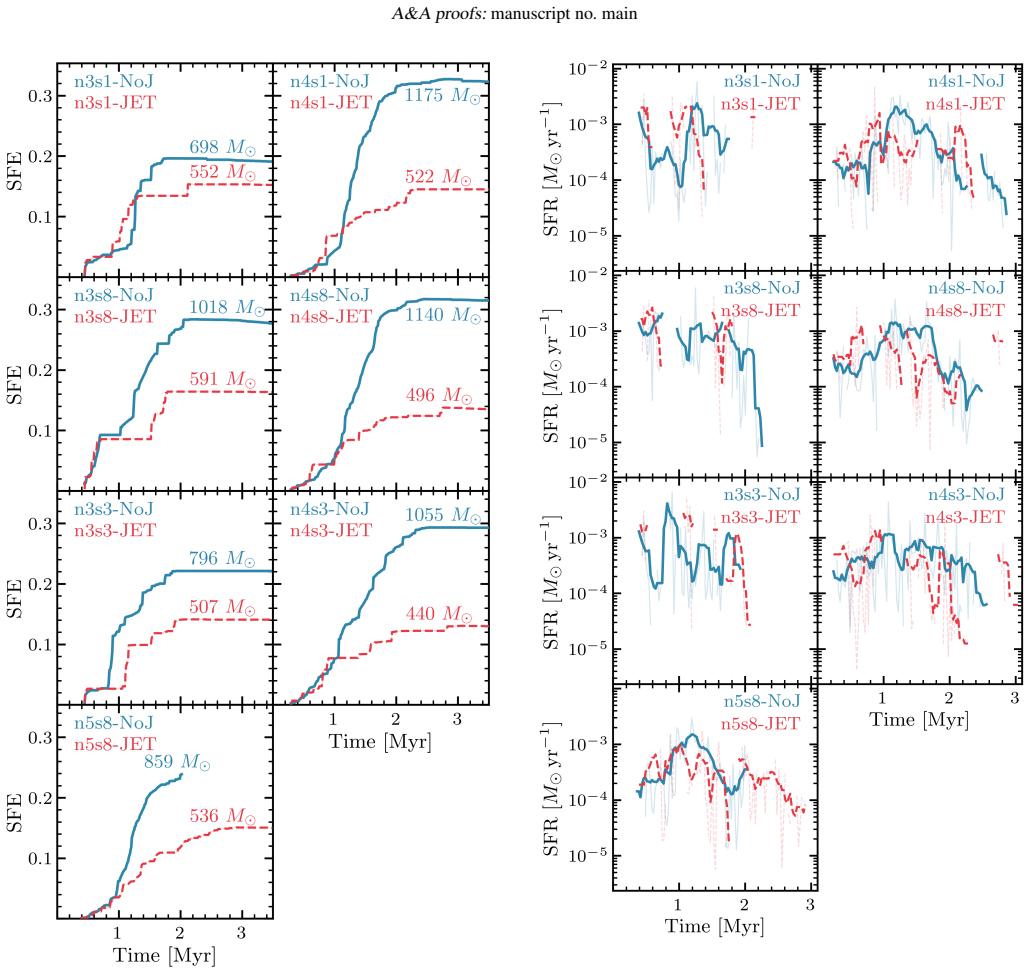
- Jet feedback reduces overall star formation efficiency from 19-33 percent to 12-16 percent.
- Jets shift star formation from continuous to discrete bursts.
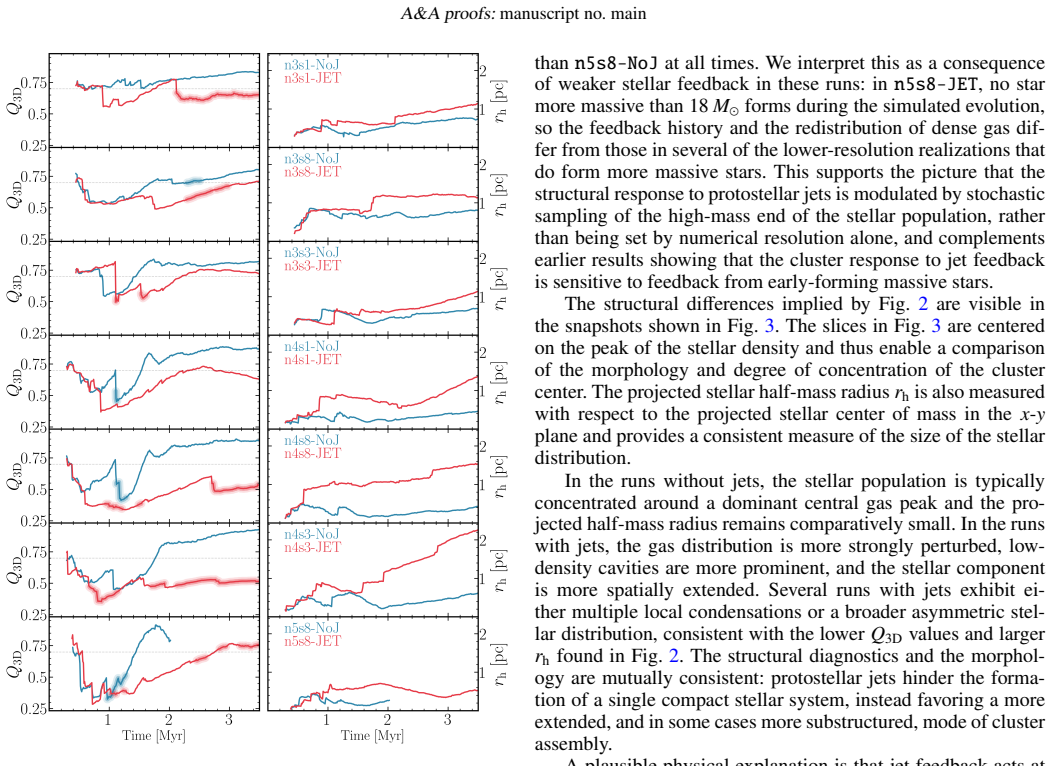
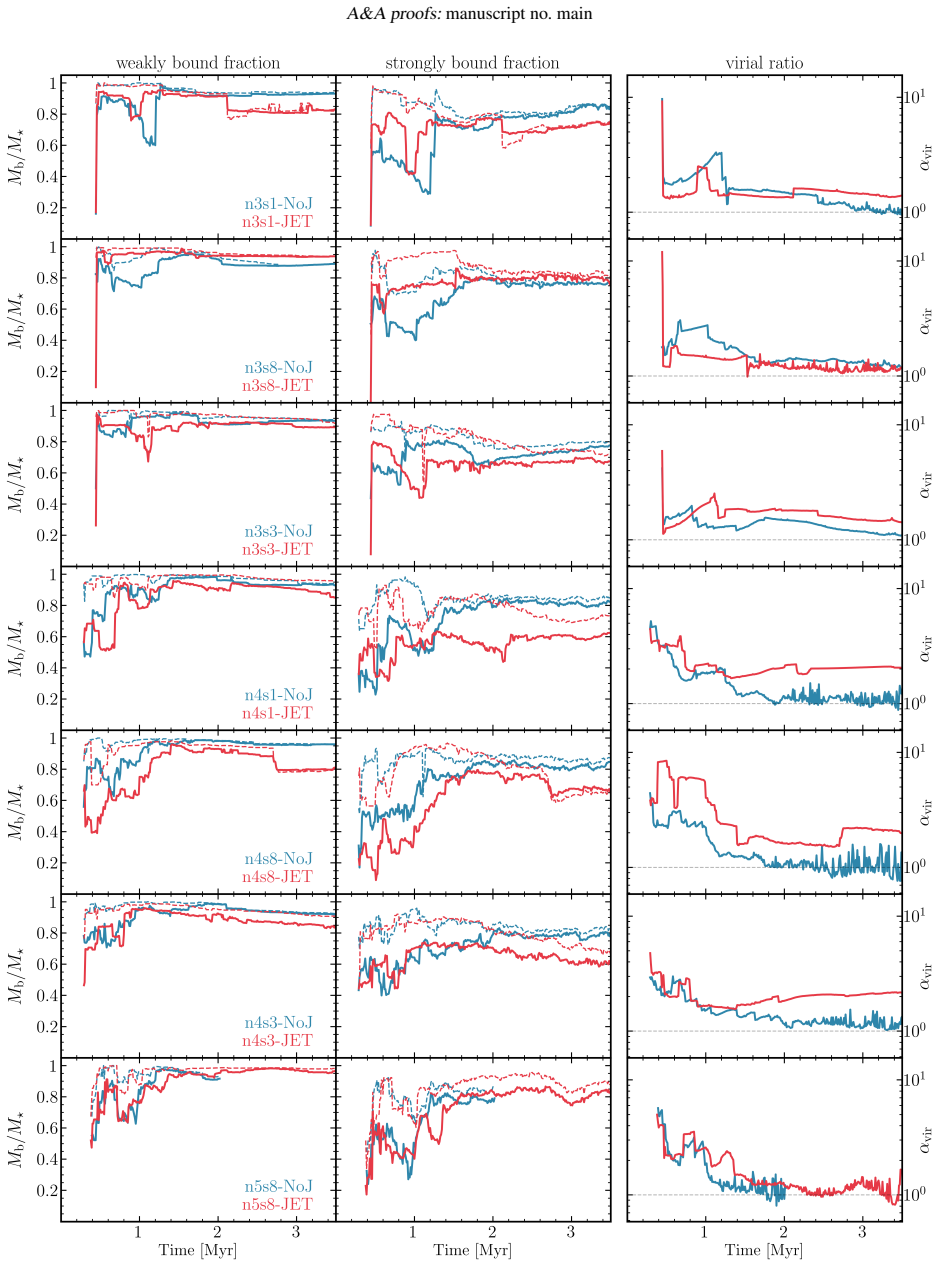
- Jets leave stellar populations that are less tightly bound and have higher virial parameters.
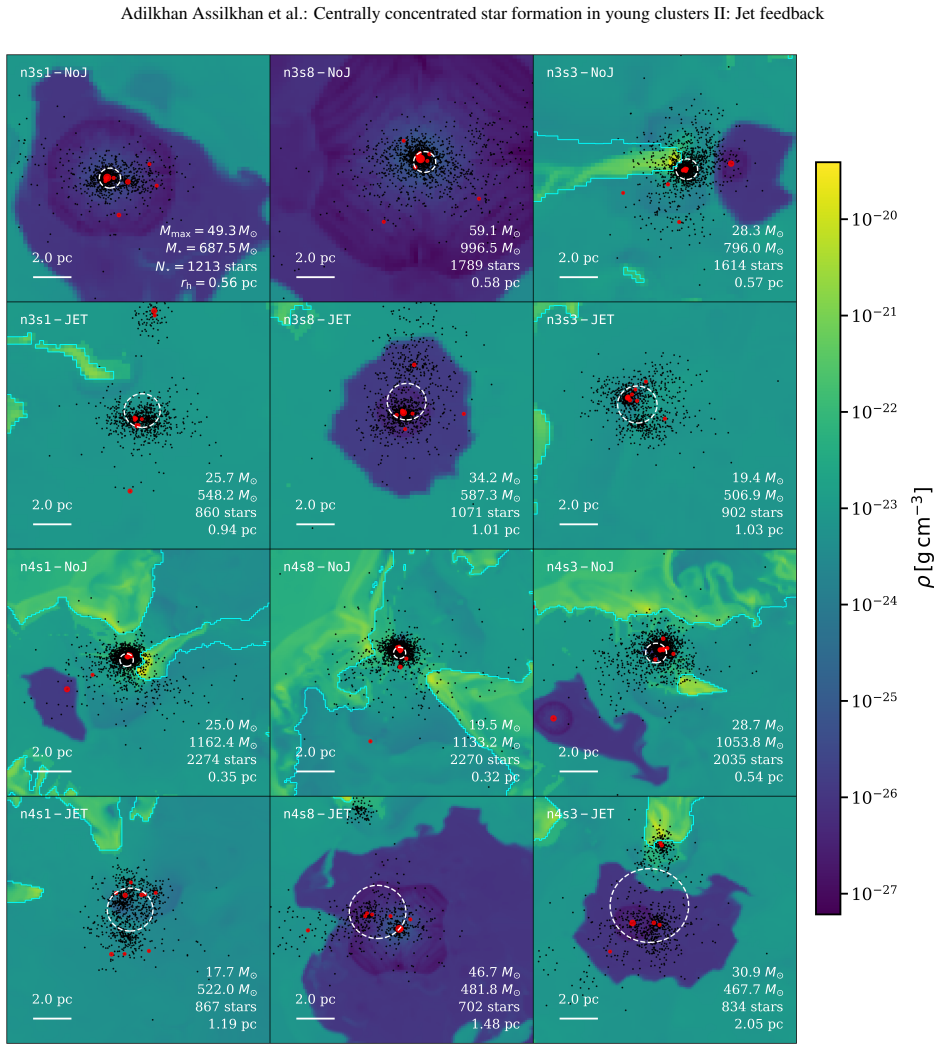
- Jets produce more extended and substructured stellar systems.
Where Pith is reading between the lines
- If jets shape structure this early, later gas expulsion may start from a less bound configuration than usually assumed.
- The bursty star formation pattern could imprint on the age spreads observed in some young clusters.
- Higher-resolution runs or different cloud masses could test whether the Q_2D improvement persists when more small-scale physics is resolved.
Load-bearing premise
The chosen centrally concentrated cloud model and the way the simulations isolate jet feedback accurately represent the conditions under which real young clusters form.
What would settle it
A survey measuring Q_2D in a sample of very young clusters still embedded in centrally concentrated gas and comparing those values to the ranges produced by the jet and no-jet runs.
Figures
read the original abstract
Protostellar jets are one of the earliest forms of stellar feedback, but their impact on star formation and cluster assembly in centrally concentrated molecular clouds remains poorly understood. We study how protostellar jets affect the star formation efficiency, the temporal variability of star formation, star cluster structure, and the early dynamical state of centrally concentrated, newly forming star clusters using the Torch star cluster formation framework. We adopt a centrally concentrated initial cloud model with mass M = 2.5 x 10^3 solar masses and compare six pairs of simulations with and without protostellar jets, supplemented by one additional higher resolution pair of simulations. We analyze our simulations using global star formation diagnostics together with structural and dynamical measures of the stellar population. Models with jet feedback achieve star formation efficiencies of 12-16%, while the corresponding models without jets yield higher efficiencies of 19-33%. Jets also cause star formation to occur in discrete bursts rather than continuously, to produce more extended and substructured stellar systems, and to leave behind stellar populations that are less tightly bound and have higher virial parameters. In our centrally concentrated initial conditions, runs with jets form stellar systems that better reproduce the observed range of the projected structural parameter Q_2D in young clusters than runs without jets, indicating that protostellar jets are an important early feedback channel even in centrally concentrated clouds that regulates star formation efficiencies and shapes the emerging cluster structure.
Editorial analysis
A structured set of objections, weighed in public.
Referee Report
Summary. The paper uses the Torch framework to simulate star cluster formation in a single centrally concentrated molecular cloud model (M = 2.5 × 10^3 M_⊙). It compares six pairs of runs (plus one higher-resolution pair) with and without protostellar jet feedback, claiming that jets lower star formation efficiency (12–16% vs. 19–33%), produce burstier star formation, yield more extended and substructured stellar systems, and result in stellar populations whose projected structural parameter Q_2D better matches the observed range in young clusters. The authors conclude that jets constitute an important early feedback channel even in centrally concentrated clouds.
Significance. If the numerical results hold under the stated conditions, the work would provide concrete evidence that protostellar jets can regulate star-formation efficiency and imprint observable structural signatures on young clusters, offering a testable early-feedback mechanism that operates before other channels become dominant.
major comments (3)
- [Abstract / §2] Abstract and initial-conditions description: the central claim that jets are important “even in centrally concentrated clouds” rests on a single cloud mass (2.5 × 10^3 M_⊙) and concentration parameter with no additional runs at different masses, concentrations, or turbulence spectra. Without such variation the reported SFE difference and Q_2D improvement cannot be shown to be general rather than setup-specific.
- [Methods / Results] Methods and results sections: the manuscript supplies no information on spatial or mass resolution, particle or cell counts, or convergence tests for either the with-jet or without-jet runs. Because Q_2D and the structural diagnostics are sensitive to small-scale fragmentation and projection effects, the absence of these checks makes it impossible to judge whether the claimed structural differences are numerically robust.
- [Results] Results section: the SFE ranges (12–16 % vs. 19–33 %) and the statement that jets produce a “better” match to observed Q_2D are presented without uncertainties, bootstrap errors, or statistical tests on the six simulation pairs. This weakens the quantitative support for the efficiency and structural claims.
minor comments (1)
- [Abstract] The abstract states “solar masses” rather than the conventional M_⊙; consistent notation should be used throughout.
Simulated Author's Rebuttal
We thank the referee for their thoughtful comments on our manuscript. We respond to each major comment below. We will revise the manuscript to address concerns about the specificity of the model, add missing numerical details, and include more quantitative information on the results.
read point-by-point responses
-
Referee: [Abstract / §2] Abstract and initial-conditions description: the central claim that jets are important “even in centrally concentrated clouds” rests on a single cloud mass (2.5 × 10^3 M_⊙) and concentration parameter with no additional runs at different masses, concentrations, or turbulence spectra. Without such variation the reported SFE difference and Q_2D improvement cannot be shown to be general rather than setup-specific.
Authors: We acknowledge that our results are based on a single cloud mass and concentration. The paper focuses on this specific centrally concentrated model to isolate the effect of jets. We will revise the abstract and section 2 to emphasize that the conclusions apply to this setup and that further studies with varied parameters are required to establish generality. revision: yes
-
Referee: [Methods / Results] Methods and results sections: the manuscript supplies no information on spatial or mass resolution, particle or cell counts, or convergence tests for either the with-jet or without-jet runs. Because Q_2D and the structural diagnostics are sensitive to small-scale fragmentation and projection effects, the absence of these checks makes it impossible to judge whether the claimed structural differences are numerically robust.
Authors: We will add a dedicated paragraph in the Methods section detailing the spatial and mass resolution, the number of SPH particles or grid cells used, and the results from the higher-resolution pair of simulations. The higher-resolution runs confirm the same trends in SFE and structure, providing evidence of numerical robustness. revision: yes
-
Referee: [Results] Results section: the SFE ranges (12–16 % vs. 19–33 %) and the statement that jets produce a “better” match to observed Q_2D are presented without uncertainties, bootstrap errors, or statistical tests on the six simulation pairs. This weakens the quantitative support for the efficiency and structural claims.
Authors: We will expand the Results section to list the SFE for each of the six pairs individually and report the Q_2D values for all runs. This will allow readers to assess the consistency. Given the small number of simulations, we will avoid overclaiming statistical significance but note the systematic difference across pairs. revision: partial
Circularity Check
No circularity: direct simulation comparison of jet vs. no-jet runs
full rationale
The paper reports outcomes from paired Torch simulations (with/without jets) on a fixed centrally concentrated initial cloud (M=2.5e3 Msun). Star formation efficiency (12-16% vs 19-33%), bursty SF, Q_2D distributions, virial parameters, and structural measures are direct numerical outputs, not fitted parameters renamed as predictions, not self-defined quantities, and not reduced via self-citation chains. The abstract and described methods contain no equations or steps that equate a claimed result to its own inputs by construction. The comparison is independent across the two sets of runs; the initial model is stated as an assumption but does not create circularity in the reported differences.
Axiom & Free-Parameter Ledger
free parameters (2)
- Initial cloud mass =
2.5 x 10^3 solar masses
- Number of simulation pairs =
six pairs plus one higher resolution pair
axioms (2)
- domain assumption The Torch framework correctly implements hydrodynamics, gravity, and protostellar jet feedback physics.
- domain assumption The initial cloud is centrally concentrated as modeled and representative of young cluster formation sites.
Reference graph
Works this paper leans on
-
[1]
Plummer, H. C. , title =. Monthly Notices of the Royal Astronomical Society , volume =. 1911 , doi =
1911
-
[2]
Early evolution and three-dimensional structure of embedded star clusters. , keywords =. doi:10.1093/mnras/stad568 , archivePrefix =. 2302.08536 , primaryClass =
-
[3]
Computer Methods in Applied Mechanics and Engineering , year = 1987, month = apr, volume =
An adaptive finite element scheme for transient problems in CFD. Computer Methods in Applied Mechanics and Engineering , year = 1987, month = apr, volume =. doi:10.1016/0045-7825(87)90098-3 , adsurl =
-
[4]
Initial conditions for disc galaxies. , keywords =. doi:10.1111/j.1365-2966.2007.11753.x , archivePrefix =. astro-ph/0703534 , primaryClass =
-
[5]
The Astrophysical Journal , volume =
Ginsburg, Adam and Federrath, Christoph and Darling, Jeremy , title =. The Astrophysical Journal , volume =. 2013 , doi =
2013
-
[6]
Portegies Zwart and Stephen L
Simon F. Portegies Zwart and Stephen L. W. McMillan and Mark Gieles , title =. Annual Review of Astronomy and Astrophysics , volume =. 2010 , doi =
2010
-
[7]
and Kroupa, P
Baumgardt, H. and Kroupa, P. , title =. MNRAS , volume =. 2007 , pages =
2007
-
[8]
Goodwin, S. P. , title =. MNRAS , volume =. 1997 , pages =
1997
-
[9]
Dale, J. E. , title =. MNRAS , volume =. 2014 , pages =
2014
-
[10]
Building a Better Leapfrog. , keywords =. doi:10.1086/187844 , adsurl =
-
[11]
Journal of Computational Physics , year = 2005, month = sep, volume =
A multi-state HLL approximate Riemann solver for ideal magnetohydrodynamics. Journal of Computational Physics , year = 2005, month = sep, volume =. doi:10.1016/j.jcp.2005.02.017 , adsurl =
-
[12]
Journal of Computational Physics , keywords =
The Piecewise Parabolic Method (PPM) for Gas-Dynamical Simulations. Journal of Computational Physics , keywords =. doi:10.1016/0021-9991(84)90143-8 , adsurl =
-
[13]
Communications in Nonlinear Science and Numerical Simulations , keywords =
Non-intrusive hierarchical coupling strategies for multi-scale simulations in gravitational dynamics. Communications in Nonlinear Science and Numerical Simulations , keywords =. doi:10.1016/j.cnsns.2020.105240 , archivePrefix =. 2002.11206 , primaryClass =
-
[14]
Supercomputing '92 , year = 1992, month = jan, pages =
Astrophysical N-body Simulations Using Hierarchical Tree Data Structures. Supercomputing '92 , year = 1992, month = jan, pages =
1992
-
[15]
Bulletin of the American Astronomical Society , year = 1991, volume =
FOREST: A Parallel Treecode for Gravitational N-Body Simulations with up to 20 Million Particles. Bulletin of the American Astronomical Society , year = 1991, volume =
1991
-
[16]
The Jeans Condition: A New Constraint on Spatial Resolution in Simulations of Isothermal Self-gravitational Hydrodynamics. , keywords =. doi:10.1086/310975 , adsurl =
-
[17]
The Initial Mass Function of Stars: Evidence for Uniformity in Variable Systems. Science , keywords =. doi:10.1126/science.1067524 , archivePrefix =. astro-ph/0201098 , primaryClass =
-
[18]
Bound mass of Dehnen models with a centrally peaked star formation efficiency. , keywords =. doi:10.1051/0004-6361/202141299 , archivePrefix =. 2105.09510 , primaryClass =
-
[19]
Impact of a star formation efficiency profile on the evolution of open clusters. , keywords =. doi:10.1051/0004-6361/201730607 , archivePrefix =. 1706.03228 , primaryClass =
-
[20]
Surviving infant mortality in the hierarchical merging scenario. , keywords =. doi:10.1111/j.1365-2966.2011.18604.x , archivePrefix =. 1102.5360 , primaryClass =
-
[21]
Embedded Clusters in Molecular Clouds. , keywords =. doi:10.1146/annurev.astro.41.011802.094844 , archivePrefix =. astro-ph/0301540 , primaryClass =
-
[22]
The effect of mass loss on the dynamical evolution of a stellar system - Analytic approximations. , keywords =. doi:10.1086/157703 , adsurl =
-
[23]
The formation and early dynamical evolution of bound stellar systems. , keywords =. doi:10.1086/162485 , adsurl =
-
[24]
Residual gas expulsion from young globular clusters. , keywords =. doi:10.1093/mnras/284.4.785 , archivePrefix =. astro-ph/9607083 , primaryClass =
-
[25]
Gas expulsion and the destruction of massive young clusters. , keywords =. doi:10.1111/j.1365-2966.2006.11078.x , archivePrefix =. astro-ph/0609477 , primaryClass =
-
[26]
A comprehensive set of simulations studying the influence of gas expulsion on star cluster evolution. , keywords =. doi:10.1111/j.1365-2966.2007.12209.x , archivePrefix =. 0707.1944 , primaryClass =
-
[27]
Indicators for Cluster Survivability in a Dispersing Cloud. , keywords =. doi:10.1088/0004-637X/698/2/1659 , archivePrefix =. 0905.0077 , primaryClass =
-
[28]
Mapping the Filamentary Nebula of NGC 1275 with Multiwavelength SITELLE Observations. , keywords =. doi:10.3847/1538-3881/adb732 , archivePrefix =. 2502.05406 , primaryClass =
-
[29]
Filamentary star formation in NGC 1275. , keywords =. doi:10.1093/mnras/stu1191 , archivePrefix =. 1406.4800 , primaryClass =
-
[30]
Stellar-wind feedback and magnetic fields around young compact star clusters: 3D MHD simulations. arXiv e-prints , keywords =. doi:10.48550/arXiv.2503.19745 , archivePrefix =. 2503.19745 , primaryClass =
-
[31]
Embedded star clusters surviving gas expulsion with low star formation efficiencies
-
[32]
Toward a Complete Accounting of Energy and Momentum from Stellar Feedback in Galaxy Formation Simulations. , keywords =. doi:10.1088/0004-637X/770/1/25 , archivePrefix =. 1210.4957 , primaryClass =
-
[33]
Before the first supernova: combined effects of H II regions and winds on molecular clouds. , keywords =. doi:10.1093/mnras/stu816 , archivePrefix =. 1404.6102 , primaryClass =
-
[34]
Feedback from winds and supernovae in massive stellar clusters - I. Hydrodynamics. , keywords =. doi:10.1093/mnras/stt255 , archivePrefix =. 1302.2443 , primaryClass =
-
[35]
A CO Survey of Regions around 34 Open Clusters. , keywords =. doi:10.1086/191357 , adsurl =
-
[36]
Interstellar Turbulence I: Observations and Processes. , keywords =. doi:10.1146/annurev.astro.41.011802.094859 , archivePrefix =. astro-ph/0404451 , primaryClass =
-
[37]
Stellar Feedback in Molecular Clouds and its Influence on the Mass Function of Young Star Clusters. , keywords =. doi:10.1088/2041-8205/710/2/L142 , archivePrefix =. 0910.2238 , primaryClass =
-
[38]
Star Clusters , year = 1980, editor =
Star clusters. Star Clusters , year = 1980, editor =
1980
-
[39]
Slingshot mechanism for clusters: Gas density regulates star density in the Orion Nebula Cluster (M42). , keywords =. doi:10.1093/mnras/stx2629 , archivePrefix =. 1705.05838 , primaryClass =
-
[40]
Local-density-driven clustered star formation. , keywords =. doi:10.1051/0004-6361/201219648 , archivePrefix =. 1211.1383 , primaryClass =
-
[41]
Turbulence and star formation in molecular clouds. , keywords =. doi:10.1093/mnras/194.4.809 , adsurl =
-
[42]
Theory of Star Formation. , keywords =. doi:10.1146/annurev.astro.45.051806.110602 , archivePrefix =. 0707.3514 , primaryClass =
-
[43]
The evolution of embedded star clusters. , keywords =. doi:10.1111/j.1365-2966.2011.20137.x , archivePrefix =. 1111.0992 , primaryClass =
-
[44]
When feedback fails: the scaling and saturation of star formation efficiency. , keywords =. doi:10.1093/mnras/sty035 , archivePrefix =. 1612.05635 , primaryClass =
-
[45]
American Astronomical Society Meeting Abstracts \#242 , year = 2023, series =
Modeling Evolution from Gas to Young Massive Star Clusters. American Astronomical Society Meeting Abstracts \#242 , year = 2023, series =
2023
-
[47]
arXiv , author =:2312.06509 , journal =
doi:10.1051/0004-6361/202348840 , eid =. arXiv , author =:2312.06509 , journal =
-
[48]
arXiv , author =:2405.12286 , journal =
doi:10.1051/0004-6361/202450774 , eid =. arXiv , author =:2405.12286 , journal =
-
[49]
American Astronomical Society Meeting Abstracts \#241 , year = 2023, series =
Star Cluster Formation: The effects of early forming massive stars and building a bridge between Voronoi mesh and block-structured codes. American Astronomical Society Meeting Abstracts \#241 , year = 2023, series =
2023
-
[50]
PAH Feature Ratios around Stellar Clusters and Associations in 19 Nearby Galaxies. , keywords =. doi:10.3847/1538-3881/ada89f , archivePrefix =. 2501.10539 , primaryClass =
-
[51]
Winds and radiation in unison: a new semi-analytic feedback model for cloud dissolution. , keywords =. doi:10.1093/mnras/stx1532 , archivePrefix =. 1704.04240 , primaryClass =
-
[52]
The Orion Nebula and its Associated Population. , keywords =. doi:10.1146/annurev.astro.39.1.99 , adsurl =
-
[53]
Dynamical Evolution of Young Embedded Clusters: A Parameter Space Survey. , keywords =. doi:10.1088/0067-0049/185/2/486 , archivePrefix =. 0910.4679 , primaryClass =
-
[54]
Dynamical ejections of stars due to an accelerating gas filament. , keywords =. doi:10.1093/mnras/stx1821 , archivePrefix =. 1704.00720 , primaryClass =
-
[55]
Primordial mass segregation in simulations of star formation?. , keywords =. doi:10.1093/mnras/stu2393 , archivePrefix =. 1411.3002 , primaryClass =
-
[56]
Star cluster formation in a turbulent molecular cloud self-regulated by photoionization feedback. , keywords =. doi:10.1093/mnras/stx2222 , archivePrefix =. 1701.07982 , primaryClass =
-
[57]
Disruption of giant molecular clouds and formation of bound star clusters under the influence of momentum stellar feedback. , keywords =. doi:10.1093/mnras/stz1271 , archivePrefix =. 1904.11987 , primaryClass =
-
[58]
E pur si muove: Galilean-invariant cosmological hydrodynamical simulations on a moving mesh. , keywords =. doi:10.1111/j.1365-2966.2009.15715.x , archivePrefix =. 0901.4107 , primaryClass =
-
[59]
Probing the role of the galactic environment in the formation of stellar clusters, using M83 as a test bench. , keywords =. doi:10.1093/mnras/stv1203 , archivePrefix =. 1505.07475 , primaryClass =
-
[60]
A General Theory of Turbulence-regulated Star Formation, from Spirals to Ultraluminous Infrared Galaxies. , keywords =. doi:10.1086/431734 , archivePrefix =. astro-ph/0505177 , primaryClass =
-
[61]
The Disruption of Giant Molecular Clouds by Radiation Pressure & the Efficiency of Star Formation in Galaxies. , keywords =. doi:10.1088/0004-637X/709/1/191 , archivePrefix =. 0906.5358 , primaryClass =
-
[62]
The Spitzer Space Telescope Survey of the Orion A and B Molecular Clouds. II. The Spatial Distribution and Demographics of Dusty Young Stellar Objects. , keywords =. doi:10.3847/0004-6256/151/1/5 , archivePrefix =. 1511.01202 , primaryClass =
-
[63]
Slingshot mechanism in Orion: Kinematic evidence for ejection of protostars by filaments. , keywords =. doi:10.1051/0004-6361/201527979 , archivePrefix =. 1512.04944 , primaryClass =
-
[64]
Astronomical and Astrophysical Transactions , keywords =
Study of young stellar groupings in H II regions based on the spectral and photometric data. Astronomical and Astrophysical Transactions , keywords =. doi:10.48550/arXiv.1601.04062 , archivePrefix =. 1601.04062 , primaryClass =
-
[65]
A Massive Star Odyssey: From Main Sequence to Supernova , year = 2003, editor =
A HST study of young massive star clusters in compact H II regions of the Magellanic Clouds. A Massive Star Odyssey: From Main Sequence to Supernova , year = 2003, editor =
2003
-
[66]
Theoretical Models of Young Open Star Clusters: Effects of a Gaseous Component and Gas Removal. , keywords =. doi:10.1086/317052 , archivePrefix =. astro-ph/0006231 , primaryClass =
-
[67]
Star Clusters: From the Milky Way to the Early Universe , year = 2020, editor =
Star Clusters in the Galactic tidal field, from birth to dissolution. Star Clusters: From the Milky Way to the Early Universe , year = 2020, editor =. doi:10.1017/S1743921319006781 , archivePrefix =. 1907.12819 , primaryClass =
-
[68]
Tidal radii and masses of open clusters. , keywords =. doi:10.1051/0004-6361:20078525 , adsurl =
-
[69]
Young Massive Star Clusters. , keywords =. doi:10.1146/annurev-astro-081309-130834 , archivePrefix =. 1002.1961 , primaryClass =
Pith/arXiv arXiv doi:10.1146/annurev-astro-081309-130834 1961
-
[70]
The Formation and Dynamical Evolution of Young Star Clusters. , keywords =. doi:10.3847/0004-637X/817/1/4 , archivePrefix =. 1512.00090 , primaryClass =
-
[71]
Brinkmann, Nina and Banerjee, Sambaran and Motwani, Bhawna and Kroupa, Pavel , month =. 2017 , journal =. doi:10.1051/0004-6361/201629312 , issn =
-
[72]
Stellar feedback efficiencies: supernovae versus stellar winds. , keywords =. doi:10.1093/mnras/stv2699 , archivePrefix =. 1511.05151 , primaryClass =
-
[73]
Stellar feedback in galaxies and the origin of galaxy-scale winds. , keywords =. doi:10.1111/j.1365-2966.2012.20593.x , archivePrefix =. 1110.4638 , primaryClass =
-
[74]
Modeling UV Radiation Feedback from Massive Stars. II. Dispersal of Star-forming Giant Molecular Clouds by Photoionization and Radiation Pressure. , keywords =. doi:10.3847/1538-4357/aabe27 , archivePrefix =. 1804.04664 , primaryClass =
-
[75]
Stellar feedback by radiation pressure and photoionization. , keywords =. doi:10.1093/mnras/stu155 , archivePrefix =. 1310.7572 , primaryClass =
-
[76]
WARPFIELD 2.0: feedback-regulated minimum star formation efficiencies of giant molecular clouds. , keywords =. doi:10.1093/mnras/sty3295 , archivePrefix =. 1810.10526 , primaryClass =
-
[77]
, year = 1993, month = nov, volume =
A Family of Potential-Density Pairs for Spherical Galaxies and Bulges. , year = 1993, month = nov, volume =. doi:10.1093/mnras/265.1.250 , adsurl =
-
[78]
Star cluster formation from turbulent clumps. II. Gradual star cluster formation. , keywords =. doi:10.1093/mnras/sty3470 , archivePrefix =. 1809.04607 , primaryClass =
-
[79]
Star cluster formation from turbulent clumps - III. Across the mass spectrum. , keywords =. doi:10.1093/mnras/stad1532 , archivePrefix =. 2301.08997 , primaryClass =
-
[80]
Effects of initial density profiles on massive star cluster formation in giant molecular clouds. , keywords =. doi:10.1093/mnras/stab491 , archivePrefix =. 2006.00004 , primaryClass =
-
[81]
Early-forming Massive Stars Suppress Star Formation and Hierarchical Cluster Assembly. , keywords =. doi:10.3847/1538-4357/acb0c5 , archivePrefix =. 2212.01465 , primaryClass =
discussion (0)
Sign in with ORCID, Apple, or X to comment. Anyone can read and Pith papers without signing in.