Structure-driven analog optical control in ion-pumped SrFeO_(3-δ) thin-film devices
Pith reviewed 2026-06-26 10:49 UTC · model grok-4.3
The pith
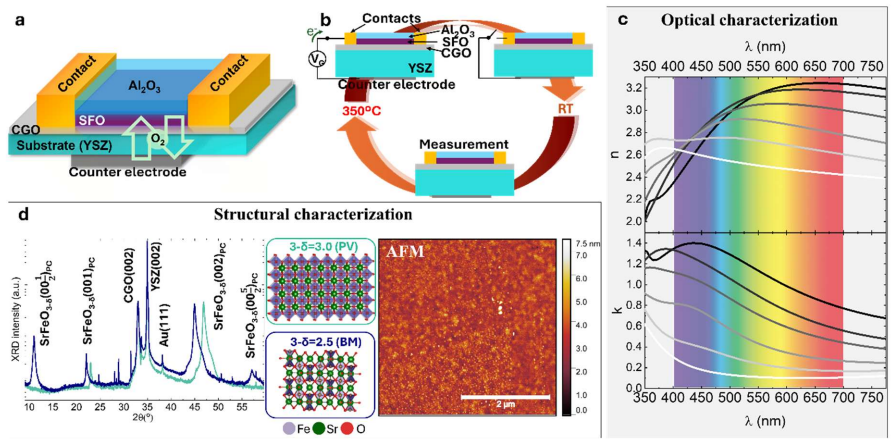
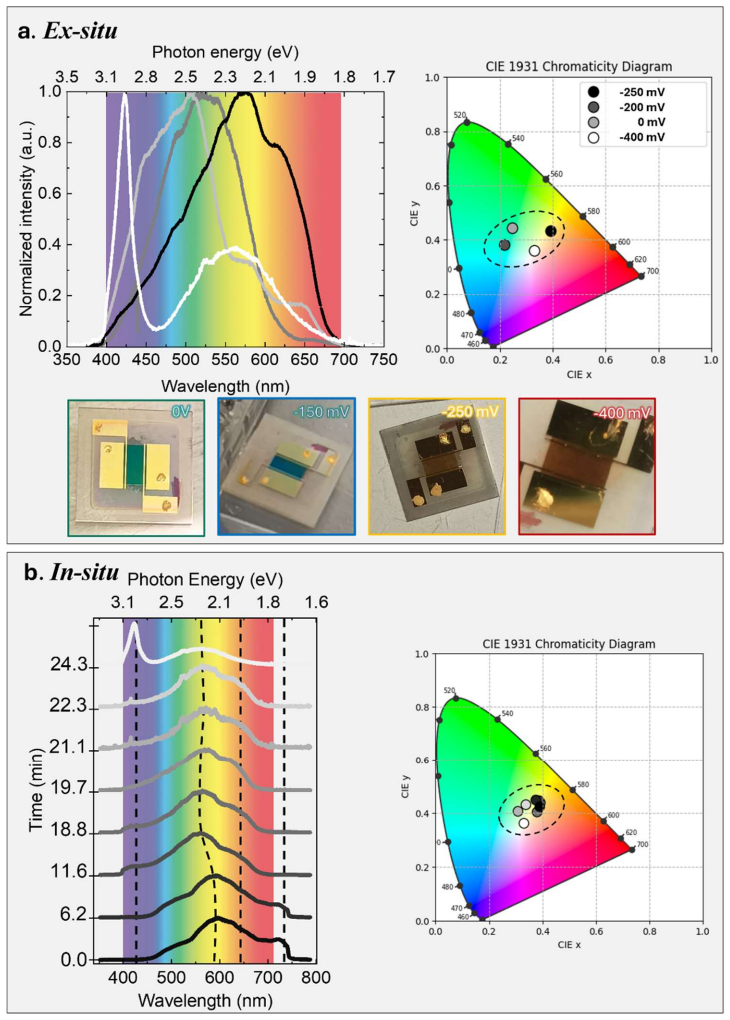
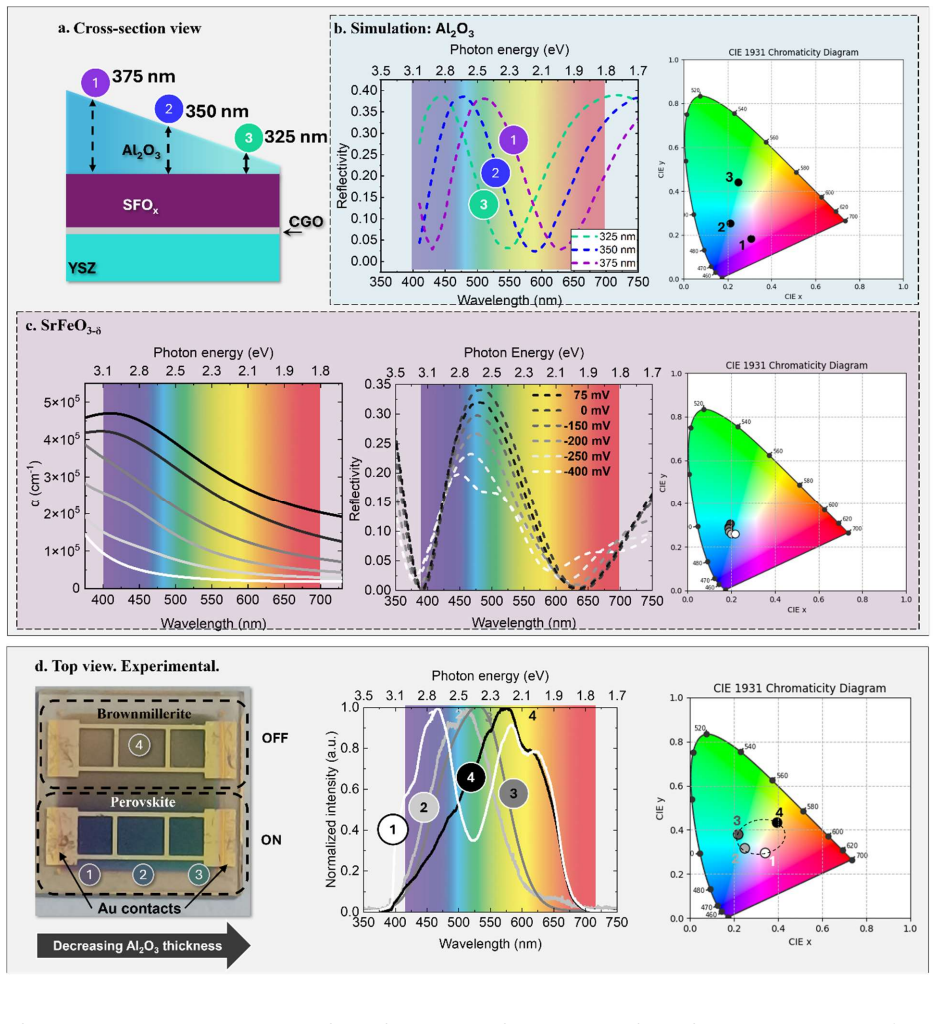
Oxygen ion pumping in SrFeO_{3-δ} thin films triggers reversible brownmillerite-perovskite transitions that enable continuous analog modulation of optical transmittance and color when paired with an Al2O3 interference layer.
A machine-rendered reading of the paper's core claim, the machinery that carries it, and where it could break.
Core claim
In an ion-pumped SrFeO_{3-δ} thin-film device, reversible oxygen-driven phase transitions between brownmillerite and perovskite structures produce pronounced changes in electronic structure and optical constants; when combined with an optically passive Al2O3 interference layer, these changes enable continuous and reversible modulation of optical transmittance and color.
What carries the argument
Reversible brownmillerite-perovskite phase transition induced by oxygen ion pumping in SrFeO_{3-δ}, which modifies electronic structure and optical constants and is enhanced by an Al2O3 interference layer.
If this is right
- Provides a general framework for ion-driven analog photonic and electrochromic devices.
- Highlights the potential of oxygen-based mixed ionic-electronic conductors for ionochromic systems.
- Enables compatibility with silicon-based photonic platforms.
- Addresses constraints on operating voltage, switching speed, color tunability, and stability found in conventional electrochromic devices.
Where Pith is reading between the lines
- The analog tuning could support applications in tunable filters or displays if cycle stability holds beyond the reported demonstrations.
- Similar oxygen-pumping control might extend to other perovskite oxides for broader photonic device libraries.
- On-chip integration with silicon photonics could yield compact non-emissive modulators for optical computing.
Load-bearing premise
The observed optical modulation stems primarily from the reversible structural phase transition rather than from degradation or other ion-related effects.
What would settle it
Repeated ion-pumping cycles that produce no corresponding structural phase change yet still alter transmittance, or cycles that degrade the optical response without loss of the phase transition, would falsify the structure-driven claim.
Figures
read the original abstract
Electrochromic devices (ECDs) offer a compelling route toward low-power, non-emissive optical modulators with nonvolatile states. However, their widespread implementation is hindered by limitations in operating voltage, switching speed, color tunability, and long-term stability. Mixed ionic-electronic conductors (MIECs) provide a promising alternative platform, enabling optical modulation through ion-driven redox and structural transformations. Oxygen-based MIECs offer enhanced durability, environmental robustness, and compatibility with oxide electronics and silicon photonics, yet remain largely underexplored for electrochromic and photonic applications. Here, we demonstrate structure-driven analog optical control in an ion-pumped SrFeO$_{3-\delta}$ thin-film device by undergoing reversible oxygen-driven phase transitions between brownmillerite and perovskite structures. Phase transition is accompanied by pronounced changes in its electronic structure and optical constants. By harnessing these ion-induced structural transformations and integrating an optically passive Al$_2$O$_3$ interference layer, we achieve continuous and reversible modulation of optical transmittance and color. These results provide a general framework for ion-driven analog photonic and electrochromic devices and highlight the potential of oxygen-based MIECs for next-generation ionochromic systems compatible with silicon-based photonic platforms.
Editorial analysis
A structured set of objections, weighed in public.
Referee Report
Summary. The manuscript claims to demonstrate structure-driven analog optical control in ion-pumped SrFeO_{3-δ} thin-film devices via reversible oxygen-driven brownmillerite-perovskite phase transitions, with an integrated optically passive Al₂O₃ interference layer enabling continuous and reversible modulation of optical transmittance and color; the work positions oxygen-based MIECs as a platform for low-power, non-emissive electrochromic and photonic devices compatible with silicon photonics.
Significance. If the structure-driven mechanism and reversibility are robustly shown, the results would supply a concrete experimental framework for ion-driven analog photonic devices, highlighting durability advantages of oxygen MIECs over conventional electrochromics and opening routes to nonvolatile optical modulators.
major comments (2)
- [Abstract] Abstract: the headline claim that optical transmittance and color modulation arise principally from the reversible brownmillerite-perovskite structural transition (rather than generic ion insertion, vacancy ordering, or degradation) is presented without accompanying quantitative transmittance spectra, cycle-life data, error bars, or control-device results that would isolate the phase-transition contribution; this data gap directly undermines verification of the structure-driven interpretation.
- [Abstract] Abstract: the statement that phase transition is 'accompanied by pronounced changes in its electronic structure and optical constants' is invoked to connect structure to optical response, yet no supporting spectra, extracted optical constants, or comparison to non-transitioning control films are referenced, leaving the causal link as an inference rather than a demonstrated necessity.
minor comments (1)
- [Abstract] The abstract uses both 'SrFeO_{3-δ}' and 'SrFeO3-δ'; ensure consistent subscript formatting throughout the manuscript.
Simulated Author's Rebuttal
We thank the referee for their careful review and constructive comments. We address each major comment point by point below, noting that the abstract is a concise summary while the supporting data and analysis appear in the main text.
read point-by-point responses
-
Referee: [Abstract] Abstract: the headline claim that optical transmittance and color modulation arise principally from the reversible brownmillerite-perovskite structural transition (rather than generic ion insertion, vacancy ordering, or degradation) is presented without accompanying quantitative transmittance spectra, cycle-life data, error bars, or control-device results that would isolate the phase-transition contribution; this data gap directly undermines verification of the structure-driven interpretation.
Authors: The abstract is a high-level summary and, per standard journal conventions, does not contain figures, quantitative data, or error bars. The quantitative transmittance spectra, cycle-life measurements with error bars, and control-device comparisons that isolate the phase-transition contribution are provided in the main manuscript (Figures 2 and 4, Section 3.1, and Supplementary Information). These data correlate the optical modulation directly with the reversible structural transition observed via XRD and distinguish it from generic ion insertion or degradation effects. revision: no
-
Referee: [Abstract] Abstract: the statement that phase transition is 'accompanied by pronounced changes in its electronic structure and optical constants' is invoked to connect structure to optical response, yet no supporting spectra, extracted optical constants, or comparison to non-transitioning control films are referenced, leaving the causal link as an inference rather than a demonstrated necessity.
Authors: Again, the abstract summarizes without including detailed spectra or extracted values. The supporting transmittance spectra, extracted optical constants (via ellipsometry), and comparisons to non-transitioning control films are presented in the main text (Figure 3 and Section 3.2), where the changes are directly linked to the brownmillerite-perovskite transition through correlated structural and optical characterization. revision: no
Circularity Check
No circularity: purely experimental demonstration with no derivation chain
full rationale
The manuscript is an experimental report on ion-pumped SrFeO3-δ thin films showing reversible optical modulation via brownmillerite-perovskite transitions. The abstract and provided text contain no equations, fitted parameters, predictive models, or self-citations invoked as load-bearing premises for any derivation. Claims rest on direct observation of phase changes and transmittance shifts, with no reduction of results to prior inputs by construction. This is the expected outcome for a device-fabrication and characterization study.
Axiom & Free-Parameter Ledger
axioms (1)
- domain assumption Reversible oxygen-driven phase transitions between brownmillerite and perovskite structures produce pronounced changes in electronic structure and optical constants.
Reference graph
Works this paper leans on
-
[1]
Granqvist, C. G. (2005). Electrochromic devices. Journal of the European Ceramic Society, 25(12), 2907-2912
2005
-
[2]
Mortimer, R. J. Electrochromic materials. Annu. Rev. Mater. Res. 41, 241–268 (2011)
2011
-
[3]
et al.(2023)
Cougnard-Gregoire, A. et al.(2023). Blue light exposure: ocular hazards and prevention—a narrative review. Ophthalmology and therapy, 12(2), 755-788
2023
-
[4]
Y ., Zhang, W., Yu, W
Zhu, M., Xu, B., He, T., Elezzabi, A. Y ., Zhang, W., Yu, W. W., & Chen, J. (2025). Smart electrochromic devices for wearables. Advanced Materials Technologies, 10(22), e01015
2025
-
[5]
Azens, A., & Granqvist, C. (2003). Electrochromic smart windows: energy eƯiciency and device aspects. Journal of Solid State Electrochemistry, 7(2), 64-68
2003
-
[6]
Baucke, F . G. K. (1991). Electrochromic applications. Materials Science and Engineering: B, 10(4), 285-292
1991
-
[8]
Wu, W., Wang, M., Ma, J., Cao, Y ., & Deng, Y . (2018). Electrochromic metal oxides: recent progress and prospect. Advanced Electronic Materials, 4(8), 1800185
2018
-
[9]
M., Lorenzini, R
Kline, W. M., Lorenzini, R. G., & Sotzing, G. A. (2014). A review of organic electrochromic fabric devices. Coloration Technology, 130(2), 73-80
2014
-
[10]
S., Blackwood, D
Rai, V ., Singh, R. S., Blackwood, D. J., & Zhili, D. (2020). A review on recent advances in electrochromic devices: a material approach. Advanced Engineering Materials, 22(8), 2000082
2020
-
[11]
D.; Rivnay, J.Organic mixed ionic–electronic conductors.Nature Materials 2020, 19, 13–26
Paulsen, B. D.; Rivnay, J.Organic mixed ionic–electronic conductors.Nature Materials 2020, 19, 13–26
2020
-
[12]
Riess, I. J. S. S. I. (2003). Mixed ionic–electronic conductors—material properties and applications. Solid State Ionics, 157(1-4), 1-17
2003
-
[13]
K., Bharadwaj, S., & Kistaiah, P
Burnwal, S. K., Bharadwaj, S., & Kistaiah, P . (2016). Review on MIEC cathode materials for solid oxide fuel cells. Journal of Molecular and Engineering Materials, 4(02), 1630001
2016
-
[14]
A., Tan, X., Schwingenschlogl, U., & Smith, S
Tahini, H. A., Tan, X., Schwingenschlogl, U., & Smith, S. C. (2016). Formation and migration of oxygen vacancies in SrCoO3 and their eƯect on oxygen evolution reactions. ACS Catalysis, 6(8), 5565-5570
2016
-
[15]
M., Bain, J
Jiang, W., Noman, M., Lu, Y . M., Bain, J. A., Salvador, P . A., & Skowronski, M. (2011). Mobility of oxygen vacancy in SrTiO3 and its implications for oxygen-migration-based resistance switching. Journal of Applied Physics, 110(3)
2011
-
[16]
P .; et al
Muecke, U. P .; et al. Temporal and spatial tuning of optical constants in praseodymium doped ceria by electrochemical means. Materials Research Bulletin 2014, 58, 74–79
2014
-
[17]
Kalaev, V .; Tuller, H. L. Active tuning of visible and ultraviolet optical constants in praseodymium-doped ceria thin films. Advanced Optical Materials 2021
2021
-
[18]
ACS Photonics 2019
Self-holding optical actuator based on mixed ionic–electronic conducting oxides. ACS Photonics 2019
2019
-
[19]
L.; et al
Runnerstrom, E. L.; et al. Electrochemically Tunable Plasmonics in Metal Oxide Nanocrystals. ACS Applied Materials & Interfaces 2019
2019
-
[20]
Nature Communications 2019
Voltage-gated optics and plasmonics enabled by solid-state proton pumping. Nature Communications 2019
2019
-
[21]
Nano Letters 2020
Nanoscale All-Solid-State Plasmochromic Waveguide Nonresonant Modulator. Nano Letters 2020
2020
-
[22]
Nano Letters 2020
Full-color-tunable nanophotonic device using electrochromic modulation. Nano Letters 2020
2020
-
[23]
Nature Photonics 2024
Programmable and nonvolatile computing with composition tuning in thin film lithium niobate. Nature Photonics 2024
2024
-
[24]
Electrochromic metal oxides: recent progress and prospect
Wu, W.; Wang, M.; Ma, J.; Cao, Y .; Deng, Y . Electrochromic metal oxides: recent progress and prospect. Advanced Electronic Materials 2018
2018
-
[25]
S.; Blackwood, D
Rai, V .; Singh, R. S.; Blackwood, D. J.; Zhili, D. A review on recent advances in electrochromic devices: a material approach. Advanced Engineering Materials 2020
2020
-
[26]
E.; et al
Zhao, J.; Chen, K.; Li, S. E.; et al. Electronic-structure evolution of SrFeO3−x during topotactic phase transformation. Journal of Physics: Condensed Matter 2022
2022
-
[27]
The overlooked middle ground in the structural and electronic evolution across intermediate phases in SrFeO3−δ
Nizet, P .; et al. The overlooked middle ground in the structural and electronic evolution across intermediate phases in SrFeO3−δ. Nature Communications 2026, accepted
2026
-
[28]
Analog control of La0.5Sr0.5FeO3−δ electrical properties through oxygen deficiency induced magnetic transition
Nizet, P .; et al. Analog control of La0.5Sr0.5FeO3−δ electrical properties through oxygen deficiency induced magnetic transition. Applied Physics Reviews 2024
2024
-
[29]
Heiroth, S., Ghisleni, R., Lippert, T., Michler, J., & Wokaun, A. (2011). Optical and mechanical properties of amorphous and crystalline yttria-stabilized zirconia thin films prepared by pulsed laser deposition. Acta Materialia, 59(6), 2330-2340
2011
-
[30]
& Dal Negro, L
Chawla, S., Franchi, R., Shubitidze, T., Brown, P ., Britton, W., Woolf, D., ... & Dal Negro, L. (2026). Structural, optical, and electrical properties of heteroepitaxial ITO/YSZ thin films. Optical Materials Express, 16(2), 266-282
2026
-
[31]
E., Zhang, Q., Wang, J
Zhao, J., Chen, K., Li, S. E., Zhang, Q., Wang, J. O., Guo, E. J., ... & Guo, H. (2022). Electronic-structure evolution of SrFeO3-x during topotactic phase transformation. Journal of Physics: Condensed Matter, 34(6), 064001
2022
-
[32]
Nizet et al., The overlooked middle ground in the structural and electronic evolution across intermediate phases in SrFeO3−δ, Nature Comm., 2026, accepted
P . Nizet et al., The overlooked middle ground in the structural and electronic evolution across intermediate phases in SrFeO3−δ, Nature Comm., 2026, accepted
2026
-
[33]
Analog control of La0. 5Sr0. 5FeO3-δ electrical properties through oxygen deficiency induced magnetic transition
P . Nizet, et al. "Analog control of La0. 5Sr0. 5FeO3-δ electrical properties through oxygen deficiency induced magnetic transition. " Applied Physics Reviews 11.4 (2024)
2024
-
[34]
& Paulus, W
Maity, A., Dutta, R., Penkala, B., Ceretti, M., Letrouit-Lebranchu, A., Chernyshov, D., ... & Paulus, W. (2015). Solid-state reactivity explored in-situ by synchrotron radiation on single crystals: from SrFeO2.5 to SrFeO3 via electrochemical oxygen intercalation. Journal of Physics D: Applied Physics, 48(50), 504004
2015
-
[35]
& Duan, Y
Jia, T., Zeng, Z., Zhang, X., Ohodnicki, P ., Chorpening, B., Hackett, G., ... & Duan, Y . (2019). The influence of oxygen vacancy on the electronic and optical properties of ABO 3− δ (A= La, Sr, B= Fe, Co) perovskites. Physical Chemistry Chemical Physics, 21(36), 20454- 20462
2019
-
[36]
Sze, S. M. & Ng, K. K. Physics of Semiconductor Devices, 3rd edn. (Wiley, 2007)
2007
-
[37]
J., Strukov, D
Yang, J. J., Strukov, D. B. & Stewart, D. R. Memristive devices for computing. Nat. Nanotechnol. 8, 13–24 (2013)
2013
-
[38]
F ., Ponce de León, C., & Walsh, F
Arenas, L. F ., Ponce de León, C., & Walsh, F . C. (2020). Critical review—the versatile plane parallel electrode geometry: an illustrated review. Journal of The Electrochemical Society, 167(2), 023504
2020
-
[39]
BADWAL, S. P . S. Stability of solid oxide fuel cell components. Solid State Ionics, 2001, vol. 143, no 1, p. 39-46
2001
-
[40]
Broadbent, A. D. (2004). A critical review of the development of the CIE1931 RGB color-matching functions. Color Research & Application: Endorsed by Inter-Society Color Council, The Colour Group (Great Britain), Canadian Society for Color, Color Science Association of Japan, Dutch Society for the Study of Color, The Swedish Colour Centre Foundation, Colou...
2004
-
[41]
Stølen, S., Bakken, E., & Mohn, C. E. (2006). Oxygen-deficient perovskites: linking structure, energetics and ion transport. Physical Chemistry Chemical Physics, 8(4), 429- 447
2006
-
[42]
Bennett, J. M. (1964). Precise method for measuring the absolute phase change on reflection. Journal of the Optical Society of America, 54(5), 612-624
1964
-
[43]
Windt, D. L. IMD—Software for modeling the optical properties of multilayer films. Computers in Physics 1998, 12, 360–370
1998
discussion (0)
Sign in with ORCID, Apple, or X to comment. Anyone can read and Pith papers without signing in.