A flexibility result for polynomial entropy of pointwise periodic homeomorphisms
Pith reviewed 2026-06-29 01:44 UTC · model grok-4.3
The pith
Certain continua admit pointwise periodic homeomorphisms realizing any polynomial entropy value in [0, infinity].
A machine-rendered reading of the paper's core claim, the machinery that carries it, and where it could break.
Core claim
We construct a family of continua and pointwise periodic homeomorphisms realizing arbitrary polynomial entropy values in [0,+∞]. In particular, this provides examples of pointwise periodic homeomorphisms with positive polynomial entropy. This contrasts with the fact that pointwise periodic homeomorphisms on connected manifolds and local dendrites have zero polynomial entropy.
What carries the argument
A family of continua equipped with pointwise periodic homeomorphisms whose polynomial entropy can be prescribed arbitrarily.
If this is right
- Pointwise periodic homeomorphisms on some continua can have positive polynomial entropy.
- Any real number in [0, infinity] is attainable as the polynomial entropy of some pointwise periodic homeomorphism on a continuum.
- The zero-entropy theorem for manifolds and local dendrites does not extend to all continua.
- The entropy value can be tuned continuously across the entire interval by choice of the underlying continuum.
Where Pith is reading between the lines
- The construction may indicate which topological features of a continuum allow positive entropy under periodicity.
- Similar flexibility results could be sought for other entropy notions such as topological entropy or measure-theoretic entropy.
- The examples raise the question of whether every value is also realizable on compact metric spaces that are not continua.
Load-bearing premise
Suitable continua exist that admit pointwise periodic homeomorphisms realizing every prescribed polynomial entropy value.
What would settle it
An exhaustive proof that every continuum forces zero polynomial entropy for its pointwise periodic homeomorphisms would refute the claim.
Figures
read the original abstract
We construct a family of continua and pointwise periodic homeomorphisms realizing arbitrary polynomial entropy values in $[0,+\infty]$. In particular, this provides examples of pointwise periodic homeomorphisms with positive polynomial entropy. This contrasts with the fact that pointwise periodic homeomorphisms on connected manifolds and local dendrites have zero polynomial entropy.
Editorial analysis
A structured set of objections, weighed in public.
Referee Report
Summary. The manuscript constructs, for every real number α ∈ [0, +∞], a continuum X_α together with a pointwise periodic homeomorphism f_α : X_α → X_α whose polynomial entropy equals α. The construction proceeds by an inverse-limit procedure in which the bonding maps are chosen so that the periods of periodic points grow at a rate that produces exactly the desired polynomial degree while ensuring every orbit is periodic. The result is contrasted with the known vanishing of polynomial entropy for pointwise periodic homeomorphisms on connected manifolds and local dendrites.
Significance. The explicit inverse-limit construction supplies the first examples of pointwise periodic homeomorphisms with positive polynomial entropy and demonstrates that every value in [0, +∞] is attainable on suitable continua. This flexibility result clarifies the possible range of polynomial entropy within the class of pointwise periodic maps and provides concrete counter-examples to any conjecture that would extend the zero-entropy theorem from manifolds to arbitrary continua. The parameter-free character of the construction (no auxiliary fitting parameters) is a notable strength.
minor comments (2)
- [§2] §2, Definition 2.3: the notation h_pol(f) for polynomial entropy is introduced without an explicit reference to the standard definition in the literature; a one-sentence reminder of the formula involving lim sup (log P(n))/log n would improve readability.
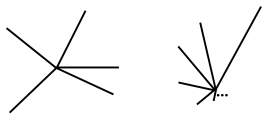
- [Figure 1] Figure 1: the bonding maps are drawn schematically; labeling the periods of the periodic points on each level would make the growth-rate control more immediately visible.
Simulated Author's Rebuttal
We thank the referee for their positive assessment of the manuscript and for recommending acceptance. Their summary correctly identifies the main result and its contrast with known vanishing theorems on manifolds and local dendrites.
Circularity Check
No circularity: explicit inverse-limit construction
full rationale
The manuscript is a pure existence result via explicit construction of continua X_α and homeomorphisms f_α using inverse limits. Bonding maps are chosen so that period growth produces exactly the target polynomial entropy degree α while preserving pointwise periodicity. No parameters are fitted to data, no predictions are made from subsets of results, and no load-bearing steps reduce to self-citations or ansatzes imported from prior work by the same authors. The derivation is self-contained and does not equate any claimed output to its inputs by definition.
Axiom & Free-Parameter Ledger
Reference graph
Works this paper leans on
-
[1]
Artigue, D
A. Artigue, D. Carrasco-Olivera, I. Monteverde,Polynomial entropy and expansivity, Acta Math. Hungar. 152, 140–149 (2017) 1, 3, 4.2
2017
-
[2]
Bohorquez,On the entropy of the continuum hyperspace map, Phd thesis (Brasil, 2017)
J. Bohorquez,On the entropy of the continuum hyperspace map, Phd thesis (Brasil, 2017). 3
2017
-
[3]
M. R. Bridson, A. HaefligerMetric spaces of non-positive curvature Grundlehren der Mathematischen Wissenschaften, 319. Springer-Verlag, Berlin (1999) 4.3
1999
-
[4]
G. T. Seidler,The topological entropy of homeomorphisms on one- dimensional continua, Proceedings of the American Mathematical Society, 108, 1025-1030, 1990. 3
1990
-
[5]
R. K. Kim, H. G. Park, I. L. Ko, B. H. Kim,A study on quadratic curves and generalized eccentricity in polar taxicab geometry, Korean J. Math. Vol. 22 No.3(2014) pp.567-581, DOI: https://doi.org/10.11568/kjm.2014.22.3.567 4
-
[6]
-Dori´ c, J
M. -Dori´ c, J. Kati´ c,On Polynomial Entropy on regular curves, Appl. Gen. Topol. 27, no. 2 (2026), 25695. 1, 3
2026
-
[7]
C. Labrousse,Polynomial entropy for the circle homeomorphisms and for C 1 nonvanishing vector fields onT 2, arXiv:1311.0213, 2013. 1
Pith/arXiv arXiv 2013
-
[8]
J. P. Marco,Dynamical complexity and symplectic integrability, arXiv:0907.5363v1, 2009. 1, 3, 3
Pith/arXiv arXiv 2009
-
[9]
J. P. Marco,Polynomial entropies and integrable Hamiltonian systems, Regul. Chaotic Dyn.18(6), 623–655, 2013. 1, 2
2013
-
[10]
Montgomery,Pointwise periodic homeomorphisms, Amer
D. Montgomery,Pointwise periodic homeomorphisms, Amer. J. Math. 59 (1937), 118-120. 1, 3
1937
-
[11]
S. B. Nadler, Jr.,Continuum theory. An introduction, Marcel Dekker, New York, 1992. 3 17
1992
discussion (0)
Sign in with ORCID, Apple, or X to comment. Anyone can read and Pith papers without signing in.