REVIEW 5 major objections 5 minor 40 references
Inference with weights: Residualization produces short, valid intervals for varying estimands and varying resampling processes
T0 review · 5 major / 5 minor · reviewed 2026-08-06 · deepseek-v4-flash
Pith's one-line read After weighting, adding covariates and treatment interactions to the regression gives shorter confidence intervals that still cover the target, under design-based, model-based, and superpopulation resampling.
desk verdict Useful consolidation with a real theory gap in the design-based case, but the practical advice is sound and the simulations are extensive. read the letter →
The pith
A machine-rendered reading of the paper's core claim, the machinery that carries it, and where it could break.
The reading
What carries the argument
The central mechanism is residualization: regressing the outcome on the balancing covariates (centered) and their interactions with treatment, under the weights, so that the estimated effect is driven only by outcome variation orthogonal to the covariates. The carrier is the weighted least squares fit $$\min_{\tau,\$\beta$,\gamma} \sum_{i=1}^{n} w_i (Y_i - \beta_0 - \tau Z_i - \tilde{\phi}(X_i)^\top \$\beta$ - Z_i \tilde{\phi}(X_i)^\top \gamma)^2,$$ with $\tilde{\phi}(X_i)$ the de-meaned balancing features. A numerical fact carries the exact-balance case: when the weights exactly balance these features, the estimated $\tau$ equals the weighted difference in means, but the HC0 standard error is computed from the residual $\hat{\epsilon}_i$, which is what lets the variance estimator take credit for balance. For superpopulation inference, a correction term of the form $(\hat{\beta}_1^w - \hat{\beta}_0^w)^\top \hat{S}_{X,w}^2 (\hat{\beta}_1^w - \hat{\beta}_0^w)/n$ is added, using the weighted covariance of the covariates and the interaction coefficients from the same regression.
What would settle it
A decisive check is a design-based simulation on a fixed finite population: assign treatment with probabilities that depend on $X$, recompute exact mean-balancing weights under each randomization, and estimate coverage of 95% HC0 intervals for the sample average treatment effect when the outcome is strongly nonlinear in $X$; if average coverage falls clearly below 95% (for example below 93%) across many repetitions, the paper's central coverage claim is wrong.
Extended reading notes
Core claim
The paper's central claim is that the right variance estimator for a weighted treatment-effect estimate is the heteroskedasticity-consistent (HC0) standard error from the fully interacted weighted regression of outcome on treatment and centered balancing covariates, not from the weighted difference in means. When the weights balance the covariates exactly, this regression produces the same point estimate as the weighted difference in means, but its standard error reflects only the outcome variation left after removing the covariates, which is the variation that actually drives the estimator across resamples. The paper argues this residualized variance is justified in both dominant resampling frameworks: under design-based uncertainty it inherits the conservative behavior of regression-based standard errors for fixed finite populations, and under model-based uncertainty it is exactly the conditional variance of the estimator given covariates and treatment. For population-level estimands in a superpopulation, an added term accounts for sampling variation in the covariate means. The same prescription is recommended for inverse-propensity and approximate balancing weights, where including covariates can also act as augmentation that corrects residual imbalance and can change the point estimate.
Load-bearing premise
The load-bearing premise is the design-based argument in Section 4.2.1: the known conservatism of robust standard errors for unweighted regression is assumed to extend to weighted regression in which exact-balancing weights are recomputed under each hypothetical treatment assignment, and the paper motivates this by analogy to survey linearization rather than proving it; if that extension fails, the coverage guarantee for sample estimands collapses.
Editorial extensions
If this is right
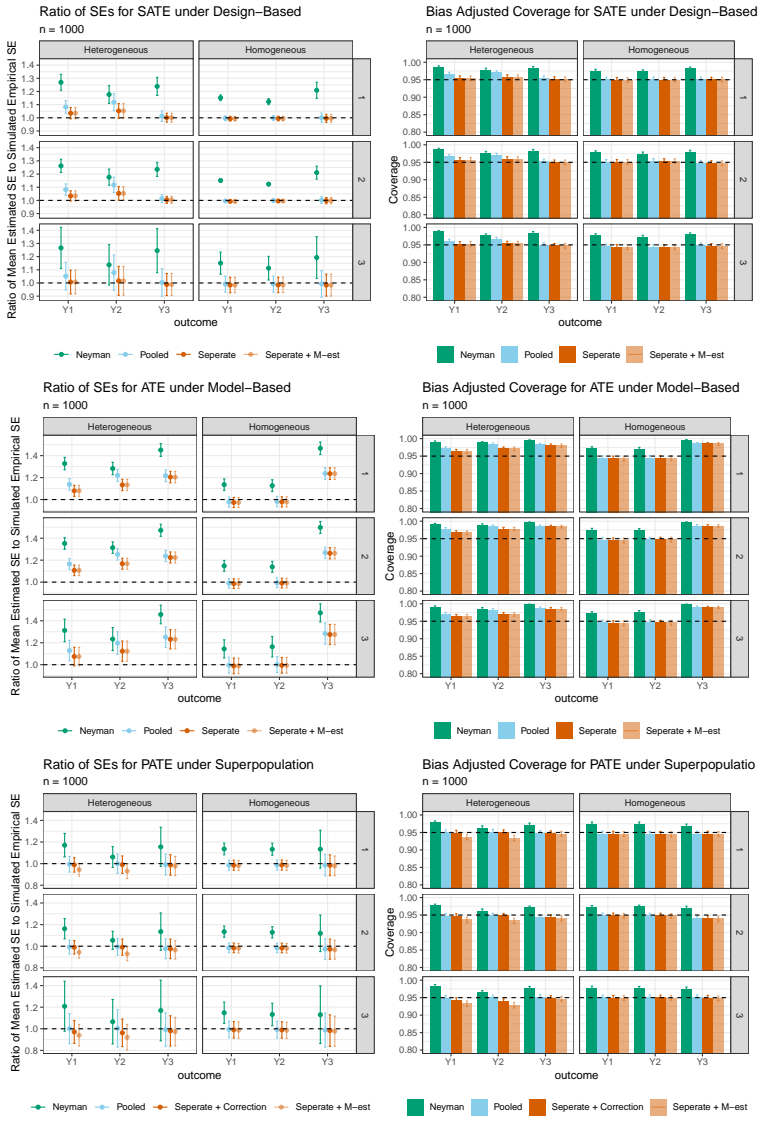
- Investigators using exact balancing weights can switch from weighted difference-in-means intervals to interacted-regression intervals and get the same point estimate with nominal or conservative coverage and standard errors roughly 10 to 45 percent smaller in the simulated settings.
- With inverse-propensity or approximate balancing weights, the same approach shortens intervals as well; when a prognostic covariate remains imbalanced after weighting, the point estimate can move toward the balanced estimate, effectively acting as augmentation.
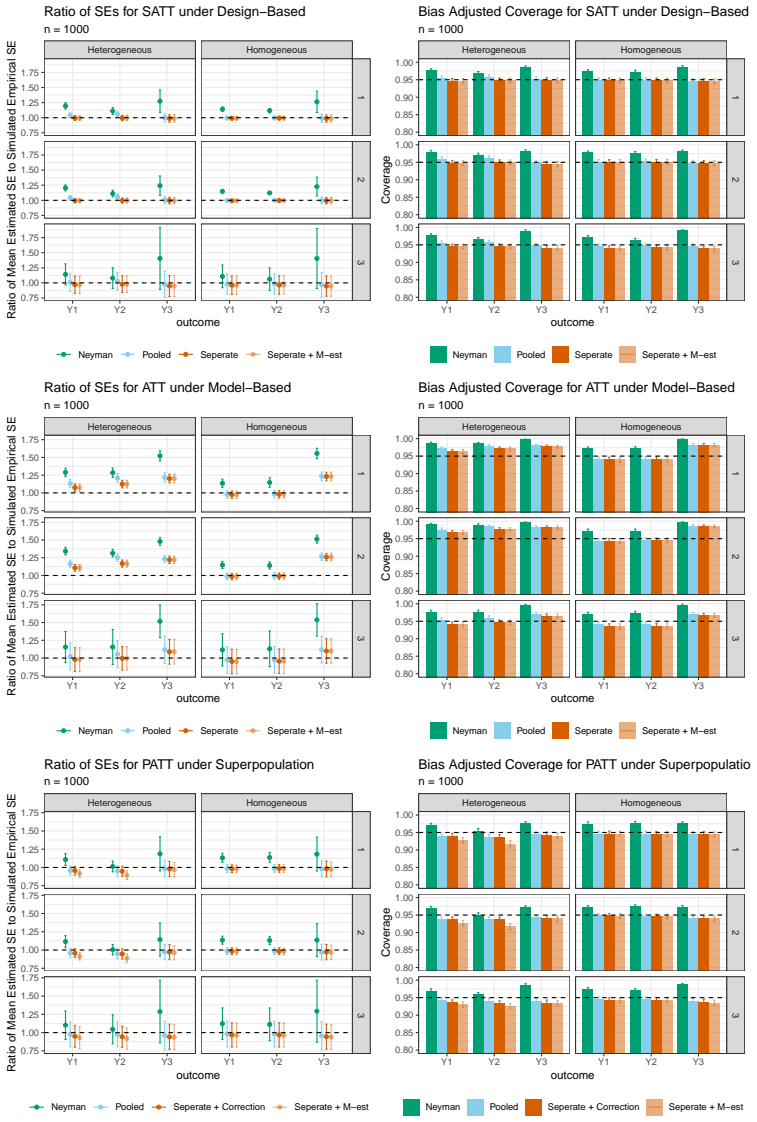
- For superpopulation estimands the correction in equation (7) is required; without it, residualized intervals can undercover, and the paper reports slight undercoverage for the treated-population target in some simulations.
- The size of the precision gain depends on how well the covariates predict the outcome: the empirical re-analyses show roughly 21 to 25 percent standard-error reductions in studies with prognostic covariates and only 1 to 7 percent where covariates are weakly prognostic.
- The recommended estimator is the same under design-based and model-based resampling, which lets researchers avoid framework-specific procedures even though the meaning of the estimand differs between frameworks.
Reading between the lines
- Because the paper shows the residualized variance is driven only by variation orthogonal to the balancing features, using richer outcome models for the residualization step—splines, kernels, or other flexible fits—should shrink intervals further whenever the true outcome model is nonlinear; the paper leaves model choice open but does not demonstrate the gains.
- The paper's distinction between sample and superpopulation estimands implies that software reporting weight uncertainty through M-estimation may be silently targeting sample effects unless it also estimates the covariate means; users should check which estimand the reported interval covers.
- The same residualization logic should apply to matching estimators that can be written as weights: intervals after matching with covariate adjustment ought to shorten without losing coverage, a direct extension that the paper notes in passing but does not simulate.
- A natural stress test would vary the balancing features (higher moments, non-negative weights, tolerance level) to see whether the conservative coverage guarantee persists when balance is exact only up to a tolerance, since real implementations of entropy balancing use small tolerances.
Signed reviews
Editorial analysis
A structured set of objections, weighed in public.
Referee Report
Summary. The paper proposes that, after constructing balancing or propensity weights, researchers should estimate standard errors from a weighted Lin-style regression that includes the centered balancing covariates and their interactions with treatment, using HC0 robust standard errors. It argues that for weights achieving exact balance, these residualized standard errors are valid or conservative under design-based, model-based, and superpopulation resampling, and that for IPW or approximate balancing weights they improve precision through augmentation. The paper supports these claims with simulations across three designs, three outcome models, homogeneity/heterogeneity, and multiple estimands, as well as re-analyses of three published studies.
Significance. If the central claims hold, the proposal is practically valuable: it gives a simple, software-implementable recipe that can reduce estimated standard errors by 10-45% while preserving or improving coverage, and it connects causal inference practice to the survey-sampling linearization literature. The manuscript is honest about its debts to prior work, cites the relevant literature, and does not appear to tune parameters to force the simulation results. Its main weakness is that the design-based justification for exact balancing weights is asserted rather than proved, and some of the supporting algebra for nonlinear outcomes is not correct as written. The paper would be a useful contribution after the theoretical gaps are closed and the scope of the IPW recommendation is clarified.
major comments (5)
- [§4.2.1] The design-based argument for exact balancing weights rests on an unproved extension of Abadie et al. (2020). That paper's conservatism result for HC0 standard errors is for unweighted multiple regression with fixed regressors, while survey linearization (Deville and Särndal 1992; D'Arrigo and Skinner 2010) treats the sampling design as fixed and the calibration totals as known. Here the balancing weights w(Z) are recomputed under each treatment assignment, making the estimator a nonlinear function of Z, and the HC0 sandwich is evaluated at a single realized weight. The sentence 'Confirming the above intuition...' is not a proof. This gap is load-bearing because the abstract's claim that the standard errors are 'asymptotically correct' for exact balancing weights under design-based inference depends on it. The authors should either supply a theorem with regularity conditions or clearly identify a published result that covers weighted regression with re-estimated balancing weights.
- [§4.2.2, Eq. (6)] The treatment of omitted nonlinear terms is not correct. The paper writes the conditional variance as w1'V[epsilon1]w1 + w0'V[epsilon0]w0. If the true CEF contains an omitted h(phi(X)) component, that component is part of epsilon and contributes w1'V[alpha1 h]w1 + w0'V[alpha0 h]w0, which is not zero in general. The claim that these components vanish because the impact of h is 'independent of w1 and w0' confuses independence from the weights with zero weighted variance. Thus the statement that the wLS standard error is appropriate 'regardless of whether Y1 and Y0 are truly linear' is not justified by the algebra presented. A correct derivation, perhaps based on projection arguments, is needed.
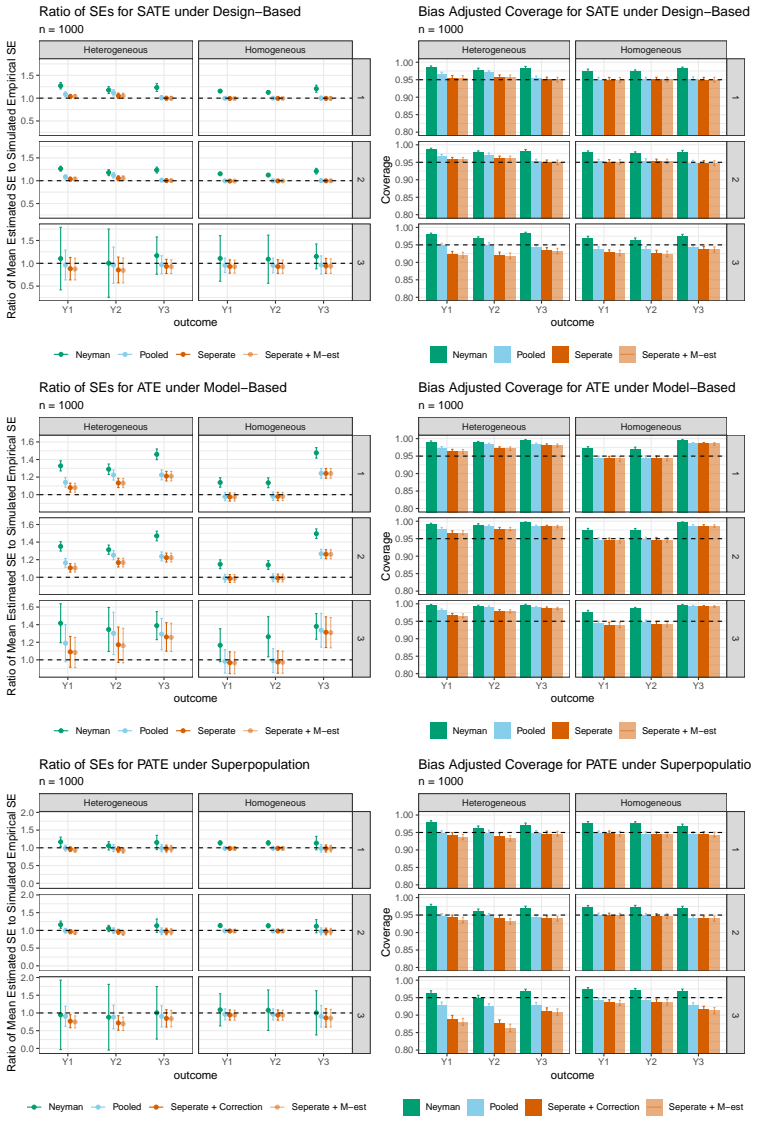
- [§5.2, Figure 3] For IPW weights, the simulations show undercoverage under Design 3 in the design-based and superpopulation rows, even with the correction. The text attributes this to extreme weights caused by the probit model's inability to handle leptokurtic selection errors and reports that a robust GLM fixes the problem, but no simulation results for that claim are shown. Since Section 4.1 recommends the proposal 'regardless of the origins of the weights,' this exception should either be resolved in the simulations or explicitly carved out of the recommendation, with the conditions under which the method should not be used stated in the main text rather than only in a qualitative aside.
- [§3.1, footnote 2] The design-based SATT is defined as a design-marginalized estimand: the expected effect on the treated over the randomization distribution. This is a new target, not the effect on the treated in the realized sample. The paper claims empirically that coverage for the oracle realized treated effect also maintains nominal rates, but provides no theory. If the paper's contribution includes design-based inference for the ATT, the estimand shift should be justified more carefully, and the finite-sample coverage for the realized SATT should either be proved or presented only as exploratory evidence.
- [§4.2.3, Eq. (7)] The superpopulation correction is imported from Berk et al. (2013), Negi and Wooldridge (2021), and Ding (2023) without a derivation for the weighted, exact-balancing setting considered here. The simulations show 'slight undercoverage' for the PATT and the paper calls this 'an area for further research.' Since the abstract claims the method extends to superpopulation sampling with a finite sample correction, the correction should be derived for the weighted estimator or the scope of the claim should be narrowed. A heuristic citation is not sufficient for the central abstract claim.
minor comments (5)
- [§5] The covariance specification for the multivariate normal covariates lists Cov[X1, X2] twice; presumably the second entry is Cov[X1, X3] = -0.5.
- [Figures 1-4] The figure legends spell 'Separate' as 'Seperate' in all panels, and the n=1000 annotation is repeated in every panel rather than stated once in the caption.
- [§6.4] The phrase 'we use conduct both exact entropy balancing and inverse propensity score weighting' contains a repeated verb and should read 'we conduct both...'.
- [Throughout] There are several typos, including 'respecitvely' (§2), 'variaion' (§4.1), and 'innocous' (§4.2). These should be corrected in a final pass.
- [§4.2.3] The acronym 'BNWD' is used without definition; it should be spelled out when first introduced.
Circularity Check
No significant circularity: residualized standard errors are justified by independent external results and regression algebra; self-citations are supportive only.
full rationale
The paper's central recommendation, HC0 standard errors from the weighted Lin regression in Eq. (2), is not obtained by fitting a parameter that is then renamed as a prediction, nor by defining the estimand as the estimator's own expectation. The design-based justification (Sec. 4.2.1) appeals to Abadie et al. (2020) for unweighted multiple regression under design-based asymptotics and to survey linearization (Deville and Sarndal 1992; D'Arrigo and Skinner 2010) for calibration weights; these are independent published results, not self-citations. The step 'Confirming the above intuition...' is an analogy or extension rather than a proof, so the design-based coverage claim for recomputed balancing weights may fail in some regimes, but that is a validity and correctness risk, not a circular reduction. The model-based derivation (Sec. 4.2.2, Eqs. 4-6) is direct algebra: the conditional variance of the weighted difference in means given X and Z equals the weighted variance of residuals, and the HC0 estimator from the interacted regression operationalizes exactly that expression; no input is assumed equal to the output. The superpopulation correction (Eq. 7) is imported from Berk et al. (2013), Negi and Wooldridge (2021), and Ding (2023), again external. Self-citations (Hazlett 2020; Hartman et al. 2024; Hazlett and Shinkre 2024) are supportive: they motivate kernel balancing, approximate balancing, and the interacted-regression point-estimate interpretation, but the paper's variance claim does not reduce to these references. Simulations evaluate coverage and ratios of estimated to empirical standard errors; no fitted constant is relabeled as a theoretical result. The term 'residualized' explicitly renames the survey-linearization variance estimator (Sec. 4.1), and the paper acknowledges this prior literature, so the renaming does not masquerade as a new derivation. Overall, no load-bearing step is equivalent to its input by construction.
Assumptions & free parameters
assumptions (7)
- domain assumption SUTVA and consistency hold: no interference, single version of treatment, Yi(z)=Yi for unit i with Zi=z.
- domain assumption Conditional ignorability {Y(1),Y(0)} perpendicular Z given X.
- domain assumption Exact balancing weights satisfy the moment constraints with delta=0.
- domain assumption Finite-population asymptotic framework with bounded higher moments and treatment/selection probabilities bounded away from zero.
- ad hoc to paper The HC0 sandwich result of Abadie et al. (2020) applies to weighted regression with re-estimated balancing weights.
- domain assumption For IPW simulations, the probit propensity score model is correct or at least not severely misspecified; extreme weights caused by leptokurtic selection errors invalidate coverage.
- standard math Standard weighted least squares and sandwich algebra (FWL theorem, HC0 formula).
invented entities (1)
-
Design-marginalized SATT (expected treatment effect on the treated over the randomization distribution)
Cite this review
Pith. "Pith review of Inference with weights: Residualization produces short, valid intervals for varying estimands and varying resampling processes." pith.science (2026). https://pith.science/paper/C46VARYX
@misc{pith2026250719607,
  author       = {Pith},
  title        = {Pith review of: Inference with weights: Residualization produces short, valid intervals for varying estimands and varying resampling processes},
  year         = {2026},
  howpublished = {\url{https://pith.science/paper/C46VARYX}},
  note         = {Machine review of arXiv:2507.19607}
}
read the original abstract
Weighting procedures are used in observational causal inference to adjust for covariate imbalance within the sample. Common practice for inference is to estimate robust standard errors from a weighted regression of outcome on treatment. However, it is well known that weighting can inflate variance estimates, sometimes significantly, leading to standard errors and confidence intervals that are overly conservative. We instead examine and recommend the use of robust standard errors from a weighted regression that additionally includes the balancing covariates and their interactions with treatment. We show that these standard errors are more precise and asymptotically correct for weights that achieve exact balance under multiple common resampling frameworks, including design-based and model-based inference, as well as superpopulation sampling with a finite sample correction. Gains to precision can be quite significant when the balancing weights adjust for prognostic covariates. For procedures that balance only approximately or in expectation, such as inverse propensity weighting or approximate balancing weights, our proposed method improves precision by reducing residuals through augmentation with the parametric model. We demonstrate our approach through simulation and re-analysis of multiple empirical studies.
Figures
Figures from the paper (1 more)

Reference graph
Works this paper leans on
-
[1]
Abadie, A., Athey, S., Imbens, G. W., and Wooldridge, J. M. (2020). Sampling- Based versus Design - Based Uncertainty in Regression Analysis . Econometrica , 88(1):265--296. \_eprint: https://onlinelibrary.wiley.com/doi/pdf/10.3982/ECTA12675
-
[2]
Ben-Michael, E., Feller, A., Hirshberg, D. A., and Zubizarreta, J. R. (2021). The balancing act in causal inference
work page 2021
-
[3]
Berk, R., Pitkin, E., Brown, L., Buja, A., George, E., and Zhao, L. (2013). Covariance adjustments for the analysis of randomized field experiments. Evaluation Review , 37(3-4):170--196. PMID: 24647925
work page 2013
-
[4]
Black, R. C. and Owens, R. J. (2016). Courting the president: how circuit court judges alter their behavior for promotion to the supreme court. American Journal of Political Science , 60(1):30--43
work page 2016
-
[5]
Breidt, F. J. and Opsomer, J. D. (2017). Model-Assisted Survey Estimation with Modern Prediction Techniques . Statistical Science , 32(2):190 -- 205
work page 2017
-
[6]
Bruns-Smith, D., Dukes, O., Feller, A., and Ogburn, E. L. (2025). Augmented balancing weights as linear regression. Journal of the Royal Statistical Society Series B: Statistical Methodology , page qkaf019
work page 2025
-
[7]
Chan, K. C. G., Yam, S. C. P., and Zhang, Z. (2016). Globally efficient non-parametric inference of average treatment effects by empirical balancing calibration weighting. Journal of the Royal Statistical Society Series B: Statistical Methodology , 78(3):673--700
work page 2016
-
[8]
Chattopadhyay, A. and Zubizarreta, J. R. (2023). On the implied weights of linear regression for causal inference. Biometrika , 110(3):615--629
work page 2023
Show all 40 references
-
[9]
R., Ben-Michael, E., Feller, A., and Zubizarreta, J
Cohn, E. R., Ben-Michael, E., Feller, A., and Zubizarreta, J. R. (2023). Balancing weights for causal inference. In Handbook of Matching and Weighting Adjustments for Causal Inference , pages 293--312. Chapman and Hall/CRC
2023
-
[10]
and Skinner, C
D'Arrigo, J. and Skinner, C. J. (2010). Linearization variance estimation for generalized raking estimators in the presence of nonresponse. Survey Methodology , 36(2):181--192
2010
-
[11]
and S \"a rndal, C.-E
Deville, J.-C. and S \"a rndal, C.-E. (1992). Calibration estimators in survey sampling. Journal of the American statistical Association , 87(418):376--382
1992
-
[12]
Ding, P. (2023). A first course in causal inference
2023
-
[13]
Ding, P., Li, X., and Miratrix, L. W. (2017). Bridging finite and super population causal inference. Journal of Causal Inference , 5(2):20160027
2017
-
[14]
and Waugh, F
Frisch, R. and Waugh, F. V. (1933). Partial time regressions as compared with individual trends. Econometrica: Journal of the Econometric Society , pages 387--401
1933
-
[15]
Fuller, W. (2009). Frontmatter . John Wiley & Sons, Ltd
2009
-
[16]
E., Sachs, M
Gabriel, E. E., Sachs, M. C., Martinussen, T., Waernbaum, I., Goetghebeur, E., Vansteelandt, S., and Sj \"o lander, A. (2024). Inverse probability of treatment weighting with generalized linear outcome models for doubly robust estimation. Statistics in Medicine , 43(3):534--547
2024
-
[17]
Greifer, N. (2025). WeightIt: Weighting for Covariate Balance in Observational Studies . R package version 1.4.0.9002
2025
-
[18]
and Stuart, E
Greifer, N. and Stuart, E. A. (2021). Matching methods for confounder adjustment: An addition to the epidemiologist’s toolbox. Epidemiologic Reviews , 43(1):118--129
2021
-
[19]
Hainmueller, J. (2012). Entropy Balancing for Causal Effects : A Multivariate Reweighting Method to Produce Balanced Samples in Observational Studies . Political Analysis , 20(1):25--46. Publisher: Cambridge University Press
2012
-
[20]
Hartman, E., Hazlett, C., and Sterbenz, C. (2024). Kpop: A kernel balancing approach for reducing specification assumptions in survey weighting. Journal of the Royal Statistical Society Series A: Statistics in Society , page qnae082
2024
-
[21]
Hazlett, C. (2020). Kernel balancing. Statistica Sinica , 30(3):1155--1189
2020
-
[22]
weighting problem
Hazlett, C. and Shinkre, T. (2024). Demystifying and avoiding the ols" weighting problem": Unmodeled heterogeneity and straightforward solutions. arXiv preprint arXiv:2403.03299
2024 arXiv
-
[23]
Hern \'a n, M. A. and Robins, J. M. (2020). Causal inference . Boca Raton: Chapman & Hall/CRC
2020
-
[24]
W., and Ridder, G
Hirano, K., Imbens, G. W., and Ridder, G. (2003). Efficient estimation of average treatment effects using the estimated propensity score. Econometrica , 71(4):1161--1189
2003
-
[25]
E., Imai, K., King, G., and Stuart, E
Ho, D. E., Imai, K., King, G., and Stuart, E. A. (2007). Matching as nonparametric preprocessing for reducing model dependence in parametric causal inference. Political analysis , 15(3):199--236
2007
-
[26]
and Waernbaum, I
K \"a llberg, D. and Waernbaum, I. (2023). Large sample properties of entropy balancing estimators of average causal effects. Econometrics and Statistics
2023
-
[27]
Ladd, J. M. and Lenz, G. S. (2009). Exploiting a rare communication shift to document the persuasive power of the news media. American Journal of Political Science , 53(2):394--410
2009
-
[28]
Lin, W. (2013). Agnostic notes on regression adjustments to experimental data: Reexamining Freedman ’s critique. The Annals of Applied Statistics , 7(1):295--318. Publisher: Institute of Mathematical Statistics
2013
-
[29]
Lovell, M. C. (1963). Seasonal adjustment of economic time series and multiple regression analysis. Journal of the American Statistical Association , 58(304):993--1010
1963
-
[30]
Lunceford, J. K. and Davidian, M. (2004). Stratification and weighting via the propensity score in estimation of causal treatment effects: a comparative study. Statistics in Medicine , 23(19):2937--2960
2004
-
[31]
and Wooldridge, J
Negi, A. and Wooldridge, J. (2021). Revisiting regression adjustment in experiments with heterogeneous treatment effects. Econometric Reviews , 40(5):504--534
2021
-
[32]
Reifeis, S. A. and Hudgens, M. G. (2022). On variance of the treatment effect in the treated when estimated by inverse probability weighting. American Journal of Epidemiology , 191(6):1092--1097
2022
-
[33]
Rosenbaum, P. R. and Rubin, D. B. (1983). The central role of the propensity score in observational studies for causal effects. Biometrika , 70(1):41--55
1983
-
[34]
Rubin, D. B. (1974). Estimating causal effects of treatments in randomized and nonrandomized studies. Journal of educational Psychology , 66(5):688
1974
-
[35]
Rubin, D. B. (1980). Randomization analysis of experimental data: The fisher randomization test comment. Journal of the American statistical association , 75(371):591--593
1980
-
[36]
a rndal, C.-E. and Lundstr \
S \"a rndal, C.-E. and Lundstr \"o m, S. (2005). Estimation in surveys with nonresponse . John Wiley & Sons
2005
-
[37]
Stuart, E. A. (2010). Matching methods for causal inference: A review and a look forward. Statistical science: a review journal of the Institute of Mathematical Statistics , 25(1):1
2010
-
[38]
and Yang, E
Xu, Y. and Yang, E. (2023). Hierarchically regularized entropy balancing. Political Analysis , 31(3):457--464
2023
-
[39]
and Percival, D
Zhao, Q. and Percival, D. (2017). Entropy balancing is doubly robust. Journal of Causal Inference , 5(1):20160010
2017
-
[40]
Zubizarreta, J. R. (2015). Stable weights that balance covariates for estimation with incomplete outcome data. Journal of the American Statistical Association , 110(511):910--922
2015
Reviewed August 6, 2026 · model on record in the stance chip above.
Discussion (0). Continue with ORCID to comment.