Delegation Rights: Property, Agency, and Investment Incentives in the Age of AI Agents
Pith reviewed 2026-07-01 02:06 UTC · model grok-4.3
The pith
Certified delegation rights restore investment incentives by conditioning AI agent access on verifiable standards.
A machine-rendered reading of the paper's core claim, the machinery that carries it, and where it could break.
Core claim
The paper claims that delegation rights represent revocable authority for proxy execution, and that certified delegation allocates residual control conditionally on meeting standards for authorization, revocability, auditability, rate limits, data minimization, and risk mitigation, thereby reducing deadweight loss compared to platform or user control regimes.
What carries the argument
Residual control over the mode of account execution in a three-party model between user, AI agent provider, and platform.
If this is right
- Platform control weakens the user-agent coalition's disagreement payoff, depressing investment.
- User control reduces hold-up but fails to internalize risks sufficiently.
- Certified delegation restores incentives for delegation while bounding residual risk through conditional access.
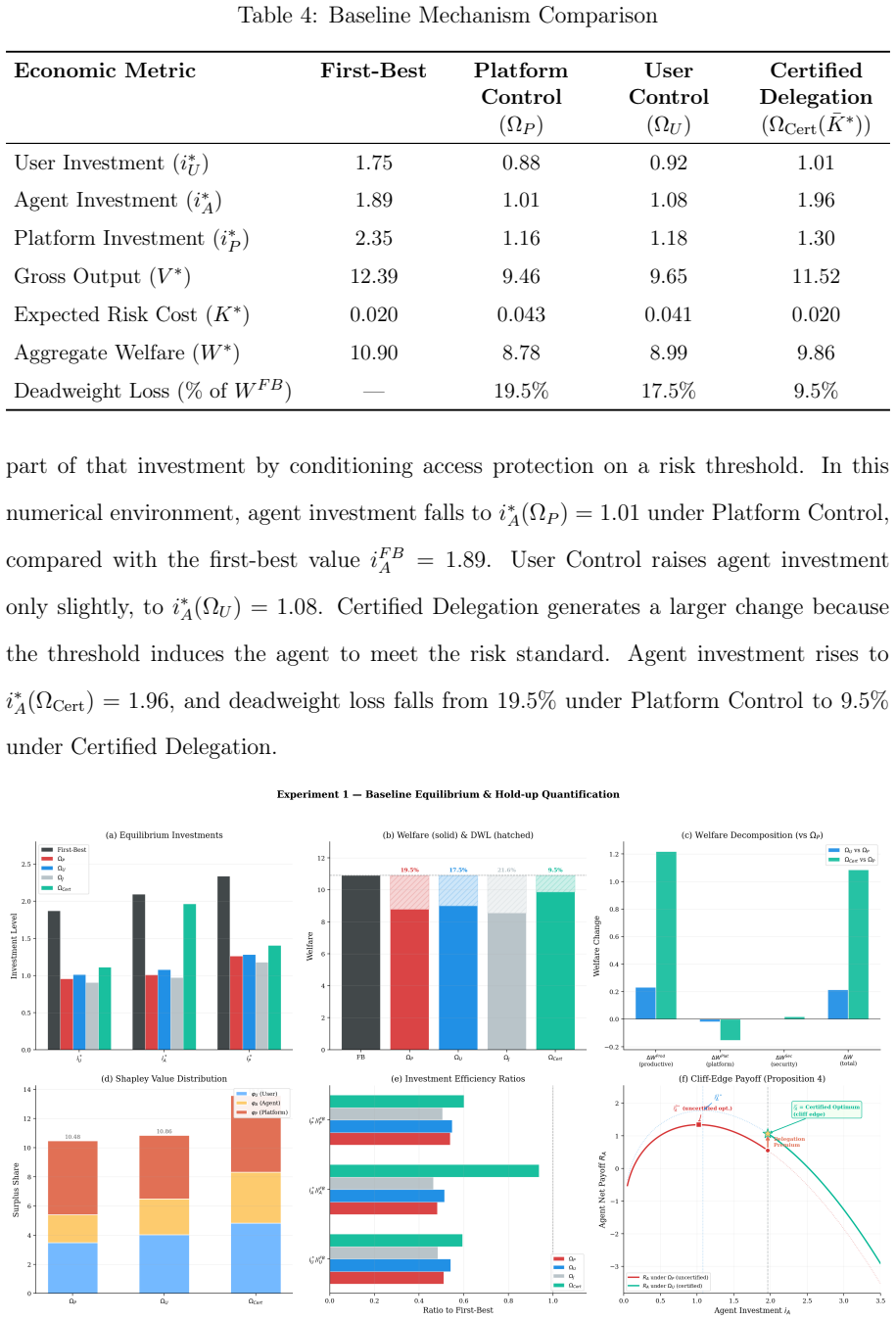
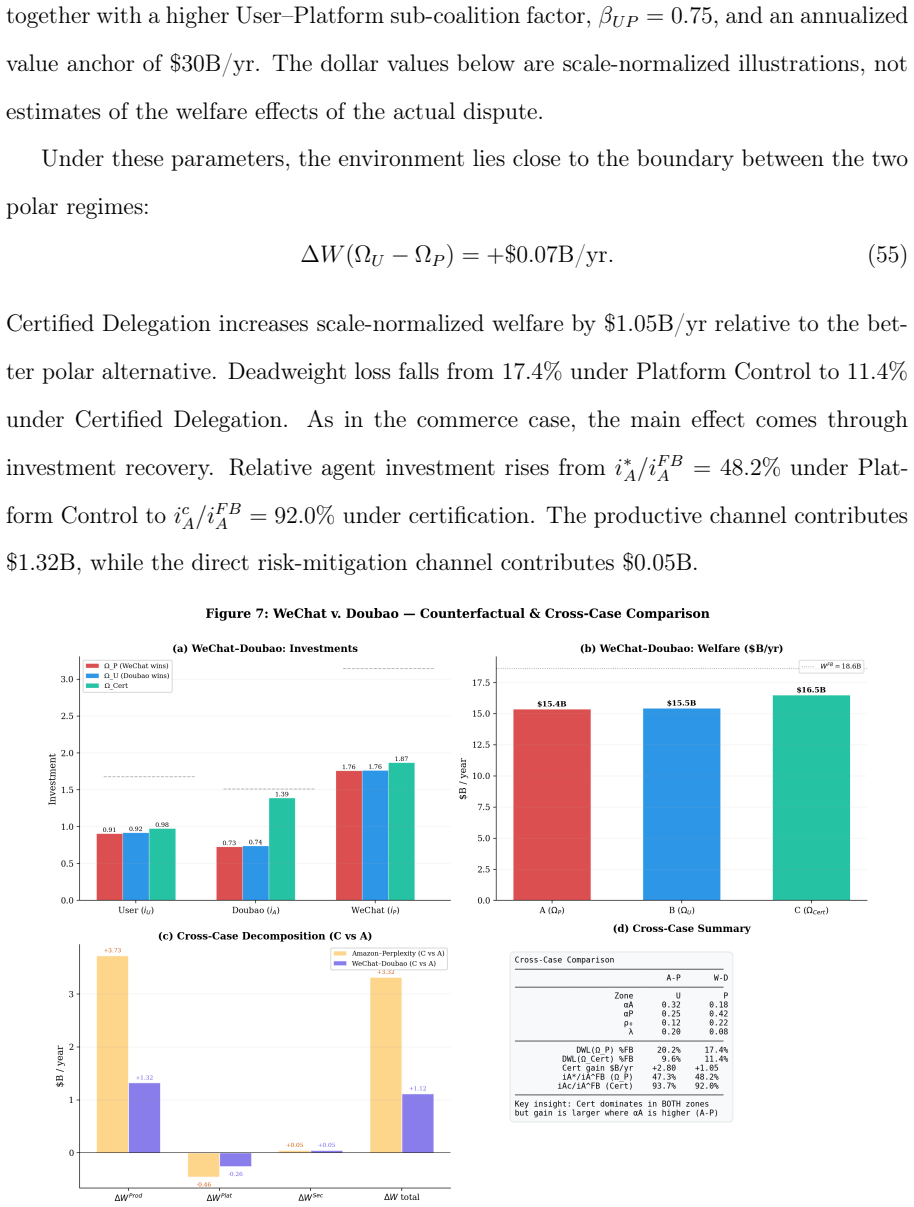
- Mechanism simulations demonstrate reduced deadweight loss under this regime.
Where Pith is reading between the lines
- The approach may apply to delegation in other digital services beyond AI agents.
- Testing could involve observing investment changes when platforms implement certified delegation options.
- Certification functions as an economic governance tool allocating control rights.
Load-bearing premise
The model assumes that under platform control the platform's discretionary veto weakens the user-agent coalition's disagreement payoff and depresses relationship-specific investment.
What would settle it
A simulation or empirical study showing no increase in relationship-specific investments or no reduction in deadweight loss under certified delegation would falsify the central claim.
Figures



read the original abstract
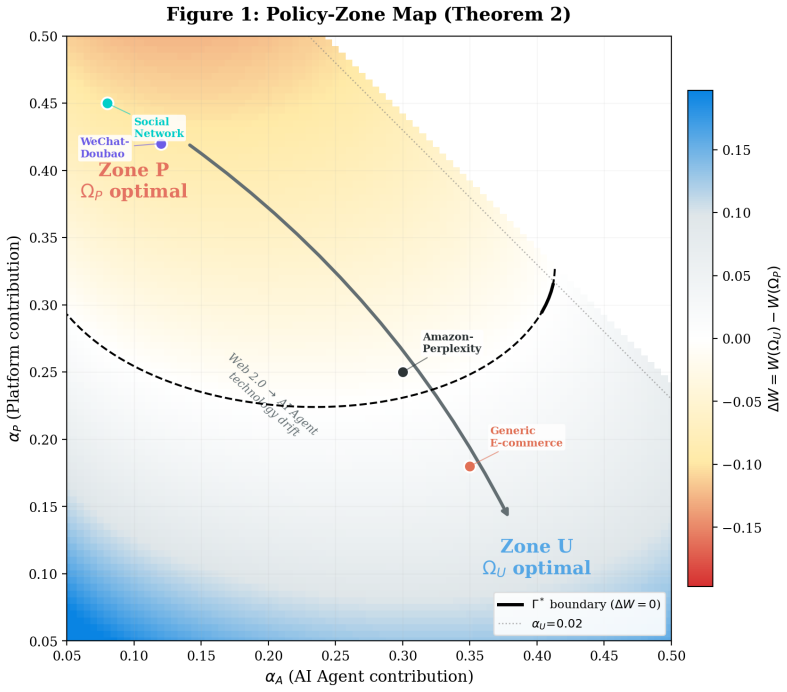
AI agents increasingly operate inside digital accounts by exercising privileges that users already hold, raising a new control question: whether an existing account entitlement must be exercised manually or may be exercised through a user-authorized automated proxy. We define \emph{delegation rights} as the revocable, identity-preserving, scope-limited, and mode-specific authority of an account holder to authorize such proxy execution. We develop a three-party incomplete-contracts model with a User, an AI Agent provider, and a Platform. The contested object is not platform ownership, account transferability, data portability, or unrestricted API access, but residual control over the mode of account execution. Under Platform Control, the platform can protect infrastructure, identity systems, privacy boundaries, and third parties, but its discretionary veto weakens the User--Agent coalition's disagreement payoff and depresses relationship-specific investment. Under User Control, hold-up is reduced, but security, privacy, congestion, and third-party risks may remain insufficiently internalized. We then analyze \emph{Certified Delegation}, under which access protection is conditional on verifiable authorization, revocability, auditability, rate-limit compliance, data minimization, and risk mitigation. Certification is therefore not merely a technical safety screen; it is a conditional allocation of residual control. Illustrative mechanism simulations show how this regime can reduce deadweight loss by restoring delegation incentives while bounding residual risk.
Editorial analysis
A structured set of objections, weighed in public.
Referee Report
Summary. The paper defines delegation rights as revocable, identity-preserving, scope-limited authority for users to authorize AI agent proxies in digital accounts. It develops a three-party incomplete-contracts model (User, AI Agent provider, Platform) comparing Platform Control (discretionary veto weakens User-Agent coalition disagreement payoff and depresses investment), User Control (reduced hold-up but uninternalized risks), and Certified Delegation (conditional on verifiable authorization, revocability, auditability, etc.). Illustrative mechanism simulations are presented to show that Certified Delegation reduces deadweight loss by restoring delegation incentives while bounding residual risk.
Significance. If the central claim holds after robustness checks, the paper contributes a new framing of residual control rights over account execution modes in AI settings, extending incomplete-contracts theory to platform-AI interactions. The three-party structure and focus on certification as a conditional allocation of control are strengths, though the illustrative simulations limit immediate applicability without analytical backing or sensitivity results.
major comments (1)
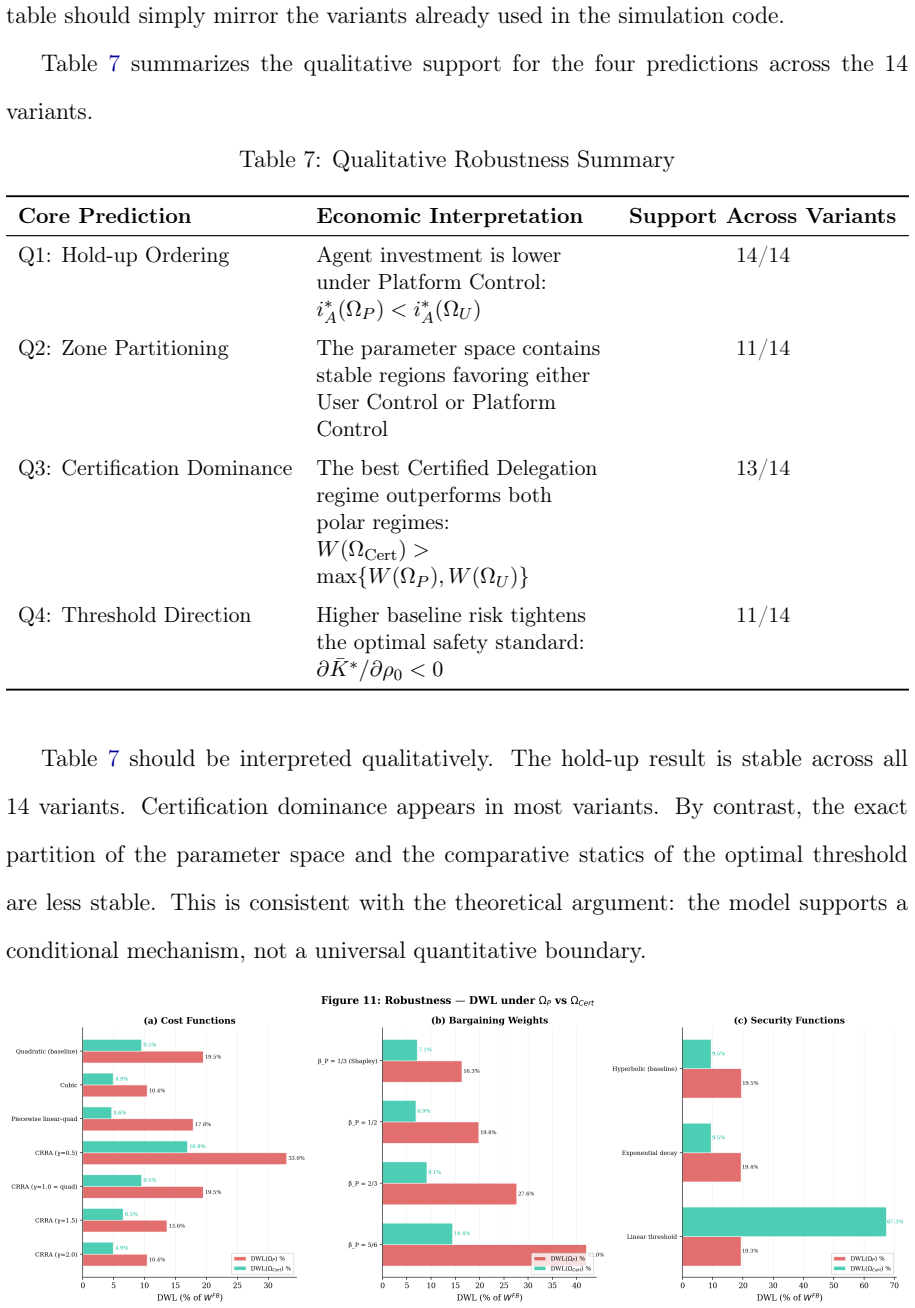
- [mechanism simulations] The central claim that Certified Delegation reduces deadweight loss rests on illustrative mechanism simulations. No equilibrium derivation, closed-form comparative statics, or sensitivity table is referenced in the provided description; the ranking of regimes therefore depends on the specific payoff functions and parameter values chosen. Altering functional forms (e.g., convex veto costs or positive certification costs) could reverse the result without violating the incomplete-contracts setup.
Simulated Author's Rebuttal
We thank the referee for the detailed report and constructive feedback on the mechanism simulations. We address the major comment below.
read point-by-point responses
-
Referee: [mechanism simulations] The central claim that Certified Delegation reduces deadweight loss rests on illustrative mechanism simulations. No equilibrium derivation, closed-form comparative statics, or sensitivity table is referenced in the provided description; the ranking of regimes therefore depends on the specific payoff functions and parameter values chosen. Altering functional forms (e.g., convex veto costs or positive certification costs) could reverse the result without violating the incomplete-contracts setup.
Authors: We agree that the simulations are illustrative and that the paper does not derive closed-form equilibria or provide exhaustive sensitivity tables. The core contribution is a three-party incomplete-contracts model that frames delegation rights as a conditional allocation of residual control over account execution mode. In this tradition, the analysis emphasizes qualitative predictions about how control rights affect relationship-specific investment and risk internalization, rather than quantitative robustness across all functional forms. The simulations demonstrate a mechanism by which Certified Delegation can reduce deadweight loss relative to the other regimes under the model's maintained assumptions. We do not claim that the ranking is invariant to arbitrary changes in functional forms. To strengthen the presentation, we will add a dedicated sensitivity section in the revision that varies key parameters (including convex costs and certification costs) and reports the conditions under which the ranking is preserved. revision: yes
Circularity Check
No significant circularity detected
full rationale
The paper develops a three-party incomplete-contracts model and presents illustrative mechanism simulations as evidence that Certified Delegation can reduce deadweight loss. The provided abstract and text contain no equations, fitted parameters, or self-citations where a claimed prediction or result reduces by construction to its own inputs. The modeling assumptions (e.g., effects of discretionary veto on disagreement payoffs) are stated explicitly as part of the setup rather than derived from the target outcome, and the simulations are described as illustrative without any indication that outcomes are forced by parameter fitting or renaming. The derivation chain remains self-contained against external benchmarks.
Axiom & Free-Parameter Ledger
axioms (1)
- domain assumption Incomplete contracts framework applies directly to residual control over AI agent execution mode
invented entities (1)
-
delegation rights
no independent evidence
Reference graph
Works this paper leans on
-
[1]
Regulation (eu) 2016/679 (general data protection regulation), article 20: Right to data portability
European Parliament and Council. Regulation (eu) 2016/679 (general data protection regulation), article 20: Right to data portability. Official Journal of the European Union, L 119,
2016
-
[2]
Regulation (eu) 2022/1925 on contestable and fair markets in the digital sector (digital markets act)
European Parliament and Council. Regulation (eu) 2022/1925 on contestable and fair markets in the digital sector (digital markets act). Official Journal of the European Union, L 265, 2022a. European Parliament and Council. Regulation (eu) 2022/2065 on a single market for digital services (digital services act). Official Journal of the European Union, L 27...
2022
-
[3]
Regulation (eu) 2024/1689 laying down harmonised rules on artificial intelligence (ai act)
European Parliament and Council. Regulation (eu) 2024/1689 laying down harmonised rules on artificial intelligence (ai act). Official Journal of the European Union,
2024
-
[4]
ISO/IEC 42001:2023 — artificial intelli- gence management system
International Organization for Standardization. ISO/IEC 42001:2023 — artificial intelli- gence management system. ISO,
2023
-
[5]
doi: 10.1086/466922. Jan Krämer. Personal data portability in the platform economy: Economic implications and policy recommendations.Journal of Competition Law & Economics, 17(2):263– 308,
-
[6]
Jan Krämer and Nadine Stüdlein
doi: 10.1093/joclec/nhaa030. Jan Krämer and Nadine Stüdlein. Data portability, data disclosure and data-induced switching costs: Some unintended consequences of the general data protection regula- tion.Economics Letters, 181:99–103,
-
[7]
Jan Krämer, Pierre Senellart, and Alexandre de Streel
doi: 10.1016/j.econlet.2019.05.015. Jan Krämer, Pierre Senellart, and Alexandre de Streel. Making data portability more effective for the digital economy. Technical report, Centre on Regulation in Europe (CERRE),
-
[8]
White, Margaret Mitchell, Timnit Gebru, Ben Hutchinson, Jamila Smith-Loud, Daniel Theron, and Parker Barnes
Inioluwa Deborah Raji, Andrew Smart, Rebecca N. White, Margaret Mitchell, Timnit Gebru, Ben Hutchinson, Jamila Smith-Loud, Daniel Theron, and Parker Barnes. Clos- ing the AI accountability gap: Defining an end-to-end framework for internal algorith- mic auditing. InProceedings of the 2020 Conference on Fairness, Accountability, and Transparency, pages 33–44,
2020
-
[9]
Jean-Charles Rochet and Jean Tirole
doi: 10.1145/3351095.3372873. Jean-Charles Rochet and Jean Tirole. Platform competition in two-sided markets.Jour- nal of the European Economic Association, 1(4):990–1029,
-
[10]
Van buren v
71 Supreme Court of the United States. Van buren v. united states, 593 u.s. 374 (2021),
2021
-
[11]
hiq labs, inc
United States Court of Appeals for the Ninth Circuit. hiq labs, inc. v. linkedin corp., 31 f.4th 1180 (9th cir. 2022),
2022
-
[12]
WebArena: A Realistic Web Environment for Building Autonomous Agents
Shuyan Zhou, Frank F. Xu, Hao Zhu, Xuhui Zhou, Robert Lo, Abishek Sridhar, Xianyi Cheng, Tianyue Ou, Yonatan Bisk, Daniel Fried, Uri Alon, and Graham Neubig. WebArena: A realistic web environment for building autonomous agents. arXiv:2307.13854,
work page internal anchor Pith review Pith/arXiv arXiv
discussion (0)
Sign in with ORCID, Apple, or X to comment. Anyone can read and Pith papers without signing in.