REVIEW 2 major objections 4 minor 23 references
An Efficient Evolutionary Algorithm for Minimum Cost Submodular Cover
T0 review · 2 major / 4 minor · reviewed 2026-08-14 · deepseek-v4-flash
Pith's one-line read An evolutionary algorithm achieves the first polynomial-time constant bicriteria guarantee for Minimum Cost Submodular Cover.
desk verdict Solid, first-of-its-kind EA guarantee for submodular cover; theory holds up, but the bin-index definition needs an integer repair before it's publishable. read the letter →
The pith
A machine-rendered reading of the paper's core claim, the machinery that carries it, and where it could break.
The reading
What carries the argument
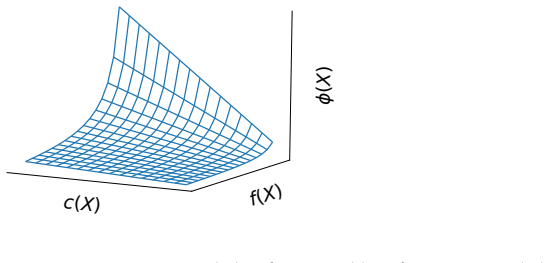
The machinery rests on a bin function that cuts $[0,\tau]$ into $\log_\delta(\epsilon)+1$ intervals of the form $[(1-\delta^i)\tau,(1-\delta^{i+1})\tau)$, with the final bin holding all sets with $f(X) \ge (1-\epsilon)\tau$; each bin holds at most one solution, so the population stays at $O((c_{\max}/c_{\min})\ln(1/\epsilon)n)$. Within a bin, the comparison uses the cost-effectiveness $\varphi(X)=c(X)/\ln(\tau/(\tau-f(X)))$ (with $\varphi(X)=c(X)$ in the first and last bins). This $\varphi$ is chosen so that a solution with $\varphi(X)\le c(A^*)$ is as cost-effective as any greedy step; the bin spacing matches the greedy marginal-gain lemma, so adding the best marginal element always advances a cost-effective solution into a strictly higher bin. Two submodularity lemmas carry the argument: $\tau - f_\tau(X\cup\{x^*\}) \le (1 - c(x^*)/c(A^*))(\tau - f_\tau(X))$, and $c(x^*) \le c(A^*)$.
What would settle it
A counterexample would be an MCSC instance with known optimum $A^*$, $\epsilon$ constant, and $\delta$ chosen in the permitted range $[1 - c_{\min}/c(A^*),\, 1 - c_{\min}/c(S)]$, for which EASC's expected number of iterations to first place a solution in the final bin exceeds $e n ((c_{\max}/c_{\min}) \ln(1/\epsilon) n + 1)^2$ by more than a constant factor; such instances could be produced by exhaustive search over small ground sets and tested by repeated simulation.
Extended reading notes
Core claim
The central result is Theorem 1: for an MCSC instance with optimal solution $A^* \ne \emptyset$, if EASC is run with $\epsilon \in (0,1)$ and $\delta \in [1 - c_{\min}/c(A^*),\, 1 - c_{\min}/c(S)]$, then within an expected $e n ((c_{\max}/c_{\min}) \ln(1/\epsilon) n + 1)^2$ iterations its population contains a set $A$ in the final bin with $f(A) \ge (1-\epsilon)\tau$ and $c(A) \le (\ln(1/\epsilon)+1)c(A^*)$. The proof shows that the highest bin containing a cost-effective set never decreases, and that a specific mutation -- adding the element with maximum marginal benefit per unit cost -- advances that bin by at least one step. When $c_{\max}/c_{\min}$ is polynomial in $n$ and $\epsilon$ is constant, the expected time is polynomial, which is the first such guarantee for an evolutionary algorithm on MCSC.
Load-bearing premise
The guarantee depends on the user supplying a bin parameter $\delta$ that is at least $1 - c_{\min}/c(A^*)$, and since $c(A^*)$ is unknown this requires an upper bound $B$ on the optimum cost with $B \le c(S)$, typically obtained from a greedy solution; if no such bound is available, the proof's bin-progress step fails.
Editorial extensions
If this is right
- When $c_{\max}/c_{\min}$ is polynomially bounded in $n$ and $\epsilon$ is constant, EASC reaches a solution meeting the guarantee in expected polynomial time; the population size stays at $O((c_{\max}/c_{\min})\ln(1/\epsilon)n)$ throughout.
- Once a qualifying solution enters the final bin, the comparison rule in that bin uses only cost, so the guarantee is permanent.
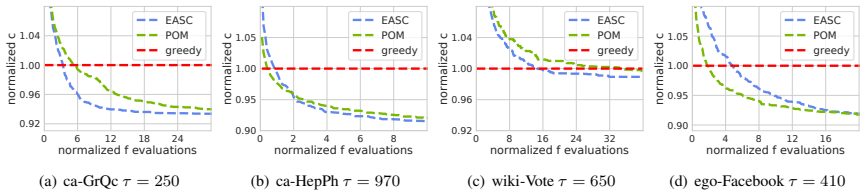
- Because the same $(1-\epsilon,\ \ln(1/\epsilon)+1)$ bicriteria guarantee holds for the greedy algorithm, EASC matches the worst-case guarantee while experiments show it can improve on the greedy solution.
- The bin structure and cost-effectiveness comparison are designed from monotone submodularity and are presented as generalizable ideas for other submodular optimization problems.
Reading between the lines
- If the bin-progress argument generalizes to other monotone submodular objectives (for example submodular maximization under matroid or knapsack constraints), the same logarithmic bin schedule could yield polynomial-time evolutionary guarantees for those problems, replacing generic Pareto populations.
- The iteration bound scales with $(c_{\max}/c_{\min})^2$; for instances with exponentially skewed element costs the guarantee stops being polynomial, so the practical scope is limited to cost profiles within a polynomial factor of each other.
- A tighter or looser upper bound $B$ on $c(A^*)$ changes $\delta$ and therefore the number of bins; the theory only needs $B \le c(S)$, so testing convergence against noisy or loose bounds (for example $B=2c(\text{greedy})$) would probe how robust the practical runtime is to the parameter choice.
Signed reviews
Editorial analysis
A structured set of objections, weighed in public.
Referee Report
Summary. The paper proposes EASC, an evolutionary algorithm for the Minimum Cost Submodular Cover (MCSC) problem. EASC maintains a population with at most one solution per benefit bin, compares solutions in the same bin by a cost-effectiveness measure φ, and mutates a uniformly random population member at each step. The main theoretical contribution is Theorem 1, which claims that, when run indefinitely with ε∈(0,1) and δ in a specific interval, EASC eventually contains a set A with f(A)≥(1−ε)τ and c(A)≤(ln(1/ε)+1)c(A*) in expected O(n^3 ((cmax/cmin) ln(1/ε))^2) iterations. The proof is organized in five parts, establishing monotonicity of a cost-effectiveness progress measure, bin progress via the greedy marginal-gain lemma, preservation of cost-effectiveness, and an expected-iteration bound. The paper also gives an experimental comparison with the greedy algorithm and the POM evolutionary algorithm on four influence-threshold instances. The exposition is generally clear, and the appendix contains proofs of the standard submodularity lemmas. However, the central algorithm and theorem are not well-defined for generic δ and ε because the bin structure uses the generally non-integer quantity log_δ(ε) as both a bin count and a final bin index; this needs a repair. A second, smaller gap appears in one subcase of the proof of Theorem 1. Both issues are fixable without changing the claimed asymptotic result.
Significance. If Theorem 1 holds after the necessary repairs, the paper makes a significant contribution: EASC would be the first evolutionary algorithm with an expected polynomial-time constant bicriteria approximation guarantee for MCSC, avoiding the polynomial-population assumption required by POM. The proof strategy, especially the cost-effectiveness comparison and the use of bin progress, is a genuinely useful idea that may extend to other submodular problems. The paper is also honest in noting in Proposition 2 that the same bicriteria guarantee already holds for the greedy algorithm, so the theoretical novelty is the algorithmic mechanism rather than a new approximation factor. The public code and the careful inclusion of the standard lemmas in the appendix are strengths. The experimental section is illustrative rather than decisive, since it averages only three runs and reports no variance or statistical tests.
major comments (2)
- [Section 2.1, Algorithm 1, Theorem 1] The bin function and the algorithm are not well-defined for generic input parameters. In the definition of bin(X), the index set {0,...,log_δ(ε)−1} and the final case 'bin(X)=log_δ(ε)' require r=log_δ(ε) to be an integer, but for arbitrary δ∈(0,1) and ε∈(0,1) this is generally false; for example, δ=0.5 and ε=0.1 give r≈3.32. As a result, many subsets X are not assigned to any bin, and Algorithm 1's call to bin(X') is undefined. The proof in Section 3 also silently assumes that r is an integer and that bin a+1 exists for every a<r. The manuscript needs a repair, for instance by defining q=ceil(log_δ(ε)), indexing bins 0,...,q, giving the final bin priority whenever f(X)≥(1−ε)τ, and adjusting the population-size bound from q+1 to q+2. With such a repair, the proof steps in Parts One through Five appear to go through, but the current text does not state the repair.
- [Section 3, Part Three, Case (i)] The proof that {x*} is cost-effective when bin({x*})<r is incomplete in the subcase bin({x*})=0. The displayed inequality τ−fτ(x*)≤exp(−c(x*)/c(A*))τ can be rearranged to φ({x*})≤c(A*) only when φ is the ratio c/ln(τ/(τ−f)), but for bin 0 the definition in Section 2.2 sets φ({x*})=c({x*}) instead. The missing argument is supplied by Lemma 2, which gives c(x*)≤c(A*) because f(∅)<τ; invoking Lemma 2 would complete the subcase. As written, this subcase is not proved, although the repair is straightforward.
minor comments (4)
- [Section 2, penultimate paragraph] The sentence 'Lower ϵ and δ values result in less bins' is backwards for ε: decreasing ε increases ln(1/ε) and hence increases the number of bins. Only decreasing δ reduces the bin count.
- [Section 4] The experimental results average only three runs per algorithm and report no error bars, variance, or significance tests. Claims such as 'EASC converges faster than POM' in Section 4.2 should be softened or quantitatively supported.
- [Figure 1] The figure labels the final bin as 'logδ(ϵ)', which is the same non-integer quantity that causes the well-definedness problem in Section 2.1; the figure should be updated to match the repaired integer bin count.
- [Theorem 1] The stated expected-iteration bound of en((cmax/cmin)ln(1/ε)n + 1)^2 depends on the bin-count bound. If the repair uses q=ceil(log_δ(ε)), the additive constant becomes 2, so the bound should be restated to be consistent with the repaired definition.
Circularity Check
No circular derivation: EASC's guarantee is proven from independent submodularity lemmas; the δ parameter is a standard conditional scaling choice, not a fitted prediction.
full rationale
EASC's Theorem 1 is not circular. The proof in Section 3 defines cost-effective sets and shows via Lemmas 1 and 2, which are proven in Appendix 5.2 from monotone submodularity, that cost-effective solutions are never replaced by non-cost-effective ones, that a lower-bin solution can mutate into a strictly higher bin with polynomially bounded probability, and that a final-bin solution satisfies c(A) ≤ (ln(1/ε)+1)c(A*). The f(A) ≥ (1−ε)τ part is true by definition of the final bin, but the cost bound is derived, not assumed. The input δ is required to lie in an interval depending on c(A*), but the paper explicitly shows how to instantiate it from an upper bound B on c(A*) (e.g., the cost of the greedy solution), which is a standard parameter-setting device and does not feed the target solution into the algorithm or the proof. No parameter is fitted to experimental outcomes, and the lemmas are standard and self-contained. The non-integer bin-index issue for generic δ and ε (r = log_δ(ε) need not be an integer) is a genuine well-definedness and correctness defect in the statement, but it is not a circularity: it does not make any claimed result an input to itself.
Assumptions & free parameters
free parameters (2)
- delta =
1 - cmin/B, where B is an upper bound on c(A*) with B <= c(S)
- epsilon =
input parameter in (0,1)
assumptions (5)
- domain assumption f is monotone submodular
- standard math f_tau = min(f, tau) is monotone submodular
- standard math There exists an a* in A* with Delta f_tau(X,a*)/c(a*) >= Delta f_tau(X,A*)/c(A*)
- domain assumption delta >= 1 - cmin/c(A*)
- domain assumption A* is not empty
Cite this review
Pith. "Pith review of An Efficient Evolutionary Algorithm for Minimum Cost Submodular Cover." pith.science (2026). https://pith.science/paper/C4XUKVG2
@misc{pith2026190801029,
  author       = {Pith},
  title        = {Pith review of: An Efficient Evolutionary Algorithm for Minimum Cost Submodular Cover},
  year         = {2026},
  howpublished = {\url{https://pith.science/paper/C4XUKVG2}},
  note         = {Machine review of arXiv:1908.01029}
}
read the original abstract
In this paper, the Minimum Cost Submodular Cover problem is studied, which is to minimize a modular cost function such that the monotone submodular benefit function is above a threshold. For this problem, an evolutionary algorithm EASC is introduced that achieves a constant, bicriteria approximation in expected polynomial time; this is the first polynomial-time evolutionary approximation algorithm for Minimum Cost Submodular Cover. To achieve this running time, ideas motivated by submodularity and monotonicity are incorporated into the evolutionary process, which likely will extend to other submodular optimization problems. In a practical application, EASC is demonstrated to outperform the greedy algorithm and converge faster than competing evolutionary algorithms for this problem.
Figures

Reference graph
Works this paper leans on
-
[1]
A. Badanidiyuru and J. Vondr \'a k. Fast algorithms for maximizing submodular functions. In Proceedings of the twenty-fifth annual ACM-SIAM symposium on Discrete algorithms, pages 1497--1514. SIAM, 2014
work page 2014
- [2]
-
[3]
W. Chen, C. Wang, and Y. Wang. Scalable influence maximization for prevalent viral marketing in large-scale social networks. In Proceedings of the 16th ACM SIGKDD international conference on Knowledge discovery and data mining, pages 1029--1038. ACM, 2010
work page 2010
-
[4]
U. Feige. A threshold of ln n for approximating set cover. Journal of the ACM (JACM), 45 0 (4): 0 634--652, 1998
1998
-
[5]
T. Friedrich and F. Neumann. Maximizing submodular functions under matroid constraints by multi-objective evolutionary algorithms. In International Conference on Parallel Problem Solving from Nature, pages 922--931. Springer, 2014
work page 2014
-
[6]
T. Friedrich and F. Neumann. Maximizing submodular functions under matroid constraints by evolutionary algorithms. Evolutionary computation, 23 0 (4): 0 543--558, 2015
work page 2015
-
[7]
T. Friedrich, A. G \"o bel, F. Quinzan, and M. Wagner. Heavy-tailed mutation operators in single-objective combinatorial optimization. In International Conference on Parallel Problem Solving from Nature, pages 134--145. Springer, 2018
work page 2018
- [8]
Show all 23 references
-
[9]
Guillory and J
A. Guillory and J. A. Bilmes. Simultaneous learning and covering with adversarial noise. In ICML, volume 11, pages 369--376, 2011
2011
-
[10]
Horoba and F
C. Horoba and F. Neumann. Additive approximations of pareto-optimal sets by evolutionary multi-objective algorithms. In Proceedings of the tenth ACM SIGEVO workshop on Foundations of genetic algorithms, pages 79--86. ACM, 2009
2009
-
[11]
R. K. Iyer and J. A. Bilmes. Submodular optimization with submodular cover and submodular knapsack constraints. In Advances in Neural Information Processing Systems, pages 2436--2444, 2013
2013
-
[12]
Kempe, J
D. Kempe, J. Kleinberg, and \'E . Tardos. Maximizing the spread of influence through a social network. In Proceedings of the ninth ACM SIGKDD international conference on Knowledge discovery and data mining, pages 137--146. ACM, 2003
2003
-
[13]
Kuhnle, T
A. Kuhnle, T. Pan, M. A. Alim, and M. T. Thai. Scalable bicriteria algorithms for the threshold activation problem in online social networks. In INFOCOM 2017-IEEE Conference on Computer Communications, IEEE, pages 1--9. IEEE, 2017
2017
-
[14]
Laumanns, L
M. Laumanns, L. Thiele, K. Deb, and E. Zitzler. Combining convergence and diversity in evolutionary multiobjective optimization. Evolutionary computation, 10 0 (3): 0 263--282, 2002
2002
-
[15]
Leskovec and A
J. Leskovec and A. Krevl. \ SNAP Datasets \ : \ Stanford \ large network dataset collection. 2015
2015
-
[16]
Mirzasoleiman, A
B. Mirzasoleiman, A. Karbasi, A. Badanidiyuru, and A. Krause. Distributed submodular cover: Succinctly summarizing massive data. In Advances in Neural Information Processing Systems, pages 2881--2889, 2015
2015
-
[17]
Mirzasoleiman, M
B. Mirzasoleiman, M. Zadimoghaddam, and A. Karbasi. Fast distributed submodular cover: Public-private data summarization. In Advances in Neural Information Processing Systems, pages 3594--3602, 2016
2016
-
[18]
G. L. Nemhauser, L. A. Wolsey, and M. L. Fisher. An analysis of approximations for maximizing submodular set functions—i. Mathematical programming, 14 0 (1): 0 265--294, 1978
1978
-
[19]
Norouzi-Fard, A
A. Norouzi-Fard, A. Bazzi, I. Bogunovic, M. El Halabi, Y.-P. Hsieh, and V. Cevher. An efficient streaming algorithm for the submodular cover problem. In Advances in Neural Information Processing Systems, pages 4493--4501, 2016
2016
-
[20]
C. Qian, Y. Yu, and Z.-H. Zhou. On constrained boolean pareto optimization. In IJCAI, pages 389--395, 2015 a
2015
-
[21]
C. Qian, Y. Yu, and Z.-H. Zhou. Subset selection by pareto optimization. In Advances in Neural Information Processing Systems, pages 1774--1782, 2015 b
2015
-
[22]
Qian, J.-C
C. Qian, J.-C. Shi, Y. Yu, and K. Tang. On subset selection with general cost constraints. In Proceedings of the 26th International Joint Conference on Artificial Intelligence (IJCAI-2017), pages 2613--2619, 2017
2017
-
[23]
L. A. Wolsey. An analysis of the greedy algorithm for the submodular set covering problem. Combinatorica, 2 0 (4): 0 385--393, 1982
1982
Reviewed August 14, 2026 · model on record in the stance chip above.
Discussion (0). Continue with ORCID to comment.