Reconstructing the Type Ia Supernova Absolute Magnitude with Two-Probe Physics-Informed Neural Networks
Pith reviewed 2026-05-21 10:01 UTC · model grok-4.3
The pith
Physics-informed neural networks show the Etherington distance duality relation acts as a stronger constraint than cosmological model choices, recovering a consistent supernova absolute magnitude near -19.3 mag.
A machine-rendered reading of the paper's core claim, the machinery that carries it, and where it could break.
Core claim
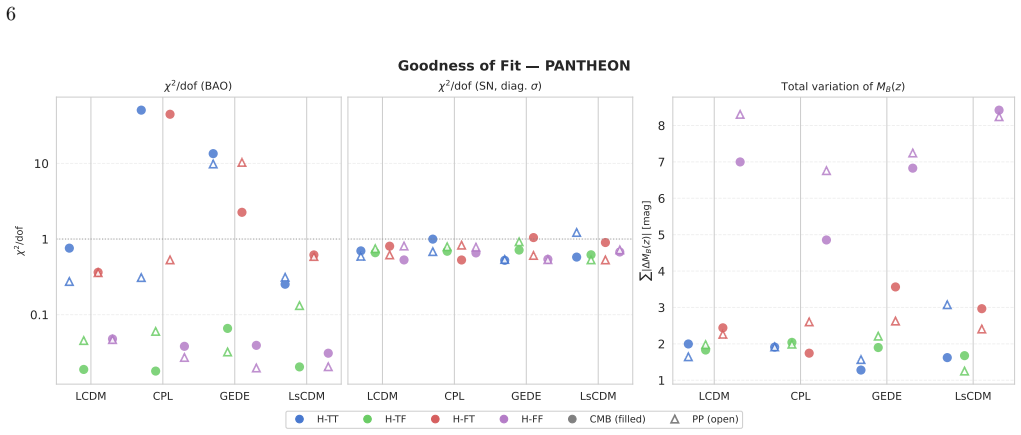
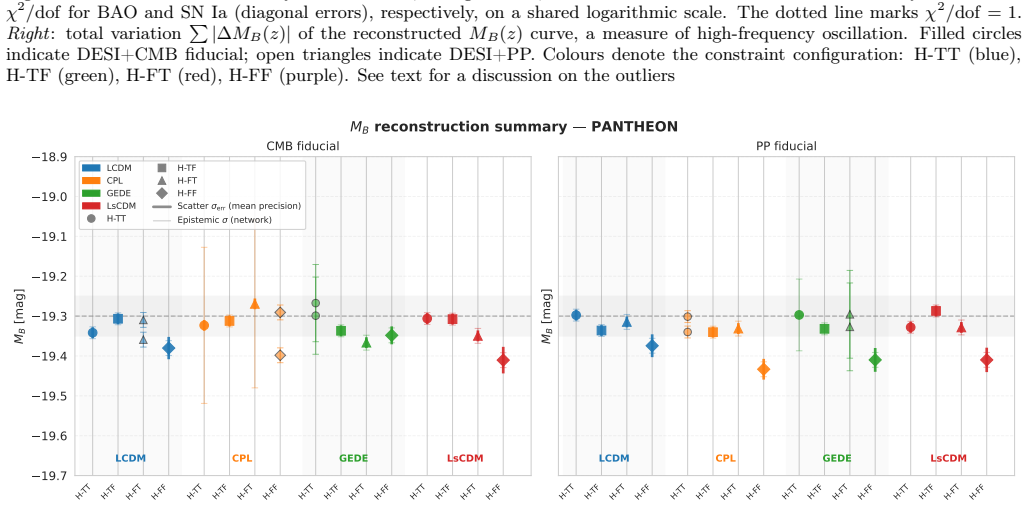
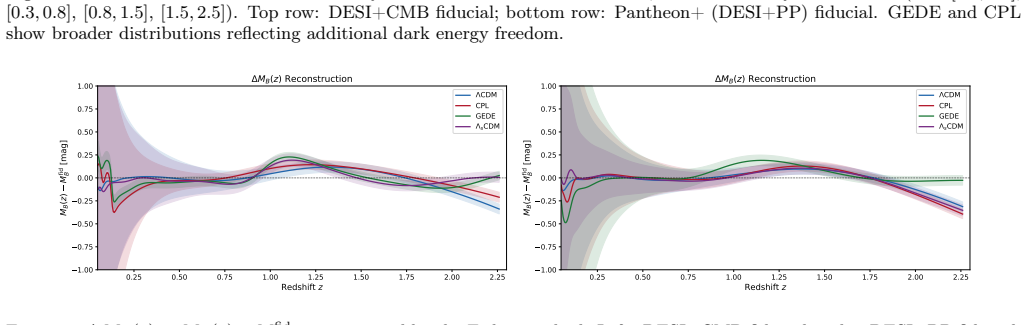
When physics-informed neural networks are trained on combined BAO and supernova data while enforcing the Etherington distance duality relation as a primary constraint, the reconstructed Type Ia supernova absolute magnitude MB settles at approximately -19.3 mag across four different cosmological models, with biases below 0.05 mag and no significant pointwise evolution over the redshift interval from 0.3 to 1.5; the duality relation reduces inconsistencies more effectively than model priors alone, while a model-independent residual persists at z approximately 0.4 to 0.5.
What carries the argument
Two variants of Physics-Informed Neural Networks trained jointly on BAO and supernova data, one heteroscedastic single-network approach and one Fisher-weighted two-network approach, using the Etherington distance duality relation as the central constraint to enforce consistency between luminosity and angular-diameter distances.
If this is right
- All four cosmological models recover MB approximately -19.3 mag with biases below 0.05 mag once the full set of constraints is imposed.
- No significant pointwise evolution of MB appears across the redshift range 0.3 to 1.5.
- The Etherington distance duality relation reduces internal inconsistencies by up to an order of magnitude relative to cosmological model priors alone.
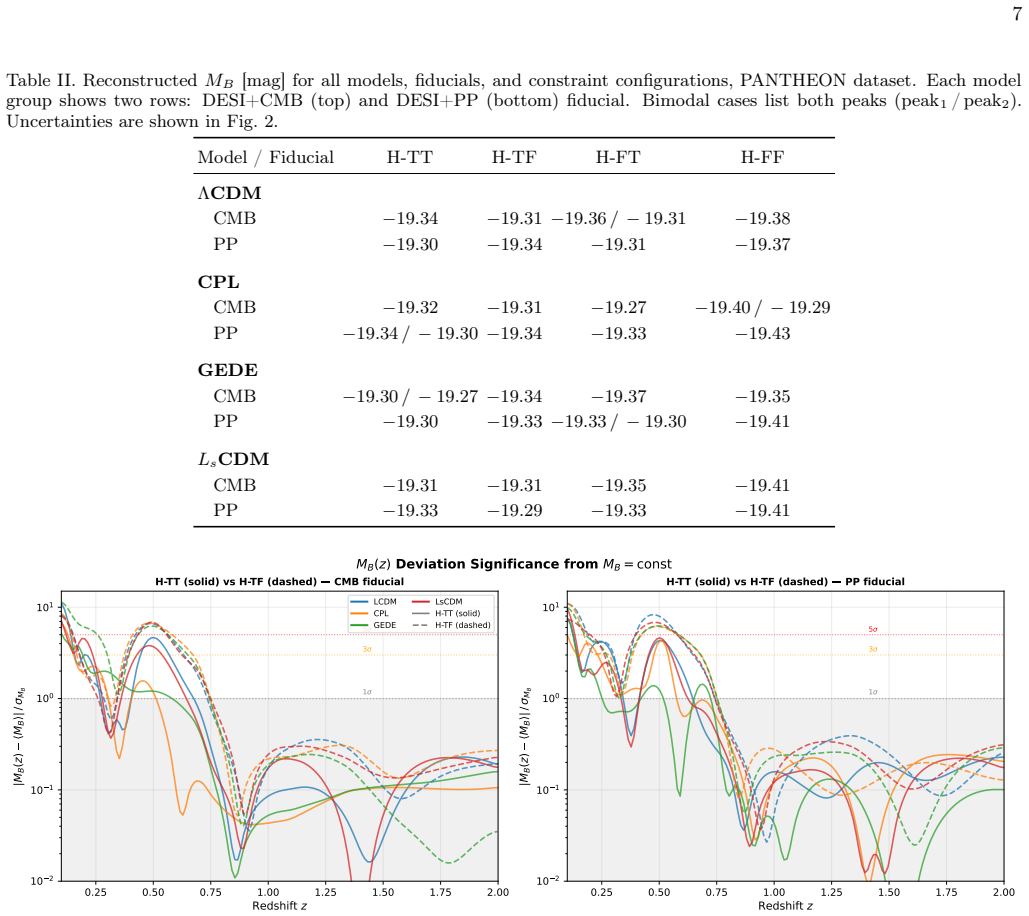
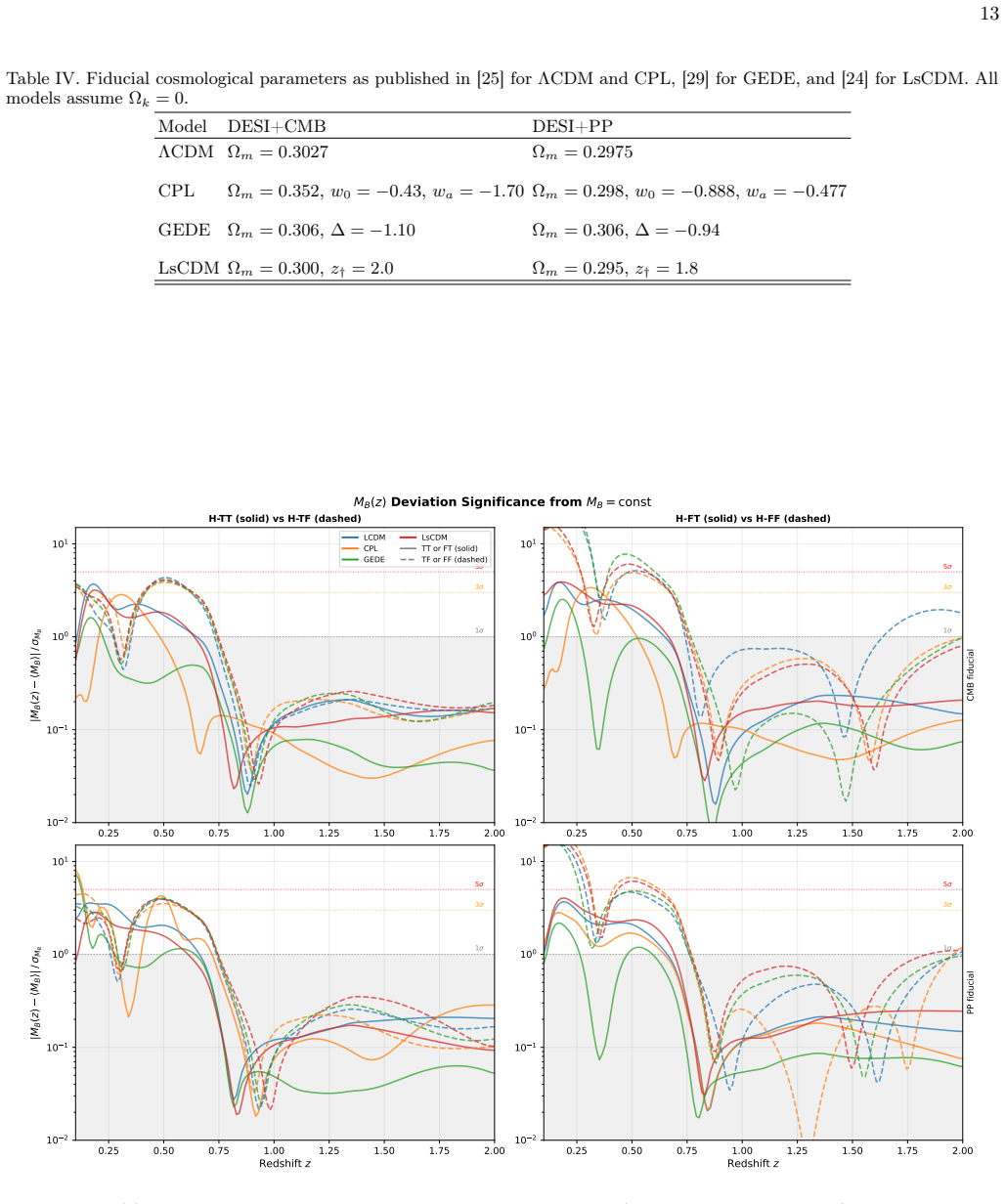
- A persistent 2 to 3 sigma residual feature remains at z approximately 0.4 to 0.5 in every model and both fiducial sets.
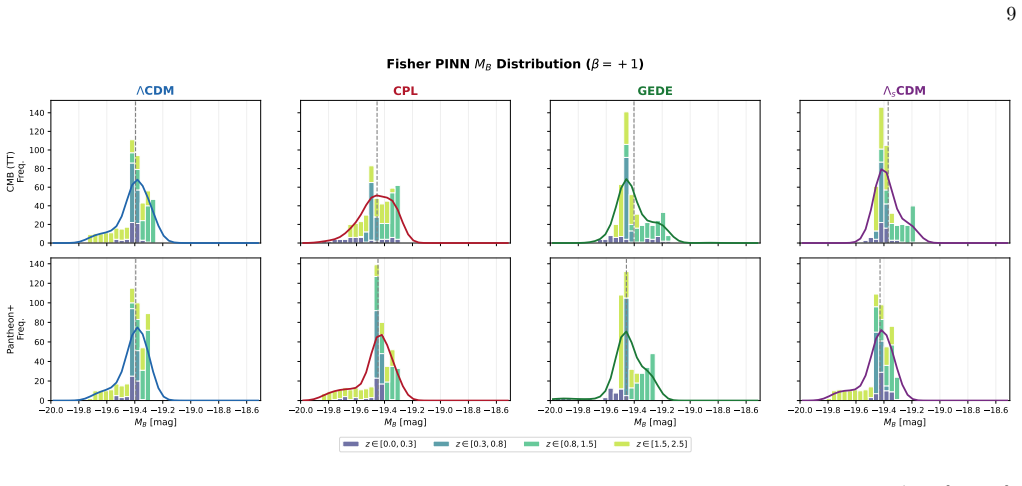
- The two-network variant cleanly separates the probes and reveals systematic differences in redshift-binned magnitude distributions.
Where Pith is reading between the lines
- The method could be applied to future surveys with higher precision to test whether the residual at z approximately 0.4 to 0.5 grows or disappears.
- Extending the same constrained networks to include additional distance indicators might reveal whether the duality relation remains dominant in other probe combinations.
- If the residual feature persists in independent data sets, it could point to either an unrecognized systematic in current observations or a mild departure from standard distance relations.
- The separation of probes demonstrated here offers a template for model-independent checks on other cosmological tensions without assuming a specific expansion history.
Load-bearing premise
The networks can separate information specific to each probe and reconstruct the magnitude function without introducing artifacts from their architecture or training procedure.
What would settle it
A new, independent supernova catalog that shows statistically significant redshift evolution in MB or large model-to-model differences even after enforcing the Etherington distance duality relation would falsify the central claim.
Figures
read the original abstract
We apply two variants of Physics-Informed Neural Networks (PINNs) to reconstruct the Type~Ia supernova absolute magnitude $M_B(z)$ from joint BAO and supernova data under four cosmological models ($\Lambda$CDM, CPL, GEDE, $\Lambda_s$CDM) and two DESI~DR2 fiducial sets. A heteroscedastic single-network method tested across four constraint configurations establishes that the Etherington distance duality relation is a more fundamental constraint than cosmological model priors, reducing internal inconsistencies by up to an order of magnitude. Under full constraints all models recover $M_B \approx -19.3$~mag with biases below 0.05~mag. A Fisher information-weighted two-network variant trains independent networks on BAO and SN data, providing clean probe separation; it finds no significant pointwise $M_B$ evolution in $z \in [0.3, 1.5]$, but reveals a systematic separation of redshift-binned $M_B$ distributions. The heteroscedastic method identifies a persistent $2$--$3\sigma$ residual at $z \sim 0.4$--$0.5$ that is consistent across all four models and both fiducials, implying the same underlying tension. While the origin of this feature remains ambiguous, its model-independence and cross-method consistency warrant further investigation with forthcoming data.
Editorial analysis
A structured set of objections, weighed in public.
Referee Report
Summary. The manuscript applies Physics-Informed Neural Networks (PINNs) in two variants to reconstruct the absolute magnitude MB(z) of Type Ia supernovae from joint BAO and SN observations. Using four cosmological models (ΛCDM, CPL, GEDE, ΛsCDM) and two DESI DR2 fiducials, it compares different constraint setups and concludes that the Etherington distance duality relation (DDR) is a more fundamental constraint than cosmological model priors, reducing inconsistencies by up to an order of magnitude. All models recover MB ≈ -19.3 mag with biases < 0.05 mag under full constraints. The heteroscedastic approach finds a persistent 2-3σ residual at z ~ 0.4-0.5, while the Fisher-weighted variant shows no significant MB evolution in z ∈ [0.3, 1.5] but notes systematic separations in binned distributions.
Significance. Should the results prove robust, the work would highlight the utility of the distance duality relation as a strong, model-independent constraint in multi-probe cosmological analyses, potentially leading to more consistent inferences of supernova magnitudes and better characterization of data tensions. The PINN-based reconstruction method offers a flexible framework for future joint analyses with large datasets from surveys like DESI and LSST.
major comments (2)
- Abstract: The central claim that the DDR reduces internal inconsistencies by up to an order of magnitude compared to model priors is load-bearing for the paper's significance, but the description does not detail the specific metric used to quantify these inconsistencies or provide the equations governing the constraint implementations in the PINN loss function.
- Abstract: The assumption that the PINN variants can cleanly separate probe-specific information without artifacts from architecture or training choices is critical to attributing the inconsistency reduction to the DDR rather than optimization, yet no architecture ablations, loss-weight sensitivity tests, or synthetic data recovery experiments are reported to validate this separation.
minor comments (2)
- The abstract refers to 'two DESI DR2 fiducial sets' but does not provide their specific parameter values or citations, which would aid reproducibility.
- The range z ∈ [0.3, 1.5] is specified for no evolution, but the data coverage or selection for BAO and SN in this range is not elaborated.
Simulated Author's Rebuttal
We thank the referee for the constructive review and for recognizing the potential significance of the DDR as a model-independent constraint. We address each major comment point by point below.
read point-by-point responses
-
Referee: Abstract: The central claim that the DDR reduces internal inconsistencies by up to an order of magnitude compared to model priors is load-bearing for the paper's significance, but the description does not detail the specific metric used to quantify these inconsistencies or provide the equations governing the constraint implementations in the PINN loss function.
Authors: We agree that the abstract would be strengthened by briefly specifying the inconsistency metric and referencing the DDR constraint implementation. The metric is the reduction in the spread (standard deviation) of reconstructed M_B values across the four cosmological models and two fiducials at fixed redshift bins; the DDR enters the PINN loss as an additional penalty term enforcing the distance-duality relation between luminosity and angular-diameter distances. The full loss-function equations appear in Section 3. In the revised manuscript we will expand the abstract to include a concise statement of the metric and a reference to the relevant loss term. revision: yes
-
Referee: Abstract: The assumption that the PINN variants can cleanly separate probe-specific information without artifacts from architecture or training choices is critical to attributing the inconsistency reduction to the DDR rather than optimization, yet no architecture ablations, loss-weight sensitivity tests, or synthetic data recovery experiments are reported to validate this separation.
Authors: The Fisher-weighted two-network variant was introduced precisely to enforce independent training on BAO and SN data, thereby providing a cleaner probe separation than the joint heteroscedastic network. The manuscript already shows that both variants recover consistent M_B values and the same model-independent residual at z ~ 0.4-0.5, which we interpret as supporting robustness. However, we did not report dedicated architecture ablations or synthetic recovery tests. In the revision we will add a short discussion of the architectural rationale and loss-weighting choices, together with a statement that future synthetic-data experiments could further validate the separation. This constitutes a partial revision because performing and documenting new synthetic experiments would require additional computational work beyond the scope of the current resubmission. revision: partial
Circularity Check
No significant circularity; reconstruction uses independent external data and physical constraint
full rationale
The paper trains PINNs on joint BAO and SN datasets under explicit cosmological models plus the Etherington distance duality relation as an added constraint. The reported MB consistency across models, bias levels below 0.05 mag, and absence of significant pointwise evolution are outputs of the constrained optimization rather than quantities defined into the inputs. No equations or self-citations in the provided description reduce the central claim (DDR superiority over model priors) to a fit or renaming by construction. The method is self-contained against external benchmarks and does not exhibit self-definitional, fitted-input, or load-bearing self-citation patterns.
Axiom & Free-Parameter Ledger
axioms (1)
- domain assumption Etherington distance duality relation holds exactly
Lean theorems connected to this paper
-
IndisputableMonolith/Foundation/AbsoluteFloorClosure.leanabsolute_floor_iff_bare_distinguishability unclear?
unclearRelation between the paper passage and the cited Recognition theorem.
A heteroscedastic single-network method tested across four constraint configurations establishes that the Etherington distance duality relation is a more fundamental constraint than cosmological model priors, reducing internal inconsistencies by up to an order of magnitude.
-
IndisputableMonolith/Foundation/AlexanderDuality.leanalexander_duality_circle_linking unclear?
unclearRelation between the paper passage and the cited Recognition theorem.
Lphys = 1/Ncoll Σ [μ_pred_i - μ_DDR_i]^2 where μ_DDR = 5 log10[(1+z)^2 D_A^pred r_d] + 25 + M_B
What do these tags mean?
- matches
- The paper's claim is directly supported by a theorem in the formal canon.
- supports
- The theorem supports part of the paper's argument, but the paper may add assumptions or extra steps.
- extends
- The paper goes beyond the formal theorem; the theorem is a base layer rather than the whole result.
- uses
- The paper appears to rely on the theorem as machinery.
- contradicts
- The paper's claim conflicts with a theorem or certificate in the canon.
- unclear
- Pith found a possible connection, but the passage is too broad, indirect, or ambiguous to say the theorem truly supports the claim.
Reference graph
Works this paper leans on
-
[1]
The in- put is normalized as˜z=z/3
Network Design We use a feed-forward network mappingz→ {DA/rd, µ,logσ 2 DA ,logσ 2 µ}, with four hidden layers (128–64–64–32 neurons) and Swish activations. The in- put is normalized as˜z=z/3. The two distance out- puts use softplus activations with physically motivated bias initialization (DA/rd: bias 10.0;µ: linear with bias 40.0). The log-variance outp...
-
[2]
Loss Function The total loss is L=L NLL-BAO +L NLL-SN +λ phys Lphys +λ cosmo Lcosmo, (8) where each term is described below. 3 a. Data terms.The heteroscedastic NLL for observ- ableywith known measurement uncertaintyσ obs and learned model uncertaintyσmodel(z)is LNLL = 1 2N NX i=1 " (yobs i −y pred i )2 σ2 obs,i +e si + log σ2 obs,i +e si −logσ 2 obs,i # ...
-
[3]
Two-Network Architecture The heteroscedastic method of Section IIIA uses a single shared-backbone network that outputs both DA/rd(z)andµ(z), which entangles the two probes and obscures the errors of the residualM B(z). The Fisher variant replaces the single network with two fully inde- pendent heteroscedastic networks trained with separate optimisers and ...
-
[4]
Loss Function Structure Both networks use the excess-variance parametrisation σ2 total =σ 2 obs(1+e s), ensuringσtotal ≥σ obs. The variance NLL per point is ℓvar(ri, si) = 1 2 " r2 i σ2 obs,i(1 +e si) + log(1 +e si) # ,(14) wherer i is the residual. The DA-net loss combines data, physics, and regularisation terms: LDA = X i wiLBAO χ2 + X i wnll,i ℓvar | {...
-
[5]
Fisher Information Weighting Standard heteroscedastic NLL training weights data implicitly byσ −2 i but ignores non-uniform redshift sam- pling. To address both simultaneously we construct two sets of weights from the per-point Fisher information Ii = 1 σ2 i X θ ∂f ∂θ 2 ,(17) where the sum runs over all active cosmological parame- tersθand derivatives are...
-
[6]
Eleonora Di Valentino et al. The CosmoVerse White Pa- per: Addressing observational tensions in cosmology with systematics and fundamental physics.Phys. Dark Univ., 49:101965, 2025
work page 2025
-
[7]
The Pantheon+ Analysis: Cosmolog- ical Constraints.Astrophys
Dillon Brout et al. The Pantheon+ Analysis: Cosmolog- ical Constraints.Astrophys. J., 938(2):110, 2022
work page 2022
-
[8]
Rose, Brodie Popovic, Dan Scolnic, and Dillon Brout
Benjamin M. Rose, Brodie Popovic, Dan Scolnic, and Dillon Brout. Constraining RV variation using highly reddened Type Ia supernovae from the Pantheon+ sam- ple.Mon. Not. Roy. Astron. Soc., 516(4):4822–4832, 2022
work page 2022
-
[9]
On the homogeneity of SnIa absolute magnitude in the Pantheon+ sample.Mon
Leandros Perivolaropoulos and Foteini Skara. On the homogeneity of SnIa absolute magnitude in the Pantheon+ sample.Mon. Not. Roy. Astron. Soc., 520(4):5110–5125, 2023
work page 2023
-
[10]
Jun-Qian Jiang, Davide Pedrotti, Simony Santos da Costa, and Sunny Vagnozzi. Nonparametric late-time expansion history reconstruction and implications for the Hubble tension in light of recent DESI and type Ia su- pernovae data.Phys. Rev. D, 110(12):123519, 2024
work page 2024
-
[11]
Shubham Barua and Shantanu Desai. Effect of peak ab- solute magnitude of Type Ia supernovae and sound hori- zon values on the Hubble constant using DESI Data Re- lease 1 results.Eur. Phys. J. C, 85(4):470, 2025
work page 2025
-
[12]
M. Dixon et al. Calibrating the absolute magnitude of type Ia supernovae in nearby galaxies using [Oii] and implications for H0.Mon. Not. Roy. Astron. Soc., 538(2):782–796, 2025
work page 2025
-
[13]
Stephen Thorp, Kaisey S. Mandel, David O. Jones, Robert P. Kirshner, and Peter M. Challis. Using rest- frame optical and NIR data from the RAISIN survey to explore the redshift evolution of dust laws in SN Ia host galaxies.Mon. Not. Roy. Astron. Soc., 530(4):4016–4031, 2024
work page 2024
-
[14]
Chul Chung, Seunghyun Park, Junhyuk Son, Hyejeon Cho, and Young-Wook Lee. Strong progenitor age bias in supernovacosmology–I.Robustandubiquitousevidence from a larger sample of host galaxies in a broader redshift range.Mon. Not. Roy. Astron. Soc., 538(4):3340–3350, 2025
work page 2025
-
[15]
Reconstructing the redshift evolution of Type Ia supernovae absolute magnitude
Rodrigo von Marttens, Javier Gonzalez, and Jailson Al- caniz. Reconstructing the redshift evolution of Type Ia supernovae absolute magnitude. 4 2025
work page 2025
-
[16]
Testing the constancy of type Ia supernova luminosities with Gaussian process.Phys
Akshay Rana. Testing the constancy of type Ia supernova luminosities with Gaussian process.Phys. Dark Univ., 52:102256, 2026
work page 2026
-
[17]
P. Wiseman et al. A galaxy-driven model of type Ia su- pernova luminosity variations.Mon. Not. Roy. Astron. Soc., 515(3):4587–4605, 2022
work page 2022
-
[18]
David Benisty, Jurgen Mifsud, Jackson Levi Said, and Denitsa Staicova. On the robustness of the constancy of the Supernova absolute magnitude: Non-parametric reconstruction&Bayesianapproaches.Phys. Dark Univ., 39:101160, 2023
work page 2023
-
[19]
StudyingtheSupernovaAbsoluteMag- nitude Constancy with Baryonic Acoustic Oscillations
DenitsaStaicova. StudyingtheSupernovaAbsoluteMag- nitude Constancy with Baryonic Acoustic Oscillations. PoS, CORFU2023:180, 2024
work page 2024
- [20]
-
[21]
Physics-informed neural net- works and extensions, 2024
Maziar Raissi, Paris Perdikaris, Nazanin Ahmadi, and George Em Karniadakis. Physics-informed neural net- works and extensions, 2024
work page 2024
-
[22]
Physics-informed neural networks in the recreation of hydrodynamic simulations from dark matter.Mon
Zhenyu Dai, Ben Moews, Ricardo Vilalta, and Romeel Dave. Physics-informed neural networks in the recreation of hydrodynamic simulations from dark matter.Mon. Not. Roy. Astron. Soc., 527(2):3381–3394, 2023
work page 2023
-
[23]
Luca Gomez Bachar, Augusto T. Chantada, Susana J. Landau, Claudia G. Scóccola, and Pavlos Protopapas. Evolution of linear matter perturbations with error- bounded bundle physics-informed neural networks.Phys. Rev. D, 112(6):063515, 2025
work page 2025
-
[24]
Anshul Verma, Shashwat Sourav, Pavan K. Aluri, and David F. Mota. Cosmology-informed Neural Networks to infer dark energy equation-of-state. 8 2025
work page 2025
-
[25]
Michel Chevallier and David Polarski. Accelerating uni- verses with scaling dark matter.International Journal of Modern Physics D, 10(2):213–223, 2001
work page 2001
-
[26]
Eric V. Linder. Exploring the expansion history of the universe.Physical Review Letters, 90(9):091301, 2003
work page 2003
-
[27]
Evidence for Emergent Dark Energy.Astrophys
Xiaolei Li and Arman Shafieloo. Evidence for Emergent Dark Energy.Astrophys. J., 902(1):58, 2020
work page 2020
-
[28]
Özgür Akarsu, Suresh Kumar, Emre Özülker, and J. Al- berto Vazquez. Relaxing cosmological tensions with a sign switching cosmological constant.Phys. Rev. D, 104(12):123512, 2021
work page 2021
-
[29]
Özgür Akarsu, Antonio De Felice, Eleonora Di Valentino, Suresh Kumar, Rafael C. Nunes, Emre Özülker, J. Al- berto Vazquez, and Anita Yadav. Cosmological con- straints onΛsCDM scenario in a type II minimally mod- ified gravity.Phys. Rev. D, 110(10):103527, 2024
work page 2024
-
[30]
M. Abdul Karim et al. DESI DR2 results. II. Measure- ments of baryon acoustic oscillations and cosmological constraints.Phys. Rev. D, 112(8):083515, 2025
work page 2025
-
[31]
Planck Collaboration. Planck 2018 results. vi. cosmolog- ical parameters.A&A, 641:A6, 2020
work page 2018
-
[32]
The pantheon+ analysis: The full data set and light-curve release.ApJ, 938(2):113, 2022
Dan Scolnic et al. The pantheon+ analysis: The full data set and light-curve release.ApJ, 938(2):113, 2022
work page 2022
-
[33]
Diederik P. Kingma and Jimmy Ba. Adam: A Method for Stochastic Optimization. 12 2014
work page 2014
-
[34]
Himanshu Chaudhary, Salvatore Capozziello, Vipin Ku- mar Sharma, Isidro Gómez-Vargas, and G. Mustafa. Ev- 12 idence for evolving dark energy from DESI DR2 BAO and Pantheon+, DES-Dovekie, and Union3. 8 2025. Appendix A: Fiducial Parameters and Implementation Details Table IV lists the fiducial cosmological parameters used in this work. Both PINN variants u...
work page 2025
discussion (0)
Sign in with ORCID, Apple, or X to comment. Anyone can read and Pith papers without signing in.