REVIEW 4 major objections 5 minor 41 references
Shaping Outflows and Jets by Ambient Pressure: a Unified Framework
T0 review · 4 major / 5 minor · reviewed 2026-08-12 · deepseek-v4-flash
Pith's one-line read Ambient pressure with a nearly universal -2 power-law index can shape outflows from young stars to galactic jets.
desk verdict The universal α≈−2 claim rests on a mathematically incorrect pressure-to-Mach-number mapping, so the paper as written does not establish its central result, though the multiscale de Laval analogy is worth a serious look. read the letter →
The pith
A machine-rendered reading of the paper's core claim, the machinery that carries it, and where it could break.
The reading
What carries the argument
The load-bearing object is the de Laval nozzle analogy: the rigid diverging walls of an engineering nozzle are replaced by a declining ambient pressure that balances the outflow boundary and drives the same subsonic-to-supersonic transition. The mathematics is the isentropic nozzle relation giving Mach number and cross-sectional area from the pressure ratio, combined with the prescribed pressure profile $P(R)=P_0(R/R_s)^{\alpha}+P_2$; a differential gravity term modifies the Mach number near compact sources. This machinery converts an assumed pressure gradient into the width, velocity, temperature, and density of the outflow, and fixes the location of the sonic throat that identifies the launching point.
What would settle it
Map the actual ambient pressure profile around one fitted source, for example by deprojecting the X-ray-emitting hot gas around M 87 or measuring molecular cloud pressure tracers around HOPS 370, and compare it with the fitted $P(R)=P_0(R/R_s)^{\alpha}+P_2$; if the observed profile's exponent departs from the value needed to fit the outflow width, the boundary shape is not set by ambient pressure alone.
Extended reading notes
Core claim
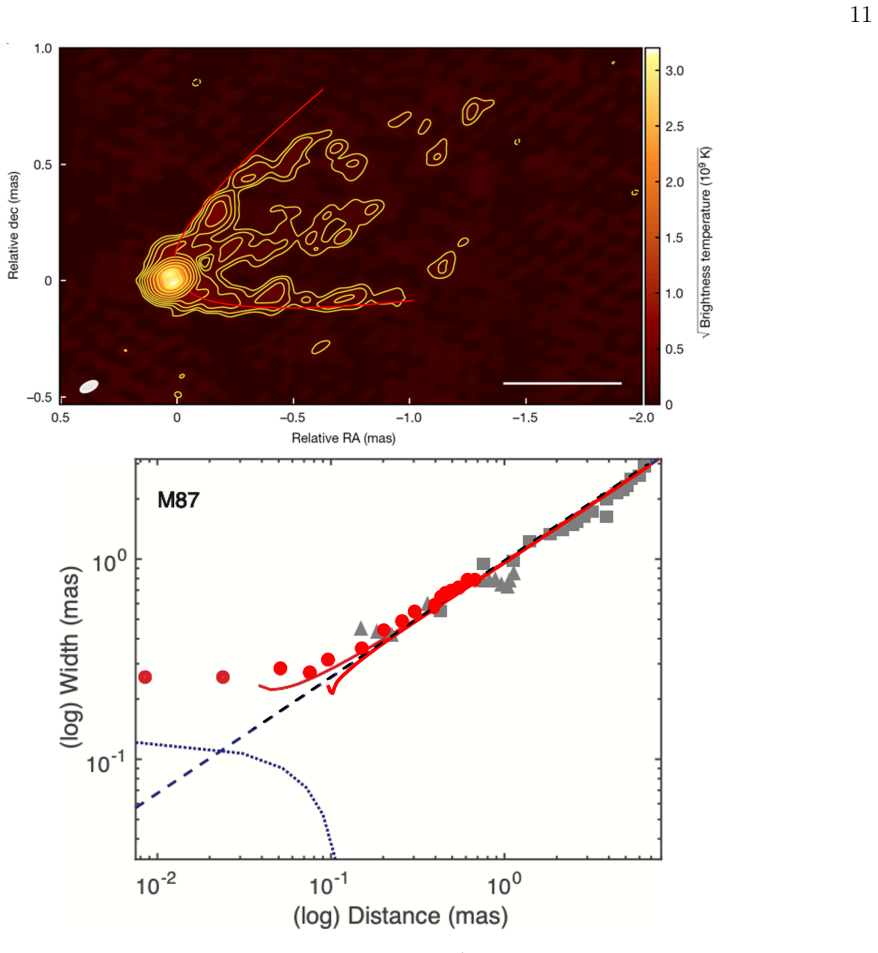
The paper's central claim is that outflow morphology is controlled by pressure balance at the boundary with an ambient medium whose pressure falls as a power law with distance, $P(R)=P_0(R/R_s)^{\alpha}+P_2$, and that the exponent $\alpha$ is nearly universal, around -2.0 to -2.8, across sources whose sizes differ by six orders of magnitude. Using the de Laval nozzle analogy, the authors derive the Mach number, density, temperature, velocity, and lateral width of the outflow from this pressure profile, with a Newtonian gravity correction near the launching region for supermassive black hole jets. Applied to the planetary nebula Hb 12, the protostellar outflow HOPS 370, and the FR I jets in 3C 84 and M 87, the model reproduces the observed widths and yields launching points close to the stellar envelope, accretion disk, or black hole ergosphere. The authors conclude that ambient pressure confinement, not the details of the launching engine, determines the large-scale shape of outflows.
Load-bearing premise
The argument assumes the outflow boundary is set by simple pressure balance between an isentropically expanding ideal gas and a prescribed ambient pressure profile, with magnetic fields, entrainment, and non-isentropic heating playing no leading role in the shape.
Editorial extensions
If this is right
- If the exponent near -2 is universal, then the shape of an outflow can be inverted to read off the ambient pressure gradient around any resolved source, without needing to model the engine.
- The model locates the launching point from morphology alone: inside the stellar envelope for Hb 12, near the accretion disk for HOPS 370, and at tens of gravitational radii for the FR I jets.
- The same pressure-confined boundary layer would produce the observed edge-brightening and the transition from conical to cylindrical shape when the constant ambient pressure $P_2$ dominates at large distances.
- Gravitational deceleration affects only the inner launching region of supermassive black hole jets, explaining a wider opening angle near the nucleus while leaving the outer shape unchanged.
Reading between the lines
- The apparent universality of $\alpha\approx -2$ may partly be a consequence of self-regulated feedback: outflows carve and heat their own cavities, so the pressure profile they meet could be a product of earlier outflow episodes rather than a pre-existing ambient property.
- A direct test would compare the fitted pressure exponent with an independently measured pressure profile, for example deprojecting the X-ray-emitting hot gas around M 87 or measuring molecular cloud pressure tracers around HOPS 370.
- The paper leaves open whether magnetic fields, rotation, or entrainment could reproduce the same shapes without an ambient power-law index of -2; if a magnetically collimated flow matches the same boundaries, the uniqueness of the pressure-confinement interpretation would be weakened.
Editorial analysis
A structured set of objections, weighed in public.
Referee Report
Summary. The paper proposes a unified model for astrophysical outflows, from planetary nebulae and protostars to low-power radio galaxies, based on the idea that the outflow shape is set by pressure confinement against an ambient pressure profile P(R) = P0(R/Rs)^α + P2. The authors adapt classical de Laval nozzle theory to describe a supersonic flow whose boundary is shaped by this pressure gradient, and they fit the model to four sources: PN Hb 12, YSO HOPS 370, and the FR I jets of 3C 84 and M 87. They claim that the fitted pressure-gradient exponent is universal, α ≈ −2, across six orders of magnitude in spatial scale, and that gravitational deceleration is important for the extragalactic sources. The central quantitative claim rests on the mapping from the assumed pressure law to the Mach number profile, Eq. (4), and on a Newtonian gravity correction, Eq. (5).
Significance. If the claimed universal pressure-gradient exponent near -2 were established, it would be a striking and important result: a single pressure-confinement mechanism would explain the collimation of outflows from stellar to galactic scales, independent of the central engine. The paper also makes testable predictions, including the shape of the nozzle region and edge-brightening in jets, which is a strength. However, the analysis as written contains algebraic and dimensional errors in the central equations, and the statistical evidence from four fitted sources is too weak to support the universality claim. The idea is interesting, but the present execution does not provide a sound derivation of the claimed result.
major comments (4)
- [§2.1, Eq. (4)] Equation (4) contains an algebraic error. Substituting P(R) = P0(R/Rs)^α + P2 into the isentropic relation P/P0 = [1 + (γ−1)/2 M^2]^{−γ/(γ−1)} gives M^2 = 2/(γ−1)[((R/Rs)^α + P2/P0)^{(1−γ)/γ} − 1]. The second line of Eq. (4) instead writes this as 2/(γ−1)[(R/Rs)^{α(1−γ)/γ} − 1 + P2^{(1−γ)/γ}], which incorrectly distributes the exponent (1−γ)/γ over the sum and drops the P0 factor from the P2 term. While the expression is correct for P2 = 0, the P2 term is non-zero in four of the five fitted lobes and dominates in the outer regions where the model transitions to a cylindrical shape. Therefore the model shapes in Figs. 2–5 and the fitted values of α, Rs, and P2 in Table 1 are outputs of an invalid equation. The fits must be redone with the correct pressure-to-Mach relation, and the claimed universal α ≈ −2 is not supported by the present analysis.
- [§2.1, Eq. (5)] Equation (5) is dimensionally inconsistent. The right-hand side has dimensions (dR/cs) × (GM/R^2) × V(R), which gives velocity squared, while the left-hand side dM is dimensionless. A Newtonian deceleration correction to the Mach number should involve a term of the form −(GM/(R^2 c_s^2)) dR or an equivalent expression derived from dV/dR. Because this equation is used in the gravity-corrected fits of 3C 84 and M 87 and is claimed to determine the launching radii and minimum temperatures in Table 1, those results are not quantitatively meaningful as derived.
- [§3 and Table 1] The central claim of a universal pressure exponent is not established by the analysis. The values in Table 1 are free parameters fitted individually to four hand-picked sources, with no quoted uncertainties, no goodness-of-fit statistics, and no discussion of degeneracies among α, Rs, and P2. The fitted range spans from −1.95 to −2.8, which is not a particularly narrow range once the algebraic errors are corrected. Moreover, the model is constructed from the assumed pressure law and the same law is then fitted to observed shapes, so the resemblance is not an independent confirmation of the power-law form. Establishing universality would require robust parameter uncertainties and, ideally, a prediction of the shape without re-fitting α for each source.
- [§2.2 and §4.1] The paper assumes that pressure balance at the boundary sets the outflow shape, but it does not provide a quantitative argument that magnetic collimation, entrainment, or boundary-layer dynamics are subdominant. Indeed, §4.1 states that the boundary layer 'has not yet been incorporated in the simulations' yet is 'crucial for jet evolution,' and §2.2 similarly defers boundary-layer physics to future numerical work. This acknowledged omission weakens the claim that the pressure-gradient model alone explains the observed morphologies and edge-brightening features.
minor comments (5)
- [Abstract, §3] The sign of α is inconsistent: the abstract and text say 'α ≈ 2.0–2.8' or 'α ≈ −2.05' in different places. The exponent should be consistently quoted as negative.
- [Figure 5 caption] The caption calls the source 'M 87 - NGC 1275,' but NGC 1275 is the host galaxy of 3C 84, not M 87. The caption should be corrected.
- [Table 1] The column heading 'Scale Height' is not defined in the text; the text uses Rs as the pressure-gradient scale length, and the column seems to list Rs values. This should be labeled consistently.
- [§2.2 vs §4.5] The paper states in §2.2 that gravitational corrections are used 'to obtain a more precise fit with the observed shape,' but §4.5 says the gravity correction 'has not yet been used to optimize this shape with regard to the observed launching shape.' These statements are contradictory.
- [Figure 1 caption vs §2.2] The Figure 1 caption says the outflow velocity increases by a factor of two along the displayed section, while §2.2 says the flow velocity increases fivefold. These numbers should be reconciled.
Circularity Check
Central 'universal α≈−2' result is the fitted free parameter of the assumed pressure profile presented as a model prediction; Eq. (4) also mis-applies the isentropic exponent, corrupting the fits.
-
fitted input called prediction
[Section 3 (Modeling Results), restating the Abstract's central claim]
"A striking feature of our results is the narrow range of pressure gradient indices ( α ≈ 2.0–2.8) required to fit outflows across six orders of magnitude in spatial scale."
The index α is the free parameter of the pressure profile assumed in Eq. (3), and Section 2.2 states: 'The measured outflow widths of the example sources have been used to constrain and optimize the values of α and Rs.' The model shape is a deterministic function of (α, Rs, P2) through Eqs. (1)–(4), so the 'remarkable consistency' and universal 'power-law exponent near minus two' announced in the Abstract and Section 3 are the fitted values read back as a discovery; the deLaval mapping only converts pressure into shape and never derives α≈−2 from independent physics. Four hand-picked sources, no quoted uncertainties, and an internal sign inconsistency (Section 3: α≈2.0–2.8; Table 1: −1.95…−2.8) further show the claim is the fit itself.
-
self definitional
[Section 2.1, after Eq. (4); method sentence]
"By incorporating the above equations into a MatLab code, a model outflow shape can be generated based on the pressure gradient distribution parameters α and Rs and a distant P2 where needed. Superposing this model shape on the observed shape allows us to constrain these values for each astrophysical outflow."
Every model shape is generated from the assumed pressure profile: Eq. (4) defines M(R) from P(R), Eq. (1) defines the width from M(R), and the same parameters are then recovered by superposing the generated shape on the observed morphology. The agreement is therefore guaranteed by construction once a power-law profile is chosen; the fit cannot discriminate pressure confinement from magnetic collimation, shear instabilities, or a structured ambient density (the paper concedes boundary-layer physics 'has not yet been incorporated in the simulations,' Section 4.1). Presenting the match as confirmation that 'pressure confinement represents a fundamental mechanism in outflow physics' (Section 3) turns the assumed profile's exponent into the model's output.
full rationale
The central claim — ambient pressure profiles with a universal exponent α≈−2 shape outflows from YSOs to AGNs — is the fitted value of the free parameter of the assumed pressure profile, not a quantity derived from the deLaval framework. The chain is: assume P(R)=P0(R/Rs)^α+P2 (Eq. 3); map pressure to Mach number with the isentropic relation (Eq. 4); map Mach number to width with the nozzle area relation (Eq. 1); fit (α, Rs, P2) to each observed boundary; then report the spread of fitted α as 'a remarkable consistency in pressure profiles' and a 'universal mechanism.' Because each model shape is a deterministic function of the profile parameters, the fits cannot independently confirm that ambient pressure — rather than magnetic fields, instabilities, or ambient density structure — sets the observed shape; the paper itself concedes that boundary-layer physics, 'proven to be crucial for jet evolution,' has not been incorporated (Section 4.1). The abstract's headline prediction therefore reduces to the fitted parameters (score 6: partial circularity). Some independent content exists: Section 4.3 compares model-based velocities with observed ones (Hb 12: ~110 vs ~90 km/s; HOPS 370: ~57 vs ~51 km/s), and the M87 throat at 13 Rg is checked against the externally imaged nuclear ring (Lu et al. 2023). These are genuine external checks of secondary quantities (the velocity factor itself is taken from the model's Fig. 1), which is why the score is not 8–10. Self-citations (Baan 1980; An & Baan 2012) appear but are not load-bearing for the central claim. A separate algebraic error compounds the problem: substituting Eq. (3) into P/P0=[1+(γ−1)M²/2]^{−γ/(γ−1)} requires M² = 2/(γ−1)[((R/Rs)^α + P2/P0)^{(1−γ)/γ} − 1], but Eq. (4) writes M² = 2/(γ−1)[(R/Rs)^{α(1−γ)/γ} − 1 + P2^{(1−γ)/γ}], applying the exponent to each term separately and dropping P0 from the P2 term. Every fitted shape in Figs. 2–5 inherits this error, so the tabulated α values (Table 1: −1.95 to −2.8) are unreliable as computed. This is a correctness risk distinct from circularity, but it means even the fitted-input result is not established as stated. Internal inconsistencies (Section 3 quotes α≈2.0–2.8 positive; Section 4.5 says gravity was not used to optimize the shape while Section 2.2 says it was) further reduce confidence in the claimed universality.
Assumptions & free parameters
free parameters (4)
- alpha (pressure gradient index) =
-2.05, -2.8, -2.7, -2.2, -1.95 for the five fitted outflows (3C 84 caption says -2.4)
- Rs (pressure scale length) =
107 AU (Hb 12); 280 and 250 AU (HOPS 370); 12 Rg (3C 84); 3 Rg (M 87)
- P2 / flat ambient pressure level =
6e-4, 1.9e-4, 2.1e-3, 1.8e-3 of nozzle pressure; none for M 87
- Throat location and size =
Launching/throat distances: 134 AU, 330 AU, 32 Rg, 13 Rg; throat sizes: 1630 AU, 1750/1520 AU, 207 Rg, 26 Rg
assumptions (5)
- ad hoc to paper Ambient pressure follows a single power law plus a constant, P(R) = P0 (R/Rs)^alpha + P2 (Eq. 3).
- domain assumption The outflow is an ideal gas in isentropic de Laval nozzle flow with gamma = 5/3 (Eqs. 1-2).
- domain assumption The observed boundary of the outflow is in pressure balance with the ambient medium and its width equals the nozzle area from Eq. (1).
- ad hoc to paper Newtonian gravitational deceleration is given by Eq. (5).
- ad hoc to paper The four chosen sources are representative of outflows in general.
Cite this review
Pith. "Pith review of Shaping Outflows and Jets by Ambient Pressure: a Unified Framework." pith.science (2026). https://pith.science/paper/C5NSGWSU
@misc{pith2026241111704,
  author       = {Pith},
  title        = {Pith review of: Shaping Outflows and Jets by Ambient Pressure: a Unified Framework},
  year         = {2026},
  howpublished = {\url{https://pith.science/paper/C5NSGWSU}},
  note         = {Machine review of arXiv:2411.11704}
}
read the original abstract
Astrophysical outflows are ubiquitous across cosmic scales, from stellar to galactic systems. While diverse launching mechanisms have been proposed, we demonstrate that these outflows share a fundamental commonality: their morphology follows the physics of pressure-confined supersonic flows. By extending classical deLaval nozzle theory to account for ambient pressure gradients, we present a unified framework that successfully describes outflows from young stellar objects to active galactic nuclei. Our model reveals a remarkable consistency in pressure profiles, characterized by a power-law exponent near minus two, independent of the internal characteristics of the outflow or the nature of central engine. This discovery suggests a universal mechanism for outflow collimation and acceleration, bridging the gap between theoretical models and observational features across a wide range of astronomical scales.
Figures


Figures from the paper (2 more)

Reference graph
Works this paper leans on
-
[1]
Aloy, M. A., & Mimica, P. 2008, ApJ, 681, 84, doi: 10.1086/588605
doi:10.1086/588605 2008
-
[2]
An, T., & Baan, W. A. 2012, ApJ, 760, 77, doi: 10.1088/0004-637X/760/1/77
-
[3]
Baan, W. A. 1980, ApJ, 239, 433, doi: 10.1086/158127
-
[4]
2019, ARA&A, 57, 467, doi: 10.1146/annurev-astro-081817-051948
Blandford, R., Meier, D., & Readhead, A. 2019, ARA&A, 57, 467, doi: 10.1146/annurev-astro-081817-051948
-
[5]
Blandford, R. D., & Payne, D. G. 1982, MNRAS, 199, 883, doi: 10.1093/mnras/199.4.883
-
[6]
Blandford, R. D., & Rees, M. J. 1974, MNRAS, 169, 395, doi: 10.1093/mnras/169.3.395
-
[7]
Blandford, R. D., & Znajek, R. L. 1977, MNRAS, 179, 433, doi: 10.1093/mnras/179.3.433
-
[8]
2016, A&A, 593, A92, doi: 10.1051/0004-6361/201628546
Bujarrabal, V., Castro-Carrizo, A., Alcolea, J., et al. 2016, A&A, 593, A92, doi: 10.1051/0004-6361/201628546
Show all 41 references
-
[9]
Filippenko, A. V. 2001, ApJ, 555, 338, doi: 10.1086/321481
2001 doi
-
[10]
2023, arXiv e-prints, arXiv:2311.00432, doi: 10.48550/arXiv.2311.00432
Markoff, S. 2023, arXiv e-prints, arXiv:2311.00432, doi: 10.48550/arXiv.2311.00432
2023 doi
-
[11]
Choudhuri, A. R. 1998, The physics of fluids and plasmas : an introduction for astrophysicists /
1998
-
[12]
2014, AJ, 148, 98, doi: 10.1088/0004-6256/148/5/98
Winge, C. 2014, AJ, 148, 98, doi: 10.1088/0004-6256/148/5/98
2014 doi
-
[13]
2015, A&A, 582, A60, doi: 10.1051/0004-6361/201526585
Clyne, N., Akras, S., Steffen, W., et al. 2015, A&A, 582, A60, doi: 10.1051/0004-6361/201526585
2015 doi
-
[14]
Corradi, R. L. M., Livio, M., Balick, B., Munari, U., & Schwarz, H. E. 2001, ApJ, 553, 211, doi: 10.1086/320665
2001 doi
-
[15]
2023, Nature, 621, 711, doi: 10.1038/s41586-023-06479-6
Cui, Y., Hada, K., Kawashima, T., et al. 2023, Nature, 621, 711, doi: 10.1038/s41586-023-06479-6
2023 doi
-
[16]
K., Das, S., Maity, D., & Chakrabarti, S
Dihingia, I. K., Das, S., Maity, D., & Chakrabarti, S. 2018, PhRvD, 98, 083004, doi: 10.1103/PhysRevD.98.083004
2018 doi
-
[17]
1981, MNRAS, 196, 1051, doi: 10.1093/mnras/196.4.1051
Ferrari, A., Trussoni, E., & Zaninetti, L. 1981, MNRAS, 196, 1051, doi: 10.1093/mnras/196.4.1051
1981 doi
-
[18]
2018, Nat
Giovannini, G., Savolainen, T., Orienti, M., et al. 2018, Nat. Astron., 2, 472, doi: 10.1038/s41550-018-0431-2
2018 doi
-
[19]
Hardee, P. E. 1982, ApJ, 257, 509, doi: 10.1086/160008
1982 doi
-
[20]
2021, Nature Astronomy, 5, 1017, doi: 10.1038/s41550-021-01417-w
Janssen, M., Falcke, H., Kadler, M., et al. 2021, Nature Astronomy, 5, 1017, doi: 10.1038/s41550-021-01417-w
2021 doi
-
[21]
R., & Alexander, P
Kaiser, C. R., & Alexander, P. 1997, MNRAS, 286, 215, doi: 10.1093/mnras/286.1.215
1997 doi
-
[22]
Kwok, S., & Hsia, C. H. 2007, ApJ, 660, 341, doi: 10.1086/513096
2007 doi
-
[23]
D., & Lifshitz, E
Landau, L. D., & Lifshitz, E. M. 1987, Fluid Mechanics
1987
-
[24]
1997, in Astronomical Society of the Pacific Conference Series, Vol
Livio, M. 1997, in Astronomical Society of the Pacific Conference Series, Vol. 121, IAU Colloq. 163: Accretion Phenomena and Related Outflows, ed. D. T. Wickramasinghe, G. V. Bicknell, & L. Ferrario, 845
1997
-
[25]
1999, PhR, 311, 225, doi: 10.1016/S0370-1573(98)00102-1
Livio, M. 1999, PhR, 311, 225, doi: 10.1016/S0370-1573(98)00102-1
1999 doi
-
[26]
P., et al
Lu, R.-S., Asada, K., Krichbaum, T. P., et al. 2023, Nature, 616, 686, doi: 10.1038/s41586-023-05843-w
2023 doi
-
[27]
1996, MNRAS, 279, 389, doi: 10.1093/mnras/279.2.389 Mart ´ ı, J.-M
Lynden-Bell, D. 1996, MNRAS, 279, 389, doi: 10.1093/mnras/279.2.389 Mart ´ ı, J.-M. 2019, Galaxies, 7, 24, doi: 10.3390/galaxies7010024 Mart ´ ı, J. M., Perucho, M., & G´ omez, J. L. 2016, ApJ, 831, 163, doi: 10.3847/0004-637X/831/2/163
1996 doi
-
[28]
1984, A&A, 133, 205
Nepveu, M. 1984, A&A, 133, 205
1984
-
[29]
S., Kovalev, Y
Nikonov, A. S., Kovalev, Y. Y., Kravchenko, E. V., Pashchenko, I. N., & Lobanov, A. P. 2023, MNRAS, 526, 5949, doi: 10.1093/mnras/stad3061
2023 doi
-
[30]
K., Anglada, G., et al
Osorio, M., D ´ ıaz-Rodr ´ ıguez, A. K., Anglada, G., et al. 2017, ApJ, 840, 36, doi: 10.3847/1538-4357/aa6975 18
2017 doi
-
[31]
N., Hardee, P
Owen, F. N., Hardee, P. E., & Cornwell, T. J. 1989, ApJ, 340, 698, doi: 10.1086/167430 Paczy´ nsky, B., & Wiita, P. J. 1980, A&A, 88, 23
1989 doi
-
[32]
S., Davies, R
Pedlar, A., Ghataure, H. S., Davies, R. D., et al. 1990, MNRAS, 246, 477
1990
-
[33]
E., Hardcastle, M
Pudritz, R. E., Hardcastle, M. J., & Gabuzda, D. C. 2012, SSRv, 169, 27, doi: 10.1007/s11214-012-9895-z
2012 doi
- [34]
- [35]
-
[36]
2023, ApJ, 944, 92, doi: 10.3847/1538-4357/aca7c9
Sato, A., Takahashi, S., Ishii, S., et al. 2023, ApJ, 944, 92, doi: 10.3847/1538-4357/aca7c9
2023 doi
-
[37]
H., Ruden, S
Shu, F. H., Ruden, S. P., Lada, C. J., & Lizano, S. 1991, ApJL, 370, L31, doi: 10.1086/185970
1991 doi
-
[38]
2002, ApJ, 568, 726, doi: 10.1086/339065
Soker, N. 2002, ApJ, 568, 726, doi: 10.1086/339065
2002 doi
-
[39]
V., Koldoba, A
Ustyugova, G. V., Koldoba, A. V., Romanova, M. M., Chechetkin, V. M., & Lovelace, R. V. E. 1995, ApJL, 439, L39, doi: 10.1086/187739
1995 doi
-
[40]
C., Hardee, P
Walker, R. C., Hardee, P. E., Davies, F. B., Ly, C., & Junor, W. 2018, ApJ, 855, 128, doi: 10.3847/1538-4357/aaafcc
2018 doi
-
[41]
R., Laing, R., et al
Wang, Y., Kaiser, C. R., Laing, R., et al. 2009, MNRAS, 397, 1113, doi: 10.1111/j.1365-2966.2009.15026.x
2009
Reviewed August 12, 2026 · model on record in the stance chip above.
Discussion (0). Continue with ORCID to comment.