Demographic Dependence of Vaccine Adoption under Opinion Persuasion
Pith reviewed 2026-05-22 12:59 UTC · model grok-4.3
The pith
Targeted policy messages on signed opinion networks can shift demographic groups toward higher vaccination and a disease-free state.
A machine-rendered reading of the paper's core claim, the machinery that carries it, and where it could break.
Core claim
In the SIS-Vo model, vaccine-related information propagates on a signed opinion network while subpopulations respond to policy messages with heterogeneous effects. Fixed-point equations characterize the disease-free and endemic equilibria, and local stability of the disease-free equilibrium is determined by the spectral properties of the contact network combined with opinion-dependent vaccination rates. Simulations demonstrate that suitably chosen interventions, acting through the opinion dynamics, can drive the system into the healthy regime.
What carries the argument
The SIS-Vo model, which couples an SIS epidemic process to opinion propagation on a signed network with demographic-specific policy responses.
If this is right
- The disease-free equilibrium is locally stable when the contact network's largest eigenvalue and the opinion-weighted vaccination capacities satisfy a derived threshold inequality.
- Policy messages that strengthen positive opinion links within high-risk demographic groups can increase their vaccination capacity enough to stabilize the whole population.
- The framework supplies explicit conditions under which misinformation aimed at one subgroup can be counteracted by messages directed at another.
- Control-theoretic extensions of the model can identify minimal sets of interventions that guarantee return to the healthy state.
Where Pith is reading between the lines
- Real social-media data on opinion signs and vaccination rates could be used to estimate the signed network parameters and test the predicted stability thresholds.
- The same modeling approach might apply to other health behaviors such as mask adoption or antibiotic use when opinions are polarized.
- If demographic response heterogeneity is smaller than assumed, the required targeting precision for interventions increases.
Load-bearing premise
Vaccine information travels on a signed opinion network and different demographic groups react differently to the same policy messages.
What would settle it
A controlled experiment or field study in which policy messages are delivered to specific demographic subgroups on an observable social network and vaccination uptake is tracked over time; if uptake does not rise in the predicted subgroups or the epidemic does not decline, the stability predictions fail.
Figures
read the original abstract
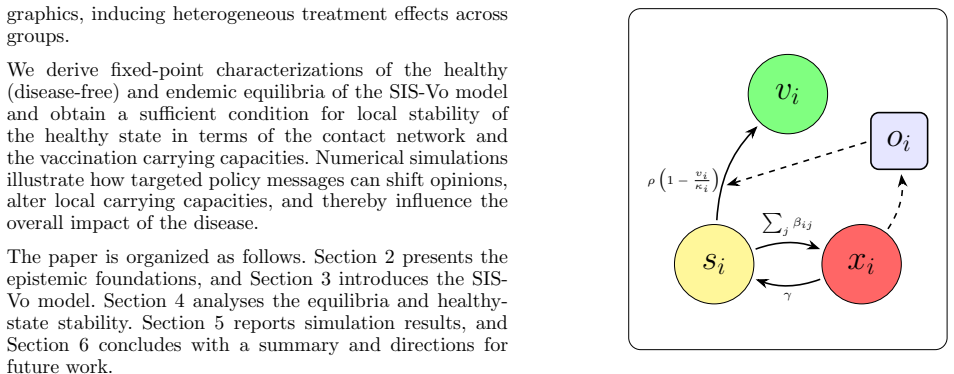
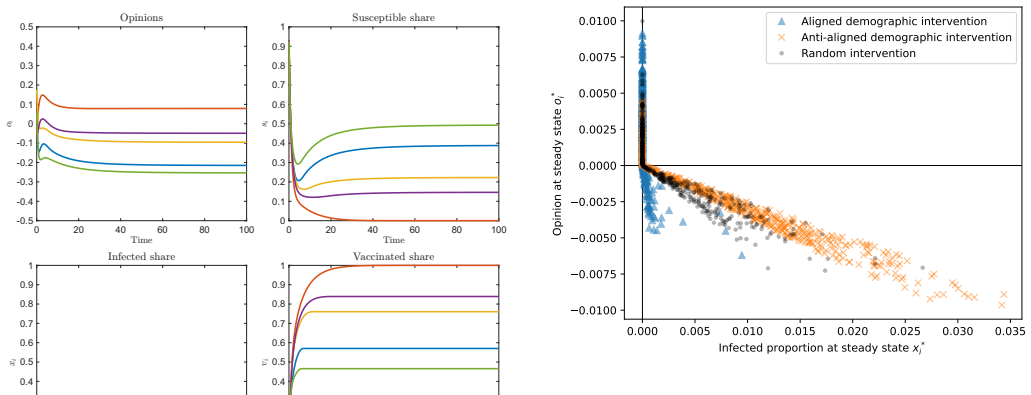
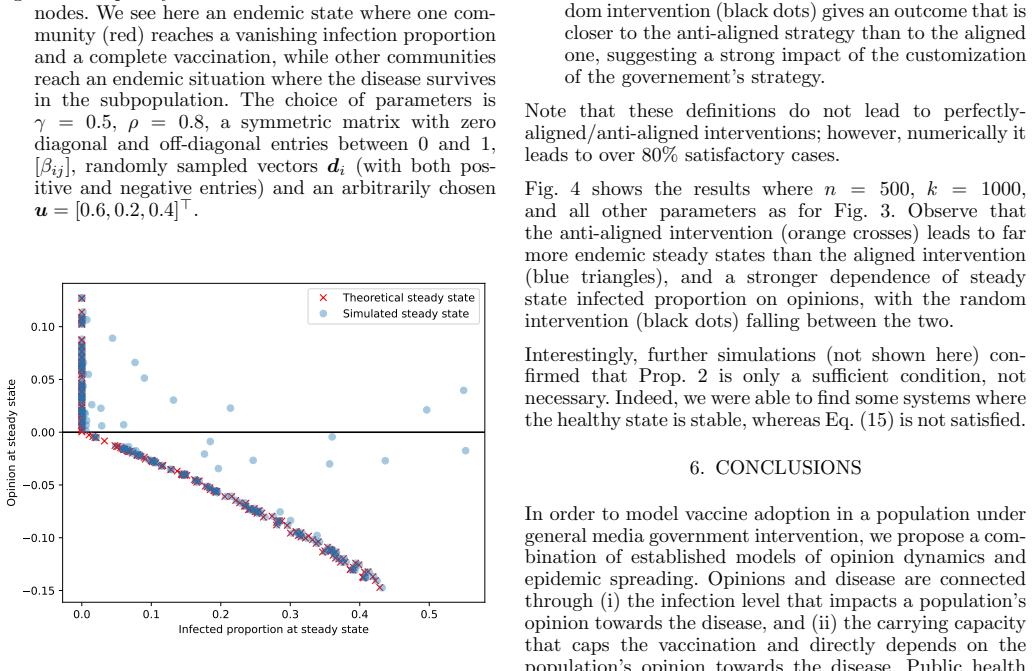
Inspired by contagion models of social belief formation, we develop an epistemically-informed modeling framework, SIS-Vo, in which vaccine-related information propagates on a signed opinion network. Our model allows for heterogeneous treatment effects of policy messages across subpopulations through demographic-specific responses. We derive fixed-point characterizations of the healthy (disease-free) and endemic equilibria of this model, and obtain conditions for local stability of the healthy state in terms of the contact network and opinion-dependent vaccination capacities. Using numerical simulations, we illustrate how suitably targeted policy interventions, acting through opinion dynamics, can stabilize the epidemic process by moving the system towards the healthy regime. The SIS-Vo framework thus provides a natural basis for control-theoretic analysis of vaccination policies that remain robust even when misinformation targets specific subgroups.
Editorial analysis
A structured set of objections, weighed in public.
Referee Report
Summary. The manuscript introduces the SIS-Vo framework that couples SIS epidemic dynamics with opinion propagation on signed networks, allowing for demographic heterogeneity in responses to policy messages. It derives fixed-point characterizations of the healthy (disease-free) and endemic equilibria, obtains local stability conditions for the healthy state in terms of the contact network and opinion-dependent vaccination capacities, and presents numerical simulations to illustrate that suitably targeted policy interventions acting through opinion dynamics can move the system toward the healthy regime.
Significance. If the central claims hold, the SIS-Vo framework supplies a basis for control-theoretic analysis of vaccination policies that remain robust when misinformation targets specific subgroups. The paper is credited for its fixed-point derivations, local stability analysis, and numerical illustrations of opinion-mediated policy effects.
major comments (2)
- [§5 (Numerical Simulations)] The abstract and §5 claim that targeted interventions can stabilize the epidemic by moving the system from an endemic regime to the healthy one. However, only local stability of the healthy equilibrium is derived; the simulations do not analyze basin boundaries, multiple equilibria, or trajectories starting from endemic initial conditions under intervention, leaving the global reachability claim unsupported.
- [§4 (Stability Analysis)] The heterogeneous treatment effects across subpopulations are introduced via demographic-specific response parameters, yet the stability conditions in §4 appear to treat these as fixed rather than dynamically responsive to the signed opinion network updates; this weakens the link between opinion dynamics and the claimed policy robustness.
minor comments (2)
- [§2] Notation for the signed opinion network adjacency matrix is introduced without an explicit definition of the sign convention in the model equations.
- [Figure 2] Figure 2 caption does not specify the initial conditions or parameter values used for the intervention scenarios.
Simulated Author's Rebuttal
We thank the referee for their constructive comments, which have helped us improve the clarity and scope of our manuscript. We address each major comment in detail below.
read point-by-point responses
-
Referee: [§5 (Numerical Simulations)] The abstract and §5 claim that targeted interventions can stabilize the epidemic by moving the system from an endemic regime to the healthy one. However, only local stability of the healthy equilibrium is derived; the simulations do not analyze basin boundaries, multiple equilibria, or trajectories starting from endemic initial conditions under intervention, leaving the global reachability claim unsupported.
Authors: We agree that our current simulations primarily illustrate the effect of interventions under specific initial conditions and do not provide a comprehensive global stability analysis. To address this, we will expand §5 with additional numerical experiments that include trajectories starting from endemic equilibria and apply interventions to demonstrate convergence to the healthy state. We will also add a discussion noting that while local stability is proven, global reachability is supported numerically in the revised simulations but a full basin analysis remains for future work. revision: yes
-
Referee: [§4 (Stability Analysis)] The heterogeneous treatment effects across subpopulations are introduced via demographic-specific response parameters, yet the stability conditions in §4 appear to treat these as fixed rather than dynamically responsive to the signed opinion network updates; this weakens the link between opinion dynamics and the claimed policy robustness.
Authors: The stability conditions are derived for the coupled system at the joint equilibrium of the epidemic and opinion dynamics. The demographic response parameters are determined by the steady-state opinions on the signed network, which are solved as part of the fixed-point equations. The linearization accounts for the opinion updates through the Jacobian of the full system. We will revise the presentation in §4 to explicitly connect the opinion-dependent vaccination capacities to the network updates and clarify that the parameters are not fixed but equilibrium values responsive to the opinion propagation. revision: yes
Circularity Check
No circularity: equilibria and stability derived directly from model equations
full rationale
The paper constructs the SIS-Vo model from first principles combining SIS epidemic dynamics with signed opinion networks and demographic heterogeneity. Fixed-point characterizations of the healthy and endemic equilibria, plus local stability conditions in terms of the contact network and opinion-dependent vaccination capacities, are obtained by direct algebraic manipulation of the governing equations. Numerical simulations then illustrate the effect of policy interventions on opinion dynamics. No step reduces by construction to a fitted input, self-citation, or renamed ansatz; the derivation chain remains independent of the target claims and is self-contained against the model's stated assumptions.
Axiom & Free-Parameter Ledger
free parameters (1)
- opinion-dependent vaccination capacities
axioms (2)
- domain assumption Vaccine-related information propagates on a signed opinion network
- domain assumption Subpopulations exhibit heterogeneous treatment effects to policy messages
invented entities (1)
-
SIS-Vo framework
no independent evidence
Reference graph
Works this paper leans on
-
[1]
Bhowmick, S. and Selvaganesan, N. (2024). Social network-based epidemic spread with opinion-dependent vaccination. IEEE Control Systems Letters, 8, 1829--1834
work page 2024
-
[2]
Eom, D., Molder, A.L., Tosteson, H.A., Howell, E.L., DeSalazar, M., Kirschner, E., Goodwin, S.S., and Scheufele, D.A. (2025). Race and gender biases persist in public perceptions of scientists’ credibility. Scientific Reports, 15(1), 11021
work page 2025
-
[3]
Fricker, M. (2007). Epistemic Injustice: Power and the Ethics of Knowing. Oxford University Press
work page 2007
-
[4]
Funk, S., Salath \'e , M., and Jansen, V.A. (2010). Modelling the influence of human behaviour on the spread of infectious diseases: A review. Journal of the Royal Society Interface, 7(50), 1247--1256
work page 2010
-
[5]
Gauchat, G. (2012). Politicization of science in the public sphere: A study of public trust in the United States , 1974 to 2010. American Sociological Review, 77(2), 167--187
work page 2012
-
[6]
Hardwig, J. (1985). Epistemic dependence. The Journal of Philosophy, 82(7), 335--349
work page 1985
-
[7]
Horn, R.A. and Johnson, C.R. (2012). Matrix Analysis. Cambridge University Press, Cambridge, 2nd ed edition
work page 2012
-
[8]
Kahan, D.M., Jenkins-Smith, H., and Braman, D. (2011). Cultural cognition of scientific consensus. Journal of Risk Research, 14(2), 147--174
work page 2011
-
[9]
Leung, C.H., Gibbs, M.E., and Paré, P.E. (2022). The impact of vaccine hesitancy on epidemic spreading. In Proc. American Control Conference (ACC), 3656--3661
work page 2022
-
[10]
Leung, H.C.H., Li, Z., She, B., and Paré, P.E. (2023). Leveraging opinions and vaccination to eradicate networked epidemics. In Proc. European Control Conference (ECC), 1--6
work page 2023
-
[11]
Longino, H.E. (1990). Science as Social Knowledge: Values and Objectivity in Scientific Inquiry. Princeton University Press
work page 1990
-
[12]
McPherson, M., Smith-Lovin, L., and Cook, J.M. (2001). Birds of a feather: Homophily in social networks. Annual Review of Sociology, 27(1), 415--444
work page 2001
-
[13]
Mitchell, L. and Ross, J.V. (2016). A data-driven model for influenza transmission incorporating media effects. Royal Society Open Science, 3(10), 160481
work page 2016
-
[14]
Newman, M.E.J. (2010). Networks: An Introduction. Oxford University Press
work page 2010
-
[15]
Quaresmini, C., Villa, E., Maghool, S., Breschi, V., Schaffonati, V., and Tanelli, M. (2025). The role of epistemic fairness in dynamics models to support sustainable mobility diffusion. In Engineering and Value Change, 179--198. Springer
work page 2025
-
[16]
She, B., Liu, J., Sundaram, S., and Paré, P.E. (2022). On a networked SIS epidemic model with cooperative and antagonistic opinion dynamics. IEEE Transactions on Control of Network Systems, 9(3), 1154--1165
work page 2022
-
[17]
Sieghart, M.A. (2022). The Authority Gap: Why Women Are Still Taken Less Seriously Than Men, and What We Can Do About It. WW Norton & Company
work page 2022
-
[18]
Sonmez, B., Makarovs, K., and Allum, N. (2023). Public perception of scientists: Experimental evidence on the role of sociodemographic, partisan, and professional characteristics. PLOS One, 18(7), e0287572
work page 2023
-
[19]
Villa, E., Quaresmini, C., Breschi, V., Schiaffonati, V., and Tanelli, M. (2025). The epistemic dimension of algorithmic fairness: Assessing its impact in innovation diffusion and fair policy making. arXiv e-prints, arXiv--2504
work page 2025
-
[20]
Wang, Z., Andrews, M.A., Wu, Z.X., Wang, L., and Bauch, C.T. (2015). Coupled disease--behavior dynamics on complex networks: A review. Physics of Life Reviews, 15, 1--29
work page 2015
discussion (0)
Sign in with ORCID, Apple, or X to comment. Anyone can read and Pith papers without signing in.