REVIEW 2 major objections 2 minor 1 cited by
Constraining the Photon Intensity of Extragalactic Background Light with the HAWC Observatory for the Blazar Mrk 421
T0 review · 2 major / 2 minor · reviewed 2026-05-25 · grok-4.3
Pith's one-line read Mrk 421 high-state spectrum shows a cutoff at 13 TeV that is intrinsic to the source rather than from EBL absorption.
desk verdict HAWC data gives a 13 TeV cutoff in Mrk 421 high states at 3.8 sigma that the authors call intrinsic and use for EBL limits, but the key comparison to EBL model predictions is not shown with numbers or uncertainties. read the letter →
The pith
A machine-rendered reading of the paper's core claim, the machinery that carries it, and where it could break.
The reading
What carries the argument
The direct numerical comparison of the fitted 13 TeV cutoff energy against the EBL-absorption cutoff predicted by prior models, performed on the high-state data selected by the All-sky Root around in an Unbiased way method.
What would settle it
A future spectral measurement during a high state of Mrk 421 that places the cutoff energy within a few TeV of the value predicted by current EBL models would remove the basis for claiming an intrinsic cutoff.
Extended reading notes
Core claim
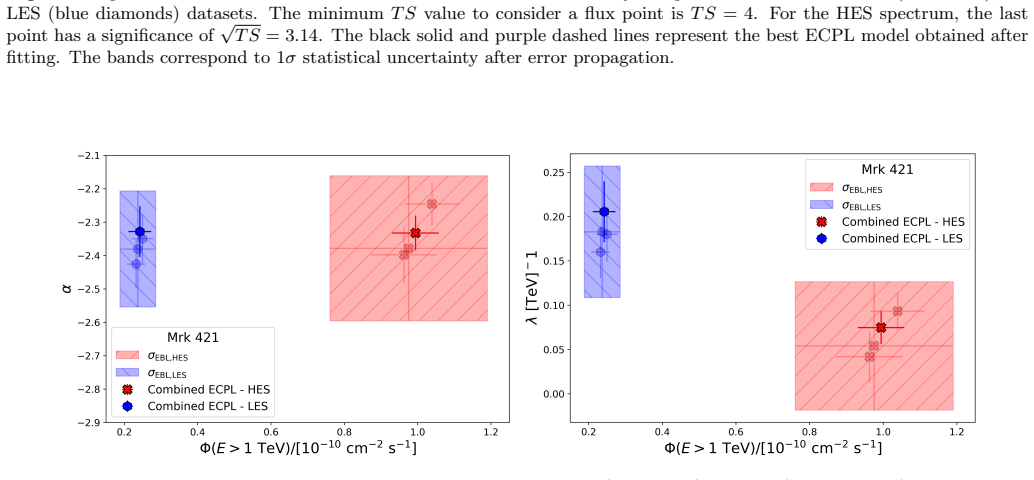
An Exponential Cutoff Power Law is preferred over a Simple Power Law for the high-emission spectrum of Mrk 421 at the 3.8 sigma level, with the cutoff energy measured at 13 plus or minus 3 TeV. This value differs from the cutoff expected from gamma-ray interactions with EBL photons, indicating the cutoff is intrinsic to the source and permitting upper limits on EBL photon intensity.
Load-bearing premise
The expected EBL-induced cutoff energy is known accurately enough from existing models that any mismatch with the observed 13 TeV value must mean the cutoff is produced inside the source.
Editorial extensions
If this is right
- The intrinsic cutoff implies that particle acceleration or photon production inside Mrk 421 is limited at energies around 13 TeV during bright flares.
- Upper limits on EBL intensity follow directly once the observed cutoff is attributed to the source rather than to propagation.
- Spectral shape differences between high and low states can be exploited for tests of the Hubble constant or EBL density.
- The same state-selection technique can be applied to other blazars monitored by HAWC or similar arrays.
Reading between the lines
- If the intrinsic cutoff persists across multiple flares, it may constrain the maximum electron energy or the size of the emission region in the jet.
- Repeated application to other variable blazars could tighten EBL limits without relying solely on distant sources.
- The result highlights the value of long-term monitoring to catch rare high states where such cutoffs become measurable.
Signed reviews
Editorial analysis
A structured set of objections, weighed in public.
Referee Report
Summary. The manuscript analyzes 2460 transits of HAWC data on Mrk 421, using the All-sky Root around in an Unbiased way (ARU) method to select high- and low-emission states. It reports that an Exponential Cutoff Power Law is preferred over a Simple Power Law for the high-state spectrum at 3.8σ significance, with a fitted cutoff energy of 13±3 TeV. This cutoff is stated to differ from the energy expected from EBL pair-production absorption, leading to the conclusion that it is intrinsic to the source; the result is then used to derive upper limits on the specific intensity of EBL photons.
Significance. If the quantitative demonstration that the observed cutoff lies outside the range of EBL-predicted cutoffs (accounting for model variations and uncertainties) is provided, the work would offer useful constraints on both the intrinsic spectra of high-state blazars and the EBL photon density at near-IR wavelengths. The long-term HAWC monitoring and state-selection approach represent a strength for variability studies.
major comments (2)
- [Abstract] Abstract: The central claim that 'the value of the energy cutoff found in our analysis is different from the cutoff expected by the interaction of gamma-rays with EBL photons' (and the subsequent intrinsic-source conclusion plus EBL upper limits) is not supported without an explicit comparison. The manuscript must quote the EBL-induced cutoff energies (where τ(E)≈1) predicted by the specific models employed (e.g., Franceschini, Gilmore, Domínguez), together with their uncertainty bands, and demonstrate that 10–16 TeV lies outside those ranges. Model-to-model variation in EBL density at 1–10 μm directly maps into a range of possible cutoff energies for z=0.03; overlap would undermine both the intrinsic interpretation and the derived limits.
- [Results / spectral fitting] Spectral analysis / results section: The 3.8σ preference for the Exponential Cutoff Power Law and the quoted cutoff of 13±3 TeV require accompanying details on the fit statistic (e.g., Δχ² or likelihood ratio), degrees of freedom, systematic uncertainties (energy scale, background subtraction, effective area), and the precise procedure used to translate the cutoff into EBL intensity upper limits. Without these, the statistical significance and the EBL constraint cannot be evaluated.
minor comments (2)
- [Data selection] The ARU state-selection method should be described with sufficient detail (thresholds, time bins, potential correlation with spectral hardness) to allow assessment of possible bias in the high-state spectrum.
- [Discussion] Explicit references to the EBL models used for the expected-cutoff comparison and for the upper-limit derivation should be added.
Simulated Author's Rebuttal
We thank the referee for the constructive comments, which identify key elements needed to strengthen the manuscript's claims. We will revise the paper to incorporate explicit EBL model comparisons and detailed fit information as requested.
read point-by-point responses
-
Referee: [Abstract] The central claim that 'the value of the energy cutoff found in our analysis is different from the cutoff expected by the interaction of gamma-rays with EBL photons' (and the subsequent intrinsic-source conclusion plus EBL upper limits) is not supported without an explicit comparison. The manuscript must quote the EBL-induced cutoff energies (where τ(E)≈1) predicted by the specific models employed (e.g., Franceschini, Gilmore, Domínguez), together with their uncertainty bands, and demonstrate that 10–16 TeV lies outside those ranges. Model-to-model variation in EBL density at 1–10 μm directly maps into a range of possible cutoff energies for z=0.03; overlap would undermine both the intrinsic interpretation and the derived limits.
Authors: We agree that an explicit quantitative comparison is required to support the claim of an intrinsic cutoff. In the revised manuscript we will add a dedicated paragraph (and accompanying table) that computes the EBL absorption cutoff energies (τ(E)≈1) for the Franceschini, Gilmore, and Domínguez models at z=0.03, including their published uncertainty bands. We will then directly compare these ranges to the observed 13±3 TeV cutoff and state whether the observed value lies outside the EBL-predicted interval. If overlap is found we will revise the interpretation and the derived EBL limits accordingly. This material will also be referenced in the abstract. revision: yes
-
Referee: [Results / spectral fitting] The 3.8σ preference for the Exponential Cutoff Power Law and the quoted cutoff of 13±3 TeV require accompanying details on the fit statistic (e.g., Δχ² or likelihood ratio), degrees of freedom, systematic uncertainties (energy scale, background subtraction, effective area), and the precise procedure used to translate the cutoff into EBL intensity upper limits. Without these, the statistical significance and the EBL constraint cannot be evaluated.
Authors: We will expand the spectral-analysis subsection to supply the missing quantitative information. The 3.8σ significance will be shown to arise from a likelihood-ratio test; the exact test statistic, degrees of freedom, and p-value will be reported. Systematic uncertainties associated with the energy scale, background subtraction, and effective area will be evaluated and quoted separately from the statistical error on the cutoff energy. Finally, we will describe the step-by-step procedure that converts the observed cutoff (under the assumption it is intrinsic) into upper limits on EBL specific intensity, including the assumed intrinsic spectral shape and any propagation of uncertainties. These additions will appear in the results section of the revised manuscript. revision: yes
Circularity Check
No circularity: direct spectral fit to external data compared against independent EBL models
full rationale
The derivation consists of selecting high/low emission periods from HAWC transits via the All-sky Root around in an Unbiased way method, fitting an Exponential Cutoff Power Law to the high-state spectrum (preferred at 3.8σ over simple power law, cutoff 13±3 TeV), deriving EBL intensity upper limits from the observed cutoff, and noting that this cutoff differs from the pair-production cutoff predicted by external EBL models (Franceschini, Gilmore, Domínguez etc.). None of these steps reduce by construction to quantities defined by the fit itself; the EBL comparison uses prior models whose optical-depth predictions are independent of the present dataset. No self-citation chains, ansatzes smuggled via citation, or fitted parameters renamed as predictions appear in the load-bearing claims.
Assumptions & free parameters
free parameters (1)
- cutoff energy =
13 TeV
assumptions (1)
- domain assumption Existing EBL models accurately predict the gamma-ray cutoff energy expected from pair-production absorption.
Cite this review
Pith. "Pith review of Constraining the Photon Intensity of Extragalactic Background Light with the HAWC Observatory for the Blazar Mrk 421." pith.science (2026). https://pith.science/paper/C6OVAEFW
@misc{pith2026260523107,
  author       = {Pith},
  title        = {Pith review of: Constraining the Photon Intensity of Extragalactic Background Light with the HAWC Observatory for the Blazar Mrk 421},
  year         = {2026},
  howpublished = {\url{https://pith.science/paper/C6OVAEFW}},
  note         = {Machine review of arXiv:2605.23107}
}
abstract
The blazar Mrk 421 exhibits rapid variability over a wide range of timescales. Spectral differences have been observed during the different emission states of Mrk 421. During the high emission states, tests to constraint the Hubble constant and the photon intensity of Extragalactic Background Light (EBL) can be performed. The HAWC observatory provides an exceptionally long term monitoring of the source at TeV energies. We selected periods of high emission state and low emission state in data with total observation time of 2460 transits from the HAWC observatory using the All-sky Root around in an Unbiased way methodology. We report on evidence of a cutoff in the spectrum of Mrk 421 during high emission states. An Exponential Cutoff Power Law is preferred over a Simple Power Law at a $3.8\,\sigma$ level. In the Exponential Cutoff Power Law, the cutoff is found at $13\pm3~\text{TeV}$. Using this result, we provide upper limits on the specific intensity of EBL photons. Moreover, the value of the energy cutoff found in our analysis is different from the cutoff expected by the interaction of gamma-rays with EBL photons. This result indicates that the cutoff is intrinsic to the source.
Figures


Figures from the paper (5 more)




Forward citations
Cited by 1 Pith paper
-
CIBER $\times$ galaxy cross-correlations reveal a bright, low-redshift NIR background
First tomographic CIBER×galaxy cross-correlations reveal near-infrared background fluctuations at z<0.6 several times stronger than integrated-galaxy-light model predictions.
Reference graph
Works this paper leans on
-
[1]
, archivePrefix = "arXiv", eprint =
Abdollahi, S., Ackermann, M., Ajello, M., et al. 2017, The Astrophysical Journal, 846, 34, doi: 10.3847/1538-4357/aa8092
-
[2]
2023, Nuclear Instruments and Methods in Physics Research Section A:
Abeysekara, A., Albert, A., Alfaro, R., et al. 2023, Nuclear Instruments and Methods in Physics Research Section A:
work page 2023
-
[3]
Accelerators, Spectrometers, Detectors and Associated Equipment, 1052, 168253, doi: https://doi.org/10.1016/j.nima.2023.168253
-
[4]
U., Albert, A., Alfaro, R., et al
Abeysekara, A. U., Albert, A., Alfaro, R., et al. 2017, The Astrophysical Journal, 841, 100
work page 2017
-
[5]
U., Albert, A., Alfaro, R., et al
Abeysekara, A. U., Albert, A., Alfaro, R., et al. 2019, The Astrophysical Journal, 881, 134, doi: 10.3847/1538-4357/ab2f7d
-
[6]
A., Aliu, E., Arlen, T., et al
Acciari, V. A., Aliu, E., Arlen, T., et al. 2011, The Astrophysical Journal, 738, 25
work page 2011
-
[7]
Acciari, V. A., Ansoldi, S., Antonelli, L. A., et al. 2020, Monthly Notices of the Royal Astronomical Society, 504, 1427, doi: 10.1093/mnras/staa3727
-
[8]
, archivePrefix = "arXiv", eprint =
Ackermann, M., Ajello, M., Albert, A., et al. 2013, The Astrophysical Journal, 771, 57, doi: 10.1088/0004-637X/771/1/57
Show all 26 references
-
[9]
2022b, The Astrophysical Journal, 933, 223, doi: 10.3847/1538-4357/ac7714
Albert, A., Alfaro, R., Alvarez, C., et al. 2022b, The Astrophysical Journal, 933, 223, doi: 10.3847/1538-4357/ac7714
-
[10]
C., et al
Albert, A., Alfaro, R., Arteaga-Vel´ azquez, J. C., et al. 2022c, A&A, 667, A36, doi: 10.1051/0004-6361/202243527
-
[11]
2024, The Astrophysical Journal, 972, 144, doi: 10.3847/1538-4357/ad5f2d
Albert, A., Alfaro, R., Alvarez, C., et al. 2024, The Astrophysical Journal, 972, 144, doi: 10.3847/1538-4357/ad5f2d
2024 doi
-
[12]
2007, The Astrophysical Journal, 663, 125 Aleksi´ c, J., Anderhub, H., Antonelli, L
Albert, J., Aliu, E., Anderhub, H., et al. 2007, The Astrophysical Journal, 663, 125 Aleksi´ c, J., Anderhub, H., Antonelli, L. A., et al. 2010, A&A, 519, A32 Aleksi´ c, J., Alvarez, E. A., Antonelli, L. A., et al. 2012, A&A, 542, A100
2007
-
[13]
2025, The Astrophysical Journal, 980, 88
Alfaro, R., Alvarez, C., Andr´ es, A., et al. 2025, The Astrophysical Journal, 980, 88
2025
-
[14]
2021, A&A, 647, A88, doi: 10.1051/0004-6361/201935557
Arbet-Engels, A., Baack, D., Balbo, M., et al. 2021, A&A, 647, A88, doi: 10.1051/0004-6361/201935557
2021 doi
-
[15]
Biteau, J., & Williams, D. A. 2015, The Astrophysical Journal, 812, 60 Dom´ ınguez, A., Primack, J. R., Rosario, D. J., et al. 2011, Monthly Notices of the Royal Astronomical Society, 410, 2556, doi: 10.1111/j.1365-2966.2010.17631.x
2015 doi
-
[16]
L., Ma, C., Arias, E
Fey, A. L., Ma, C., Arias, E. F., et al. 2004, The Astronomical Journal, 127, 3587, doi: 10.1086/420998
2004 doi
-
[17]
D., Razzaque, S., & Dermer, C
Finke, J. D., Razzaque, S., & Dermer, C. D. 2010, The Astrophysical Journal, 712, 238, doi: 10.1088/0004-637X/712/1/238
2010 doi
-
[18]
2019, A&A, 629, A2
Franceschini, A., Foffano, L., Prandini, E., & Tavecchio, F. 2019, A&A, 629, A2
2019
-
[19]
2008, A&A, 487, 837, doi: 10.1051/0004-6361:200809691
Franceschini, A., Rodighiero, G., & Vaccari, M. 2008, A&A, 487, 837, doi: 10.1051/0004-6361:200809691
2008 doi
-
[20]
2024, Monthly Notices of the Royal Astronomical Society, 529, 1450, doi: 10.1093/mnras/stae643 16 Gr´ eaux, L., Biteau, J., & Nievas Rosillo, M
Gokus, A., Wilms, J., Kadler, M., et al. 2024, Monthly Notices of the Royal Astronomical Society, 529, 1450, doi: 10.1093/mnras/stae643 16 Gr´ eaux, L., Biteau, J., & Nievas Rosillo, M. 2024, The Astrophysical Journal Letters, 975, L18, doi: 10.3847/2041-8213/ad85c9
2024 doi
-
[21]
C., Banerjee, D
Gupta, A. C., Banerjee, D. P. K., Ashok, N. M., & Joshi, U. C. 2004, A&A, 422, 505, doi: 10.1051/0004-6361:20040306 Hern´ andez Cadena, S., Torres Escobedo, R., & Zhou, H. 2025, PoS, ICRC2025, 674, doi: 10.22323/1.501.0674 H.E.S.S. Collaboration, Abramowski, A., Acero, F., et ...
2004 doi
-
[22]
M., Villata, M., Carnerero, M
Raiteri, C. M., Villata, M., Carnerero, M. I., et al. 2014, Monthly Notices of the Royal Astronomical Society, 442, 629, doi: 10.1093/mnras/stu886
2014 doi
-
[23]
Rieger, F. M. 2004, The Astrophysical Journal, 615, L5, doi: 10.1086/426018
2004 doi
-
[24]
G., et al
Saldana-Lopez, A., Dom´ ınguez, A., P´ erez-Gonz´ alez, P. G., et al. 2021, Monthly Notices of the Royal Astronomical Society, 507, 5144, doi: 10.1093/mnras/stab2393
2021 doi
-
[25]
L., Wagner, S
Taylor, G. L., Wagner, S. J., Wierzcholska, A., & Zacharias, M. 2026, Not so Swift: 20 years of multiwavelength observations of Mrk 421 and Mrk 501, https://arxiv.org/abs/2601.08344 The LHAASO Collaboration, Cao, Z., Aharonian, F., et al. 2026, LHAASO observation of Mrk 421 du...
2026
-
[26]
2024, The Astrophysical Journal Supplement Series, 271, 10
Wang, Z.-R., Xue, R., Xiong, D., et al. 2024, The Astrophysical Journal Supplement Series, 271, 10
2024
Reviewed May 25, 2026 · model on record in the stance chip above.
Discussion (0). Continue with ORCID to comment.