REVIEW 3 major objections 4 minor 52 references
Transmission Nonreciprocity in a Mutually Coupled Circulating Structure
T0 review · 3 major / 4 minor · reviewed 2026-08-14 · deepseek-v4-flash
Pith's one-line read Three mutually coupled cavities or fiber rings can transmit light nonreciprocally between two ports while preserving Lorentz reciprocity.
desk verdict The three-cavity topology is attractive, but the linear nonreciprocity claim without breaking Lorentz reciprocity rests on a mistaken reciprocity criterion; the gain-saturation mechanism remains conventional. read the letter →
The pith
A machine-rendered reading of the paper's core claim, the machinery that carries it, and where it could break.
The reading
What carries the argument
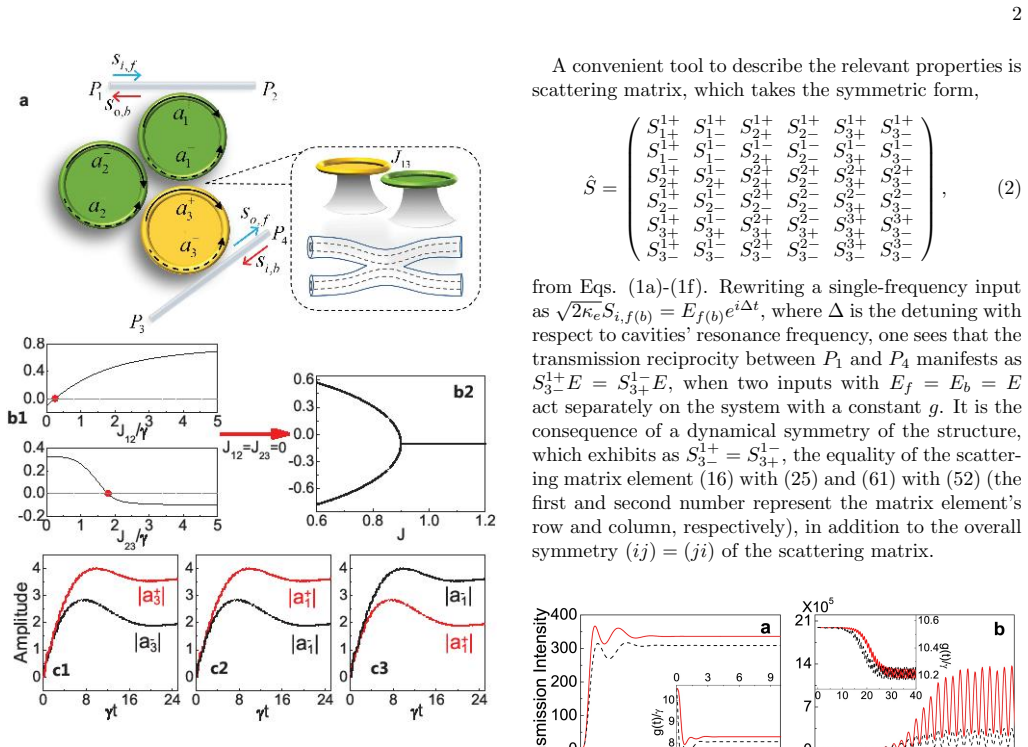
The load-bearing object is the six-mode scattering matrix of the mutually coupled circulating structure, whose entries are labelled by cavity and circulation direction ($1+, 1-, 2+, 2-, 3+, 3-$). Lorentz reciprocity is identified with the overall symmetry of this matrix, $S_{ij}=S_{ji}$. The paper's trick is that the physically relevant forward and backward transmissions are two different elements, $S^{1+}_{3-}$ and $S^{1-}_{3+}$, which the overall symmetry does not relate. An input from one port excites only the clockwise mode of one cavity and leaves through the counter-clockwise mode of another, so the reverse path is a different pair of modes. The mechanisms are (i) saturable gain, $g(t)=g_0/(1+|a^+_3+a^-_3|^2/I_0)$, which makes the forward and backward drives evolve under different effective Hamiltonians, and (ii) asymmetric coupling $J_{13}\pm\epsilon$ between the two helicities, which breaks the 'additional symmetry' $S^{1+}_{3-}=S^{1-}_{3+}$ while preserving the overall symmetry. The latter is the part that challenges the standard doctrine.
What would settle it
Measure the complex scattering coefficients $S^{1+}_{3-}$ and $S^{1-}_{3+}$ of a passive fiber-ring mutually coupled circulating structure with asymmetric directional couplers; if the two are equal whenever the full scattering matrix is symmetric, the paper's central claim is refuted, and if they differ while the matrix stays symmetric, the claim is supported.
Extended reading notes
Core claim
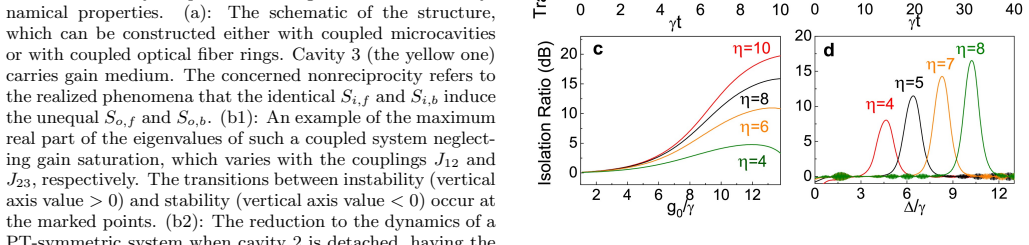
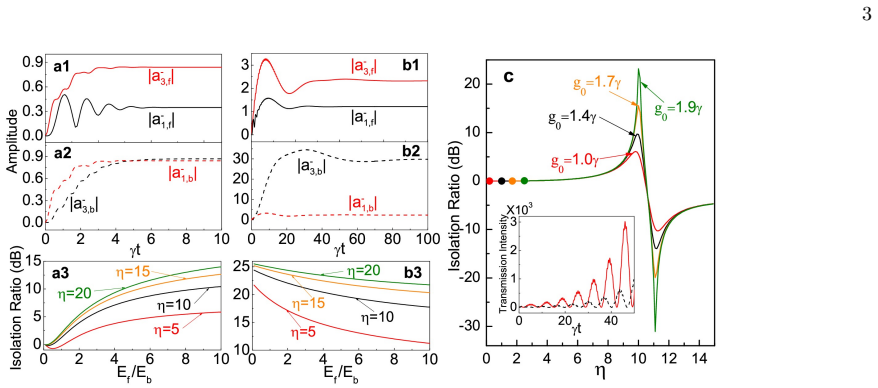
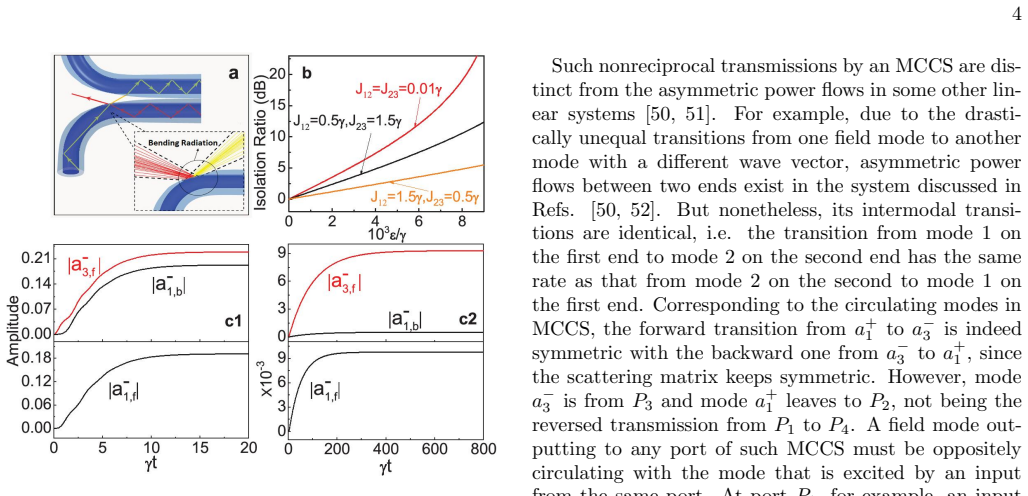
The paper's central claim is that a 'mutually coupled circulating structure'—three cavities or fiber rings, each carrying a clockwise (+) and counter-clockwise (−) circulating mode, with the cavities coupled in a triangle—can transmit identical inputs from two ports nonreciprocally even though its coupling to both inputs is the same. In the fiber-ring realization this happens in a time-independent linear system: by making the coupling between one pair of counter-circulating modes slightly stronger than the reverse pair (e.g., through a directional coupler exploiting macrobending loss), the scattering matrix stays symmetric—so Lorentz reciprocity holds—but the two off-diagonal elements $S^{1+}_{3-}$ and $S^{1-}_{3+}$ become unequal. Because an input at one port excites only one circulating direction while the output from the other port is collected from the opposite direction, the forward and backward transitions are not the matrix elements that reciprocity ties together. The paper shows numerically that this asymmetry yields isolation ratios and approximate optical isolator behaviour, and it also shows a second mechanism—saturable gain in one cavity—that produces nonreciprocity by making the dynamics direction-dependent, thereby actually breaking Lorentz reciprocity.
Load-bearing premise
The claim rests on the classification of Lorentz reciprocity as only the overall symmetry of the scattering matrix, so that the forward and backward transmissions are not required to be equal by reciprocity; if the standard reciprocity theorem instead ties those two particular transitions, the nonreciprocity without breaking reciprocity disappears.
Editorial extensions
If this is right
- A linear, time-independent, isotropic, magnet-free structure can perform approximate optical isolation, a capability usually assumed to require breaking Lorentz reciprocity.
- The same structure can isolate two simultaneous inputs from opposite ports, not just sequential forward and backward drives.
- Nonreciprocity can be tuned by geometry—coupling constants and cavity spacings—rather than by external modulation or nonlinear response.
- Gain saturation offers a separate mechanism, but it breaks Lorentz reciprocity; the asymmetric-coupling mechanism does not.
Reading between the lines
- If the paper's definition of reverse transmission is accepted, many other loop geometries with chiral internal couplings might realize reciprocity-preserving nonreciprocity; testing four- or more-cavity loops would show whether the effect is generic or specific to three cavities.
- The practical usefulness depends on whether directional couplers can deliver a large ratio $(J_{13}+\epsilon)/(J_{13}-\epsilon)$ at low loss; the paper only demonstrates weak coupling, so a stronger asymmetric coupler would be a natural next test.
- A direct experimental check is to measure the full $6\times 6$ scattering matrix and verify it is symmetric while the two cross-helicity elements differ; this would settle whether the paper's distinction between reciprocity and transmission symmetry is physically realized.
Signed reviews
Editorial analysis
A structured set of objections, weighed in public.
Referee Report
Summary. The paper presents a coupled three-cavity or three-fiber-ring structure ('mutually coupled circulating structure', MCCS) and claims to realize optical nonreciprocity between two ports despite equal coupling to both inputs. Two mechanisms are claimed: (i) gain saturation in an active cavity gives nonlinear nonreciprocal transmission, and (ii) a directional coupler that makes the coupling between clockwise and counter-clockwise modes asymmetric gives, in a time-independent linear system, nonreciprocal transmission 'without breaking Lorentz reciprocity.' The manuscript also reports approximate optical isolation for simultaneous forward and backward inputs and argues that the structure provides a new concept for nonreciprocity based on topology and coupling geometry rather than direction-dependent media or nonidentical input couplings.
Significance. If the linear nonreciprocity-without-Lorentz-reciprocity-breaking claim were correct, the paper would overturn a widely accepted restriction and demonstrate that linear, time-invariant, isotropic components can perform approximate optical isolation without magnets, modulation, or nonlinearity. The gain-saturation mechanism is a plausible nonlinear effect, but it builds directly on prior active-microcavity works (Refs. [24,25,32]) and does not by itself constitute a fundamental new concept. The paper's specific claim that the six-mode scattering matrix remains symmetric while port-to-port transmission becomes nonreciprocal is, however, based on an incorrect identification of the reciprocity condition, and the central conceptual advance therefore fails. The paper also contains a number of presentation issues and deferred derivations that hinder verification.
major comments (3)
- [After Fig. 1 and Eq. (2); Conclusion] The paper's definition of the 'mutually reversed transmissions' as the transitions from a+1 to a-3 and from a+3 to a-1 is not the standard two-port reciprocity relation. For the two physical ports P1 and P4, the incoming modes are a+1 and a+3 and the outgoing modes are a-1 and a-3, so Lorentz reciprocity, as stated in the paper's own Refs. [4,33], requires S_{3-,1+} = S_{1-,3+}. The symmetry of the six-mode matrix in Eq. (2) enforces S_{3-,1+} = S_{1+,3-}, which is an equality between elements that do not correspond to the reciprocal port-to-port transmissions. The inequality S_{3-,1+} ≠ S_{1-,3+} reported in Fig. 4 is therefore exactly a violation of Lorentz reciprocity between the physical ports, not a mere breaking of an 'additional symmetry.' The central conclusion that nonreciprocity can be achieved 'while preserving the Lorentz reciprocity of the system' is consequently unsupported.
- [Eqs. (1a), (1f), and Fig. 4] The directional-coupler modification replaces the coefficient J13 in Eqs. (1a) and (1f) by J13+ε and J13-ε, respectively. This makes the coupling between modes a+1 and a-3 non-Hermitian: the coupling from a-3 to a+1 is -i(J13+ε) while the coupling from a+1 to a-3 is -i(J13-ε), so the coupled-mode Hamiltonian is not Hermitian even when the gain is zero and the detuning is real. A non-Hermitian coupling term of this type is itself a source of nonreciprocity, so the claim that the structure 'preserves Lorentz reciprocity' after this modification is internally inconsistent with the coupled-mode equations. The manuscript should either show that the coupled-mode Hamiltonian remains Hermitian in some appropriate sense or acknowledge that the asymmetry breaks reciprocity.
- [Supplementary Material, Sec. III] The proof that the scattering matrix remains symmetric after introducing the directional coupler, as well as the derivation of the equality E_f a+1,b = E_b a+3,f as a manifestation of Lorentz reciprocity, is deferred to Sec. III of the Supplementary Material, which is not included in the arXiv v1 manuscript. Because the central claim of the paper depends on this proof, the claim cannot be verified from the manuscript as written. Moreover, as argued above, even a symmetric six-mode matrix does not imply port-to-port reciprocity, so the deferred proof would need to address the physical-port condition explicitly.
minor comments (4)
- [Eq. (1c)] There is a typo in Eq. (1c): the first term on the right-hand side is written as '-γ2 a+1', but it should presumably be '-γ2 a+2' to describe the damping of the mode a+2.
- [Eq. (2)] The scattering matrix in Eq. (2) is printed with a layout that makes the row and column labels difficult to correlate with the matrix entries. The convention (row = output mode, column = input mode) should be stated explicitly and the labels aligned with the array.
- [References] The reference to 'Supplementary Material at [URL will be inserted by publisher]' is not accessible to the reader; a functioning link or an included appendix is needed for the key derivations.
- [Notation] The phrase 'the first and second number represent the matrix element's row and column' is awkward; use a standard notation such as S_{row,column} or S^{row}_{column} consistently.
Circularity Check
The 'nonreciprocity without breaking Lorentz reciprocity' claim is self-definitional: the equality the paper labels an 'additional symmetry' and breaks (S^{1+}_{3-} vs S^{1-}_{3+}) is, after using the retained transpose symmetry, exactly the standard two-port Lorentz reciprocity condition.
-
self definitional
[Section III, discussion after Fig. 4, and concluding paragraph; also Eqs. (2)-(3)]
"one of its additional symmetries is broken such that S^{1+}_{3−} ≠ S^{1−}_{3+}. ... The mutually reversed transmissions in Fig. 1(a), therefore, have to be the transitions from a+1 to a−3 and from a+3 to a−1, respectively. Such transitions from the CL (“+”) to the CCL (“−”) modes ... will become nonidentical once the symmetry S^{1+}_{3−}=S^{1−}_{3+} is broken"
The paper's own definition of the mutually reversed transmissions is a+1→a−3 (forward) and a+3→a−1 (backward). Lorentz reciprocity for those two physical transitions is the equality of the corresponding S-matrix elements. Because the paper retains the transpose symmetry of its six-mode scattering matrix, S^{1−}_{3+}=S^{3+}_{1−}, so the forward/backward reciprocity condition is equivalent to S^{1+}_{3−}=S^{1−}_{3+}. The paper instead classifies this equality as an 'additional symmetry' and breaks it, while declaring Lorentz reciprocity preserved because the matrix remains symmetric. Thus the central claim is true only under a redefined 'Lorentz reciprocity' (mode-basis transpose symmetry); the equality actually broken is the standard port-to-port reciprocity constraint of Refs. [4,33].
full rationale
The paper has two mechanisms. The gain-saturation mechanism (Figs. 2 and 3) is a genuinely nonlinear, time-dependent process that explicitly breaks Lorentz reciprocity; it is a design proposal rather than a circular prediction. The second mechanism, the directional-coupler version (Fig. 4), inserts the asymmetric coupling J13±ε by hand; the resulting isolation is a direct consequence of that asymmetry, but that by itself is an engineering input, not a statistical fit. The load-bearing and circular step is the reciprocity accounting: the paper defines reciprocity as the transpose symmetry of a six-mode S matrix and calls the standard port-to-port equality S^{1+}_{3−}=S^{1−}_{3+} an 'additional symmetry' that may be broken. Given the paper's own identification of the reversed transmissions as a+1→a−3 and a+3→a−1, the standard Lorentz reciprocity condition for ports P1 and P4 is exactly that equality; the paper's transpose symmetry is not sufficient. Breaking the 'additional symmetry' therefore breaks Lorentz reciprocity in the usual sense while the paper's redefined criterion remains satisfied. The proof of the reciprocity claim is deferred to Supplemental Sec. III, which is not present in v1, so the assertion is not independently checkable here. Score 8: the central linear nonreciprocity claim is forced by a definitional reclassification of the reciprocity constraint.
Assumptions & free parameters
free parameters (5)
- Gain rate g0 =
10.55gamma, 9.7gamma, 1.9gamma, 0.9gamma in different figures
- Saturation intensity I0 =
1.33e3 and 1.33e7 (dimensionless)
- Coupling coefficients J12, J13, J23 =
2.2gamma, gamma, 1e-2gamma, with eta=J23/J12 varied
- Asymmetric coupling epsilon =
9e-3gamma in Fig. 4
- Detuning Delta =
0, 5gamma, 10gamma, 20gamma, and Delta/gamma=eta
assumptions (5)
- domain assumption Coupled-mode equations (1a)-(1f) with one clockwise and one counterclockwise mode per cavity describe the system correctly.
- domain assumption Lorentz reciprocity is fully captured by symmetry of the six-mode scattering matrix.
- domain assumption The external drives at P1 and P4 excite only the clockwise modes a+1 and a+3, and the outputs at P4 and P1 come only from the counterclockwise modes a-3 and a-1.
- domain assumption Gain saturation follows g(t)=g0/(1+|a+3+a-3|^2/I0).
- domain assumption The directional macrobending coupler produces unequal coupling J13+/-epsilon without introducing nonreciprocal material response or significant reflections.
Cite this review
Pith. "Pith review of Transmission Nonreciprocity in a Mutually Coupled Circulating Structure." pith.science (2026). https://pith.science/paper/C6Q4MLPZ
@misc{pith2026190803280,
  author       = {Pith},
  title        = {Pith review of: Transmission Nonreciprocity in a Mutually Coupled Circulating Structure},
  year         = {2026},
  howpublished = {\url{https://pith.science/paper/C6Q4MLPZ}},
  note         = {Machine review of arXiv:1908.03280}
}
read the original abstract
Breaking Lorentz reciprocity was believed to be a prerequisite for nonreciprocal transmissions of light fields, so the possibility of nonreciprocity by linear optical systems was mostly ignored. We put forward a structure of three mutually coupled microcavities or optical fiber rings to realize optical nonreciprocity. Although its couplings with the fields from two different input ports are constantly equal, such system transmits them nonreciprocally either under the saturation of an optical gain in one of the cavities or with the asymmetric couplings of the circulating fields in different cavities. The structure made up of optical fiber rings can perform nonreciprocal transmissions as a time-independent linear system without breaking Lorentz reciprocity. Optical isolation for inputs simultaneously from two different ports and even approximate optical isolator operations are implementable with the structure.
Figures
Figures from the paper (1 more)
Reference graph
Works this paper leans on
-
[1]
L. J. Aplet and J. W. Carson, A Faraday effect optical isolator. Appl. Opt. 3, 544 (1964)
work page 1964
-
[2]
H. Dotsch, et al. Applications of magneto-optical waveg- uides in integrated optics: review. J. Opt. Soc. Am. B 22, 240 (2005)
work page 2005
- [3]
-
[4]
D. Jalas, et al. What is and what is not an optical isola- tor. Nat. Photon 7, 579 (2013)
work page 2013
- [5]
-
[6]
H. Lira, Z. Yu, S. Fan, and M. Lipson, Electrically driven nonreciprocity induced by interband transition on a sili- con chip. Phys. Rev. Lett. 109, 033901 (2012)
work page 2012
-
[7]
C. R. Doerr, L. Chen, and D. Vermeulen, Silicon photon- ics broadband modulation-based isolator. Opt. Express 22, 4493 (2014)
work page 2014
- [8]
Show all 52 references
-
[9]
N. A. Estep, D. L. Sounas, J. Soric, and A. Al´ u, Magnetic-free non-reciprocity and isolation based on parametrically modulated coupled-resonator loops. Na- ture Physics 10, 923 (2014)
2014
-
[10]
E. Li, B. Eggleton, K. Fang, and S. Fan, Photonic Aharonov-Bohm effect in photon-phonon interactions. Nat. Commun. 5, 3225 (2014)
2014
-
[11]
D. L. Sounas and A. Al´ u, Angular-momentum-biased nanorings to realize magnetic-free integrated optical iso- lation. ACS Photonics 1, 198 (2014)
2014
-
[12]
Longhi, Non-reciprocal transmission in photonic lat- tices based on unidirectional coherent perfect absorption
S. Longhi, Non-reciprocal transmission in photonic lat- tices based on unidirectional coherent perfect absorption. Opt. Lett. 40, 1278 (2015)
2015
-
[13]
Ruesink, M
F. Ruesink, M. Miri, A. Al´ u, and E. Verhagen, Nonre- ciprocity and magnetic-free isolation based on optome- chanical interactions. Nat. Commun. 7, 13662 (2016)
2016
-
[14]
Fang, et al
K. Fang, et al. Generalized nonreciprocity in an optome- chanical circuit via synthetic magnetism and reservoir engineering. Nature Physics 13, 465 (2017)
2017
-
[15]
M. Miri, F. Ruesink, E. Verhagen, and A. Al´ u, Opti- cal Nonreciprocity Based on Optomechanical Coupling. Phys. Rev. Applied 7, 064014 (2017)
2017
-
[16]
Gallo, G
K. Gallo, G. Assanto, K. R. Parameswaran, and M. M. Fejer, All-optical diode in a periodically poled lithium niobate waveguide. Appl. Phys. Lett. 79, 314 (2001)
2001
-
[17]
Grigoriev and F
V. Grigoriev and F. Biancalana, Nonreciprocal switching thresholds in coupled nonlinear microcavities. Opt. Lett. 36, 2131 (2011)
2011
-
[18]
I. V. Shadrivov, K. Y. Bliokh, Y. P. Bliokh, V. Frei- likher, and Y. S. Kivshar, Bistability of Anderson local- ized states in nonlinear random media. Phys. Rev. Lett. 104, 123902 (2010)
2010
-
[19]
Krause, H
M. Krause, H. Renner, and E. Brinkmeyer, Optical isola- tion in silicon waveguides based on nonreciprocal Raman amplification. Electron. Lett. 44, 691 (2008)
2008
-
[20]
Huang and S
X. Huang and S. Fan. Complete all-optical silica fiber isolator via stimulated Brillouin scattering. J. Lightwave Technol. 29, 2267 (2011)
2011
-
[21]
Fan, et al
L. Fan, et al. An all-silicon passive optical diode. Science 335, 447 (2012)
2012
-
[22]
M. S. Kang, A. Butsch, and P. St. J. Russel, Recon- figurable light-driven opto-acoustic isolators in photonic crystal fibre. Nat. Photon 5, 549 (2011)
2011
-
[23]
S. A. R. Horsley, J. Wu, M. Artoni, and G. C. La Rocca, Optical nonreciprocity of cold atom Bragg mirrors in mo- tion. Phys. Rev. Lett. 110, 223602 (2013)
2013
-
[24]
Wen, et al
J. Wen, et al. Modeling of on-chip optical nonreciprocity with an active microcavity. Photonics 2, 498 (2015)
2015
-
[25]
X. S. Jiang, et al. On-chip optical nonreciprocity using an active microcavity. Sci. Rep. 6, 38972 (2016)
2016
-
[26]
Hua, et al
S. Hua, et al. Demonstration of a chip-based optical iso- lator with parametric amplification. Nat. Commun. 7, 13657 (2016)
2016
-
[27]
Y. Shen, M. Bradford, and J.-T. Shen, Single-photon diode by exploiting the photon polarization in a waveg- uide. Phys. Rev. Lett. 107, 173902 (2011)
2011
-
[28]
Xia, et al
K. Xia, et al. Reversible nonmagnetic single-photon iso- lation using unbalanced quantum coupling. Phys. Rev. A 90, 043802 (2014)
2014
-
[29]
Hafezi and P
M. Hafezi and P. Rabl, Optomechanically induced nonre- ciprocity in microring resonators. Opt. Express 20, 7672 (2012)
2012
-
[30]
Shen, et al
Z. Shen, et al. Experimental realization of optome- chanically induced non-reciprocity. Nat. Photon 10, 657 (2016)
2016
-
[31]
E. I. Rosenthal, B. J. Chapman, A. P. Higginbotham, J. Kerckhoff, and K. W. Lehnert, Breaking Lorentz reci- procity with frequency conversion and delay. Phys. Rev. Lett. 119, 147703 (2017)
2017
-
[32]
Chang, et al
L. Chang, et al. Parity-time symmetry and variable op- tical isolation in activepassive-coupled microresonators. Nat. Photon 8, 524 (2014)
2014
-
[33]
L. D. Landau and E. M. Lifshitz, Electrodynamics of Continuous Media (Addison-Wesley: Reading, MA, 1960)
1960
-
[34]
El-Ganainy, K
R. El-Ganainy, K. G. Makris, D. N. Christodoulides, and Z. H. Musslimani, Theory of coupled optical PT- symmetric structures. Opt. Lett. 32, 2632 (2007)
2007
-
[35]
Guo, et al
A. Guo, et al. Observation of PT-symmetry breaking in complex optical potentials. Phys. Rev. Lett. 103, 093902 (2009)
2009
-
[36]
Regensburger, et al
A. Regensburger, et al. Parity-time synthetic photonic lattices. Nature 488, 167 (2012)
2012
-
[37]
Peng, et al
B. Peng, et al. Parity-time-symmetric whispering-gallery microcavities. Nat. Phys. 10, 394 (2014)
2014
-
[38]
He, S.-B
B. He, S.-B. Yan, J. Wang, and M. Xiao, Quantum noise effects with Kerr-nonlinearity enhancement in coupled gain-loss waveguides. Phys. Rev. A 91, 053832 (2015)
2015
-
[39]
B. He, L. Yang, and M. Xiao, Dynamical phonon laser in coupled active-passive microresonators. Phys. Rev. A 94, 031802(R) (2016)
2016
-
[40]
L. Feng, R. El-Ganainy, and L. Ge, Non-Hermitian pho- tonics based on parity-time symmetry. Nat. Photon 11, 752 (2017)
2017
-
[41]
Yang, et al
C. Yang, et al. Realization of controllable photonic molecule based on three ultrahigh-Q microtoroid cavi- ties. Laser & Photonics Reviews 11, 1770021 (2017)
2017
-
[42]
C. Yang, Y. Hu, X.-S. Jiang, and M. Xiao, Analysis of a triple-cavity photonic molecule based on coupled mode theory. Phys. Rev A 95, 033847 (2017)
2017
-
[43]
Hodaei, et al
H. Hodaei, et al. Enhanced sensitivity at higher-order 6 exceptional points. Nature 548, 187 (2017)
2017
-
[44]
B. He, L. Yang, Z. Zhang, and M. Xiao, Cyclic permutation-time symmetric structure with coupled gain-loss microcavities. Phys. Rev. A 91, 033830 (2015)
2015
-
[45]
Weiss, et al
D. Weiss, et al. Splitting of high-Q Mie modes induced by light backscattering in silica microspheres. Opt. Lett. 20, 1835 (1995)
1995
-
[46]
Schmidt, Mode dynamics in coupled disk opti- cal microresonators
C. Schmidt, Mode dynamics in coupled disk opti- cal microresonators. PhD Thesis, der Friedrich-Schiller- Universit¨ at Jena (2013)
2013
-
[47]
See more detailed discussion in Supplementary Material at [URL will be inserted by publisher]
-
[48]
Y. Shi, Z. Yu, and S. Fan. Limitations of nonlinear optical isolators due to dynamic reciprocity. Nat. Photon 9, 388 (2015)
2015
-
[49]
J. A. Jay, An overview of macrobending and microbend- ing of optical fibers. Corning Incorporated, Corning, NY, USA, White Paper WP1212 (2010)
2010
-
[50]
Feng, et al
L. Feng, et al. Nonreciprocal light propagation in a silicon photonic circuit. Science 333, 729 (2011)
2011
-
[51]
Wang, X.-L
C. Wang, X.-L. Zhong, and Z.-Y. Li, Linear and passive silicon optical isolator. Sci. Rep. 2, 674 (2012)
2012
-
[52]
Nonreciprocal light propaga- tion in a silicon photonic circuit
S. Fan, et al. Comment on “Nonreciprocal light propaga- tion in a silicon photonic circuit”. Science 335, 38 (2012)
2012
Reviewed August 14, 2026 · model on record in the stance chip above.
Discussion (0). Continue with ORCID to comment.