REVIEW 4 major objections 5 minor 37 references
Numerical Estimation of Spatial Distributions under Differential Privacy
T0 review · 4 major / 5 minor · reviewed 2026-08-11 · deepseek-v4-flash
Pith's one-line read A disk-shaped reporting rule called DAM is optimal among a broad class of LDP mechanisms for estimating 2D spatial distributions, and beats prior mechanisms on fine grids.
desk verdict DAM is a real, practical mechanism with solid experiments, but the paper's central optimality claim does not survive contact with its own proof. read the letter →
The pith
A machine-rendered reading of the paper's core claim, the machinery that carries it, and where it could break.
The reading
What carries the argument
The central object is the Spatial Area Mechanism (SAM), a randomized reporting rule whose output density is a radial wave function W(·) taking values between q and e^ε q, equal to q outside radius b, and integrating to 1−(4b+1)q inside. DAM is the step-function instance with W = e^ε q inside the disk of radius b. The argument runs on the sliced Wasserstein distance: the Radon transform projects the 2D densities onto lines, the 1D Wasserstein distance along each direction is summed over angles, and a partial derivative with respect to the projection angle is shown to be ∆(1 − ($πb^{2}$ + 4b + 1)q), which pins the best mechanism to the smallest q and hence to DAM. A mutual-information upper bound supplies a distribution-independent way to set b.
What would settle it
Simulate two SAM mechanisms, DAM and a non-step radial mechanism such as HUEM, on a fixed spatial distribution (for example, a two-point mixture with distant modes) with identical ε and b, and compare the true 2D Wasserstein error $W2^{2}$ between the actual histogram and the estimated histogram over many runs. If HUEM (or any other SAM) ever achieves a strictly lower expected $W2^{2}$ than DAM on such a distribution, the sliced-Wasserstein surrogate is not faithful and the optimality claim fails; the paper's own experiments already show SEM-Geo-I beating DAM in some coarse-grid and small-ε regimes, so this is a concrete, checkable boundary.
Extended reading notes
Core claim
The core discovery is an optimality theorem for 2D local privacy. For any fixed privacy budget ε and high-probability radius b, every SAM must have a minimum report probability q at least 1/($πb^{2}$ e^ε + 4b + 1); the bound comes from integrating the density over a disk of area $πb^{2}$ and its boundary region of width b. The paper proves this minimum is achieved if and only if the mechanism is DAM, whose wave function is a step: p = e^ε q inside the disk and q outside. Because no closed form exists for 2D Wasserstein distance, the argument uses the Radon transform to reduce the problem to one-dimensional slices and maximizes the sliced Wasserstein distance between the output distributions of any two inputs; the derivative of that objective is shown to be proportional to (1 − ($πb^{2}$ + 4b + 1)q), making DAM the unique maximizer. The paper then gives a closed-form choice of b derived from an upper bound on mutual information, discretizes the mechanism to a grid with a shrinkage scheme for cells crossed by the disk boundary, and reports experiments where DAM achieves the lowest measured 2D Wasserstein error among the compared mechanisms.
Load-bearing premise
The paper assumes that maximizing the sliced Wasserstein distance between the output distributions of a mechanism for any two inputs (for fixed b and ε) yields the mechanism that minimizes the true 2D Wasserstein distance between the actual and estimated distributions; this surrogate is adopted from an earlier one-dimensional result without a formal justification here, and the final mechanism does not itself use sliced Wasserstein when run.
Editorial extensions
If this is right
- For any privacy budget ε and radius b, the smallest possible low-probability level in a SAM is q = 1/(πb^2 e^ε + 4b + 1), giving a closed-form noise design.
- DAM always yields a lower 2D Wasserstein error than the Multi-dimensional Square Wave Mechanism (MDSW) in the reported experiments.
- DAM beats SEM-Geo-I when the grid is fine enough (larger d), since the discretized disk approaches the continuous disk as cells shrink.
- The mechanism can be implemented on a grid with a shrinkage rule for boundary cells, keeping the time complexity O(ng + nk) and memory O(g).
- DAM can be compared fairly to Geo-I-based mechanisms using a local-privacy loss measure, not just the nominal ε.
Reading between the lines
- If the sliced Wasserstein surrogate is faithful to the true 2D Wasserstein objective, DAM should also be optimal against any mechanism with radial symmetry, not just SAMs; a direct proof of the surrogate would settle this.
- The disk design generalizes naturally to k dimensions: a hypersphere of radius b with probability e^ε q inside and q outside would satisfy the same integral argument, suggesting a k-dimensional counterpart of DAM.
- Because the chosen b maximizes an upper bound on mutual information under a uniform prior on inputs, real-world skewed distributions might benefit from a data-dependent b; testing DAM with b tuned to the data is a natural extension.
- DAM could be plugged into hierarchical decomposition schemes for private range queries, since the paper notes its mechanism can combine with HIO/HDG/AHEAD-style methods.
Editorial analysis
A structured set of objections, weighed in public.
Referee Report
Summary. The manuscript studies the problem of estimating a spatial distribution over a 2-D domain under local differential privacy, measuring utility by the squared 2-Wasserstein distance between true and estimated distributions (PSDEP, Definition 3). It introduces a general mechanism family, Spatial Area Mechanisms (SAM, Definition 4), a concrete instance HUEM (Definition 5), and a piecewise-constant mechanism DAM (Definition 8), together with a grid-based implementation, a border-shrinkage scheme, and EM post-processing. The authors claim that DAM is optimal among all SAM mechanisms, that the radius b can be chosen via mutual information, and they report experiments on real and synthetic data comparing DAM with MDSW, SEM-Geo-I, HUEM, and DAM-NS.
Significance. The problem is well motivated, and the paper makes several concrete advances. Theorem IV.1 correctly proves ϵ-LDP for the SAM class; the discretization section (Theorems VI.1–VI.4) provides detailed combinatorial area calculations that are non-trivial and appear internally consistent; and the experimental study covers multiple data sets and baselines, with pseudo-code that would allow reproduction. The strong claim of optimality, however, is not supported by the current proof. The paper's contribution would still be meaningful if the claims are scaled back to 'DAM maximizes a sliced-Wasserstein separation surrogate among SAM mechanisms at fixed radius' and the empirical superiority is presented as evidence rather than proof. If the missing link between the surrogate objective and the PSDEP Wasserstein error can be supplied, the result would be a substantial contribution to private spatial statistics.
major comments (4)
- [Section V-B, Theorem V.1] The theorem as stated is formally incorrect. The quantity in Eq. (7), the integral of the absolute difference of the two projected cumulative functions over the projection domain, is the 1-Wasserstein distance between the one-dimensional Radon projections at the fixed angle θ, i.e., the integrand of the sliced Wasserstein distance in Definition 7. It is not the partial derivative of the sliced Wasserstein distance with respect to θ, since the sliced distance is an integral over θ. Moreover, the proof introduces DIFF(z) in Eq. (4) with an unspecified domain D′, and the steps leading from Eq. (6) to Eq. (7) are not fully spelled out. The authors should restate the theorem as an identity for the pointwise (in θ) projected 1-Wasserstein distance, or provide a genuine derivative calculation.
- [Section V-B, optimality transfer] The central optimality claim is not established because the paper never proves that maximizing the pairwise sliced Wasserstein distance between the output distributions of M_{v1} and M_{v2} over all input pairs minimizes the PSDEP objective W_2^2(D, \tilde D) after the EM post-processing of Section VI. The sentence 'According to Reference [6]' in Section V-B is not a proof, and reference [6] is a 1-D result that does not cover the 2-D sliced surrogate, the grid discretization, or the post-processing. As a result, Theorem V.2 establishes at most that DAM maximizes a surrogate objective among SAM mechanisms for fixed b and ε. This gap is load-bearing because the paper's abstract and conclusion claim optimality for PSDEP.
- [Section IV and Theorem V.2] The lower bound on q and the characterization of DAM are direct consequences of the SAM normalization and range constraints: since W ≤ e^ε q and the mass outside the disk is fixed to (4b+1)q, the condition 1 = (4b+1)q + ∫_{‖z‖≤b} W(z) dz forces q ≥ 1/(πb^2 e^ε + 4b + 1), with equality if and only if W(z) = e^ε q on the disk. The paper should present this transparently as a constrained-optimization result about the surrogate, not as an independent derivation of PSDEP optimality.
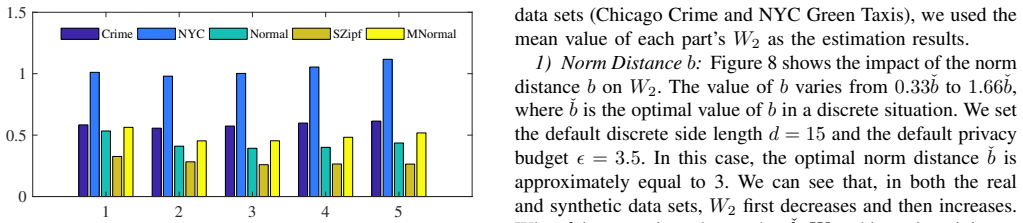
- [Section V-C] The choice of b by maximizing an upper bound on mutual information (Eqs. (9)–(12)) is not connected to the PSDEP objective. The bound assumes a uniform input distribution and does not account for the grid discretization or EM post-processing; the experiments (Figure 8) show that the empirical optimal b sometimes deviates from the analytic ˇb. This is a reasonable heuristic, but the paper should describe it as such rather than as part of the optimality argument.
minor comments (5)
- [Theorem V.2 proof] The proof defines the set as {˜v | ‖˜v − v‖_1 ≤ b} but then states its area is πb^2. The area πb^2 corresponds to the L2 ball, not the L1 ball (whose area is 2b^2). Since the mechanism is defined with the L2 norm in Definition 8, this is presumably a typo and should be corrected.
- [Algorithm 1] The pseudo-code is inconsistent: the noisy map is initialized as N R, but the update on line 7 increments N M(I(x)). The code should use the same variable name throughout.
- [Eq. (9)] The expression for g(b) is missing parentheses around the argument of the first logarithm; it should read log((πb^2+4b+1)/(πb^2 e^ε + 4b + 1)).
- [Theorem IV.1 proof] The LDP proof bounds the ratio Pr[SAM(v1)∈O]/Pr[SAM(v2)∈O] without discussing the case where the denominator is zero. Since W(z) ≥ q on the output domain, the denominator can only vanish when O has measure zero, in which case the inequality is trivial, but this should be stated explicitly.
- [Section VII-B, privacy comparison] The Local Privacy calibration used to compare DAM and SEM-Geo-I assumes a uniform prior Pr(i)=1/n and unbiased estimation. These assumptions are not satisfied by the real data sets (e.g., crime and taxi distributions are highly non-uniform), so the fairness of the comparison between DAM and SEM-Geo-I is conditioned on an idealized setup. The paper should acknowledge this limitation when interpreting Figures 9 and 13.
Circularity Check
No circularity: DAM's q-minimization is derived from LDP constraints; the sliced-Wasserstein surrogate is an unproven heuristic but not a circular reduction.
full rationale
The paper's derivation chain is not circular. Theorem V.2 proves a lower bound on q from the SAM normalization condition and the LDP constraint W ≤ e^ϵ q; this is a genuine lower-bound argument, not an assumption of the conclusion. DAM is then defined as the mechanism attaining that bound, which is a standard construction. The step from Equation (7) to 'minimize q' is a valid monotonicity argument for the sliced-Wasserstein surrogate: the expression Δ(1 − (πb^2 + 4b + 1)q) is decreasing in q, so the SAM with the smallest feasible q maximizes that surrogate. The paper does not prove that the sliced-Wasserstein surrogate is equivalent to the PSDEP objective W2^2(D, \tilde D); this criterion is imported from external Reference [6] and extended to 2D by substitution. That is an unproven modeling assumption and a correctness risk, but it is not a circular reduction, because the surrogate is not defined in terms of DAM's optimality and is not fitted to the experimental data. The choice of b is derived from an information-theoretic upper bound, not from the test data, and the experiments compare against external benchmarks. No load-bearing self-citation appears; the optimality criterion is attributed to an external reference, and the grid-implementation theorems are proved within the paper. Therefore, under the circularity rules, the appropriate finding is no significant circularity.
Assumptions & free parameters
free parameters (2)
- b (high probability radius) =
b = (2m2 + sqrt(4m2^2 + pi*e^epsilon*m1*m2)) / (pi*e^epsilon*m1) * L, with m1 = e^epsilon - 1 - epsilon and m2 = 1…
- grid side length g (equivalently d = L/g) =
varied in experiments from 1 to 20
assumptions (4)
- domain assumption The objective of maximizing pairwise Wasserstein (or sliced Wasserstein) distance between mechanism outputs is the right surrogate for minimizing the Wasserstein distance of the recovered distribution.
- ad hoc to paper The sliced Wasserstein distance between Mv1 and Mv2, maximized over all pairs, determines the utility of the frequency oracle.
- domain assumption The mutual information upper bound g(b) is a valid basis for choosing b.
- domain assumption Uniform prior distribution over locations in the LP comparison.
Cite this review
Pith. "Pith review of Numerical Estimation of Spatial Distributions under Differential Privacy." pith.science (2026). https://pith.science/paper/C6X6YZLL
@misc{pith2026241206541,
  author       = {Pith},
  title        = {Pith review of: Numerical Estimation of Spatial Distributions under Differential Privacy},
  year         = {2026},
  howpublished = {\url{https://pith.science/paper/C6X6YZLL}},
  note         = {Machine review of arXiv:2412.06541}
}
read the original abstract
Estimating spatial distributions is important in data analysis, such as traffic flow forecasting and epidemic prevention. To achieve accurate spatial distribution estimation, the analysis needs to collect sufficient user data. However, collecting data directly from individuals could compromise their privacy. Most previous works focused on private distribution estimation for one-dimensional data, which does not consider spatial data relation and leads to poor accuracy for spatial distribution estimation. In this paper, we address the problem of private spatial distribution estimation, where we collect spatial data from individuals and aim to minimize the distance between the actual distribution and estimated one under Local Differential Privacy (LDP). To leverage the numerical nature of the domain, we project spatial data and its relationships onto a one-dimensional distribution. We then use this projection to estimate the overall spatial distribution. Specifically, we propose a reporting mechanism called Disk Area Mechanism (DAM), which projects the spatial domain onto a line and optimizes the estimation using the sliced Wasserstein distance. Through extensive experiments, we show the effectiveness of our DAM approach on both real and synthetic data sets, compared with the state-of-the-art methods, such as Multi-dimensional Square Wave Mechanism (MDSW) and Subset Exponential Mechanism with Geo-I (SEM-Geo-I). Our results show that our DAM always performs better than MDSW and is better than SEM-Geo-I when the data granularity is fine enough.
Figures


Figures from the paper (9 more)




Reference graph
Works this paper leans on
-
[6]
Estimating numerical distributions under local differential privacy,
Z. Li, T. Wang, M. Lopuha ¨a-Zwakenberg, N. Li, and B. Skoric, “Estimating numerical distributions under local differential privacy,” in Proceedings of the 2020 International Conference on Management of Data, SIGMOD Conference 2020, online conference [Portland, OR, USA], June 14-19, 2020 , D. Maier, R. Pottinger, A. Doan, W. Tan, A. Alawini, and H. Q. Ngo...
work page 2020
-
[1]
C. Dwork, “Differential privacy,” in Automata, Languages and Pro- gramming, 33rd International Colloquium, ICALP 2006, Venice, Italy, July 10-14, 2006, Proceedings, Part II , ser. Lecture Notes in Computer Science, M. Bugliesi, B. Preneel, V . Sassone, and I. Wegener, Eds., vol
work page 2006
-
[2]
Local, private, efficient protocols for succinct histograms,
R. Bassily and A. D. Smith, “Local, private, efficient protocols for succinct histograms,” in Proceedings of the Forty-Seventh Annual ACM on Symposium on Theory of Computing, STOC 2015, Portland, OR, USA, June 14-17, 2015 , R. A. Servedio and R. Rubinfeld, Eds. ACM, 2015, pp. 127–135
work page 2015
-
[3]
Locally differentially private protocols for frequency estimation,
T. Wang, J. Blocki, N. Li, and S. Jha, “Locally differentially private protocols for frequency estimation,” in 26th USENIX Security Sympo- sium, USENIX Security 2017, Vancouver, BC, Canada, August 16-18, 2017, E. Kirda and T. Ristenpart, Eds. USENIX Association, 2017, pp. 729–745
work page 2017
-
[4]
Minimax optimal procedures for locally private estimation,
J. C. Duchi, M. J. Wainwright, and M. I. Jordan, “Minimax optimal procedures for locally private estimation,” CoRR, vol. abs/1604.02390, 2016
arXiv 2016
-
[5]
Privtrie: Effective frequent term discovery under local differential privacy,
N. Wang, X. Xiao, Y . Yang, T. D. Hoang, H. Shin, J. Shin, and G. Yu, “Privtrie: Effective frequent term discovery under local differential privacy,” in 34th IEEE International Conference on Data Engineering, ICDE 2018, Paris, France, April 16-19, 2018. IEEE Computer Society, 2018, pp. 821–832
work page 2018
-
[7]
Frequency estimation under local differential privacy,
G. Cormode, S. Maddock, and C. Maple, “Frequency estimation under local differential privacy,” Proc. VLDB Endow. , vol. 14, no. 11, pp. 2046–2058, 2021
work page 2021
-
[8]
AHEAD: adaptive hierarchical decomposition for range query under local differential privacy,
L. Du, Z. Zhang, S. Bai, C. Liu, S. Ji, P. Cheng, and J. Chen, “AHEAD: adaptive hierarchical decomposition for range query under local differential privacy,” in CCS ’21: 2021 ACM SIGSAC Conference on Computer and Communications Security, Virtual Event, Republic of Korea, November 15 - 19, 2021 , Y . Kim, J. Kim, G. Vigna, and E. Shi, Eds. ACM, 2021, pp. 1266–1288
work page 2021
Show all 37 references
-
[9]
Answering multi-dimensional analytical queries under local differen- tial privacy,
T. Wang, B. Ding, J. Zhou, C. Hong, Z. Huang, N. Li, and S. Jha, “Answering multi-dimensional analytical queries under local differen- tial privacy,” in Proceedings of the 2019 International Conference on Management of Data, SIGMOD Conference 2019, Amsterdam, The Netherlands, ...
2019
-
[10]
Answering multi- dimensional range queries under local differential privacy,
J. Yang, T. Wang, N. Li, X. Cheng, and S. Su, “Answering multi- dimensional range queries under local differential privacy,” Proc. VLDB Endow., vol. 14, no. 3, pp. 378–390, 2020
2020
-
[11]
Privnud: Effective range query processing under local differential privacy,
N. Wang, Y . Wang, Z. Wang, J. Nie, Z. Wei, P. Tang, Y . Gu, and G. Yu, “Privnud: Effective range query processing under local differential privacy,” in 39th IEEE International Conference on Data Engineering, ICDE 2023, Anaheim, CA, USA, April 3-7, 2023 . IEEE, 2023, pp. 2660–2672
2023
-
[12]
Local private ordinal data distribution estimation,
S. Wang, Y . Nie, P. Wang, H. Xu, W. Yang, and L. Huang, “Local private ordinal data distribution estimation,” in2017 IEEE Conference on Computer Communications, INFOCOM 2017, Atlanta, GA, USA, May 1-4, 2017. IEEE, 2017, pp. 1–9
2017
-
[13]
R. B. Ash, Information theory. Courier Corporation, 2012
2012
-
[14]
Statistical aspects of wasserstein distances,
V . M. Panaretos and Y . Zemel, “Statistical aspects of wasserstein distances,” Annual review of statistics and its application , vol. 6, pp. 405–431, 2019
2019
-
[15]
Helgason and S
S. Helgason and S. Helgason, The radon transform . Springer, 1980, vol. 2
1980
-
[16]
Gen- eralized sliced wasserstein distances,
S. Kolouri, K. Nadjahi, U. Simsekli, R. Badeau, and G. K. Rohde, “Gen- eralized sliced wasserstein distances,” inAdvances in Neural Information Processing Systems 32: Annual Conference on Neural Information Pro- cessing Systems 2019, NeurIPS 2019, December 8-14, 2019, Vancouve...
2019
-
[17]
Protecting location privacy: optimal strategy against localiza- tion attacks,
R. Shokri, G. Theodorakopoulos, C. Troncoso, J. Hubaux, and J. L. Boudec, “Protecting location privacy: optimal strategy against localiza- tion attacks,” in the ACM Conference on Computer and Communications Security, CCS’12, Raleigh, NC, USA, October 16-18, 2012 , T. Yu, G. Da...
2012
-
[18]
Differentially private location protection for worker datasets in spatial crowdsourcing,
H. To, G. Ghinita, L. Fan, and C. Shahabi, “Differentially private location protection for worker datasets in spatial crowdsourcing,” IEEE Trans. Mob. Comput., vol. 16, no. 4, pp. 934–949, 2017
2017
-
[19]
Providing input-discriminative protection for local differential privacy,
X. Gu, M. Li, L. Xiong, and Y . Cao, “Providing input-discriminative protection for local differential privacy,” in 36th IEEE International Conference on Data Engineering, ICDE 2020, Dallas, TX, USA, April 20-24, 2020. IEEE, 2020, pp. 505–516
2020
-
[20]
Geo-indistinguishability: differential privacy for location-based sys- tems,
M. E. Andr ´es, N. E. Bordenabe, K. Chatzikokolakis, and C. Palamidessi, “Geo-indistinguishability: differential privacy for location-based sys- tems,” in 2013 ACM SIGSAC Conference on Computer and Commu- nications Security, CCS’13, Berlin, Germany, November 4-8, 2013 , A. Sad...
2013
-
[21]
Dif- ferentially private spatial decompositions,
G. Cormode, C. M. Procopiuc, D. Srivastava, E. Shen, and T. Yu, “Dif- ferentially private spatial decompositions,” in IEEE 28th International Conference on Data Engineering (ICDE 2012), Washington, DC, USA (Arlington, Virginia), 1-5 April, 2012 , A. Kementsietsidis and M. A. V...
2012
-
[22]
Priview: practical differentially private release of marginal contingency tables,
W. H. Qardaji, W. Yang, and N. Li, “Priview: practical differentially private release of marginal contingency tables,” in International Con- ference on Management of Data, SIGMOD 2014, Snowbird, UT, USA, June 22-27, 2014 , C. E. Dyreson, F. Li, and M. T. ¨Ozsu, Eds. ACM, 2014,...
2014
-
[23]
What can we learn privately?
S. P. Kasiviswanathan, H. K. Lee, K. Nissim, S. Raskhodnikova, and A. D. Smith, “What can we learn privately?” in 49th Annual IEEE Symposium on Foundations of Computer Science, FOCS 2008, October 25-28, 2008, Philadelphia, PA, USA . IEEE Computer Society, 2008, pp. 531–540
2008
-
[24]
Local privacy and statistical minimax rates,
J. C. Duchi, M. I. Jordan, and M. J. Wainwright, “Local privacy and statistical minimax rates,” in 54th Annual IEEE Symposium on Foundations of Computer Science, FOCS 2013, 26-29 October, 2013, Berkeley, CA, USA. IEEE Computer Society, 2013, pp. 429–438
2013
-
[25]
Coordinates and coordinate systems,
J. D. Bossler, J. Campbell, R. Mcmaster, and C. Rizos, “Coordinates and coordinate systems,” Manual of Geospatial Science and Technology, pp. 9–16, 2010
2010
-
[26]
Locally differentially private frequency estimation with consistency,
T. Wang, M. Lopuha ¨a-Zwakenberg, Z. Li, B. Skoric, and N. Li, “Locally differentially private frequency estimation with consistency,” in 27th Annual Network and Distributed System Security Symposium, NDSS 2020, San Diego, California, USA, February 23-26, 2020 . The Internet S...
2020
-
[27]
[online] Chicago Crimes 2022,
“[online] Chicago Crimes 2022,” https://data.cityofchicago.org/ Public-Safety/Crimes-2022/9hwr-2zxp, 2024
2022
-
[28]
[online] NYC Green Taxi Trip 2016,
“[online] NYC Green Taxi Trip 2016,” https://data.cityofnewyork.us/ Transportation/2016-Green-Taxi-Trip-Data/hvrh-b6nb, 2024
2016
-
[29]
Ldptrace: Locally differentially private trajectory synthesis,
Y . Du, Y . Hu, Z. Zhang, Z. Fang, L. Chen, B. Zheng, and Y . Gao, “Ldptrace: Locally differentially private trajectory synthesis,” Proc. VLDB Endow., vol. 16, no. 8, pp. 1897–1909, 2023
1909
-
[30]
Trajectory data collection with local differential privacy,
Y . Zhang, Q. Ye, R. Chen, H. Hu, and Q. Han, “Trajectory data collection with local differential privacy,” Proc. VLDB Endow., vol. 16, no. 10, pp. 2591–2604, 2023
2023
-
[31]
Sinkhorn distances: Lightspeed computation of optimal transport,
M. Cuturi, “Sinkhorn distances: Lightspeed computation of optimal transport,” in Advances in Neural Information Processing Systems 26: 27th Annual Conference on Neural Information Processing Systems
-
[34]
Let S ˆD be the area size of ˆD
Proof of Theorem VI.2: Proof. Let S ˆD be the area size of ˆD. Let Sp be the area size of the pure high probability area Ap. Let Sm be the area size of the mixed probability area Am, which can be divided into the high probability area Am,p and low probability areas Am,q with a...
-
[35]
Notice that given any an positive integer ˆb, each horizontal line in Sˆb,(0, π 4 ) contains and only contains one cell in SO ˆb
Proof of Theorem VI.3: Proof. Notice that given any an positive integer ˆb, each horizontal line in Sˆb,(0, π 4 ) contains and only contains one cell in SO ˆb . Let Hˆb, π 4 be the height of Sˆb, π 4 (the maximal ˆy index in Sˆb, π 4 ). Then we have Hˆb, π 4 = ⌈ ˆb√ 2 − 1 2 ⌉....
-
[36]
When ˆb < r, the high probability circle border will intersect the bottom boundary of V , and Hˆb,(0, π 4 ) = Hˆb, π 4 − 1
In triangle Ovlvr, according to the law of cosines, r = q r2 1 + 12 − 2r1 cos 3π 4 = q r2 1 + 1 + √ 2r1. When ˆb < r, the high probability circle border will intersect the bottom boundary of V , and Hˆb,(0, π 4 ) = Hˆb, π 4 − 1. When ˆb > r, the high probability circle border ...
-
[37]
According to the definition of Sˆb,(0, π 4 ), SI ˆb and SO ˆb , we have |SI ˆb | = |Sˆb,(0, π 4 )| − |SO ˆb |
Proof of Theorem VI.4: Proof. According to the definition of Sˆb,(0, π 4 ), SI ˆb and SO ˆb , we have |SI ˆb | = |Sˆb,(0, π 4 )| − |SO ˆb |. Thus, we need to calculate |Sˆb,(0, π 4 )|. As is shown in Figure 10(b), we can divide Sˆb,(0, π 4 ) into two parts: S(1) ˆb,(0, π 4 ) (...
-
[2013]
Proceedings of a meeting held December 5-8, 2013, Lake Tahoe, Nevada, United States , C. J. C. Burges, L. Bottou, Z. Ghahramani, and K. Q. Weinberger, Eds., 2013, pp. 2292–2300. (a) Division for HUEM (b) Division of Sˆb,(0, π 4 ) Fig. 10: Division for HUEM and division of Sˆb,...
2013
-
[4052]
Springer, 2006, pp. 1–12
2006
Reviewed August 11, 2026 · model on record in the stance chip above.
Discussion (0). Continue with ORCID to comment.