Dissecting the 3D chemo-dynamical structures of NGC 1381: a galaxy hosting an ancient slow bar with an accreted bulge and thick disc
Pith reviewed 2026-07-02 09:25 UTC · model grok-4.3
The pith
NGC 1381 hosts an ancient slow bar formed in situ with an accreted bulge, thick disc and halo
A machine-rendered reading of the paper's core claim, the machinery that carries it, and where it could break.
Core claim
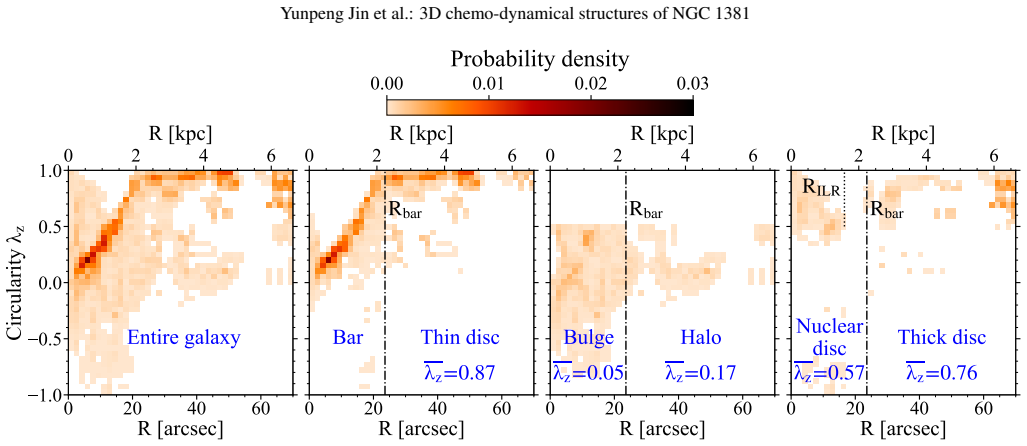
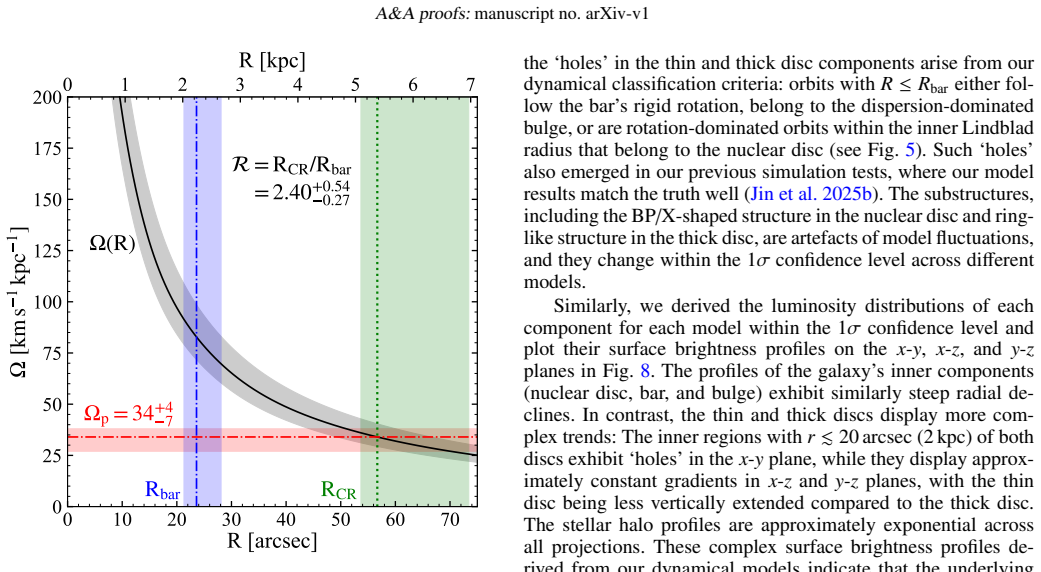
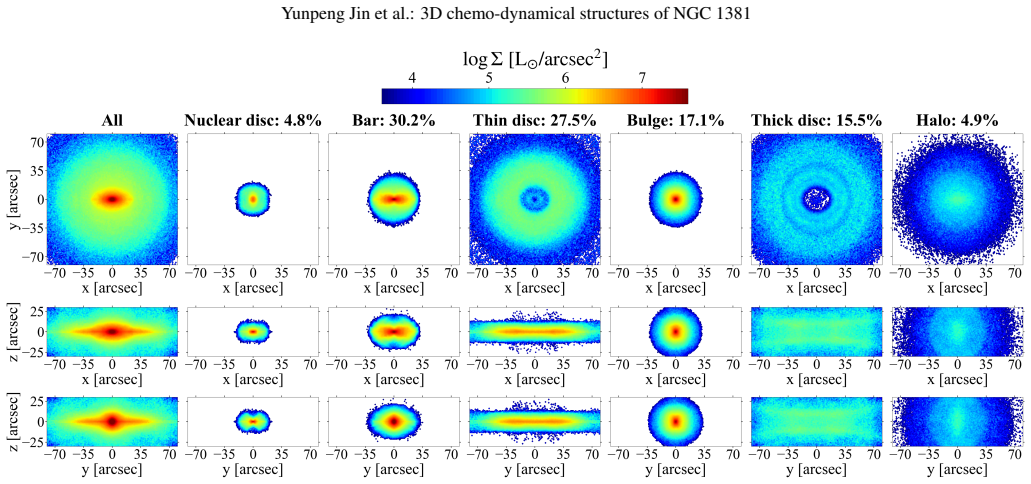
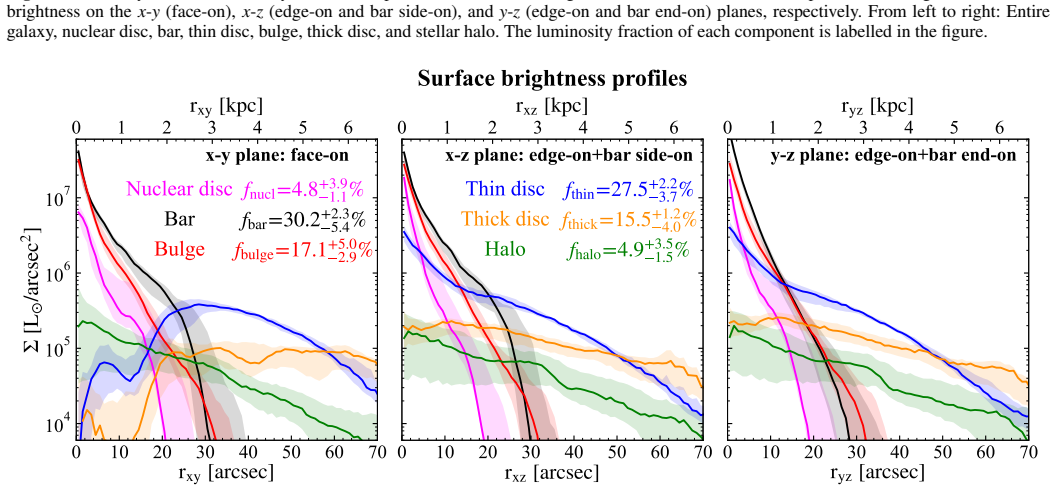
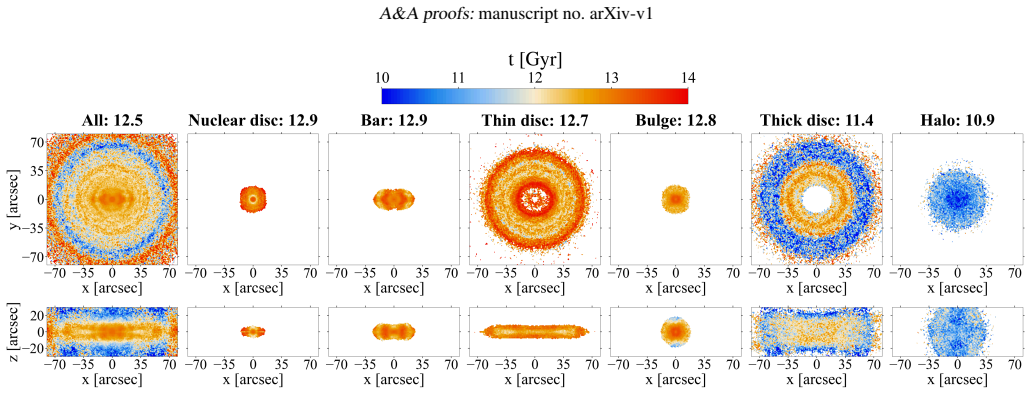
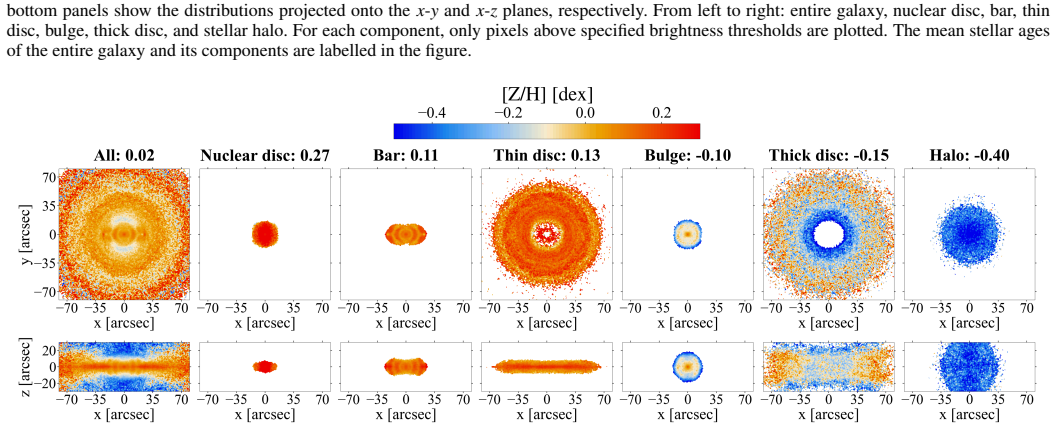
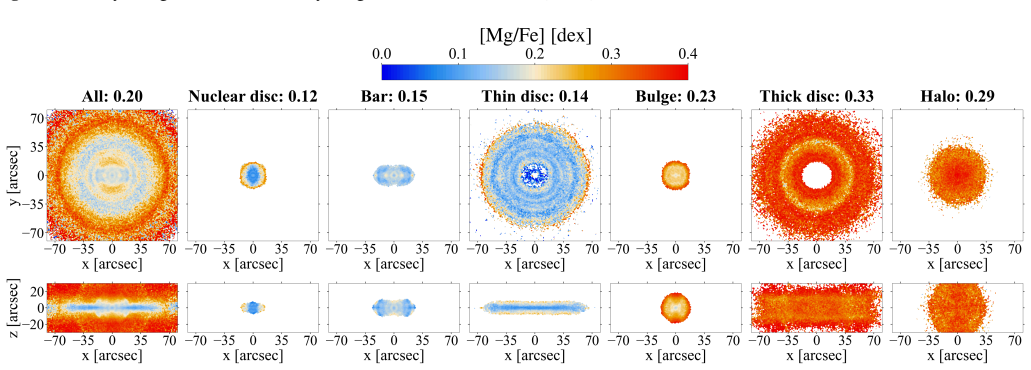
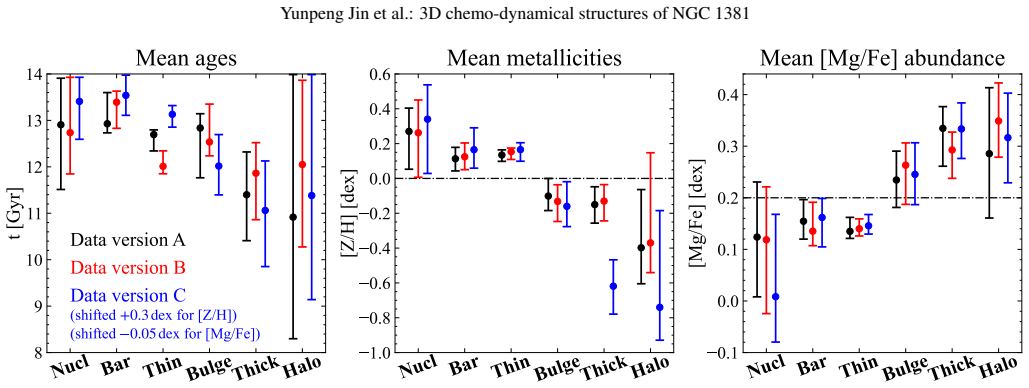
NGC 1381 is decomposed into a dynamically warm nuclear disc (5%), a rigidly rotating BP/X-shaped bar (30%), a hot spheroidal bulge (17%), a cold thin disc (28%), a vertically extended thick disc (16%), and a hot diffuse stellar halo (5%). The first three components are metal-rich, alpha-poor and ~13 Gyr old and therefore in-situ; the latter three are metal-poor, alpha-rich and indicate ex-situ formation. The bar is slow (R=2.40) with pattern speed 34 km/s/kpc, bar length 2.24 kpc and corotation radius 5.38 kpc, consistent with early formation.
What carries the argument
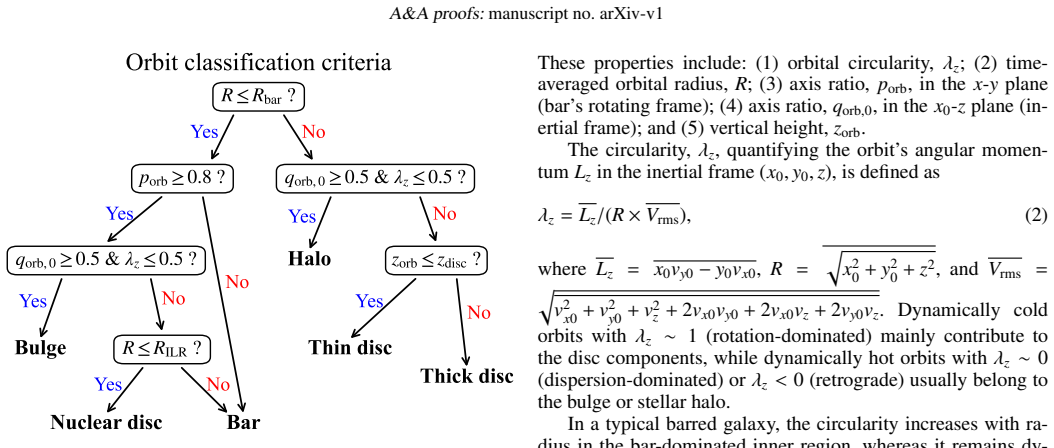
barred population-orbit superposition method that assigns orbital weights to match observed kinematics and chemistry and thereby decomposes the galaxy into six distinct components
If this is right
- The bar, nuclear disc and thin disc formed together in place more than 13 Gyr ago.
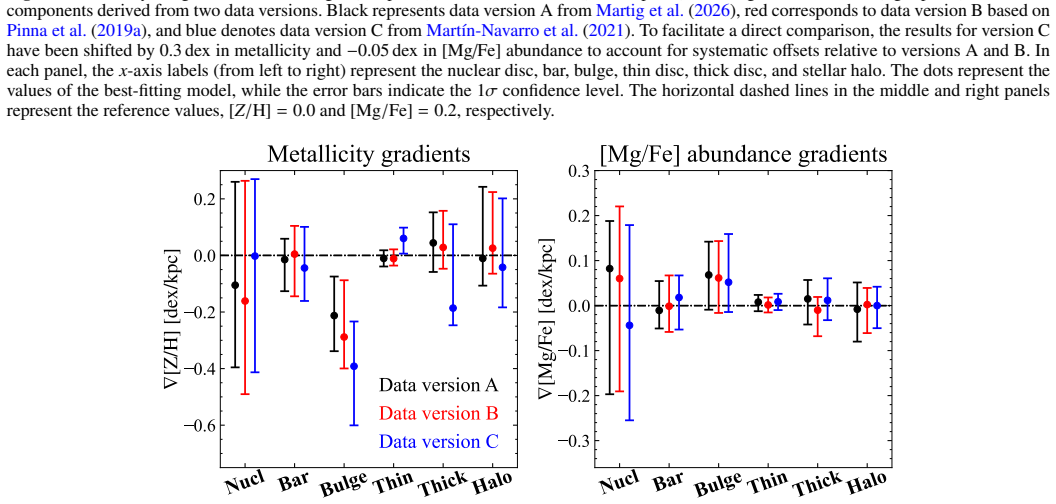
- The thick disc and halo share a common ex-situ population with flat metallicity and [Mg/Fe] gradients.
- The bulge shows a negative metallicity gradient, implying either dominant ex-situ origin or a mixture of in-situ and ex-situ stars.
- The measured slow pattern speed and large R value are consistent with the bar having formed early and remained stable.
- Minor mergers supplied the ex-situ stars that now dominate the outer components.
Where Pith is reading between the lines
- Repeating the six-component decomposition on other cluster S0 galaxies could test whether slow bars are systematically ancient.
- The accreted bulge and thick disc may be generic signatures of minor-merger activity inside the Fornax cluster environment.
- Higher-resolution spectroscopy could tighten the in-situ versus ex-situ fractions inside the bulge.
- The flat chemical gradients in the thick disc and halo suggest they were built from stars stripped from similar progenitor satellites.
Load-bearing premise
The barred population-orbit superposition method can uniquely recover the orbital weights, pattern speed and component fractions from the available kinematic and chemical data for NGC 1381.
What would settle it
An independent measurement of the bar pattern speed that falls well outside the range 27-38 km/s/kpc or yields a corotation radius far from 5.38 kpc would falsify the slow ancient bar identification.
Figures
read the original abstract
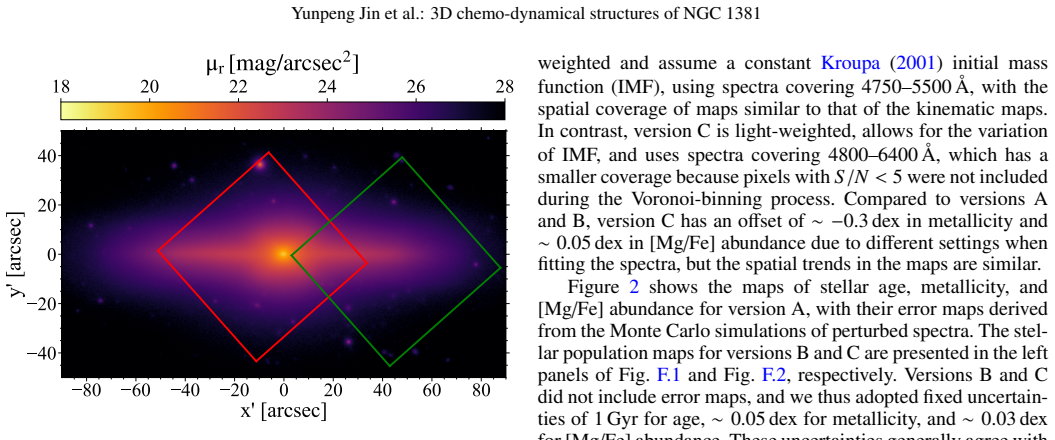
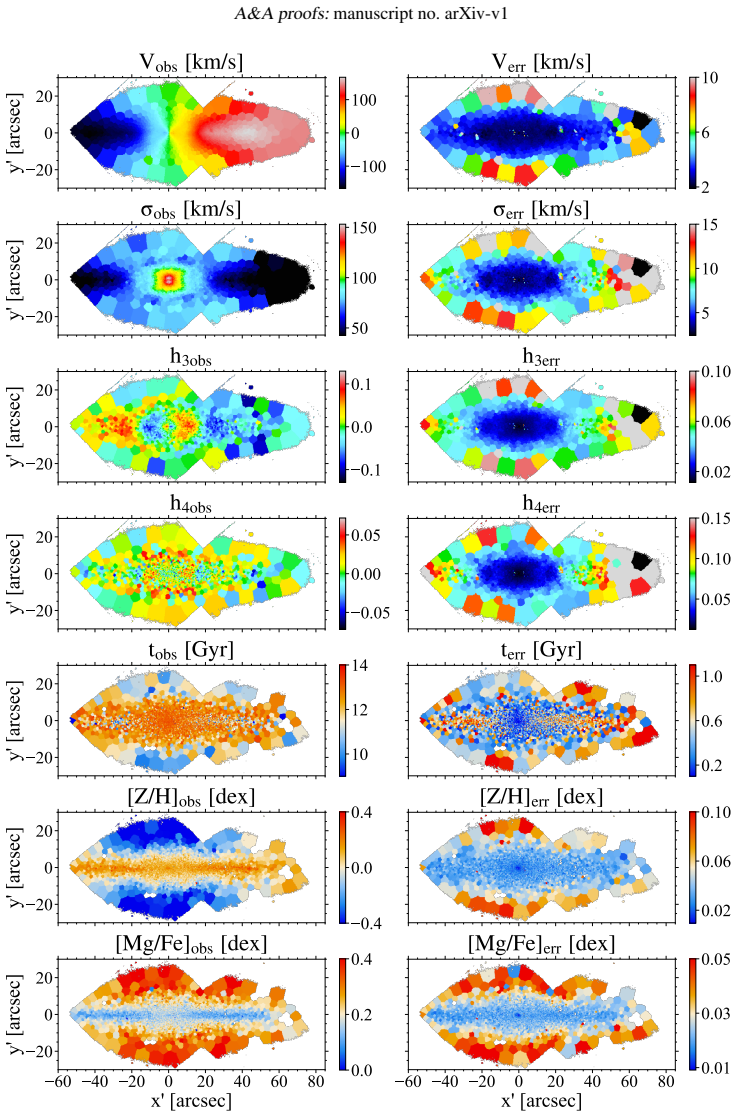
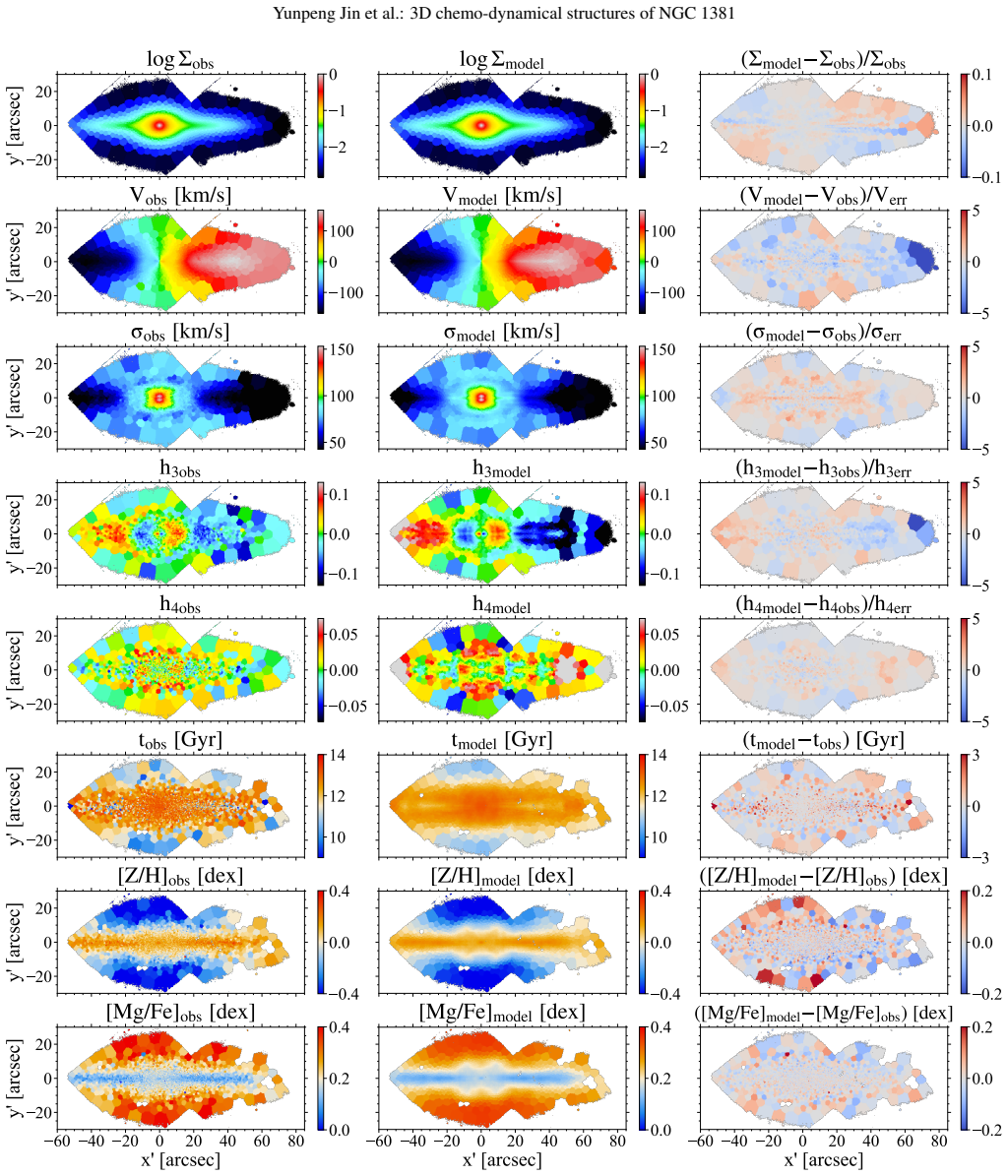
We applied the barred population-orbit superposition method developed in \citet{Jin2025a,Jin2025b} to construct 3D chemo-dynamical models for the barred S0 galaxy NGC~1381 in the Fornax cluster. Based on the stellar orbits in the models, we decomposed NGC~1381 into six components: (1) a dynamically warm nuclear disc with $f_{\rm nucl}\sim5\%$; (2) a rigidly rotating, BP/X-shaped bar with $f_{\rm bar}\sim30\%$; (3) a dynamically hot, spheroidal bulge with $f_{\rm bulge}\sim17\%$; (4) a dynamically cold thin disc with $f_{\rm thin}\sim28\%$; (5) a vertically extended thick disc with $f_{\rm thick}\sim16\%$; and (6) a dynamically hot, spatially diffuse stellar halo with $f_{\rm halo}\sim5\%$. The nuclear disc, bar, and thin disc are metal-rich ($[Z/\rm H]\gtrsim0$), $\alpha$-poor ($\rm[Mg/Fe]\lesssim0.2$), and old ($\sim13\rm\,Gyr$), corresponding to in situ formation in the early Universe. The bulge, thick disc, and stellar halo are metal-poor ($[Z/\rm H]\lesssim0$), $\alpha$-rich ($\rm[Mg/Fe]\gtrsim0.2$), and younger than or comparable in age to the in situ components, suggesting their relations with ex situ formation contributed by minor mergers. The flat metallicity and [Mg/Fe] gradients in the thick disc and stellar halo indicate they are dominated by a similar population of ex situ stars. In contrast, the bulge exhibits a negative metallicity gradient ($\nabla[Z/\rm H]_{bulge}<0$) pointing to a more complex formation history: the bulge could be either predominantly ex situ or contain a non-negligible mixture of in situ and ex situ stars. Our modelling also reveals the presence of a slow bar ($\mathcal{R}=2.40_{-0.27}^{+0.54}$), with a bar pattern speed of $\rm\Omega_p=34_{-7}^{+4}\,km\,s^{-1}\,kpc^{-1}$, a bar length of $R_{\rm bar}=2.24_{-0.22}^{+0.43}\rm\,kpc$, and a corotation radius of $R_{\rm CR}=5.38_{-0.28}^{+1.59}\rm\,kpc$, which is consistent with its ancient formation time.
Editorial analysis
A structured set of objections, weighed in public.
Referee Report
Summary. The paper applies the barred population-orbit superposition method from Jin2025a and Jin2025b to NGC 1381, decomposing the galaxy into six chemo-dynamical components (nuclear disc ~5%, bar ~30%, bulge ~17%, thin disc ~28%, thick disc ~16%, halo ~5%) with associated metallicities, [Mg/Fe], ages, and formation channels (in-situ for nuclear disc/bar/thin disc; ex-situ for bulge/thick disc/halo). It also reports a slow bar with R=2.40, Omega_p=34 km/s/kpc, R_bar=2.24 kpc, and R_CR=5.38 kpc, consistent with ancient formation.
Significance. If robust, the work provides a detailed 3D chemo-dynamical decomposition of a cluster S0 galaxy that links specific orbital populations to in-situ versus accreted origins and constrains bar dynamics, offering quantitative fractions and gradients that can be compared to simulations of galaxy assembly.
major comments (1)
- [Abstract] Abstract and modeling description: the six-component decomposition, in-situ/ex-situ assignments, and bar parameters (R=2.40_{-0.27}^{+0.54}, Omega_p=34_{-7}^{+4} km/s/kpc) rest on the assumption that the barred population-orbit superposition method uniquely recovers orbital weights, pattern speed, and fractions from the available kinematic+chemical data. No mock-data recovery tests, multiple converged solutions, or posterior widths on Omega_p are described to address known degeneracies when jointly fitting potential, viewing angle, and abundance distributions.
minor comments (1)
- [Abstract] Component fractions are given only as approximate values (~5%, ~30%, etc.) without accompanying uncertainties or a dedicated table summarizing all six components' properties.
Simulated Author's Rebuttal
We thank the referee for their constructive review and for acknowledging the potential significance of our work. We address the major comment on the robustness of the decomposition and bar parameters below.
read point-by-point responses
-
Referee: [Abstract] Abstract and modeling description: the six-component decomposition, in-situ/ex-situ assignments, and bar parameters (R=2.40_{-0.27}^{+0.54}, Omega_p=34_{-7}^{+4} km/s/kpc) rest on the assumption that the barred population-orbit superposition method uniquely recovers orbital weights, pattern speed, and fractions from the available kinematic+chemical data. No mock-data recovery tests, multiple converged solutions, or posterior widths on Omega_p are described to address known degeneracies when jointly fitting potential, viewing angle, and abundance distributions.
Authors: The barred population-orbit superposition method was developed and validated in our companion papers (Jin et al. 2025a,b), which include extensive mock-data recovery tests demonstrating reliable recovery of orbital weights, pattern speeds, component fractions, and handling of degeneracies in the joint fit of potential, viewing angle, and abundance distributions. Those works also explore multiple converged solutions and report posterior information. The present manuscript applies the validated method to NGC 1381 and provides uncertainties on Ω_p (and other bar parameters) from the fitting procedure. To directly address the referee’s concern, we will revise the Methods section to include a concise summary of the key validation results and degeneracy mitigation from Jin et al. (2025a,b), and we will clarify how the chemical constraints help reduce degeneracies. The reported asymmetric errors on Ω_p already reflect the range of acceptable models. revision: yes
Circularity Check
Central decomposition and slow-bar parameters rest on uniqueness of self-cited orbit-superposition method
specific steps
-
self citation load bearing
[Abstract]
"We applied the barred population-orbit superposition method developed in \citet{Jin2025a,Jin2025b} to construct 3D chemo-dynamical models for the barred S0 galaxy NGC~1381 in the Fornax cluster. Based on the stellar orbits in the models, we decomposed NGC~1381 into six components: (1) a dynamically warm nuclear disc with $f_{\rm nucl}\sim5\%$; (2) a rigidly rotating, BP/X-shaped bar with $f_{\rm bar}\sim30\%$; ... Our modelling also reveals the presence of a slow bar (\mathcal{R}=2.40_{-0.27}^{+0.54}), with a bar pattern speed of \rm\Omega_p=34_{-7}^{+4}\,km\,s^{-1}\,kpc^{-1}..."
All reported quantities (component fractions, formation channels, R, Omega_p, R_CR) are outputs of the cited method. The paper supplies no separate demonstration that the method uniquely recovers these quantities from the NGC 1381 kinematic+chemical data; uniqueness is imported solely via the self-citation to Jin2025a/Jin2025b.
full rationale
The paper's derivation applies the barred population-orbit superposition method from Jin2025a/Jin2025b to NGC 1381 data, then reports six-component fractions, in-situ/ex-situ assignments, and bar parameters (R=2.40, Omega_p=34 km/s/kpc) as direct outputs. No independent test of uniqueness or degeneracy breaking for this dataset is provided; the load-bearing premise that the method recovers unique orbital weights, pattern speed, and fractions therefore reduces to the self-citation. This produces partial circularity while the data application itself remains new.
Axiom & Free-Parameter Ledger
free parameters (2)
- component mass fractions
- bar pattern speed and length
axioms (2)
- domain assumption Stellar orbits can be linearly superposed to reproduce the observed line-of-sight velocity distributions and chemical maps.
- domain assumption Metal-rich, alpha-poor, old populations trace in-situ formation while metal-poor, alpha-rich populations trace ex-situ accretion.
Reference graph
Works this paper leans on
-
[1]
Aguerri, J. A. L., M \'e ndez-Abreu, J., Falc \'o n-Barroso, J., et al. 2015, , 576, A102
2015
-
[2]
1992 a , , 259, 345
Athanassoula, E. 1992 a , , 259, 345
1992
-
[3]
1992 b , , 259, 328
Athanassoula, E. 1992 b , , 259, 328
1992
-
[4]
2003, , 341, 1179
Athanassoula, E. 2003, , 341, 1179
2003
-
[5]
2005, , 358, 1477
Athanassoula, E. 2005, , 358, 1477
2005
-
[6]
2010, in Society of Photo-Optical Instrumentation Engineers (SPIE) Conference Series, Vol
Bacon, R., Accardo, M., Adjali, L., et al. 2010, in Society of Photo-Optical Instrumentation Engineers (SPIE) Conference Series, Vol. 7735, Ground-based and Airborne Instrumentation for Astronomy III, ed. I. S. McLean , S. K. Ramsay , & H. Takami , 773508
2010
-
[7]
2017, , 608, A1
Bacon, R., Conseil, S., Mary, D., et al. 2017, , 608, A1
2017
-
[8]
2001, , 326, 23
Bacon, R., Copin, Y., Monnet, G., et al. 2001, , 326, 23
2001
-
[9]
A., Marshall, P
Barnab \`e , M., Dutton, A. A., Marshall, P. J., et al. 2012, , 423, 1073
2012
-
[10]
& Tremaine, S
Binney, J. & Tremaine, S. 2008, Galactic Dynamics: Second Edition
2008
-
[11]
P., Jord \'a n, A., Mei, S., et al
Blakeslee, J. P., Jord \'a n, A., Mei, S., et al. 2009, , 694, 556
2009
-
[12]
G., & Elmegreen, D
Bournaud, F., Elmegreen, B. G., & Elmegreen, D. M. 2007, , 670, 237
2007
-
[13]
2020, , 640, A20
Breda, I., Papaderos, P., & Gomes, J.-M. 2020, , 640, A20
2020
-
[14]
J., Owers, M
Bryant, J. J., Owers, M. S., Robotham, A. S. G., et al. 2015, , 447, 2857
2015
-
[15]
A., Law, D
Bundy, K., Bershady, M. A., Law, D. R., et al. 2015, , 798, 7
2015
-
[16]
2006, , 370, 753
Bureau, M., Aronica, G., Athanassoula, E., et al. 2006, , 370, 753
2006
-
[17]
& Athanassoula, E
Bureau, M. & Athanassoula, E. 2005, , 626, 159
2005
-
[18]
J., Sheth, K., Athanassoula, E., et al
Buta, R. J., Sheth, K., Athanassoula, E., et al. 2015, , 217, 32
2015
-
[19]
Buta, R. J. & Zhang, X. 2009, , 182, 559
2009
-
[20]
M., Cuomo, V., et al
Buttitta, C., Corsini, E. M., Cuomo, V., et al. 2022, , 664, L10
2022
-
[21]
2002, , 333, 400
Cappellari, M. 2002, , 333, 400
2002
-
[22]
2017, , 466, 798
Cappellari, M. 2017, , 466, 798
2017
-
[23]
& Copin, Y
Cappellari, M. & Copin, Y. 2003, , 342, 345
2003
-
[24]
& Emsellem, E
Cappellari, M. & Emsellem, E. 2004, , 116, 138
2004
-
[25]
2011, , 413, 813
Cappellari, M., Emsellem, E., Krajnovi \'c , D., et al. 2011, , 413, 813
2011
-
[26]
2013, , 432, 1709
Cappellari, M., Scott, N., Alatalo, K., et al. 2013, , 432, 1709
2013
-
[27]
& Hernandez, O
Chemin, L. & Hernandez, O. 2009, , 499, L25
2009
-
[28]
& Bureau, M
Chung, A. & Bureau, M. 2004, , 127, 3192
2004
-
[29]
& Mertzanides, C
Contopoulos, G. & Mertzanides, C. 1977, , 61, 477
1977
-
[30]
A., Schaye, J., Clauwens, B., et al
Correa, C. A., Schaye, J., Clauwens, B., et al. 2017, , 472, L45
2017
-
[31]
A., Abadi, M
Cristiani, V. A., Abadi, M. G., Taverna, A., et al. 2024, , 692, A63
2024
-
[32]
Cuomo, V., Aguerri, J. A. L., Corsini, E. M., & Debattista, V. P. 2020, , 641, A111
2020
-
[33]
2024, , 530, 1195
Dattathri, S., Valluri, M., Vasiliev, E., Wheeler, V., & Erwin, P. 2024, , 530, 1195
2024
-
[34]
A., et al
de S \'a -Freitas, C., Fragkoudi, F., Gadotti, D. A., et al. 2023, , 671, A8
2023
-
[35]
A., Fragkoudi, F., et al
de S \'a -Freitas, C., Gadotti, D. A., Fragkoudi, F., et al. 2025, , 698, A5
2025
-
[36]
Debattista, V. P. & Sellwood, J. A. 2000, , 543, 704
2000
-
[37]
2023, , 672, A84
Ding, Y., Zhu, L., van de Ven, G., et al. 2023, , 672, A84
2023
-
[38]
J., Gregg, M
Drinkwater, M. J., Gregg, M. D., & Colless, M. 2001, , 548, L139
2001
-
[39]
C., Debattista, V
Du, M., Ho, L. C., Debattista, V. P., et al. 2020, , 895, 139
2020
-
[40]
C., Zhao, D., et al
Du, M., Ho, L. C., Zhao, D., et al. 2019, , 884, 129
2019
-
[41]
1982, , 199, 1069
Efstathiou, G., Lake, G., & Negroponte, J. 1982, , 199, 1069
1982
-
[42]
1994, , 285, 723
Emsellem, E., Monnet, G., & Bacon, R. 1994, , 285, 723
1994
-
[43]
& Debattista, V
Erwin, P. & Debattista, V. P. 2017, , 468, 2058
2017
-
[44]
P., et al
Erwin, P., Seth, A., Debattista, V. P., et al. 2021, , 502, 2446
2021
-
[45]
Ferguson, H. C. 1989, , 98, 367
1989
-
[46]
Fisher, D. B. & Drory, N. 2008, , 136, 773
2008
-
[47]
A., et al
Fraser-McKelvie, A., van de Sande, J., Gadotti, D. A., et al. 2025, , 700, A237
2025
-
[48]
Gadotti, D. A. 2009, , 393, 1531
2009
-
[49]
Gadotti, D. A. 2011, , 415, 3308
2011
-
[50]
Gadotti, D. A. 2026, , 545, staf2072
2026
-
[51]
A., Bittner, A., Falc \'o n-Barroso, J., et al
Gadotti, D. A., Bittner, A., Falc \'o n-Barroso, J., et al. 2020, , 643, A14
2020
-
[52]
2022, , 517, 5660
Garma-Oehmichen, L., Hern \'a ndez-Toledo, H., Aquino-Ort \' z, E., et al. 2022, , 517, 5660
2022
-
[53]
Gerhard, O. E. 1993, , 265, 213
1993
-
[54]
Grand, R. J. J., Fragkoudi, F., G \'o mez, F. A., et al. 2024, , 532, 1814
2024
-
[55]
Grand, R. J. J., G \'o mez, F. A., Marinacci, F., et al. 2017, , 467, 179
2017
-
[56]
2019, , 482, 1733
Guo, R., Mao, S., Athanassoula, E., et al. 2019, , 482, 1733
2019
-
[57]
2025, , 985, 181
Guo, Y., Jogee, S., Wise, E., et al. 2025, , 985, 181
2025
-
[58]
2024, , 691, A122
Habibi, A., Roshan, M., Hosseinirad, M., et al. 2024, , 691, A122
2024
-
[59]
H., et al
Helmi, A., Babusiaux, C., Koppelman, H. H., et al. 2018, , 563, 85
2018
-
[60]
1971, , 168, 343
Hohl, F. 1971, , 168, 343
1971
-
[61]
F., Bundy, K., Croton, D., et al
Hopkins, P. F., Bundy, K., Croton, D., et al. 2010, , 715, 202
2010
-
[62]
2016, , 820, 42
Iodice, E., Capaccioli, M., Grado, A., et al. 2016, , 820, 42
2016
-
[63]
2019b, , 627, A136
Iodice, E., Sarzi, M., Bittner, A., et al. 2019b, , 627, A136
-
[64]
2019a, , 623, A1
Iodice, E., Spavone, M., Capaccioli, M., et al. 2019a, , 623, A1
-
[65]
2020, DYNAMITE: DYnamics, Age and Metallicity Indicators Tracing Evolution, Astrophysics Source Code Library, record ascl:2011.007
Jethwa, P., Thater, S., Maindl, T., & Van de Ven, G. 2020, DYNAMITE: DYnamics, Age and Metallicity Indicators Tracing Evolution, Astrophysics Source Code Library, record ascl:2011.007
2020
-
[66]
J., et al
Jin, Y., Zhu, L., Long, R. J., et al. 2020, , 491, 1690
2020
-
[67]
J., et al
Jin, Y., Zhu, L., Long, R. J., et al. 2019, , 486, 4753
2019
-
[68]
2025b, , 704, A262
Jin, Y., Zhu, L., Tahmasebzadeh, B., et al. 2025b, , 704, A262
-
[69]
2025a, , 700, A249
Jin, Y., Zhu, L., Tahmasebzadeh, B., et al. 2025a, , 700, A249
-
[70]
2024, , 681, A95
Jin, Y., Zhu, L., Zibetti, S., et al. 2024, , 681, A95
2024
-
[71]
& Kennicutt, Robert C., J
Kormendy, J. & Kennicutt, Robert C., J. 2004, , 42, 603
2004
-
[72]
2001, , 322, 231
Kroupa, P. 2001, , 322, 231
2001
-
[73]
Lawson, C. L. & Hanson, R. J. 1974, Solving least squares problems
1974
-
[74]
A., Gadotti, D
Le Conte, Z. A., Gadotti, D. A., Ferreira, L., et al. 2024, , 530, 1984
2024
-
[75]
H., Hwang, H
Lee, Y. H., Hwang, H. S., Cuomo, V., et al. 2025, , 989, 55
2025
-
[76]
D., Di Matteo, P., Haywood, M., & Snaith, O
Lehnert, M. D., Di Matteo, P., Haywood, M., & Snaith, O. N. 2014, , 789, L30
2014
-
[77]
C., & Barth, A
Li, Z.-Y., Ho, L. C., & Barth, A. J. 2017, , 845, 87
2017
-
[78]
2018, , 854, 65
Li, Z.-Y., Shen, J., Bureau, M., et al. 2018, , 854, 65
2018
-
[79]
okas, E. L. 2018, , 857, 6
2018
-
[80]
Long, R. J. & Mao, S. 2018, Research in Astronomy and Astrophysics, 18, 145
2018
discussion (0)
Sign in with ORCID, Apple, or X to comment. Anyone can read and Pith papers without signing in.