REVIEW 3 major objections 5 minor 70 references
Geodesic vortex detection on curved surfaces: Analyzing the 2002 austral stratospheric polar vortex warming event
T0 review · 3 major / 5 minor · reviewed 2026-08-10 · deepseek-v4-flash
Pith's one-line read Geodesic vortex detection, extended to curved surfaces and arbitrary coordinates, reconstructs the 2002 austral polar vortex life cycle from isentropic winds.
desk verdict Useful, honest manifold extension of geodesic vortex detection with a solid 2002 SPV case study, but the curved-surface stationarity proof is skipped and the birth/death dates rest on a 30-day wedge assumption - still worth refereeing. read the letter →
The pith
A machine-rendered reading of the paper's core claim, the machinery that carries it, and where it could break.
The reading
What carries the argument
The load-bearing object is the p-loop equation (15), $r'=\ell^\pm_p(r)$, built from the two eigenvalue–eigenvector pairs of $G^{-1}C$ with $0<\lambda_1<p^2<\lambda_2$; the eigenvectors are orthonormal with respect to the metric, and the line-field coefficients make every solution stretch by exactly $p$. The paper's second mechanism is the modified birth-and-death framing: because stratospheric air leaves an isentropic surface after roughly $\tau=30$ days, the life-expectancy curve $T_{\mathrm{exp}}(t_0)$ is expected to be a truncated wedge of height $\tau$, so the pre-split vortex death is read as $t_{\mathrm{death}}=t_0^{\mathrm{late}}+\tau$ and its birth as $t_{\mathrm{birth}}=t_0^{\mathrm{early}}-\tau$ from the plateau edges in forward and backward time.
What would settle it
Run the birth-and-death framing on the same isentropic winds with the coherence cap set to 20, 30, and 45 days; if the inferred birth and death dates move with the cap, the plateau-edge dates are artifacts of the cap and not intrinsic vortex properties.
Extended reading notes
Core claim
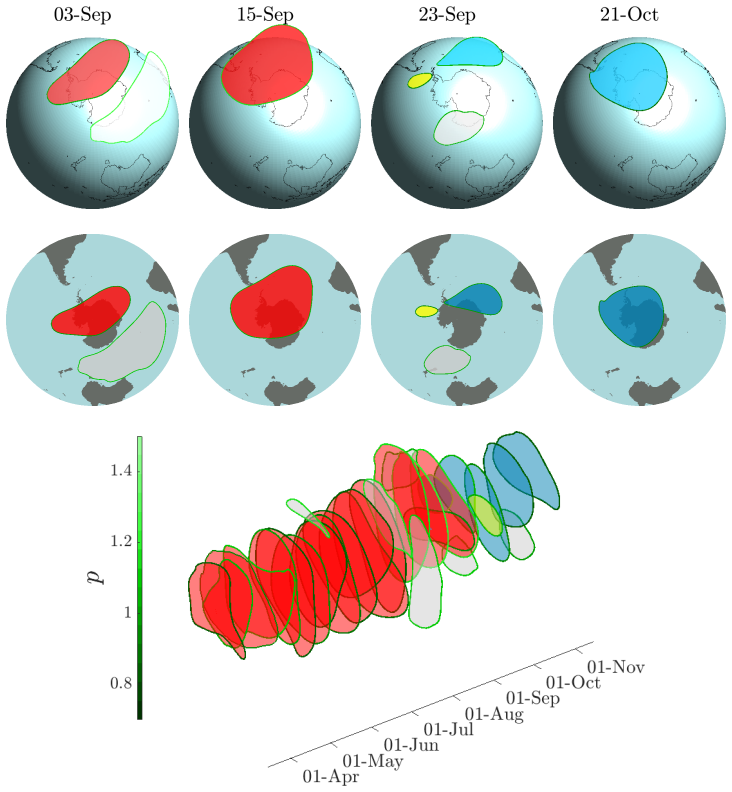
The paper's central claim is that geodesic vortex detection remains valid and observer-independent on a 2D Riemannian manifold when the p-loop line field is formed from the eigenvalue–eigenvector pairs of $G^{-1}C$, where $G$ is the coordinate representation of the manifold metric and $C$ is the coordinate representation of the right Cauchy–Green strain tensor. The closed limit cycles of the resulting line field, the p-loops, are material curves stretching uniformly by a factor $p$ over $[t_0,t_0+T]$, and the outermost loop in a nested family is the vortex boundary. With this metric-aware construction and a truncated-wedge birth-and-death algorithm capped at 30 days of valid two-dimensional motion, the authors report the first geodesic-detection-based life cycle of the austral stratospheric polar vortex: birth on 31 March 2002, pre-split death on 21 September 2002, split on 23 September 2002, and ozone-poor air held by the vortex edge ($p\approx1$) but leaking poleward across an inner loop with $p\approx1.6$.
Load-bearing premise
The birth and death dates rest on the assumption that the vortex's measured coherence lifetime forms a flat plateau of height 30 days, so the dates can be read off the plateau edges; if the plateau is not flat or the 30-day cap does not match how long the two-dimensional isentropic approximation really holds, the dates are artifacts of the cap rather than properties of the vortex.
Editorial extensions
If this is right
- The metric-aware p-loop construction can be applied to any two-dimensional flow on a curved surface without projecting to a plane, so ocean and planetary vortices on a sphere become directly detectable.
- Vortex boundaries identified this way are observer-independent even in non-orthogonal coordinates, so edge-based diagnostics such as ozone or temperature contrasts can be compared across studies without frame corrections.
- The method gives a concrete timetable for the 2002 sudden stratospheric warming—birth 31 March, pre-split death 21 September, split 23 September—that can anchor kinematic comparisons with dynamical explanations of the event.
- The ozone analysis indicates that the vortex edge is a stronger transport barrier than the inner $p\approx1.6$ loop, so ozone-poor air is mixed poleward into the vortex interior; a similar two-barrier geometry may structure other polar vortices.
Reading between the lines
- The authors do not test whether the plateau-edge dates shift under a different coherence cap; re-running the framing with $\tau=20$ and 45 days would separate a genuine vortex property from a cap artifact.
- The same metric-aware construction should extend to a global atlas of charts, making geodesic vortex detection usable on full spherical data; the southern-cap parameterization used here is a natural template.
- The kinematic poleward-mixing claim is testable in a chemistry-transport model: seed an inert tracer inside the 13 August 2002 low-ozone ring and see whether it crosses the $p\approx1.6$ loop poleward within 30 days.
Editorial analysis
A structured set of objections, weighed in public.
Referee Report
Summary. The paper extends geodesic vortex detection, previously formulated for Euclidean flows with Cartesian coordinates, to two-dimensional Riemannian manifolds with arbitrary coordinates, and adapts the birth-and-death CLV framing algorithm to the finite-time validity of the isentropic two-dimensional approximation in the stratosphere. The method is applied to ERA5 600-K isentropic winds to characterize the 2002 austral stratospheric polar vortex, reporting a birth around 31 March 2002, a pre-split death around 21 September 2002, a split around 23 September 2002, and an ozone depletion analysis identifying an outer vortex edge with p≈1 and an inner p-loop with p≈1.6 that routes ozone-poor air poleward. The paper also makes a computational implementation available.
Significance. If the methodological claims hold, the paper provides a general framework for objective vortex detection on curved surfaces and delivers the first geodesic-detection-based life cycle of the austral polar vortex, which is a widely studied but difficult case due to the splitting event. The objectivity argument under isometric observer changes is clean and correctly distinguishes coordinate from metric representations. The public code release and the use of a standard reanalysis are strengths. The main significance depends on the unresolved stationarity question for the manifold p-loop equation and on the robustness of the birth/death dates to the assumed truncated-wedge coherence profile.
major comments (3)
- [Section 2.2, Eq. (15), Appendix A] The central claim that limit cycles of the line field (15) are stationary curves of the variational principle (14) is not established. Appendix A verifies only that curves tangent to (15) satisfy the pointwise uniform-stretching condition L(r,r')=p, i.e., that they are null curves of C−pG, but it does not verify the Euler–Lagrange equations. The authors' own statement that the equivalence to the HBV13 p-loop equation is 'only formal' concedes this gap. On a curved surface the stationarity condition involves connection terms that depend on derivatives of G and C, and the algebraic construction (15) contains no such terms. Because the vortex identifications in Section 4 and the ozone analysis in Section 5 all rely on (15), the paper should either supply a rigorous derivation for arbitrary 2-D Riemannian manifolds or explicitly revise the claim to describe the detected loops as uniformly stretching material loops rather than extremizers of the averaged stretching.
- [Section 3, steps 2.a and 2.b] The inferred birth and death dates, including tbirth=31 March 2002 and tdeath=21 September 2002, rest entirely on the assumption that Texp(t0) has a truncated wedge shape at height τ=30 days. This assumption is asserted without sensitivity analysis: no tests for other values of τ, no error bars on the plateau edges t_late^0 and t_early^0, and no discussion of how deviations from a flat plateau would shift the dates. The paper acknowledges that the estimated vortex lifespan exceeds τ, so the objects are only quasi-CLVs. Given that the life-cycle dates are a headline result, the authors should provide evidence that the plateau structure is robust to the choice of τ or reframe the dates as conditional on this modeling assumption.
- [Section 5, Figures 7 and 8] The validation of the vortex edge as a transport barrier is weakened by two acknowledged issues that should be addressed more directly. First, the advected image of the 21 August 2002 p≈0.9 loop on 19 September exhibits a measured relative stretching of about 2.15, which contradicts the uniform-stretching property defining a p-loop; the explanation in terms of tangential stretching and noise is plausible but unquantified. Second, the inner p≈1.6 loop of 13 August is selected a posteriori to coincide with the poleward boundary of the low-ozone ring, using the same ERA5 wind and ozone fields, so the conclusion that ozone-depleted air mixes poleward is partly constructed from the target data. The authors should add independent support, such as a different tracer, a different reanalysis, or an a priori selection of the inner loop from the line field alone, or explicitly label this part as a consistency check rather than a prediction.
minor comments (5)
- [Section 1.1.1] The heading 'Kinematics of SVPs' and nearby text use 'SVP' inconsistently with the stated acronym 'SPV'; please harmonize the terminology throughout.
- [Introduction] The first sentence contains the typo 'deliniate'; it should read 'delineate'.
- [Section 3] The word 'dyapicnic' appears in the paragraph on the temporal validity of the 2-D assumption; it should be 'diapycnic'.
- [References] Reference [LR10] contains the typo 'Lyapunoc'; the correct term is 'Lyapunov'.
- [Equations (15)-(17)] The eigenvector notation is inconsistent: equations (15) and (17) use a superscript parenthetical index while equation (16) does not; please standardize.
Circularity Check
Ozone-barrier 'confirmation' is partly constructed: the p≈1.6 inner loop is chosen to sit on the low-ozone ring, and the birth/death dates are arithmetic consequences of the truncated-wedge cap; the central manifold p-loop equation is independent but only formally justified.
-
fitted input called prediction
[Section 5, paragraph describing Figure 8 (inner p-loop selection)]
"In addition to the SPV’s edge, on t0 = 13 August 2002, we extracted the p-loop closest to the poleward boundary of the low-ozone concentration ring on that day. This p-loop has p≈ 1.6, and by t0 +T = 11 September 2002, it shows visible signs inward filamentation. Consistent with the presence of the two p-loops extracted, the ozone-poor air is not mixed equatorward, but rather poleward."
The p≈1.6 loop is not an independent find: it is selected precisely because it lies on the target low-ozone ring's poleward boundary. Its alignment with that boundary is therefore enforced by the selection procedure, not discovered. Presenting this loop as a transport barrier that explains poleward ozone mixing is a post-hoc attribution to a structure fitted to the ozone field. The paper's own admission that the low-ozone boundary 'does not precisely follow' the movement of the 1.6-loop shows the match is approximate, so the kinematic explanation is constructed rather than independently tested.
-
self definitional
[Section 3, steps 2.a–2.b; applied in Section 4.4.1]
"It is anticipated that the theoretical Texp(t0) will exhibit the form of a truncated wedge at height τ. The death date of the CLV can consequently be forecasted by determining the latest t0, tlate0, for which Texp(t0) maintains stability around τ, augmented by τ, viz., tdeath = tlate0 +τ. ... tbirth will be determined as the earliest t0, tearly0, for which |Texp(t0)| remains stable and close to τ, minus τ."
The reported birth and death dates (31 March and 21 September 2002) are not independent predictions; they are arithmetic consequences of the assumed truncated-wedge shape and the chosen cap τ=30 days, read off the plateau edges. When Section 4.4.1 says the observed Texp is 'validating the predicted birth date', the validation is circular because the 'prediction' is the same formula used to define the date. At most this is a consistency check of the wedge assumption, not a derivation of the vortex lifetime.
full rationale
The central manifold extension is not circular: Eq. (15) is constructed directly from the eigenpairs of G^{-1}C and reduces to the Euclidean p-loop equation when G=I, and the objectivity calculation is a self-contained tensor computation. The Appendix A statement that the equivalence to [HBV13] is 'only formal' is a proof gap rather than circularity: the stationarity of the action (14) for curves tangent to (15) on curved surfaces is imported by analogy with the authors' earlier Euclidean work, so the central claim should be treated as an ansatz pending an explicit Euler–Lagrange proof on the manifold. That is a correctness risk, not an input-output identity. The two partial circularities that do warrant flagging are in the applications: the inner p-loop used to interpret ozone depletion is selected to match the low-ozone ring, so its 'explanation' of poleward ozone mixing is fitted rather than tested; and the life-cycle dates are defined by the truncated-wedge convention with τ=30 days, so calling them 'predicted' and 'validated' is self-referential. The outer-edge ozone comparison is not circular because the edge is detected from the wind field and then overlaid on an independently archived ozone field, although both fields come from the same reanalysis system, which limits the strength of the test but does not make it circular.
Assumptions & free parameters
free parameters (3)
- coherence horizon tau =
30 days
- quick-scan window T =
10 days
- inner p-loop value p =
about 1.6
assumptions (5)
- domain assumption The 2D isentropic flow model is valid for up to tau = 30 days on the 600 K surface.
- ad hoc to paper Texp(t0) has a truncated wedge shape at height tau for a quasi-CLV.
- domain assumption Observer changes on a manifold are isometries satisfying Q^T \bar G Q = G.
- domain assumption ERA5 600 K isentropic winds faithfully represent stratospheric flow in the 2002 austral winter.
- standard math Standard index theory for planar line fields applies locally to p-line fields on manifolds.
invented entities (1)
-
quasi-CLV
Cite this review
Pith. "Pith review of Geodesic vortex detection on curved surfaces: Analyzing the 2002 austral stratospheric polar vortex warming event." pith.science (2026). https://pith.science/paper/C7M3ZITJ
@misc{pith2026250103135,
  author       = {Pith},
  title        = {Pith review of: Geodesic vortex detection on curved surfaces: Analyzing the 2002 austral stratospheric polar vortex warming event},
  year         = {2026},
  howpublished = {\url{https://pith.science/paper/C7M3ZITJ}},
  note         = {Machine review of arXiv:2501.03135}
}
read the original abstract
Geodesic vortex detection is a tool in nonlinear dynamical systems to objectively identify transient vortices with flow-invariant boundaries that defy the typical deformation found in 2-d turbulence. Initially formulated for flows on the Euclidean plane with Cartesian coordinates, we have extended this technique to flows on 2-d Riemannian manifolds with arbitrary coordinates. This extension required the further formulation of the concept of objectivity on manifolds. Moreover, a recently proposed birth-and-death vortex framing algorithm, based on geodesic detection, has been adapted to address the limited temporal validity of 2-d motion in otherwise 3-d flows, like those found in the Earth's stratosphere. With these adaptations, we focused on the Lagrangian, i.e., kinematic, aspects of the austral stratospheric polar vortex during the exceptional sudden warming event of 2002, which resulted in the vortex splitting. This study involved applying geodesic vortex detection to isentropic winds from reanalysis data. We provide a detailed analysis of the vortex's life cycle, covering its birth, the splitting process, and its eventual death. In addition, we offer new kinematic insights into ozone depletion within the vortex.
Figures


Figures from the paper (5 more)


Reference graph
Works this paper leans on
-
[1]
Andrade‐Canto and F
F. Andrade‐Canto and F. J. Beron‐Vera. Do eddies connect the tropical Atlantic Ocean and the Gulf of Mexico? Geophysical Research Letters , 49:e2022GL099637, 2022
2022
-
[2]
Fernando Andrade-Canto, Francisco J. Beron-Vera, Gustavo J. Goni, Daniel Karrasch, Maria J. Olascoaga, and Joquin Trinanes. Carriers of Sargassum and mechanism for coastal inundation in the Caribbean Sea . Phys.\ Fluids , 34:016602, 2022
work page 2022
-
[3]
Andrade-Canto, D
F. Andrade-Canto, D. Karrasch, and F. J. Beron-Vera. Genesis, evolution, and apocalyse of Loop Current rings . Phys. Fluids , 32:116603, 2020
2020
-
[4]
Jason Atnip, Gary Froyland, and P\'eter Koltai. An inflated dynamic laplacian to track the emergence and disappearance of semi-material coherent sets. arXiv.2403.10360, 2024
arXiv 2024
-
[5]
D. G. Andrews, J. R. Holton, and C. B. Leovy. Middle Atmosphere Dynamics , volume 40 of International Geophysical Series . Academic, 1987
work page 1987
-
[6]
V. I. Arnold, V. V. Kozlov, and A. I. Neishtadt. Mathematical aspects of classical and celestial mechanics. In Dynamical Systems III , volume 3 of Encyclopedia of Mathematical Sciencies , page 518. Springer-Verlag, Berlin Heidelberg, third edition, 2006
work page 2006
-
[7]
R. Abraham, J. E. Marsden, and T. Ratiu. Manifolds, Tensor Analysis and Applications . Second E dition, A pplied M athematical S ciences 75. Springer, 1988
work page 1988
-
[8]
V. I. Arnold. Ordinary Differential Equations . Massachussets Institute of Technology, 1973
work page 1973
Show all 70 references
-
[9]
Butler, Dian J
Amy H. Butler, Dian J. Seidel, Steven C. Hardiman, Neal Butchart, Thomas Birner, and Aaron Match. Defining sudden stratospheric warmings. Bulletin of the American Meteorological Society , 96(11):1913–1928, November 2015
1913
-
[10]
Bodnariuk, M
N. Bodnariuk, M. Saraceno, L. A. Ruiz‐Etcheverry, C. Simionato, F. Andrade‐Canto, F. J. Beron‐Vera, and M. J. Olascoaga. Multiple lagrangian jet‐core structures in the Malvinas Current . Journal of Geophysical Research: Oceans , 129:e2023JC020446, 2024
2024
-
[11]
F. J. Beron-Vera, M. G. Brown, M. J. Olascoaga, I. I. Rypina, H. Kocak, and I. A. Udovydchenkov. Zonal jets as transport barriers in planetary atmospheres. J. Atmos. Sci. , 65:3316--3326, 2008
2008
-
[12]
F. J. Beron-Vera, M. J. Olascoaga, M. G. Brown, and H. Ko c ak. Zonal jets as meridional transport barriers in the subtropical and polar lower stratosphere. J. Atmos Sci. , 69:753--767, 2012
2012
-
[13]
F. J. Beron-Vera, M. J. Olascoaga, and G. J. Goni. Surface ocean mixing inferred from different multisatellite altimetry measurements. J. Phys. Oceanogr. , 40:2466--2480, 2010
2010
-
[14]
F. J. Beron-Vera, M. J. Olascoaga, G. Haller, M. Farazmand, J. Tri\ nanes , and Y. Wang. Dissipative inertial transport patterns near coherent Lagrangian eddies in the ocean . Chaos , 25:087412, 2015
2015
-
[15]
F. J. Beron-Vera, Y. Wang, M. J. Olascoaga, G. J. Goni, and G. Haller. Objective detection of oceanic eddies and the Agulhas leakage . J. Phys. Oceanogr. , 43:1426--1438, 2013
2013
-
[16]
Lagrangian analysis of the northern stratospheric polar vortex split in april 2020
Jezabel Curbelo, Gang Chen, and Carlos Roberto Mechoso. Lagrangian analysis of the northern stratospheric polar vortex split in april 2020. Geophysical Research Letters , 48(16), August 2021
2020
-
[17]
Mechoso, Ana M
Jezabel Curbelo, Carlos R. Mechoso, Ana M. Mancho, and Stephen Wiggins. Lagrangian study of the final warming in the southern stratosphere during 2002: Part I. T he vortex splitting at upper levels. Climate Dynamics , 53:2779–2792, 2019
2002
-
[18]
del-Castillo-Negrete and P
D. del-Castillo-Negrete and P. J. Morrison. Chaotic transport by R ossby waves in shear flow. Phys. Fluids A , 5(4):948--965, 1993
1993
-
[19]
D. G. Dritschel and M. E. McIntyre. Multiple jets as PV staircases: the Phillips effect and the resilience of eddy-transport barriers . J. Atmos. Sci. , 65:855--874, 2008
2008
-
[20]
G. F. D. Duff. Limit cycles and rotated vector fields. Ann. Math. , 57:15--31, 1953
1953
-
[21]
J. G. Esler, L. M. Polvani, and R. K. Scott. The Antarctic stratospheric sudden warming of 2002: A self-tuned resonance? Geophys. Res. Lett. , 33:L12804, 2006
2002
-
[22]
Farazmand, D
M. Farazmand, D. Blazevski, and G. Haller. Shearless transport barriers in unsteady two-dimensional flows and maps. Physica D , 278-279:44--57, 2014
2014
-
[23]
J. C. Farman, B. G. Gardiner, and J. D. Shanklin. Large losses of ozone in Antarctica reveal seasonal ClO _x /NO _x interaction . Nature , 315:207--210, 1985
1985
-
[24]
Detecting the birth and death of finite‐time coherent sets
Gary Froyland and Péter Koltai. Detecting the birth and death of finite‐time coherent sets. Communications on Pure and Applied Mathematics , 76(12):3642–3684, July 2023
2023
-
[25]
G. Haller. A variational theory of hyperbolic Lagrangian Coherent Structures . Physica D , 240:574--598, 2011
2011
-
[26]
G. Haller. Lagrangian coherent structures. Ann. Rev. Fluid Mech. , 47:137--162, 2015
2015
-
[27]
G. Haller. Climate, black holes and vorticity: H ow on E arth are they related? SIAM News , 49:1--2, 2016
2016
-
[28]
Transport Barriers and Coherent Structures in Flow Data
George Haller. Transport Barriers and Coherent Structures in Flow Data . Cambridge University Press, Cambridge, United Kindom, 2023
2023
-
[29]
P. Haynes. Stratospheric dynamics. Annu. Rev. Fluid Mech. , 37:263--293, 2005
2005
-
[30]
Hans Hersbach, Bill Bell, Paul Berrisford, Shoji Hirahara, András Horányi, Joaquín Muñoz‐Sabater, Julien Nicolas, Carole Peubey, Raluca Radu, Dinand Schepers, Adrian Simmons, Cornel Soci, Saleh Abdalla, Xavier Abellan, Gianpaolo Balsamo, Peter Bechtold, Gionata Biavati, Jean B...
1999
-
[31]
Beron-Vera
George Haller and Francisco J. Beron-Vera. Geodesic theory of transport barriers in two-dimensional flows. Physica D , 241:1680--1702, 2012
2012
-
[32]
Beron-Vera
George Haller and Francisco J. Beron-Vera. Coherent Lagrangian vortices: The black holes of turbulence . J. Fluid Mech. , 731:R4, 2013
2013
-
[33]
Beron-Vera
George Haller and Francisco J. Beron-Vera. Addendum to `Coherent Lagrangian vortices: The black holes of turbulence' . J. Fluid Mech. , 755:R3, 2014
2014
-
[34]
Hadjighasem and G
A. Hadjighasem and G. Haller. Geodesic transport barriers in Jupiter's atmosphere: a video-based analysis . SIAM Review , 58:69--89, 2016
2016
-
[35]
Material barriers to diffusive and stochastic transport
George Haller, Daniel Karrasch, and Florian Kogelbauer. Material barriers to diffusive and stochastic transport. Proceedings of the National Academy of Sciences , 115:9074--9079, 2018
2018
-
[36]
Haller and G
G. Haller and G. Yuan. Lagrangian coherent structures and mixing in two-dimensional turbulence. Physica D , 147:352--370, 2000
2000
-
[37]
N. M. Juckes and M. E. McIntyre. A high-resolution one-layer model of breaking planetary waves in the stratosphere. Nature , 328:590--596, 1987
1987
-
[38]
Jucker, T
M. Jucker, T. Reichler, and D. W. Waugh. How frequent are Antarctic sudden stratospheric warmings in present and future climate? Geophysical Research Letters , 48(11), June 2021
2021
-
[39]
Karrasch
D. Karrasch. Attracting Lagrangian coherent structures on Riemannian manifolds . Chaos , 25:087411, 2015
2015
-
[40]
Karrasch, F
D. Karrasch, F. Huhn, and G. Haller. Automated detection of coherent Lagrangian vortices in two-dimensional unsteady flows . Proc. Royal Soc. A , 471:20140639, 2014
2014
-
[41]
Fast and robust computation of coherent Lagrangian vortices on very large two-dimensional domains
Daniel Karrasch and Nathanael Schilling. Fast and robust computation of coherent Lagrangian vortices on very large two-dimensional domains . The SMAI Journal of Computational Mathematics , 6:101--124, 2020
2020
-
[42]
Hendon, Amy H
Eun-Pa Lim, Harry H. Hendon, Amy H. Butler, David W. J. Thompson, Zachary D. Lawrence, Adam A. Scaife, Theodore G. Shepherd, Inna Polichtchouk, Hisashi Nakamura, Chiaki Kobayashi, Ruth Comer, Lawrence Coy, Andrew Dowdy, Rene D. Garreaud, Paul A. Newman, and Guomin Wang. The 20...
2019
-
[43]
Lekien and S
F. Lekien and S. D. Ross. The computation of finite-time Lyapunoc exponents on unstructured meshes and for non-Euclidean manifolds . Chaos , 20:017505, 2010
2010
-
[44]
A dynamical model of the stratospheric sudden warming
Taroh Matsuno. A dynamical model of the stratospheric sudden warming. Journal of Atmospheric Sciences , 28(8):1479 -- 1494, 1971
1971
-
[45]
McIntyre
M. McIntyre. How well do we understand the dynamics of stratospheric warmings? J. Meteorol. Soc. Japan , 60:37--65, 1982
1982
-
[46]
M. E. McIntyre. On the Antartic ozone hole . J. Atmos. Terr. Phys. , 51:29--43, 1989
1989
-
[47]
Molina and F
Mario J. Molina and F. S. Rowland. Stratospheric sink for chlorofluoromethanes: chlorine atom-catalysed destruction of ozone. Nature , 249(5460):810–812, June 1974
1974
-
[48]
Mancho, Stephen Wiggins, Jezabel Curbelo, and Carolina Mendoza
Ana M. Mancho, Stephen Wiggins, Jezabel Curbelo, and Carolina Mendoza. Lagrangian descriptors: A method for revealing phase space structures of general time dependent dynamical systems. Comm. Nonlin. Sci. Numer. Sim. , 18:3530--3557, 2013
2013
-
[49]
Nash, Paul A
Eric R. Nash, Paul A. Newman, Joan E. Rosenfield, and Mark R. Schoeberl. An objective determination of the polar vortex using Ertel’s potential vorticity . Journal of Geophysical Research: Atmospheres , 101(D5):9471–9478, April 1996
1996
-
[50]
Spectral early-warning signals for sudden changes in time-dependent flow patterns
Moussa Ndour, Kathrin Padberg-Gehle, and Martin Rasmussen. Spectral early-warning signals for sudden changes in time-dependent flow patterns. Fluids , 6:49, 2021
2021
-
[51]
Ngan and T
K. Ngan and T. G. Shepherd. A closer look at chaotic advection in the stratosphere. P art I : G eometric structure. J. Atmos. Sci. , 56:4,134--4,152, 1999
1999
-
[52]
J. M. Ottino. The Kinematics of Mixing: Stretching, Chaos and Transport . Cambridge Texts in Applied Mathematics. Cambridge University Press, Cambridge, 1989
1989
-
[53]
Stratospheric modelling and assimilation
Inna Polichtchouk, Peter Bechtold, Massimo Bonavita, Richard Forbes, Sean Healy, Robin Hogan, Patrick Laloyaux, Michael Rennie, Tim Stockdale, Nils Wedi, Michail Diamantakis, Johannes Flemming, Stephen English, Lars Isaksen, Filip Vána, Sonja Gisinger, and Nicholas Byrne. Stra...
-
[54]
Polvani and Darryn W
Lorenzo M. Polvani and Darryn W. Waugh. Upward wave activity flux as a precursor to extreme stratospheric events and subsequent anomalous surface weather regimes. Journal of Climate , 17(18):3548 -- 3554, 2004
2004
-
[55]
I. I. Rypina, M. G. Brown, F. J. Beron-Vera, H. Kocak, M. J. Olascoaga, and I. A. Udovydchenkov. On the L agrangian dynamics of atmospheric zonal jets and the permeability of the stratospheric polar vortex. J. Atmos. Sci. , 64:3595--3610, 2007
2007
-
[56]
I. I. Rypina, M. G. Brown, F. J. Beron-Vera, H. Ko c ak, M. J. Olascoaga, and I. A. Udovydchenkov. Robust transport barriers resulting from strong Kolmogorov--Arnold--Moser stability . Phys. Rev. Lett. , 98:104102, 2007
2007
-
[57]
Serra and G
M. Serra and G. Haller. Objective Eulerian coherent structures . Chaos , 26:053110, 2016
2016
-
[58]
T. G. Shepherd. The middel atmosphere. J. Atmos. Sol.--Terr. Phys. , 62:1587--1601, 2000
2000
-
[59]
T. G. Shepherd, J. N. Koshyk, and K. Ngan. On the nature of large-scale mixing in the stratosphere and mesosphere. J. Geophys. Res. , 105:12433--12466, 2000
2000
-
[60]
S. Solomon. Stratospheric ozone depletion: A review of concepts and history . Rev. Geophys. , 37:275--316, 1999
1999
-
[61]
Speziale
Charles G. Speziale. A review of material frame-indifference in mechanics. Applied Mechanics Reviews , 51:489–504, 1998
1998
-
[62]
Shepherd, I
T.G. Shepherd, I. Polichtchouk, Robin Hogan, and A.J. Simmons. Report on stratosphere task force. ECMWF Technical Memoranda 824, https://www.ecmwf.int/node/18259, doi:10.21957/0vkp0t1xx, 2018
2018 doi
-
[63]
Shepherd, T., R
G. Shepherd, T., R. A. Plumb, and S. C. Wofsy. Preface. J. Atmos. Sci. , 62:565--566, 2005
2005
-
[64]
Serra, P
M. Serra, P. Sathe, F. J. Beron-Vera, and G. Haller. Uncovering the edge of the polar vortex. J. Atoms. Sci. , 74:3871--3885, 2017
2017
-
[65]
Stewartson
K. Stewartson. The evolution of the critical layer of a Rossby wave . Geophys. Astrophys. Fluid Dyn , 9:185--200, 1978
1978
-
[66]
Tsitouras
Ch. Tsitouras. Runge--Kutta pairs of order 5(4) satisfying only the first column simplifying assumption . Computers & Mathematics with Applications , 62:770–775, 2011
2011
-
[67]
Y. Wang, M. J. Olascoaga, and F. J. Beron-Vera. Coherent water transport across the South Atlantic . Geophys. Res. Lett. , 42:4072--4079, 2015
2015
-
[68]
Y. Wang, M. J. Olascoaga, and F. J. Beron-Vera. The life cycle of a coherent Lagrangian Agulhas ring . J. Geophys. Res. , 121:3944--3954, 2016
2016
-
[69]
D. W. Waugh and L. M. Polvani. Stratospheric polar vortices. In L. M Polvani, A. H. Sobel, and D. W. Waugh, editors, The Stratosphere: Dynamics, Chemistry and Transport , volume 190 of Geophys. Monogr. , pages 43--57, Washington DC, 2010. American Geophysical Union
2010
-
[70]
Warn and H
T. Warn and H. Warn. The evolution of a nonlinear critical level. Stud. Appl. Math. , 59:37--71, 1978
1978
Reviewed August 10, 2026 · model on record in the stance chip above.
Discussion (0). Continue with ORCID to comment.