Betti Numbers of Sequentially Cohen-Macaulay Co-Chordal Graphs and Their Applications
Pith reviewed 2026-06-26 09:21 UTC · model grok-4.3
The pith
Sequentially Cohen-Macaulay co-chordal graphs receive explicit graded Betti number formulas for their edge ideals once their chordal complements are identified as (d1,...,dq)-trees.
A machine-rendered reading of the paper's core claim, the machinery that carries it, and where it could break.
Core claim
Using the characterization of these complements as (d1,…,dq)-trees, we derive explicit formulas for the graded Betti numbers of the associated edge ideals, yielding a complete homological characterization of sequentially Cohen-Macaulay co-chordal graphs. The same formulas give exact invariants for split graphs, threshold graphs, and prime ideal graphs, classify their Cohen-Macaulay cases, characterize sequentially Cohen-Macaulay nilpotent graphs of finite direct products of Artinian chain rings with a closed formula in terms of local nilpotency indices and residue field cardinalities, and classify the zero-divisor graphs of Z_n as sequentially Cohen-Macaulay exactly when n=2p or n=p^a for pr
What carries the argument
The characterization of chordal complements as (d1,…,dq)-trees, which supports derivation of the graded Betti numbers via glued clique complexes of the edge ideals.
If this is right
- Split graphs, threshold graphs, and prime ideal graphs receive exact homological invariants together with a classification of their Cohen-Macaulay cases.
- Nilpotent graphs of finite direct products of Artinian chain rings are characterized as sequentially Cohen-Macaulay with a closed Betti formula in terms of nilpotency indices and residue field sizes.
- Zero-divisor graphs of Z_n are sequentially Cohen-Macaulay if and only if n=2p or n=p^a for prime p.
- The glued clique complex construction supplies the explicit Betti formulas once the tree characterization is in place.
Where Pith is reading between the lines
- The same tree-based formulas could be tested on additional families whose complements admit a (d1,...,dq)-tree description.
- The classification for zero-divisor graphs of Z_n suggests checking whether the same n-condition governs sequential Cohen-Macaulayness in related algebraic graph constructions.
- Explicit Betti numbers open the possibility of computing projective dimensions or regularity directly from the parameters d1,...,dq without resolving the ideal.
Load-bearing premise
The complements of the graphs under study can be characterized as (d1,…,dq)-trees.
What would settle it
A counterexample would be a sequentially Cohen-Macaulay co-chordal graph whose chordal complement is not a (d1,…,dq)-tree, or a mismatch between the derived Betti number formula and direct computation for any listed family such as the zero-divisor graph of Z_6.
Figures
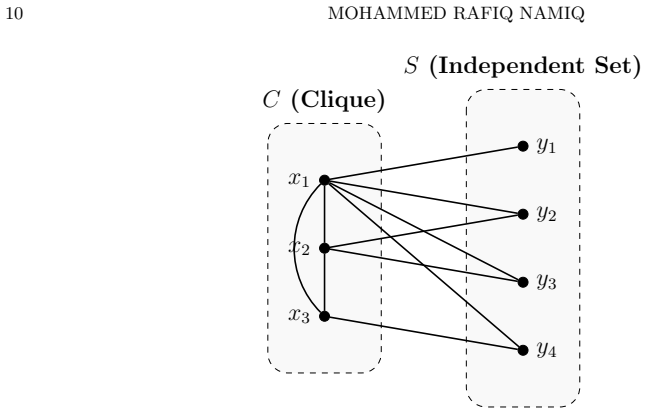
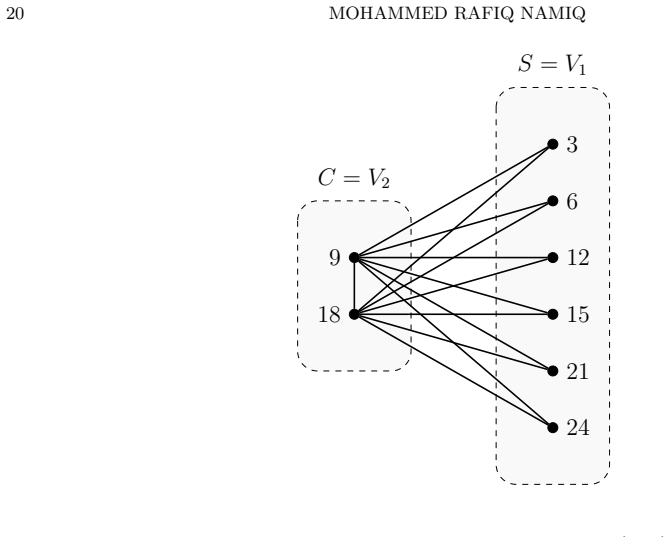
read the original abstract
We study sequentially Cohen-Macaulay co-chordal graphs through the glued clique complexes of their chordal complements. Using the characterization of these complements as $(d_1,\ldots,d_q)$-trees, we derive explicit formulas for the graded Betti numbers of the associated edge ideals, yielding a complete homological characterization of sequentially Cohen-Macaulay co-chordal graphs. As applications, we determine exact homological invariants for several important graph families, including split graphs, threshold graphs, and prime ideal graphs, and classify their Cohen-Macaulay cases. We further characterize the sequentially Cohen-Macaulay nilpotent graphs of finite direct products of Artinian chain rings and establish a closed formula for their graded Betti numbers in terms of local nilpotency indices and residue field cardinalities. Finally, we classify the zero-divisor graphs of $\mathbb{Z}_n$, proving that they are sequentially Cohen-Macaulay if and only if $n=2p$ or $n=p^a$, where $p$ is a prime.
Editorial analysis
A structured set of objections, weighed in public.
Referee Report
Summary. The paper claims that sequentially Cohen-Macaulay co-chordal graphs can be studied via the glued clique complexes of their chordal complements. It asserts that these complements are characterized as (d1,…,dq)-trees, from which explicit formulas for the graded Betti numbers of the associated edge ideals are derived, giving a complete homological characterization. Applications include exact invariants and Cohen-Macaulay classifications for split graphs, threshold graphs, and prime ideal graphs; a characterization and closed Betti formula for sequentially Cohen-Macaulay nilpotent graphs of finite direct products of Artinian chain rings; and a classification showing that the zero-divisor graph of Zn is sequentially Cohen-Macaulay precisely when n=2p or n=p^a for prime p.
Significance. If the tree characterization and the resulting Betti formulas are valid, the work supplies explicit homological data for several standard graph families and resolves the sequentially Cohen-Macaulay property for zero-divisor graphs of Zn. Such formulas would be directly usable for further computations in algebraic combinatorics and could serve as test cases for broader conjectures on sequentially Cohen-Macaulay edge ideals.
minor comments (2)
- The abstract paragraph on glued clique complexes invokes the (d1,…,dq)-tree characterization without indicating where the justification appears; a forward reference to the relevant theorem or section would improve readability.
- The applications section lists several graph families; it would help to state explicitly which of the derived Betti formulas are new versus recovered from earlier literature.
Simulated Author's Rebuttal
We thank the referee for their careful summary of the manuscript. No specific major comments or points of criticism were listed in the report, so we have no individual items to address point-by-point. We remain available to clarify any aspect of the tree characterization, Betti formulas, or applications if the referee or editor requests further details.
Circularity Check
No circularity; derivation self-contained against external characterization
full rationale
The abstract invokes an external characterization of complements as (d1,…,dq)-trees to derive Betti formulas, but supplies no equations or self-citations that reduce the claimed predictions back to fitted inputs or prior self-results by construction. The skeptic analysis confirms that without supplied full text exhibiting such a reduction, the central homological characterization rests on the stated premise rather than re-deriving it tautologically. This is the normal case of an independent derivation once the tree characterization is granted.
Axiom & Free-Parameter Ledger
Reference graph
Works this paper leans on
- [1]
-
[2]
D. F. Anderson and P. S. Livingston.The zero-divisor graph of a commutative ring. Journal of Algebra,217(2):434–447, 1999
1999
-
[3]
M. F. Atiyah and I. G. Macdonald.Introduction to Commutative Algebra. Addison-Wesley Publish- ing Co., Reading, Mass.-London-Don Mills, Ont., 1969
1969
-
[4]
Badawi.On the annihilator graph of a commutative ring
A. Badawi.On the annihilator graph of a commutative ring. Communications in Algebra,42(1):108– 121, 2014
2014
-
[5]
Beck.Coloring of commutative rings
I. Beck.Coloring of commutative rings. Journal of Algebra,116(1):208–226, 1988
1988
-
[6]
P. W. Chen.A kind of graph structure of rings. Algebra Colloquium,10(2):229–238, 2003
2003
-
[7]
Chv´ atal and P
V. Chv´ atal and P. L. Hammer.Aggregation of inequalities in integer programming. Annals of Discrete Mathematics,1:145–162, 1977
1977
-
[8]
L. X. Dung and T. Vu.Cochordal zero divisor graphs and Betti numbers of their edge ideals. Com- munications in Algebra,54(2):736–744, 2026
2026
-
[9]
Faridi.The facet ideal of a simplicial complex
S. Faridi.The facet ideal of a simplicial complex. Manuscripta Mathematica,109(2):159–174, 2002
2002
-
[10]
F¨ oldes and P
S. F¨ oldes and P. L. Hammer.Split graphs. Proceedings 8th Southeastern Conference on Combina- torics, Graph Theory and Computing, Congressus Numerantium19:311–315, 1977
1977
-
[11]
Fr¨ oberg.On Stanley-Reisner rings
R. Fr¨ oberg.On Stanley-Reisner rings. Topics in Algebra, Part 2, Banach Center Publ.,26:57–70, 1990
1990
-
[12]
Fr¨ oberg.Betti numbers of fat forests and their Alexander dual
R. Fr¨ oberg.Betti numbers of fat forests and their Alexander dual. Journal of Algebraic Combina- torics,56:1023–1030, 2022
2022
-
[13]
Fr¨ oberg.Betti numbers of split graphs
R. Fr¨ oberg.Betti numbers of split graphs. arXiv preprint arXiv:2606.03101v1, 2026
Pith/arXiv arXiv 2026
-
[14]
P. L. Hammer and B. Simeone.The splittance of a graph. Combinatorica,1(3):275–284, 1981
1981
-
[15]
P. L. Hammer, T. Ibaraki, and B. Simeone.Threshold sequences. SIAM Journal on Algebraic Discrete Methods,2(1):39–49, 1981
1981
-
[16]
Harary and U
F. Harary and U. Peled.Hamiltonian threshold graphs. Discrete Applied Mathematics,16(1):11–15, 1987
1987
-
[17]
Herzog and Y
J. Herzog and Y. Takayama.Resolutions by mapping cones. Homology, Homotopy and Applications, 4(2):277–294, 2002. 22 MOHAMMED RAFIQ NAMIQ
2002
-
[18]
N. V. R. Mahadev and U. N. Peled.Threshold Graphs and Related Topics. Annals of Discrete Mathematics, Vol. 56, Elsevier, 1995
1995
-
[19]
Merris.Split graphs
R. Merris.Split graphs. European Journal of Combinatorics,24(4):413–430, 2003
2003
-
[20]
Moradi and D
S. Moradi and D. Kiani.Bounds for the regularity of edge ideal of vertex decomposable and shellable graphs. Bulletin of the Iranian Mathematical Society,36(2):267–277, 2010
2010
-
[21]
Nagel and V
U. Nagel and V. Reiner.Betti numbers of monomial ideals and shifted skew shapes. Electronic Journal of Combinatorics,16(2), 2009
2009
-
[22]
M. R. Namiq.Initially Cohen-Macaulay modules. New Mathematics and Natural Computation, 2026.https://doi.org/10.1142/S1793005728500226
-
[23]
M. R. Namiq.Explicit Betti Numbers for Skeletons of Chordal Clique Complexes and Their Alexan- der Duals. arXiv preprint, 2026
2026
-
[24]
Rasheed.Edge Ideals of Prime Ideal Graphs: Ordinary Powers, Polymatroidality, and Analytic Spread
T. Rasheed.Edge Ideals of Prime Ideal Graphs: Ordinary Powers, Polymatroidality, and Analytic Spread. arXiv preprint arXiv:2604.19408, 2026
Pith/arXiv arXiv 2026
-
[25]
B. A. Rather, M. Imran, and S. Pirzada.Linear strand of edge ideals of zero divisor graphs of the ringZ n. Communications in Algebra,52(12):5069–5085, 2024
2024
-
[26]
B. A. Rather.Betti numbers for cochordal zero-divisor graphs of commutative rings. arXiv preprint arXiv:2605.13622, 2026
Pith/arXiv arXiv 2026
-
[27]
H. M. M. Salih and A. A. Jund.Prime ideal graphs of commutative rings. Indonesian Journal of Combinatorics,6(1):42–49, 2022
2022
-
[28]
Singh and R
P. Singh and R. Verma.Betti numbers of edge ideals of some split graphs. Communications in Algebra,48(12):5026–5037, 2020
2020
-
[29]
R. H. Villarreal.Cohen-Macaulay graphs. Manuscripta Math.,66(3):277–293, 1990
1990
-
[30]
Zheng.Resolutions of facet ideals
X. Zheng.Resolutions of facet ideals. Communications in Algebra,32(6):2301–2324, 2004. Department of Mathematics, College of Science, University of Sulaimani, Kurdistan Region, Iraq Email address:mohammed.namiq@univsul.edu.iq
2004
discussion (0)
Sign in with ORCID, Apple, or X to comment. Anyone can read and Pith papers without signing in.