REVIEW 3 major objections 3 minor 56 references
Simple homotopy theory for Fukaya categories
T0 review · 3 major / 3 minor · reviewed 2026-08-15 · deepseek-v4-flash
Pith's one-line read In a Weinstein manifold with $c_1(X)=0$, any isomorphism in the Fukaya category between two closed exact Maslov zero Lagrangians is automatically simple, carrying trivial Whitehead torsion.
desk verdict A novel categorical refinement of Fukaya-categorical isomorphism that would extend Abouzaid–Kragh to Weinstein manifolds, but the main theorem currently rests on an unproved compactly-supported deformation claim. read the letter →
The pith
A machine-rendered reading of the paper's core claim, the machinery that carries it, and where it could break.
The reading
What carries the argument
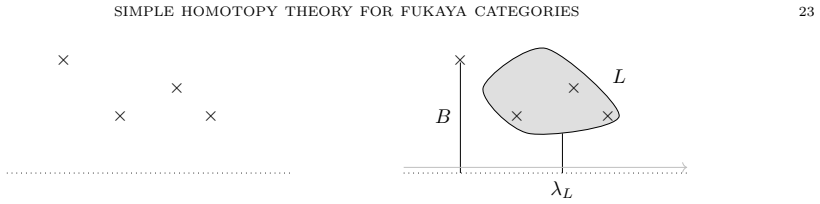
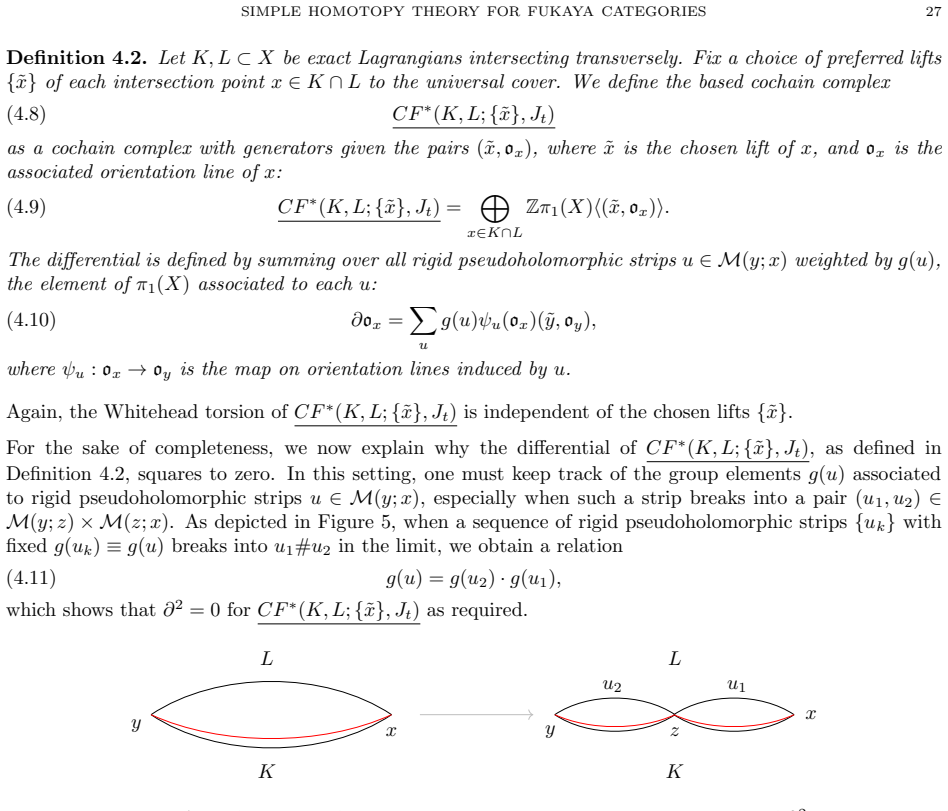
The load-bearing object is the $A_\infty$-bimodule $CF^*(K,L)$ with coefficients in the group ring $\mathbb{Z}[\pi_1(X)]$, built from lifts of intersection points and pseudoholomorphic strips to the universal cover of $X$. Its underlying based cochain complex has a well-defined simple homotopy type, so one can speak of simply acyclic objects, simple isomorphisms, and simple generation. The automatic simplicity lemma (Proposition 4.19) shows that if a Fukaya category has simple generators that are simply connected, every isomorphism is automatically simple. The paper proves that the Lefschetz thimbles of a Lefschetz fibration form such simple generators (Proposition 4.27), and uses the Giroux-Pardon deformation to present any Weinstein manifold as such a fibration, transferring the conclusion back to the original Fukaya category.
What would settle it
Construct a Weinstein manifold $X$ with $c_1(X)=0$ and two closed exact Maslov zero Lagrangians $K,L$ that are isomorphic in the compact Fukaya category $F(X)$ but whose Reidemeister torsions, computed for some representation of $\pi_1(X)$ to $\mathbb{C}$, differ; this would contradict Theorem 4.28 via Proposition 4.21.
Extended reading notes
Core claim
The paper's central claim is Theorem 4.28: if $X$ is a Weinstein manifold with $c_1(X)=0$ and $K,L$ are closed exact Maslov zero Lagrangians with brane structures whose objects in the compact Fukaya category $F(X)$ are isomorphic, then the isomorphism is a simple isomorphism, i.e., its Whitehead torsion vanishes. Consequently, whenever the fundamental groups of $K$ and $L$ inject into $\pi_1(X)$, the associated homotopy equivalence between $K$ and $L$ is a simple homotopy equivalence, and the Reidemeister torsions of their cellular cochain complexes agree for any representation of $\pi_1(X)$. In particular, if one Lagrangian is homotopy equivalent to the ambient Weinstein manifold and the other has isomorphic fundamental group, the other Lagrangian is also homotopy equivalent to $X$, and the composed map $K \to X \to L$ is a simple homotopy equivalence.
Load-bearing premise
The argument assumes that the Giroux-Pardon Weinstein deformation of $X$ to a Lefschetz fibration can be chosen compactly supported, so that the exact symplectomorphism is the identity outside a compact set and the Lagrangians' isomorphism class and $\mathbb{Z}[\pi_1(X)]$-bimodule structure transfer unchanged.
Editorial extensions
If this is right
- Isomorphic objects in the compact Fukaya category of a $c_1=0$ Weinstein manifold are simply isomorphic, so their Whitehead torsion vanishes.
- When the Lagrangians' fundamental groups inject into $\pi_1(X)$, their Reidemeister torsions agree for every representation of $\pi_1(X)$.
- The cotangent bundles $T^*L(p,q)$ and $T^*L(p,q')$ are symplectomorphic if and only if the lens spaces $L(p,q)$ and $L(p,q')$ are diffeomorphic.
- The Weinstein connect sum $T^*L(7,1)\natural T^*L(7,2)$ admits no exact symplectomorphism that swaps the two middle-dimensional homology summands, a purely symplectic obstruction.
- In a simply-connected 6-dimensional Weinstein manifold with $c_1=0$, any closed exact Maslov zero Spin Lagrangian in $T^*L(p,q)\natural X$ whose fundamental group maps isomorphically to $\pi_1(M)$ is diffeomorphic to $L(p,q)$.
Reading between the lines
- The same automatic-simplicity pattern should hold in any setting where a Fukaya category is generated by simply connected objects with a geometric reason for simple generation, for example plumbings of cotangent bundles; this would let Reidemeister torsion obstruct Lagrangian embeddings more generally.
- The paper implicitly separates the information carried by wrapped Fukaya categories (which cannot distinguish $L(7,1)$ from $L(7,2)$) from the compact Fukaya category, suggesting that compact Fukaya categories are finer simple-homotopy invariants than wrapped ones.
- A direct testable extension would be to look for Fukaya-isomorphic Lagrangians modeled on pairs of spaces that are simple homotopy equivalent but not homeomorphic, in higher dimensions where fake lens spaces exist; the theory predicts no such pair can occur with $c_1=0$.
Signed reviews
Editorial analysis
A structured set of objections, weighed in public.
Referee Report
Summary. The paper develops a categorical framework for simple homotopy theory in Fukaya categories. It introduces the A∞-bimodule CF*(K,L) with Zπ1(X)-coefficients, defines 'simply acyclic' objects and 'simple isomorphisms' in the category Tw^Ch F, and proves an automatic simplicity lemma (Prop 4.19) under the existence of simply connected simple generators. The main theorem (Thm 4.28) asserts that for a Weinstein manifold X with c1(X)=0, any isomorphism in the compact Fukaya category F(X) between two closed exact Maslov-zero Lagrangian branes is automatically simple. The proof transfers the problem to the Fukaya category F(π) of a Lefschetz fibration obtained from a Giroux–Pardon deformation, using Prop 4.27 (simple generation by Lefschetz thimbles). The paper then derives applications to cotangent bundles of lens spaces, Weinstein 1-handle connect sums, and simple homotopy equivalence of isomorphic closed Lagrangians.
Significance. If the main theorem holds, the framework is a valuable contribution: it gives a categorical refinement of Whitehead torsion and extends the Abouzaid–Kragh simple-homotopy result from cotangent bundles to general Weinstein manifolds with vanishing c1. The algebraic core is well structured; the torsion lemmas 2.17–2.19 are clean and the automatic simplicity lemma 4.19 is elegant. The applications, especially the lens-space obstruction in Theorem 5.2, are concrete and falsifiable. However, the central geometric transfer (compactly-supported Giroux–Pardon deformation) is not established in the manuscript, and Prop 4.27 relies on an unpublished manuscript; these are load-bearing gaps. The paper is not yet at the standard of a definitive proof, but the framework and algebraic results are likely to be useful.
major comments (3)
- [Section 4.3, proof of Theorem 4.28] The proof asserts that the Giroux–Pardon deformation can be chosen compactly supported: specifically, the sentence 'In our case, where the Weinstein structure is standard at infinity, the Stein deformation can also be chosen to be compactly supported' is given without proof. The citations [CE, Proposition 11.8] and [GP17, Theorem 1.5] do not, as stated, establish this; the former covers Liouville homotopies of Weinstein structures and the latter constructs a Lefschetz fibration on a Weinstein domain. This is load-bearing because automatic simplicity (Propositions 4.19 and 4.27) is proved in the admissible category F(π), not in F(X); if the exact symplectomorphism φ: X → X' is not identity outside a compact set, an isomorphism in F(X) need not become an isomorphism in F(π), and the simple-isomorphism conclusion for K,L in F(X) does not follow. The same transfer is used in Theorems 5.1, 5.7 and 5.12, so the gap affects all main applications. The author should either prove the compactly supported deformation claim or supply a precise reference, and should explain how K,L are regarded as objects of F(π) (including admissibility and properness).
- [Section 4.3, Proposition 4.27] The proof of simple generation of F(π) by Lefschetz thimbles adapts the unpublished manuscript [BS]. Several steps are asserted rather than proved, in particular the claim that all pseudoholomorphic curves contributing to CF*(T_S1...T_Sm N,N') are entirely supported within the first branch, used to identify this complex with CF*(T_B1...T_Bm L,L'). Since this proposition is the key generation input for automatic simplicity (Proposition 4.19), the proof as written is not self-contained. If [BS] remains unpublished, the author should either include the full argument or extract the specific statements being used and prove them here.
- [Sections 4.2–4.3, transfer to F(π)] The proof of Theorem 4.28 also assumes without argument that the Fukaya category F(π) of the Lefschetz fibration is chain-level proper, so that Whitehead torsion is defined, and that closed exact Lagrangians in X' define admissible objects of F(π). These points are necessary for the isomorphism in F(X) to be transported to a simple isomorphism in F(π) and for the torsion computations to make sense; they should be stated and justified explicitly, even if the compactly supported deformation claim is repaired.
minor comments (3)
- [Section 5.2, proof of Theorem 5.2] The text reads 'By Proposition 4.28, this isomorphism will be simple', but there is no Proposition 4.28; the reference should be to Theorem 4.28.
- [Section 2.3 and Theorem 5.1] The notation in equations (2.44)–(2.45) and in the proof of Theorem 5.1 is inconsistent: the condition should be q' ≡ ±q±1 (mod p) as stated in Theorem 2.24(2), but the proof uses r' = ±r±1 without defining the relation between r and q clearly; please align the notation.
- [References and typos] There are several typographical and citation errors: in the reference [CE] the publisher appears as 'Amre. Math. Soc.'; the author name 'Karabas–Lee' is written with inconsistent hyphenation; and the numbering 'Proposition 4.28' is used where 'Theorem 4.28' is meant. These should be corrected uniformly.
Circularity Check
No circularity: automatic simplicity is derived from geometric inputs (Dehn twist triangle, monotonicity, branched covers); the only caveat is an unproved compactly-supported deformation claim, which is a correctness gap, not a circular reduction.
full rationale
The derivation of Theorem 4.28 is not circular. The automatic simplicity lemma (Proposition 4.19) requires the existence of simply connected simple generators; this hypothesis is verified geometrically in Section 4.3 for Lefschetz fibrations via the branched-cover argument and the simplicity of the Dehn twist triangle (Theorem 4.25), which rests on action filtrations and monotonicity estimates rather than on the theorem's conclusion. The Lefschetz-thimble generation statement and the lens-space torsion computations are external inputs, and the cited results [GP17], [CE], [Sei18], and [Sei03] are background tools rather than the target result. No parameter is fitted and no 'prediction' is a renamed input. The adaptation from the unpublished manuscript [BS] is presented with full proof details, so its unpublished status is not a circular reliance. The only flagged weakness is the compactly supported assertion in the proof of Theorem 4.28: 'In our case, where the Weinstein structure is standard at infinity, the Stein deformation can also be chosen to be compactly supported.' This is an unproved geometric claim; if false, the transfer from F(X) to F(π) would fail. That is a correctness risk, not a circular reduction, so it does not affect the circularity score.
Assumptions & free parameters
assumptions (7)
- domain assumption The relevant Fukaya category is chain-level proper, so Whitehead torsion is well-defined for the bimodule CF^*(K,L).
- domain assumption Every Weinstein manifold admits a Weinstein deformation to a Lefschetz fibration (Giroux-Pardon [GP17]).
- ad hoc to paper The Giroux-Pardon deformation can be chosen compactly supported for Weinstein structures standard at infinity.
- domain assumption The Lefschetz thimbles simply generate F(pi) (Proposition 4.27).
- domain assumption There is a cohomologically fully faithful embedding of F into a strictly unital A-infinity category over Z, as shown in [PS].
- standard math Standard Whitehead and Reidemeister torsion machinery from Milnor, Cohen, and Turaev, including multiplicativity and invariance properties.
- domain assumption Monotonicity lemmas for pseudoholomorphic curves with switching Lagrangian boundary conditions hold (Lemma A.4, [CEL10]).
Cite this review
Pith. "Pith review of Simple homotopy theory for Fukaya categories." pith.science (2026). https://pith.science/paper/C7YD5XWD
@misc{pith2026250905856,
  author       = {Pith},
  title        = {Pith review of: Simple homotopy theory for Fukaya categories},
  year         = {2026},
  howpublished = {\url{https://pith.science/paper/C7YD5XWD}},
  note         = {Machine review of arXiv:2509.05856}
}
read the original abstract
We develop a categorical framework for simple homotopy theory in Fukaya categories, based on the fundamental group of the ambient symplectic manifold. When the first Chern class vanishes, we show that any isomorphism in the Fukaya category of a Weinstein manifold has trivial Whitehead torsion. As an application, we prove that any pair of closed connected Lagrangians that are isomorphic in the Fukaya category of such Weinstein manifolds are simple homotopy equivalent, provided one of the Lagrangians is homotopy equivalent to the ambient symplectic manifold and their fundamental groups are isomorphic.
Figures


Figures from the paper (10 more)



Reference graph
Works this paper leans on
-
[1]
A. Abbondandolo, & M. Schwarz. Floer homology of cotangent bundles and the loop product. Geom. Topol. , 14(3):1569--1722, 2010
work page 2010
- [2]
- [3]
- [4]
-
[5]
M. Abouzaid, & T. Kragh. Simple homotopy equivalence of nearby Lagrangians. Acta. Math. , 220(2):207--237, 2018
work page 2018
-
[6]
M. Abouzaid, & P. Seidel. An open string analogue of Viterbo functoriality. Geom. Topol. , 14(2):627--718, 2010
work page 2010
-
[7]
M. Abouzaid, & P. Seidel. Altering symplectic manifolds by homogeneous recombination. Preprint Arxiv:1007.3281
-
[8]
M. Abouzaid, & I. Smith. Exact Lagrangians in plumbings. Geom. Funct. Anal. , 22(4):785--831, 2012
work page 2012
Show all 56 references
-
[9]
Álvarez-Gavela, & K
D. Álvarez-Gavela, & K. Igusa. A Legendrian Turaev torsion via generating families. J. Éc. polytech. Math. , 8:57--119, 2021
2021
-
[10]
Bai, & P
S. Bai, & P. Seidel. Injectivity of twisted open-closed string maps. Unpublished manuscript
-
[11]
Berglund
A. Berglund. Homological perturbation theory for algebras over operads. Algebr. Geom. Topol. , 14(5):2511--2548, 2014
2014
-
[12]
Biran, & O
P. Biran, & O. Cornea. A Lagrangian quantum homology. In New perspectives and challenges in symplectic field theory , pages 1--44. Amer. Math. Soc., 2009
2009
-
[13]
T. A. Chapman. Topological invariance of Whitehead torsion. Amer. J. Math. , 96(3):488--497, 1974
1974
-
[14]
Charette
F. Charette. Quantum Reidemeister torsion, open Gromov-Witten invariants and a spectral sequence of Oh. Int. Math. Res. Not. , 2019(8):2483--2518, 2019
2019
-
[15]
Cieliebak, Y
K. Cieliebak, Y. Eliashberg. From Stein to Weinstein and Back. AMS Colloquium Publications , Vol. 59. Amre. Math. Soc., Providence, RI, 2012
2012
-
[16]
Cieliebak, T
K. Cieliebak, T. Ekholm, & J. Latschev. Compactness for holomorphic curves with switching Lagrangian boundary conditions. J. Symplectic Geom. , 8(3):267--298, 2010
2010
-
[17]
M. Cohen. A course in simple homotopy theory. Graduate Texts in Mathematics , Vol. 10. Springer-Verlag, New York-Berlin, 1973
1973
-
[18]
Courte, & N
S. Courte, & N. Porcelli. On the parametrized Whitehead torsion of families of nearby Lagrangian submanifolds. Preprint Arxiv:2506.06110
-
[19]
A. Floer. Morse theory for Lagrangian intersections. J. Differential Geom. , 28(3):513--547, 1988
1988
-
[20]
A. Floer. Witten's complex and infinite-dimensional Morse theory. J. Differential Geom. , 30(1):207--221, 1989
1989
-
[21]
K. Fukaya. Floer homology and mirror symmetry II. In Minimal surfaces, geometric analysis and symplectic geometry , pages 31--127. Math. Soc. Japan, 2002
2002
-
[22]
Fukaya, P
K. Fukaya, P. Seidel, & I. Smith. Exact Lagrangians in simply-connected cotangent bundles. Invent. Math. , 172:1--27, 2008
2008
-
[23]
Fukaya, P
K. Fukaya, P. Seidel, & I. Smith. The symplectic geometry of cotangent bundles from a categorical viewpoint. In Homological Mirror Symmetry , pages 1--26. Springer-Verlag Berlin, 2009
2009
-
[24]
Giroux, & J
E. Giroux, & J. Pardon. Existence of Lefschetz fibrations on Stein and Weinstein domains. Geom. Topol. , 21(2):963--997, 2017
2017
-
[25]
Ganatra, J
S. Ganatra, J. Pardon, & V. Shende. Sectorial descent for wrapped Fukaya categories. J. Amer. Math. Soc. , 37:499--635, 2024
2024
-
[26]
A. Hatcher. Algebraic Topology . Cambridge University Press, Cambridge, 2002
2002
-
[27]
Husin, & T
A. Husin, & T. Kragh. Local systems and vanishing Maslov class. Preprint Arxiv:2410.01586
-
[28]
Hutchings, & Y
M. Hutchings, & Y. Lee. Circle-valued Morse theory and Reidemeister torsion. Geom. Topol. , 3:369--396, 1999
1999
-
[29]
Karabas, & S
D. Karabas, & S. Lee. Homotopy colimits of DG categories and Fukaya categories. Preprint Arxiv:2109.03411
-
[30]
Kenigsberg, & N
L. Kenigsberg, & N. Porcelli. Obstructions to homotopy invariance of loop coproduct via parametrised fixed-point theory. Preprint Arxiv:2407.13662
-
[31]
Kontsevich & Y
M. Kontsevich & Y. Soibelman. Homological mirror symmetry and torus fibrations. In Symplectic geometry and mirror symmetry , pages 203--263. World Sci. Publ., River Edge, NJ, 2001
2001
-
[32]
T. Kragh. Parametrized ring spectra and the nearby Lagrangian conjecture. Geom. Topol. , 17(2):639--731, 2013
2013
-
[33]
T. Kragh. Homotopy equivalence of nearby Lagrangians and the Serre spectral sequence. Math. Ann. , 368:945--970, 2017
2017
-
[34]
Lazarev, & Z
O. Lazarev, & Z. Sylvan. Prime-localized Weinstein subdomains. Geom. Topol. , 27(2):699--737, 2023
2023
-
[35]
W. Leavitt. The module type of a ring. Trans. Am. Math. Soc. , 103(1):113--130, 1962
1962
-
[36]
Mak, & W
C. Mak, & W. Wu. Dehn twists and Lagrangian spherical submanifolds. Selecta Math. , 25(5):25--68, 2019
2019
-
[37]
M. McLean. Lefschetz fibrations and symplectic homology. Geom. Topol. , 13(4):1877--1944, 2009
1944
-
[38]
J. Milnor. Two complexes which are homeomorphic but combinatorially distinct. Ann. of Math. , 74(2):575--590, 1961
1961
-
[39]
J. Milnor. A Duality Theorem for Reidemeister Torsion. Ann. of Math. , 76(1):137--147, 1962
1962
-
[40]
J. Milnor. Whitehead torsion. Bull. Amer. Math. Soc. , 72:358--428, 1966
1966
-
[41]
D. Nadler. Microlocal branes are constructible sheaves. Selecta Math. , 15(4):563--619, 2009
2009
-
[42]
Petersen
D. Petersen. A closer look at Kadeishvili's theorem. High. Struct. , 4(2):211--221, 2020
2020
-
[43]
Pomerleano, & P
D. Pomerleano, & P. Seidel. The quantum connection and its mod p reduction. Unpublished manuscript
-
[44]
Reidemeister
K. Reidemeister. Homotopieringe und Linsenräume. Abh. Math. Sem. Univ. Hamburg , 11(1):102--109, 1935
1935
-
[45]
P. Seidel. Graded Lagrangian submanifolds. Bull. Soc. Math. France , 128(1):103--149, 2000
2000
-
[46]
P. Seidel. A long exact sequence for symplectic Floer homology. Topology , 42(5):1003--1063, 2003
2003
-
[47]
P. Seidel. A_ -subalgebras and natural transformations. Homology Homotopy Appl. , 10(2):83--114, 2008
2008
-
[48]
P. Seidel. Fukaya categories and Picard-Lefschetz theory . European Math. Soc., 2008
2008
-
[49]
P. Seidel. Fukaya A_ -structures associated to Lefschetz fibrations. IV . In Breadth in contemporary topology , pages 195--276. Amer. Math. Soc., 2019
2019
-
[50]
P. Seidel. Fukaya A_ -structures associated to Lefschetz fibrations. IV 1/2. J. Symplectic Geom. , 18:291--332, 2020
2020
-
[51]
Sheridan
N. Sheridan. Homological mirror symmetry for Calabi-Yau hypersurfaces in projective space. Invent. Math. , 199(1):1--186, 2015
2015
-
[52]
J. Sikorav. Some properties of holomorphic curves in almost complex manifolds. In Holomorphic curves in symplectic geometry , volume 117 of Progress in Math. , pages 165--189. Birkh \"a user, 1994
1994
-
[53]
L. Suarez. Exact Lagrangian cobordism and pseudo-isotopy. Geom. Funct. Anal. , 12:810--872, 2002
2002
-
[54]
Sullivan
M. Sullivan. K-theoretic invariants for Floer homology. Internat. J. Math. , 28(8), 2017
2017
-
[55]
V. Turaev. Introduction to combinatorial torsions. Birkh \"a user, Basel, 2001
2001
-
[56]
J. H. C. Whitehead. Combinatorial homotopy. I. Bull. Amer. Math. Soc. , 55:213--245, 1949
1949
Reviewed August 15, 2026 · model on record in the stance chip above.
Discussion (0). Continue with ORCID to comment.