REVIEW 2 major objections 5 minor 113 references
Every Sample Counts: Supervised Fine-Tuning of Language Models with Pointwise Constraints
T0 review · 2 major / 5 minor · reviewed 2026-07-13 · grok-4.5
Pith's one-line read Pointwise constraints cut tail violations in language-model fine-tuning while keeping average performance.
desk verdict Clean dual recipe for pointwise LM constraints that actually shrinks violation tails on three small-model tasks; ordinary dual-method caveats, not a broken argument. read the letter →
The pith
A machine-rendered reading of the paper's core claim, the machinery that carries it, and where it could break.
The reading
What carries the argument
The empirical augmented Lagrangian (and its quadratically regularized dual for the relaxed problem) that assigns a nonnegative multiplier to each training sample and is maximized by dual ascent interleaved with a few primal steps on the language-model parameters.
What would settle it
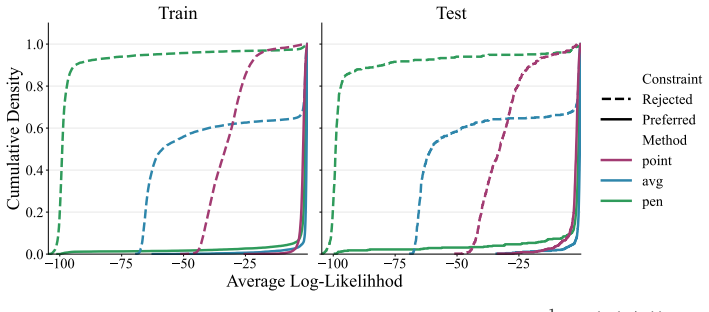
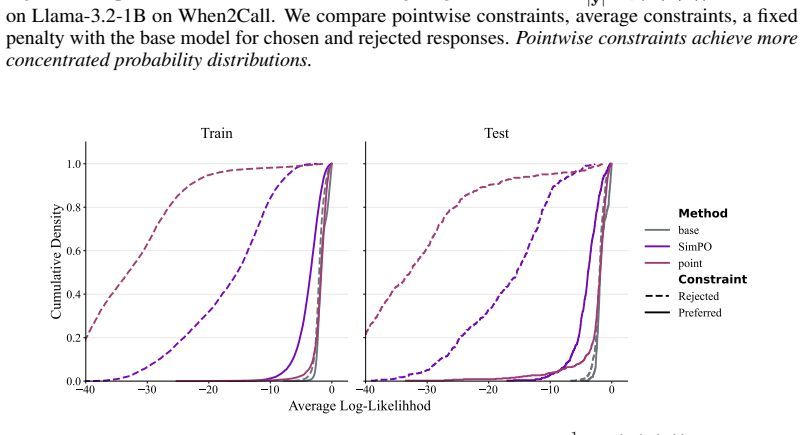
On a held-out test split of any of the three tasks, the empirical CDF of constraint values for the pointwise method fails to dominate the average-constraint and fixed-penalty baselines in the upper tail (high-violation region), or the reported CVaR of violations is no smaller while the average objective is worse.
Extended reading notes
Core claim
Enforcing constraints almost everywhere, rather than only in expectation, and optimizing the resulting dual with sample-wise multipliers and a quadratic augmentation term, reduces both the frequency and severity of large per-sample violations while still attaining competitive average objective values and task metrics.
Load-bearing premise
A handful of inexact gradient steps on the model parameters, together with a hand-chosen fixed augmentation strength, is enough for the dual iterates to recover near-feasible solutions that generalize beyond the training samples.
Editorial analysis
A structured set of objections, weighed in public.
Referee Report
Summary. The paper proposes a pointwise constrained supervised fine-tuning framework for language models: minimize an average objective subject to almost-everywhere (per-sample) inequality constraints, rather than average constraints. To handle overly tight constraints and outliers it introduces a learned sample-dependent relaxation u with a user-chosen convex cost (instantiated as quadratic β‖u‖²), and solves the resulting problem via an empirical augmented Lagrangian dual with sample-wise multipliers and a fixed augmentation parameter α (Algorithm 1). Strong duality for the empirical relaxed problem is proved under mild assumptions (Prop. 3, App. B). The framework is instantiated on three small-LM tasks—safety refusal in instruction following, preference constraints in tool calling, and length-aware re-ranking—and compared to average constraints, fixed penalties, and task-specific baselines. Empirically, pointwise (and relaxed) methods reduce the tails of the constraint-violation distribution (CDFs, CVaR) while preserving or improving average objective and downstream metrics, often expanding the Pareto frontier (Figs. 1–4, Tables 2, 10–12).
Significance. If the claims hold, the work supplies a clean, reusable dual formulation that directly targets sample-level disparities that average-constrained alignment can leave unaddressed. The combination of pointwise constraints, resilient quadratic relaxation (Prop. 1), and an AL dual tailored to non-convex LM fine-tuning is a natural and useful extension of constrained learning theory to SFT. Strengths include: (i) clean duality derivations and a strong-duality result for the empirical relaxed problem; (ii) three distinct, carefully specified task instantiations that demonstrate flexibility; (iii) transparent empirical reporting (seed means ± std, full CDFs, CVaR, Pareto fronts, ablations on α/β, and explicit negative cases in E.4). The contribution is methods-oriented rather than a new theoretical guarantee for non-convex LMs, but it is a solid and timely addition to constrained alignment.
major comments (2)
- §3.3 and Algorithm 1 (and App. C): The central practical claim—that modest inexact primal steps plus a hand-chosen fixed α recover near-feasible, generalizing solutions—rests on the cited AL-COLE theory without finite-sample rates for the non-convex LM setting. The paper already scopes this as a limitation and shows empirical stability to α (App. F.2) and out-of-sample CDFs/CVaR, so it does not overturn the results; still, a short discussion of when the dual may fail to generalize (linking to the E.4 negative cases) would strengthen the load-bearing optimization claim.
- §4 / Tables 2, 10–12 and Figs. 1–4: The evidence that tail reduction improves downstream metrics is convincing on the reported small models and datasets, but the paper does not quantify how much of the gain is due to the sample-wise multipliers versus the particular choice of ε and β. A more systematic sensitivity analysis (or a simple ablation that freezes the dual variables after a few epochs) would make H2 more robust; without it the Pareto improvements remain empirical rather than fully attributed.
minor comments (5)
- Notation: the same symbol ε is used for different constraint levels across tasks (ε_U, ε_H, ε_win, ε_lose, margin ε); a short table of task-specific tolerances would help.
- Fig. 1 and related CDFs: axis labels and the meaning of positive vs. negative constraint values could be stated more explicitly in the caption for readers who skip §4.1.
- App. A / related work: the connection to soft-margin SVMs and scenario optimization is useful; a sentence clarifying that the present work targets infinite-dimensional (functional) duals rather than finite-sample scenario bounds would avoid confusion.
- Typos / polish: occasional missing spaces after periods and a few long sentences in §3.2–3.3; a light copy-edit would improve readability.
- Reproducibility: runtime/memory overhead is discussed (App. F) and is negligible; releasing the dual-ascent implementation or a minimal reference script would further help adoption.
Circularity Check
No significant circularity: dual construction and empirical claims are independent of fitted targets; only minor self-citation of authors' AL theory for non-convex guarantees.
-
self citation load bearing
[§3.1 (after Eq. 6) and §3.3 / App. C (Alg. 1)]
"under the conditions studied in [27], an approximate solution for a constrained learning problem can be obtained via the primal minimizer of the empirical augmented Lagrangian at the optimal augmented dual pair [27, Theorem 2.3]. ... convergence can still be guaranteed as long as the primal minimization error decreases sufficiently across iterations [27, Theorem 3.1]."
The paper invokes its own concurrent AL-COLE preprint for the key non-convex duality-gap and inexact-ascent guarantees that justify using fixed-α dual ascent with few primal steps. This is a self-citation of overlapping authors, but it is not load-bearing for the central empirical claims (tail reduction, Pareto improvements), which are validated independently on held-out CDFs/CVaR/downstream metrics; the citation merely supplies theoretical scaffolding already partially re-derived for the relaxed case in App. B.
full rationale
The derivation chain is standard constrained optimization applied to LM fine-tuning: primal (P) with pointwise inequalities, Lagrangian dual, then augmented Lagrangian (6) to address non-convexity, plus quadratic relaxation whose dual is derived in Prop. 1 (rescaling + regularization of gA). These steps are algebraic identities or classical AL results (Rockafellar, Wierzbicki–Kurcyusz), not self-definitional. Hyperparameters ε, β, α are free knobs whose effects are ablated (Figs. 1, 4; App. F), not fitted then re-labeled as predictions. Downstream metrics (CVaR tails, F1, LC-WR, MRR/LenRank, Pareto) are held-out and distinct from the dual objective, so empirical claims C1–C4/H1–H2 stand independently. The sole self-citation of note is [27] (same authors) for AL strong duality / inexact primal-dual convergence (Thm. 2.3, 3.1); this supplies theoretical motivation but is not load-bearing for the reported reductions in violation tails, which rest on the experiments themselves. No uniqueness theorem forbids alternatives, no ansatz is smuggled, and soft-margin SVM is correctly acknowledged as a classical special case rather than renamed. Score 1 reflects only that minor self-citation; the paper is otherwise self-contained against external benchmarks.
Assumptions & free parameters
free parameters (4)
- relaxation cost β
- augmentation parameter α
- constraint tolerances ε (ε_U, ε_H, ε_win, ε_lose, margin ε)
- dual learning rate η
assumptions (3)
- domain assumption The empirical augmented dual with inexact primal steps converges to a near-optimal dual pair when α is large enough (shifted-penalty theory).
- domain assumption Pointwise almost-everywhere constraints are the appropriate modeling target for safety/preference/length requirements.
- standard math Standard continuity, compactness, and bounded-loss assumptions that guarantee strong duality of the empirical relaxed problem.
invented entities (1)
-
sample-dependent relaxation function u(x,y) with quadratic cost c(u)=β‖u‖²
Cite this review
Pith. "Pith review of Every Sample Counts: Supervised Fine-Tuning of Language Models with Pointwise Constraints." pith.science (2026). https://pith.science/paper/CAIULV7A
@misc{pith2026260708968,
  author       = {Pith},
  title        = {Pith review of: Every Sample Counts: Supervised Fine-Tuning of Language Models with Pointwise Constraints},
  year         = {2026},
  howpublished = {\url{https://pith.science/paper/CAIULV7A}},
  note         = {Machine review of arXiv:2607.08968}
}
read the original abstract
Fine-tuning language models often requires enforcing constraints on individual inputs without compromising downstream performance. Existing constrained alignment methods impose constraints on average, which can induce undesirable disparities across inputs or users. We propose a novel alignment framework that addresses this gap by enforcing per-sample constraints while still minimizing an average loss. To mitigate the impact of overly restrictive constraints and outliers, we introduce a learned, sample-dependent relaxation that minimally adjusts the constraints, trading off a user-defined relaxation cost with the training objective. To address practical duality and optimization challenges, we develop an augmented Lagrangian approach tailored to this formulation. We demonstrate the flexibility of the framework by instantiating it under distinct small language-model fine-tuning tasks and constraints: safety in instruction following, preferences in function calling and length in re-ranking. Across these settings, our approach reduces tail constraint violations while largely preserving the model's performance.
Figures


Figures from the paper (12 more)



Reference graph
Works this paper leans on
-
[1]
Yining Huang, Keke Tang, Meilian Chen, and Boyuan Wang. A comprehensive survey on evaluating large language model applications in the medical industry.arXiv preprint arXiv:2404.15777, 2024
arXiv 2024
-
[2]
On large language models in mission-critical it governance: Are we ready yet?, 2025
Matteo Esposito, Francesco Palagiano, Valentina Lenarduzzi, and Davide Taibi. On large language models in mission-critical it governance: Are we ready yet?, 2025. URL https: //arxiv.org/abs/2412.11698
arXiv 2025
-
[3]
Safe RLHF: Safe reinforcement learning from human feedback
Josef Dai, Xuehai Pan, Ruiyang Sun, Jiaming Ji, Xinbo Xu, Mickel Liu, Yizhou Wang, and Yaodong Yang. Safe RLHF: Safe reinforcement learning from human feedback. InThe Twelfth International Conference on Learning Representations, 2024
2024
-
[4]
One-shot safety alignment for large language models via optimal dualization.Advances in Neural Information Processing Systems, 37:84350–84383, 2024
Xinmeng Huang, Shuo Li, Edgar Dobriban, Osbert Bastani, Hamed Hassani, and Dongsheng Ding. One-shot safety alignment for large language models via optimal dualization.Advances in Neural Information Processing Systems, 37:84350–84383, 2024
2024
-
[5]
Stepwise alignment for constrained language model policy optimization.Advances in Neural Information Processing Systems, 37:104471–104520, 2024
Akifumi Wachi, Thien Q Tran, Rei Sato, Takumi Tanabe, and Youhei Akimoto. Stepwise alignment for constrained language model policy optimization.Advances in Neural Information Processing Systems, 37:104471–104520, 2024
2024
-
[6]
Zixuan Liu, Xiaolin Sun, and Zizhan Zheng. Enhancing LLM safety via constrained direct preference optimization.arXiv preprint arXiv:2403.02475, 2024
arXiv 2024
-
[7]
Xiyue Peng, Hengquan Guo, Jiawei Zhang, Dongqing Zou, Ziyu Shao, Honghao Wei, and Xin Liu. Enhancing safety in reinforcement learning with human feedback via rectified policy optimization.arXiv preprint arXiv:2410.19933, 2024
arXiv 2024
-
[8]
L3ms–lagrange large language models.arXiv preprint arXiv:2410.21533, 2024
Guneet S Dhillon, Xingjian Shi, Yee Whye Teh, and Alex Smola. L3ms–lagrange large language models.arXiv preprint arXiv:2410.21533, 2024
arXiv 2024
Show all 113 references
-
[9]
Adversarial training for high-stakes reliability.Advances in neural information processing systems, 35: 9274–9286, 2022
Daniel Ziegler, Seraphina Nix, Lawrence Chan, Tim Bauman, Peter Schmidt-Nielsen, Tao Lin, Adam Scherlis, Noa Nabeshima, Benjamin Weinstein-Raun, Daniel de Haas, et al. Adversarial training for high-stakes reliability.Advances in neural information processing systems, 35: 9274–...
2022
-
[10]
Confronting reward model overoptimization with constrained RLHF
Ted Moskovitz, Aaditya K Singh, DJ Strouse, Tuomas Sandholm, Ruslan Salakhutdinov, Anca Dragan, and Stephen Marcus McAleer. Confronting reward model overoptimization with constrained RLHF. InThe Twelfth International Conference on Learning Representations, 2024. URLhttps://ope...
2024
-
[11]
Large lan- guage models struggle to learn long-tail knowledge
Nikhil Kandpal, Haikang Deng, Adam Roberts, Eric Wallace, and Colin Raffel. Large lan- guage models struggle to learn long-tail knowledge. In Andreas Krause, Emma Brunskill, Kyunghyun Cho, Barbara Engelhardt, Sivan Sabato, and Jonathan Scarlett, editors,Proceed- ings of the 40...
2023
-
[12]
The devil is in the tails: How long-tailed code distributions impact large language models
Xin Zhou, Kisub Kim, Bowen Xu, Jiakun Liu, DongGyun Han, and David Lo. The devil is in the tails: How long-tailed code distributions impact large language models. In2023 38th IEEE/ACM International Conference on Automated Software Engineering (ASE), pages 40–52,
-
[13]
doi: 10.1109/ASE56229.2023.00157
2023 doi
-
[14]
The neglected tails in vision-language models
Shubham Parashar, Zhiqiu Lin, Tian Liu, Xiangjue Dong, Yanan Li, Deva Ramanan, James Caverlee, and Shu Kong. The neglected tails in vision-language models. InProceedings of the IEEE/CVF Conference on Computer Vision and Pattern Recognition (CVPR), pages 12988–12997, June 2024. 10
2024
-
[15]
The law of knowledge overshadowing: Towards understanding, predicting, and preventing llm hallucination.arXiv preprint arXiv:2502.16143, 2025
Yuji Zhang, Sha Li, Cheng Qian, Jiateng Liu, Pengfei Yu, Chi Han, Yi R Fung, Kathleen McKeown, Chengxiang Zhai, Manling Li, et al. The law of knowledge overshadowing: Towards understanding, predicting, and preventing llm hallucination.arXiv preprint arXiv:2502.16143, 2025
2025 arXiv
-
[16]
Is gpt-oss good? a comprehensive evaluation of openai’s latest open source models.arXiv preprint arXiv:2508.12461, 2025
Ziqian Bi, Keyu Chen, Chiung-Yi Tseng, Danyang Zhang, Tianyang Wang, Hongying Luo, Lu Chen, Junming Huang, Jibin Guan, Junfeng Hao, et al. Is gpt-oss good? a comprehensive evaluation of openai’s latest open source models.arXiv preprint arXiv:2508.12461, 2025
2025
-
[17]
Probably approximately correct constrained learning
Luiz Chamon and Alejandro Ribeiro. Probably approximately correct constrained learning. Advances in Neural Information Processing Systems, 33:16722–16735, 2020
2020
-
[18]
Achieving zero constraint violation for constrained reinforcement learning via primal-dual approach, 2022
Qinbo Bai, Amrit Singh Bedi, Mridul Agarwal, Alec Koppel, and Vaneet Aggarwal. Achieving zero constraint violation for constrained reinforcement learning via primal-dual approach, 2022. URLhttps://arxiv.org/abs/2109.06332
2022 arXiv
-
[19]
Strong duality relations in nonconvex risk- constrained learning
Dionysis Kalogerias and Spyridon Pougkakiotis. Strong duality relations in nonconvex risk- constrained learning. In2024 58th Annual Conference on Information Sciences and Systems (CISS), pages 1–6, 2024. doi: 10.1109/CISS59072.2024.10480186
2024 doi
-
[20]
Andrei Manolache, Luiz F. O. Chamon, and Mathias Niepert. Learning (approximately) equivariant networks via constrained optimization, 2025. URL https://arxiv.org/abs/ 2505.13631
2025
-
[21]
Constrained sliced wasserstein embedding, 06 2025
Navid Naderializadeh, Darian Salehi, Xinran Liu, and Soheil Kolouri. Constrained sliced wasserstein embedding, 06 2025
2025
-
[22]
Near-optimal solutions of constrained learning problems.arXiv preprint arXiv:2403.11844, 2024
Juan Elenter, Luiz FO Chamon, and Alejandro Ribeiro. Near-optimal solutions of constrained learning problems.arXiv preprint arXiv:2403.11844, 2024
2024 arXiv
-
[23]
Simultaneous multi-robot motion planning with projected diffusion models.arXiv preprint arXiv:2502.03607, 2025
Jinhao Liang, Jacob K Christopher, Sven Koenig, and Ferdinando Fioretto. Simultaneous multi-robot motion planning with projected diffusion models.arXiv preprint arXiv:2502.03607, 2025
2025 arXiv
-
[24]
Qifeng Hu, Shamsulhaq Basir, and Inanc Senocak. Conditionally adaptive augmented lagrangian method for physics-informed learning of forward and inverse problems using artificial neural networks.arXiv preprint arXiv:2508.15695, 2025
2025
-
[25]
Safe: Finding sparse and flat minima to improve pruning.arXiv preprint arXiv:2506.06866, 2025
Dongyeop Lee, Kwanhee Lee, Jinseok Chung, and Namhoon Lee. Safe: Finding sparse and flat minima to improve pruning.arXiv preprint arXiv:2506.06866, 2025
2025 arXiv
-
[26]
Constrained discrete diffusion.arXiv preprint arXiv:2503.09790, 2025
Michael Cardei, Jacob K Christopher, Thomas Hartvigsen, Bhavya Kailkhura, and Ferdinando Fioretto. Constrained discrete diffusion.arXiv preprint arXiv:2503.09790, 2025
2025
-
[27]
Dual optimistic ascent (pi control) is the augmented lagrangian method in disguise.arXiv preprint arXiv:2509.22500, 2025
Juan Ramirez and Simon Lacoste-Julien. Dual optimistic ascent (pi control) is the augmented lagrangian method in disguise.arXiv preprint arXiv:2509.22500, 2025
2025
-
[28]
Al-cole: Augmented lagrangian for constrained learning.arXiv preprint arXiv:2510.20995, 2025
Ignacio Boero, Ignacio Hounie, and Alejandro Ribeiro. Al-cole: Augmented lagrangian for constrained learning.arXiv preprint arXiv:2510.20995, 2025
2025
-
[29]
Xstest: A test suite for identifying exaggerated safety behaviours in large language models
Paul Röttger, Hannah Kirk, Bertie Vidgen, Giuseppe Attanasio, Federico Bianchi, and Dirk Hovy. Xstest: A test suite for identifying exaggerated safety behaviours in large language models. InProceedings of the 2024 Conference of the North American Chapter of the Association for...
2024
-
[30]
Safedpo: A simple approach to direct preference optimization with enhanced safety.arXiv preprint arXiv:2505.20065, 2025
Geon-Hyeong Kim, Yu Jin Kim, Byoungjip Kim, Honglak Lee, Kyunghoon Bae, Youngsoo Jang, and Moontae Lee. Safedpo: A simple approach to direct preference optimization with enhanced safety.arXiv preprint arXiv:2505.20065, 2025
2025
-
[31]
Safety-tuned llamas: Lessons from improving the safety of large language models that follow instructions
Federico Bianchi, Mirac Suzgun, Giuseppe Attanasio, Paul Rottger, Dan Jurafsky, Tatsunori Hashimoto, and James Zou. Safety-tuned llamas: Lessons from improving the safety of large language models that follow instructions. InThe Twelfth International Conference on Learning Repr...
-
[32]
Direct preference optimization: Your language model is secretly a reward model
Rafael Rafailov, Archit Sharma, Eric Mitchell, Christopher D Manning, Stefano Ermon, and Chelsea Finn. Direct preference optimization: Your language model is secretly a reward model. InProceedings of the Advances in Neural Information Processing Systems, volume 36, 2024
2024
-
[33]
Simpo: Simple preference optimization with a reference-free reward.Advances in Neural Information Processing Systems, 37:124198–124235, 2024
Yu Meng, Mengzhou Xia, and Danqi Chen. Simpo: Simple preference optimization with a reference-free reward.Advances in Neural Information Processing Systems, 37:124198–124235, 2024
2024
-
[34]
Contrastive preference optimization: Pushing the boundaries of llm performance in machine translation.arXiv preprint arXiv:2401.08417, 2024
Haoran Xu, Amr Sharaf, Yunmo Chen, Weiting Tan, Lingfeng Shen, Benjamin Van Durme, Ken- ton Murray, and Young Jin Kim. Contrastive preference optimization: Pushing the boundaries of llm performance in machine translation.arXiv preprint arXiv:2401.08417, 2024
2024 arXiv
-
[35]
Slic- hf: Sequence likelihood calibration with human feedback.arXiv preprint arXiv:2305.10425, 2023
Yao Zhao, Rishabh Joshi, Tianqi Liu, Misha Khalman, Mohammad Saleh, and Peter J Liu. Slic- hf: Sequence likelihood calibration with human feedback.arXiv preprint arXiv:2305.10425, 2023
2023 arXiv
-
[36]
Retrieval-augmented generation for knowledge-intensive nlp tasks.Advances in neural information processing systems, 33:9459–9474, 2020
Patrick Lewis, Ethan Perez, Aleksandra Piktus, Fabio Petroni, Vladimir Karpukhin, Naman Goyal, Heinrich Küttler, Mike Lewis, Wen-tau Yih, Tim Rocktäschel, et al. Retrieval-augmented generation for knowledge-intensive nlp tasks.Advances in neural information processing systems,...
2020
-
[37]
Tyrrell Rockafellar
R. Tyrrell Rockafellar. Augmented lagrange multiplier functions and duality in nonconvex programming.SIAM Journal on Control, 12(2):268–285, 1974. doi: 10.1137/0312021
1974 doi
-
[38]
The augmented lagrangian methods: Overview and recent advances.arXiv preprint arXiv:2510.16827, 2025
Kangkang Deng, Rui Wang, Zhenyuan Zhu, Junyu Zhang, and Zaiwen Wen. The augmented lagrangian methods: Overview and recent advances.arXiv preprint arXiv:2510.16827, 2025
2025
-
[39]
Resilient constrained learning
Ignacio Hounie, Alejandro Ribeiro, and Luiz FO Chamon. Resilient constrained learning. Advances in Neural Information Processing Systems, 36, 2024
2024
-
[40]
Rockafellar.Convex Analysis
R.T. Rockafellar.Convex Analysis. Princeton Landmarks in Mathematics and Physics. Princeton University Press, 1997. ISBN 9780691015866. URL https://books.google.com/books? id=GV6YDwAAQBAJ
1997
-
[41]
Wierzbicki and Stanislaw Kurcyusz
Andrzej P. Wierzbicki and Stanislaw Kurcyusz. Projection on a cone, penalty functionals and duality theory for problems with inequaltity constraints in hilbert space.SIAM Journal on Control and Optimization, 15(1):25–56, 1977. doi: 10.1137/0315003. URL https://doi. org/10.1137/0315003
1977 doi
-
[42]
Reproducibility in machine-learning-based research: Overview, barriers, and drivers.AI Magazine, 46(2):e70002, 2025
Harald Semmelrock, Tony Ross-Hellauer, Simone Kopeinik, Dieter Theiler, Armin Haberl, Stefan Thalmann, and Dominik Kowald. Reproducibility in machine-learning-based research: Overview, barriers, and drivers.AI Magazine, 46(2):e70002, 2025
2025
-
[43]
Small language models are the future of agentic ai,
Peter Belcak, Greg Heinrich, Shizhe Diao, Yonggan Fu, Xin Dong, Saurav Muralidharan, Yingyan Celine Lin, and Pavlo Molchanov. Small language models are the future of agentic ai,
-
[44]
URLhttps://arxiv.org/abs/2506.02153
-
[45]
Fali Wang, Zhiwei Zhang, Xianren Zhang, Zongyu Wu, Tzuhao Mo, Qiuhao Lu, Wanjing Wang, Rui Li, Junjie Xu, Xianfeng Tang, et al. A comprehensive survey of small language models in the era of large language models: Techniques, enhancements, applications, collaboration with llms,...
2025
-
[46]
When2call: When (not) to call tools
Hayley Ross, Ameya Sunil Mahabaleshwarkar, and Yoshi Suhara. When2call: When (not) to call tools. InProceedings of the 2025 Conference of the Nations of the Americas Chapter of the Association for Computational Linguistics: Human Language Technologies (Volume 1: Long Papers), ...
2025
-
[47]
The berkeley function calling leaderboard (bfcl): From tool use to agentic evaluation of large language models
Shishir G Patil, Huanzhi Mao, Fanjia Yan, Charlie Cheng-Jie Ji, Vishnu Suresh, Ion Stoica, and Joseph E Gonzalez. The berkeley function calling leaderboard (bfcl): From tool use to agentic evaluation of large language models. InForty-second International Conference on Machine ...
2025
-
[48]
Apigen: Generative api method recommendation
Yujia Chen, Cuiyun Gao, Muyijie Zhu, Qing Liao, Yong Wang, and Guoai Xu. Apigen: Generative api method recommendation. In2024 IEEE International Conference on Software Analysis, Evolution and Reengineering (SANER), pages 171–182. IEEE, 2024
2024
-
[49]
The llama 3 herd of models.arXiv preprint arXiv:2407.21783, 2024
Aaron Grattafiori, Abhimanyu Dubey, Abhinav Jauhri, Abhinav Pandey, Abhishek Kadian, Ahmad Al-Dahle, Aiesha Letman, Akhil Mathur, Alan Schelten, Alex Vaughan, et al. The llama 3 herd of models.arXiv preprint arXiv:2407.21783, 2024
2024 arXiv
-
[50]
Apigen-mt: Agentic pipeline for multi-turn data generation via simulated agent-human interplay.arXiv preprint arXiv:2504.03601, 2025
Akshara Prabhakar, Zuxin Liu, Ming Zhu, Jianguo Zhang, Tulika Awalgaonkar, Shiyu Wang, Zhiwei Liu, Haolin Chen, Thai Hoang, Juan Carlos Niebles, et al. Apigen-mt: Agentic pipeline for multi-turn data generation via simulated agent-human interplay.arXiv preprint arXiv:2504.03601, 2025
2025 arXiv
-
[51]
Long is more for alignment: A simple but tough-to-beat baseline for instruction fine-tuning
Hao Zhao, Maksym Andriushchenko, Francesco Croce, and Nicolas Flammarion. Long is more for alignment: A simple but tough-to-beat baseline for instruction fine-tuning. InInternational Conference on Machine Learning, pages 60674–60703. PMLR, 2024
2024
-
[52]
Stanford alpaca: An instruction-following llama model, 2023
Rohan Taori, Ishaan Gulrajani, Tianyi Zhang, Yann Dubois, Xuechen Li, Carlos Guestrin, Percy Liang, and Tatsunori B Hashimoto. Stanford alpaca: An instruction-following llama model, 2023
2023
-
[53]
Beavertails: Towards improved safety alignment of LLM via a human-preference dataset
Jiaming Ji, Mickel Liu, Josef Dai, Xuehai Pan, Chi Zhang, Ce Bian, Boyuan Chen, Ruiyang Sun, Yizhou Wang, and Yaodong Yang. Beavertails: Towards improved safety alignment of LLM via a human-preference dataset. InProceedings of the Advances in Neural Information Processing Syst...
2024
-
[54]
Llama: Open and efficient foundation language models, 2023
Hugo Touvron, Thibaut Lavril, Gautier Izacard, Xavier Martinet, Marie-Anne Lachaux, Timo- thée Lacroix, Baptiste Rozière, Naman Goyal, Eric Hambro, Faisal Azhar, Aurelien Rodriguez, Armand Joulin, Edouard Grave, and Guillaume Lample. Llama: Open and efficient foundation langua...
2023
-
[55]
Hashimoto
Xuechen Li, Tianyi Zhang, Yann Dubois, Rohan Taori, Ishaan Gulrajani, Carlos Guestrin, Percy Liang, and Tatsunori B. Hashimoto. Alpacaeval: An automatic evaluator of instruction-following models, 2023
2023
-
[56]
Ms marco: A human generated machine reading comprehension dataset.arXiv preprint arXiv:1611.09268, 2016
Payal Bajaj, Daniel Campos, Nick Craswell, Li Deng, Jianfeng Gao, Xiaodong Liu, Rangan Majumder, Andrew McNamara, Bhaskar Mitra, Tri Nguyen, et al. Ms marco: A human generated machine reading comprehension dataset.arXiv preprint arXiv:1611.09268, 2016
2016 arXiv
-
[57]
Smarter, better, faster, longer: A modern bidirectional encoder for fast, memory efficient, and long context finetuning and inference
Benjamin Warner, Antoine Chaffin, Benjamin Clavié, Orion Weller, Oskar Hallström, Said Taghadouini, Alexis Gallagher, Raja Biswas, Faisal Ladhak, Tom Aarsen, Griffin Thomas Adams, Jeremy Howard, and Iacopo Poli. Smarter, better, faster, longer: A modern bidirectional encoder f...
2025
-
[58]
Multi-stage document ranking with bert.arXiv preprint arXiv:1910.14424, 2019
Rodrigo Nogueira, Wei Yang, Kyunghyun Cho, and Jimmy Lin. Multi-stage document ranking with bert.arXiv preprint arXiv:1910.14424, 2019
1910 arXiv
-
[59]
C- pack: Packed resources for general chinese embeddings
Shitao Xiao, Zheng Liu, Peitian Zhang, Niklas Muennighoff, Defu Lian, and Jian-Yun Nie. C- pack: Packed resources for general chinese embeddings. InProceedings of the 47th international ACM SIGIR conference on research and development in information retrieval, pages 641–649, 2024
2024
-
[60]
cross-encoder/ms-marco-minilm-l12-v2
Sentence Transformers. cross-encoder/ms-marco-minilm-l12-v2. https://huggingface. co/cross-encoder/ms-marco-MiniLM-L12-v2 , 2026. Hugging Face model card, accessed 2026-04-21
2026
-
[61]
Pattern recognition using generalized portrait method.Automa- tion and Remote Control, 24:774–780, 1963
Vladimir Naumovich Vapnik. Pattern recognition using generalized portrait method.Automa- tion and Remote Control, 24:774–780, 1963. URL https://api.semanticscholar.org/ CorpusID:115205884. 13
1963
-
[62]
Boser, Isabelle M
Bernhard E. Boser, Isabelle M. Guyon, and Vladimir N. Vapnik. A training algorithm for optimal margin classifiers. InProceedings of the Fifth Annual Workshop on Computational Learning Theory, COLT ’92, page 144–152, New York, NY , USA, 1992. Association for Computing Machinery...
1992 doi
-
[63]
Support-vector networks.Machine learning, 20(3): 273–297, 1995
Corinna Cortes and Vladimir Vapnik. Support-vector networks.Machine learning, 20(3): 273–297, 1995
1995
-
[64]
A theory of the risk for optimization with relaxation and its application to support vector machines.Journal of Machine Learning Research, 22(288): 1–38, 2021
Marco C Campi and Simone Garatti. A theory of the risk for optimization with relaxation and its application to support vector machines.Journal of Machine Learning Research, 22(288): 1–38, 2021
2021
-
[65]
Non-convex scenario optimization.Mathematical Programming, 209(1):557–608, 2025
Simone Garatti and Marco C Campi. Non-convex scenario optimization.Mathematical Programming, 209(1):557–608, 2025
2025
-
[66]
Feasible learning, 2025
Juan Ramirez, Ignacio Hounie, Juan Elenter, Jose Gallego-Posada, Meraj Hashemizadeh, Alejandro Ribeiro, and Simon Lacoste-Julien. Feasible learning, 2025. URL https://arxiv. org/abs/2501.14912
2025 arXiv
-
[67]
Reinforce- ment learning with almost sure constraints
Agustin Castellano, Hancheng Min, Enrique Mallada, and Juan Andrés Bazerque. Reinforce- ment learning with almost sure constraints. In Roya Firoozi, Negar Mehr, Esen Yel, Rika Antonova, Jeannette Bohg, Mac Schwager, and Mykel Kochenderfer, editors,Proceedings of The 4th Annual...
2022
-
[68]
Anytime-constrained reinforcement learning
Jeremy McMahan and Xiaojin Zhu. Anytime-constrained reinforcement learning. In Sanjoy Dasgupta, Stephan Mandt, and Yingzhen Li, editors,Proceedings of The 27th International Conference on Artificial Intelligence and Statistics, volume 238 ofProceedings of Machine Learning Rese...
2024
-
[69]
Sauté rl: Almost surely safe reinforcement learning using state augmentation
Aivar Sootla, Alexander I Cowen-Rivers, Taher Jafferjee, Ziyan Wang, David H Mguni, Jun Wang, and Haitham Ammar. Sauté rl: Almost surely safe reinforcement learning using state augmentation. InInternational Conference on Machine Learning, pages 20423–20443. PMLR, 2022
2022
-
[70]
On tilted losses in machine learning: Theory and applications.Journal of Machine Learning Research, 24(142):1–79, 2023
Tian Li, Ahmad Beirami, Maziar Sanjabi, and Virginia Smith. On tilted losses in machine learning: Theory and applications.Journal of Machine Learning Research, 24(142):1–79, 2023. URLhttp://jmlr.org/papers/v24/21-1095.html
2023
-
[71]
Large-scale methods for distributionally robust optimization.Advances in neural information processing systems, 33: 8847–8860, 2020
Daniel Levy, Yair Carmon, John C Duchi, and Aaron Sidford. Large-scale methods for distributionally robust optimization.Advances in neural information processing systems, 33: 8847–8860, 2020
2020
-
[72]
Probabilistically robust learning: Balancing average and worst-case performance
Alexander Robey, Luiz Chamon, George J Pappas, and Hamed Hassani. Probabilistically robust learning: Balancing average and worst-case performance. InInternational Conference on Machine Learning, pages 18667–18686. PMLR, 2022
2022
-
[73]
Robust llm alignment via distributionally robust direct preference optimization
Zaiyan Xu, Sushil Vemuri, Kishan Panaganti, Dileep Kalathil, Rahul Jain, and Deepak Ra- machandran. Robust llm alignment via distributionally robust direct preference optimization. arXiv preprint arXiv:2502.01930, 2025
2025
-
[74]
Learning to summarize with human feedback
Nisan Stiennon, Long Ouyang, Jeffrey Wu, Daniel Ziegler, Ryan Lowe, Chelsea V oss, Alec Radford, Dario Amodei, and Paul F Christiano. Learning to summarize with human feedback. InProceedings of the Advances in Neural Information Processing Systems, volume 33, pages 3008–3021, 2020
2020
-
[75]
Training language models to follow instructions with human feedback.Advances in neural information processing systems, 35:27730–27744, 2022
Long Ouyang, Jeffrey Wu, Xu Jiang, Diogo Almeida, Carroll Wainwright, Pamela Mishkin, Chong Zhang, Sandhini Agarwal, Katarina Slama, Alex Ray, et al. Training language models to follow instructions with human feedback.Advances in neural information processing systems, 35:27730...
2022
-
[76]
Rrhf: Rank responses to align language models with human feedback without tears.arXiv preprint arXiv:2304.05302, 2023
Zheng Yuan, Hongyi Yuan, Chuanqi Tan, Wei Wang, Songfang Huang, and Fei Huang. Rrhf: Rank responses to align language models with human feedback without tears.arXiv preprint arXiv:2304.05302, 2023
2023 arXiv
-
[77]
Repo: Understanding preference learning through relu-based optimization
Junkang Wu, Kexin Huang, Xue Wang, Jinyang Gao, Bolin Ding, Jiancan Wu, Xiangnan He, and Xiang Wang. Repo: Understanding preference learning through relu-based optimization. arXiv preprint arXiv:2503.07426, 2025
2025
-
[78]
A general theoretical paradigm to understand learn- ing from human preferences
Mohammad Gheshlaghi Azar, Zhaohan Daniel Guo, Bilal Piot, Remi Munos, Mark Rowland, Michal Valko, and Daniele Calandriello. A general theoretical paradigm to understand learn- ing from human preferences. InProceedings of the International Conference on Artificial Intelligence ...
2024
-
[79]
Cal-dpo: Calibrated direct preference optimization for language model alignment.Advances in Neural Information Processing Systems, 37:114289–114320, 2024
Teng Xiao, Yige Yuan, Huaisheng Zhu, Mingxiao Li, and Vasant G Honavar. Cal-dpo: Calibrated direct preference optimization for language model alignment.Advances in Neural Information Processing Systems, 37:114289–114320, 2024
2024
-
[80]
Training a helpful and harmless assistant with reinforcement learning from human feedback.arXiv preprint arXiv:2204.05862, 2022
Yuntao Bai, Andy Jones, Kamal Ndousse, Amanda Askell, Anna Chen, Nova DasSarma, Dawn Drain, Stanislav Fort, Deep Ganguli, Tom Henighan, et al. Training a helpful and harmless assistant with reinforcement learning from human feedback.arXiv preprint arXiv:2204.05862, 2022
2022 arXiv
-
[81]
Pku-saferlhf: Towards multi-level safety alignment for llms with human preference
Jiaming Ji, Donghai Hong, Borong Zhang, Boyuan Chen, Josef Dai, Boren Zheng, Tianyi Alex Qiu, Jiayi Zhou, Kaile Wang, Boxun Li, et al. Pku-saferlhf: Towards multi-level safety alignment for llms with human preference. InProceedings of the 63rd Annual Meeting of the Association...
2025
-
[82]
Alignment of large language models with constrained learning.arXiv preprint arXiv:2505.19387, 2025
Botong Zhang, Shuo Li, Ignacio Hounie, Osbert Bastani, Dongsheng Ding, and Alejandro Ribeiro. Alignment of large language models with constrained learning.arXiv preprint arXiv:2505.19387, 2025
2025
-
[83]
Cat-dpo: Category- adaptive safety alignment.arXiv preprint arXiv:2604.17299, 2026
Tiankai Yang, Yi Nian, Xinyuan Li, Ruiyao Xu, Kaize Ding, and Yue Zhao. Cat-dpo: Category- adaptive safety alignment.arXiv preprint arXiv:2604.17299, 2026
2026 arXiv
-
[84]
Bi-factorial preference op- timization: Balancing safety-helpfulness in language models.arXiv preprint arXiv:2408.15313, 2024
Wenxuan Zhang, Philip HS Torr, Mohamed Elhoseiny, and Adel Bibi. Bi-factorial preference op- timization: Balancing safety-helpfulness in language models.arXiv preprint arXiv:2408.15313, 2024
2024 arXiv
-
[85]
Midpo: Dual preference optimization for safety and helpfulness in large language models via a mixture of experts framework.arXiv preprint arXiv:2506.02460, 2025
Yupeng Qi, Ziyu Lyu, Min Yang, Yanlin Wang, Lu Bai, and Lixin Cui. Midpo: Dual preference optimization for safety and helpfulness in large language models via a mixture of experts framework.arXiv preprint arXiv:2506.02460, 2025
2025 arXiv
-
[86]
Mitigating the safety alignment tax with null-space constrained policy optimization.arXiv preprint arXiv:2512.11391, 2025
Yifan Niu, Han Xiao, Dongyi Liu, Nuo Chen, and Jia Li. Mitigating the safety alignment tax with null-space constrained policy optimization.arXiv preprint arXiv:2512.11391, 2025
2025
-
[87]
Rule based rewards for fine-grained llm safety
Tong Mu, Alec Helyar, Johannes Heidecke, Joshua Achiam, Andrea Vallone, Ian D Kivlichan, Molly Lin, Alex Beutel, John Schulman, and Lilian Weng. Rule based rewards for fine-grained llm safety. InICML 2024 Next Generation of AI Safety Workshop, 2024
2024
-
[88]
Controllable preference optimization: Toward controllable multi-objective alignment
Yiju Guo, Ganqu Cui, Lifan Yuan, Ning Ding, Zexu Sun, Bowen Sun, Huimin Chen, Ruobing Xie, Jie Zhou, Yankai Lin, et al. Controllable preference optimization: Toward controllable multi-objective alignment. InProceedings of the 2024 Conference on Empirical Methods in Natural Lan...
2024
-
[89]
Metaaligner: Conditional weak-to-strong correction for generalizable multi-objective alignment of language models.arXiv preprint arXiv:2403.17141, 2024
Kailai Yang, Zhiwei Liu, Qianqian Xie, Tianlin Zhang, Nirui Song, Jimin Huang, Ziyan Kuang, and Sophia Ananiadou. Metaaligner: Conditional weak-to-strong correction for generalizable multi-objective alignment of language models.arXiv preprint arXiv:2403.17141, 2024
2024 arXiv
-
[90]
Nonlinear programming.Journal of the Operational Research Society, 48 (3):334–334, 1997
D P Bertsekas. Nonlinear programming.Journal of the Operational Research Society, 48 (3):334–334, 1997. doi: 10.1057/palgrave.jors.2600425. URL https://doi.org/10.1057/ palgrave.jors.2600425. 15
1997 doi
-
[91]
Toolllm: Facilitating large language models to master 16000+ real-world apis.arXiv preprint arXiv:2307.16789, 2023
Yujia Qin, Shihao Liang, Yining Ye, Kunlun Zhu, Lan Yan, Yaxi Lu, Yankai Lin, Xin Cong, Xiangru Tang, Bill Qian, et al. Toolllm: Facilitating large language models to master 16000+ real-world apis.arXiv preprint arXiv:2307.16789, 2023
2023 arXiv
-
[92]
Toolbehonest: A multi-level hallucination diagnostic benchmark for tool-augmented large language models
Yuxiang Zhang, Jing Chen, Junjie Wang, Yaxin Liu, Cheng Yang, Chufan Shi, Xinyu Zhu, Zihao Lin, Hanwen Wan, Yujiu Yang, et al. Toolbehonest: A multi-level hallucination diagnostic benchmark for tool-augmented large language models. InProceedings of the 2024 Conference on Empir...
2024
-
[93]
ToolSandbox: A stateful, conversational, interactive evaluation benchmark for LLM tool use capabilities
Jiarui Lu, Thomas Holleis, Yizhe Zhang, Bernhard Aumayer, Feng Nan, Haoping Bai, Shuang Ma, Shen Ma, Mengyu Li, Guoli Yin, Zirui Wang, and Ruoming Pang. ToolSandbox: A stateful, conversational, interactive evaluation benchmark for LLM tool use capabilities. In Luis Chiruzzo, A...
2025 doi
-
[94]
Lora: Low-rank adaptation of large language models.Iclr, 1(2):3, 2022
Edward J Hu, Yelong Shen, Phillip Wallis, Zeyuan Allen-Zhu, Yuanzhi Li, Shean Wang, Liang Wang, Weizhu Chen, et al. Lora: Low-rank adaptation of large language models.Iclr, 1(2):3, 2022
2022
-
[95]
Decoupled weight decay regularization.arXiv preprint arXiv:1711.05101, 2017
Ilya Loshchilov and Frank Hutter. Decoupled weight decay regularization.arXiv preprint arXiv:1711.05101, 2017
2017 arXiv
-
[96]
Constitutional classifiers: Defending against universal jailbreaks across thousands of hours of red teaming.arXiv preprint arXiv:2501.18837, 2025
Mrinank Sharma, Meg Tong, Jesse Mu, Jerry Wei, Jorrit Kruthoff, Scott Goodfriend, Euan Ong, Alwin Peng, Raj Agarwal, Cem Anil, et al. Constitutional classifiers: Defending against universal jailbreaks across thousands of hours of red teaming.arXiv preprint arXiv:2501.18837, 2025
2025 arXiv
-
[97]
Shieldgemma 2: Robust and tractable image content moderation.arXiv preprint arXiv:2504.01081, 2025
Wenjun Zeng, Dana Kurniawan, Ryan Mullins, Yuchi Liu, Tamoghna Saha, Dirichi Ike-Njoku, Jindong Gu, Yiwen Song, Cai Xu, Jingjing Zhou, et al. Shieldgemma 2: Robust and tractable image content moderation.arXiv preprint arXiv:2504.01081, 2025
2025 arXiv
-
[98]
Safety through reasoning: An empirical study of reasoning guardrail models.Findings of the Association for Computational Linguistics: EMNLP, 2025:21862–21880, 2025
Makesh Narsimhan Sreedhar, Traian Rebedea, and Christopher Parisien. Safety through reasoning: An empirical study of reasoning guardrail models.Findings of the Association for Computational Linguistics: EMNLP, 2025:21862–21880, 2025
2025
-
[99]
OR-bench: An over-refusal benchmark for large language models
Justin Cui, Wei-Lin Chiang, Ion Stoica, and Cho-Jui Hsieh. OR-bench: An over-refusal benchmark for large language models. In Aarti Singh, Maryam Fazel, Daniel Hsu, Simon Lacoste-Julien, Felix Berkenkamp, Tegan Maharaj, Kiri Wagstaff, and Jerry Zhu, editors, Proceedings of the ...
2025
-
[100]
kernel trick
Thomas Wolf, Lysandre Debut, Victor Sanh, Julien Chaumond, Clement Delangue, Anthony Moi, Pierric Cistac, Tim Rault, Rémi Louf, Morgan Funtowicz, Joe Davison, Sam Shleifer, Patrick von Platen, Clara Ma, Yacine Jernite, Julien Plu, Canwen Xu, Teven Le Scao, Sylvain Gugger, Mari...
2020
-
[101]
We use the When2call dataset [44] that aims to evaluate the decision-making capabilities of language models (LMs) when interacting with external tools
and the Berkeley Function Calling Leaderboard (BFCL) [ 45], which primarily focus on the accuracy of tool selection and parameter filling, recent research highlights common failure modes when the correct tool is not provided or the user does not provide enough information to s...
-
[102]
2.Tool call:A correctly formatted call to an available tool
Direct answer:A text response without using tools (which, in the context of this benchmark, constitutes a hallucination). 2.Tool call:A correctly formatted call to an available tool. 3.Follow-up question:Requesting missing information required by the tool parameters. 25 Table ...
-
[103]
Unable to answer:Correctly stating the request cannot be fullfilled with the available tools
-
[104]
unable to answer
construct a preference dataset including the correct option as the preferred response and one disprefered response randomly sampled from the incorrect options. We utilize this preference dataset to train the model, minimizing the expected KL divergence between the policy πθ an...
-
[105]
Student-athletes to represent SEC at NCAA Convention
-
[106]
Division of Corporation Finance
The SEC has four major divisions. . . Division of Corporation Finance
-
[107]
five commissioners
Securities and Exchange Commission (SEC). . . five commissioners
-
[108]
assertion made in sec
Historical Examples. . . assertion made in sec
-
[109]
filing the papers for BH Global Aviation with the sec
-
[110]
$100 million under management
The sec disclosure filed last month. . . $100 million under management
-
[111]
sec= hypotenuse adjacent
Trig Cheat Sheet. . .sec= hypotenuse adjacent
-
[112]
SEC Network’s Jimmy Dykes
-
[113]
i’m sorry
The FEC has held. . . organized under sec.. . . Each instance contains one correct passage (the positive) and n related but incorrect passages (negatives). When the positive is placed first, shorter negatives are preferable to longer ones: in RAG, this reduces token usage. Bec...
Reviewed July 13, 2026 · model on record in the stance chip above.
Discussion (0). Sign in to comment.