An analysis of IQ LINK^(TM)
Pith reviewed 2026-05-24 17:27 UTC · model grok-4.3
The pith
Theoretical and computational strategy exploration of IQ-Link shows what kind of game it actually is.
A machine-rendered reading of the paper's core claim, the machinery that carries it, and where it could break.
Core claim
A combined theoretical and computational examination of IQ-Link maps its move sequences and position spaces, thereby classifying the game as one whose strategic content can be assessed independently of its visual presentation and whose replayability follows from the density and variety of those positions.
What carries the argument
Theoretical and computational strategy exploration that enumerates and classifies reachable positions and move sequences to assess overall strategic value.
If this is right
- Players receive an evidence-based basis for deciding whether to pursue the game beyond initial visual appeal.
- The same style of exploration can be applied to other visually attractive single-player puzzles to separate presentation from substance.
- Game designers obtain a concrete method for quantifying the strategic depth they have built into a title.
- Puzzlists gain a way to compare IQ-Link against other abstract strategy games on shared quantitative terms.
Where Pith is reading between the lines
- If the exploration method generalizes, it could be used to rank-order a collection of commercial puzzles by estimated replay hours before purchase.
- The approach might reveal whether certain visual motifs systematically correlate with shallow or deep underlying graphs.
- Extending the computation to larger boards or variants could test how scaling changes the density of interesting positions.
Load-bearing premise
The chosen theoretical and computational probes capture a representative sample of the game's full strategic possibilities rather than a narrow or atypical subset.
What would settle it
A systematic play log or exhaustive enumeration that shows either far higher or far lower variety of distinct winning strategies than the paper's exploration predicts.
Figures


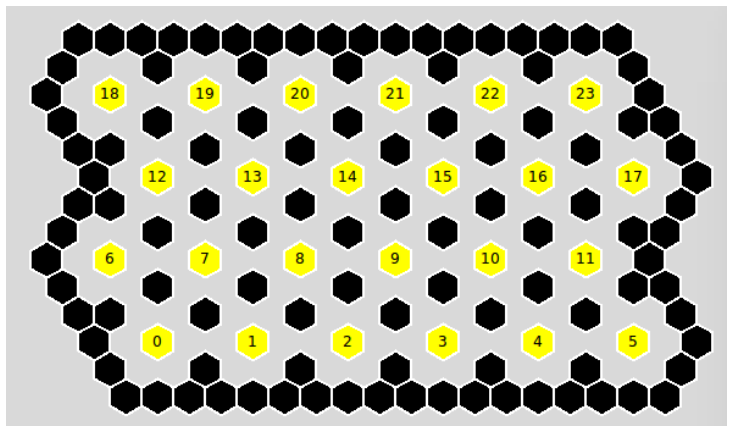


read the original abstract
This is a theoretical and computational strategy exploration of the visually attractive game IQ-Link. Not all games which are visually appealing are worthy of your time as a puzzlist. This analysis gives a would-be addict some idea of what type of game they are falling for.
Editorial analysis
A structured set of objections, weighed in public.
Referee Report
Summary. The manuscript presents a theoretical and computational strategy exploration of the IQ-Link puzzle game. Its central claim is modest and advisory: the exploration provides would-be players with an idea of the type of game they might be engaging with, noting that visual appeal alone does not guarantee a game worthy of a puzzlist's time.
Significance. If the exploration holds, the paper offers an illustrative example of applying strategy analysis to a commercial puzzle game within the recreational mathematics tradition. This aligns with the journal's history-and-overview scope by documenting one instance of game assessment, though the advisory framing limits its scope to guidance rather than new formal results or exhaustive enumeration.
minor comments (2)
- The abstract states the intent of the analysis but provides no outline of the theoretical framework, computational methods, or specific observations used. Adding a sentence summarizing the scope or key observations would improve accessibility without altering the modest claim.
- No equations, tables, or numbered sections are referenced in the provided abstract; if the full manuscript contains such elements, ensure they are clearly labeled so readers can trace how any strategy observations support the advisory conclusion.
Simulated Author's Rebuttal
We thank the referee for their thoughtful summary and positive assessment of the manuscript's scope within the recreational mathematics tradition. The recommendation for minor revision is noted, but the report contains no specific major comments requiring point-by-point response.
Circularity Check
No significant circularity identified
full rationale
The paper is a non-formal theoretical and computational exploration of the IQ-Link game whose central claim is modest and advisory: it simply aims to give a would-be player 'some idea' of the game's nature. No equations, derivations, fitted parameters, uniqueness theorems, or self-citation chains appear in the provided text. The analysis therefore contains no load-bearing steps that reduce by construction to their own inputs, satisfying the default expectation that most papers exhibit no circularity.
Axiom & Free-Parameter Ledger
Reference graph
Works this paper leans on
-
[1]
Elwyn R Berlenkamp, John Conway, and Richard Guy, Winning ways for your mathematical plays: Volume 1 . AK Peters, 2001
work page 2001
-
[2]
Dagstahl Reports, Artifical and computational intelligence in games: integration. Vol. 5, Issue 1, pp 207-242. Editors: Simon Lucas, Michael Mateas, Mike Preuss, Pieter Spronck, and Julian Togelius, January 2015
work page 2015
-
[3]
pp 475-535 in MSRI publications Volume 42, 2002
Aviezre Fraenkel, Bibliography of Combinatorial Games: Updated . pp 475-535 in MSRI publications Volume 42, 2002. More games of no chance , editor Richard Nowakowski
work page 2002
-
[4]
Hearn, Games, puzzles, and computation
Robert A. Hearn, Games, puzzles, and computation . PhD Thesis, Massachusetts Institute of Technology, 1987
work page 1987
-
[5]
Internet Archive. https://web.archive.org/web/2018061023045/http://www.smartgames.eu/en/smartgames/iq-link errata notice published between 2014 and 2018
-
[6]
IEEE Conference on Computational Intelligence and Games, August 2017
Aaron Isaksen, Drew Wallace, Adam Finkelstein, and Andy Nealen, Simulating strategy and dexterity for puzzle games . IEEE Conference on Computational Intelligence and Games, August 2017
work page 2017
-
[7]
https://www.cse.iitk.ac.in/users/hk/cs785/2016172/details/gametheory.pdf, 24 February 2019
Harish Karnick, Basics of game theory 1 . https://www.cse.iitk.ac.in/users/hk/cs785/2016172/details/gametheory.pdf, 24 February 2019
work page 2019
-
[8]
In 2015 IEEE Conference on Computational Intelligence and Games
Marc van Kreveld, Maarten L¨ offler and Paul Muster,Automated Puzzle Difficulty Estimation . In 2015 IEEE Conference on Computational Intelligence and Games
work page 2015
-
[9]
http://www.staff.science.uu.nl/˜loffl001/puzzles/html/puzzlecomplexity.html
Mark van Kreveld, Maarten L¨ offler, Nicky Vendrig, and Paul Muster, Puzzle Complexity . http://www.staff.science.uu.nl/˜loffl001/puzzles/html/puzzlecomplexity.html
-
[10]
PhD Thesis, City University of New York, 2014
Valia Mitsou, The computational complexity of some games and puzzles with theoretical applications . PhD Thesis, City University of New York, 2014
work page 2014
-
[11]
http://norvig.com/sudoku.html, June 2006
Peter Norvig, Solving every Sudoku puzzle . http://norvig.com/sudoku.html, June 2006
work page 2006
-
[12]
E-mail address: dietz@american.edu
Website of IQ-Link manufacturer smartgamesandpuzzles.com, 2019. E-mail address: dietz@american.edu
work page 2019
discussion (0)
Sign in with ORCID, Apple, or X to comment. Anyone can read and Pith papers without signing in.