A Nonstandard Finite Difference Scheme for an SEIQR Epidemiological PDE Model
Pith reviewed 2026-05-21 22:53 UTC · model grok-4.3
The pith
A nonstandard finite difference scheme for the SEIQR reaction-diffusion PDE preserves positivity, boundedness, and stability of the continuous model.
A machine-rendered reading of the paper's core claim, the machinery that carries it, and where it could break.
Core claim
The paper constructs a structure-preserving NSFD scheme for the SEIQR reaction-diffusion system. This discretization maintains the positivity, boundedness, and stability properties of the original continuous model while converging to the true solution, with the local truncation error shown to be consistent with the order of the approximation.
What carries the argument
The nonstandard finite difference discretization, which applies a nonlocal treatment to the reaction terms so that the discrete equations exactly replicate the sign and bound constraints of the continuous SEIQR system.
If this is right
- The discrete solutions remain non-negative and bounded for any time step size, matching the continuous model's behavior.
- The scheme converges to the exact solution of the PDE system as the mesh is refined.
- Numerical simulations produce biologically plausible spatiotemporal patterns without artificial oscillations or instabilities.
- The method extends classical compartmental models by incorporating spatial diffusion while retaining qualitative reliability.
Where Pith is reading between the lines
- Similar NSFD constructions could apply to other reaction-diffusion systems in epidemiology that include additional compartments or nonlinear incidence rates.
- Running the scheme on real geographic data for past outbreaks would test whether the preserved properties translate into better forecasts of spatial spread.
- The approach might combine with adaptive step-size control to handle stiff reaction terms while still guaranteeing positivity.
Load-bearing premise
The reaction terms and diffusion coefficients in the SEIQR system permit a discretization that inherits the continuous model's positivity and boundedness without restrictions on step sizes or parameter values.
What would settle it
A numerical experiment in which the computed solution becomes negative or exceeds the total population upper bound for some choice of positive parameters and step sizes would show that the preservation property fails.
Figures


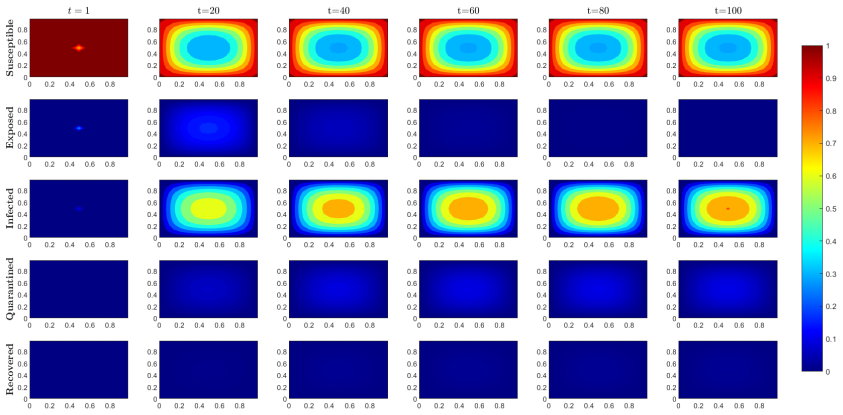
read the original abstract
This paper introduces a nonstandard finite difference (NSFD) approach to a reaction-diffusion SEIQR epidemiological model, which captures the spatiotemporal dynamics of infectious disease transmission. Formulated as a system of semilinear parabolic partial differential equations (PDEs), the model extends classical compartmental models by incorporating spatial diffusion to account for population movement and spatial heterogeneity. The proposed NSFD discretization is designed to preserve the continuous model's essential qualitative features, such as positivity, boundedness, and stability, which are often compromised by standard finite difference methods. We rigorously analyze the model's well-posedness, construct a structure-preserving NSFD scheme for the PDE system, and study its convergence and local truncation error. Numerical simulations validate the theoretical findings and demonstrate the scheme's effectiveness in preserving biologically consistent dynamics.
Editorial analysis
A structured set of objections, weighed in public.
Referee Report
Summary. The manuscript introduces a nonstandard finite difference (NSFD) scheme for a reaction-diffusion SEIQR epidemiological model formulated as a system of semilinear parabolic PDEs. It claims to establish well-posedness of the continuous model, construct an NSFD discretization that preserves positivity, boundedness, and stability, derive convergence results and local truncation error bounds, and validate the approach via numerical simulations demonstrating biologically consistent dynamics.
Significance. If the NSFD scheme truly inherits the continuous model's qualitative properties without step-size or parameter restrictions, the work would offer a meaningful contribution to structure-preserving methods for spatiotemporal epidemiological models, enabling more flexible simulations than standard finite differences. The combination of well-posedness analysis, convergence study, and numerical validation is a positive feature, though the unconditional preservation claim requires verification against standard diffusion discretizations.
major comments (1)
- [Abstract and scheme construction] Abstract and scheme construction (likely §3–4): The central claim that the NSFD scheme preserves positivity, boundedness, and stability without extra restrictions on dt or parameters is load-bearing. Standard explicit central-second-difference treatment of the diffusion terms (common in NSFD PDE constructions) yields a discrete maximum principle only under a CFL restriction dt ≤ C h² / max(D_i). If this condition is tacitly required but unstated, the qualitative-preservation guarantee is conditional rather than unconditional as asserted. Please clarify the precise discretization of the Laplacian, state any step-size conditions in the positivity/boundedness theorem, and confirm whether the scheme is fully explicit.
minor comments (2)
- [Analysis section] Ensure all theorems on preservation properties explicitly list any hidden assumptions on parameters or mesh ratios.
- [Numerical simulations] In the numerical results, include tests with time steps near or above the CFL limit (if applicable) to demonstrate robustness or identify limitations.
Simulated Author's Rebuttal
We thank the referee for the careful and constructive review of our manuscript. The feedback on the preservation properties of the NSFD scheme is particularly valuable, and we address the major comment in detail below. We will revise the manuscript to improve clarity on these points.
read point-by-point responses
-
Referee: [Abstract and scheme construction] Abstract and scheme construction (likely §3–4): The central claim that the NSFD scheme preserves positivity, boundedness, and stability without extra restrictions on dt or parameters is load-bearing. Standard explicit central-second-difference treatment of the diffusion terms (common in NSFD PDE constructions) yields a discrete maximum principle only under a CFL restriction dt ≤ C h² / max(D_i). If this condition is tacitly required but unstated, the qualitative-preservation guarantee is conditional rather than unconditional as asserted. Please clarify the precise discretization of the Laplacian, state any step-size conditions in the positivity/boundedness theorem, and confirm whether the scheme is fully explicit.
Authors: We thank the referee for this important observation. In our discretization, the diffusion (Laplacian) terms are treated with the standard explicit central second-difference approximation, while the nonstandard finite difference approach (following Mickens) is applied to the reaction terms. Consequently, the positivity and boundedness results do require a CFL-type restriction of the form Δt ≤ h² / (2 max(D_i)) to guarantee the discrete maximum principle; this condition was not explicitly stated in the theorems of §§3–4. The scheme is fully explicit. We agree that the presentation should be clarified to avoid implying unconditional preservation independent of step size. We will revise the manuscript to (i) explicitly describe the Laplacian discretization in §3, (ii) state the step-size condition in the statements of the positivity/boundedness theorems, and (iii) update the abstract and introduction to reflect the conditional nature of the guarantees under the stated restriction. revision: yes
Circularity Check
NSFD discretization derived from continuous PDE system with independent convergence analysis
full rationale
The paper constructs the NSFD scheme directly from the semilinear parabolic SEIQR PDE system by applying Mickens-type nonlocal discretizations to reaction terms and standard central differences to diffusion. Positivity, boundedness, and stability are then proven as theorems on the resulting discrete system using comparison principles and maximum principles that follow from the scheme's structure, without reducing to any fitted parameter or self-referential definition. Convergence and truncation error are analyzed separately via consistency and stability estimates. No load-bearing step invokes a self-citation chain or renames an input as a prediction; the qualitative preservation follows from the explicit form of the scheme rather than being assumed by construction. The derivation remains self-contained against the continuous model.
Axiom & Free-Parameter Ledger
axioms (2)
- domain assumption The continuous SEIQR reaction-diffusion system admits a unique positive bounded solution for suitable initial data.
- domain assumption Standard finite difference methods can violate positivity and boundedness for this class of semilinear parabolic systems.
Forward citations
Cited by 1 Pith paper
-
A Koopman Operator Framework for Nonlinear Epidemic Dynamics: Application to an SIRSD Model
Applies Koopman operator with EDMD and tailored dictionary to an SIRSD model to identify dominant modes and predict outbreak peaks from synthetic data across four diseases.
Reference graph
Works this paper leans on
-
[1]
L. J. S. Allen, B. M. Bolker, Y. Lou, A. L. Nevai, Asymptotic profiles of the steady states for an SIS epidemic reaction-diffusion model, Discrete and Continuous Dynamical Systems - B 21 (2008) 1-20
work page 2008
- [2]
-
[3]
L. Bolzoni, R. Della Marca, M. Groppi, On the optimal control of SIR model with Erlang-distributed infectious period: isolation strategies, Journal of Mathematical Biology 83 (2021)
work page 2021
-
[4]
Capasso, Reaction-Diffusion Models for the Spread of a Class of Infectious Diseases
V. Capasso, Reaction-Diffusion Models for the Spread of a Class of Infectious Diseases. In: H. Neunzert (eds), Proceedings of the Second European Symposium on Mathematics in Industry. European Consortium for Mathematics in Industry 3, 1988, Springer, Dordrecht
work page 1988
-
[5]
M. Chapwanya, J. M.-S. Lubuma, R. E. Mickens, Nonstandard finite difference schemes for Michaelis- Menten type reaction-diffusion equations, Numerical Methods for Partial Differential Equations 29(1) (2013) 337-360
work page 2013
-
[6]
B. M. Chen-Charpentier, H. V. Kojouharov, An unconditionally positivity preserving scheme for advec- tion–diffusion reaction equations, Mathematical and Computer Modelling 57(9-10) (2013) 2177-2185
work page 2013
- [7]
- [8]
-
[9]
G. M. R. Costa, M. Lobosco, M. Ehrhardt, R. F. Reis, Mathematical Analysis and a Nonstandard Scheme for a Model of the Immune Response against COVID-19, Mathematical and Computational Modeling of Phenomena Arising in Population Biology and Nonlinear Oscillations, AMS Contemporary Mathematics, 2023
work page 2023
-
[10]
G. N. de Waal, A. R. Appadu, C. J. Pretorius, Some standard and nonstandard finite difference schemes for a reaction–diffusion–chemotaxis model, Open Physics 21(1) (2023) 20220231
work page 2023
-
[11]
O. Diekmann, J. A. P. Heesterbeek, J. A. J. Metz, On the definition and the computation of the basic repro- duction ratio R0 in models for infectious diseases in heterogeneous populations, Journal of Mathematical Biology 28 (1990)
work page 1990
-
[12]
M. Ehrhardt, R. E. Mickens, A nonstandard finite difference scheme for convection-diffusion equations having constant coefficients, Applied Mathematics and Computation 219 (2013) 6591-6604
work page 2013
-
[13]
M. Ehrhardt, J. Gaˇ sper, S. Kilianov´ a, SIR-based Mathematical Modeling of Infectious Diseases with Vac- cination and Waning Immunity, Journal of Computational Science 37 (2019) 101027
work page 2019
-
[14]
R. Feng, J. Garrido, L. Jin, S. H. Loke, L. Zhang, Epidemic Compartmental Models and Their Insurance Applications, in: M. d. C. Boado-Penas, J. Eisenberg, S. S ¸ahin (eds.), Pandemics: Insurance and Social Protection, Springer Actuarial. Springer, Cham, 2022
work page 2022
-
[15]
X. Fu, J. Wang, Dynamic behaviors and non-instantaneous impulsive vaccination of an SAIQR model on complex networks, Applied Mathematics and Computation 465 (2024) 128425
work page 2024
-
[16]
D. J. Gerberry, F. A. Milner, An SEIQR model for childhood diseases, Journal of Mathematical Biology 59 (2008) 535–561
work page 2008
-
[17]
Y. Guo, Z. Liu, L. Wang, R. Tan, Modeling the role of information and optimal control on an SEIR epidemic model with infectivity in latent period, Mathematical Methods in the Applied Sciences 47 (2023) 1044–1064
work page 2023
- [18]
- [19]
-
[20]
O. R. Isik, N. Tuncer, M. Martcheva, A mathematical model for the role of vaccination and treatment in measles transmission in Turkey, Journal of Computational and Applied Mathematics 457 (2025) 116308
work page 2025
-
[21]
W. O. Kermack, A. G. McKendrick, A contribution to the mathematical theory of epidemics, Proceedings of the Royal Society of London - Series A 115 (1927) 700-721
work page 1927
- [22]
-
[23]
Z. Li, T. Zhang, Analysis of a COVID-19 epidemic model with seasonality, Bulletin of Mathematical Biology 84 (2022)
work page 2022
-
[24]
Y. Ma, Y. Cui, M. Wang, Global stability and control strategies of a SIQRS epidemic model with time delay, Mathematical Methods in the Applied Sciences 45 (2022) 8269–8293
work page 2022
-
[25]
M. H. Maamar, M. Ehrhardt, L. Tabharit, A nonstandard finite difference scheme for a time-fractional model of Zika virus transmission, Mathematical Biosciences and Engineering 21(1) (2024) 924-962. 18
work page 2024
-
[26]
Y. Mammeri, A reaction-diffusion system to better comprehend the unlockdown: Application of SEIR- type model with diffusion to the spatial spread of COVID-19 in France, Computational and Mathematical Biophysics 8(1) (2020) 102-113
work page 2020
-
[27]
Martcheva, An Introduction to Mathematical Epidemiology, Springer New York, NY, 2015
M. Martcheva, An Introduction to Mathematical Epidemiology, Springer New York, NY, 2015
work page 2015
-
[28]
R. E. Mickens, Nonstandard Finite Difference Models of Differential Equations, World Scientific, Singapore, 1994
work page 1994
-
[29]
R. E. Mickens, Nonstandard finite difference schemes for reaction-diffusion equation, Numerical Methods for Partial Differential Equation 15 (1999) 201-214
work page 1999
-
[30]
R. E. Mickens, A nonstandard finite difference scheme for the diffusionless Burgers equation with logistic reaction, Mathematics and Computers in Simulation 62(1–2) (2003), 117-124
work page 2003
-
[31]
R. E. Mickens, Calculation of denominator functions for nonstandard finite difference schemes for dif- ferential equations satisfying a positivity condition, Numerical Methods for Partial Differential Equation 23(3)(2007), 672-691
work page 2007
-
[32]
S. A. Pasha, Y. Nawaz, M. S. Arif, On the nonstandard finite difference method for reaction-diffusion models, Chaos, Solitons & Fractals 166 (2023) 112929
work page 2023
-
[33]
Y. Pei, S. Liu, S. Gao, S. Li, C. Li, A delayed SEIQR epidemic model with pulse vaccination and the quarantine measure, Computers & Mathematics with Applications 58 (2009) 135–145
work page 2009
-
[34]
A. Ruiz-Herrera, P. J. Torres, The role of movement patterns in epidemic models on complex networks, Bulletin of Mathematical Biology 83(10) (2021) Article No. 98
work page 2021
-
[35]
M. Taghipour, H. Aminikhah, An Efficient Non-standard Finite Difference Scheme for Solving Distributed Order Time Fractional Reaction–Diffusion Equation, International Journal of Applied and Computational Mathematics 8(2) (2022) 56
work page 2022
-
[36]
P. van den Driessche, J. Watmough, Reproduction numbers and sub-threshold endemic equilibria for compartmental models of disease transmission, Mathematical Biosciences 180 (2002) 29-48
work page 2002
- [37]
-
[38]
C. Yang, J. Wang, Basic reproduction numbers for a class of reaction-diffusion epidemic models, Bulletin of Mathematical Biology 82 (2020)
work page 2020
-
[39]
C. Yang, J. Wang, Computation of the basic reproduction numbers for reaction-diffusion epidemic models, Mathematical Biosciences and Engineering 20 (2023) 15201–15218
work page 2023
- [40]
-
[41]
M. Zhou, H. Xiang, Z. Li, Optimal control strategies for a reaction-diffusion epidemic system, Nonlinear Analysis: Real World Applications 46 (2019) 446-464
work page 2019
-
[42]
C.-C. Zhu, J. Zhu, Spread trend of COVID-19 epidemic outbreak in China: using exponential attractor method in a spatial heterogeneous SEIQR model. Mathematical Biosciences and Engineering 17(4) (2020), 3062-3087
work page 2020
- [43]
- [44]
- [45]
discussion (0)
Sign in with ORCID, Apple, or X to comment. Anyone can read and Pith papers without signing in.