REVIEW 4 minor 1 cited by
Definable coordinate geometries over fields, part 2: applications
T0 review · 0 major / 4 minor · reviewed 2026-08-06 · deepseek-v4-flash
Pith's one-line read The paper proves that relativistic and Minkowski spacetime are definitionally equivalent — they define exactly the same relations — and that Late Classical spacetime contains the definable concepts of Euclidean, relativistic, and…
desk verdict A solid applications paper that computes the concept-set lattice for classical spacetimes via automorphism groups; the dependency on Part 1's bridge theorem is real but standard. read the letter →
The pith
A machine-rendered reading of the paper's core claim, the machinery that carries it, and where it could break.
The reading
What carries the argument
The load-bearing machinery is a pair of results from the companion paper, Theorem 2.0.1 and Corollary 2.0.2, which state that for finitely field-definable coordinate geometries G and G′ over the same ordered field, the concept-set of G is contained in that of G′ exactly when the affine automorphism group of G contains that of G′, and the concept-sets are equal exactly when the affine automorphism groups coincide. Applied here, this bridge turns the problem of comparing definability into the problem of computing affine automorphism groups. The paper computes those groups as similarity transformations: Euclidean similarities for Euclidean geometry, Poincaré similarities for both Rel and Minkowski, Galilean similarities for Galilean spacetime, trivial Galilean similarities for Newtonian spacetime, and trivial Euclidean similarities for Late Classical spacetime. The nontrivial parts of the proof are lemmas showing, for example, that a product and its squared distance function are interdefinable, and that the only affine maps that are simultaneously Euclidean and Poincaré similarities are the trivial Euclidean similarities.
What would settle it
Find a relation on the point set of one of the seven structures, over an ordered field such as the rationals, that is preserved by every affine automorphism of the structure but is not first-order definable from its defining relations; this would refute the bridge theorem and thereby the concept-set inclusions of Theorem 3.2.2. For instance, one could search for a relation in the affine-automorphism-invariant closure of ordered affine geometry that is not definable from the betweenness relation.
Extended reading notes
Core claim
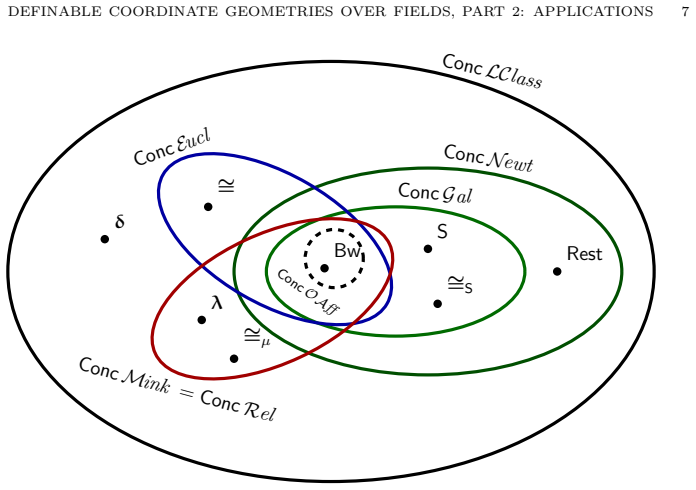
On the paper's own terms, the central discovery is that the concept-sets of the seven standard geometries and spacetimes are partially ordered exactly as shown in the Venn diagram: the concept-sets of Rel and Mink are equal; the concept-set of Gal is contained in that of Newt; the concept-set of OAff is contained in the intersection of those of Eucl, Rel, and Gal; and the union of the concept-sets of Eucl, Rel, and Newt is contained in that of LClass, with a table showing precisely which of the relations S, Rest, lightlike relatedness, Euclidean congruence, congruence on simultaneity, Minkowski congruence, and the derived ternary relation belong to which concept-set. The reason is Theorem 3.3.5: the affine automorphism group of each geometry is a specific similarity group, namely the Euclidean similarities for Eucl, the Poincaré similarities for both Rel and Mink, the Galilean similarities for Gal, the trivial Galilean similarities for Newt, and the trivial Euclidean similarities for LClass. By the bridge result from the companion paper, for finitely field-definable coordinate geometries over the same ordered field, a smaller concept-set corresponds to a larger affine automorphism group, so these five equalities force all the concept-set inclusions. A further theorem shows that adding any missing concept from the list to Eucl, Rel, Gal, or Newt usually produces the full concept-set of LClass, with a handful of exceptions in dimension two.
Load-bearing premise
The whole comparison rests on the bridge theorem from the companion paper — that for these geometries, one concept-set contains another exactly when the affine automorphism group of the containing set is contained in the other — and that theorem is cited rather than proved here.
Editorial extensions
If this is right
- Relativistic and Minkowski spacetime define exactly the same relations, so in this unit-free setting lightlike relatedness and Minkowski congruence are interchangeable starting from betweenness.
- Every relation definable in Euclidean geometry, in relativistic spacetime, or in Newtonian spacetime is also definable in Late Classical spacetime, which is therefore the richest of the seven structures considered.
- None of the relations S, Rest, lightlike relatedness, Euclidean congruence, congruence on simultaneity, Minkowski congruence, or the derived ternary relation can distinguish Rel from Mink; they can, however, distinguish all the other geometries, as Table 1 shows.
- If the dimension is at least three, adjoining a single missing concept from the list to Eucl, Rel, Gal, or Newt collapses the expanded structure to definitional equivalence with LClass.
- In the plane, there is an exceptional equivalence class: the expansion of Rel by Euclidean congruence, of Eucl by Minkowski congruence, and of Eucl by lightlike relatedness are definitionally equivalent to each other but not to LClass.
Reading between the lines
- Editorial inference: the same group-comparison strategy would apply to any other geometry whose affine automorphism group is a known similarity group, so the method in principle extends beyond the seven structures listed here.
- Editorial inference: because the models are unit-free, scaling is an automorphism; physical theories that fix units, as metric approaches do, have smaller automorphism groups and hence more definable relations, which explains the apparent contradiction with metric treatments noted in the paper.
- Editorial inference: the dimension-two exceptional cases suggest that the usual separation of time and space is not definably forced in the plane under these definitions, so low-dimensional versions of the geometry behave differently.
- Editorial inference: the open problems asking whether certain intersections of concept-sets are strictly larger than the concept-set of ordered affine geometry could be approached by computing affine automorphism groups of the corresponding intersection geometries; the paper does not do this.
Editorial analysis
A structured set of objections, weighed in public.
Referee Report
Summary. The paper applies a theorem from the authors' companion paper [MSS25] to compare the definable relation sets ('concept sets') of seven classical coordinate geometries over an ordered field. It defines ordered affine, Euclidean, Relativistic, Minkowski, Galilean, Newtonian, and Late Classical spacetimes in a first-order language with betweenness, proves that their affine automorphism groups coincide with various groups of 'similarities' (Theorem 3.3.5), and then derives a complete Hasse diagram of concept-set inclusions (Theorem 3.2.2) and results about expansions of these geometries (Theorem 3.2.3).
Significance. If correct, the results give a clean and illuminating lattice of concept-sets for historically important geometries, including the definitional equivalence of Rel and Mink and the maximality of LClass. The proofs in Sections 3.4 through 3.6 are detailed, case-by-case, and appear internally sound. The paper also demonstrates a powerful proof strategy for establishing concept-set inclusions without writing explicit definitions. The main results are conditional on the bridge theorem from Part 1, which is cited rather than proved here; for a two-part study this is a legitimate dependency, but it should be acknowledged explicitly rather than obscured by the word 'self-contained'.
minor comments (4)
- [Abstract] The abstract and introduction describe the paper as 'self-contained', but Theorem 2.0.1 and Corollary 2.0.2 are stated without proof and are essential to Theorems 3.2.2 and 3.2.3. The authors should clarify the precise sense in which the paper is self-contained, or remove that claim in favor of an explicit statement of the dependency on [MSS25].
- [§3.6.1] In the proof of Theorem 3.2.2(v), 'techniocal' should be 'technical'.
- [§3.6.2] In the proof of Theorem 3.2.3(iii), the final sentence refers to 'λClass' instead of 'LClass'.
- [§3.5] In the proof of Theorem 3.3.5(iii), the assertion that GalSim is closed under composition is stated without proof; a one-sentence justification would make the argument easier to follow.
Circularity Check
No circularity found; the concept-set inclusions follow from independent affine-automorphism computations plus a cited general bridge theorem.
full rationale
The paper's derivation chain has two separable parts. First, Theorem 3.3.5 computes the affine automorphism groups of Eucl, Rel, Mink, Gal, Newt, and LClass directly from the definitions: Euclidean similarities, Poincaré similarities, Galilean similarities, trivial Galilean similarities, and trivial Euclidean similarities. These proofs are self-contained geometric arguments (with one external citation to Lester for the d > 2 case of AffAut Rel = PoiSim) and do not presuppose any of the concept-set relationships they later derive. Second, Theorem 3.2.2 and Theorem 3.2.3 convert these group equalities and inclusions into concept-set equalities and inclusions using Theorem 2.0.1 and Corollary 2.0.2 from the authors' companion paper [MSS25]. That bridge theorem is indeed load-bearing and is cited rather than reproved here, and despite the abstract's claim that Part 2 is 'self-contained', the paper does depend on Part 1. However, this is a structural dependency, not circularity: the cited theorem is a general statement about finitely field-definable coordinate geometries with stated assumptions that do not include any of the specific conclusions of this paper, and the affine-automorphism computations are not derived from the concept-set inclusions. No parameter is fitted to a subset of data and then renamed as a prediction, no geometry is defined in terms of the concept-set relation being proved, and no uniqueness theorem is imported from the authors to force a choice. The Table 1 entries are verified using explicit automorphisms plus the already-established inclusions, not by assuming the table. Thus the central claims have independent content, and the self-citation is legitimate support rather than a circular premise.
Assumptions & free parameters
assumptions (3)
- domain assumption Theorem 2.0.1 and Corollary 2.0.2 from [MSS25]: for finitely field-definable coordinate geometries over the same ordered field, Conc G ⊆ Conc G' iff AffAut G ⊇ AffAut G' (and equality iff equality).
- standard math The ordered field F has characteristic 0 and embeds the rational numbers.
- domain assumption All the studied structures are finitely field-definable coordinate geometries over F.
Cite this review
Pith. "Pith review of Definable coordinate geometries over fields, part 2: applications." pith.science (2026). https://pith.science/paper/CBJIHPIR
@misc{pith2026250710289,
  author       = {Pith},
  title        = {Pith review of: Definable coordinate geometries over fields, part 2: applications},
  year         = {2026},
  howpublished = {\url{https://pith.science/paper/CBJIHPIR}},
  note         = {Machine review of arXiv:2507.10289}
}
abstract
In Part 1 of this study we showed, for a wide range of geometries, that the relationships between their concept-sets are fully determined by those between their (affine) automorphism groups. In this (self-contained) part, we show how this result can be applied to quickly determine relationships and differences between various geometries and spacetimes, including ordered affine, Euclidean, Galilean, Newtonian, Late Classical, Relativistic and Minkowski spacetimes (we first define these spacetimes and geometries using a Tarskian first-order language centred on the ternary relation $\mathsf{Bw}$ of betweenness). We conclude with a selection of open problems related to the existence of certain intermediate geometries.
Figures

Forward citations
Cited by 1 Pith paper
-
On Andr\'eka's Conjecture that special relativity is the only possible conceptual reduct of classical kinematics
Andr\'eka's conjecture is proven: no intermediate model of spacetime exists strictly between special relativity and late classical kinematics on R^4.
Reference graph
Works this paper leans on
-
[1]
H. Andr \'e ka, J. X. Madar \'a sz, I. N \'e meti, P. N \'e meti, and G. Sz \'e kely, Vienna C ircle and logical analysis of relativity theory , The V ienna C ircle in H ungary ( W iener K reis und U ngarn) (A. M \'a t \'e , M. R \'e dei, and F. Stadler, eds.), Springer Verlag, 2011, pp. 247--268
work page 2011
-
[2]
T. W. Barrett, On the structure of classical mechanics, The British Journal for the Philosophy of Science 66 (2015), no. 4, 801--828
work page 2015
-
[3]
, Spacetime structure, Studies in History and Philosophy of Science Part B: Studies in History and Philosophy of Modern Physics 51 (2015), 37--43
work page 2015
- [4]
-
[5]
T. W. Barrett, J. B. Manchak, and J. O. Weatherall, On automorphism criteria for comparing amounts of mathematical structure, Synthese 201 (2023), no. 6, 191
work page 2023
-
[6]
G. Formica and M. Friend, In the footsteps of H ilbert: The A ndr \'e ka-- N \'e meti group's logical foundations of theories in physics , H ajnal A ndr \'e ka and I stv \'a n N \'e meti on Unity of Science: From Computing to Relativity Theory Through Algebraic Logic (J. Madar \'a sz and G. Sz \'e kely, eds.), Springer International Publishing, Cham, 2021...
work page 2021
-
[7]
H. H. Field, Science without numbers: A defence of nominalism, Princeton University Press, Princeton, NJ, USA, 1980
1980
-
[8]
M. Friend, On the epistemological significance of the H ungarian project , Synthese 192,7 (2015), 2035--2051
work page 2015
Show all 27 references
-
[9]
Henkin, J.D
L. Henkin, J.D. Monk, and A. Tarski, Cylindric algebras part I , North-Holland, 1971
1971
-
[10]
Ketland, Axiomatization of G alilean spacetime , Dialectica 77 (2023), no
J. Ketland, Axiomatization of G alilean spacetime , Dialectica 77 (2023), no. 2, 153--202
2023
-
[11]
Khaled and G
M. Khaled and G. Sz \'e kely, Algebras of concepts and their networks, Progress in Intelligent Decision Science (Cham) (T. Allahviranloo, S. Salahshour, and N. Arica, eds.), Springer International Publishing, 2021, pp. 611--622
2021
-
[12]
1, 300–315
, Conceptual distance and algebras of concepts, The Review of Symbolic Logic 18 (2025), no. 1, 300–315
2025
-
[13]
Khaled, G
M. Khaled, G. Sz \'e kely, K. Lefever, and M. Friend, Distances between formal theories, The Review of Symbolic Logic 13 (2020), no. 3, 633–654
2020
-
[14]
Lefever, Using logical interpretation and definitional equivalence to compare classical kinematics and special relativity theory, Ph.D
K. Lefever, Using logical interpretation and definitional equivalence to compare classical kinematics and special relativity theory, Ph.D. thesis, Vrije Universiteit Brussel, 2017
2017
-
[15]
J. A. Lester, Chapter 16 - distance preserving transformations, Handbook of Incidence Geometry (F. Buekenhout, ed.), North-Holland, Amsterdam, 1995, pp. 921--944
1995
-
[16]
Lefever and G
K. Lefever and G. Sz\'ekely, Comparing classical and relativistic kinematics in first-order-logic, Logique et Analyse 61 (2018), no. 241, 57--117
2018
-
[17]
J. D. Monk, An introduction to cylindric set algebras , Logic Journal of the IGPL 8 (2000), no. 4, 451--496
2000
-
[18]
A. A. Muchnik and A. L. Semenov, Lattice of definability in the order of rational numbers, Mathematical Notes 108 (2020), no. 1, 94--107
2020
-
[19]
Madar \'a sz, M
J. Madar \'a sz, M. Stannett, and G. Sz \'e kely, Finitely definable coordinate geometries over fields, part 1: theory, 2025
2025
-
[20]
North, The ``structure'' of physics, Journal of Philosophy 106 (2009), no
J. North, The ``structure'' of physics, Journal of Philosophy 106 (2009), no. 2, 57--88
2009
-
[21]
Swanson and H
N. Swanson and H. Halvorson, On N orth's ``the structure of physics'' , 2012, manuscript
2012
-
[22]
A. L. Semenov and S. F. Soprunov, Lattice of definability (of reducts) for integers with successor, Izvestiya: Mathematics 85 (2021), 1257--1269
2021
-
[23]
, Automorphisms and definability (of reducts) for upward complete structures, Mathematics 10 (2022), no. 20
2022
-
[24]
, On a lattice of relational spaces (reducts) for the order of integers, 2024, arXiv:2411.18181
2024 arXiv
-
[25]
Semenov, S
A. Semenov, S. Soprunov, and V. Uspensky, The lattice of definability. origins, recent developments, and further directions, Computer Science - Theory and Applications (Cham) (E. A. Hirsch, S. O. Kuznetsov, J.- \'E . Pin, and N. K. Vereshchagin, eds.), Springer International P...
2014
-
[26]
Szczerba and A
L. Szczerba and A. Tarski, Metamathematical discussion of some affine geometries, Fundamenta Mathematicae 104 (1979), no. 3, 155--192 (eng)
1979
-
[27]
Wilhelm, Comparing the structures of mathematical objects, Synthese 199 (2021), no
I. Wilhelm, Comparing the structures of mathematical objects, Synthese 199 (2021), no. 3, 6357--6369
2021
Reviewed August 6, 2026 · model on record in the stance chip above.
Discussion (0). Continue with ORCID to comment.