REVIEW 3 major objections 5 minor 46 references
Resonant inelastic x-ray scattering study of $\alpha$-RuCl$_3$: a progress report
T0 review · 3 major / 5 minor · reviewed 2026-08-14 · deepseek-v4-flash
Pith's one-line read Ru M3-edge RIXS resolves an unsplit spin-orbit exciton in α-RuCl3, confirming its jeff=1/2 nature with λ=154 meV.
desk verdict First M-edge RIXS on a 4d system, with a clean spin-orbit exciton measurement and a soft but probably correct trigonal-field bound. read the letter →
The pith
A machine-rendered reading of the paper's core claim, the machinery that carries it, and where it could break.
The reading
What carries the argument
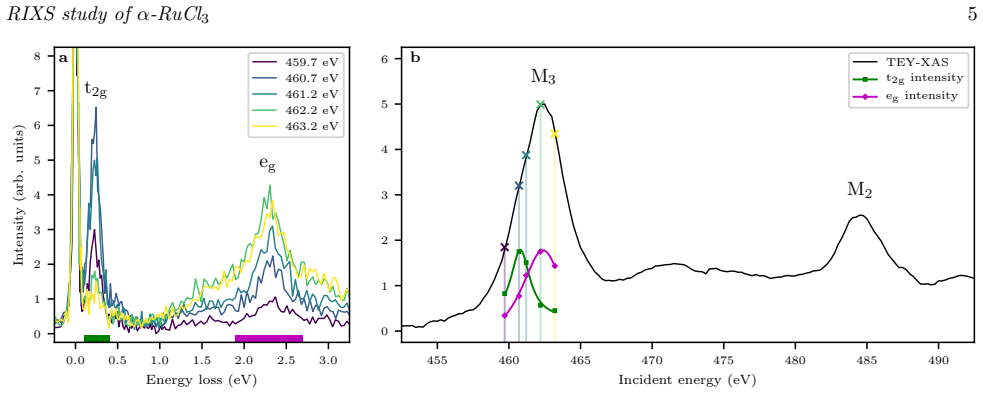
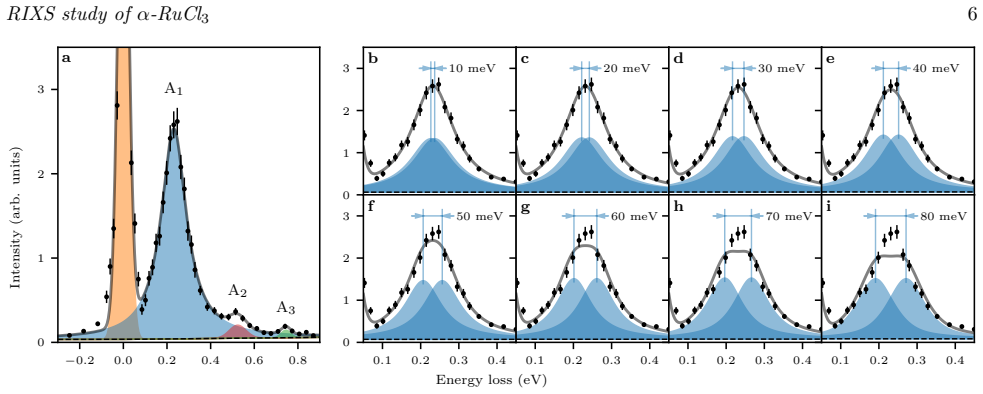
The load-bearing object is the spin-orbit exciton: the dipole-forbidden d-d excitation from the filled $j_{\rm eff}=3/2$ doublet to the half-filled $j_{\rm eff}=1/2$ doublet, whose energy equals $3\lambda/2$ in the ideal octahedral limit. The paper detects it at the Ru $M_3$ edge through the second-order RIXS process $3p_{3/2}\to 4d\to 3p_{3/2}$, whose strong resonant enhancement separates $t_{2g}$ from $e_g$ final states. To bound the trigonal distortion it fits the A1 peak with two pseudo-Voigt components of equal intensity, width, and Lorentzian/Gaussian ratio at fixed separations $|D_{\rm trig}|$ from 10 to 80 meV, and uses the splitting formula $D_{\rm trig}/\lambda=\tfrac14[\sqrt{8+(1+\delta)^2}-3+\delta]$, $\delta=2\Delta/\lambda$, to convert the observed non-splitting into the bound $|\Delta|<65$ meV.
What would settle it
A higher-resolution, polarization-dependent M3-edge RIXS measurement at low temperature that resolves the 231 meV peak into two components separated by 40 meV or more, or an ab initio calculation of the Ru M3 RIXS cross-section showing that the A1 peak's main weight comes from a final state other than the jeff=1/2 doublet, would overturn the central claim.
Extended reading notes
Core claim
The central discovery is that the low-energy dd excitation spectrum of α-RuCl3 contains an unsplit spin-orbit exciton at 231±3 meV, which the paper identifies as the transition from the filled jeff=3/2 doublet to the half-filled jeff=1/2 doublet of the Ru3+ t2g manifold. Since the ideal octahedral splitting of these levels is 3λ/2, this places the spin-orbit coupling constant at λ=154±2 meV. Fitting the A1 peak with pairs of pseudo-Voigt lines separated by fixed Dtrig values leads to an upper bound |Dtrig|<40 meV, which translates, through the relation Dtrig/λ = 1/4[√(8+(1+δ)^2) − 3 + δ] with δ = 2Δ/λ, into |Δ|<65 meV for trigonal elongation and |Δ|<55 meV for compression. The paper concludes that the energy hierarchy |Δ| ≪ λ ≪ 10Dq required for jeff=1/2 physics is satisfied, that the g factor should be nearly isotropic, and that previous assignments of the A1–A3 peaks to SOC-split eg states were incorrect. It also reports, as a methodological first, that M-edge RIXS on a 4d transition-metal system is feasible and already provides sub-30 meV resolution.
Load-bearing premise
The argument stands or falls on whether the 231 meV peak is the transition between the two spin-orbit-split energy levels, rather than a lattice vibration, a charge-transfer excitation, or some other electronic transition; the paper does not compute the scattering probability for that peak, and its fits assume the two split components are equally intense.
Editorial extensions
If this is right
- If the hierarchy holds, α-RuCl3's magnetism is carried by jeff=1/2 pseudospins, so the trigonal distortion does not quench the orbital angular momentum and Kitaev bond-dependent interactions remain viable.
- The g factor should be nearly isotropic (g⊥/g‖ ≈ 1), consistent with L-edge XAS linear dichroism.
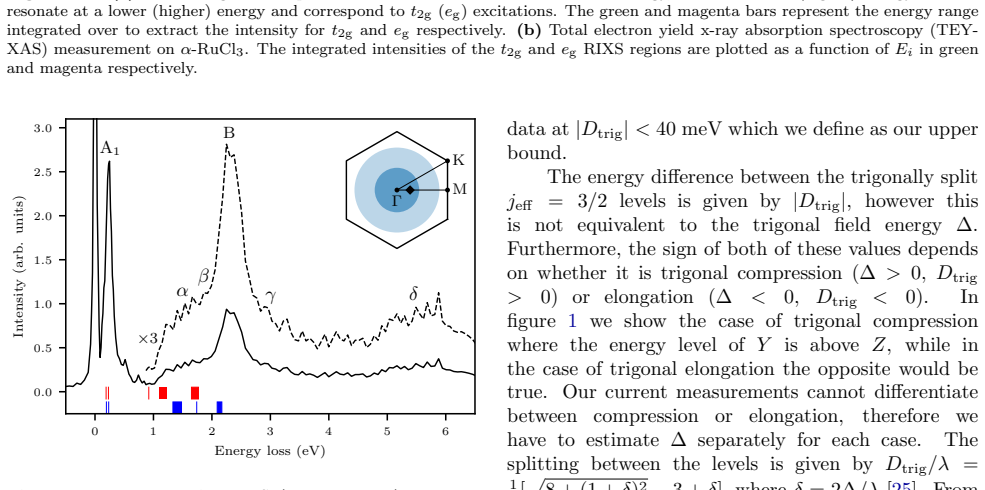
- The earlier optical assignment of A1–A3 as transitions to SOC-split eg states is ruled out; A1 is the spin-orbit exciton and its optical counterpart is phonon-assisted, explaining the 30–40 meV shift.
- M-edge RIXS for 4d systems can achieve sub-30 meV resolution now on existing soft x-ray beamlines, roughly five times better than current L-edge RIXS instruments, so it is the practical route until L-edge instrumentation improves.
- The A2 and A3 peaks are not multiparticle spin-orbit excitons; their near-identical energies in RIXS and optical spectra point to a common origin likely involving Ru 4d–Cl 3p hybridization.
Reading between the lines
- A tractable extension is to compute the M3-edge RIXS matrix elements for the two trigonally split components; if their intensity ratio differs from 1, the |Dtrig|<40 meV bound could tighten or shift, and the sign of Dtrig (compression vs elongation) might be read off from the asymmetry.
- The measured λ=154±2 meV nearly equals the free Ru3+ ion value (155 meV), suggesting the solid hardly screens the spin-orbit interaction; comparing λ across 4d honeycomb halides by the same M-edge method would show whether this is generic.
- Because the M edge restricts momentum transfer to a small part of the Brillouin zone, the technique is best suited to small magnetic Brillouin zones; a testable prediction is that in magnetically ordered 4d compounds the full zone can be mapped, while gapless Majorana signatures in α-RuCl3 remain within reach.
- If later sub-20 meV resolution still shows no splitting, the trigonal field would be pushed well below the MRCI prediction of 39 meV, which would indicate the static distortion is dynamically averaged or the MRCI estimate is too large.
Signed reviews
Editorial analysis
A structured set of objections, weighed in public.
Referee Report
Summary. The paper reports Ru M3-edge resonant inelastic x-ray scattering (RIXS) measurements on α-RuCl3 with 27 meV resolution. The central feature is a low-energy peak A1 at 231±3 meV, which the authors identify as the spin-orbit exciton (transition between jeff=3/2 and jeff=1/2 levels). From the peak position they extract a spin-orbit coupling constant λ=154±2 meV. They further perform two-peak fits with fixed splittings to argue that the trigonal distortion splitting satisfies |Dtrig|<40 meV, which they convert to |Δ|<65 meV, establishing the hierarchy |Δ| < λ ≪ 10Dq required for jeff=1/2 physics. The paper also discusses the general feasibility of M-edge RIXS for 4d systems, comparing it with L-edge RIXS and addressing the elastic line, cross-section, and Brillouin-zone coverage. The manuscript is written as a progress report and includes comparisons with optical spectroscopy, Raman scattering, and MRCI calculations.
Significance. If the central claim holds, the paper provides a direct, high-resolution RIXS measurement of the spin-orbit exciton in α-RuCl3, giving a precise λ value and an upper bound on the trigonal distortion that supports the jeff=1/2 description essential for Kitaev physics. It also demonstrates that M-edge RIXS can achieve better resolution than current L-edge instruments for 4d transition-metal compounds, which is methodologically valuable. The paper's strengths include the clean identification of A1 as a d-d excitation via resonant behavior, the consistency with MRCI calculations and recent Raman data, and the careful comparison with earlier misassignments. However, the quantitative upper bound on the trigonal splitting rests on an equal-intensity fitting assumption that is acknowledged but not validated by a computed RIXS cross-section, and the bound criterion is not statistically quantified. These issues affect the rigor of the main hierarchy claim, though they appear addressable with additional analysis.
major comments (3)
- [Section 3, Fig. 4(b–i); Section 4] The upper bound |Dtrig|<40 meV (hence |Δ|<65 meV) is derived from two-peak fits in which the two trigonally split components are constrained to equal intensity, equal width, and equal pseudo-Voigt ratio. The paper acknowledges in Section 4 that "the use of equal intensity peaks for our fitting in figure 4(b–i) is an approximation, the peaks should actually have different relative intensities depending on the RIXS matrix elements." Because the RIXS cross-section is not computed, it is not demonstrated that allowing unequal intensities would still force a single-peak fit to diverge at |Dtrig|≥40 meV. The equal-intensity constraint is therefore load-bearing for the central conclusion that |Δ|<65 meV, and the bound is not a rigorous upper limit without a cross-section calculation or an unequal-intensity fitting analysis.
- [Section 3, upper-bound criterion] The criterion for the upper bound is qualitative. The text states "We notice the fit diverging from our data at |Dtrig|<40 meV which we define as our upper bound," but no goodness-of-fit metric (e.g., reduced chi-squared, AIC, or a statistical test) is reported. Without a quantitative measure, the reader cannot assess whether the divergence is statistically meaningful or reproduce the bound. A quantitative comparison of the fits at different fixed splittings is needed to support the claimed |Dtrig|<40 meV limit.
- [Section 3, λ extraction] The quoted uncertainty on λ=154±2 meV is the statistical fitting error. Systematic contributions from the choice of background (constant plus linear term only in the energy-loss region), the line-shape model (Lorentzian for A1), and the possible unresolved trigonal splitting are not estimated. Since the abstract presents λ with two-meV precision, a discussion of systematic errors is necessary to justify this precision and to assess whether the identification of A1 with an unsplit 3λ/2 transition is robust.
minor comments (5)
- [Section 2] There are typographical errors: "consant" should be "constant," and "the the" appears in the sentence about the P3112 space group.
- [Section 3] "consisent" should be "consistent" in the sentence about the branching ratio.
- [Section 3] The formula Dtrig/λ = (1/4)[√(8+(1+δ)^2) − 3 + δ] with δ=2Δ/λ is presented without derivation; a citation to Chaloupka and Khaliullin [25] is given, but a brief derivation or an explicit statement of the model assumptions would help the reader understand the conversion from Dtrig to Δ.
- [Section 4] The sentence "The limit |Dtrig| < 40 meV is likely an overestimation" is confusingly worded; the authors presumably mean that the limit is a conservative upper bound, but the phrasing could be interpreted as contradicting the preceding analysis. Clarifying this would improve readability.
- [Figure 3] The inset showing the Brillouin zone uses dark and light blue regions, but the caption does not explicitly label which region corresponds to 2θ=90° and which to 2θ=150°; the text describes them, but a direct label in the figure would aid interpretation.
Circularity Check
No significant circularity: measured RIXS peak energy is converted to λ via the standard j_eff model, and the trigonal-field bound is a fit with explicitly acknowledged modeling approximations, not a construction from its own inputs.
full rationale
The paper reports a Ru M3-edge RIXS measurement and extracts λ = 154 ± 2 meV from the observed A1 peak at 231 ± 3 meV using the standard atomic j_eff relation ΔE = 3λ/2. This is a parameter extraction from newly measured data, not a prediction of a quantity that was already used as input. Similarly, the trigonal-distortion upper bound is obtained by fitting the A1 feature with two fixed-splitting pseudo-Voigt peaks and determining when the fit visibly diverges from the data; although the equal-intensity constraint is an approximation explicitly acknowledged in Section 4, that is a modeling caveat and a correctness risk, not a circular reduction. The assignment of A1 as the j_eff = 3/2 → 1/2 spin-orbit exciton is supported by its resonant enhancement, agreement with MRCI calculations, and consistency with independent Raman and optical work; it is not derived from the λ value that it is later used to extract. Citations to the authors' prior work concern sample preparation, crystal characterization, and earlier optical/XAS assignments, and they are background material rather than load-bearing premises for the central RIXS conclusion. No equation in the paper equates the extracted parameters to the fitted inputs by construction, and no central claim depends on an unverified self-citation chain. The identified limitations—especially the untested equal-intensity fitting assumption—are legitimate scientific caveats, but they do not constitute circularity.
Assumptions & free parameters
free parameters (2)
- A1 spin-orbit exciton energy E_A1 =
231 ± 3 meV
- Upper bound threshold for |Dtrig| =
40 meV (by fit divergence)
assumptions (4)
- standard math The energy difference between jeff=3/2 and jeff=1/2 states in a t2g manifold is 3λ/2.
- domain assumption The trigonal distortion splitting of the jeff=3/2 doublets is given by Dtrig/λ = [√(8+(1+δ)^2) - 3 + δ]/4 with δ=2Δ/λ, from Chaloupka and Khaliullin (Ref [25]).
- domain assumption The A1 RIXS feature is the spin-orbit exciton, not a phonon or charge-transfer excitation.
- domain assumption The measured RIXS energy loss is not significantly shifted by the 3p core-hole potential or by resonant effects; the peak position equals the bare d-d excitation energy.
Cite this review
Pith. "Pith review of Resonant inelastic x-ray scattering study of $\alpha$-RuCl$_3$: a progress report." pith.science (2026). https://pith.science/paper/CBTM7Q7M
@misc{pith2026190801190,
  author       = {Pith},
  title        = {Pith review of: Resonant inelastic x-ray scattering study of $\alpha$-RuCl$_3$: a progress report},
  year         = {2026},
  howpublished = {\url{https://pith.science/paper/CBTM7Q7M}},
  note         = {Machine review of arXiv:1908.01190}
}
abstract
Ru M$_3$-edge resonant inelastic x-ray scattering (RIXS) measurements of RuCl$_3$ with 27 meV resolution reveals a spin-orbit exciton without noticeable splitting. We extract values for the spin-orbit coupling constant ($\lambda=154\pm2$ meV) and trigonal distortion field energy ($\left|\Delta\right|<65$ meV) which support the $j_{\rm eff}=1/2$ nature of RuCl$_3$. We demonstrate the feasibility of M-edge RIXS for $4d$ systems, which allows ultra high-resolution RIXS of $4d$ systems until instrumentation for L-edge RIXS improves.
Figures

Figures from the paper (1 more)
Reference graph
Works this paper leans on
-
[1]
Kitaev A 2006 Annals of Physics 321 2 – 111 ISSN 0003-4916 january Special Issue
work page 2006
-
[2]
Trebst S 2017 arXiv preprint arXiv:1701.07056
arXiv 2017
-
[3]
Winter S M, Tsirlin A A, Daghofer M, van den Brink J, Singh Y, Gegenwart P and Valenti R 2017 Journal of Physics - Condensed Matter 29 ISSN 0953-8984
work page 2017
-
[4]
Hermanns M, Kimchi I and Knolle J 2018 Annual Review of Condensed Matter Physics 9 17–33
work page 2018
-
[5]
Jackeli G and Khaliullin G 2009 Phys. Rev. Lett. 102(1) 017205
work page 2009
-
[6]
Chaloupka J, Jackeli G and Khaliullin G 2010 Phys. Rev. Lett. 105(2) 027204
work page 2010
-
[7]
Singh Y and Gegenwart P 2010 Phys. Rev. B 82 064412
work page 2010
-
[8]
Singh Y, Manni S, Reuther J, Berlijn T, Thomale R, Ku W, Trebst S and Gegenwart P 2012 Phys. Rev. Lett. 108(12) 127203
work page 2012
Show all 46 references
-
[9]
Modic K A, Smidt T E, Kimchi I, Breznay N P, Biffin A, Choi S, Johnson R D, Coldea R, Watkins-Curry P, McCandless G T, Chan J Y, Gandara F, Islam Z, Vishwanath A, Shekhter A, McDonald R D and Analytis J G 2014 Nature Communications 5 4203
2014
-
[10]
Takayama T, Kato A, Dinnebier R, Nuss J, Kono H, Veiga L S I, Fabbris G, Haskel D and Takagi H 2015 Phys. Rev. Lett. 114(7) 077202
2015
-
[11]
Takagi H, Takayama T, Jackeli G, Khaliullin G and Nagler S E 2019 Nature Reviews Physics 1 264–280
2019
-
[12]
Plumb K W, Clancy J P, Sandilands L J, Shankar V V, Hu Y F, Burch K S, Kee H Y and Kim Y J 2014 Phys. Rev. B 90(4) 041112
2014
-
[13]
Banerjee A, Yan J, Knolle J, Bridges C A, Stone M B, Lumsden M D, Mandrus D G, Tennant D A, Moessner R and Nagler S E 2017 Science 356 1055–1059 ISSN 0036-8075
2017
-
[14]
Do S H, Park S Y, Yoshitake J, Nasu J, Motome Y, Kwon Y S, Adroja D T, Voneshen D J, Kim K, Jang T H, Park J H, Choi K Y and Ji S 2017 Nat. Phys. 13 1079–1084
2017
-
[15]
Sandilands L J, Tian Y, Plumb K W, Kim Y J and Burch K S 2015 Phys. Rev. Lett. 114(14) 147201
2015
-
[16]
Kasahara Y, Ohnishi T, Mizukami Y, Tanaka O, Ma S, Sugii K, Kurita N, Tanaka H, Nasu J, Motome Y, Shibauchi T and Matsuda Y 2018 Nature 559 227–231 ISSN 1476-4687
2018
-
[17]
Stroganov E V and Ovchinnikov K V 1957 Ser. Fiz. i Khim. 12 152
1957
-
[18]
Banerjee A, Bridges C A, Yan J Q, Aczel A A, Li L, Stone M B, Granroth G E, Lumsden M D, Yiu Y, Knolle J, Bhattacharjee S, Kovrizhin D L, Moessner R, Tennant D A, Mandrus D G and Nagler S E 2016 Nature Materials 15 733–740
2016
-
[19]
Cao H B, Banerjee A, Yan J Q, Bridges C A, Lumsden M D, Mandrus D G, Tennant D A, Chakoumakos B C and Nagler S E 2016Phys. Rev. B 93(13) 134423
-
[20]
Gretarsson H, Clancy J P, Liu X, Hill J P, Bozin E, Singh Y, Manni S, Gegenwart P, Kim J, Said A H, Casa D, Gog T, Upton M H, Kim H S, Yu J, Katukuri V M, Hozoi L, van den Brink J and Kim Y J 2013 Phys. Rev. Lett. 110(7) 076402
2013
-
[21]
Agrestini S, Kuo C Y, Ko K T, Hu Z, Kasinathan D, Vasili H B, Herrero-Martin J, Valvidares S M, Pellegrin E, Jang L Y, Henschel A, Schmidt M, Tanaka A and Tjeng L H 2017 Phys. Rev. B 96(16) 161107
2017
-
[22]
Sears J A, Songvilay M, Plumb K W, Clancy J P, Qiu Y, Zhao Y, Parshall D and Kim Y J 2015 Phys. Rev. B 91(14) 144420
2015
-
[23]
Dvorak J, Jarrige I, Bisogni V, Coburn S and Leonhardt W 2016 Review of Scientific Instruments 87 115109
2016
-
[24]
Jarrige I, Bisogni V, Zhu Y, Leonhardt W and Dvorak J 2018 Synchrotron Radiation News 31 7–13
2018
-
[25]
Chaloupka J and Khaliullin G 2016 Phys. Rev. B 94(6) 064435
2016
-
[26]
Sandilands L J, Tian Y, Reijnders A A, Kim H S, Plumb K W, Kim Y J, Kee H Y and Burch K S 2016 Phys. Rev. B 93(7) 075144
2016
-
[27]
Yadav R, Bogdanov N A, Katukuri V M, Nishimoto S, Van Den Brink J and Hozoi L 2016 Scientific reports 6 37925
2016
-
[28]
Johnson R D, Williams S C, Haghighirad A A, Singleton J, Zapf V, Manuel P, Mazin I I, Li Y, Jeschke H O, Valent´ ı R and Coldea R 2015Phys. Rev. B 92(23) 235119
-
[29]
thesis University of Toronto
Sears J A 2017 Neutron and X-ray Diffraction Studies of Structure and Magnetism in α-RuCl3 Ph.D. thesis University of Toronto
2017
-
[30]
Kim J, Casa D, Upton M H, Gog T, Kim Y J, Mitchell J F, van Veenendaal M, Daghofer M, van den Brink J, Khaliullin G and Kim B J 2012 Phys. Rev. Lett. 108(17) 177003
2012
-
[31]
Kim J, Daghofer M, Said A H, Gog T, van den Brink J, Khaliullin G and Kim B J 2014 Nature Communications 5 4453
2014
-
[32]
thesis Universit¨ at zu K¨ oln URL https://kups.ub.uni-koeln.de/9187/
Borgwardt N 2019 Optics on materials with strong spin-orbit coupling: topological insulators Bi2- xSbxTe3-ySey and the j=1/2 compounds Na2IrO3 REFERENCES 9 and alpha-RuCl3 Ph.D. thesis Universit¨ at zu K¨ oln URL https://kups.ub.uni-koeln.de/9187/
2019
-
[33]
Plotnikova E M, Daghofer M, van den Brink J and Wohlfeld K 2016 Phys. Rev. Lett. 116(10) 106401
2016
-
[34]
Porterfield W 2013 Inorganic Chemistry (Elsevier Science) ISBN 9780323138949
2013
-
[35]
Reschke S, Mayr F, Wang Z, Do S H, Choi K Y and Loidl A 2017 Phys. Rev. B 96(16) 165120
2017
-
[36]
Kuiper P, Guo J H, S˚ athe C, Duda L C, Nordgren J, Pothuizen J J M, de Groot F M F and Sawatzky G A 1998 Phys. Rev. Lett. 80(23) 5204–5207
1998
-
[37]
Lai C H, Fung H S, Wu W B, Huang H Y, Fu H W, Lin S W, Huang S W, Chiu C C, Wang D J, Huang L J, Tseng T C, Chung S C, Chen C T and Huang D J 2014 Journal of Synchrotron Radiation 21 325–332
2014
-
[38]
Brookes N, Yakhou-Harris F, Kummer K, Fondac- aro A, Cezar J, Betto D, Velez-Fort E, Amorese A, Ghiringhelli G, Braicovich L, Barrett R, Berruyer G, Cianciosi F, Eybert L, Marion P, van der Lin- den P and Zhang L 2018 Nuclear Instruments and Methods in Physics Research Section...
2018
-
[39]
Diamond light source: I21 beamline homepage https://www.diamond.ac.uk/Instruments/ Magnetic-Materials/I21.html
-
[40]
Max iv: Veritas beamline homepage https: //www.maxiv.lu.se/accelerators-beamlines/ beamlines/veritas/
-
[41]
Wray L A, Huang S W, Jarrige I, Ikeuchi K, Ishii K, Li J, Qiu Z Q, Hussain Z and Chuang Y D 2015 Frontiers in Physics 3 32 ISSN 2296-424X
2015
-
[42]
Bambynek W, Crasemann B, Fink R W, Freund H U, Mark H, Swift C D, Price R E and Rao P V 1972 Rev. Mod. Phys. 44(4) 716–813
1972
-
[43]
Hal´ asz G B, Perkins N B and van den Brink J 2016 Phys. Rev. Lett. 117(12) 127203
2016
-
[44]
Ament L J P, van Veenendaal M, Devereaux T P, Hill J P and van den Brink J 2011Rev. Mod. Phys. 83(2) 705–767
-
[45]
Suzuki H, Gretarsson H, Ishikawa H, Ueda K, Yang Z, Liu H, Kim H, Kukusta D, Yaresko A, Minola M, Sears J A, Francoual S, Wille H C, Nuss J, Takagi H, Kim B J, Khaliullin G, Yavas H and Keimer B 2019 Nature Materials 18 563– 567 ISSN 1476-4660
2019
-
[46]
Gretarsson H, Suzuki H, Kim H, Ueda K, Krautloher M, Kim B J, Yava¸ s H, Khaliullin G and Keimer B 2019 Phys. Rev. B 100(4) 045123
2019
Reviewed August 14, 2026 · model on record in the stance chip above.
Discussion (0). Continue with ORCID to comment.