REVIEW 4 major objections 8 minor 33 references
Unveiling TCP BBR Dominance in Starlink Internet: Experimental Insights and Analysis
T0 review · 4 major / 8 minor · reviewed 2026-07-09 · glm-5.2
Pith's one-line read BBR-v3 Wins on Balance, Not Aggression, Over Starlink
desk verdict First comprehensive real-world BBR-v3 evaluation over operational Starlink, but 'global' claims rest on a single terminal in Melbourne read the letter →
The pith
A machine-rendered reading of the paper's core claim, the machinery that carries it, and where it could break.
The reading
What carries the argument
The paper builds three coupled analytical tools: (1) an end-to-end packet-drop probability model that multiplies failure probabilities across the Starlink user link, inter-satellite laser links, and feeder link, incorporating atmospheric attenuation, handover drops, and capacity limitations; (2) a fluid model of BBR-v3's inflight dynamics that tracks phase transitions between probing, cruising, and draining states using indicator variables triggered when inflight exceeds 5/4 of the estimated bandwidth-delay product or when packet-drop probability exceeds 2%; and (3) an M/G/1 queuing approximation that derives arrival rates from observed service rates and queue-occupancy indicators, showing B
What would settle it
If a second Starlink terminal at a different latitude or with different gateway routing showed BBR-v3 falling below the fair-share line or incurring retransmission penalties comparable to BBR-v1 under concurrent contention, the balanced-trade-off claim would weaken. Similarly, if a Starlink-specific adaptive-gain controller built on the paper's fluid model failed to outperform default BBR-v3 parameters in trace-driven validation, the argument for the model's predictive utility would be undermined.
Extended reading notes
Core claim
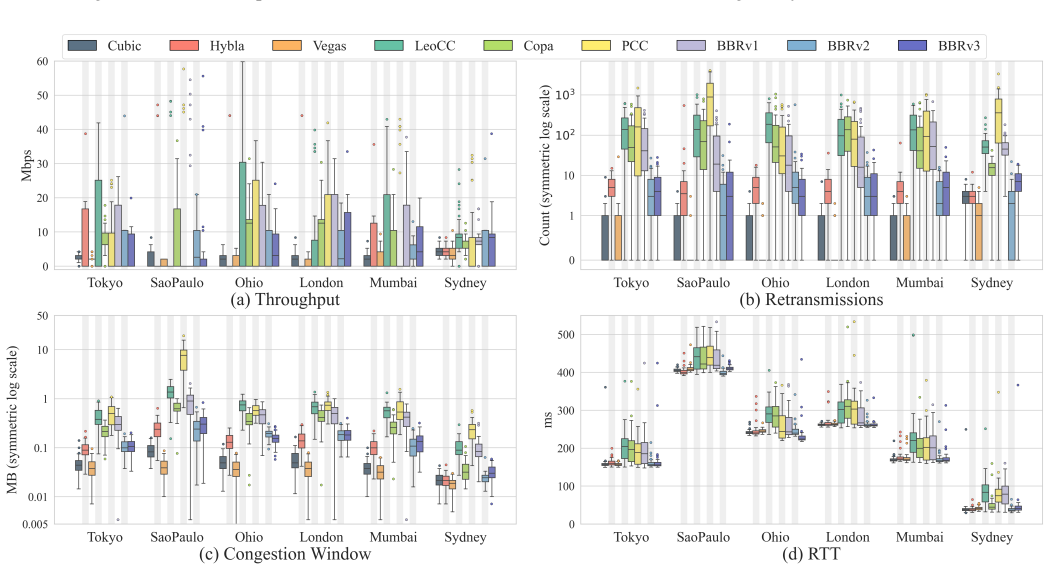
BBR-v3's advantage over Starlink is a balanced trade-off between throughput, fairness, loss, and delay, not aggressive bandwidth capture. When nine congestion controllers compete simultaneously over the same Starlink path, BBR-v3 operates near the fair-share line with moderate RTT inflation and substantially lower retransmissions per gigabyte than LeoCC, PCC, and BBR-v1, which capture more bandwidth but at a higher loss cost. In dedicated single-flow tests, BBR-v3 achieves consistently high median throughput across all six geographic paths while maintaining a more controlled congestion-window profile than its predecessors.
Load-bearing premise
All measurements originate from a single Starlink user terminal in Melbourne, Australia. The six-city testbed varies the far endpoint in the cloud, not the satellite terminal itself, so the global claims about BBR-v3 behavior depend on that one terminal being representative of Starlink performance worldwide, even though satellite visibility, gateway routing, and atmospheric conditions vary significantly by latitude and region.
Editorial extensions
If this is right
- Satellite internet providers could adopt BBR-v3 as a default congestion controller for user terminals, reducing retransmission overhead and latency without sacrificing throughput, provided the default parameters are tuned for non-stationary satellite links.
- The fluid model and link-failure probability framework could serve as a design template for new satellite-specific congestion controllers that explicitly account for handover timing, ISL routing, and ACM-driven capacity variation.
- Network operators running mixed CCA traffic over shared Starlink paths can use the fairness benchmarks to predict which algorithms will starve under contention and which will coexist, informing traffic engineering decisions for enterprise or government satellite uplinks.
- The finding that fixed BBR-v3 pacing gains underutilize or over-aggress in Starlink's variable capacity suggests adaptive gain control tied to RTT variance or handover events as a concrete next step for transport-layer optimization.
Reading between the lines
- If the single-terminal limitation were addressed by deploying matching testbeds at different latitudes, the fairness and queuing results might shift significantly in regions with different satellite visibility geometry, gateway density, or weather patterns, potentially weakening or strengthening the BBR-v3 balance claim depending on local conditions.
- The observation that BBR-v3's 2% loss tolerance prevents catastrophic rate collapse suggests it could also perform well over other non-stationary wireless links beyond LEO satellite, such as high-mobility 5G mmWave or airborne mesh networks, though this is untested here.
- The staggered-flow experiment showing that earlier BBR-v3 flows retain a measurable throughput advantage over later joiners implies that flow-arrival ordering matters for fairness in satellite networks, which could affect applications like multipath TCP or content-distribution prefetching that initiate staggered connections.
Signed reviews
Editorial analysis
A structured set of objections, weighed in public.
Referee Report
Summary. This paper presents an experimental evaluation of Google's BBR-v3 congestion control algorithm over SpaceX's Starlink LEO satellite network. The authors deploy a testbed consisting of a single Starlink terminal in Melbourne, Australia, and six AWS EC2 endpoints across five continents. They benchmark BBR-v3 against eight other CCAs (Cubic, Hybla, Vegas, LeoCC, Copa, PCC, BBR-v1, BBR-v2) under dedicated and concurrent flow conditions. The central finding is that BBR-v3's advantage over Starlink is not aggressive bandwidth capture, but a more balanced trade-off between fairness, loss, and delay. The paper also presents a fluid model of BBR-v3, an M/G/1 queuing analysis, an end-to-end link failure probability model, and a fairness evaluation.
Significance. The paper addresses a timely and practically important problem: the interaction of modern model-based congestion control (BBR-v3) with the highly dynamic environment of LEO satellite networks (Starlink). The systematic comparison against eight CCAs under both dedicated and concurrent conditions provides useful empirical data. The development of a fluid model and queuing analysis to explain the experimental observations adds analytical depth. The finding that BBR-v3 offers a balanced trade-off rather than sheer dominance is a nuanced and valuable insight for the networking community. The inclusion of a sensitivity analysis (Appendix C) exploring Starlink-specific parameter tuning is also a strength.
major comments (4)
- The title, abstract, and introduction claim a 'global assessment' based on a 'six-city testbed across five continents.' However, §III.A reveals that all measurements originate from a single Starlink user terminal (UTA-232) located in Melbourne, Australia. The six AWS EC2 instances serve as remote endpoints, varying the Internet path but not the Starlink access link. Since Starlink's capacity, satellite visibility, gateway routing, and atmospheric conditions vary significantly by geographic location and latitude, the 'global' framing is not supported by the experimental design. The central claim that BBR-v3 provides a balanced trade-off 'over the Starlink Internet' is drawn entirely from one terminal's perspective. The authors should explicitly acknowledge this limitation, reframe the 'global' claims to accurately reflect path diversity from a single terminal, and discuss how a single v6.
- The fluid model presented in §IV.A (Eq. 12) is validated against the same Sydney downlink trace (Fig. 11) that was used to derive its parameters (measured delivery rate and RTT). This constitutes a circular validation. The model's ability to 'reproduce' the transitions in the Sydney trace is expected since it was calibrated on that data. To demonstrate predictive power, the model should be validated against an independent trace (e.g., a different city or a different time period) that was not used in parameterization. Without such out-of-sample validation, the model's generalizability to other Starlink paths or conditions remains unproven.
- The M/G/1 queuing analysis in §IV.C relies on an approximation for the arrival rate (Eq. 15): λ_i = μ_i * X̄_i, where X̄_i is the queue occupancy fraction. This assumes that arrivals occur at the service rate during busy periods. This is a strong assumption that may not hold for TCP traffic, which is bursty and self-clocking. The authors should justify this assumption more rigorously or discuss its potential impact on the queue size estimates. The saturation of the queue at approximately 100 packets (Fig. 13) emerges 'implicitly' from the M/G/1 formulation through the bounded utilization constraint (ρ_max = 0.995), which is an imposed parameter rather than an emergent property of the system. The authors should clarify the sensitivity of the queue size estimates to the choice of ρ_max.
- The end-to-end link failure probability model (Eq. 2) combines several impairment terms (p_cap, p_at, p_ho, p_isl). However, the model is not empirically validated against measured packet loss rates in the paper. The authors state that the model 'encapsulates' these factors, but they do not demonstrate that the model's predictions match the observed retransmission rates or throughput drops in the experimental data. The connection between the analytical model (Eq. 2) and the experimental observations (e.g., the retransmission bursts in Fig. 12) is stated qualitatively but not quantitatively. The authors should either validate the model against measured loss rates or explicitly state that it is a conceptual framework for interpretation rather than a predictive tool.
minor comments (8)
- The paper uses the term 'dominance' in the title, but the results and conclusion explicitly state that BBR-v3's advantage is 'not aggressive bandwidth capture' and that it does not 'consistently dominate.' The title should be revised to better reflect the nuanced findings, perhaps replacing 'Dominance' with 'Performance' or 'Behavior'.
- In §III.A, the authors state that the default free-tier settings were used for AWS EC2 instances. Free-tier instances often have network performance limitations. The authors should specify the instance type used and confirm that the AWS network was not a bottleneck. Appendix B (Fig. 23) partially addresses this, but the main text should clarify this point.
- The paper mentions '10,408 active Starlink satellites' and '2.7 million subscribers' as of May 2026. Given the rapid evolution of the Starlink constellation, the authors should ensure these figures are up-to-date at the time of publication and cite the source clearly.
- In §IV.A, Eq. (3) defines the time interval between ProbeBW events. The notation '2 + i/N' is unclear. Is this 2 seconds plus i/N seconds? The authors should clarify the units and meaning of this term.
- Figures 5-8 are dense and difficult to read. The y-axis scales vary across subplots, making comparisons challenging. Consider using consistent scales where appropriate or adding clearer labels to highlight key differences.
- The paper uses both 'BBR-v3' and 'BBRv3' (e.g., in §IV.A). The notation should be consistent throughout.
- In §IV.D, the α=0 throughput-maximization share is defined, but the meaning of α=0 is not explained. The authors should briefly clarify what α=0 represents in this context.
- The paper would benefit from a brief discussion of the potential impact of Starlink's network evolution (e.g., the introduction of V2-DTC satellites and laser ISLs) on the generalizability of the results.
Circularity Check
No significant circularity found; fluid model validation reuses calibration traces but model has independent structural content
full rationale
The paper's derivation chain does not exhibit circularity in the strict sense. The BBR-v3 fluid model (§IV.A) encodes the protocol's known state machine (ProbeBW states, pacing rules, inflight bounds) and is validated against Sydney traces that also supply path parameters — a methodological weakness (no held-out validation data) but not circularity, since the model's predicted inflight dynamics are not equal to its inputs by construction. The link failure probability model (Eq. 2) is built from ITU recommendations and Poisson assumptions, not from the paper's own measurements. The M/G/1 queuing analysis uses standard formulas with empirically estimated parameters. The sensitivity analysis (Appendix C) is explicitly a parameter sweep, not a prediction. No load-bearing self-citations were found. The single-terminal limitation is an external validity concern, not a circularity issue. Score 1 reflects the minor reuse of calibration traces for model validation without independent confirmation, which is a methodological gap but does not reduce the model's output to its inputs by definition.
Assumptions & free parameters
free parameters (5)
- λ (relaxation rate) =
not specified numerically
- β (queue draining margin) =
0.15
- ρ_max (utilization bound) =
0.995
- c²s (squared coefficient of variation) =
1
- σ(t) (heaviside step function) =
N/A
assumptions (5)
- domain assumption BBR-v3 ProbeBW state machine and pacing rules as specified in IETF draft [5]
- domain assumption Starlink link failures are independent across legs (user, ISL, feeder, gateway)
- domain assumption ISL failure and recovery are Poisson processes
- ad hoc to paper Packet arrivals during busy periods occur at service rate
- domain assumption AWS EC2 instances provide consistent network connections
Cite this review
Pith. "Pith review of Unveiling TCP BBR Dominance in Starlink Internet: Experimental Insights and Analysis." pith.science (2026). https://pith.science/paper/CBWB2XC5
@misc{pith2026260707133,
  author       = {Pith},
  title        = {Pith review of: Unveiling TCP BBR Dominance in Starlink Internet: Experimental Insights and Analysis},
  year         = {2026},
  howpublished = {\url{https://pith.science/paper/CBWB2XC5}},
  note         = {Machine review of arXiv:2607.07133}
}
read the original abstract
This experimental study delivers a global assessment of Google's Bottleneck Bandwidth and Round-trip propagation time-version 3 (BBR-v3) Congestion Control Algorithm (CCA) over SpaceX's Starlink network. Leveraging a strategically deployed six-city testbed across five continents, we systematically benchmark BBR-v3 against eight CCAs: Cubic, Hybla, Vegas, LeoCC, Copa, PCC, BBR-v1, and BBR-v2 under both dedicated and concurrent conditions. Our results demonstrate that BBR-v3's advantage is not aggressive bandwidth capture, but a more balanced fairness, loss, and delay trade-off over the Starlink Internet. We develop pragmatic mathematical models that capture Starlink's complex network dynamics and characterize BBR-v3 behavior to better explain the experimental observations. Our extensive evaluation of queue buildup and fairness further demonstrates BBR-v3's capability to maximize throughput in high-latency, variable satellite environments, while maintaining a balance between aggressiveness and fairness. The findings establish BBR-v3 as a compelling CCA for Low Earth Orbit (LEO) satellite networks and provide a principled analytical foundation for next generation satellite Internet transport design.
Figures


Figures from the paper (19 more)




Reference graph
Works this paper leans on
-
[1]
S. Starlink, “Starlink Updates,” May 2026. [Online]. Available: https://www.starlink.com
work page 2026
-
[2]
Satellite Map, “Find starlink,” https://satellitemap.space/constellation/ starlink, 2026, accessed: May 2026
work page 2026
-
[3]
Model-based insights on the performance, fairness, and stability of bbr,
S. Scherrer, M. Legner, A. Perrig, and S. Schmid, “Model-based insights on the performance, fairness, and stability of bbr,” inProceedings of the 22nd ACM Internet Measurement Conference, 2022, pp. 519–537
work page 2022
-
[4]
Bbr congestion control algorithms: Evolution, challenges and future directions,
A. Abrol, P. Murali Mohan, T. Truong-Huu, and M. Gurusamy, “Bbr congestion control algorithms: Evolution, challenges and future directions,”ACM Comput. Surv., vol. 58, no. 9, Feb. 2026. [Online]. Available: https://doi-org.ezproxy-f.deakin.edu.au/10.1145/3793537
-
[5]
N. Cardwell, I. Swett, and J. Beshay, “Bbr congestion control,” IETF Congestion Control Working Group (CCWG), Internet-Draft draft-ietf-ccwg-bbr-03, Oct 2024, expires 19 April 2025. [Online]. Available: https://datatracker.ietf.org/doc/html/draft-ietf-ccwg-bbr-03
work page 2024
-
[6]
G. Barbosa, S. Theeranantachai, B. Zhang, and L. Zhang, “A comparative evaluation of tcp congestion control schemes over low-earth-orbit (leo) satellite networks,” inProceedings of the 18th Asian Internet Engineering Conference, 2023, pp. 105–112
work page 2023
-
[7]
Comparison of tcp congestion control performance over a satellite network,
S. Claypool, J. Chung, and M. Claypool, “Comparison of tcp congestion control performance over a satellite network,” inInternational Conference on Passive and Active Network Measurement. Springer, 2021, pp. 499– 512
work page 2021
-
[8]
Mobility-aware congestion control for multipath quic in integrated terrestrial satellite networks,
W. Yang, L. Cai, S. Shu, and J. Pan, “Mobility-aware congestion control for multipath quic in integrated terrestrial satellite networks,”IEEE Transactions on Mobile Computing, 2024
work page 2024
Show all 33 references
-
[9]
A multifaceted look at starlink performance,
N. Mohanet al., “A multifaceted look at starlink performance,” in Proceedings of the ACM Web Conference 2024, 2024, pp. 2723–2734
2024
-
[10]
A global perspective on the past, present, and future of video streaming over starlink,
L. Izhikevich, R. Enghardt, T.-Y . Huang, and R. Teixeira, “A global perspective on the past, present, and future of video streaming over starlink,”Proceedings of the ACM on Measurement and Analysis of Computing Systems, vol. 8, no. 3, pp. 1–22, 2024
2024
-
[11]
CUBIC for Fast Long-Distance Networks,
I. Rhee, L. Xu, S. Ha, A. Zimmermann, L. Eggert, and R. Scheffenegger, “CUBIC for Fast Long-Distance Networks,” RFC 8312, Feb. 2018. [Online]. Available: https://www.rfc-editor.org/info/rfc8312
2018
-
[12]
Understanding tcp vegas: a duality model,
S. H. Low, L. L. Peterson, and L. Wang, “Understanding tcp vegas: a duality model,”Journal of the ACM (JACM), vol. 49, no. 2, pp. 207– 235, 2002
2002
-
[13]
Tcp hybla: a tcp enhancement for heteroge- neous networks,
C. Caini and R. Firrincieli, “Tcp hybla: a tcp enhancement for heteroge- neous networks,”International journal of satellite communications and networking, vol. 22, no. 5, pp. 547–566, 2004
2004
-
[14]
Leocc: Making internet congestion control robust to leo satellite dynamics,
Z. Lai, Z. Li, Q. Wu, H. Li, J. Li, X. Xie, Y . Li, J. Liu, and J. Wu, “Leocc: Making internet congestion control robust to leo satellite dynamics,” in Proceedings of the ACM SIGCOMM 2025 Conference, 2025, pp. 129– 146
2025
-
[15]
Copa: Practical{Delay-Based}congestion control for the internet,
V . Arun and H. Balakrishnan, “Copa: Practical{Delay-Based}congestion control for the internet,” in15th USENIX Symposium on Networked Systems Design and Implementation (NSDI 18), 2018, pp. 329–342
2018
-
[16]
{PCC}: Re- architecting congestion control for consistent high performance,
M. Dong, Q. Li, D. Zarchy, P. B. Godfrey, and M. Schapira, “{PCC}: Re- architecting congestion control for consistent high performance,” in12th USENIX Symposium on Networked Systems Design and Implementation (NSDI 15), 2015, pp. 395–408
2015
-
[17]
An updated comparison of four low earth orbit satellite constellation systems to provide global broadband,
N. Pachler, I. Del Portillo, E. F. Crawley, and B. G. Cameron, “An updated comparison of four low earth orbit satellite constellation systems to provide global broadband,” in2021 IEEE ICC workshops. IEEE, 2021, pp. 1–7
2021
-
[18]
A technical com- parison of three low earth orbit satellite constellation systems to provide global broadband,
I. Del Portillo, B. G. Cameron, and E. F. Crawley, “A technical com- parison of three low earth orbit satellite constellation systems to provide global broadband,”Acta astronautica, vol. 159, pp. 123–135, 2019
2019
-
[19]
Analysis and design of starlink- like satellite constellation,
T. Jing-shi, Q. Ying-ying, and W. Qi, “Analysis and design of starlink- like satellite constellation,”Chinese Astronomy and Astrophysics, vol. 48, no. 1, pp. 161–189, 2024
2024
-
[20]
Alcs: An adaptive latency compensation scheduler for multipath tcp in satellite-terrestrial integrated networks,
L. Wang, Z. Wang, Z. Deng, J. Zhang, and Y . Gao, “Alcs: An adaptive latency compensation scheduler for multipath tcp in satellite-terrestrial integrated networks,”IEEE Transactions on Mobile Computing, 2025
2025
-
[21]
Update to Foreign Space Objects Determination,
ACMA, “Update to Foreign Space Objects Determination,” Oct. 2019. [Online]. Available: https://www.acma.gov.au/sites/default/files/2019-10/ Consultation%20paper%20-%20Update%20to%20Foreign%20Space% 20Objects%20Determination%20docx.docx
2019
-
[22]
Signal structure of the starlink ku-band downlink,
T. E. Humphreys, P. A. Iannucci, Z. M. Komodromos, and A. M. Graff, “Signal structure of the starlink ku-band downlink,”IEEE Transactions on Aerospace and Electronic Systems, vol. 59, no. 5, pp. 6016–6030, 2023
2023
-
[23]
Petition of Starlink Services, LLC for Designa- tion as an Eligible Telecommunications Carrier,
Starlink Services, LLC, “Petition of Starlink Services, LLC for Designa- tion as an Eligible Telecommunications Carrier,” FCC, WC Docket No. 09-197, Feb. 2021
2021
-
[24]
Deep learning forecasting and statistical modeling for q/v-band leo satellite channels,
B. Al Homssiet al., “Deep learning forecasting and statistical modeling for q/v-band leo satellite channels,”IEEE Transactions on Machine Learning in Communications and Networking, vol. 1, pp. 78–89, 2023
2023
-
[25]
Rate splitting multiple access for cognitive radio GEO-LEO co-existing satellite networks,
W. U. Khanet al., “Rate splitting multiple access for cognitive radio GEO-LEO co-existing satellite networks,” inGLOBECOM 2022. IEEE, 2022, pp. 5165–5170
2022
-
[26]
Optimising beam size in multibeam leo satellite networks: Addressing interbeam interference, doppler shift, and frequency reuse,
K. Weththasinghe, Q. T. Ngo, Y . He, and B. Jayawickrama, “Optimising beam size in multibeam leo satellite networks: Addressing interbeam interference, doppler shift, and frequency reuse,”IEEE Transactions on Aerospace and Electronic Systems, 2024
2024
-
[27]
Analysis of link failure performance in low earth orbit satellite networks,
Z. Song, Y . Liu, L. Xi, B. Ma, and X. Ma, “Analysis of link failure performance in low earth orbit satellite networks,” in2024 IEEE/CIC International Conference on Communications in China (ICCC). IEEE, 2024, pp. 705–710
2024
-
[28]
Latency versus reliability in leo mega-constellations: Terrestrial, aerial, or space relay?
G. Pan, J. Ye, J. An, and M.-S. Alouini, “Latency versus reliability in leo mega-constellations: Terrestrial, aerial, or space relay?”IEEE Transactions on Mobile Computing, vol. 22, 2023
2023
-
[29]
ITU-R Recommendations for Atmospheric Attenuation Models: P.676-12, P.840-8, and P.838-3,
International Telecommunication Union, “ITU-R Recommendations for Atmospheric Attenuation Models: P.676-12, P.840-8, and P.838-3,” ITU- R, Geneva, Switzerland, Recommendations, 2005–2019
2005
-
[30]
Attenuation by atmospheric gases and related effects – recommen- dation,
ITU, “Attenuation by atmospheric gases and related effects – recommen- dation,” ITU-R, Recommendation P.676-13, Aug 2022
2022
-
[31]
Synchronization for satellite system,
W. Hrehaet al., “Synchronization for satellite system,” U.S. Patent US10411362B2, Sep. 2019, assignee: Space Systems/Loral, LLC. [Online]. Available: https://patents.google.com/patent/US10411362B2
2019
-
[32]
Laser inter-satellite link visibility and topology optimization for mega constellation,
Q. Zhu, H. Tao, Y . Cao, and X. Li, “Laser inter-satellite link visibility and topology optimization for mega constellation,”Electronics, vol. 11, no. 14, p. 2232, 2022. 13
2022
-
[33]
Propagation data and prediction methods required for the design of earth-space telecommunication systems,
ITU, “Propagation data and prediction methods required for the design of earth-space telecommunication systems,” ITU-R, Recommendation P.618-14, Aug 2023. APPENDIXA LINKFAILURE ANDPACKETDROPPROBABILITY IN STARLINKTRANSMISSION A. Starlink Channel Model We model the Starlink com...
2023
Reviewed July 9, 2026 · model on record in the stance chip above.
Discussion (0). Continue with ORCID to comment.