REVIEW 3 major objections 5 minor 33 references
Representing Graphs and Hypergraphs by Touching Polygons in 3D
T0 review · 3 major / 5 minor · reviewed 2026-08-14 · deepseek-v4-flash
Pith's one-line read Every graph with minimum degree 3—and hence every graph after adding dummy neighbors—can be drawn as convex polygons in 3D that touch only at shared corners.
desk verdict The universal construction is real but the write-up is too terse; the deletion-step worry the reader flagged actually closes with a one-line extreme-point argument, so this deserves refereeing, not rejection. read the letter →
The pith
A machine-rendered reading of the paper's core claim, the machinery that carries it, and where it could break.
The reading
What carries the argument
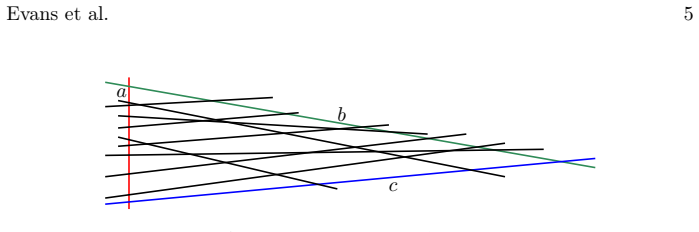
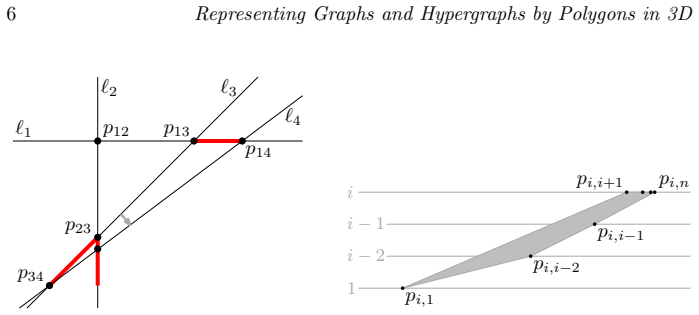
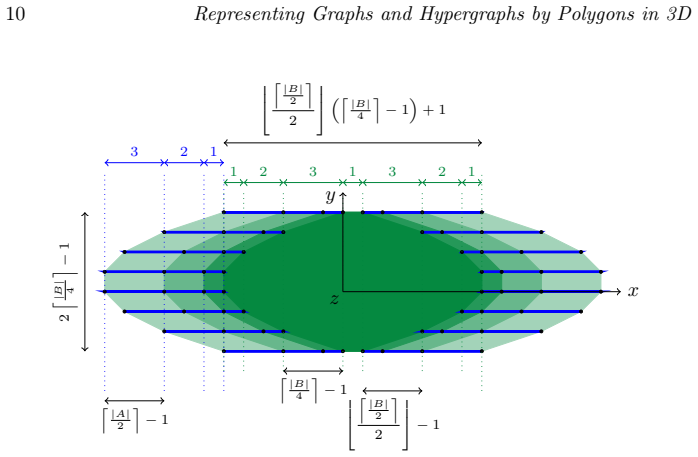
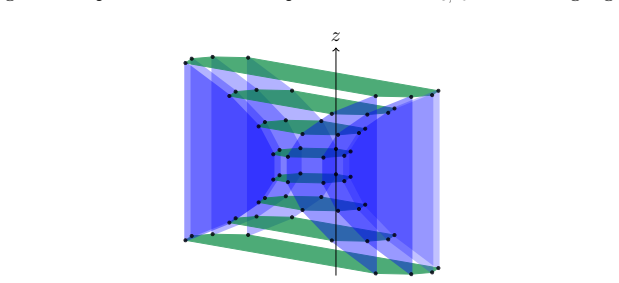
The load-bearing construction is an arrangement of $n$ lines in the $xy$-plane with exponentially decreasing gaps between consecutive intersection points along each line. Lifting each intersection point $p_{i,j}$ to height $\min(i,j)$ and taking the convex hull of the lifted points on each line produces the polygon $P_i$ in the vertical plane over line $i$. The halving condition does two jobs: it forces the boundary angles of each polygon to stay below $\pi$, so the polygon is simple, and it controls the vertical overlap of polygons whose projections meet, so $P_i$ and $P_j$ touch only at $p_{i,j}$. Deleting $p_{i,j}$ for each non-edge is the step that extends the complete-graph representation to arbitrary graphs of minimum degree 3.
What would settle it
Construct the line arrangement of Lemma 2.2 for a small graph such as $K_5$ with one edge removed, delete the point for the missing edge, and test whether the two corresponding convex hulls intersect anywhere outside that point; an intersection would refute Corollary 2.4.
Extended reading notes
Core claim
The central discovery is Corollary 2.4: every graph with minimum vertex-degree 3 admits a contact representation by nondegenerate convex polygons in 3D, where two polygons share a corner point exactly when the corresponding vertices are adjacent and each corner point represents one edge. The proof first realizes the complete graph $K_n$. Each vertex $i$ becomes the convex hull of points placed on a line $\ell_i$ in the $xy$-plane, with the intersection point $p_{i,j}$ of $\ell_i$ and $\ell_j$ lifted to height $\min(i,j)$; polygon $i$ therefore lies in the vertical plane over $\ell_i$. The lines are arranged so distances between consecutive intersection points halve, which keeps each polygon simple and separates non-adjacent polygons vertically. For a non-edge $\{i,j\}$, removing the point $p_{i,j}$ before taking convex hulls is claimed to separate the two polygons. For hypergraphs, the paper shows that the two smallest Steiner triple systems can be drawn with triangles, while no Steiner quadruple system can be drawn with convex quadrilaterals and none of size at least 20 can be drawn with arbitrary quadrilaterals.
Load-bearing premise
The construction assumes that deleting the corner point for a non-edge separates the two polygons vertically, so that wherever their projections still overlap the two polygons occupy different heights.
Editorial extensions
If this is right
- Every graph with minimum degree 3, and hence every graph after adding dummy neighbors, can be realized by convex polygons in 3D; the question of whether coordinates can be kept polynomial for all graphs remains open.
- Bipartite graphs admit linear-time constructions on grids of volume $O(n^4)$; 1-planar cubic graphs use volume $O(n^2)$, and all cubic graphs use volume $O(n^3)$.
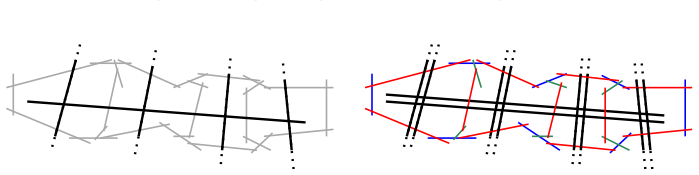
- Squares of even cycles can be represented by unit squares with a constant ratio between longest and shortest quadrilateral edge.
- No Steiner quadruple system is realizable by convex quadrilaterals, and any such system with at least 20 vertices is not realizable by quadrilaterals at all.
- Recognizing intersection graphs of line segments in 3D is complete for the existential theory of the reals, so the recognition problem for this class is computationally hard.
Reading between the lines
- Because the halving condition forces the general construction's coordinates to grow super-polynomially, a positive answer to the paper's open problem about polynomial volume would need a fundamentally different construction.
- The same vertical-separation idea—giving each contact a low height for one polygon and a high height for the other—may transfer to other 3D contact models, such as the monotone polygonal curves mentioned in the conclusion.
- The counting argument used against Steiner quadruple systems suggests a general density threshold: a $k$-uniform hypergraph with too many edges through each vertex cannot have a non-crossing polygon drawing, because the local contact graph around any vertex would become non-planar.
- Running the deletion construction on small graphs, for example $K_5$ with one edge removed, would provide a concrete check of the separation step that carries the universal graph result.
Signed reviews
Editorial analysis
A structured set of objections, weighed in public.
Referee Report
Summary. The manuscript studies contact representations of graphs and hypergraphs by non-intersecting convex polygons in 3D, where two polygons touch only at shared corner points. Its main positive claim is that every graph with minimum vertex degree 3 admits such a representation (Corollary 2.4), obtained by starting from a contact representation of K_n and deleting the points corresponding to non-edges. The paper also gives polynomial-volume constructions for bipartite, 1-planar cubic, cubic, and squares-of-cycles graph classes, shows that recognizing 3D segment intersection graphs is ∃R-complete, and proves several representability and non-representability results for Steiner systems: the two smallest Steiner triple systems are representable, while Steiner quadruple systems are not representable with convex quadrilaterals and sufficiently large ones are not representable with arbitrary quadrilaterals.
Significance. If the central construction can be made rigorous, the result that every graph with minimum degree 3 admits a contact representation by convex polygons in 3D is a strong and surprising contribution: it shows that this geometric contact model is universal for a broad graph class. The paper is also valuable for its explicit constructions for special graph classes (bipartite, subcubic, 1-planar cubic, squares of cycles) and for its negative results on Steiner quadruple systems, which give interesting limits on what touching-polygon representations can express. The use of known tools (Petersen's theorem, Schnyder's algorithm, Dey–Edelsbrunner counting) and the clarity of the exposition are assets; however, no machine-checked proofs or reproducible code accompany the manuscript, and the main constructive proof currently rests on under-specified geometric arguments.
major comments (3)
- [Lemma 2.2 (p. 6)] The proof of Lemma 2.2 is not a complete existence proof of the line arrangement. When line l_i is introduced by rotating a copy of l_{i-1} about p_{i-1,i}, the order property (A1) for l_i includes intersections with lines l_{i+1},...,l_n that have not yet been constructed, so the proof cannot verify at that stage that l_i intersects those future lines in the required order; moreover, the subsequent rotations that create those future lines can change the distances between the intersection points on l_i, yet the argument asserts without justification that 'all inequalities in (A2) are satisfied' throughout. A rigorous induction would need to specify how future lines are placed so as to respect all previously fixed orders and distance bounds, or the authors should cite or prove an alternative existence result. Since Theorem 2.3 builds every polygon on this arrangement, this gap affects the main construction.
- [Corollary 2.4 (p. 7)] The deletion step in Corollary 2.4 does not, as written, establish that P_i and P_j are disjoint for a non-edge {i,j}. For i<j, removing p_{i,j} from both vertex sets does not remove the projection point from either convex hull: P_i typically retains points at height z=i on both sides of p_{i,j} along l_i, and P_j retains lower-chain points on both sides of p_{j,i} along l_j, so both polygons may still have nonempty vertical sections over the same xy-location. The proof only says to 'just remove the point p_{i,j}', and the final sentence of Theorem 2.3 does not apply because p_{i,j} is no longer a common vertex. A complete argument must show that at every such projection the upper z-extent of P_i is strictly below i and the lower z-extent of P_j is strictly above i (or that the projection lies outside one of the hulls), using the exponential distance decay (A2). Without this separation argument the universal claim 'every graph with minimum vertex-degree 3' is not supported.
- [Theorem 3.6 (Section 3.1)] The proof of Theorem 3.6 is a sketch rather than a complete proof. The authors state that they 'need to redo' the Dey–Edelsbrunner counting lemma taking lower-order terms into account, but the redo is not provided; the subsequent claims that intersecting the split triangles with a small sphere around a vertex yields a planar graph with (n-1)(n-2)/3 edges, and at least (n-1)(n-2)/6 edges in the non-convex case, presuppose an unstated choice of the triangulation and an unstated verification that the resulting triangles have no non-trivial intersections. The thresholds n>8 and n≥20 are asserted without the derivation. Since Theorem 3.6 is the main negative result for Steiner quadruple systems, this is a load-bearing gap in the hypergraph part of the paper.
minor comments (5)
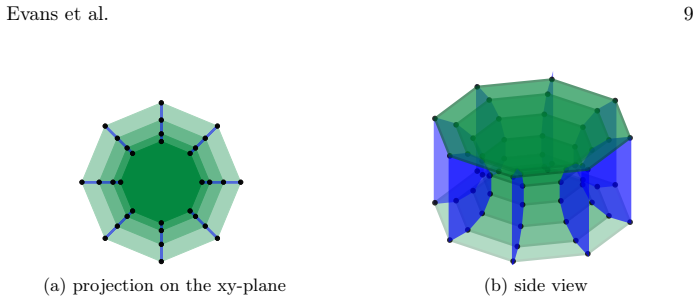
- [After Corollary 2.4 (p. 8)] The remark on making the polygons strictly convex is unclear: if the z-coordinate of every point p_{i,j} is decreased, then adjacent polygons no longer share p_{i,j}; please clarify which points are moved and how the contact property is preserved.
- [Theorem 2.1 proof (p. 5)] The name 'Schaeffer' appears where 'Schaefer' is meant; reference [17] also contains a corrupted author name that should be repaired.
- [Proposition 3.1 (p. 20)] The proof for S(2,3,9) relies on several assertions stated as 'it is easy to see' and on inspection of Fig. 16; the choice β=45° and the lifting of P by 1/10 should be justified numerically or by a short convexity argument.
- [Theorem 2.12 (p. 18)] The case C_5^2 = K_5 is left as an exercise; since the paper otherwise gives explicit constructions, please include a short description or a citation for this base case.
- [Lemma 2.2 (p. 6)] The proof would be much easier to follow if, at each incremental step, the authors stated explicitly which of the inequalities (1)–(4) is being enforced with equality and how the previously established inequalities remain invariant under the rotation.
Circularity Check
No significant circularity: the construction is self-contained and external citations are independent.
full rationale
This is a constructive existence proof with no fitted parameters, empirical predictions, or data-derived outputs. The main chain (Lemma 2.2, Theorem 2.3, Corollary 2.4) builds a contact representation of K_n from an explicitly constructed line arrangement and then attempts to specialize to arbitrary minimum-degree-3 graphs by deleting the points p_{i,j} for non-edges. That specialization does not assume the target graph's representation as an input; it starts from a stronger universal object (K_n) and deletes information, so there is no self-definitional or fitted-input circularity. The cited external results (Petersen's theorem, Schnyder's grid drawing, the Dey-Edelsbrunner counting lemma, and Ossona de Mendez's poset embedding) are genuinely independent and are not by the present authors. The only self-citations are to the authors' own GD 2019 preliminary version [13] and to related work [2], neither of which is load-bearing for the main construction. The possible gap in Corollary 2.4, namely that deleting p_{i,j} may not separate the two convex hulls at that xy-projection, is a proof-correctness concern about a concrete geometric separation claim, not a circularity, because the conclusion is not assumed in the premises. The hypergraph results similarly rely on external combinatorial facts and explicit case analysis. Accordingly the paper receives a circularity score of 0.
Assumptions & free parameters
free parameters (3)
- Rotation angle beta for the S(2,3,9) drawing =
45 degrees
- Scale factor for the inner triangle in S(2,3,9) =
1/5
- Lift constant for vertex 7 in S(2,3,9) =
1/10 unit
assumptions (3)
- standard math Petersen's theorem: every 2-edge-connected cubic graph has a perfect matching.
- standard math Schnyder's algorithm draws 3-connected planar graphs straight-line on a grid of linear size.
- domain assumption A reworked Dey-Edelsbrunner counting bound for triangles spanned by n points in 3D, with lower-order terms included.
Cite this review
Pith. "Pith review of Representing Graphs and Hypergraphs by Touching Polygons in 3D." pith.science (2026). https://pith.science/paper/CC5CXDB6
@misc{pith2026190808273,
  author       = {Pith},
  title        = {Pith review of: Representing Graphs and Hypergraphs by Touching Polygons in 3D},
  year         = {2026},
  howpublished = {\url{https://pith.science/paper/CC5CXDB6}},
  note         = {Machine review of arXiv:1908.08273}
}
read the original abstract
Contact representations of graphs have a long history. Most research has focused on problems in 2D, but 3D contact representations have also been investigated, mostly concerning fully-dimensional geometric objects such as spheres or cubes. In this paper we study contact representations with convex polygons in 3D. We show that every graph admits such a representation. Since our representations use super-polynomial coordinates, we also construct representations on grids of polynomial size for specific graph classes (bipartite, subcubic). For hypergraphs, we represent their duals, that is, each vertex is represented by a point and each edge by a polygon. We show that even regular and quite small hypergraphs do not admit such representations. On the other hand, the two smallest Steiner triple systems can be represented.
Figures
Figures from the paper (14 more)




Reference graph
Works this paper leans on
-
[1]
M. J. Alam.Contact Representations of Graphs in 2D and 3D. PhD thesis, The University of Arizona, 2015
work page 2015
-
[2]
M. J. Alam, W. Evans, S. G. Kobourov, S. Pupyrev, J. Toeniskoetter, and T. Ueckerdt. Contact representations of graphs in 3D. In F. Dehne, J.-R. Sack, and U. Stege, editors,Proc. Algorithms and Data Structures Symposium (WADS’15), volume 9214 ofLNCS, pages 14–27, 2015.doi: 10.1007/978-3-319-21840-3\_2
-
[3]
M. J. Alam, M. Kaufmann, and S. G. Kobourov. On contact graphs with cubes and proportional boxes. In R. M. Freivalds, G. Engels, and B. Cata- nia, editors, Proc. 42nd Conf. Current Trends Theory & Pract. Comput. Sci. (SOFSEM’16), volume 9587 ofLNCS, pages 107–120. Springer, 2016. doi:10.1007/978-3-662-49192-8\_9
-
[4]
U. Brandes, S. Cornelsen, B. Pampel, and A. Sallaberry. Path-based sup- ports for hypergraphs. J. Discrete Algorithms, 14:248–261, 2012. doi: 10.1016/j.jda.2011.12.009
-
[5]
D. Bremner, W. Evans, F. Frati, L. Heyer, S. G. Kobourov, W. J. Lenhart, G. Liotta, D. Rappaport, and S. H. Whitesides. On representing graphs by touching cuboids. In W. Didimo and M. Patrignani, editors,Proc. Int. Symp. Graph Drawing (GD’12), volume 7704 of LNCS, pages 187–198,
-
[6]
K. Buchin, M. J. van Kreveld, H. Meijer, B. Speckmann, and K. Verbeek. On planar supports for hypergraphs.J. Graph Algorithms Appl., 15(4):533– 549, 2011. doi:10.7155/jgaa.00237
-
[7]
J. F. Canny. Some algebraic and geometric computations in PSPACE. In J.Simon, editor,Proc. 20th Ann. ACM Symp. Theory Comput. (STOC’88), pages 460–467, 1988.doi:10.1145/62212.62257
arXiv 1988
-
[8]
J. Cardinal, S. Felsner, T. Miltzow, C. Tompkins, and B. Vogtenhuber. Intersection graphs of rays and grounded segments.J. Graph Algorithms Appl., 22(2):273–295, 2018.doi:10.7155/jgaa.00470
Show all 33 references
-
[9]
Carmesin
J. Carmesin. Embedding simply connected 2-complexes in 3-space – I. A Kuratowski-type characterisation. ArXiv report, 2019. URL: http: //arxiv.org/abs/1709.04642
2019 arXiv
-
[10]
T. K. Dey and H. Edelsbrunner. Counting triangle crossings and halv- ing planes. Discrete Comput. Geom., 12(3):281–289, 1994.doi:10.1007/ BF02574381
1994
-
[11]
Diks and P
K. Diks and P. Stańczyk. Perfect matching for biconnected cubic graphs in O(n log2n) time. In J. van Leeuwen, A. Muscholl, D. Peleg, J. Poko- rný, and B. Rumpe, editors,Proc. 36th Conf. Current Trends Theory & Evans et al. 29 Pract. Comput. Sci. (SOFSEM’10), volume 5901 ofLNCS...
2010 doi
-
[12]
Erickson and S
J. Erickson and S. Kim. Arbitrarily large neighborly families of congru- ent symmetric convex 3-polytopes. In A. Bezdek, editor,Discrete Geome- try, volume 253 ofPure and Applied Mathematics, pages 267–278. Marcel Dekker, New York, 2003. In Honor of W. Kuperberg’s 60th Birthday
2003
-
[13]
W. S. Evans, P. Rz1ażewski, N. Saeedi, C. Shin, and A. Wolff. Represent- ing graphs and hypergraphs by touching polygons in 3d. In D. Archam- bault and C. D. Tóth, editors,Graph Drawing and Network Visualization - 27th International Symposium, GD 2019, Prague, Czech Republic, S...
2019 doi
-
[14]
Felsner and M
S. Felsner and M. C. Francis. Contact representations of planar graphs with cubes. In F. Hurtado and M. J. van Kreveld, editors, Proc. 27th Ann. Symp. Comput. Geom. (SoCG’11), pages 315–320. ACM, 2011.doi: 10.1145/1998196.1998250
2011
-
[15]
H. Gropp. The drawing of configurations. In F. J. Brandenburg, editor, Proc. Int. Symp. Graph Drawing (GD’95), volume 1027 ofLNCS, pages 267–276. Springer, 1996.doi:10.1007/BFb0021810
1996 doi
-
[16]
Hliněný and J
P. Hliněný and J. Kratochvíl. Representing graphs by disks and balls (a survey of recognition-complexity results). Discrete Mathematics, 229(1– 3):101–124, 2001.doi:10.1016/S0012-365X(00)00204-1
2001 doi
-
[17]
Ho0+1+1+1sten and W
S. Ho0+1+1+1sten and W. D. Morris. The order dimension of the complete graph. Discrete Math., 201(1):133–139, 1999. doi:10.1016/ S0012-365X(98)00315-X
1999
-
[18]
D. S. Johnson and H. O. Pollak. Hypergraph planarity and the complexity of drawing Venn diagrams.J. Graph Theory, 11(3):309–325, 1987.doi: 10.1002/jgt.3190110306
1987 doi
-
[19]
P. Koebe. Kontaktprobleme der konformen Abbildung.Berichte über die Verhandlungen der Sächsischen Akad. der Wissen. zu Leipzig. Math.-Phys. Klasse, 88:141–164, 1936
1936
-
[20]
Kratochvíl and J
J. Kratochvíl and J. Matoušek. Intersection graphs of segments.J. Comb. Theory, Ser. B, 62(2):289–315, 1994.doi:10.1006/jctb.1994.1071
1994
-
[21]
Matoušek
J. Matoušek. Intersection graphs of segments and∃R. ArXiv report, 2014. URL: http://arxiv.org/abs/1406.2636
2014 arXiv
-
[22]
Ossona de Mendez
P. Ossona de Mendez. Realization of posets.J. Graph Algorithms Appl., 6(1):149–153, 2002.doi:10.7155/jgaa.00048. 30 Representing Graphs and Hypergraphs by Polygons in 3D
2002 doi
-
[23]
Petersen
J. Petersen. Die Theorie der regulären graphs. Acta Math., 15:193–220,
-
[24]
Schaefer
M. Schaefer. Complexity of some geometric and topological problems. In D. Eppstein and E. R. Gansner, editors,Proc. 17th Int. Symp. Graph Drawing (GD’09), volume 5849 ofLNCS, pages 334–344. Springer, 2010. doi:10.1007/978-3-642-11805-0\_32
2010 doi
-
[25]
Schnyder
W. Schnyder. Embedding planar graphs on the grid. InProc. 1st ACM- SIAM Symp. Discrete Algorithms (SODA’90), pages 138–148, 1990. URL: https://dl.acm.org/citation.cfm?id=320176.320191
1990
-
[26]
Thomassen
C. Thomassen. Interval representations of planar graphs.J. Combin. The- ory Ser. B, 40(1):9–20, 1986.doi:10.1016/0095-8956(86)90061-4
1986 doi
-
[27]
Convexpolygonintersectiongraphs
E.J.vanLeeuwenandJ.vanLeeuwen. Convexpolygonintersectiongraphs. In U. Brandes and S. Cornelsen, editors, Proc. 18th Int. Symp. Graph Drawing (GD’10), volume 6502 ofLNCS, pages 377–388. Springer, 2011. doi:10.1007/978-3-642-18469-7\_35
2011 doi
-
[28]
E. W. Weisstein. Steiner quadruple system. From MathWorld – A Wolfram Web Resource. Accessed 2019-08-20. URL:http://mathworld.wolfram. com/SteinerQuadrupleSystem.html
2019
-
[29]
E. W. Weisstein. Steiner triple system. From MathWorld – A Wolfram Web Resource. Accessed 2019-08-20. URL:http://mathworld.wolfram. com/SteinerTripleSystem.html
2019
-
[30]
Westbrook and R
J. Westbrook and R. E. Tarjan. Maintaining bridge-connected and bi- connected components on-line. Algorithmica, 7(1):433–464, 1992. doi: 10.1007/BF01758773
1992 doi
-
[31]
A. A. Zykov. Hypergraphs.Uspekhi Mat. Nauk, 29(6):89–154, 1974.doi: 10.1070/RM1974v029n06ABEH001303
1974 doi
-
[1891]
doi:10.1007/BF02392606
-
[2012]
doi:10.1007/978-3-642-36763-2\_17
Reviewed August 14, 2026 · model on record in the stance chip above.
Discussion (0). Continue with ORCID to comment.