REVIEW 4 major objections 5 minor 58 references
Voter model on heterogeneous directed networks
T0 review · 4 major / 5 minor · reviewed 2026-08-07 · deepseek-v4-flash
Pith's one-line read The paper claims that on directed configuration models with Pareto-distributed degrees of any exponent $\alpha>0$, the expected voter-model consensus time is $H(u)\vartheta_n(d^+,d^-)n$, with an explicit prefactor $\vartheta_n$; the…
desk verdict A useful conjecture with strong numerical support, packaged in an abstract that oversells it as a derivation; the heavy-tailed transfer from the bounded-degree theorem is genuinely unproved. read the letter →
The pith
A machine-rendered reading of the paper's core claim, the machinery that carries it, and where it could break.
The reading
What carries the argument
The argument is carried by the voter model's dual process of coalescing random walks: consensus time is controlled by the meeting time of two stationary random walks, and under mean-field conditions one has $E[\tau^u_{\rm cons}]\sim 2H(u)\,m_\pi$, where $m_\pi$ is the mean meeting time from stationarity. The load-bearing object is the degree-sequence functional $\vartheta_n(d^+,d^-)$ above, which packages the random-walk meeting-time computation and is conjectured to remain the correct prefactor when maximal degrees grow like $n^{1/\alpha}$ rather than staying bounded. A secondary mechanism is the effective diffusion parameter $\chi=1-\frac{1-\sqrt{1-\rho}}{\delta\rho}$, which converts the same degree statistics into the variance of the Wright-Fisher diffusion $dY_t=\sqrt{Y_t(1-Y_t)}\,dW_t$ that approximates the weighted opinion density on the consensus time scale.
What would settle it
Run the directed configuration model with Pareto degrees for $\alpha=0.7$ and $\alpha=1$ up to large $n$, and measure the ratio $E_u[\tau_{\rm cons}]/(H(u)\,\vartheta_n n)$ averaged over many degree sequences, graphs, and voter runs; if the ratio does not converge to $1$, the central formula fails. A sharper check is to estimate the stationary meeting time $m_\pi$ directly from two independent random walks and test the mean-field relation $m_\pi\sim n\vartheta/2$ implied by (IV.8)-(IV.9).
Extended reading notes
Core claim
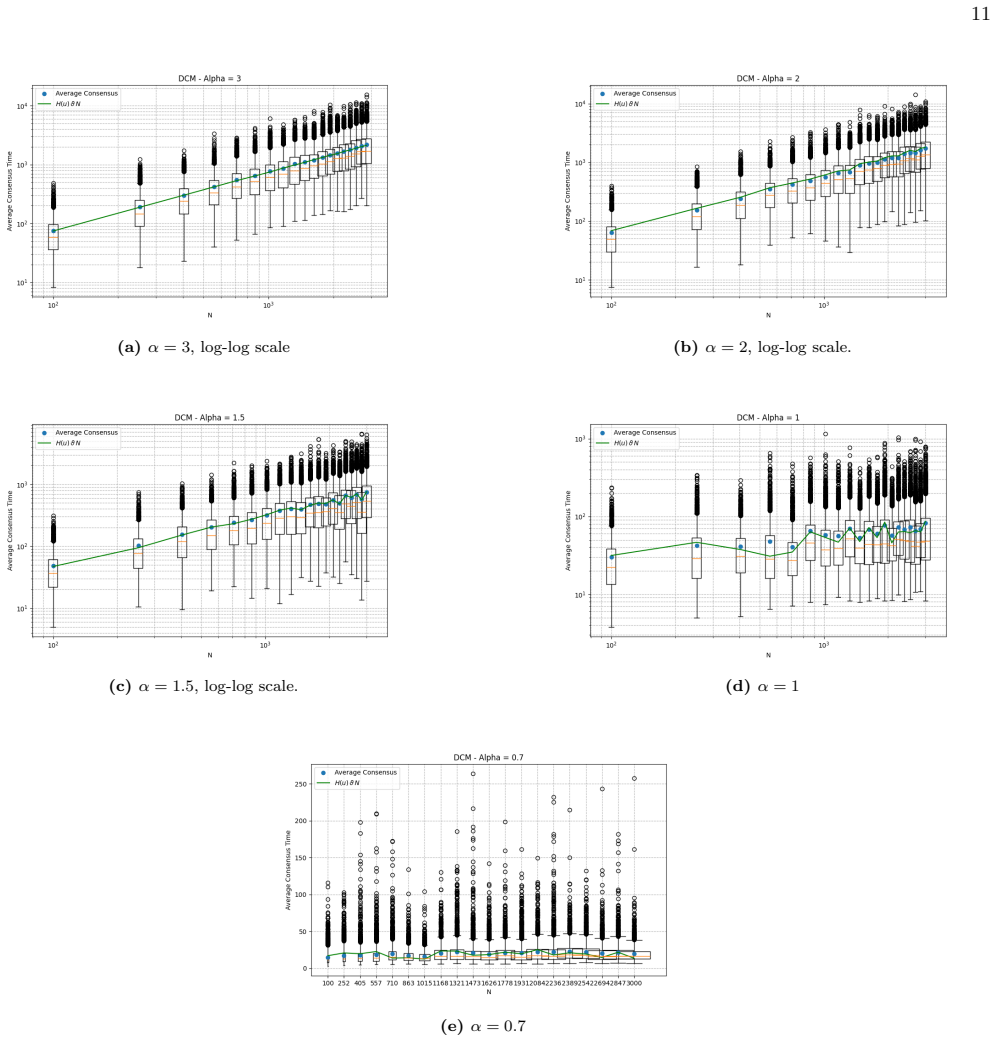
The central claim is that on the directed configuration model with i.i.d. Pareto degrees of exponent $\alpha>0$, the expected consensus time satisfies $E_u[\tau_{\rm cons}] \sim H(u)\,\vartheta_n(d^+,d^-)\,n$ as $n\to\infty$, with convergence in probability over the degree sequence and the graph. The prefactor is the explicit degree-sequence functional $$\vartheta = \frac{\delta}{\frac{\gamma-\rho}{1-\rho}\left(1-\frac{1-\sqrt{1-\rho}}{\rho}\right)+\$\beta$-1},$$ built from $\delta=m/n$, $\beta=\frac1m\sum_x (d^-_x)^2$, $\rho=\frac1m\sum_x d^-_x/d^+_x$, and $\gamma=\frac1m\sum_x (d^-_x)^2/d^+_x$. For Pareto degrees its leading order is $\Theta((m^-_1)^2/m^-_2)$, so the expected consensus time scales as $n$ for $\alpha>2$, as $n/\log n$ for $\alpha=2$, as $n^{2(\alpha-1)/\alpha}$ for $1<\alpha<2$, as $(\log n)^2$ for $\alpha=1$, and stays $O(1)$ for $\alpha<1$. The order is governed by in-degree moments while out-degrees enter only through the prefactor. The bounded-degree version of this statement is a theorem; the heavy-tailed extension is presented as a conjecture, with numerical evidence.
Load-bearing premise
The load-bearing premise is that the explicit prefactor formula, proven only for bounded degree sequences, and the mean-field coalescence picture linking consensus time to stationary meeting time remain valid when maximal degrees grow like $n^{1/\alpha}$, even though the paper does not prove this and labels the heavy-tailed extension a conjecture.
Editorial extensions
If this is right
- If the conjecture holds, the mean consensus time on directed heavy-tailed networks is known to first order for every Pareto exponent $\alpha>0$, with an explicit prefactor rather than just a scaling order.
- The scaling phases that follow from $\vartheta=\Theta((m^-_1)^2/m^-_2)$: linear for $\alpha>2$, $n/\log n$ at $\alpha=2$, $n^{2(\alpha-1)/\alpha}$ for $1<\alpha<2$, $(\log n)^2$ at $\alpha=1$, and bounded for $\alpha<1$.
- Out-degree fluctuations affect only the prefactor, never the order of consensus time; the in-degree sequence controls how fast information collects at vertices.
- For finite-mean Pareto regimes ($\alpha>1$) the weighted opinion density should converge to the Wright-Fisher diffusion with the explicit parameter $\chi$; for $\alpha\le 1$ the mean-field approximation breaks down even though the first-order consensus formula appears to survive.
- The formula gives a graph-observable prediction: computing $\delta,\beta,\rho,\gamma$ from a single degree sequence yields a numerical prediction for consensus time, testable without averaging over graph ensembles.
Reading between the lines
- A testable implication the paper leaves implicit: for $\alpha<1$, where consensus time is $O(1)$, the dynamics should be driven by a few giant in-degree hubs whose stationary masses dominate $m_\pi$; tracking which vertices are last to coalesce would expose this mechanism.
- The simulations suggest a sharper conjecture than the paper states, namely that finite mean degree is sufficient for the mean-field conditions; verifying (IV.5) for $1<\alpha\le 2$ would turn the extension into a theorem.
- The same $\vartheta$ functional, with $n$ and moments restricted to the largest strongly connected component, is the natural candidate for the consensus-time formula on disconnected directed configuration models, extending a remark the paper makes.
- Because $\vartheta_n$ is a deterministic function of the degree sequence, the formula predicts quenched universality in regimes where the prefactor self-averages; the paper's data suggest this holds for $\alpha>2$ but may fail for smaller $\alpha$.
Editorial analysis
A structured set of objections, weighed in public.
Referee Report
Summary. The paper studies the voter model on the directed configuration model (DCM) with i.i.d. Pareto-distributed in- and out-degrees of exponent α>0, and also reports on the undirected configuration model. Its central object is the expected consensus time E_u[τ^u_cons], for which the paper proposes the explicit first-order formula (I.4)/(III.8): E_u[τ^u_cons] ∼ H(u) ϑ_n(d^+,d^-) n, with ϑ_n given by (III.7). The paper computes the orders of magnitude of ϑ in different α regimes, reports extensive simulations supporting these orders and the explicit prefactor, and investigates the validity of the mean-field/Wright–Fisher approximation in the same ensembles, including the infinite-mean regime α≤1. The abstract states that the paper derives exact first-order asymptotics, but the body explicitly labels (III.8) a conjecture and supplies no proof of the extension beyond the bounded-degree case treated in [32].
Significance. If the conjectured formula (III.8) were established, it would be a significant contribution: it would give the first explicit, degree-sequence-dependent prefactor for consensus time in directed heavy-tailed random graphs, sharpening the Sood–Redner order predictions and extending the bounded-degree result of [32]. The paper also provides a useful numerical exploration of the frontier of the mean-field and Wright–Fisher approximations in heterogeneous directed networks. The simulations are extensive across α and across different layers of randomness, and the explicit formulas (III.7) and (VI.2) are concrete and falsifiable. However, the main advertised result is not proven: the central formula is introduced as a conjecture, and the paper's own simulations indicate that its mean-field basis fails in part of the claimed range. The significance therefore currently rests on a plausible but unproved extrapolation.
major comments (4)
- [III.B, Eq. (III.8)] The central formula (III.8) is explicitly introduced as a conjecture, and no proof is given that the bounded-degree theorem of [32] extends to Pareto degree sequences with arbitrary α>0. The abstract, however, states that the paper derives exact first-order asymptotics. This mismatch is load-bearing: the paper's advertised main result is not established. The manuscript should either provide a proof of (III.8) under the stated assumptions or be reframed as a conjectural and numerical study, with the abstract adjusted accordingly.
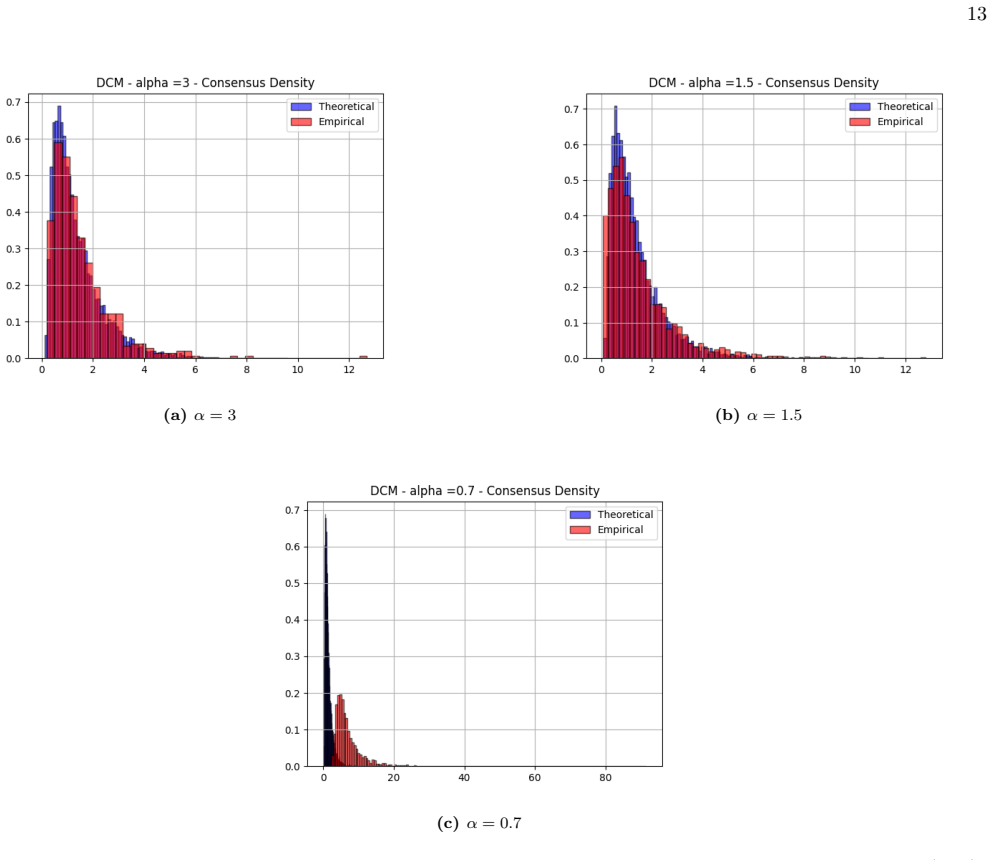
- [IV, Eq. (IV.5) and Fig. 7] The only indicated route from the mean-field theory to the central formula is the relation E[τ^u_cons] ∼ 2H(u)m_π in (IV.8), which is valid only under condition (IV.5), namely (1+q_max t_mix)π_max → 0. For α<1 in the α-DCM, d_max = Θ_P(n^{1/α}) and m = n m_1 = Θ_P(n^{1/α}), so π_max = Θ_P(1) and (IV.5) fails immediately; for α=1 the condition is not verified. This is consistent with Fig. 7, where the rescale consensus-time density for α=0.7 visibly deviates from the Kingman-coalescent target. Thus the claimed universality of (III.8) for all α>0 has no proof route in the infinite-mean regime, and the paper's own numerical evidence points against the mean-field mechanism there.
- [III.B, Eqs. (III.9)–(III.13)] The derivation of the leading order ϑ = Θ((m^-_1)^2/m^-_2) in (III.12)–(III.13) is heuristic: it replaces empirical moments by truncated moments, uses the bounds (III.10)–(III.11) on ρ and γ, and then drops subleading terms in the prefactor. No error control is provided for these approximations uniformly in n, and no argument shows that the explicit prefactor (III.7) is asymptotically accurate rather than merely of the same order. Since the prefactor is the main quantitative output of the paper, this gap needs to be filled or the heuristic character of the computation must be stated clearly.
- [Figures 6 and 7] The numerical support for the central formula is not quantitative. Figure 6 reports box plots and means for n up to 3000 without confidence intervals or convergence diagnostics, and Figure 7 compares empirical and theoretical densities without error bars or a distance measure. The claim that discrepancies are negligible in the large-size limit for α>1 is therefore not supported by the displayed data. Adding error bars, multiple independent runs, and a quantitative measure of deviation (e.g., Kolmogorov–Smirnov distance as a function of n) would be necessary to substantiate the simulations.
minor comments (5)
- [Abstract and Section IV] The abstract contains the duplicated phrase 'in the in the infinite mean regime'; the same typo appears in Section IV's subheading region.
- [I.A] The sentence 'An important of the voter model is its deep connection to random walks' is missing a noun; it should read 'An important feature of the voter model'.
- [III.B] In (III.8), the phrase 'with high probability' is ambiguous: it is not specified whether the probability is over the degree sequence, the graph realization, or the joint law P̄_α. Clarifying the probability space would make the conjecture easier to test and potentially to prove.
- [II.B.1, Eq. (II.8)] The notation Fréchet(α) is introduced without specifying how the scale parameter of the Pareto distribution enters; stating the normalization would avoid confusion in later comparisons.
- [Figures 8 and 9] The figures use colors to distinguish degree sequences and graphs but do not include a legend that identifies which color corresponds to which realization; adding a legend or a consistent caption would improve readability.
Circularity Check
No significant circularity: the central prefactor formula is a deterministic functional imported from a proven bounded-degree theorem and is not fitted to the data being predicted; the heavy-tailed extension is explicitly conjectural.
full rationale
The main asymptotic (III.8) uses the prefactor vartheta(d+,d-) defined in (III.7), which is taken from the authors' earlier bounded-degree theorem [32]. That citation is self-citation with substantial author overlap, but it is not circular: [32] proves (III.8) for deterministic degree sequences with bounded degrees, assumptions that do not include the Pareto alpha<infinity target regime, and the formula contains no parameters fitted to the consensus-time data used for validation. The paper's own text marks the heavy-tailed statement as a conjecture (Section III.B: 'We conjecture that ... (III.8)') and says 'We show via simulations the validity of the conjecture', so no derivation is being offered that could reduce to its own inputs. Section IV likewise identifies the unverified step: the mean-field relation E[tau_cons]~2H(u)m_pi requires condition (IV.5), and for alpha<=1 the paper's simulations show the Wright-Fisher/Kingman approximating density deviates from the target (Fig. 7). That is an unsupported extrapolation and a stated limitation, not a tautology. The abstract's phrase 'we derive exact first-order asymptotics' overstates what the body presents as a conjecture; this is a correctness and overclaim concern outside the circularity definition. No self-definitional, fitted-input, uniqueness-import, or renaming pattern is present.
Assumptions & free parameters
assumptions (4)
- domain assumption The preconstant formula (III.7) for the expected consensus time, proven in [32] for bounded degrees, remains valid for degree sequences with unbounded maximum degree.
- domain assumption The mean-field condition (IV.5) or (IV.4) holds with high probability for the alpha-DCM ensemble in the regimes where E[tau] ~ 2 H(u) m_pi is used.
- domain assumption The alpha-DCM graph is strongly connected with high probability for all alpha>0 when x_min>=2.
- domain assumption The Wright-Fisher diffusion parameter chi in (VI.2) extends from the bounded-degree computation in [39] to DCM ensembles with finite mean degree.
Cite this review
Pith. "Pith review of Voter model on heterogeneous directed networks." pith.science (2026). https://pith.science/paper/CCVRQAML
@misc{pith2026250612169,
  author       = {Pith},
  title        = {Pith review of: Voter model on heterogeneous directed networks},
  year         = {2026},
  howpublished = {\url{https://pith.science/paper/CCVRQAML}},
  note         = {Machine review of arXiv:2506.12169}
}
read the original abstract
We investigate the consensus dynamics of the voter model on large random graphs with heterogeneous and directed features, focusing in particular on networks with power-law degree distributions. By extending recent results on sparse directed graphs, we derive exact first-order asymptotics for the expected consensus time in directed configuration models with i.i.d. Pareto-distributed in- and out-degrees. For any tail exponent {\alpha}>0, we derive the mean consensus time scaling depending on the network size and a pre-factor that encodes detailed structural properties of the degree sequences. We give an explicit description of the pre factor in the directed setting. This extends and sharpens previous mean-field predictions from statistical physics, providing the first explicit consensus-time formula in the directed heavy-tailed setting. Through extensive simulations, we confirm the validity of our predictions across a wide range of heterogeneity regimes, including networks with infinite variance and infinite mean degree distribution. We further explore the interplay between network topology and voter dynamics, highlighting how degree fluctuations and maximal degrees shape the consensus landscape. Complementing the asymptotic analysis, we provide numerical evidence for the emergence of Wright-Fisher diffusive behavior in both directed and undirected ensembles under suitable mixing conditions, and demonstrate the breakdown of this approximation in the in the infinite mean regime.
Figures


Figures from the paper (5 more)



Reference graph
Works this paper leans on
-
[29]
V. Sood, T. Antal, and S. Redner, Voter models on het- erogeneous networks, Phys. Rev. E77, 041121 (2008)
work page 2008
-
[30]
J. Fernley and M. Ortgiese, Voter models on subcriti- cal scale-free random graphs, Random Struct. Algorithms 62, 376 (2023)
work page 2023
- [32]
-
[1]
Annealed vs Quenched We begin by noting thatτ u cons involves four distinct, dependent sources of randomness.: the initial condition of the opinions, the degree sequence, the random graph and the voter model evolution. For theα-CM, so far we analyzed theannealeddynamic of the process, averaging on all the layers, while we are also interested in the study ...
-
[2]
R. A. Holley and T. M. Liggett, Ergodic theorems for weakly interacting infinite systems and the voter model, Ann. Probability3, 643 (1975)
work page 1975
-
[3]
Connectivity So far we have always assumed the underlying (ran- dom) graph to be connected. In the caseα-CM and α-DCM this assumption is translated into requiring the minimal (in-out) degree to be at least 2 in the directed and 3 in the undirected setting. We enforce it in the sim- ulations by taking the minimal value of Pareto(α) large enough, i.e.x min ...
-
[4]
D. Aldous,Probability approximations via the Pois- son clumping heuristic, Applied Mathematical Sciences, Vol. 77 (Springer-Verlag, New York, 1989)
work page 1989
-
[5]
Durrett,Random graph dynamics, Cambridge Series in Statistical and Probabilistic Mathematics, Vol
R. Durrett,Random graph dynamics, Cambridge Series in Statistical and Probabilistic Mathematics, Vol. 20 (Cambridge University Press, Cambridge, 2007)
work page 2007
Show all 58 references
-
[6]
Clifford and A
P. Clifford and A. Sudbury, A model for spatial conflict, Biometrika60, 581 (1973)
1973
-
[7]
Durrett, Some features of the spread of epidemics and information on a random graph, Proceedings of the Na- tional Academy of Sciences107, 4491 (2010)
R. Durrett, Some features of the spread of epidemics and information on a random graph, Proceedings of the Na- tional Academy of Sciences107, 4491 (2010)
2010
-
[8]
T. M. Liggett,Interacting particle systems, Grundlehren der mathematischen Wissenschaften (Fundamental Prin- ciples of Mathematical Sciences), Vol. 276 (Springer- Verlag, New York, 1985)
1985
-
[9]
B. L. Granovsky and N. Madras, The noisy voter model, Stochastic Process. Appl.55, 23 (1995)
1995
-
[10]
Durrett and J
R. Durrett and J. E. Steif, Fixation results for threshold voter systems, Ann. Probab.21, 232 (1993)
1993
-
[11]
P. A. P. Moran, Random processes in genetics, Mathe- matical Proceedings of the Cambridge Philosophical So- ciety54, 60 (1958)
1958
-
[12]
M. J. de Oliveira, Isotropic majority-vote model on a square lattice, J. Stat. Phys.66, 273 (1992)
1992
-
[13]
Cooper, M
C. Cooper, M. Dyer, A. Frieze, and N. Rivera, Discordant voting processes on finite graphs, SIAM J. Discrete Math. 32, 2398 (2018)
2018
-
[14]
Cruciani, H
E. Cruciani, H. A. Mimun, M. Quattropani, and S. Rizzo, Phase transition of the k-majority dynamics in biased communication models, Distrib. Comput.36, 107 (2023)
2023
-
[15]
Rivera,Voting Models on Graphs, Phd thesis, King’s College London (2018)
N. Rivera,Voting Models on Graphs, Phd thesis, King’s College London (2018)
2018
-
[16]
Castellano, M
C. Castellano, M. A. Mu˜ noz, and R. Pastor-Satorras, Nonlinearq-voter model, Phys. Rev. E80, 041129 (2009)
2009
-
[17]
M. E. Yildiz, R. Pagliari, A. E. Ozdaglar, and A. Scaglione, Voting models in random networks, inProc. Inf. Theory Appl. Workshop (ITA)(IEEE, 2010) pp. 1–7
2010
-
[18]
Huo and R
R. Huo and R. Durrett, The zealot voter model, Ann. Appl. Probab.29, 3128 (2019)
2019
-
[19]
J. T. Cox and A. Greven, On the long term behavior of some finite particle systems, Probab. Theory Relat. Fields85, 195 (1990). 18
1990
-
[20]
J. T. Cox, Coalescing random walks and voter model consensus times on the torus inZ d, Ann. Probab.17, 1333 (1989)
1989
-
[21]
Hassin and D
Y. Hassin and D. Peleg, Distributed probabilistic polling and applications to proportionate agreement, inInter- national Colloquium on Automata, Languages, and Pro- gramming(Springer, 1999) pp. 402–411
1999
-
[22]
proves that the density of one opinion type evolves diffusively on the meeting-time scale and converges to the Wright–Fisher diffusion. For the directed Pareto random-graph ensemble used to test prediction (I.4), and for the corresponding undi- rected ensemble studied in [29],...
-
[23]
Baronchelli, C
A. Baronchelli, C. Castellano, and R. Pastor-Satorras, Voter models on weighted networks, Phys. Rev. E83, 066117 (2011)
2011
-
[24]
R. v. d. Hofstad,Random graphs and complex networks, Vol. 2 (Cambridge university press, 2024)
2024
-
[25]
Durrett,Dynamics on Graphs, 2nd ed., Cambridge Se- ries in Statistical and Probabilistic Mathematics (Cam- bridge University Press, 2025)
R. Durrett,Dynamics on Graphs, 2nd ed., Cambridge Se- ries in Statistical and Probabilistic Mathematics (Cam- bridge University Press, 2025)
2025
-
[26]
Cooper and A
C. Cooper and A. Frieze, The cover time of random reg- ular graphs, SIAM J. Discrete Math.18, 728 (2005)
2005
-
[27]
Y.-T. Chen, J. Choi, and J. T. Cox, On the convergence of densities of finite voter models to the Wright-Fisher diffusion, Ann. Inst. Henri Poincar´ e Probab. Stat.52, 286 (2016)
2016
-
[28]
R. v. d. Hofstad,Random graphs and complex networks (Cambridge university press, 2016)
2016
-
[31]
Newman,Networks(Oxford university press, 2018)
M. Newman,Networks(Oxford university press, 2018)
2018
-
[33]
Avena, R
L. Avena, R. Baldasso, R. S. Hazra, F. den Hollan- der, and M. Quattropani, The voter model on random regular graphs with random rewiring, arXiv preprint arXiv:2501.08703 (2025), arXiv:2501.08703
2025 arXiv
-
[34]
Durrett, J
R. Durrett, J. P. Gleeson, A. L. Lloyd, P. J. Mucha, F. Shi, D. Sivakoff, J. E. Socolar, and C. Varghese, Graph fission in an evolving voter model, Proceedings of the National Academy of Sciences109, 3682 (2012)
2012
-
[35]
Basu and A
R. Basu and A. Sly, Evolving voter model on dense ran- dom graphs, Ann. Appl. Prob.27, 1235 (2017)
2017
-
[36]
X. S. Cai, P. Caputo, G. Perarnau, and M. Quattropani, Rankings in directed configuration models with heavy tailed in-degrees, Ann. Appl. Probab.33, 5613 (2023)
2023
-
[37]
Avena, F
L. Avena, F. Capannoli, R. S. Hazra, and M. Quat- tropani, Meeting, coalescence and consensus time on random directed graphs, Ann. Appl. Probab.34, 4940 (2024)
2024
-
[38]
Holme and M
P. Holme and M. E. Newman, Nonequilibrium phase transition in the coevolution of networks and opinions, Phys. Rev. E74, 056108 (2006)
2006
-
[39]
Capannoli, Evolution of discordant edges in the voter model on random sparse digraphs, Electron
F. Capannoli, Evolution of discordant edges in the voter model on random sparse digraphs, Electron. J. Probab. 30, Paper No. 6, 24 (2025)
2025
-
[40]
R. I. Oliveira, On the coalescence time of reversible ran- dom walks, Trans. Amer. Math. Soc.364, 2109 (2012)
2012
-
[41]
Athreya, F
S. Athreya, F. d. Hollander, and A. R¨ ollin, Co-evolving vertex and edge dynamics in dense graphs, arXiv preprint arXiv:2504.06493 (2025)
2025 arXiv
-
[42]
Baldassarri, P
S. Baldassarri, P. Braunsteins, F. d. Hollander, and M. Mandjes, Opinion dynamics on dense dynamic ran- dom graphs, arXiv preprint arXiv:2410.14618 (2024)
2024 arXiv
-
[43]
en- tropic time
C. Bordenave, P. Caputo, and J. Salez, Cutoff at the “en- tropic time” for sparse markov chains, Probab. Theory Relat. Fields173, 261 (2019)
2019
-
[44]
Bollob´ as, A probabilistic proof of an asymptotic for- mula for the number of labelled regular graphs, Eur
B. Bollob´ as, A probabilistic proof of an asymptotic for- mula for the number of labelled regular graphs, Eur. J. Comb.1, 311 (1980)
1980
-
[45]
X. S. Cai and G. Perarnau, Minimum stationary val- ues of sparse random directed graphs, arXiv preprint, arXiv:2010.07246 (2020)
2020 arXiv
-
[46]
R. I. Oliveira, Mean field conditions for coalescing ran- dom walks, Ann. Probab.41, 3420 (2013)
2013
-
[47]
T. M. Liggett,Stochastic interacting systems: con- tact, voter and exclusion processes, Grundlehren der mathematischen Wissenschaften [Fundamental Princi- ples of Mathematical Sciences], Vol. 324 (Springer- Verlag, Berlin, 1999)
1999
-
[48]
Aldous and J
D. Aldous and J. A. Fill, Reversible markov chains and random walks on graphs (2002), unfinished mono- graph, recompiled 2014, available athttp://www.stat. berkeley.edu/~aldous/RWG/book.html
2002
-
[49]
We now ex- plore via simulations whether the coalescence result state above in (IV.6) is valid in the directed case, specifically theα−DCM ensemble
no formula has been found out, predicting the precise first-order remains a difficult open problem. We now ex- plore via simulations whether the coalescence result state above in (IV.6) is valid in the directed case, specifically theα−DCM ensemble. a.Coalescence in directed Pa...
-
[50]
strongly connected with high probability [49])
(resp. strongly connected with high probability [49]). Clearly the voter model is well defined on non-connected graphs, the only difference is that we need to redefine τ u cons accordingly: it will be the first time such that all connected components reach local consensus. The...
-
[51]
Caputo and M
P. Caputo and M. Quattropani, Stationary distribution and cover time of sparse directed configuration models, Probab. Theory Relat. Fields178, 1011 (2020)
2020
-
[52]
Caputo and M
P. Caputo and M. Quattropani, Mixing time trichotomy in regenerating dynamic digraphs, Stochastic Process. Appl.137, 222 (2021)
2021
-
[53]
Bordenave, P
C. Bordenave, P. Caputo, and J. Salez, Random walk on sparse random digraphs, Probab. Theory Relat. Fields 170, 933 (2018)
2018
-
[54]
Cooper and A
C. Cooper and A. Frieze, The size of the largest strongly connected component of a random digraph with a given degree sequence, Combin. Probab. Comput.13, 319 (2004)
2004
-
[55]
Federico and R
L. Federico and R. v. d. Hofstad, Critical window for connectivity in the configuration model, Comb. Probab. Comput.26, 660 (2017)
2017
-
[56]
First Visit Time Lemma
F. Manzo, M. Quattropani, and E. Scoppola, A prob- abilistic proof of Cooper & Frieze’s “First Visit Time Lemma”, ALEA Lat. Am. J. Probab. Math. Stat.18, 1739 (2021)
2021
-
[57]
Chen, Wright-fisher diffusions for evolutionary games with death-birth updating, Ann
Y.-T. Chen, Wright-fisher diffusions for evolutionary games with death-birth updating, Ann. Appl. Probab. 28, 3418 (2018)
2018
-
[58]
F. d. Hollander, Evolution of discordance, arXiv preprint arXiv:2410.17808 (2024)
2024 arXiv
Reviewed August 7, 2026 · model on record in the stance chip above.
Discussion (0). Sign in to comment.