REVIEW 4 major objections 3 minor 40 references
Spin Hall Magnetoresistance in Metallic Bilayers with In-plane Magnetized Ferromagnets
T0 review · 4 major / 3 minor · reviewed 2026-08-14 · deepseek-v4-flash
Pith's one-line read An extended drift-diffusion model, with anisotropic magnetoresistance explicitly included in the ferromagnetic layer, separates spin Hall magnetoresistance from AMR in four metallic bilayers and yields separate spin Hall and AMR angles.
desk verdict Worthwhile model extension, but the 'precise SMR/AMR separation' claim needs error bars and a resolution of cross-series parameter discrepancies. read the letter →
The pith
A machine-rendered reading of the paper's core claim, the machinery that carries it, and where it could break.
The reading
What carries the argument
The carrying object is an extended spin drift-diffusion model for the H/F bilayer. Charge and spin currents in the heavy metal are governed by the spin Hall effect, while in the ferromagnet the current equations include $\theta_{AMR}$ and $\theta_{AH}$ terms alongside spin polarization $\beta$; the two layers are connected by an interface boundary condition written in terms of spin-mixing conductances. Solving these equations with open boundary conditions yields the conductivity tensor whose anisotropy, inserted into $MR = (\rho_{xx}(\hat m \parallel \hat e_x)-\rho_{xx}(\hat m \parallel \hat e_y))/\rho_{xx}(\hat m \parallel \hat e_x)$, is the measured quantity. The mechanism that does the work is the explicit separation $\sigma_x = \sigma_x^{SH}+\sigma_x^{AMR}$ and $\sigma_y = \sigma_y^{SH}+\sigma_y^{AH}$, which lets the angular and thickness dependence of resistance single out each contribution.
What would settle it
Measure the AMR of single ferromagnetic layers (with no heavy metal) across the same thickness range used in the bilayer fits; if the single-layer $\theta_{AMR}$ varies with thickness while the bilayer model treats it as constant, the SMR/AMR separation is misattributing the thickness trend. A second check would be to fit the bilayer data with $\theta_{AMR}(t_F)$ as a free function and compare residuals.
Extended reading notes
Core claim
On its own terms, the paper claims that the measured magnetoresistance of heavy-metal/ferromagnet bilayers can be decomposed into a spin Hall part and an AMR part by solving coupled spin and charge diffusion equations in both layers with AMR terms included in the ferromagnet. The central result is the decomposition $MR \approx (\sigma_y-\sigma_x)/\sigma_0$, where $\sigma_x$ contains $\sigma_x^{SH}+\sigma_x^{AMR}$ and $\sigma_y$ contains spin Hall and anomalous Hall contributions; setting $\theta_{AMR}\to 0$ and $\theta_{AH}\to 0$ recovers the earlier SMR-only model. For the four studied bilayers, the fits give $|\theta_{SH}|$ roughly 0.09–0.47 and $\theta_{AMR}$ roughly 0.13–2.4%, with W-based samples dominated by SMR and Pt-based samples dominated by AMR. The paper also reports negative SMR in Co-based systems, where large AMR would otherwise be mistaken for spin Hall physics.
Load-bearing premise
The fitting assumes the spin Hall angle and the AMR angle do not change with layer thickness, although the paper itself notes this may overestimate parameters for very thin ferromagnetic layers.
Editorial extensions
If this is right
- In Pt-based bilayers, where the spin Hall angle is small, the measured magnetoresistance is dominated by AMR, so SMR-only fits would overestimate spin Hall transport parameters.
- In Co-based bilayers, large AMR can mask or reverse the apparent SMR signal; the model identifies a negative SMR contribution that only appears once AMR is removed.
- The model provides separate $\theta_{SH}$ and $\theta_{AMR}$ values for W/CoFeB, W/Co, CoFeB/Pt, and Co/Pt, which can be used to interpret other magnetoresistance-based spin transport experiments.
- The decomposed magnetoresistance is directly relevant to optimizing magnetic stray field sensors, where the AMR background must be separated from the SMR response.
Reading between the lines
- If thin-film AMR is genuinely thickness dependent, as suggested by the paper's own caveat, then the constant-$\theta_{AMR}$ fit likely underestimates AMR in thick layers and overestimates it in very thin ones; this could be tested by capping single ferromagnetic layers with an insulating spacer instead of a heavy metal.
- The anomalous Hall terms, which are negligible for the in-plane magnetized systems studied here, should become visible in out-of-plane magnetized bilayers or in ferromagnets with larger anomalous Hall angles, where the same framework predicts an extra $\sigma_y^{AH}$ contribution to the transverse conductivity.
- Because the model gives closed-form expressions for the conductivity tensor, one could extract both angles from a single angle-resolved magnetoresistance measurement rather than a full thickness series, speeding up materials screening.
Signed reviews
Editorial analysis
A structured set of objections, weighed in public.
Referee Report
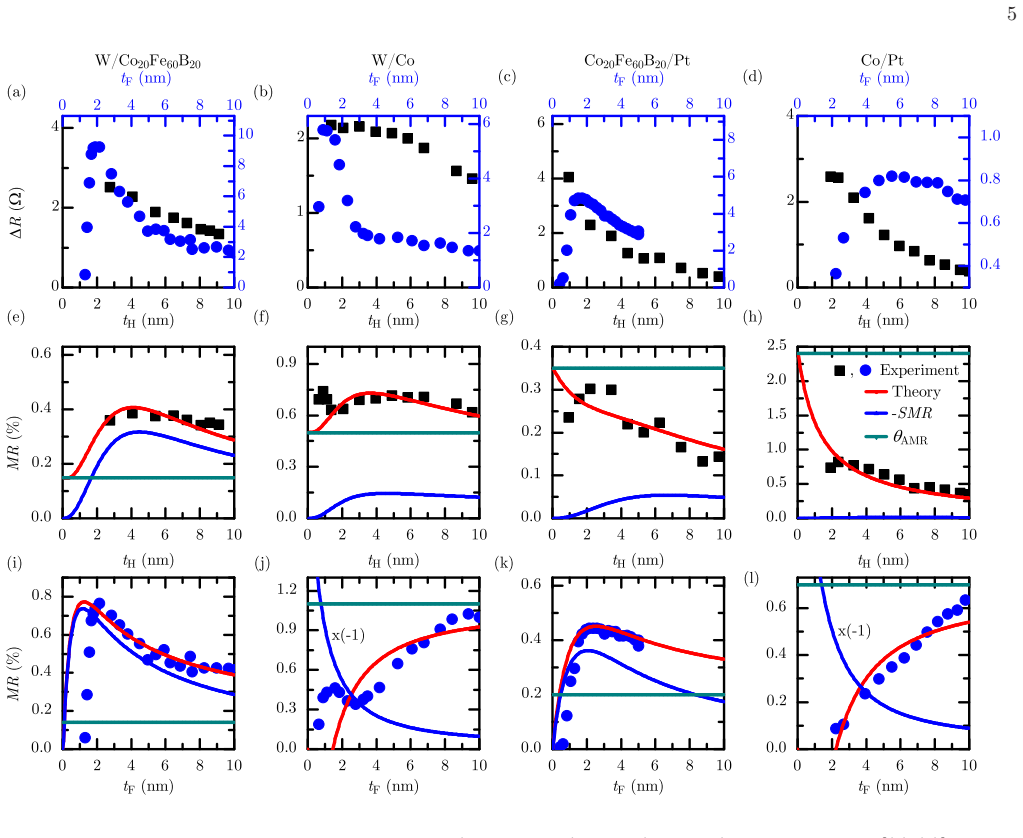
Summary. The paper revisits the theory of spin Hall magnetoresistance (SMR) in heavy-metal/ferromagnetic-metal bilayers by explicitly including anisotropic magnetoresistance (AMR) and the anomalous Hall effect (AHE) in the spin drift-diffusion equations for the ferromagnet. The authors derive closed-form expressions for the magnetoresistance, define SMR by setting the AMR and AHE angles to zero in Eq. (22), and fit the model to resistance measurements on W/Co20Fe60B20, W/Co, Co20Fe60B20/Pt, and Co/Pt bilayers with varied heavy-metal or ferromagnetic thickness. From these fits they extract spin Hall angles, AMR angles, spin-mixing conductances, and spin diffusion lengths, and conclude that the approach allows precise determination of the SMR and AMR contributions to the magnetoresistance.
Significance. If valid, the model would provide a useful framework for separating SMR from AMR in metallic ferromagnet/heavy-metal bilayers, with relevance for magnetoresistance-based spin-transport metrology and for optimizing magnetic stray-field sensors. The derivation in Section II is a genuine extension of earlier SMR theory and the paper compares its model with the simplified Kim et al. model, which is a strength. However, the central quantitative claim of 'precise determination' is currently not supported because the fitted parameters are not accompanied by uncertainties and, more seriously, fits to complementary thickness series of the same nominal bilayers yield mutually inconsistent values. The paper would need a substantially more rigorous fitting and validation procedure before the claimed precision can be accepted.
major comments (4)
- [Sec. IV, Table II] The fitted parameters are reported without uncertainties, confidence intervals, or goodness-of-fit measures, yet the abstract and Section IV claim 'precise determination' of the SMR and AMR contributions. This is especially problematic because the two complementary series for the same nominal bilayers give inconsistent values: for W/Co, |θSH| = 0.34 in W3 versus 0.47 in W4 and θAMR = 1.1% versus 0.5%; for Co/Pt, |θSH| = 0.09 in P3 versus 0.28 in P4 and θAMR = 2.4% versus 0.7%; the fitted Gr also differs by an order of magnitude between the two series. Without uncertainty estimates or a demonstration that these differences are within expected scatter, the claim of precise determination is not established.
- [Sec. II, Eq. (22); Sec. IV] The decomposition into SMR and AMR is obtained by setting θAMR = 0 and θAH = 0 in the fitted model, so the separated contributions are computed from the same fitted parameters that reproduce the total magnetoresistance. There is no independent measurement of θAMR or θSH against which the separation is validated. Because the functional forms of the SMR and AMR terms are not orthogonal in general, the decomposition could be an artifact of the model rather than a physical separation. The authors should validate the procedure, for example by comparing extracted θAMR with values from single-layer AMR measurements or by testing whether the separation is stable under small perturbations of the fitting constraints.
- [Sec. IV, thickness independence assumption] The paper states that 'we assume θAMR and θSH to be independent of layer thickness, which may result in overestimated parameters for very thin ferromagnetic layers.' This assumption is load-bearing: if θAMR varies with ferromagnet thickness, as is known for very thin layers, the fitted separation between SMR and AMR will be systematically wrong, and the differences between the tF and tH series in Table II may reflect exactly such thickness dependence. The authors should either justify the assumption quantitatively (e.g., by comparing fits with and without thickness-dependent angles) or restrict the conclusions to thickness ranges where the assumption is supported by the data.
- [Sec. II and Sec. IV, model simplifications] The model uses several simplifying assumptions whose quantitative impact on the fitted parameters is not assessed: transparent interfaces (GF → ∞), negligible imaginary spin-mixing conductance (Gi = 0), fixed spin polarization β = 0.3, and neglect of AHE. While each assumption is plausible, the fitted values of θSH, θAMR, and Gr may be sensitive to them, especially the transparent-interface and β values. A sensitivity analysis, at least for the most influential parameters, would substantially strengthen the paper's central claim of precise determination.
minor comments (3)
- [Abstract and Introduction] The text contains several typographical errors, including 'in-p lane' in the title header and 'meansurements' in the Introduction; a careful proofreading pass is needed.
- [Fig. 2 and Fig. 3 captions] The figure captions are difficult to parse because they use abbreviations like 'H' and 'F' without fully defining them in the caption; consider spelling out 'heavy metal' and 'ferromagnet' at first use.
- [References] Reference [35] has a typographical extra comma after 'Ralph,' and the Supplemental Material reference [39] is cited as 'URL will be inserted by publisher'; the authors should provide the actual URL or DOI.
Circularity Check
No significant circularity: the SMR/AMR decomposition is a fitted model interpretation rather than a parameter-free derivation, and the paper's self-citations are methodological, not load-bearing.
full rationale
The paper derives a drift-diffusion model (Sec. II) in which AMR and AHE appear explicitly (Eqs. 6-7), then fits the resulting magnetoresistance expression (Eqs. 20-21) to measured thickness-dependent MR data (Fig. 3), reporting fitted θSH and θAMR values in Table II. Eq. (22) defines SMR as the MR with θAMR and θAH set to zero; this is a model-based decomposition, not a circular derivation, because the fitted parameters are not equal by construction to the total MR data — they are estimated from it, and the same parameters are then used to discuss relative SMR/AMR strengths. No step predicts a quantity from a parameter fitted to that same quantity. The cited prior work [4] is external (Kim et al.), and self-citations [36,38] are used only for deposition and structural characterization details, not to justify the central separation. The admitted thickness-independence assumption in Sec. IV ('we assume θAMR and θSH to be independent of layer thickness, which may result in overestimated parameters for very thin ferromagnetic layers') and the large differences between tH- and tF-series fits in Table II are genuine concerns about accuracy and model validity, but they are correctness risks, not circularity: an invalid or oversimplified model does not make the derivation equivalent to its inputs. There is no self-referential uniqueness theorem, no ansatz smuggled via citation, and no renaming of a known result as a new one. The central derivation is self-contained and benchmarked against measured resistances, so the circularity score is 0.
Assumptions & free parameters
free parameters (5)
- spin Hall angle θSH =
0.09 to 0.47, per sample (Table II)
- AMR angle θAMR =
0.13% to 2.4%, per sample (Table II)
- spin-mixing conductance Gr =
10^11 to 10^14 Ω^-1 m^-2, per sample (Table II)
- heavy-metal spin diffusion length λH =
1.3 nm (W), 2.2 nm (Pt)
- ferromagnet spin diffusion length λF =
1 to 5 nm, per sample (Table II)
assumptions (5)
- standard math Standard drift-diffusion equations for charge and spin transport in the heavy metal and ferromagnet.
- domain assumption Interfacial spin current described by the spin-mixing conductance model of Brataas et al. (ref. 37).
- domain assumption Linear response; unidirectional SMR and Rashba-Edelstein interface effects are neglected.
- domain assumption Transparent contacts (GF to infinity) and negligible imaginary mixing conductance Gi.
- ad hoc to paper Spin polarization β = 0.3 for both Co and Co20Fe60B20.
Cite this review
Pith. "Pith review of Spin Hall Magnetoresistance in Metallic Bilayers with In-plane Magnetized Ferromagnets." pith.science (2026). https://pith.science/paper/CDGBLJK2
@misc{pith2026190803906,
  author       = {Pith},
  title        = {Pith review of: Spin Hall Magnetoresistance in Metallic Bilayers with In-plane Magnetized Ferromagnets},
  year         = {2026},
  howpublished = {\url{https://pith.science/paper/CDGBLJK2}},
  note         = {Machine review of arXiv:1908.03906}
}
abstract
We revisit the theory and experiment on spin Hall magnetoresistance (SMR) in bilayers consisting of a heavy metal (H) coupled to in-plane magnetized ferromagnetic metal (F), and determine contributions to the magnetoresistance due to SMR and anisotropic magnetoresistance (AMR) in four different bilayer systems: W/$\text{Co}_{20}\text{Fe}_{60}\text{B}_{20}$, W/Co, $\text{Co}_{20}\text{Fe}_{60}\text{B}_{20}$/Pt, and Co/Pt. To do this, the AMR is explicitly included in the diffusion transport equations in the ferromagnet. The results allow precise determination of different contributions to the magnetoresistance, which can play an important role in optimizing prospective magnetic stray field sensors. They also may be useful in the determination of spin transport properties of metallic magnetic heterostructures in other experiments based on magnetoresistance measurements.
Figures


Reference graph
Works this paper leans on
-
[1]
M. Althammer, S. Meyer, H. Nakayama, M. Schreier, S. Altmannshofer, M. Weiler, H. Huebl, S. Geprägs, M. Opel, R. Gross, D. Meier, C. Klewe, T. Kuschel, J.-M. Schmalhorst, G. Reiss, L. Shen, A. Gupta, Y.-T. Chen, G. E. W. Bauer, E. Saitoh, and S. T. B. Goennen- wein, Quantitative study of the spin Hall magnetoresis- tance in ferromagnetic insulator/normal ...
work page 2013
-
[2]
H. Nakayama, M. Althammer, Y.-T. Chen, K. Uchida, Y. Kajiwara, D. Kikuchi, T. Ohtani, S. Geprägs, M. Opel, S. Takahashi, R. Gross, G. E. W. Bauer, S. T. B. Goennenwein, and E. Saitoh, Spin Hall magne- toresistance induced by a nonequilibrium proximity ef- fect, Phys. Rev. Lett. 110, 206601 (2013)
work page 2013
-
[3]
Y.-T. Chen, S. Takahashi, H. Nakayama, M. Al- thammer, S. T. B. Goennenwein, E. Saitoh, and G. E. W. Bauer, Theory of spin Hall magnetoresis- tance, Phys. Rev. B 87, 144411 (2013) ; Theory of spin Hall magnetoresistance (SMR) and related phenomena, J. Phys.: Condens. Matt. 28, 103004 (2016)
work page 2013
-
[4]
J. Kim, P. Sheng, S. Takahashi, S. Mitani, and M. Hayashi, Spin Hall magnetoresistance in metallic bi- layers, Phys. Rev. Lett. 116, 097201 (2016)
work page 2016
-
[5]
J.-G. Choi, J. W. Lee, and B.-G. Park, Spin Hall magne- toresistance in heavy-metal/metallic-ferromagnet multi - layer structures, Phys. Rev. B 96, 174412 (2017)
work page 2017
-
[6]
M. Kawaguchi, D. Towa, Y. C. Lau, S. Takahashi, and M. Hayashi, Anomalous spin Hall magnetoresistance in Pt/Co bilayers, Appl. Phys. Lett. 112, 202405 (2018)
work page 2018
-
[7]
Y. Lv, J. Kally, D. Zhang, J. S. Lee, M. Ja- mali, N. Samarth, and J.-P. Wang, Unidirectional spin-hall and rashba-edelstein magnetoresistance in topological insulator-ferromagnet layer heterostructur es, Nature Communications 9, 111 (2018)
work page 2018
-
[8]
K. Narayanapillai, G. Go, R. Ramaswamy, K. Gopinad- han, D. Go, H.-W. Lee, T. Venkatesan, K.-J. Lee, and H. Yang, Interfacial rashba magnetoresistance of the two- dimensional electron gas at the LaAlO3 / SrTiO3 inter- face, Physical Review B 96, 064401 (2017)
work page 2017
Show all 40 references
-
[9]
J. E. Hirsch, Spin Hall effect, Phys. Rev. Lett. 83, 1834 (1999)
1999
-
[10]
M. I. Dyakonov, Magnetoresistance due to edge spin ac- cumulation, Phys. Rev. Lett. 99, 126601 (2007)
2007
-
[11]
S. Y. Huang, X. Fan, D. Qu, Y. P. Chen, W. G. Wang, J. Wu, T. Y. Chen, J. Q. Xiao, and C. L. Chien, Transport magnetic proximity effects in platinum, Phys. Rev. Lett. 109, 107204 (2012)
2012
-
[12]
Sinova, S
J. Sinova, S. O. Valenzuela, J. Wunderlich, C. H. Back, and T. Jungwirth, Spin Hall effects, Rev. Mod. Phys. 87, 1213 (2015)
2015
-
[13]
Y. Liu, B. Zhou, and J.-G. Zhu, Field-free mag- netization switching by utilizing the spin hall ef- fect and interlayer exchange coupling of iridium, 7 Scientific Reports 9, 325 (2019)
2019
-
[14]
A. Kobs, S. Heße, W. Kreuzpaintner, G. Winkler, D. Lott, P. Weinberger, A. Schreyer, and H. P. Oepen, Anisotropic interface magnetoresistance in Pt/Co/Pt sandwiches, Phys. Rev. Lett. 106, 217207 (2011)
2011
-
[15]
C.-F. Pai, Y. Ou, L. H. Vilela-Leão, D. C. Ralph, and R. A. Buhrman, Dependence of the efficiency of spin Hall torque on the transparency of Pt/ferromagnetic layer in- terfaces, Phys. Rev. B 92, 064426 (2015)
2015
-
[16]
Zhang, W
W. Zhang, W. Han, X. Jiang, S.-H. Yang, and S. S. P. Parkin, Role of transparency of platinum–ferromagnet interfaces in determining the intrinsic magnitude of the spin Hall effect, Nat. Phys. 11, 496 (2015)
2015
-
[17]
S. S.-L. Zhang, G. Vignale, and S. Zhang, Anisotropic magnetoresistance driven by surface spin-orbit scatter- ing, Phys. Rev. B 92, 024412 (2015)
2015
-
[18]
Tokaç, M
M. Tokaç, M. Wang, S. Jaiswal, A. W. Rushforth, B. L. Gallagher, D. Atkinson, and A. T. Hindmarch, Interfacial contribution to thickness dependent in-plane anisotropic magnetoresistance, AIP Advances 5, 127108 (2015)
2015
-
[19]
Tokaç, S
M. Tokaç, S. A. Bunyaev, G. N. Kakazei, D. S. Schmool, D. Atkinson, and A. T. Hindmarch, Interfacial structure dependent spin mixing conductance in cobalt thin films, Phys. Rev. Lett. 115, 056601 (2015)
2015
-
[20]
L. J. Zhu, D. C. Ralph, and R. A. Buhrman, Irrelevance of magnetic proximity effect to spin- orbit torques in heavy-metal/ferromagnet bilayers, Phys. Rev. B 98, 134406 (2018)
2018
-
[21]
V. P. Amin, J. Zemen, and M. D. Stiles, Interface-generated spin currents, Phys. Rev. Lett. 121, 136805 (2018)
2018
-
[22]
C. O. A vci, K. Garello, A. Ghosh, M. Gabureac, S. F. Alvarado, and P. Gambardella, Unidirectional spin Hall magnetoresistance in ferromagnet/normal metal bilayers, Nat. Phys. 11, 570 (2015)
2015
-
[23]
C. O. A vci, K. Garello, J. Mendil, A. Ghosh, N. Blasakis, M. Gabureac, M. Trassin, M. Fiebig, and P. Gambardella, Magnetoresistance of heavy and light metal/ferromagnet bilayers, Appl. Phys. Lett. 107, 192405 (2015)
2015
-
[24]
S. S.-L. Zhang and G. Vignale, Theory of unidirectional spin Hall magnetoresistance in heavy-metal/ferromagnetic-metal bilayers, Phys. Rev. B 94, 140411(R) (2016)
2016
-
[25]
C. O. A vci, J. Mendil, G. S. D. Beach, and P. Gambardella, Origins of the unidirectional spin Hall magnetoresistance in metallic bilayers, Phys. Rev. Lett. 121, 087207 (2018)
2018
-
[26]
Taniguchi, J
T. Taniguchi, J. Grollier, and M. D. Stiles, Spin-transfer torques generated by the anoma- lous Hall effect and anisotropic magnetoresistance, Phys. Rev. Appl. 3, 044001 (2015)
2015
-
[27]
Taniguchi, Magnetoresistance generated from charge-spin conversion by anomalous Hall effect in metallic ferromagnetic/nonmagnetic bilayers, Phys
T. Taniguchi, Magnetoresistance generated from charge-spin conversion by anomalous Hall effect in metallic ferromagnetic/nonmagnetic bilayers, Phys. Rev. B 94, 174440 (2016)
2016
-
[28]
Y. Yang, Z. Luo, H. Wu, Y. Xu, R. W. Li, S. J. Penny- cook, S. Zhang, and Y. Wu, Anomalous Hall magnetore- sistance in a ferromagnet, Nat. Commun. 9, 2255 (2018)
2018
-
[29]
Jan, Galvamomagnetic and thermomagnetic effects in metals, in Solid State Physics (Elsevier, 1957) pp
J.-P. Jan, Galvamomagnetic and thermomagnetic effects in metals, in Solid State Physics (Elsevier, 1957) pp. 1– 96
1957
-
[30]
McGuire and R
T. McGuire and R. Potter, Anisotropic mag- netoresistance in ferromagnetic 3d alloys, IEEE Trans. Magn. 11, 1018 (1975)
1975
-
[31]
Bass and W
J. Bass and W. P. Pratt, Spin-diffusion lengths in metals and alloys, and spin-flipping at metal/metal interfaces: an experimentalist’s critical review, J. Phys.: Condens. Mat. 19, 183201 (2007)
2007
-
[32]
P. S. Bechthold, Galvanomagnetic trans- port: from Hall effect to AMR, in Spintronics – From GMR to Quantum Information , edited by S. Blügel, D. Bürgler, M. Morgenstern, C. M. Schneider, and R. Waser, Institute of Solid State Re- search, Forschungszentrum Jülich (Forschungszen...
2009
-
[33]
Nagaosa, J
N. Nagaosa, J. Sinova, S. Onoda, A. H. Mac- Donald, and N. P. Ong, Anomalous Hall effect, Rev. Mod. Phys. 82, 1539 (2010)
2010
-
[34]
Iihama, T
S. Iihama, T. Taniguchi, K. Yakushiji, A. Fukushima, Y. Shiota, S. Tsunegi, R. Hiramatsu, S. Yuasa, Y. Suzuki, and H. Kubota, Spin-transfer torque induced by the spin anomalous hall effect, Nature Electronics 1, 120 (2018)
2018
-
[35]
L. Liu, T. Moriyama, D. C. Ralph, , and R. A. Buhrman, Spin-torque ferromagnetic resonance induced by the spin Hall effect, Phys. Rev. Lett. 106, 036601 (2011)
2011
-
[36]
Skowroński, Ł
W. Skowroński, Ł. Karwacki, S. Ziętek, J. Kanak, S. Łazarski, K. Grochot, T. Stobiecki, P. Kuświk, F. Stobiecki, and J. Barnaś, Determination of spin Hall angle in heavy-metal/Co-Fe-B-based heterostructures with interfacial spin-orbit fields, Phys. Rev. Appl. 11, 024039 (2019)
2019
-
[37]
Brataas, G
A. Brataas, G. Bauer, and P. Kelly, Non-collinear mag- netoelectronics, Phys. Rep. 427, 157 (2006)
2006
-
[38]
Łazarski, W
S. Łazarski, W. Skowroński, J. Kanak, L. Karwacki, S. Ziętek, K. Grochot, T. Stobiecki, and F. Sto- biecki, Field-free spin-orbit-torque switching in Co/Pt/Co multilayer with mixed magnetic anisotropies, Phys. Rev. Appl. 12, 014006 (2019)
2019
-
[39]
Supple- mental Material contains Refs
See Supplemental Material at [URL will be inserted by publisher] for more details on structural characterizatio n of the samples and on resistivity measurements. Supple- mental Material contains Refs. [ 6, 36, 38]
-
[40]
Tserkovnyak, A
Y. Tserkovnyak, A. Brataas, and G. E. W. Bauer, Spin pumping and magnetization dynamics in metallic multi- layers, Phys. Rev. B 66, 224403 (2002)
2002
Reviewed August 14, 2026 · model on record in the stance chip above.
Discussion (0). Continue with ORCID to comment.