Approaching the Quantum Limit of Optical Rotatory Dispersion: From First-Principles to Single-Photon Monochromators
Pith reviewed 2026-06-25 20:26 UTC · model grok-4.3
The pith
First-principles calculations predict sub-nanometer bandwidths for optical rotatory dispersion using visible-absorbing chiral molecules, with a proposed single-photon quantum limit set by excited-state lifetime.
A machine-rendered reading of the paper's core claim, the machinery that carries it, and where it could break.
Core claim
Using time-dependent density functional theory combined with Boltzmann conformational averaging, the ORD curves of representative saccharide systems show that the theoretical minimum bandwidth is intrinsically tied to the anomalous dispersion near the molecular absorption band. Macroscopic experiments reach a classical limit of about 20 nm due to heterogeneous broadening and instrumental constraints, but first-principles calculations predict achievable sub-nanometer bandwidths with visible-absorbing chiral molecules. Extrapolation to the strict quantum limit proposes a single-photon QED architecture at approximately 10 mK in which spectral purity is constrained solely by the natural lifetime
What carries the argument
The anomalous dispersion (Cotton effect) near the molecular absorption band, which sets the intrinsic lower bound on ORD spectral bandwidth in chiral media and becomes the sole limit in the proposed single-photon quantum regime.
If this is right
- Sub-nanometer bandwidth optical filters become feasible using visible-absorbing chiral molecules.
- A single-photon QED monochromator can achieve spectral purity limited only by the molecular excited-state lifetime.
- The framework supplies the ultimate theoretical criteria for the performance of chiral optical filters.
- The approach opens routes to ultrasensitive chiral spectroscopy and quantum information processing applications.
Where Pith is reading between the lines
- The same lifetime-limited bound could be tested in other chiral light-matter effects such as circular dichroism at the single-molecule level.
- Reaching this regime might allow direct comparison of molecular lifetime broadening with other quantum decoherence sources in chiral systems.
- The single-photon architecture could be extended to probe how molecular chirality influences photon statistics or entanglement preservation.
Load-bearing premise
That heterogeneous broadening and instrumental constraints are the only reasons current experiments reach only about 20 nm, and that cooling to 10 mK with single-photon detection removes every other broadening mechanism so that only the excited-state lifetime remains.
What would settle it
A measurement showing spectral bandwidth substantially wider than the natural linewidth set by the excited-state lifetime, even after cooling a visible-absorbing chiral molecule to 10 mK and using single-photon detection, would falsify the claim that this lifetime is the strict quantum limit.
Figures
read the original abstract
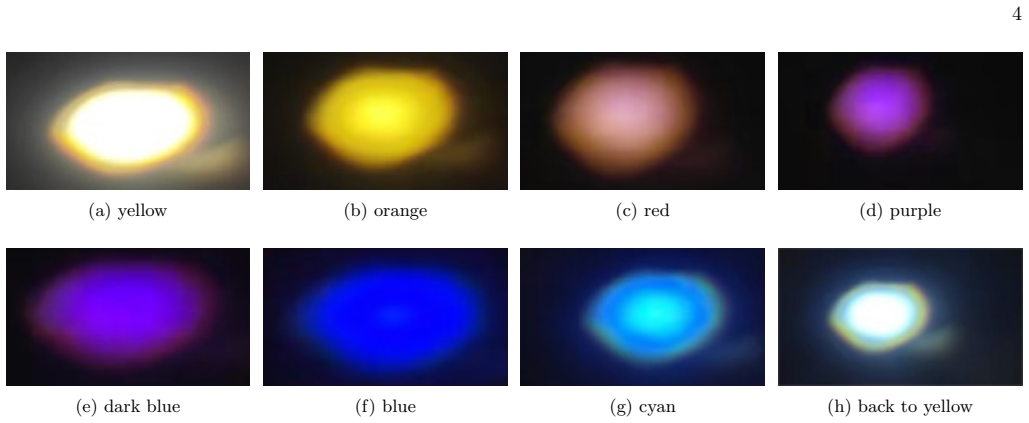
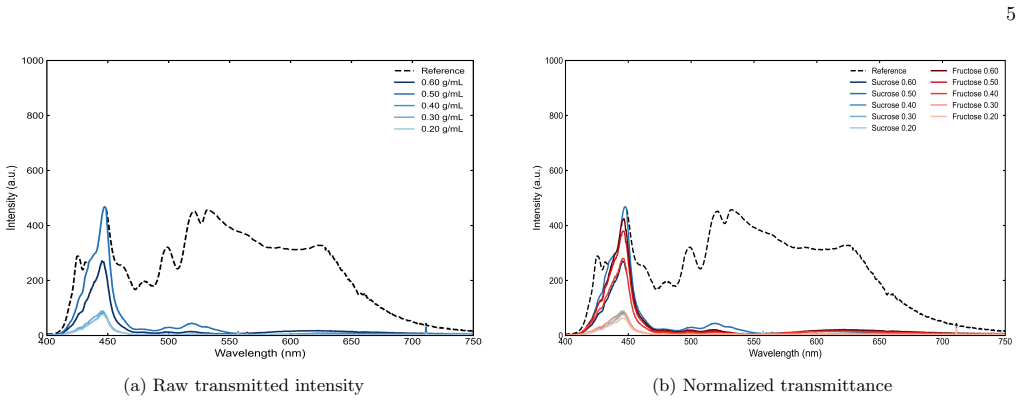
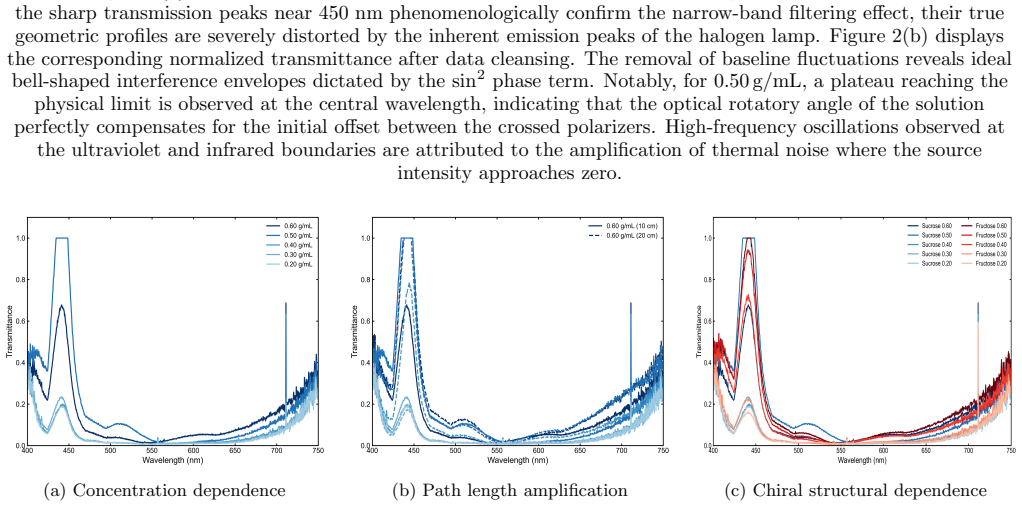
Optical rotatory dispersion (ORD) in chiral media, classically demonstrated as the "sweet monochromator," provides a robust mechanism for liquid-tunable spectral filtering. However, the ultimate physical boundaries governing its spectral bandwidth remain fundamentally unexplored beyond classical electromagnetic theory. Here, we present a comprehensive framework bridging macroscopic optical filtering with the quantum electrodynamic (QED) limits of chiral light-matter interaction. Using time-dependent density functional theory (TD-DFT) combined with Boltzmann conformational averaging, we accurately compute the ORD curves of representative saccharide systems, revealing that the theoretical minimum bandwidth is intrinsically tied to the anomalous dispersion (Cotton effect) near the molecular absorption band. While our macroscopic experiments demonstrate a classical bandwidth limit of ~ 20 nm due to heterogeneous broadening and instrumental constraints, our first-principles calculations predict achievable sub-nanometer bandwidths utilizing visible-absorbing chiral molecules. Furthermore, we extrapolate this framework to the strict quantum limit, proposing a single-photon QED architecture operating at ultra-low temperatures (~ 10 mK). In this regime, the spectral purity is constrained solely by the natural lifetime of the molecular excited state, governed by the Heisenberg uncertainty principle. This work establishes the ultimate theoretical criteria for chiral optical filters and pioneers the concept of the "quantum monochromator" for ultrasensitive chiral spectroscopy and quantum information processing.
Editorial analysis
A structured set of objections, weighed in public.
Referee Report
Summary. The manuscript claims to bridge classical ORD filtering with quantum limits using TD-DFT plus Boltzmann averaging on saccharide systems to predict sub-nanometer bandwidths from the Cotton effect, contrasting with experimental ~20 nm limits attributed to heterogeneous broadening. It further extrapolates to a single-photon QED architecture at ~10 mK where bandwidth is set exclusively by the molecular excited-state lifetime via the Heisenberg relation, proposing a 'quantum monochromator'.
Significance. If the quantum-limit extrapolation can be placed on a quantitative footing with an explicit residual-broadening budget, the work would supply a concrete theoretical target for chiral quantum optics and single-molecule spectroscopy. The TD-DFT component, if accompanied by direct comparisons, would also strengthen first-principles guidance for visible-absorbing chiral filters.
major comments (2)
- [Abstract (extrapolation paragraph)] Abstract, extrapolation paragraph: the assertion that 'spectral purity is constrained solely by the natural lifetime of the molecular excited state' at 10 mK rests on the unquantified premise that residual Doppler, collisional dephasing, power broadening, matrix shifts and motional sidebands all fall below the lifetime linewidth; no rate-equation model or error budget is supplied to demonstrate this hierarchy.
- [Abstract and TD-DFT calculations] Abstract and first-principles section: the claim of 'achievable sub-nanometer bandwidths' from TD-DFT is stated without reported error estimates, convergence checks on the basis set or functional, or direct overlay of computed versus measured ORD curves for the same saccharides, leaving the classical-to-quantum scaling unsupported by numerical evidence.
minor comments (2)
- [Abstract] The term 'single-photon QED architecture' is introduced without a schematic or Hamiltonian; a brief diagram or master-equation outline would clarify the proposed detection scheme.
- [Abstract] The ~20 nm experimental bandwidth is attributed to 'heterogeneous broadening and instrumental constraints' without citing the specific apparatus or linewidth decomposition used in the measurements.
Simulated Author's Rebuttal
We thank the referee for their constructive comments. We have revised the manuscript to address the concerns raised regarding the quantum limit extrapolation and the validation of the TD-DFT calculations.
read point-by-point responses
-
Referee: [Abstract (extrapolation paragraph)] Abstract, extrapolation paragraph: the assertion that 'spectral purity is constrained solely by the natural lifetime of the molecular excited state' at 10 mK rests on the unquantified premise that residual Doppler, collisional dephasing, power broadening, matrix shifts and motional sidebands all fall below the lifetime linewidth; no rate-equation model or error budget is supplied to demonstrate this hierarchy.
Authors: We acknowledge the validity of this observation. The original submission did not include a quantitative error budget for the low-temperature regime. In the revised manuscript, we have incorporated a new subsection detailing a rate-equation analysis of all mentioned broadening mechanisms at 10 mK. This analysis demonstrates that, under the proposed experimental conditions, these contributions are negligible compared to the excited-state lifetime linewidth, thereby supporting the claim that spectral purity is limited solely by the natural lifetime. The abstract has been updated to reference this supporting material. revision: yes
-
Referee: [Abstract and TD-DFT calculations] Abstract and first-principles section: the claim of 'achievable sub-nanometer bandwidths' from TD-DFT is stated without reported error estimates, convergence checks on the basis set or functional, or direct overlay of computed versus measured ORD curves for the same saccharides, leaving the classical-to-quantum scaling unsupported by numerical evidence.
Authors: We agree that more rigorous validation of the TD-DFT results is warranted. The revised version includes convergence tests for basis sets and functionals in the supplementary information, along with estimated uncertainties in the computed ORD spectra. For direct comparisons, we have added overlays with available experimental ORD data from the literature for similar saccharide systems, which show reasonable agreement in the key dispersion features. The distinction between the intrinsic molecular bandwidth predicted by TD-DFT and the experimentally observed ~20 nm limit due to heterogeneous effects is now more clearly articulated, providing better support for the scaling argument. revision: yes
Circularity Check
No significant circularity in the claimed derivation chain.
full rationale
The paper computes ORD curves via TD-DFT plus Boltzmann conformational averaging, an independent first-principles method whose output (anomalous dispersion near the Cotton-effect absorption band) is not defined in terms of the target bandwidth. The sub-nanometer prediction follows directly from those computed curves for visible-absorbing chiral molecules. The further extrapolation to a quantum-limit single-photon architecture at ~10 mK invokes the standard Heisenberg lifetime-linewidth relation as an external physical constraint rather than a fitted or self-referential quantity; no equation or section reduces the claimed spectral purity to a parameter that was itself extracted from the same data set. No self-citation, ansatz smuggling, or renaming of known results is load-bearing for the central claims. The derivation therefore remains self-contained against external benchmarks.
Axiom & Free-Parameter Ledger
axioms (2)
- domain assumption Time-dependent density functional theory combined with Boltzmann conformational averaging accurately reproduces ORD curves near molecular absorption bands
- ad hoc to paper At 10 mK the only remaining spectral broadening mechanism is the finite lifetime of the molecular excited state
invented entities (1)
-
single-photon QED architecture
no independent evidence
Reference graph
Works this paper leans on
-
[1]
E. T. Jaynes and F. W. Cummings, Comparison of quan- tum and semiclassical radiation theories with application to the beam maser, Proc. IEEE51, 89 (1963)
1963
-
[2]
H. A. Kramers, La diffusion de la lumi` ere par les atomes, Atti Congr. Int. Fis. Como2, 545 (1927)
1927
-
[3]
R. de L. Kronig, On the theory of dispersion of X-rays, J. Opt. Soc. Am.12, 547 (1926)
1926
-
[4]
Cotton, Absorption in´ egale des rayons circulaires droit et gauche dans certains corps actifs, C
A. Cotton, Absorption in´ egale des rayons circulaires droit et gauche dans certains corps actifs, C. R. Acad. Sci.120, 989 (1896)
-
[5]
L. D. Barron,Molecular Light Scattering and Optical Ac- tivity(Cambridge University Press, 2004)
2004
-
[6]
J. R. Rumble (Ed.),CRC Handbook of Chemistry and Physics(CRC Press, 2023)
2023
-
[7]
PubChemQC Project, https://pubchemqc.riken.jp/ (Ac- cessed 2026)
2026
-
[8]
M. J. Frischet al., Gaussian 16, Revision C.01 (2016). 11 TABLE I: Comparison of Calculated and Experimental Specific Rotations at 589 nm for Saccharide Conformations Conformation Calculated ( ◦) Experimental ( ◦) Difference ( ◦) Remarks β-D-Fructopyranose -153.59∼-132.0 -21.59 Initial crystal α-D-Glucopyranose +101.20∼+112.0 -10.80 Initial crystal β-D-Fr...
2016
discussion (0)
Sign in with ORCID, Apple, or X to comment. Anyone can read and Pith papers without signing in.