The Role of Edge Resonant Magnetic Perturbations in Edge-Localized-Mode Suppression and Density Pump-out in low-collisionality DIII-D Plasmas
Pith reviewed 2026-07-01 03:36 UTC · model grok-4.3
The pith
Nonlinear MHD simulations show magnetic islands at the H-mode pedestal edges and screening in the gradient region account for ELM suppression and density pump-out by resonant magnetic perturbations.
A machine-rendered reading of the paper's core claim, the machinery that carries it, and where it could break.
Core claim
Two-fluid nonlinear MHD simulations demonstrate that the formation of magnetic islands at the top and bottom of the H-mode pedestal, together with the strong screening of resonant fields in the gradient region of the pedestal, can account for ELM suppression and density pump-out by n = 2 Resonant Magnetic Perturbations in low-collisionality plasmas. Using experimentally relevant transport coefficients, neoclassical resistivity, electron collisionality, and RMP amplitudes, the simulations reproduce the observed level of density reduction due to narrow magnetic islands and resulting enhanced collisional transport in the resistive foot of the pedestal. For large amplitude RMPs simulations predi
What carries the argument
Two-fluid nonlinear MHD simulations modeling the formation of narrow magnetic islands at the pedestal foot and top together with resonant field screening by plasma flows in the gradient region.
If this is right
- Narrow magnetic islands in the resistive foot enhance collisional transport and produce the observed density pump-out.
- At sufficient RMP amplitude, islands at the pedestal top reduce height and width, stabilizing the peeling-ballooning mode.
- Strong ExB and diamagnetic flows screen resonant fields in the gradient region and prevent widespread stochasticity.
- The scaling relation derived from hundreds of runs reproduces the observed dependence of the ELM suppression threshold on density and ExB flow.
- Artificially raising resistivity by a factor of ten produces full stochasticity and pedestal collapse.
Where Pith is reading between the lines
- The same island formation plus screening balance may operate in other low-collisionality pedestal regimes if the flow and resistivity conditions are comparable.
- Varying the diamagnetic flow strength in additional runs could map the boundary between screened and penetrated states more finely.
- Measurements of local transport enhancement at the precise radial locations of the predicted islands would provide an independent test.
- The mechanism suggests a route to optimizing RMP spectra for simultaneous ELM control and minimal density loss.
Load-bearing premise
The transport coefficients, neoclassical resistivity, electron collisionality, and RMP amplitudes chosen for the simulations are close enough to the actual experimental values to reproduce the density reduction and suppression threshold without further adjustments.
What would settle it
A direct measurement showing no narrow magnetic islands at the predicted pedestal foot and top locations during RMP application, or an experimental ELM suppression threshold that fails to follow the simulated scaling with density and ExB flow, would falsify the account.
Figures
read the original abstract
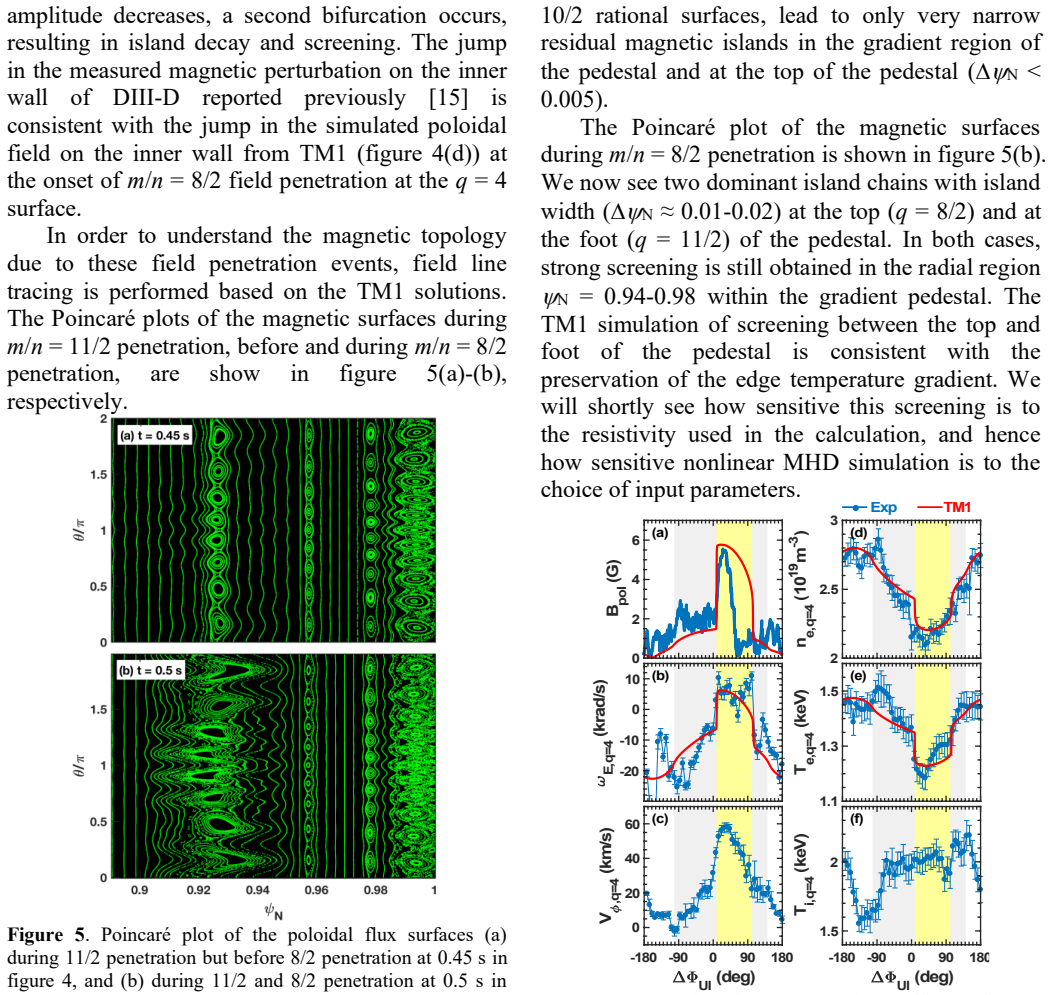
Two-fluid nonlinear MHD simulations using the TM1 code demonstrate that the formation of magnetic islands at the top and bottom of the H-mode pedestal, together with the strong screening of resonant fields in the gradient region of the pedestal, can account for ELM suppression and density pump-out by n = 2 Resonant Magnetic Perturbations (RMPs) in low-collisionality DIII-D ITER Similar Shape (ISS) plasmas. Using experimentally relevant transport coefficients, neoclassical resistivity, electron collisionality, and RMP amplitudes, nonlinear MHD simulations reproduce the observed level of density reduction (density pump-out) in DIII-D due the formation of narrow magnetic islands and resulting enhanced collisional transport in the resistive foot of pedestal. For large amplitude RMPs (Br/Bt>1*10-4) simulations predict field penetration and pressure reduction at the top of the pedestal consistent with experimental observations at the onset of ELM suppression. The predicted reduction in the height and width of the pedestal by magnetic island enhanced transport provides a quantitative mechanism for the stabilization of the Peeling-Ballooning Mode (PBM). Importantly, these simulations predict strong screening of resonant fields in the steep gradient region of the pedestal due to strong ExB and diamagnetic flows. However, if the plasma resistivity is made artificially larger (~10X) than neoclassical, the simulations predict magnetic stochasticity throughout the plasma edge and the collapse of the pedestal due to the reduction in the penetration threshold with increasing resistivity. A scaling relation for resonant field penetration at the pedestal top, using several hundred nonlinear simulations, reproduces the density and ExB dependence of the ELM suppression threshold observed in DIII-D.
Editorial analysis
A structured set of objections, weighed in public.
Referee Report
Summary. The manuscript presents two-fluid nonlinear MHD simulations using the TM1 code for n=2 RMPs in low-collisionality DIII-D ISS plasmas. It demonstrates that narrow magnetic islands at the pedestal top and bottom, with strong screening in the steep gradient region due to ExB and diamagnetic flows, account for the observed density pump-out through enhanced collisional transport. For Br/Bt > 1e-4, field penetration at the pedestal top reduces pedestal height and width, stabilizing the PBM and suppressing ELMs. A scaling relation derived from hundreds of simulations reproduces the experimental density and ExB dependence of the ELM suppression threshold. Artificially increasing resistivity by ~10X leads to full stochasticity and pedestal collapse.
Significance. If the central results hold after addressing parameter validation, the work supplies a quantitative simulation-based mechanism connecting RMP-driven islands, flow screening, and enhanced transport to both density pump-out and ELM suppression. The nonlinear treatment with neoclassical resistivity and the explicit contrast to high-resistivity stochastic cases are strengths that could inform predictive modeling for ITER-relevant conditions.
major comments (3)
- [Abstract] Abstract: the claim that the simulations reproduce the observed level of density reduction provides no error bars on the simulated density values and contains no explicit quantitative comparison of predicted island widths or locations to experimental measurements.
- [Abstract] Abstract (final sentence): the scaling relation for resonant field penetration is obtained from several hundred nonlinear simulations that already incorporate the experimental parameters, so the reported reproduction of the observed density and ExB dependence is at least partly a consistency check rather than an independent test.
- [Abstract] Abstract: no section, table, or appendix demonstrates that the transport coefficients, neoclassical resistivity, electron collisionality, and RMP amplitudes (Br/Bt) were fixed a priori from independent measurements on the same discharges; the ~10X artificial resistivity case shows strong sensitivity, making this omission load-bearing for the mechanism claim.
minor comments (1)
- [Abstract] Abstract: the phrase 'experimentally relevant transport coefficients' is used without a forward reference to the specific values or their source in the main text.
Simulated Author's Rebuttal
We thank the referee for the careful and constructive review. We address each major comment below. Revisions have been made to the abstract and methods section to improve quantitative clarity and parameter documentation while preserving the core findings.
read point-by-point responses
-
Referee: [Abstract] Abstract: the claim that the simulations reproduce the observed level of density reduction provides no error bars on the simulated density values and contains no explicit quantitative comparison of predicted island widths or locations to experimental measurements.
Authors: We agree the abstract would be strengthened by explicit quantification. The main text already compares simulated density pump-out levels and island locations to DIII-D data, but the abstract summarizes without error bars or numbers. In revision we will add approximate uncertainties (±10-15% on density reduction from input variations) and note that predicted island widths (~2-4 cm at pedestal top) are consistent with experimental inferences from magnetic probes and profile flattening. A supplemental table will tabulate these direct comparisons. revision: yes
-
Referee: [Abstract] Abstract (final sentence): the scaling relation for resonant field penetration is obtained from several hundred nonlinear simulations that already incorporate the experimental parameters, so the reported reproduction of the observed density and ExB dependence is at least partly a consistency check rather than an independent test.
Authors: The referee correctly notes that the scaling is derived from simulations using measured experimental parameters and is therefore a consistency check on the model's reproduction of observed trends. We have revised the abstract wording to state that the scaling 'reproduces the experimental density and ExB dependence of the ELM suppression threshold' rather than implying an independent first-principles prediction. This still demonstrates the mechanism's ability to capture the key dependencies and supports its use for extrapolation. revision: partial
-
Referee: [Abstract] Abstract: no section, table, or appendix demonstrates that the transport coefficients, neoclassical resistivity, electron collisionality, and RMP amplitudes (Br/Bt) were fixed a priori from independent measurements on the same discharges; the ~10X artificial resistivity case shows strong sensitivity, making this omission load-bearing for the mechanism claim.
Authors: We agree that explicit sourcing documentation is essential given the demonstrated sensitivity to resistivity. Section II and the methods already state that transport coefficients come from TRANSP, neoclassical resistivity from NEO, collisionality from measured profiles, and RMP amplitudes from coil currents plus vacuum field calculations for the specific discharges. In revision we will add a concise table and paragraph explicitly listing each quantity, its source code or diagnostic, and the discharge numbers, confirming they were fixed prior to the TM1 runs. revision: yes
Circularity Check
Scaling relation derived from TM1 simulations reproduces observed ELM suppression threshold dependence
specific steps
-
fitted input called prediction
[Abstract (final sentence)]
"A scaling relation for resonant field penetration at the pedestal top, using several hundred nonlinear simulations, reproduces the density and ExB dependence of the ELM suppression threshold observed in DIII-D."
The scaling is extracted from runs that already use the experimental density, ExB flows, resistivity, and transport coefficients as inputs; therefore the claimed reproduction of the observed density/ExB dependence is forced by construction and constitutes a consistency verification rather than a first-principles prediction.
full rationale
The paper's central demonstration relies on TM1 nonlinear MHD runs that incorporate experimentally relevant transport coefficients, neoclassical resistivity, collisionality, and RMP amplitudes to match density pump-out and ELM suppression. The load-bearing step is the derivation of a scaling relation from several hundred such runs, which is then presented as reproducing the experimental density and ExB dependence. Because the simulation inputs already embed the measured experimental parameters, this reproduction reduces to a consistency check rather than an independent prediction. No other circular patterns (self-citation chains, ansatz smuggling, or self-definitional equations) are identifiable from the provided text. The result is therefore partially circular at the level of the scaling claim.
Axiom & Free-Parameter Ledger
free parameters (2)
- transport coefficients
- RMP amplitude normalization (Br/Bt)
axioms (2)
- domain assumption Neoclassical resistivity is the appropriate resistivity model for the low-collisionality pedestal
- domain assumption ExB and diamagnetic flows are strong enough to screen resonant fields in the steep gradient region
Reference graph
Works this paper leans on
-
[1]
Fusion 54 033007
Loarte A, et al 2014 Nucl. Fusion 54 033007
2014
-
[2]
Evans T E, et al 2004 Phys. Rev. Lett. 92 235003
2004
-
[3]
Evans T E, et al 2006 Nat. Phys. 2 419–23
2006
-
[4]
Liang Y, et al 2007 Phys. Rev. Lett. 98 265004
2007
-
[5]
Fusion 50 034008
Kirk A, et al 2010 Nucl. Fusion 50 034008
2010
-
[6]
Suttrop W, et al 2011 Phys. Rev. Lett. 106 225004
2011
-
[7]
Jeon Y M, et al 2012 Phys. Rev. Lett. 109 035004
2012
-
[8]
Sun Y, et al 2016 Phys. Rev. Lett. 117 115001
2016
-
[9]
Park J-K, et al 2018 Nat. Phys. 1
2018
-
[10]
Fusion 48 045009
Joseph I, et al 2008 Nucl. Fusion 48 045009
2008
-
[11]
Plasmas 19 056105
Ferraro N M 2012 Phys. Plasmas 19 056105
2012
-
[12]
Fusion 51 083002
Liu Y, et al 2011 Nucl. Fusion 51 083002
2011
-
[13]
Fusion 52 074004 24
Waelbroeck F L, et al 2012 Nucl. Fusion 52 074004 24
2012
-
[14]
Fusion 52 054003
Becoulet M, et al 2012 Nucl. Fusion 52 054003
2012
-
[15]
Nazikian R, et al 2015 Phys. Rev. Lett. 114 105002
2015
-
[16]
Fusion 55 023002
Wade M R, et al 2015 Nucl. Fusion 55 023002
2015
-
[17]
Bécoulet M, et al 2014 Phys. Rev. Lett. 113 115001
2014
-
[18]
Plasmas 26 042503
Orain F, et al 2019 Phys. Plasmas 26 042503
2019
-
[19]
Fusion 57 022013
Orain F, et al 2017 Nucl. Fusion 57 022013
2017
-
[20]
Fusion 53 113011
McKee G R, et al 2013 Nucl. Fusion 53 113011
2013
-
[21]
Fusion 59 046005
Taimourzadeh S, et al 2019 Nucl. Fusion 59 046005
2019
-
[22]
Plasmas 19 055903
Leconte M and Diamond P H 2012 Phys. Plasmas 19 055903
2012
-
[23]
Paz-Soldan C, et al 2015 Phys. Rev. Lett. 114 105001
2015
-
[24]
Liu et al 2016 Plasma Phys. Control. Fusion 58 114005
2016
-
[25]
Plasmas 23 056110
Logan N C, et al 2016 Phys. Plasmas 23 056110
2016
-
[26]
Ryan D A, et al 2015 Plasma Phys. Control. Fusion 57 095008
2015
-
[27]
Plasmas 19 056115
Snyder P B, et al 2012 Phys. Plasmas 19 056115
2012
-
[28]
Ryan D A, et al 2018 Plasma Phys. Control. Fusion 60 065005
2018
-
[29]
Fusion 58 096031
Suttrop W, et al 2018 Nucl. Fusion 58 096031
2018
-
[30]
Fusion 59 056012
Paz-Soldan C, et al 2019 Nucl. Fusion 59 056012
2019
-
[31]
Fusion 60 036018
Liu Y, et al 2020 Nucl. Fusion 60 036018
2020
-
[32]
Fluids B: Plasma Physics 5 1804–8
Hegna C C and Callen J D 1993 Phys. Fluids B: Plasma Physics 5 1804–8
1993
-
[33]
Plasmas 19 112505
Callen J D, Cole A J and Hegna C C 2012 Phys. Plasmas 19 112505
2012
-
[34]
Park J, Boozer A H and Menard J E 2009 Phys. Rev. Lett. 102 065002
2009
-
[35]
Plasmas 26 120702
Hu Q M, et al 2019 Phys. Plasmas 26 120702
2019
-
[36]
Fusion 59 126009
Hager R, et al 2019 Nucl. Fusion 59 126009
2019
-
[37]
Fusion 57 016005
Holod I, et al 2017 Nucl. Fusion 57 016005
2017
-
[38]
Plasmas 13 056121
Evans T E, et al 2006 Phys. Plasmas 13 056121
2006
-
[39]
Fusion 53 083019
Lanctot M J, et al 2013 Nucl. Fusion 53 083019
2013
-
[40]
King J D, et al 2014 Rev. Sci. Instrum. 85 083503
2014
-
[41]
Plasmas 24 032505
Park J-K and Logan N C 2017 Phys. Plasmas 24 032505
2017
-
[42]
Fusion 41 1789
Groebner R J, et al 2001 Nucl. Fusion 41 1789
2001
-
[43]
Chrystal C, et al 2016 Rev. Sci. Instrum. 87 11E512
2016
-
[44]
Nazikian R, et al 2014 Advances in the understanding of ELM suppression by resonant magnetic perturbations (RMPs) in DIII-D and implications for ITER 25th IAEA Int. Conf. on Fusion Energy (St Petersburg, Russia,
2014
-
[45]
Fusion 56 076003
Lanctot M J, et al 2016 Nucl. Fusion 56 076003
2016
-
[46]
Fusion 49 062001
Yu Q and Günter S 2009 Nucl. Fusion 49 062001
2009
-
[47]
Fusion 51 073030
Yu Q and Günter S 2011 Nucl. Fusion 51 073030
2011
-
[48]
Fusion 50 025014
Yu Q 2010 Nucl. Fusion 50 025014
2010
-
[49]
Fusion 48 024007
Yu Q, et al 2008 Nucl. Fusion 48 024007
2008
-
[50]
Fusion 46 L1
Koslowski H R, et al 2006 Nucl. Fusion 46 L1
2006
-
[51]
Fusion 59 016005
Hu Q, et al 2019 Nucl. Fusion 59 016005
2019
-
[52]
Plasmas 13 062310
Yu Q 2006 Phys. Plasmas 13 062310
2006
-
[53]
Fusion 47 1244
Yu Q 2007 Nucl. Fusion 47 1244
2007
-
[54]
Fusion 54 064013
Hu Q, et al 2014 Nucl. Fusion 54 064013
2014
-
[55]
Fusion 54 122006
Hu Q, et al 2014 Nucl. Fusion 54 122006
2014
-
[56]
Plasmas 14 052110
Park J, Boozer A H and Glasser A H 2007 Phys. Plasmas 14 052110
2007
-
[57]
Computer Software
Breslau J, et al 2018 TRANSP v18.2. Computer Software
2018
-
[58]
Günter S, et al 2005 J. Comput. Phys. 209 354
2005
-
[59]
Fusion 52 083011
Hu Q, et al 2012 Nucl. Fusion 52 083011
2012
-
[60]
Plasmas 6 2834–9
Sauter O, Angioni C and Lin-Liu Y R 1999 Phys. Plasmas 6 2834–9
1999
-
[61]
Fusion 55 083008
Meneghini O, et al 2015 Nucl. Fusion 55 083008
2015
-
[62]
Plasmas 5 4311–20
Porter G D 1998 Phys. Plasmas 5 4311–20
1998
-
[63]
Fusion 50 064004
Callen J D, et al 2010 Nucl. Fusion 50 064004
2010
-
[64]
Haskey S R, et al 2018 Plasma Phys. Control. Fusion 60 105001
2018
-
[65]
Fitzpatirck R 2020 Edge Localized Mode Suppression by Static Resonant Magnetic Perturbations in the DIII-D Tokamak
2020
-
[66]
Evans T E, et al 1987 J. Nucl. Mater. 145–147 812–8
1987
-
[67]
Plasmas 17 102503
Park G, et al 2010 Phys. Plasmas 17 102503
2010
-
[68]
Du X D, et al 2019 Phys.Plasmas 26 042505
2019
-
[69]
Plasmas 19 032508
Waltz R E and Waelbroeck F L 2012 Phys. Plasmas 19 032508
2012
-
[70]
Fusion 58 016048
Ravensbergen T, et al 2018 Nucl. Fusion 58 016048
2018
-
[71]
Fluids B 4 2098
La Haye R J, et al 1992 Phys. Fluids B 4 2098
1992
-
[72]
Fusion 32 2119
Haye R J L, Hyatt A W and Scoville J T 1992 Nucl. Fusion 32 2119
1992
-
[73]
Fusion 40 807
Buttery R J, et al 2000 Nucl. Fusion 40 807
2000
-
[74]
Fusion 58 016007
Poli F M, et al 2018 Nucl. Fusion 58 016007
2018
-
[75]
Plasmas 25 055602
Poli F M 2018 Phys. Plasmas 25 055602
2018
-
[76]
Plasmas 24 056113
Chrystal C, et al 2017 Phys. Plasmas 24 056113
2017
-
[77]
Fusion 32 2091
Hender T C, et al 1992 Nucl. Fusion 32 2091
1992
-
[78]
Fusion 33 1049
Fitzpatrick R 1993 Nucl. Fusion 33 1049
1993
-
[79]
Fusion 56 056001
Paz-Soldan C, et al 2016 Nucl. Fusion 56 056001
2016
-
[80]
Fusion 52 063020
Yu Q, et al 2012 Nucl. Fusion 52 063020
2012
discussion (0)
Sign in with ORCID, Apple, or X to comment. Anyone can read and Pith papers without signing in.