REVIEW 4 major objections 6 minor 45 references
Ideal Triangulations and Once-Punctured Surface Bundles
T0 review · 4 major / 6 minor · reviewed 2026-08-07 · deepseek-v4-flash
Pith's one-line read Every once-punctured surface bundle with one torus cusp admits an ideal triangulation whose fiber is a spun-normal surface, and the paper gives an algorithm to construct it.
desk verdict Strong technical work on inflations and spun-normal fibers, but Theorem 4.2's fiber-identification step is internally mismatched and the general algorithmic claim is not supported. read the letter →
The pith
A machine-rendered reading of the paper's core claim, the machinery that carries it, and where it could break.
The reading
What carries the argument
The engine is the short inflation triangulation: an inflation of an ideal triangulation built from band tetrahedra, crossing tetrahedra, and branch-point tetrahedra around a frame of the vertex-linking surface, reduced to length two. A normal surface is compatible when it contains none of the two 'incompatible' quadrilateral types in any band tetrahedron; compatibility is exactly what allows the boundary crush to produce a spun-normal surface rather than a mere normal surface with boundary. The proof's technical core is a case analysis (Theorem 3.8) using counts of the surface's boundary arcs on the two-triangle torus, together with the boundary equations, to show that at most two 2-3 site-swapping moves and shortening moves make any such surface compatible. The final step crushes along the boundary-linking surface, and the Q-matching equations for the compatible surface are shown to coincide with those of a spun-normal surface in the crushed ideal triangulation.
What would settle it
Inspect the short inflation triangulations of a once-punctured surface bundle whose fiber has a boundary slope not reducible to 0 ≤ m ≤ n by the stated symmetries and 2-2 move; enumerate the fiber as a normal surface and check every sequence of at most two site-swaps followed by shortening moves. If any instance leaves an incompatible quadrilateral in a band tetrahedron, Theorem 3.8 is false. A concrete test is to run the algorithm on a family of once-punctured torus bundles with increasing monodromy and verify that the fiber's quadrilateral coordinates in the band tetrahedra are eliminated exactly as the five cases predict.
Extended reading notes
Core claim
The central claim is Theorem 4.2: for any compact, connected, irreducible, boundary-irreducible, atoroidal, orientable 3-manifold with connected torus boundary that fibers over the circle with fiber F, there is an algorithm that produces an ideal triangulation T* and a spun-normal surface S whose interior is isotopic to the interior of F. The algorithm starts with any ideal triangulation of M, inflates it along a frame of the vertex-linking torus to get a short inflation, and then applies site-swapping and shortening moves so that the normal representative of the fiber has no incompatible quadrilaterals in the band tetrahedra. Crushing the short inflation along the boundary-linking surface yields T*, and Theorem 3.9 shows the fiber's quadrilateral coordinates give an admissible spun-normal surface in T*. In the special case of knot exteriors in rational homology spheres, a taut-surface argument identifies the fiber among the vertex solutions, so the algorithm both constructs and names the spun-normal surface. The paper works through the construction for the trefoil complement and the (-2,3,7)-pretzel complement.
Load-bearing premise
The construction depends on the claim that, in a short inflation, any incompressible boundary-incompressible surface with connected boundary can be made compatible—free of forbidden quadrilaterals in the band tetrahedra—by at most two local moves plus shortenings, and on the unstated counting relations that make the case analysis work; if those counts or the slope reduction are wrong, the construction collapses.
Editorial extensions
If this is right
- Settles the open question of whether every once-cusped fibered hyperbolic 3-manifold has an ideal triangulation in which the fiber is an embedded spun-normal surface.
- Provides a constructive algorithm, not just an existence statement: the triangulation and the spun-normal fiber are produced and identified.
- For fibered knot exteriors in rational homology 3-spheres, the fiber is guaranteed to be a vertex solution of the short inflation, so standard normal-surface enumeration finds it.
- For general once-punctured surface bundles, the spun-normal fiber is a sum of at most β1 vertex solutions, giving a concrete complexity bound.
- In the trefoil and (-2,3,7)-pretzel complements, the construction yields the first triangulations in the literature in which the fiber is an embedded spun-normal surface.
Reading between the lines
- If the construction is correct, the failure of a fiber to be spun-normal is a property of the triangulation, not an intrinsic obstruction; this suggests the same inflation-and-move strategy might produce immersed spun-normal representatives for virtual fibers, which the paper notes its compatibility technique does not currently handle.
- The paper's boundary-slope observation gives a way to read the spun-normal boundary slope directly from the surface in the short inflation, which could turn the construction into a tool for prescribing boundary slopes in ideal triangulations.
- The complexity bound C ≤ n + 2 len(ξ) + 4 is specific to the starting triangulation, and the paper leaves open whether a path in the Pachner graph to a fiber-spun-normal triangulation can be found efficiently; if the case analysis generalizes, the algorithm may apply to all fibered manifolds with multiple boundary components as well.
Editorial analysis
A structured set of objections, weighed in public.
Referee Report
Summary. The paper gives constructions and algorithms for ideal triangulations of once-punctured surface bundles in which a fiber is isotopic to a spun-normal surface. The main technical ingredients are short inflations of ideal triangulations, a compatibility condition on normal surfaces in such inflations, and crushing along the boundary-linking surface. Theorem 4.1 treats knot exteriors in rational homology spheres, where the fiber is identified as a vertex solution; Theorem 4.2 treats arbitrary once-punctured surface bundles with torus boundary, where the fiber is identified by enumerating vertex solutions and subset sums. The paper also reports two worked examples (trefoil and (-2,3,7)-pretzel complements) and ends with open questions.
Significance. If the central claims hold, the paper answers Question 5.1 of Cooper, Tillmann, and Worden affirmatively and provides a concrete algorithmic route to spun-normal fibers. The idea of using short inflations and site-swapping moves to obtain compatibility is interesting and potentially useful beyond the examples considered. The worked examples, verified with Regina, SnapPy, and tnorm, are a real strength and give the first known triangulations of these knot complements in which the fiber is embedded spun-normal. However, the identification step in Theorem 4.2 and several load-bearing proof gaps described below mean that the general theorem is not yet established as written.
major comments (4)
- [Theorem 4.2 and Remark 2.7] The identification step in Theorem 4.2 is internally inconsistent. Remark 2.7 asserts, with citations but no derivation, that the fiber is isotopic to a normal surface of the form \sum_{i\le\beta_1} F_i with F_i vertex solutions. The proof of Theorem 4.2 then restricts the search to sums over subsets J of cardinality strictly less than \beta_1. These conditions are incompatible: a representation may require exactly \beta_1 summands, and if multiplicities are allowed (as the introduction's bound \sum n_i\le\beta_1 suggests), the subset-sum family misses such representations entirely. If 'sum' is interpreted literally as vector addition, the resulting surface is a disjoint union and cannot be isotopic to the connected fiber unless all but one summand is empty. No argument is given that the fiber vector lies in the semigroup generated by fewer than \beta_1 vertex solutions, so the algorithm of Theorem 4.2 may not include the fiber; this step is the only difference between Theorems 4.1 and 4.2 and is therefore load-bearing for the paper's main general claim.
- [Lemma 2.6] The proof of Lemma 2.6 asserts that in the minimal lw-taut face C_{[F]}, 'there must be some lw-taut vertex solution F_i such that [F_i]=[F]'. This does not follow from the preceding sentence alone: every homology class in the face is of the form m[F], but a vertex solution in C could carry homology class m[F] with m>1. Since the fiber F is only known to be carried by C, decomposing F into vertex solutions gives, after clearing denominators, an integer combination nF = \sum n_i V_i with [V_i]=m_i[F]; this does not force any vertex to have homology class exactly [F]. Without a detailed argument using lw-tautness or least weight, the identification of the fiber as a vertex solution in Theorem 4.1 is not justified.
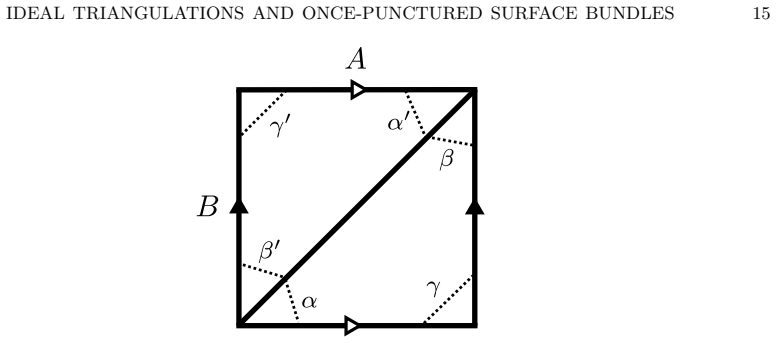
- [Theorem 3.8] The proof of Theorem 3.8 relies on several unstated normal-arc counting relations. In particular, the reduction 'up to reflective symmetry of the material boundary and relabeling the edges and possibly performing a 2-2 move on P, it can be assumed 0\le m\le n. Thus we need only to prove the result when \partial S has normal arc types of \alpha,\alpha',\gamma,\gamma'' is asserted without proof, and the subsequent case counts (for example, in Case 1 'we must have x_{\beta'}=x_\alpha. Thus we have exactly x_\gamma=x_{\gamma'}=1' and in Case 5 'x_\gamma=x_{\gamma'}=m') are given without showing the solutions of the boundary equations and the square-pyramid gluing equations. Since compatibility of S is the property on which Theorem 3.9 and both main algorithms depend, these counts need to be derived explicitly or stated as a separate lemma.
- [Lemma 3.5] The three-branch case of Lemma 3.5 is compressed. After a single site-swap at a face between a band tetrahedron and a branch-point tetrahedron, the proof states that 'this implies T'' is an inflation triangulation with two branches', but it does not verify that the new cell decomposition has normal boundary, that no crossing tetrahedra are introduced, or that the branch structure is as claimed. Because this lemma is used to produce the short inflations on which all later results are built, a fuller verification is needed.
minor comments (6)
- [Section 4, Theorem 4.2 proof] The word 'carnality' should be 'cardinality', and 'betti' should be capitalized as 'Betti'.
- [Section 3.3, Theorem 3.8 Case 4] The symbol 'y'_\gamma' is not defined; it should presumably be 'y_{\gamma'}'.
- [Section 3.3, Lemma 3.6] The phrase 'a the torus' should be 'a torus'.
- [References] In the text, reference [26] is cited as 'Jaco and Segdwick'; the correct spelling is 'Sedgwick', as in the bibliography.
- [Section 5, Example 5.2] The name 'Thistlewaite' should be 'Thistlethwaite', and in Section 5.1 'Example 2' should be 'Example 5.2'.
- [Section 2.2, Remark 2.7] The remark would benefit from stating precisely whether the 'sum' is a Haken sum or a formal vector sum, and what role multiplicities play, since the ambiguity directly affects the algorithm in Theorem 4.2.
Circularity Check
No significant circularity: the main construction and identification steps do not reduce to the paper's inputs; the one flagged issue in Theorem 4.2 is a correctness gap, not a circular argument.
full rationale
I walked the derivation chain from Lemma 2.6 through Theorems 3.8, 3.9, 4.1, and 4.2. The central construction is genuinely self-contained relative to external normal-surface results: Lemma 2.6 is proved from Tollefson-Wang's lw-taut surface theory, Jaco-Sedgwick's least-weight face theorem, and the standard fiber-detection fact Lemma 2.2; Theorem 3.8 uses a case analysis on normal disc types in a short inflation; and Theorem 3.9 derives the spun-normal Q-matching equations from the inflation geometry plus Tollefson and Kang's uniqueness theorem. The only author self-citation that is load-bearing is the appeal in Theorem 3.9 to 'the same arguments of Lemma 3.4 in [6]' for crushing normal discs to discs in the truncated cell decomposition. That is a prior published result by the author with Jaco and Rubinstein, it is not a restatement of the target theorem, and it is externally falsifiable, so it does not constitute circularity. The one genuine concern is non-circular: in the proof of Theorem 4.2, the algorithm includes 'all sums of the form sum_{i in J} F_i where J subset I of carnality less than beta_1', while Remark 2.7 only guarantees a representation by a collection of vertex solutions indexed by i <= beta_1, possibly with multiplicities. This mismatch means the search class may omit the guaranteed representation; it is a potential correctness gap, not an equivalence between the conclusion and the hypotheses. No equation is defined in terms of the claimed output, no fitted parameter is renamed as a prediction, and no uniqueness theorem from the author's own prior work is used to force the construction. Therefore I find no circular step and assign score 0.
Assumptions & free parameters
assumptions (6)
- domain assumption M is a compact, connected, irreducible, ∂-irreducible, atoroidal, orientable 3-manifold with non-empty connected boundary homeomorphic to a torus, and M fibers over the circle with once-punctured fiber.
- standard math Haken's normal surface theorem (Theorem 2.1): every incompressible, ∂-incompressible surface in a compact irreducible 3-manifold is isotopic to a normal surface.
- standard math Tollefson-Wang existence of lw-taut normal surfaces and taut carriers (Lemmas 2.3, 2.4 and Corollary 4.2 of [43]).
- standard math Jaco-Rubinstein crushing and inflation theorems (Theorem 3.1 and [23]).
- standard math Tollefson and Kang Q-matching theory: admissible solutions to the Q-matching equations correspond to unique normal or spun-normal surfaces.
- domain assumption The fiber can be represented as a sum of at most beta_1 vertex solutions (Remark 2.7, citing [41, 43]).
Cite this review
Pith. "Pith review of Ideal Triangulations and Once-Punctured Surface Bundles." pith.science (2026). https://pith.science/paper/CE367YKD
@misc{pith2026250521798,
  author       = {Pith},
  title        = {Pith review of: Ideal Triangulations and Once-Punctured Surface Bundles},
  year         = {2026},
  howpublished = {\url{https://pith.science/paper/CE367YKD}},
  note         = {Machine review of arXiv:2505.21798}
}
abstract
A well-known result of Walsh states that if $\mathcal T^*$ is an ideal triangulation of an atoroidal, acylindrical, irreducible, compact 3-manifold with torus boundary components, then every properly embedded, two-sided, incompressible surface $S$ is isotopic to a spun-normal surface unless $S$ is isotopic to a fiber or virtual fiber. Previously it was unknown if for such a 3-manifold an ideal triangulation in which a fiber spun-normalizes exists. We give a proof of existence and give an algorithm to construct the ideal triangulation provided the 3-manifold has a single boundary component.
Figures


Figures from the paper (8 more)



Reference graph
Works this paper leans on
-
[1]
Ideal triangulations of pseudo-anosov mapping tori,
I. Agol, “Ideal triangulations of pseudo-anosov mapping tori,”Topology and geometry in di- mension three, vol. 560, pp. 1–17, 2011
work page 2011
-
[2]
The virtual haken conjecture (with an appendix by ian agol, daniel groves and jason manning)
——, “The virtual haken conjecture (with an appendix by ian agol, daniel groves and jason manning).”Documenta Mathematica, vol. 18, pp. 1045–1087, 2013
work page 2013
-
[3]
Armentrout,Cellular decompositions of 3-manifolds that yield 3-manifolds
S. Armentrout,Cellular decompositions of 3-manifolds that yield 3-manifolds. American Math- ematical Soc., 1971, no. 107
work page 1971
-
[4]
A boundary criterion for cubulation,
N. Bergeron and D. T. Wise, “A boundary criterion for cubulation,”American Journal of Mathematics, vol. 134, no. 3, pp. 843–859, 2012
work page 2012
-
[5]
An alternative proof that 3-manifolds can be triangulated,
R. H. Bing, “An alternative proof that 3-manifolds can be triangulated,”Annals of Mathemat- ics, vol. 69, p. 37, 1959
work page 1959
-
[6]
Efficient triangulations and boundary slopes,
B. Bryant, W. Jaco, and J. H. Rubinstein, “Efficient triangulations and boundary slopes,” Topology and its Applications, vol. 297, p. 107689, 2021
work page 2021
-
[7]
Converting between quadrilateral and standard solution sets in normal surface theory,
B. Burton, “Converting between quadrilateral and standard solution sets in normal surface theory,”Algebraic & Geometric Topology, vol. 9, 01 2009. 30 B. BRYANT
work page 2009
-
[8]
A tree traversal algorithm for decision problems in knot theory and 3-manifold topology,
B. Burton and M. Ozlen, “A tree traversal algorithm for decision problems in knot theory and 3-manifold topology,”Algorithmica, vol. 65, 10 2010
work page 2010
Show all 45 references
-
[9]
The pachner graph and the simplification of 3-sphere triangulations,
B. A. Burton, “The pachner graph and the simplification of 3-sphere triangulations,” in Proceedings of the Twenty-Seventh Annual Symposium on Computational Geometry, ser. SoCG ’11. New York, NY, USA: Association for Computing Machinery, 2011, p. 153–162. [Online]. Available: h...
2011
-
[10]
Regina: Software for low-dimensional topol- ogy,
B. A. Burton, R. Budney, W. Pettersson,et al., “Regina: Software for low-dimensional topol- ogy,”http://regina-normal.github.io/, 1999–2023, version 7.3
1999
-
[11]
The thurston norm via spun-normal immersions,
D. Cooper, S. Tillmann, and W. Worden, “The thurston norm via spun-normal immersions,” Transactions of the American Mathematical Society, Series B, vol. 12, no. 06, pp. 191–236, 2025
2025
-
[12]
SnapPy, a computer program for studying the geometry and topology of 3-manifolds,
M. Culler, N. M. Dunfield, M. Goerner, and J. R. Weeks, “SnapPy, a computer program for studying the geometry and topology of 3-manifolds,” Available at http://snappy.computop.org (11/11/2024), version 3.1.1
2024
-
[13]
Canonical triangulations of surface bundles,
N. Dunfield, “Canonical triangulations of surface bundles,” Available online at https://dunfield. wordpress.com/2009/08/20/canonical-triangulations-of-surface-bundles/, 2009
2009
-
[14]
Group actions on fibered three-manifolds,
A. L. Edmonds and C. Livingston, “Group actions on fibered three-manifolds,”Commentarii Mathematici Helvetici, vol. 58, pp. 529–542, 1983
1983
-
[15]
Euclidean decompositions of noncompact hyperbolic mani- folds,
D. B. Epstein and R. C. Penner, “Euclidean decompositions of noncompact hyperbolic mani- folds,”Journal of Differential Geometry, vol. 27, no. 1, pp. 67–80, 1988
1988
-
[16]
Guts of surfaces and the colored jones polynomial,
D. Futer, E. Kalfagianni, and J. Purcell, “Guts of surfaces and the colored jones polynomial,” Lecture Notes in Mathematics, vol. 2069, 08 2011
2011
-
[17]
The 3D-index and normal surfaces,
S. Garoufalidis, C. D. Hodgson, N. R. Hoffman, and J. H. Rubinstein, “The 3D-index and normal surfaces,”Illinois Journal of Mathematics, vol. 60, no. 1, pp. 289 – 352, 2016. [Online]. Available: https://doi.org/10.1215/ijm/1498032034
2016
-
[18]
Theorie der normalfl¨ achen,
W. Haken, “Theorie der normalfl¨ achen,”Acta Mathematica, vol. 105, pp. 245–375, 1961
1961
-
[19]
The first 1,701,936 knots,
J. Hoste, M. Thistlethwaite, and J. Weeks, “The first 1,701,936 knots,”Math. Intelligencer, vol. 20, no. 4, pp. 33–48, 1998
1998
-
[20]
An algorithm to decide if a 3-manifold is a haken manifold,
W. Jaco and U. Oertel, “An algorithm to decide if a 3-manifold is a haken manifold,”Topology, vol. 23, no. 2, pp. 195–209, 1984
1984
-
[21]
0-efficient triangulations of 3-manifolds,
W. Jaco and H. Rubenstein, “0-efficient triangulations of 3-manifolds,”Journal of Differential Geometry, vol. 65, pp. 61–168, 2003
2003
-
[22]
Layered-triangulations of 3-manifolds,
——, “Layered-triangulations of 3-manifolds,”arXiv:math/0603601, 2006
2006 arXiv
-
[23]
Inflations of ideal triangulations,
——, “Inflations of ideal triangulations,”Advances in Mathematics, vol. 267, pp. 176–224, 2014
2014
-
[24]
Finding planar surfaces in knot- and link- manifolds,
W. Jaco, H. Rubinstein, and E. Sedgwick, “Finding planar surfaces in knot- and link- manifolds,”Journal of Knot Theory and Its Ramifications, vol. 18, pp. 397–446, 09 2006
2006
-
[25]
On minimal ideal triangulations of cusped hyperbolic 3-manifolds,
W. Jaco, H. Rubinstein, J. Spreer, and S. Tillmann, “On minimal ideal triangulations of cusped hyperbolic 3-manifolds,”Journal of Topology, vol. 13, no. 1, pp. 308–342, 2020
2020
-
[26]
Decision problems in the space of dehn fillings,
W. Jaco and E. Sedgwick, “Decision problems in the space of dehn fillings,”Topology, p. 906, 2003
2003
-
[27]
Algorithms for the complete decomposition of a closed 3- manifold,
W. Jaco and J. L. Tollefson, “Algorithms for the complete decomposition of a closed 3- manifold,”Illinois journal of mathematics, vol. 39, no. 3, pp. 358–406, 1995
1995
-
[28]
Normal surfaces in non-compact 3-manifolds,
E. Kang, “Normal surfaces in non-compact 3-manifolds,”Journal of the Australian Mathemat- ical Society, vol. 78, pp. 305 – 321, 2005
2005
-
[29]
Note on spun normal surfaces in 1-efficient ideal triangulations,
E. Kang and H. Rubinstein, “Note on spun normal surfaces in 1-efficient ideal triangulations,” Proceedings of the Japan Academy, Series A, Mathematical Sciences, vol. 91, pp. 118–122, 08 2015
2015
-
[30]
Essential normal and spun normal surfaces in 3-manifolds,
——, “Essential normal and spun normal surfaces in 3-manifolds,”Proceedings of the American Mathematical Society, vol. 146, p. 1, 12 2017
2017
-
[31]
Ideal triangulations of 3-manifolds II: taut and angle struc- tures,
E. Kang and J. H. Rubinstein, “Ideal triangulations of 3-manifolds II: taut and angle struc- tures,”Algebraic & Geometric Topology, vol. 5, no. 4, pp. 1505–1533, 2005
2005
-
[32]
Kitayama,A Survey of the Thurston Norm
T. Kitayama,A Survey of the Thurston Norm. Cham: Springer International Publishing, 2022, pp. 149–199. IDEAL TRIANGULATIONS AND ONCE-PUNCTURED SURF ACE BUNDLES 31
2022
-
[33]
Taut ideal triangulations of 3-manifolds,
M. Lackenby, “Taut ideal triangulations of 3-manifolds,” inGeometry and Topology, vol. 4, 2000, pp. 369–395
2000
-
[34]
Affine structures in 3-manifolds: V. the triangulation theorem and hauptvermutung,
E. E. Moise, “Affine structures in 3-manifolds: V. the triangulation theorem and hauptvermutung,”Annals of Mathematics, vol. 56, no. 1, pp. 96–114, 1952. [Online]. Available: http://www.jstor.org/stable/1969769
1952
-
[35]
Knot groups,
L. P. Neuwirth, “Knot groups,”Annals of Mathematics Studies.(AM-56), 1965
1965
-
[36]
Bistellare ¨ aquivalenz kombinatorischer mannigfaltigkeiten,
U. Pachner, “Bistellare ¨ aquivalenz kombinatorischer mannigfaltigkeiten,”Archiv der Mathe- matik, vol. 30, pp. 89–98, 1978
1978
-
[37]
An algorithm to recognize the 3-sphere,
J. H. Rubinstein, “An algorithm to recognize the 3-sphere,” inProceedings of the International Congress of Mathematicians, S. D. Chatterji, Ed. Basel: Birkh¨ auser Basel, 1995, pp. 601–611
1995
-
[38]
Approximating cellular maps by homeomorphisms,
L. C. Siebenmann, “Approximating cellular maps by homeomorphisms,”Topology, vol. 11, no. 3, pp. 271–294, 1972
1972
-
[39]
The Sage Developers,SageMath, the Sage Mathematics Software System (Version 9.5), 2022, https://www.sagemath.org
2022
-
[40]
Thin position and the recognition problem forS 3,
A. Thompson, “Thin position and the recognition problem forS 3,”Math. Res. Lett, vol. 1, no. 5, pp. 613–630, 1994
1994
-
[41]
A norm for the homology of 3-manifolds,
W. P. Thurston, “A norm for the homology of 3-manifolds,”Memoirs of the American Mathe- matical Society, vol. 59, pp. 99–130, 1986
1986
-
[42]
Normal surface Q-theory,
J. L. Tollefson, “Normal surface Q-theory,”Pacific Journal of Mathematics, vol. 183, pp. 359– 374, 1998
1998
-
[43]
Taut normal surfaces,
J. L. Tollefson and N. Wang, “Taut normal surfaces,”Topology, vol. 35, pp. 55–75, 1996
1996
-
[44]
Incompressible surfaces and spunnormal form,
G. S. Walsh, “Incompressible surfaces and spunnormal form,”Geometriae Dedicata, vol. 151, no. 1, pp. 221–231, 2011
2011
-
[45]
Worden, “Tnorm,” Personal blog at https://pypi.org/project/tnorm Version 1.0.5, 04/04/2023
W. Worden, “Tnorm,” Personal blog at https://pypi.org/project/tnorm Version 1.0.5, 04/04/2023
2023
Reviewed August 7, 2026 · model on record in the stance chip above.
Discussion (0). Continue with ORCID to comment.