REVIEW 3 major objections 5 minor 55 references
Analysis of the spectral symbol function for spectral approximation of a differential operator
T0 review · 3 major / 5 minor · reviewed 2026-08-14 · deepseek-v4-flash
Pith's one-line read A spectral symbol's shape sets a hard floor on eigenvalue error
desk verdict Uniform sampling of the GLT spectral symbol fails for relative eigenvalue accuracy; the paper has the right counterexample and a likely-true necessary condition, but the main theorem's proof has a gap. read the letter →
The pith
A machine-rendered reading of the paper's core claim, the machinery that carries it, and where it could break.
The reading
What carries the argument
The load-bearing object is the spectral symbol $\omega$ of the matrix sequence, a function on $[a,b]\times[0,\pi]$ whose level sets describe how the discrete eigenvalues distribute, together with its monotone rearrangement $\tilde{\omega}$, defined as the generalized inverse of the cumulative distribution $\varphi(t)=\mu\{(x,\theta):\omega(x,\theta)\le t\}/\mu(D)$. The discrete Weyl law (Theorem 3.4.1) is the mechanism that links the rearranged symbol to the ordered eigenvalues: an eigenvalue whose index is $k(n)$ with $k(n)/n\to x$ must approach $\tilde{\omega}(x)$. Comparing this limit with the exact Sturm-Liouville eigenvalue asymptotics $\lambda_k\sim k^2\pi^2/B^2$ yields the ratio $\tilde{\omega}(x)/(x^2\pi^2/B^2)$, which is exactly the quantity whose maximum controls the asymptotic relative error. The Liouville transformation is used to reduce the problem to a form where $B$ and the square profile $x^2\pi^2/B^2$ appear naturally.
What would settle it
Take the Euler-Cauchy operator with a fixed $\alpha$ and the 3-point central finite-difference scheme, compute $\max_{k\le n}|\lambda_k^{(n)}/\lambda_k-1|$ for increasing $n$, and compare it with the predicted $\max_{x\in[0,1]}|\tilde{\omega}(x)/(x^2\pi^2)-1|$; if the observed maximum converges to a strictly smaller limit, the lower bound in Theorem 5.1.1 is false.
Extended reading notes
Core claim
For a regular Sturm-Liouville problem of the form $-\partial_x(p(x)\partial_x u)+q(x)u=\lambda w(x)u$ with separated boundary conditions, any matrix method whose weighted discretization has spectral symbol $\omega$ must obey the following: the limit of the maximum relative eigenvalue error cannot be smaller than the maximum deviation of the symbol's monotone rearrangement $\tilde{\omega}$ from the square profile $x^{2}\pi^{2}/B^{2}$, where $B=\int_a^b \sqrt{w/p}\,dx$. If the method has no outlier eigenvalues for large $n$, this lower bound is an equality. Consequently a method satisfying the usual pointwise convergence for each fixed eigenvalue can still fail to approximate the spectrum uniformly: the relative error is forced to stay positive whenever the symbol rearrangement departs from the Laplacian-like profile. The paper exhibits this failure explicitly for the Euler-Cauchy operator with 3-point finite differences, where $\tilde{\omega}(x)\neq x^2\pi^2$ and the analytic relative error for eigenvalue $k$ tends to $\alpha/(4k^2\pi^2+\alpha)>0$.
Load-bearing premise
The proof's quantile-matching step assumes that the discrete eigenvalue closest to a symbol value $\tilde{\omega}(x)$ has index $k(n)$ with $k(n)/n\to x$, a step asserted rather than fully justified; the sufficiency half is additionally supported only by numerical experiments.
Editorial extensions
If this is right
- Any discretization whose symbol rearrangement deviates from $x^2\pi^2/B^2$ on a set of positive measure cannot approximate all eigenvalues uniformly in relative error, however fine the mesh.
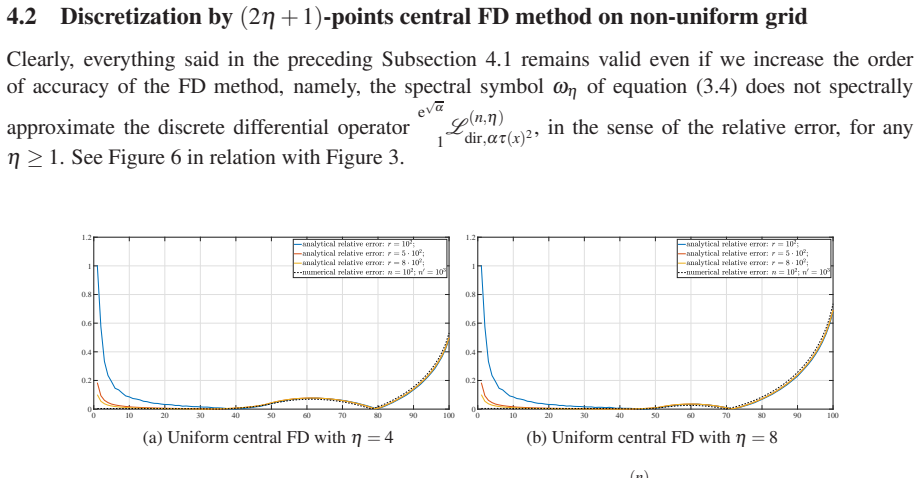
- On a uniform grid, raising the order $\eta$ of a finite-difference or IgA scheme does not automatically help: for each fixed $\eta$ the maximum relative error has a positive lower bound in the Euler-Cauchy case.
- A uniform sampling of the spectral symbol can be visually perfect while carrying a fixed positive relative error for the first eigenvalues, so symbol-based eigenvalue estimates need a relative-error check, not just an absolute-error check.
- In the absence of outliers, the computable quantity $\max_x|\tilde{\omega}(x)/(x^2\pi^2/B^2)-1|$ gives the exact asymptotic maximum relative error, making the necessary condition a practical diagnostic.
- When the grid is chosen from the symbol (via the Liouville diffeomorphism) and the approximation order increases, the observed maximum relative error tends to zero, so the condition appears sufficient in that setting.
Reading between the lines
- A practical design rule follows from the paper's mismatch formula: choose the grid map $\tau$ so that the symbol's rearrangement becomes $x^2\pi^2/B^2$, then increase order to shrink the residual error; the Euler-Cauchy computation is one template, and the same rule could be tested on other Sturm-Liouville coefficients.
- For higher-dimensional operators the analogous condition would compare the symbol's rearrangement with the exact spectrum quantile function (the paper sketches the 2D Laplacian); checking it on discretizations of the Laplace-Beltrami operator or wave-control problems would be a natural next test.
- The equality in Theorem 5.1.1 should persist after removing the fixed number of outlier eigenvalues in IgA methods; a careful outlier-excluded numerical study would turn the current validation into a sharper test.
- If the observed sufficiency holds generally, symbol-based analysis could be used to design spectrally accurate schemes for applications such as structural vibration and uniform observability, where uniform eigenvalue fidelity matters more than pointwise convergence.
Signed reviews
Editorial analysis
A structured set of objections, weighed in public.
Referee Report
Summary. The paper studies, for a regular one-dimensional Sturm-Liouville problem discretized by a matrix method, what information the GLT spectral symbol carries about relative spectral approximation. It proves a necessary condition (Theorem 5.1.1): the limit of the maximum relative eigenvalue error is bounded below by max_{x in [0,1]} |tilde_omega(x)/(x^2 pi^2 / B^2) - 1|, with equality if there are no outliers. It also argues, with numerical experiments on Euler-Cauchy problems, that a uniform sampling of the monotone rearrangement of the spectral symbol does not in general give an accurate relative approximation of the continuous spectrum, and that the condition becomes numerically sufficient when a suitable non-uniform grid and increasing method order are used. The L1 coefficient case is presented as an example where even absolute error diverges.
Significance. If the main theorem is fully established, the paper gives a simple, machine-checkable necessary condition for uniform relative spectral approximation, and it sharpens the known informal reading of the spectral symbol as an eigenvalue approximation tool. The Euler-Cauchy example is analytically explicit and the numerical experiments in Tables 4, 6, and 8 directly test the claimed equality. The paper also correctly distinguishes the necessary condition from the heuristic sufficiency statements, and it honestly labels the sufficiency part as numerical evidence rather than a theorem. The limitations are that the central proof has a real gap at the quantile-matching step, and two auxiliary results are either skipped or asserted without proof.
major comments (3)
- [Section 5.1, proof of Theorem 5.1.1] The proof defines k(n) by sigma_n(k(n))=1, i.e. as the index whose weighted eigenvalue is closest to tilde_omega(x), and then asserts that Theorem 3.4.1 gives k(n)/n -> x. However, Theorem 3.4.1, especially equation (3.12), is only a forward quantile statement: if k(n)/n ~ x and lambda_{k(n)} lies in R_omega, then lambda_{k(n)} ~ tilde_omega(x). It does not say that the eigenvalue closest to tilde_omega(x) has that quantile index. If tilde_omega has a flat segment or jump, the closest eigenvalue can correspond to a different index ratio, and the subsequent identity lambda_{k(n)} ~ (k(n)^2 pi^2 / B^2) may fail. This is exactly the step connecting the spectral distribution to the relative error, so the proof of the lower bound is incomplete as written. The equality statement under the no-outlier assumption also needs a uniform version of Corollary 3.4.1, which is only sketched.
- [Section 4.4, L1 example] The L1 example asserts that the spectral symbol theorem for the 3-point finite difference discretization 'works fine' for p(x) = x^{-1/2} in L1, citing [24, Theorem 10.5]. The divergence result (4.21) and the estimate (4.18) depend on this extension, but no proof or specific reference for the L1 extension is provided. Since this is the basis for the stronger claim that even absolute error diverges, the extension should be proved or replaced by a precise citation with the stated hypotheses.
- [Section 3.2 and Appendix A; Corollary 5.1.4] The proof of Theorem 3.2.1(i) is omitted, and Corollary 5.1.4's proof is skipped with the sentence 'It can be proved by direct computation ... we skip the details.' Both statements are load-bearing for the applicability of Theorem 5.1.1 to the FD and IgA methods. The fixed-k convergence in Theorem 3.2.1(i) is hypothesis (a) of Proposition 5.1.1, and Corollary 5.1.4 is what guarantees that the condition (5.3) is actually verified for the methods of Sections 3.2 and 3.3. Please supply complete proofs or precise references that cover exactly these hypotheses.
minor comments (5)
- [Section 3.3] The section heading contains the typo 'B-slpine'; it should read 'B-spline'.
- [Definition 4.0.1 and Section 4.1] The numerical relative error alpha_err_k^{(n)} is defined with a reference discretization of size n' >> n, while Theorem 5.1.1 compares against the continuous eigenvalues lambda_k(L). Please clarify the relation between these two definitions, since Tables 2 and 4 use different comparisons.
- [Section 4.4 and Figure 12] Figure 12's caption says 'discrete differential operator' where it appears to mean the eigenvalues of the discrete matrix; the wording is confusing.
- [Section 4.1] The phrase 'We loose convergence even for the absolute error' should read 'We lose convergence'.
- [Abstract] The phrase 'we disprove that in general a uniform sampling of the spectral symbol can provide an accurate relative approximation' is stronger than what the text shows; the paper gives counterexamples for specific methods and symbols, not a proof that no method can have this property. Consider softening to 'we show by examples that...'.
Circularity Check
No circularity: the spectral-symbol necessary condition is derived from external GLT and Weyl-law inputs, with exact benchmarks and no fitted-parameter predictions.
full rationale
The derivation chain is self-contained and non-circular. The monotone rearrangement (3.9)-(3.10) is defined from the GLT spectral symbol, whose existence is an external input (Definition 3.1.1 and Proposition 3.1.1 from [24]); Theorem 3.4.1 then derives the empirical-quantile relation from the spectral distribution and weak clustering, not from the theorem to be proved. Theorem 5.1.1 combines that relation with the classical Weyl law for the continuous operator, so the lower bound is a consequence of two independent asymptotic statements, not an input. The Euler-Cauchy computation (4.6)-(4.7) uses the exact eigenvalues lambda_k = k^2 pi^2 + alpha/4 and the small-x asymptotics of the rearrangement; no parameter is fitted and the benchmark is exact. The numerical validations compare against exact eigenvalues, and the claimed sufficiency of non-uniform grids is explicitly hedged as numerical evidence ('seems', 'numerical evidences'), not as a proven result. Two honest gaps are present but they are not circularity: Theorem 5.1.1 proves the lower bound and then asserts equality without an explicit upper-bound argument, and its step 'by Theorem 3.4.1 k(n)/n -> x' uses the forward quantile relation in reverse, which may fail if omega_tilde has flat pieces or jumps; these are correctness risks, not feedback of conclusions into hypotheses.
Assumptions & free parameters
assumptions (5)
- domain assumption The discretization matrix sequence has a GLT spectral symbol omega and its monotone rearrangement omega_tilde is piecewise Lipschitz (Theorem 5.1.1 hypotheses (c)-(d)).
- domain assumption Regular Sturm-Liouville conditions p,p',w,w',q,(pw)',(pw)'' in C([a,b]), p,w>0, with separated BCs (Section 2).
- standard math Weyl's law lambda_k(L) ~ k^2 pi^2 / B^2 for regular Sturm-Liouville problems (equation (2.3)).
- standard math Theorem 3.4.1 (Discrete Weyl's law) and the underlying weak clustering result of GLT theory (Theorem 3.1.1), cited from [24] and [38].
- ad hoc to paper For the L1 example, the GLT symbol theorem extends to p in L1([0,1]) (Section 4.4).
Cite this review
Pith. "Pith review of Analysis of the spectral symbol function for spectral approximation of a differential operator." pith.science (2026). https://pith.science/paper/CEJTBOUP
@misc{pith2026190805788,
  author       = {Pith},
  title        = {Pith review of: Analysis of the spectral symbol function for spectral approximation of a differential operator},
  year         = {2026},
  howpublished = {\url{https://pith.science/paper/CEJTBOUP}},
  note         = {Machine review of arXiv:1908.05788}
}
abstract
Given a differential operator $\mathcal{L}$ along with its own eigenvalue problem $\mathcal{L}u = \lambda u$ and an associated algebraic equation $\mathcal{L}^{(n)} \mathbf{u}_n = \lambda\mathbf{u}_n$ obtained by means of a discretization scheme (like Finite Differences, Finite Elements, Galerkin Isogeometric Analysis, etc.), the theory of Generalized Locally Toeplitz (GLT) sequences serves the purpose to compute the spectral symbol function $\omega$ associated to the discrete operator $\mathcal{L}^{(n)}$ We prove that the spectral symbol $\omega$ provides a necessary condition for a discretization scheme in order to uniformly approximate the spectrum of the original differential operator $\mathcal{L}$. The condition measures how far the method is from a uniform relative approximation of the spectrum of $\mathcal{L}$. Moreover, the condition seems to become sufficient if the discretization method is paired with a suitable (non-uniform) grid and an increasing refinement of the order of approximation of the method. On the other hand, despite the numerical experiments in many recent literature, we disprove that in general a uniform sampling of the spectral symbol $\omega$ can provide an accurate relative approximation of the spectrum, neither of $\mathcal{L}$ nor of the discrete operator $\mathcal{L}^{(n)}$.
Figures


Figures from the paper (9 more)




Reference graph
Works this paper leans on
- [26]
- [1]
-
[2]
S. D. Algazin, Calculating the eigenvalues of ordinary differential equations. Comput. Math. Math. Phys. 35(4) (1995): 477–482
work page 1995
- [3]
-
[4]
Settani, A matrix method for the solution of Sturm-Liouville problem s
P Amodio, G. Settani, A matrix method for the solution of Sturm-Liouville problem s. JNAIAM 6(1-2) (2011): 1–13
work page 2011
- [5]
-
[6]
Y . Bazilevs, L. Beirao da V eiga, J. A. Cottrell, T. J. Hugh es, G. Sangalli, Isogeometric analysis: approximation, stability and error estimates for h-refined meshes. Math. Models Methods Appl. Sci. 16(07) (2006): 1031–1090
work page 2006
-
[7]
D. Bianchi, S. Serra-Capizzano, Spectral analysis of finite-dimensional approximations of 1d waves in non-uniform grids. Calcolo 55(47) (2018)
work page 2018
Show all 55 references
-
[8]
J. M. Bogoya, A. B¨ ottcher, S. M. Grudsky, E. A. Maximenko , Eigenvalues of Hermitian Toeplitz matrices with smooth simple-loop symbols . J. Math. Anal. Appl. 442(2): 1308–1334
-
[9]
B¨ ottcher, B
A. B¨ ottcher, B. Silbermann. Analysis of Toeplitz operators . Springer Science&Business Media (2013)
2013
-
[10]
Burago, S
D. Burago, S. Ivanov, Y . Kurylev,A graph discretization of the Laplace-Beltrami operator. J. Spectr. Theory 4(4) (2014): 675–714. 45
2014
-
[11]
Carasso, Finite-difference methods and the eigenvalue problem for n onselfadjoint Sturm- Liouville operators
A. Carasso, Finite-difference methods and the eigenvalue problem for n onselfadjoint Sturm- Liouville operators. Math. Comp. 23(108) (1969): 717–729
1969
-
[12]
Chiti, and C
G. Chiti, and C. Pucci, Rearrangements of functions and convergence in Orlicz spaces. Appl. Anal. 9(1) (1979): 23–27
1979
-
[13]
Boumenir, B
A. Boumenir, B. Chanane, Eigenvalues of S-L systems using sampling theory . Appl. Anal. 62(3-4) (1996): 323–334
1996
-
[14]
J. A. Cottrell, T. J. Hughes, Y . Bazilevs. Isogeometric analysis: toward integration of CAD and FEA. John Wiley & Sons, 2009
2009
-
[15]
Courant, K
R. Courant, K. Friedrichs, H. Lewy, ¨Uber die partiellen Differenzengleichungen der mathemati s- chen Physik. Math. Ann. 100(1) (1928): 32–74
1928
-
[16]
Di Benedetto, G
F. Di Benedetto, G. Fiorentino, S. Serra-Capizzano, CG preconditioning for Toeplitz matrices . Comput. Math. Appl. 25(6) (1993): 35–45,
1993
-
[17]
Donatelli, C
M. Donatelli, C. Garoni, C. Manni, S. Serra-Capizzano, Robust and optimal multi-iterative tech- niques for IgA Galerkin linear systems . CMAME 284 (2015): 230-264
2015
-
[18]
Donatelli, M
M. Donatelli, M. Mazza, S. Serra-Capizzano, Spectral analysis and structure preserving precondi- tioners for fractional diffusion equations . J. Comput. Phys. 307 (2016): 262-279
2016
-
[19]
Dumbser, F
M. Dumbser, F. Fambri, I. Furci, M. Mazza, S. Serra-Capi zzano, M. Tavelli, Staggered discon- tinuous Galerkin methods for the incompressible NavierSto kes equations: Spectral analysis and computational results. Numer. Linear Algebra Appl. 25(5) (2018): e2151
2018
-
[20]
S. E. Ekstr¨ om, I. Furci, C. Garoni, C. Manni, S. Serra-C apizzano, H. Speleers, Are the eigenvalues of the Bspline isogeometric analysis approximation of −∆ u = λ u known in almost closed form? Numer. Linear Algebra Appl. 25(5) (2018): e2198
2018
-
[21]
Ervedoza, A
S. Ervedoza, A. Marica, E. Zuazua, Numerical meshes ensuring uniform observability of onedi- mensional waves: construction and analysis . IMA J. Numer. Anal. 36 (2016): 503-542
2016
-
[22]
W. N. Everitt, A catalogue of Sturm-Liouville differential equations . In Sturm-Liouville Theory. Birkhuser Basel, 2005: 271–331
2005
-
[23]
Garoni, Spectral distribution of PDE discretization matrices from isogeometric analysis: the case of L 1 coefficients and non-regular geometry
C. Garoni, Spectral distribution of PDE discretization matrices from isogeometric analysis: the case of L 1 coefficients and non-regular geometry . J. Spectr. Theor. 8 (2018): 297–313
2018
-
[24]
Garoni, S
C. Garoni, S. Serra-Capizzano, Generalized Locally Toeplitz Sequences: Theory and Applic ations. Springer, Cham (2017)
2017
-
[25]
Garoni, S
C. Garoni, S. Serra-Capizzano, Generalized Locally Toeplitz Sequences: Theory and Applic ations, V olume II. Springer, Cham (2018)
2018
-
[27]
Gary, Computing eigenvalues of ordinary differential equationsby finite differences
J. Gary, Computing eigenvalues of ordinary differential equationsby finite differences . Math. Comp. 19(91) (1965): 365–379
1965
-
[28]
Grenander, G
U. Grenander, G. Szego. Toeplitz F orms and their Applications, 2nd ed. Chelsea, New Y ork, 1984
1984
-
[29]
T. J.-R. Hughes, J. A. Evans, A. Reali, Finite element and NURBS approximations of eigenvalue, boundary-value, and initial-value problems. CMAME 272 (2014): 290–320
2014
-
[30]
J. A. Infante, E. Zuazua, Boundary observability for the space semi discretizations of the 1-d wave equation. Math. Model. Num. Ann. 33 (1999): 407-438
1999
-
[31]
Li, General explicit difference formulas for numerical differ entiation
J. Li, General explicit difference formulas for numerical differ entiation. J. Comput. Appl. Math. 183(1) (2005): 29–52
2005
-
[32]
Limic, N
V . Limic, N. Limi´ c, Equidistribution, uniform distribution: a probabilist’s perspective. Probab. Surv. 15 (2018): 131–155
2018
-
[33]
V on Luxburg, M
U. V on Luxburg, M. Belkin, O. Bousquet, Consistency of spectral clustering . Ann. Statist. (2008): 555-586
2008
-
[34]
I. R. Khan, R. Ohba, Closed-form expressions for the finite difference approxim ations of first and higher derivatives based on Taylor series . J. Comput. Appl. Math. 107(2) (1999): 179–193
1999
-
[35]
Kunoth, T
A. Kunoth, T. Lyche, G. Sangalli, S. Serra-Capizzano. Splines and PDEs: From Approximation Theory to Numerical Linear Algebra . V ol. 2219 Springer (2018)
2018
-
[36]
Kravchenko, L
V . Kravchenko, L. J. Navarro, S. M. Torba, Representation of solutions to the one-dimensional Schr¨odinger equation in terms of Neumann series of Bessel functi ons. Appl. Math. Comput. 314 (2017): 173–192
2017
-
[37]
Kravchenko, S
V . Kravchenko, S. M. Torba, Analytic approximation of transmutation operators and app lications to highly accurate solution of spectral problems . J. Comput. Appl. Math. 275 (2015): 1–26
2015
-
[38]
Kuipers, H
L. Kuipers, H. Niederreiter. Uniform distribution of sequences. John Wiley & Sons, Inc., New Y ork (1974)
1974
-
[39]
Paine, F
J. Paine, F. R. de Hoog, R. S. Anderssen, On the correction of finite difference eigenvalue approxi- mations for Sturm-Liouville problems. Computing 26(2) (1981): 123–139
1981
-
[40]
J. D. Pryce, Numerical solution of Sturm-Liouville problems . Oxford University Press, 1993
1993
-
[41]
Puzyrev, Q
V . Puzyrev, Q. Deng, V . Calo, Spectral approximation properties of isogeometric analys is with variable continuity. CMAME 334 (2018): 22–39
2018
-
[42]
Rosasco, M
L. Rosasco, M. Belkin, E. De Vito, On learning with integral operators . J. Mach. Learn. Res. 11 (2010): 905–934
2010
-
[43]
I. S. Sargsjan, SturmLiouville and Dirac Operators . V ol. 59. Springer Science & Business Media, 2012. 47
2012
-
[44]
Serra-Capizzano, An ergodic theorem for classes of preconditioned matrices
S. Serra-Capizzano, An ergodic theorem for classes of preconditioned matrices . Linear Algebra Appl. 282(1–3) (1998): 161–183
1998
-
[45]
Serra-Capizzano, Generalized locally Toeplitz sequences: spectral analysi s and applications to discretized partial differential equations
S. Serra-Capizzano, Generalized locally Toeplitz sequences: spectral analysi s and applications to discretized partial differential equations. Linear Algebra Appl. 366 (2003): 371–402
2003
-
[46]
Serra-Capizzano, The GLT class as a generalized F ourier analysis and applicat ions
S. Serra-Capizzano, The GLT class as a generalized F ourier analysis and applicat ions. Linear Algebra Appl. 419 (2006) 180-233
2006
-
[47]
Sewell, The numerical solution of ordinary and partial differentia l equations
G. Sewell, The numerical solution of ordinary and partial differentia l equations . V ol. 75. John Wiley&Sons, 2005
2005
-
[48]
G. D. Smith, Numerical Solution of Partial Differential Equations: Fin ite Difference Methods, 3rd edn. Clarendon Press, Oxford (1985)
1985
-
[49]
Talenti, Rearrangements of functions and partial differential equa tions
G. Talenti, Rearrangements of functions and partial differential equa tions. Nonlinear Diffusion Problems. Springer, Berlin, Heidelberg (1986): 153–178
1986
-
[50]
Tilli, Locally Toeplitz sequences: spectral properties and appli cations
P . Tilli, Locally Toeplitz sequences: spectral properties and appli cations. Linear Algebra Appl. 278(1-3) (1998): 91–120
1998
-
[51]
Tyrtyshnikov, A unifying approach to some old and new theorems on distribut ion and cluster- ing
E.E. Tyrtyshnikov, A unifying approach to some old and new theorems on distribut ion and cluster- ing. Linear Algebra Appl. 232 (1996): 1–43
1996
-
[52]
Tyrtyshnikov, N
E.E. Tyrtyshnikov, N. Zamarashkin, Spectra of multilevel Toeplitz matrices: advanced Theory v ia simple matrix relationships. Linear Algebra Appl. 270 (1998): 15–27
1998
-
[53]
Widom, On the eigenvalues of certain Hermitian operators
H. Widom, On the eigenvalues of certain Hermitian operators . Trans. Amer. Math. Soc. 88(2) (1958): 491–522
1958
-
[54]
Zettl, Sturm-liouville theory
A. Zettl, Sturm-liouville theory. No. 121. American Mathematical Soc., 2005
2005
-
[55]
Zwillinger, Handbook of differential equations
D. Zwillinger, Handbook of differential equations. Gulf Professional Publishing, 1998. 48
1998
Reviewed August 14, 2026 · model on record in the stance chip above.
Discussion (0). Continue with ORCID to comment.