Packing Boundary-Anchored Rectangles and Squares
Pith reviewed 2026-05-25 13:29 UTC · model grok-4.3
The pith
A linear-time algorithm finds the maximum total area for packing boundary-anchored rectangles inside a square when points are pre-sorted.
A machine-rendered reading of the paper's core claim, the machinery that carries it, and where it could break.
Core claim
We show how to solve this problem in time linear in n, provided that the points of P are given in sorted order along the boundary of Q. We also consider the problem for anchoring squares and give an O(n^4)-time algorithm when the points in P lie on two opposite sides of Q.
What carries the argument
The linear-time algorithm that processes the boundary points in sorted order to select and place the anchored rectangles.
If this is right
- The maximum-area packing of anchored rectangles is computable in linear time under the sorted-input precondition.
- The same framework yields an O(n^4) solution for anchored squares restricted to opposite sides.
- Each point on the boundary can be used to anchor at most one rectangle or square in the optimal solution.
- The rectangles remain interior-disjoint and axis-aligned throughout the packing.
Where Pith is reading between the lines
- If sorting the points is the only extra cost, the overall problem remains efficient for moderate n.
- The method may generalize to other convex shapes with a clear boundary ordering.
- Applications requiring repeated packing queries could pre-sort the boundary once and then solve quickly.
Load-bearing premise
The points of P are already provided in sorted order along the boundary of the square.
What would settle it
An instance of sorted points on the square boundary for which the linear-time procedure returns a packing whose total area is strictly less than some other valid packing.
Figures


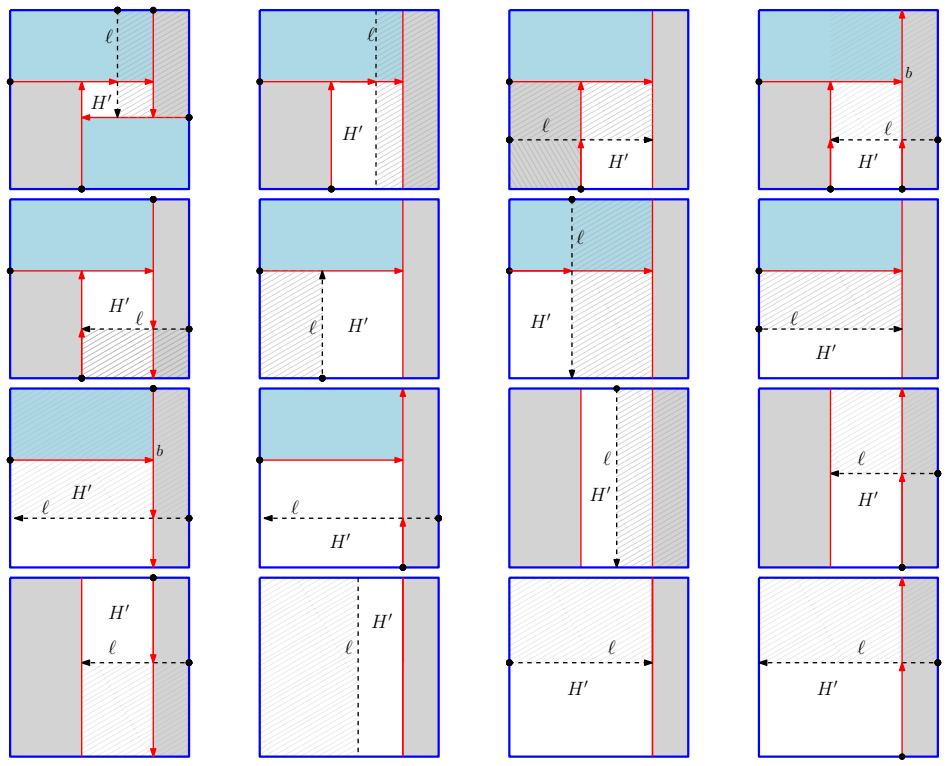


read the original abstract
Consider a set $P$ of $n$ points on the boundary of an axis-aligned square $Q$. We study the boundary-anchored packing problem on $P$ in which the goal is to find a set of interior-disjoint axis-aligned rectangles in $Q$ such that each rectangle is anchored (has a corner at some point in $P$), each point in $P$ is used to anchor at most one rectangle, and the total area of the rectangles is maximized. Here, a rectangle is anchored at a point $p$ in $P$ if one of its corners coincides with $p$. In this paper, we show how to solve this problem in time linear in $n$, provided that the points of $P$ are given in sorted order along the boundary of $Q$. We also consider the problem for anchoring squares and give an $O(n^4)$-time algorithm when the points in $P$ lie on two opposite sides of $Q$.
Editorial analysis
A structured set of objections, weighed in public.
Referee Report
Summary. The paper claims an O(n)-time algorithm for maximizing the total area of interior-disjoint axis-aligned rectangles anchored at n boundary points of a square Q, when the points are supplied already sorted along the boundary; it also claims an O(n^4)-time algorithm for the analogous problem in which the anchored shapes are squares and the points lie on two opposite sides of Q.
Significance. If the stated algorithms and their analyses are correct, the linear-time rectangle result is notable for achieving optimal time under an explicitly stated input precondition. The explicit precondition on sorted order is a strength that removes ambiguity about input representation. No machine-checked proofs or parameter-free derivations are present, but the direct algorithmic construction for a geometric packing problem constitutes a concrete contribution.
minor comments (1)
- Abstract: the claim that the points are 'given in sorted order' is load-bearing for the linear-time result; a single sentence indicating the high-level technique (e.g., dynamic programming along the boundary or greedy sweep) would make the abstract self-contained without lengthening it appreciably.
Simulated Author's Rebuttal
We thank the referee for their positive evaluation of the paper, for highlighting the strength of the explicit sorted-input precondition, and for recommending minor revision. No major comments were provided in the report.
Circularity Check
No significant circularity; direct algorithmic construction
full rationale
The paper claims an O(n) algorithm for maximum-area boundary-anchored rectangle packing (and O(n^4) for squares) when input points are explicitly preconditioned to be sorted along the boundary. This is a standard algorithmic result with no equations, fitted parameters, predictions of derived quantities, or self-citations invoked as load-bearing premises. The central claim reduces to a constructive algorithm whose correctness does not depend on re-deriving its own inputs or renaming prior results. No patterns from the enumerated circularity kinds apply.
Axiom & Free-Parameter Ledger
Reference graph
Works this paper leans on
-
[1]
Kevin Balas, Adrian Dumitrescu, and Csaba D. Tóth. Anchored rectangle and square packings. In proceedings of the 32nd International Symposium on Computational Geometry (SoCG 2016), Boston, MA, USA, pages 13:1–13:16, 2016. 1, 2, 3, 5, 17
work page 2016
-
[2]
Kevin Balas and Csaba D. Tóth. On the number of anchored rectangle packings for a planar point set. Theor. Comput. Sci., 654:143–154, 2016. 2
work page 2016
-
[3]
Biedl, Ahmad Biniaz, Anil Maheshwari, and Saeed Mehrabi
Therese C. Biedl, Ahmad Biniaz, Anil Maheshwari, and Saeed Mehrabi. Packing boundary- anchored rectangles. Inproceedings of the 29th Canadian Conference on Computational Geom- etry (CCCG 2016), Ottawa, Canada, 2017. 1
work page 2016
-
[4]
Adrian Dumitrescu and Csaba D. Tóth. Packing anchored rectangles.Combinatorica, 35(1):39– 61, 2015. 2
work page 2015
-
[5]
An efficient algorithm for finding a maximum weight 2-independent set on interval graphs.Inform
Ju Yuan Hsiao, Chuan Yi Tang, and Ruay Shiung Chang. An efficient algorithm for finding a maximum weight 2-independent set on interval graphs.Inform. Process. Lett., 43(5):229–235,
-
[6]
Elasticlabelsaroundtheperimeterofamap
ClaudiaIturriagaandAnnaLubiw. Elasticlabelsaroundtheperimeterofamap. J. Algorithms, 47(1):14–39, 2003. 2
work page 2003
-
[7]
Konstantinos G. Kakoulis and Ioannis G. Tollis. Labeling algorithms. In Roberto Tamassia, ed- itor, Handbook on Graph Drawing and Visualization., pages 489–515. Chapman and Hall/CRC,
-
[8]
J. Mark Keil, Joseph S. B. Mitchell, Dinabandhu Pradhan, and Martin Vatshelle. An algorithm for the maximum weight independent set problem on outerstring graphs. Comput. Geom., 60:19–25, 2017. 3
work page 2017
-
[9]
W. Tutte. Recent progress in combinatorics. Inproceedings of the 3rd Waterloo Conference on Combinatorics, 1968. 2
work page 1968
-
[10]
van Kreveld, Tycho Strijk, and Alexander Wolff
Marc J. van Kreveld, Tycho Strijk, and Alexander Wolff. Point labeling with sliding labels. Comput. Geom., 13(1):21–47, 1999. 2 18
work page 1999
discussion (0)
Sign in with ORCID, Apple, or X to comment. Anyone can read and Pith papers without signing in.