REVIEW 4 major objections 3 minor 35 references
Over-rotation intervals of bimodal interval maps
T0 review · 4 major / 3 minor · reviewed 2026-08-14 · deepseek-v4-flash
Pith's one-line read One formula lists every bimodal over-twist pattern.
desk verdict Solid explicit classification of N-bimodal over-twist patterns, but the proof outsources the key certification step to the companion preprint [BB19] and leaves a limiting argument for Z_f to the reader. read the letter →
The pith
A machine-rendered reading of the paper's core claim, the machinery that carries it, and where it could break.
The reading
What carries the argument
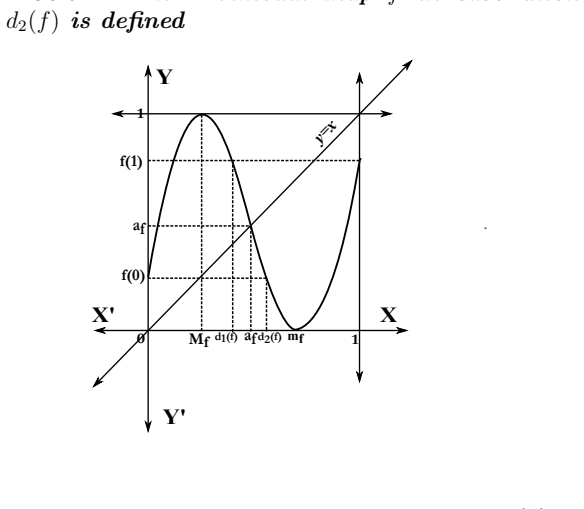
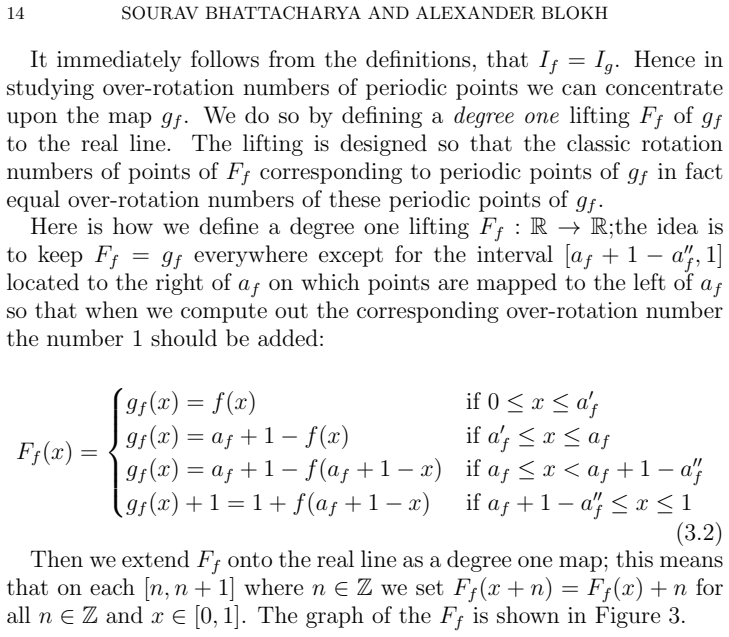
The central mechanism is a two-step transfer from the interval to the line. A discontinuous conjugacy sigma_f flips the part of [0,1] to the right of the fixed point a_f, producing a map g_f with the same over-rotation numbers as f; g_f is then lifted to a degree-one map F_f of the real line, and the lower envelope G_f(x) = inf{F_f(y) : y >= x} is the continuous non-strictly increasing function that carries the argument. Because G_f is monotone, every point has the same classical rotation number, and the property that F_f is 'eventually increasing' — for a dense set of levels there is a rightmost intersection with the graph — guarantees that G_f is continuous. The set Y_f, the union of intervals from which trajectories never enter the flat spots where G_f differs from F_f, localizes the minimal set Z_f. For the classification, the explicit permutations Pi_{r,p,q} encode the placement of the q orbit points among the four regions of Y_f: r points shift right by p, p points flip onto the right end, p points flip onto the left end, and q-2p-r points shift left.
What would settle it
Take the P-linear N-bimodal map realizing one of the listed permutations Pi_{r,p,q} and compute its over-rotation interval by iterating a point whose trajectory stays in Y_f; the paper predicts the interval is exactly [p/q, 1/2], so any wider interval would refute the endpoint claim. Alternatively, exhibit an N-bimodal over-twist pattern of over-rotation number p/q that is not gamma_{p/q} and not among the Pi_{r,p,q}; that would falsify the completeness of the classification.
Extended reading notes
Core claim
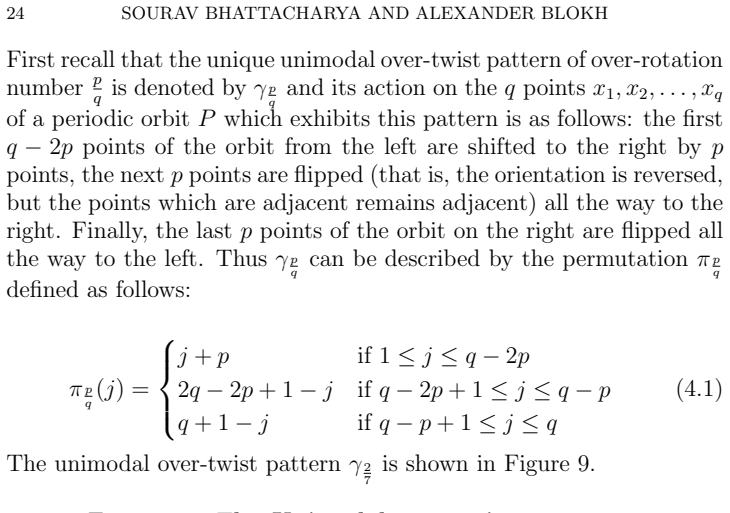
For every N-bimodal interval map f, the left endpoint rho_f of the over-rotation interval [rho_f, 1/2] coincides with the classical rotation number of the continuous monotone lift G_f, and it is assumed on a minimal f-invariant set Z_f contained in an explicitly described union Y_f of subintervals. When rho_f = p/q is rational, Z_f is a periodic orbit of period q whose over-rotation pair is the coprime pair (p,q), whose map is canonically conjugate to the rotation by p/q on one of its cycles, and whose pattern is an over-twist; when rho_f is irrational, Z_f is a Cantor set and f restricted to Z_f is at most two-to-one semi-conjugate to an irrational circle rotation. Combining this with the criterion that a convergent pattern with coprime over-rotation pair whose P-linear map has over-rotation interval exactly [p/q, 1/2] is an over-twist, the paper concludes that the N-bimodal over-twist patterns of over-rotation number p/q are exactly the unimodal pattern gamma_{p/q} and the bimodal permutations Pi_{r,p,q} for r = 1, ..., q-2p-1, with the remaining cases reducing to flips of the unimodal pattern.
Load-bearing premise
The list of over-twist patterns is complete only if the companion paper's theorem is correct: a convergent periodic pattern whose linear representative has coprime over-rotation pair and over-rotation interval exactly [p/q, 1/2] must be an over-twist.
Editorial extensions
If this is right
- For an N-bimodal map, the left endpoint rho_f is computable as the unique chi-rotation number of any point whose trajectory stays in the set Y_f, so the endpoint no longer requires inspecting the whole map.
- If rho_f is rational, the minimizing orbit is an over-twist with coprime over-rotation pair, and the map on that orbit is conjugate to a circle rotation, making the endpoint dynamically meaningful rather than merely numerical.
- If rho_f is irrational, the endpoint is realized on a Cantor minimal set, and the over-rotation interval still has the forced structure [rho_f, 1/2].
- For each rational p/q there are exactly q-2p-1 strictly bimodal oriented over-twist patterns, and these, together with the unimodal pattern, account for all N-bimodal over-twists.
- The same lower-envelope construction works for every well behaved map, so the mechanism for locating the left endpoint extends to a larger class of piecewise-monotone interval maps.
Reading between the lines
- The construction yields a finite procedure: from the branch points of an N-bimodal map one can locate Y_f and then read off rho_f from a single trajectory, so numerical experiments on families of maps could test the formula before any forcing theory is invoked.
- Whether 'eventually increasing' is also necessary for continuity of the lower envelope is not addressed; checking examples of multimodal maps that fail the condition could reveal whether the method extends beyond well behaved maps.
- The distinct permutations Pi_{r,p,q} for fixed p,q are natural candidates for the leaves of a forcing poset; if one verifies directly with the oriented graph construction that no two of them force each other, the over-twist status would follow without invoking the companion theorem.
- For small p and q one can compute the P-linear map's over-rotation interval directly and compare it with the predicted [p/q, 1/2], providing a concrete computational check of the classification.
Signed reviews
Editorial analysis
A structured set of objections, weighed in public.
Referee Report
Summary. The paper studies over-rotation intervals for bimodal interval maps of N-type and for a newly introduced class called well behaved maps. For an N-bimodal map f the authors construct a discontinuous degree-one lifting F_f and a continuous non-decreasing lower bound G_f ≤ F_f, and claim in Theorem 3.2 that the classical rotation number of G_f equals the left endpoint ρ_f of the over-rotation interval of f, and that ρ_f is realized on a minimal invariant set Z_f which is either a periodic orbit (with coprime over-rotation pair) or a Cantor set. Section 4 then gives a classification of N-bimodal over-twist patterns: the unimodal pattern γ_{p/q} together with patterns Π_{r,p,q} for r = 1, …, q − 2p − 1, with the proof relying on Theorem 4.1 quoted from the companion preprint [BB19]. Section 5 extends the construction to well behaved piecewise-monotone maps, proving that the lower bound function is continuous and stating an analogue of Theorem 3.2 plus a criterion for well behaved over-twist patterns. The paper also claims an algorithm for determining the left endpoint of the over-rotation interval by checking points whose orbits stay in an explicitly defined set Y_f.
Significance. If the main results are correct, the paper makes a substantial contribution to rotation theory for interval maps: it gives an explicit, computable description of N-bimodal over-twist patterns, a concrete algorithm for the left endpoint of the over-rotation interval for a natural class of bimodal maps, and a plausible extension to a broader class of polymodal maps. The explicit formulas (4.1) and (4.2) and the emphasis on a monotone lower-bound lifting G_f are strong and useful features of the paper. However, the significance is presently conditional: the central classification rests on an external companion theorem that is neither proved nor fully verified in the current text, and several key steps in the proofs of Theorems 3.2 and 5.5 are explicitly left to the reader. The paper therefore cannot be accepted in its present form, although the main ideas appear promising and the gaps seem fillable.
major comments (4)
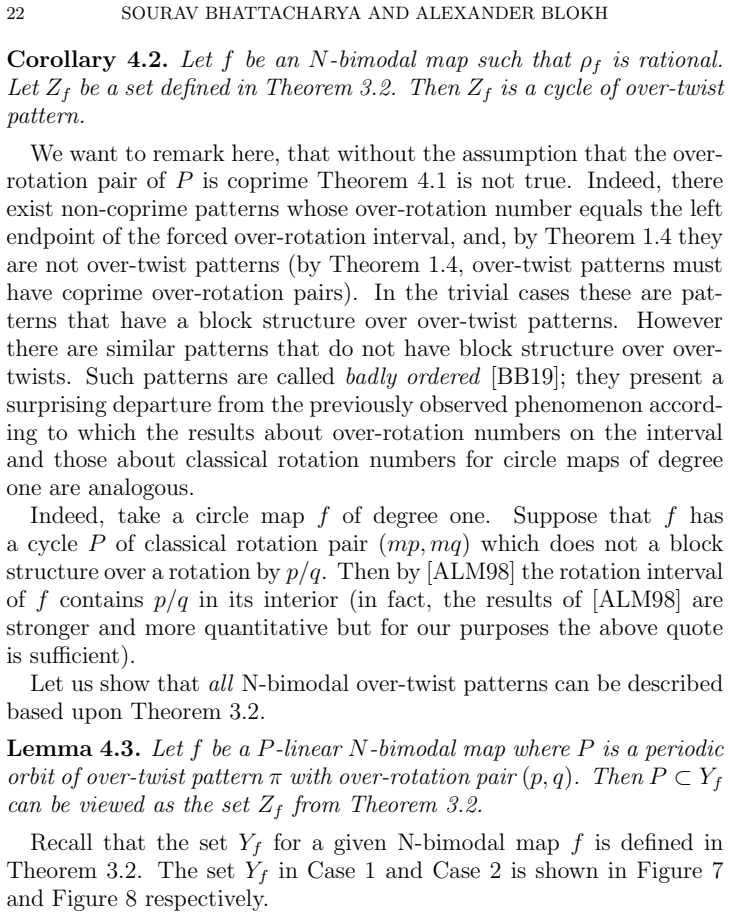
- [Section 4, Theorem 4.1 and Corollary 4.2] The statement that the pattern of Z_f is an over-twist pattern depends entirely on Theorem 4.1 of the companion preprint [BB19], which is quoted but not proved or included in this submission. Moreover, the two hypotheses of Theorem 4.1 are not verified in detail: convergence of the pattern of Z_f is not explicitly established, and the key assertion that the Z_f-linear map has over-rotation interval exactly [ρ_f, 1/2] is justified only by the sentence "This shows that the following theorem [BB19] applies" after Theorem 3.2. Since Corollary 4.2, Lemma 4.3 and Corollary 5.6 all inherit this dependency, the central classification of N-bimodal over-twist patterns is conditional on an unverified external statement. Please include a complete proof of Theorem 4.1 in this paper or make the companion preprint part of the refereed submission, and spell out the verification of its hypotheses for Z_f.
- [Section 3.2, Theorem 3.2, rational flat-spot case] In the proof of Theorem 3.2, the case where the periodic orbit A_f of the circle map passes through an endpoint of a flat spot is handled by choosing y very close to b and then passing to a limit periodic orbit Z_f of ψ_f(y). The existence of this limiting periodic orbit, its over-rotation pair being coprime, and the property that the Z_f-linear map has over-rotation interval [ρ_f, 1/2] are asserted but not proved; the final paragraph says the "remaining claims ... are left to the reader." These facts are load-bearing because they supply precisely the input needed for Theorem 4.1, so the proof needs to be completed rather than deferred.
- [Section 5, Theorem 5.5 and Corollary 5.6] The proof of Theorem 5.5 shows that F_f is eventually increasing and hence that G_f is continuous, but then states that "the remaining arguments literally repeat the arguments in the last part of the proof of Theorem 3.2 and are left to the reader." In the well behaved setting the map has a more general discontinuity structure and a canonical inverse h_f is introduced, so the transfer of the minimal-set construction from the N-bimodal case is not literally immediate and needs a full proof. Corollary 5.6 also relies on Theorem 4.1 and on arguments from Corollary 4.2 and Lemma 4.3, and the "if and only if" claim would require an explicit realization argument showing that every cycle P with P⊂Y_{f_P} is indeed an over-twist pattern.
- [Section 4, Lemma 4.3] In the proof of Lemma 4.3, the assertion that Z_f is disjoint from P is unsupported. From the failure of P⊂Y_f it does not follow that P and the set Z_f constructed in Theorem 3.2 are disjoint; all that follows is that P has a point outside Y_f. The subsequent claim that π forces a different pattern γ of the same over-rotation pair requires this disjointness, and hence the proof does not yet establish that every N-bimodal over-twist pattern must have the form Π_{r,p,q} or γ_{p/q}. Please supply a direct argument that Z_f cannot coincide with P in the case P⊄Y_f, or restructure the proof.
minor comments (3)
- [Throughout] There are several typographical errors, including "covergent" in Theorem 4.1, "oTf" in the proof of Theorem 5.5, "Nonlineraity" in reference [Blo94], "Case and Case 2" in Section 3.1, and "Y_f = K1(f)∪K2(f)∪K2(f)∪K3(f)∪K4(f)" with K2(f) repeated in the paragraph before equation (4.2).
- [Section 1.3, Theorem 1.5] The statement of Theorem 1.5 says "there exists η∈N" but the preceding definition defines the set M, not N; the symbol should be η∈M.
- [Section 5, Definition 5.1] In Definition 5.1 the assumption that the minimum and maximum of f are 0 and 1 is introduced with "Without loss of generality," but it is not explained why this normalization preserves the properties defining well behaved maps or the over-rotation interval; a brief justification would help.
Circularity Check
The central certification that the constructed Z_f patterns are over-twists is delegated to the same authors' companion preprint [BB19]; the completeness and enumeration claims inherit this unverified self-citation.
-
self citation load bearing
[Section 4, Theorem 4.1 and Corollary 4.2; also Section 5, Corollary 5.6]
"We use results of [BB19] to deduce then that the pattern of x′ is an over-twist. ... Theorem 4.1 ([BB19]). Let P be a cycle of covergent pattern π such that the P-linear map f has the over-rotation interval [ρ(P ), 1/2] ... Then the pattern π is over-twist. ... By Theorem 4.1 it follows that the pattern of Zf is an over-twist pattern."
The paper's central classification step—that the periodic orbit Z_f has an over-twist pattern, and therefore that the q−2p−1 enumeration in Section 4 is a classification of N-bimodal over-twist patterns—is not derived in this paper. It is reduced to Theorem 4.1 of [BB19], a same-day companion preprint by the same two authors. The theorem is quoted but not proved here, and it is not machine-checked or otherwise independently verified in the submission. Corollary 4.2, Lemma 4.3, and Corollary 5.6 all inherit this dependency, so the central claim rests on a load-bearing self-citation rather than on a self-contained argument.
full rationale
The construction of G_f and the equality ρ'_f = ρ_f in Theorem 3.2 are genuine new content: the inequality G_f ≤ F_f together with monotonicity of G_f yields the two bounds that pin ρ'_f to the left endpoint ρ_f, and the minimal set Z_f is constructed from the monotone circle semiconjugacy rather than assumed. However, the step that turns Z_f into an over-twist pattern is not self-contained: it invokes Theorem 4.1 from the authors' own companion preprint [BB19], and that same theorem is what allows Corollary 4.2 and Corollary 5.6 to certify the listed patterns as over-twists. Without that certification, the paper's enumeration gives candidate permutations, not a proved classification of all N-bimodal over-twist patterns. This is a load-bearing self-citation rather than a fitted-parameter or definitional circularity, so the score is substantial but not maximal.
Assumptions & free parameters
assumptions (5)
- standard math Theorem 1.4 (Blokh-Misiurewicz): the ordering on over-rotation pairs is a forcing order for interval maps.
- standard math Theorem 1.8 (Blokh): for piecewise-monotone maps with rho_f != 0 there is an invariant measure and a generic point with I_{f,chi} = {rho_f}.
- ad hoc to paper Theorem 4.1 (Bhattacharya-Blokh companion preprint [BB19], arXiv:1908.06145): a convergent pattern with coprime over-rotation pair whose P-linear map has over-rotation interval [rho(P),1/2] is an over-twist.
- domain assumption N-bimodal maps are required to satisfy f(M)=1 and f(m)=0 with a unique fixed point between turning points (Definition 3.1).
- domain assumption Well behaved maps satisfy f(x)>a_f on [M_f,a_f] and f(x)<a_f on [a_f,m_f] (Definition 5.1).
invented entities (4)
-
Lower-bound degree-one lifting G_f
-
Minimal invariant set Z_f
-
Class of well behaved maps
-
Admissible region Y_f
Cite this review
Pith. "Pith review of Over-rotation intervals of bimodal interval maps." pith.science (2026). https://pith.science/paper/CEWHDU5W
@misc{pith2026190807635,
  author       = {Pith},
  title        = {Pith review of: Over-rotation intervals of bimodal interval maps},
  year         = {2026},
  howpublished = {\url{https://pith.science/paper/CEWHDU5W}},
  note         = {Machine review of arXiv:1908.07635}
}
read the original abstract
We describe all possible bimodal over-twist patterns. In particular, we give an algorithm allowing one to determine what the left endpoint of the over-rotation interval of a given bimodal map is. We then define a new class of polymodal interval maps called well behaved, and generalize the above results onto well behaved maps.
Figures

Figures from the paper (8 more)




Reference graph
Works this paper leans on
- [1]
- [2]
-
[3]
Ll. Alsed\` a , J. Llibre and M. Misiurewicz, Combinatorial Dynamics and Entropy in Dimension One, Advanced Series in Nonlinear Dynamics (2nd edition) 5 (2000), World Scientific Singapore (2000)
work page 2000
-
[4]
Ll. Alsed\`a, J. Llibre, F. Ma\ nosas and M. Misiurewicz, Lower bounds of the topological entropy for continuous maps of the circle of degree one, Nonlinearity 1(1988), 463--479
work page 1988
-
[5]
J. Auslander, Y. Katznelson, Continuous maps of the circle without periodic points, Israel J. of Math. 32 (1979), 375--381
work page 1979
-
[6]
S.Baldwin, Generalisation of a theorem of Sharkovsky on prbits of continous real valued functions, Discrete Math. 67 (1987), 111--127
work page 1987
-
[7]
Very badly ordered cycles of interval maps
S. Bhattacharya, A. Blokh, Very badly ordered cycles of interval maps, preprint arXiv:1908.06145 (2019)
work page Pith review arXiv 2019
- [8]
Show all 35 references
-
[9]
Blokh, On transitive mappings of one-dimensional branched manifolds, (Russian), In: Differential-difference equations and problems of mathematical physics (Russian), Akad
A. Blokh, On transitive mappings of one-dimensional branched manifolds, (Russian), In: Differential-difference equations and problems of mathematical physics (Russian), Akad. Nauk Ukrain. SSR, Inst. Mat., Kiev (1984), 3–-9
1984
-
[10]
I, (Russian), Teor
, Dynamical systems on one-dimensional branched manifolds. I, (Russian), Teor. Funktsii Funktsional. Anal. i Prilozhen. 46(1986), 8--18; translation in J. Soviet Math. 48 (1990), no. 5, 500–-508
1986
-
[11]
II, (Russian), Teor
, Dynamical systems on one-dimensional branched manifolds. II, (Russian), Teor. Funktsii Funktsional. Anal. i Prilozhen. 47 (1987), 67--77; translation in J. Soviet Math. 48 (1990), no. 6, 668–-674
1987
-
[12]
III, (Russian), Teor
, Dynamical systems on one-dimensional branched manifolds. III, (Russian), Teor. Funktsii Funktsional. Anal. i Prilozhen. 48 (1987), 32--46; translation in J. Soviet Math. 49 (1990), no. 2, 875-–883
1987
-
[13]
, On Rotation Intervals for Interval Maps, Nonlineraity 7(1994), 1395--1417
1994
-
[14]
, The Spectral Decomposition for One-Dimensional Maps, Dynamics Reported 4 (1995), 1--59
1995
-
[15]
, Rotation Numbers, Twists and a Sharkovsky-Misiurewicz-type Ordering for Patterns on the Interval, Ergodic Theory and Dynamical Systems 15(1995), 1--14
1995
-
[16]
, Functional Rotation Numbers for One-Dimensional Maps, Trans. Amer. Math. Soc. 347(1995), 499--514
1995
-
[17]
Blokh, M
A. Blokh, M. Misiurewicz, A new order for periodic orbits of interval maps, Ergodic Theory and Dynamical Sys. 17(1997), 565-574
1997
-
[18]
, Rotating an interval and a circle, Trans. Amer. Math. Soc. 351(1999), 63--78
1999
-
[19]
Blokh, K
A. Blokh, K. Snider, Over-rotation numbers for unimodal maps, Journal of Difference Equations and Aplications 19(2013), 1108--1132
2013
-
[20]
Bobok, Twist systems on the interval, Fund
J. Bobok, Twist systems on the interval, Fund. Math. 175(2002), 97--117
2002
-
[21]
Bobok and M
J. Bobok and M. Kuchta X-minimal orbits for maps on the interval, Fund. Math. 156(1998), 33--66
1998
-
[22]
Chenciner, J.-M
A. Chenciner, J.-M. Gambaudo and C. Tresser Une remarque sur la structure des endo\-morphismes de degr\'e 1 du cercle, C. R. Acad. Sci. Paris, S\'er I Math. 299 (1984), 145--148
1984
-
[23]
Denker, C
M. Denker, C. Grillenberger, K. Sigmund, Ergodic theory on compact spaces, Lecture Notes in Mathematics 527(1976) Springer-Verlag, Berlin-New York
1976
-
[24]
Ito, Rotation sets are closed, Math
R. Ito, Rotation sets are closed, Math. Proc. Camb. Phil. Soc. 89(1981), 107--111
1981
-
[25]
J.Milnor and W.Thurston, On Iterated Maps on the Interval, Lecture Notes in Mathematics, Springer, Berlin 1342(1988), 465--520
1988
-
[26]
Misiurewicz, Periodic points of maps of degree one of a circle, Ergod
M. Misiurewicz, Periodic points of maps of degree one of a circle, Ergod. Th. & Dynam. Sys. 2(1982) 221--227
1982
-
[27]
, Formalism for studying periodic orbits of one dimensional maps, European Conference on Iteration Theory (ECIT 87), World Scientific Singapore (1989), 1--7
1989
-
[28]
, Combinatorial Patterns for maps of the interval, Mem. Amer. Math. Soc. 456(1990)
1990
-
[29]
Misiurewicz and K
M. Misiurewicz and K. Ziemian, Rotation Sets for Maps of Tori, J. Lond. Math. Soc. (2) 40(1989) 490--506
1989
-
[30]
Newhouse, J
S. Newhouse, J. Palis, F. Takens Bifurcations and stability of families of diffeomorphisms, Inst. Hautes \'Etudes Sci. Publ. Math. 57(1983), 5--71
1983
-
[31]
Poincar\'e, Sur les courbes d\'efinies par les \'equations diff\'erentielles, Oeuvres completes, 1 137--158, Gauthier-Villars, Paris (1952)
H. Poincar\'e, Sur les courbes d\'efinies par les \'equations diff\'erentielles, Oeuvres completes, 1 137--158, Gauthier-Villars, Paris (1952)
1952
-
[32]
Rhodes, C
F. Rhodes, C. Thompson, Rotation numbers for monotone functions on the circle, J. London Math. Soc. 34(1986), 360--368
1986
-
[33]
A. N. Sharkovsky, Coexistence of the cycles of a continuous mappimg of the line into itself, Ukraine Mat. Zh. 16(1964), 61--71 (Russian)
1964
-
[34]
A. N. Sharkovsky, Coexistence of the cycles of a continuous mapping of the line into itself, Internat. J. Bifur. Chaos Appl. Sci. Engrg. 5(1995), 1263--1273
1995
-
[35]
Ziemian, Rotation sets for subshifts of finite type, Fundam
K. Ziemian, Rotation sets for subshifts of finite type, Fundam. Math. 146(1995), 189--201
1995
Reviewed August 14, 2026 · model on record in the stance chip above.
Discussion (0). Continue with ORCID to comment.