V-TSN: A Software-Defined TSN Overlay for General-Purpose Networks
Pith reviewed 2026-06-29 01:50 UTC · model grok-4.3
The pith
V-TSN delivers gPTP synchronization and TSN traffic shaping as a software overlay on ordinary networks without dedicated hardware.
A machine-rendered reading of the paper's core claim, the machinery that carries it, and where it could break.
Core claim
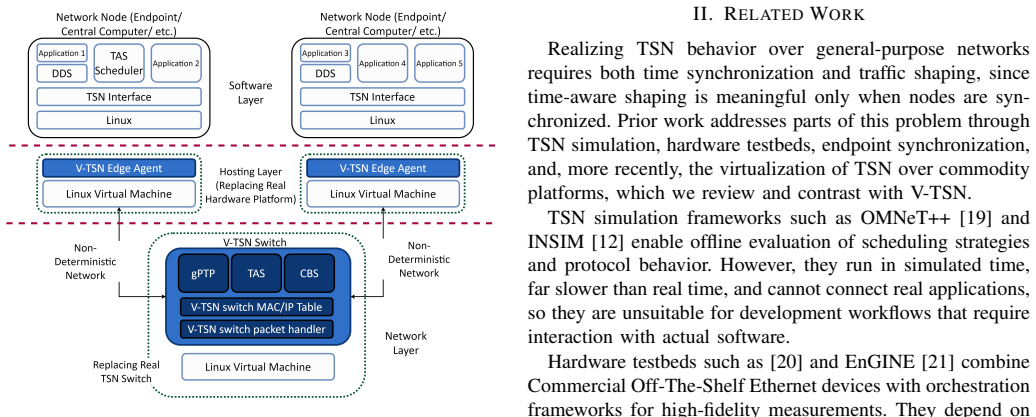
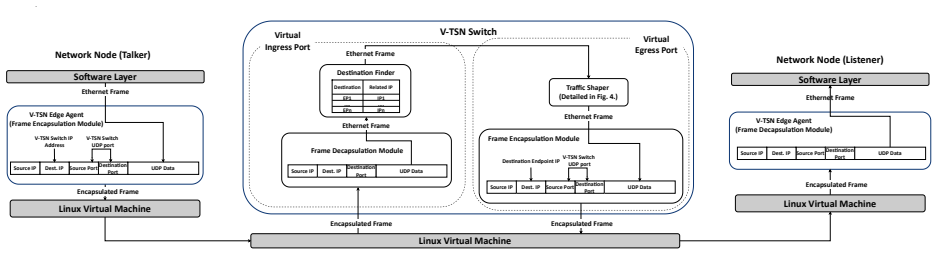
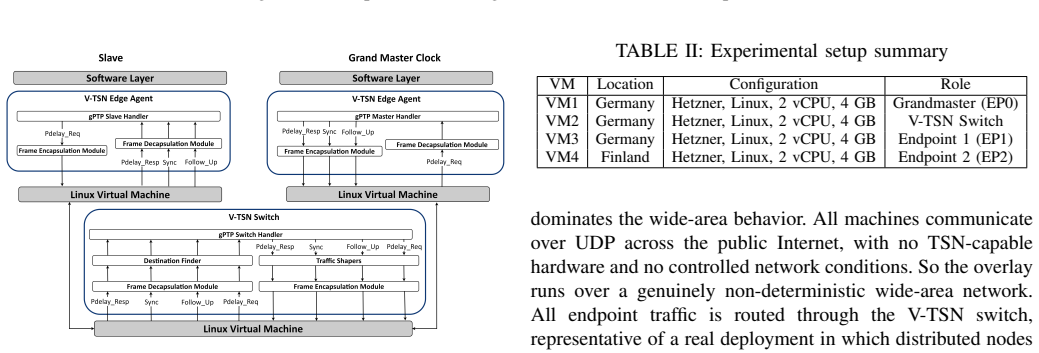
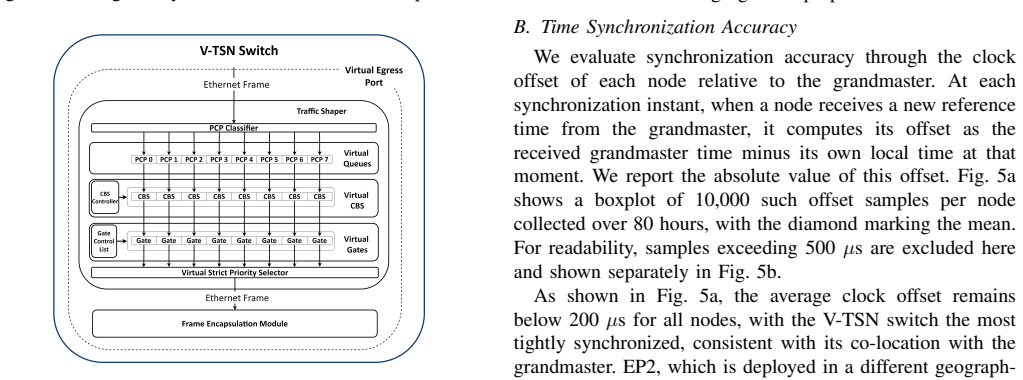
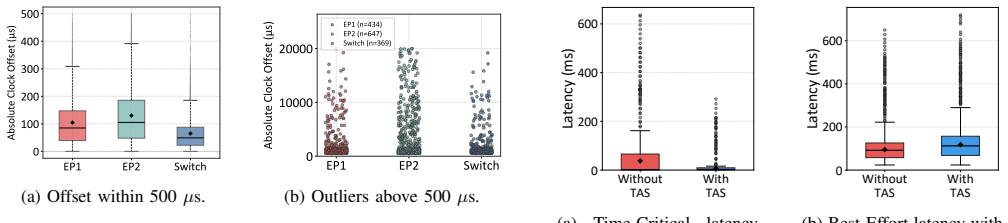
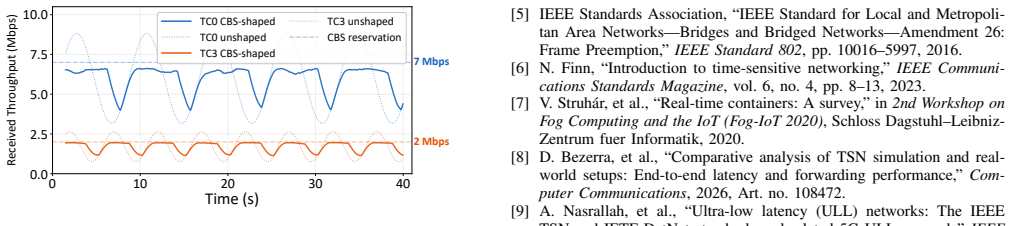
V-TSN is a software-defined overlay that realizes gPTP-based synchronization and TSN traffic shaping over general-purpose, non-deterministic networks without specialized hardware. It runs in real time alongside the unmodified application stack, serving both as a development-time emulation tool and as a cost-efficient deployment option where relaxed timing is acceptable. In a cloud-based deployment, V-TSN achieves an average clock offset below 200 microseconds, it isolates time-critical traffic through a virtual Time-Aware Shaper (TAS), and it enforces per-class bandwidth reservations through a virtual Credit-Based Shaper (CBS).
What carries the argument
V-TSN software overlay that implements virtual Time-Aware Shaper (TAS) and virtual Credit-Based Shaper (CBS) to emulate hardware TSN functions on top of standard network stacks.
If this is right
- Application software can execute with TSN-style determinism on cloud and general-purpose networks.
- Design and validation of time-critical systems can proceed without access to specialized TSN hardware.
- Systems that tolerate relaxed timing can avoid the cost of provisioning full TSN hardware.
- Virtual shapers allow per-class bandwidth reservations and time-aware isolation without hardware changes.
Where Pith is reading between the lines
- The approach could extend to hybrid environments that mix V-TSN nodes with native TSN hardware segments.
- Performance would likely vary with different host OS schedulers and virtualization layers.
- Further testing on local-area general-purpose networks could reveal whether cloud-specific interference dominates the observed offsets.
Load-bearing premise
General-purpose networks and host operating systems can supply stable enough packet timing and scheduling for the software overlay to emulate hardware TSN shapers and synchronization.
What would settle it
A cloud deployment test with background traffic that produces average clock offsets above 200 microseconds or fails to maintain traffic isolation under the virtual shapers would falsify the performance claims.
Figures
read the original abstract
Time-Sensitive Networking (TSN) extends Ethernet with deterministic communication for time-critical applications such as industrial automation, in-vehicle networks, and cyber-physical systems. However, realizing TSN behavior without dedicated hardware is difficult. During design and validation, offline simulation cannot run application software at real-time speed when costly specialized TSN hardware is not (yet) available. At deployment time, many systems run on general-purpose and cloud networks with no native TSN support, where provisioning full TSN hardware is unnecessary or impractical for applications that tolerate relaxed timing. In this paper, we introduce Virtual Time-Sensitive Networking (V-TSN), a software-defined overlay that realizes gPTP-based synchronization and TSN traffic shaping over general-purpose, non-deterministic networks without specialized hardware. V-TSN runs in real time alongside the unmodified application stack, serving both as a development-time emulation tool and as a cost-efficient deployment option where relaxed timing is acceptable. In a cloud-based deployment, V-TSN achieves an average clock offset below 200 microseconds, it isolates time-critical traffic through a virtual Time-Aware Shaper (TAS), and it enforces per-class bandwidth reservations through a virtual Credit-Based Shaper (CBS).
Editorial analysis
A structured set of objections, weighed in public.
Referee Report
Summary. The manuscript introduces V-TSN, a software-defined overlay that implements gPTP-based synchronization together with virtual Time-Aware Shaper (TAS) and virtual Credit-Based Shaper (CBS) traffic shaping on unmodified general-purpose and cloud networks, claiming an average clock offset below 200 µs in a cloud deployment while serving both as a real-time emulation tool and a cost-efficient deployment option for applications that tolerate relaxed timing.
Significance. If the implementation and evaluation were shown to be robust, the work would address a practical need for TSN-like behavior without dedicated hardware, enabling faster design/validation cycles and incremental deployment on existing infrastructure.
major comments (2)
- [Abstract] Abstract: the central performance assertions (average clock offset <200 µs, isolation via virtual TAS, per-class bandwidth via virtual CBS) are stated without any description of the evaluation methodology, testbed configuration, number of trials, worst-case metrics, or comparison baselines, rendering the claims unsupported by visible evidence.
- [Abstract] Abstract: the feasibility of enforcing time-aware gating and credit-based rate limiting in user-space or kernel-bypass software on stock Linux/cloud VMs is asserted, yet no measurements of scheduler jitter, interrupt coalescing, or isolation under cross-traffic are referenced, leaving the load-bearing assumption about timing stability unexamined.
Simulated Author's Rebuttal
We thank the referee for the constructive feedback on the abstract. We agree that the abstract would benefit from additional context to support the performance claims and will revise it in the next version. We address each comment below.
read point-by-point responses
-
Referee: [Abstract] Abstract: the central performance assertions (average clock offset <200 µs, isolation via virtual TAS, per-class bandwidth via virtual CBS) are stated without any description of the evaluation methodology, testbed configuration, number of trials, worst-case metrics, or comparison baselines, rendering the claims unsupported by visible evidence.
Authors: We agree that the abstract, as currently written, does not include methodology details. The full manuscript reports these elements in the Evaluation section (cloud testbed with multiple VMs, repeated trials, worst-case clock offsets, and TAS/CBS isolation results). To improve standalone readability of the abstract, we will add a brief clause summarizing the testbed configuration and that results are averaged over repeated trials with worst-case metrics reported in the body. revision: yes
-
Referee: [Abstract] Abstract: the feasibility of enforcing time-aware gating and credit-based rate limiting in user-space or kernel-bypass software on stock Linux/cloud VMs is asserted, yet no measurements of scheduler jitter, interrupt coalescing, or isolation under cross-traffic are referenced, leaving the load-bearing assumption about timing stability unexamined.
Authors: The evaluation section quantifies timing stability via measured clock offsets under cloud conditions, which incorporate scheduler and network effects. However, we acknowledge that the abstract does not reference explicit scheduler jitter or cross-traffic isolation measurements. We will revise the abstract to note that timing stability was assessed under representative cloud loads and will ensure the body explicitly reports scheduler jitter and cross-traffic isolation results if not already detailed. revision: yes
Circularity Check
No circularity: engineering implementation with measured results, no derivations or self-referential fits
full rationale
The paper describes a software overlay system (V-TSN) for emulating TSN features on general-purpose networks, with performance claims based on cloud deployment measurements (average clock offset <200 µs). No equations, fitted parameters, uniqueness theorems, or ansatzes are present in the provided text. Claims rest on implementation and empirical testing rather than any derivation chain that reduces to its own inputs or self-citations. This is a standard engineering contribution without load-bearing self-referential steps.
Axiom & Free-Parameter Ledger
axioms (1)
- domain assumption General-purpose networks and host schedulers can provide sufficiently predictable packet delivery and timing for software emulation of TSN functions
invented entities (2)
-
Virtual Time-Aware Shaper (TAS)
no independent evidence
-
Virtual Credit-Based Shaper (CBS)
no independent evidence
Reference graph
Works this paper leans on
-
[1]
A survey of scheduling algorithms for the time-aware shaper in time-sensitive networking (TSN),
T. St ¨uber, et al., “A survey of scheduling algorithms for the time-aware shaper in time-sensitive networking (TSN),”IEEE Access, vol. 11, pp. 61192–61233, 2023
2023
-
[2]
Standard for Local and Metropolitan Area Net- works—Timing and Synchronization for Time-Sensitive Applications,
G. Garner, “Standard for Local and Metropolitan Area Net- works—Timing and Synchronization for Time-Sensitive Applications,” IEEE Draft Standard 802.1AS, 2016
2016
-
[3]
IEEE Standard for Local and Metropolitan Area Networks—Bridges and Bridged Networks - Amendment 25: Enhancements for Scheduled Traffic,
“IEEE Standard for Local and Metropolitan Area Networks—Bridges and Bridged Networks - Amendment 25: Enhancements for Scheduled Traffic,”IEEE Std 802.1Qbv-2015(Amendment to IEEE Std 802.1Q- 2014 as amended by IEEE Std 802.1Qca-2015, IEEE Std 802.1Qcd- 2015, and IEEE Std 802.1Q-2014/Cor 1-2015), pp. 1–57, 2016
2015
-
[4]
IEEE standard for local and metropolitan area networks—virtual bridged local area networks amendment 12: Forwarding and queuing en- hancements for time-sensitive streams,
IEEE, “IEEE standard for local and metropolitan area networks—virtual bridged local area networks amendment 12: Forwarding and queuing en- hancements for time-sensitive streams,”IEEE 802.1Qav-2009 Standard, pp. C1–72, Jan. 2010
2009
-
[5]
IEEE Standard for Local and Metropoli- tan Area Networks—Bridges and Bridged Networks—Amendment 26: Frame Preemption,
IEEE Standards Association, “IEEE Standard for Local and Metropoli- tan Area Networks—Bridges and Bridged Networks—Amendment 26: Frame Preemption,”IEEE Standard 802, pp. 10016–5997, 2016
2016
-
[6]
Introduction to time-sensitive networking,
N. Finn, “Introduction to time-sensitive networking,”IEEE Communi- cations Standards Magazine, vol. 6, no. 4, pp. 8–13, 2023
2023
-
[7]
Real-time containers: A survey,
V . Struh´ar, et al., “Real-time containers: A survey,” in2nd Workshop on Fog Computing and the IoT (Fog-IoT 2020), Schloss Dagstuhl–Leibniz- Zentrum fuer Informatik, 2020
2020
-
[8]
Comparative analysis of TSN simulation and real- world setups: End-to-end latency and forwarding performance,
D. Bezerra, et al., “Comparative analysis of TSN simulation and real- world setups: End-to-end latency and forwarding performance,”Com- puter Communications, 2026, Art. no. 108472
2026
-
[9]
Ultra-low latency (ULL) networks: The IEEE TSN and IETF DetNet standards and related 5G ULL research,
A. Nasrallah, et al., “Ultra-low latency (ULL) networks: The IEEE TSN and IETF DetNet standards and related 5G ULL research,”IEEE Communications Surveys & Tutorials, vol. 21, no. 1, pp. 88–145, 2018
2018
-
[10]
A Survey on In-Vehicle Time-Sensitive Networking,
Y . Penget al., “A Survey on In-Vehicle Time-Sensitive Networking,” IEEE IoT Journal, vol. 10, no. 16, pp. 14375–14396, 2023
2023
-
[11]
TSN devel- opment platform for aerospace: a versatile TSN tool for the streamlined configuration of aerospace missions in combination with RTEMS,
E. Lopez-Ruiz, C. Arias-Mart ´ınez, and J. Sanchez-Garrido, “TSN devel- opment platform for aerospace: a versatile TSN tool for the streamlined configuration of aerospace missions in combination with RTEMS,” in EDHPC, 2025
2025
-
[12]
INSIM: A Modular Simulation Platform for TSN- based In-Vehicle Networks,
M. Karimiet al., “INSIM: A Modular Simulation Platform for TSN- based In-Vehicle Networks,” in2025 VTC-Fall, IEEE, 2025
2025
-
[13]
Network Function Virtualization: State-of-the-art and research challenges,
R. Mijumbi, et al., “Network Function Virtualization: State-of-the-art and research challenges,”IEEE Communications Surveys & Tutorials, vol. 18, no. 1, pp. 236–262, 2015
2015
-
[14]
Network functions virtualisation (NFV): Architectural framework,
ETSI GS NFV , “Network functions virtualisation (NFV): Architectural framework,”ETSI GS NFV 002 V1.1.1, 2013
2013
-
[15]
A comprehensive survey on software-defined networking for smart communities,
R. Chaudhary, et al., “A comprehensive survey on software-defined networking for smart communities,”International Journal of Communi- cation Systems, vol. 38, no. 1, Art. no. e5296, 2025
2025
-
[16]
Virtualized firewalls: Design, imple- mentation, and security challenges in modern network infrastructures,
A. A. A. Saif and A. H. Shamsan, “Virtualized firewalls: Design, imple- mentation, and security challenges in modern network infrastructures,” in2025 5th International Conference on Emerging Smart Technologies and Applications (eSmarTA), IEEE, 2025
2025
-
[17]
A comprehensive overview of load balancing methods in software-defined networks,
R. Farahi, “A comprehensive overview of load balancing methods in software-defined networks,”Discover Internet of Things, vol. 5, no. 1, Art. no. 6, 2025
2025
-
[18]
Network function virtualization: Challenges and oppor- tunities for innovations,
B. Han, et al., “Network function virtualization: Challenges and oppor- tunities for innovations,”IEEE Communications Magazine, vol. 53, no. 2, pp. 90–97, 2015
2015
-
[19]
OMNeT++,
A. Varga, “OMNeT++,”Modeling and Tools for Network Simulation, pp. 35–59, Springer Berlin Heidelberg, 2010
2010
-
[20]
Cross-validating open source in-vehicle TSN simulation models with a COTS hardware testbed,
D. Andronoviciet al., “Cross-validating open source in-vehicle TSN simulation models with a COTS hardware testbed,” inIEEE VNC, pp. 172–179, IEEE, 2024
2024
-
[21]
Engine: Flexible research infrastructure for reliable and scalable time sensitive networks,
F. Rezabeket al., “Engine: Flexible research infrastructure for reliable and scalable time sensitive networks,”Journal of Network and Systems Management, vol. 30, no. 4, pp. 74, 2022
2022
-
[22]
Precision time protocol (PTP) using linuxptp on single board computers,
J. O’Raw, D. Laverty, and D. McFadden, “Precision time protocol (PTP) using linuxptp on single board computers,” in2023 58th International Universities Power Engineering Conference (UPEC), IEEE, 2023
2023
-
[23]
Design considerations for software only implementations of the IEEE 1588 precision time proto- col,
K. Correll, N. Barendt, and M. Branicky, “Design considerations for software only implementations of the IEEE 1588 precision time proto- col,” inProc. IEEE 1588 Conference, 2005
2005
-
[24]
Pre- liminary approaches towards the integration of TSN communications into the NFV architectural framework,
J. Sasiain, A. Atutxa, D. Franco, J. Astorga, and E. Jacob, “Pre- liminary approaches towards the integration of TSN communications into the NFV architectural framework,” inXVI Jornadas de Ingenier ´ıa Telem´atica (JITEL), 2023
2023
-
[25]
Online flow scheduling in virtualized time-sensitive networks: A joint admission control and VNF embedding approach,
Y . Zhang, C. Chen, M. Li, C. You, X. Guan, and T. Q. S. Quek, “Online flow scheduling in virtualized time-sensitive networks: A joint admission control and VNF embedding approach,”IEEE Transactions on Mobile Computing, vol. 24, no. 6, pp. 4651–4667, 2025
2025
-
[26]
KuberneTSN: A deter- ministic overlay network for time-sensitive containerized environments,
A. Garbugli, L. Rosa, A. Bujari, and L. Foschini, “KuberneTSN: A deter- ministic overlay network for time-sensitive containerized environments,” inProc. IEEE Int. Conf. Commun. (ICC), 2023, pp. 1494–1499
2023
-
[27]
Virtualization,
AUMOVIO SE, “Virtualization,” Accessed: Jun. 11, 2026. [Online]. Available: https://www.aumovio.com/en/solutions/services/ virtualization.html
2026
discussion (0)
Sign in with ORCID, Apple, or X to comment. Anyone can read and Pith papers without signing in.