REVIEW 4 major objections 5 minor 38 references
Tuning Incommensurate Charge Order in Ba$_{1-x}$Sr$_x$Al$_4$ and Ba$_{1-y}$Eu$_y$Al$_4$
T0 review · 4 major / 5 minor · reviewed 2026-08-06 · deepseek-v4-flash
Pith's one-line read This paper shows that incommensurate charge order in Ba1-xSrxAl4 and Ba1-yEuyAl4 follows one universal curve of transition temperature versus ordering wavevector, vanishing near eta≈0.23, and traces the suppression to the loss of a soft…
desk verdict Useful experimental mapping of CDW suppression in two AAl4 series with a suggestive Tcdw–η scaling, but the 'universal' claim is thinner than advertised and the x=0.5 phonon calculation rests on a single ordered supercell. read the letter →
The pith
A machine-rendered reading of the paper's core claim, the machinery that carries it, and where it could break.
The reading
What carries the argument
The central object is the incommensurate ordering wavevector $\mathbf{q}_\mathrm{cdw}=(0,0,\eta)$ measured by neutron and x-ray diffraction, and the universal curve $T_\mathrm{cdw}(\eta)$ it defines for both cation series. The mechanism that carries the argument is the transverse acoustic (TA) phonon mode along the $\Gamma$–$Z$ direction: a soft mode whose minimum appears at the experimental $\eta$ in SrAl$_4$ and disappears in the 50% substituted compound. The key structural identity is that the lattice parameters barely change across substitution, so the strong suppression of charge order is uncorrelated with chemical pressure and instead correlates with the TA-mode evolution; the paper treats $\eta\simeq0.23$ as the critical wavevector at which $T_\mathrm{cdw}$ would reach zero.
What would settle it
Measure the phonon dispersion of Ba$_{0.5}$Sr$_{0.5}$Al$_4$ by inelastic neutron or x-ray scattering along $\Gamma$–$Z$: an unstable or strongly softened transverse acoustic branch at any wavevector would contradict the paper's claim that no instability exists at 50% substitution. Alternatively, a phonon calculation using a disordered special quasirandom supercell that yields an imaginary mode near $\eta\simeq0.23$ would falsify the proposed match.
Extended reading notes
Core claim
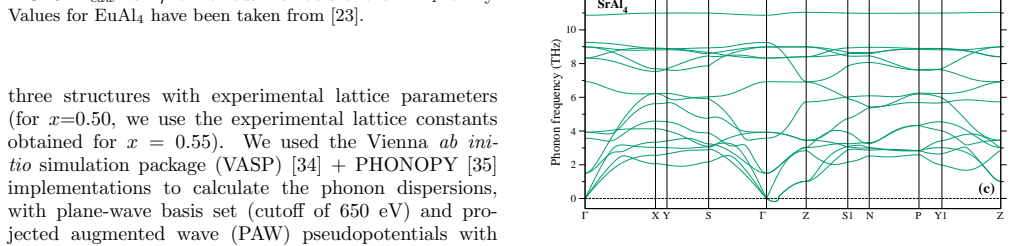
The paper claims that the evolution of incommensurate CDW order in both Ba$_{1-x}$Sr$_x$Al$_4$ and Ba$_{1-y}$Eu$_y$Al$_4$ is captured by a single, universal relationship between the ordering temperature $T_\mathrm{cdw}$ and the $c$-axis ordering wavevector $\eta$: $T_\mathrm{cdw}$ falls smoothly as $\eta$ grows, and the order disappears altogether near $\eta \simeq 0.23$. The measured wavevector in SrAl$_4$ is $(0,0,0.097(3))$ at low temperature, increasing to 0.21 for $x=0.55$ and 0.225 for $y=0.6$, and the same curve includes EuAl$_4$ with $\eta=0.19$ and $T_\mathrm{cdw}=140\,\mathrm{K}$. The paper further claims that this behavior originates in a transverse acoustic phonon mode along the $\Gamma$–$Z$ direction: DFT calculations give a soft minimum at $0.095\,(2\pi/c)$ for SrAl$_4$, matching the experimental $\eta$, and no instability for Ba$_{0.5}$Sr$_{0.5}$Al$_4$, consistent with the absence of CDW there. Together these results establish that charge order in the $A$Al$_4$ family is tied to a $(0,0,\eta)$ modulation, that the mechanism is electron-phonon coupling, and that a critical wavevector near $\eta\simeq0.23$ marks the boundary of CDW stability.
Load-bearing premise
The central claim rests on representing the random 50% Ba/Sr solid solution by a single ordered supercell in the density-functional phonon calculation (using lattice constants from the 55% compound); if the real disordered alloy has a soft phonon mode that this ordered supercell misses, the match between CDW suppression and phonon stability breaks down.
Editorial extensions
If this is right
- The abrupt drop of the CDW phase near 50% substitution in both series is not a structural artifact: lattice parameters change by only about 1%, so the suppression tracks the universal $\eta$–$T_\mathrm{cdw}$ curve.
- In the Sr-based series, CDW order exists exactly where the transverse acoustic mode along $\Gamma$–$Z$ is unstable: the mode is soft at $x=1$ and stable at $x=0.5$, matching the diffraction data.
- The universal curve holds for EuAl$_4$ as well, whose antiferromagnetic order below 15 K does not alter the charge-order relation, implying the CDW mechanism is essentially independent of magnetism.
- A critical wavevector near $\eta\simeq0.23$ emerges as the edge of CDW existence: as substitutions or other tuning variables drive the modulation wavelength shorter, the soft mode disappears and the ordered state is lost.
- The near-constant lattice and the cation-mass dependence point to the cation mass, not chemical pressure, as the control parameter for the TA-mode softening and hence for $T_\mathrm{cdw}$.
Reading between the lines
- The $\eta\simeq 0.23$ boundary suggests a length-scale criterion that could be ported to other BaAl$_4$-type compounds: any isostructural member whose natural CDW wavevector would fall beyond this value should not order, which is testable by attempting to push SrAl$_4$ or EuAl$_4$ past the boundary with pressure.
- The sudden cutoff near 50% substitution is consistent with a percolation threshold of Sr/Eu sites needed to sustain the soft mode; a direct test would be to map the local cation distribution (for example, with pair distribution function analysis) across the series and compare CDW amplitude with connected Sr/Eu clusters.
- Because the paper ties the CDW to cation mass, an isotope-substitution experiment (for example, different Sr or Ba isotopes) would provide a clean, disorder-free test of whether $T_\mathrm{cdw}$ shifts with mass, as the mechanism implies.
- Since the end members preserve the topological band structure, the region near the critical wavevector offers a tuneable platform to switch CDW order on and off while keeping Dirac physics, motivating searches for tunable topology at the suppression point.
Signed reviews
Editorial analysis
A structured set of objections, weighed in public.
Referee Report
Summary. The paper reports an experimental study of the CDW state in two isovalent solid solution series, Ba1−xSrxAl4 and Ba1−yEuyAl4, using transport, single-crystal neutron and x-ray diffraction, and complementary DFT phonon calculations. The authors find that the incommensurate CDW wavevector η = (0,0,η) increases with Ba substitution while Tcdw decreases, and that the two series fall on a common Tcdw vs η curve that extrapolates to Tcdw = 0 near η ≈ 0.23. They also calculate phonon dispersions for x = 0, 0.5, and 1 in the Sr series, finding a soft transverse acoustic mode in SrAl4 at q = 0.095(2π/c) that matches the measured η = 0.097(3), and no instability at x = 0.5, which they interpret as the phonon origin of the CDW suppression near 50% substitution. The universal correlation and the phonon calculation are presented as the main results.
Significance. If the universal Tcdw–η correlation is robust, it provides a simple tuning parameter—cation substitution—for controlling CDW order in a tetragonal platform that also hosts topological band structure, and it implicates a critical wavevector (η_c ≈ 0.23) for the stability of the CDW. The experimental data are generally clean: Tcdw and η are measured independently, the diffraction work uses both neutron and x-ray scattering, and the DFT phonon calculation is a parameter-free comparison against experiment, not a fit to the measured transition temperatures. The paper also transparently cites the conflicting phonon result of Ramakrishnan et al. However, the central claims rest on a small number of data points (seven in the Tcdw–η plot), an extrapolated critical wavevector, and a single ordered-supercell phonon calculation for the substituted compound, so the significance is conditional on addressing these limitations.
major comments (4)
- [Section III, Fig. 5] The 'universal correlation' between Tcdw and η is established with only seven points, and the extrapolation to Tcdw = 0 near η ≈ 0.23 is not supported by any fit or uncertainty quantification. The points closest to the supposed critical wavevector are x = 0.55 (Tcdw = 105 K, η = 0.21) and y = 0.6 (Tcdw = 63 K, η = 0.225), both far from Tcdw = 0, yet the text states the trend 'points to a critical wavevector that stabilizes CDW order.' Please provide a quantitative fit (e.g., Tcdw ∝ (η_c − η)^n) with error bars on η for all substituted samples, or explicitly soften the universality claim to a qualitative trend.
- [Section IV, Fig. 6] The absence of a soft TA mode at x = 0.5 is the only theoretical connection between the measured CDW cutoff and a phonon mechanism, but this calculation models the random Ba/Sr alloy with a single ordered 2×2×2 conventional-cell supercell and adopts the x = 0.55 lattice constants. The paper itself notes that Ramakrishnan et al. (Phys. Rev. Res. 6, 023277) found no soft modes even in pure SrAl4, indicating method sensitivity. A single ordered configuration cannot exclude the possibility that a disordered alloy retains a soft or imaginary TA branch near q = (0,0,0.21). Please benchmark the x = 0.5 result against multiple supercell configurations, special quasirandom structures, or at minimum discuss why the ordered supercell captures the relevant physics; as written, the electron-phonon origin claim is not yet secure.
- [Section III, text near Fig. 4] The statement that η 'nearly doubles for both series' is inaccurate for the Eu series: η goes from 0.194 (y = 0.95) to 0.225 (y = 0.6), an increase of about 16%, whereas in the Sr series η goes from 0.097(3) to 0.21, more than a factor of two. This misstatement matters because the much narrower range of η in the Eu series is part of the evidence for a universal correlation, and the current wording overstates the similarity of the two series.
- [Section III, Fig. 2 and Fig. 4] The 'abrupt' or 'discontinuous' drop of Tcdw to zero near 50% substitution is inferred from single points at x = 0.5 (zero) and x = 0.55 (105 K), with no intermediate compositions in either series. With the present data density, the suppression could be continuous but steep. Please add samples near the critical concentration (e.g., x = 0.52, 0.54, y = 0.5, 0.55) or present a quantitative test for a discontinuous jump; otherwise the claim of an 'abrupt cutoff' is not yet supported.
minor comments (5)
- [Section II (Neutron diffraction paragraph)] In the sentence 'A 57 mg single crystal of SrxAl4 was aligned...', 'SrxAl4' should be 'SrAl4'.
- [Fig. 4 caption] The caption refers to 'Ba1−xEuxAl4' in panel (c) but the series is elsewhere denoted Ba1−yEuyAl4; please use consistent notation.
- [Section III and V] The abbreviation 'c.f.' appears several times; standard usage is 'cf.' without the first period.
- [Section IV] Please clarify why the x = 0.50 phonon calculation uses a 2×2×2 supercell of the conventional cell while the parent compounds use a 2×2×2 supercell of the primitive cell; stating the number of atoms in each supercell would help readers gauge the computational effort and convergence.
- [Fig. 5] The plot would benefit from error bars on η for the substituted samples (the text quotes values like 0.18 and 0.21 without uncertainties) and a quantitative fit line or band; without these, the visual impression of a universal curve is difficult to assess.
Circularity Check
No significant circularity: all central claims rest on independent measurements and parameter-free DFT calculations.
full rationale
The paper's central empirical result is the correlation between the measured CDW transition temperature Tcdw and the measured incommensurate wavevector eta=(0,0,eta) across the Ba1-xSrxAl4 and Ba1-yEuyAl4 series. Tcdw values are extracted from resistivity kinks and from the temperature dependence of diffraction peak intensities, while eta values are obtained from independent Gaussian fits to neutron and x-ray satellite positions (e.g., eta=0.097(3) for SrAl4 and eta=0.21 for x=0.55 in Figs. 3 and 4). Neither quantity is defined in terms of the other, so the Tcdw-eta plot in Fig. 5 is an empirical correlation rather than a construction. The theoretical component is the DFT phonon calculation for x=0, 0.5, and 1 in Section IV. It is not fitted to the experimental eta or Tcdw: the calculation uses stated lattice parameters and VASP/PHONOPY with PBE+SOC, and predicts a soft transverse acoustic mode at q=0.095(2pi/c) for SrAl4, compared with the measured eta=0.097 and with the prior independent calculation of Wang et al. The x=0.5 calculation uses an ordered 2x2x2 conventional-cell supercell and the x=0.55 lattice constants, which is an approximation, but this is a modeling robustness concern rather than circularity; the absence of an unstable mode is a falsifiable prediction compared against the measured absence of CDW order at x=0.5. The paper also explicitly cites the conflicting calculation of Ramakrishnan et al. (Ref. 26) that found no soft modes in SrAl4, which shows the authors are not using a self-citation chain to force the conclusion. Self-citations in the paper (e.g., Refs. 5, 19, 36, 37) concern background topology and related pnictide systems and are not load-bearing for the CDW mechanism claim. No fitted parameter is renamed as a prediction, and no equation reduces one measured quantity to another by construction.
Assumptions & free parameters
free parameters (1)
- critical wavevector eta_c =
≈0.23
assumptions (4)
- domain assumption PBE+SOC phonon calculations reliably capture the CDW-relevant phonon instability in this family.
- domain assumption The ordered 2x2x2 supercell for Ba0.5Sr0.5Al4 represents the random solid solution.
- domain assumption The CDW wavevector is single-q and purely along c, and Gaussian fitting to satellite peaks gives the true eta.
- domain assumption Tcdw determined from resistivity kinks and diffraction intensity are equivalent.
Cite this review
Pith. "Pith review of Tuning Incommensurate Charge Order in Ba$_{1-x}$Sr$_x$Al$_4$ and Ba$_{1-y}$Eu$_y$Al$_4$." pith.science (2026). https://pith.science/paper/CH34M5B2
@misc{pith2026250702140,
  author       = {Pith},
  title        = {Pith review of: Tuning Incommensurate Charge Order in Ba$_1-x$Sr$_x$Al$_4$ and Ba$_1-y$Eu$_y$Al$_4$},
  year         = {2026},
  howpublished = {\url{https://pith.science/paper/CH34M5B2}},
  note         = {Machine review of arXiv:2507.02140}
}
abstract
The BaAl$_4$-type structure family is home to a vast landscape of interesting and exotic properties, with descendant crystal structures hosting a variety of electronic ground states including magnetic, superconducting and strongly correlated electron phenomena. BaAl$_4$ itself hosts a non-trivial topological band structure, but is otherwise a paramagnetic metal. However, the other members of the $A$Al$_4$ family ($A$= alkali earth), including SrAl$_4$ and EuAl$_4$, exhibit symmetry-breaking ground states including charge density wave (CDW) and magnetic orders. Here we investigate the properties of the solid solution series Ba$_{1-x}$Sr$_x$Al$_4$ and Ba$_{1-y}$Eu$_y$Al$_4$ using transport, thermodynamic and scattering experiments to study the evolution of the charge-ordered state as it is suppressed with Ba substitution to zero near 50% substitution in both systems. Neutron and x-ray diffraction measurements reveal an incommensurate CDW state in SrAl$_4$ with $c$-axis-oriented ordering vector (0, 0, 0.097) that evolves with Ba substitution toward a shorter wavelength. A similar progression is observed in the Ba$_{1-y}$Eu$_y$Al$_4$ series that also scales with the ordering temperature, revealing a universal correlation between charge-order transition temperature and ordering vector that points to a critical wavevector that stabilizes CDW order in both systems. We study the evolution of the phonon band structure in the Ba$_{1-x}$Sr$_x$Al$_4$ system, revealing the suppression of the CDW phase matches the suppression of a phonon instability at precisely the same momentum as observed in experiments, confirming the electron-phonon origin of charge order in this system.
Figures


Figures from the paper (4 more)


Reference graph
Works this paper leans on
-
[1]
R. Comin and A. Damascelli, Resonant x-ray scattering studies of charge order in cuprates, Annual Review of Condensed Matter Physics 7, 369 (2016)
work page 2016
-
[2]
D. Lin, S. Li, J. Wen, H. Berger, L. Forr´ o, H. Zhou, S. Jia, T. Taniguchi, K. Watanabe, X. Xi, and M. S. Bahramy, Patterns and driving forces of dimensionality- dependent charge density waves in 2H-type transition metal dichalcogenides, Nature Communications 2020 11:1 11, 1 (2020)
work page 2020
-
[3]
S. D. Wilson and B. R. Ortiz, AV 3Sb5 kagome supercon- ductors, Nature Reviews Materials 9, 420 (2024)
work page 2024
-
[4]
X. Teng, L. Chen, F. Ye, E. Rosenberg, Z. Liu, J. X. Yin, Y. X. Jiang, J. S. Oh, M. Z. Hasan, K. J. Neubauer, B. Gao, Y. Xie, M. Hashimoto, D. Lu, C. Jozwiak, A. Bostwick, E. Rotenberg, R. J. Birgeneau, J. H. Chu, M. Yi, and P. Dai, Discovery of charge density wave in a kagome lattice antiferromagnet, Nature 2022 609:7927 609, 490 (2022)
work page 2022
-
[5]
C. Eckberg, D. J. Campbell, T. Metz, J. Collini, H. Hodovanets, T. Drye, P. Zavalij, M. H. Christensen, R. M. Fernandes, S. Lee, P. Abbamonte, J. W. Lynn, and J. Paglione, Sixfold enhancement of superconductivity in a tunable electronic nematic system, Nature Physics 16, 346 (2019)
work page 2019
-
[6]
T. Neupert, M. M. Denner, J. X. Yin, R. Thomale, and M. Z. Hasan, Charge order and superconductivity in kagome materials, Nature Physics 2021 18:2 18, 137 (2021)
work page 2021
-
[7]
S.-M. Huang, S.-Y. Xu, B. Singh, M.-C. Hsu, C.-H. Hsu, C. Su, A. Bansil, and H. Lin, Aspects of symmetry and topology in the charge density wave phase of 1T–TiSe 2, New Journal of Physics 23, 083037 (2021)
work page 2021
-
[8]
M. Litskevich, M. S. Hossain, S. Zhang, Z.-J. Cheng, S. N. Guin, N. Kumar, C. Shekhar, Z. Wang, Y. Li, G. Chang, J.-X. Yin, Q. Zhang, G. Cheng, Y.-X. Jiang, T. A. Cochran, N. Shumiya, X. P. Yang, D. Multer, X. Liu, N. Yao, Y. Yao, C. Felser, T. Neupert, and M. Z. Hasan, Boundary modes of a charge density wave state in a topological material, Nature Physic...
work page 2024
Show all 38 references
-
[9]
Kneidinger, L
F. Kneidinger, L. Salamakha, E. Bauer, I. Zeiringer, P. Rogl, C. Blaas-Schenner, D. Reith, and R. Podlouck, Superconductivity in noncentrosymmetric BaAl4 derived structures, Phys. Rev. B 90, 024504 (2014)
2014
-
[10]
Paglione and R
J. Paglione and R. L. Greene, High-temperature super- conductivity in iron-based materials, Nat. Phys. 6, 645 (2010)
2010
-
[11]
Stockert, J
O. Stockert, J. Arndt, E. Faulhaber, C. Geibel, H. S. Jee- van, S. Kirchner, M. Loewenhaupt, W. S. K. Schmalzl, Q. Si, and F. Steglich, Magnetically driven superconduc- tivity in CeCu2Si2, Nature Physics 7, 119 (2010)
2010
-
[12]
T. T. M. Palstra, A. A. Menovsky, J. v. d. Berg, A. J. Dirkmaat, P. H. Kes, G. J. Nieuwenhuys, and J. A. Mydosh, Superconducting and magnetic transitions in the heavy-fermion system URu2Si2, Phys. Rev. Lett. 55, 2727 (1985)
1985
-
[13]
M. B. Maple, J. W. Chen, Y. Dalichaouch, T. Kohara, C. Rossel, M. S. Torikachvili, M. W. McElfresh, and J. D. Thompson, Partially gapped fermi surface in the heavy- electron superconductor URu 2Si2, Phys. Rev. Lett. 56, 185 (1986)
1986
-
[14]
Schlabitz, J
W. Schlabitz, J. Baumann, B. Pollit, U. Rauchschwalbe, H. M. Mayer, U. Ahlheim, and C. D. Bredl, Partially gapped fermi surface in the heavy-electron superconduc- tor URu 2Si2, Z. Physik B - Condensed Matter 62, 171 (1986)
1986
-
[15]
J. M. Moya, S. Lei, E. M. Clements, C. S. Kengle, S. Sun, K. Allen, Q. Li, Y. Y. Peng, A. A. Husain, M. Mitrano, M. J. Krogstad, R. Osborn, A. B. Puthirath, S. Chi, L. Debeer-Schmitt, J. Gaudet, P. Abbamonte, J. W. Lynn, and E. Morosan, Incommensurate magnetic orders and topol...
2022
-
[16]
Valadkhani, M
A. Valadkhani, M. Iraola, A. F¨ unfhaus, Y.-J. Song, L. ˇSmejkal, J. Sinova, and R. Valent ´ ı, Influence of mag- netism, strain, and pressure on the band topology of EuCd2As2, Phys. Rev. B 108, 235113 (2023)
2023
-
[17]
Nakamura, T
A. Nakamura, T. Uejo, H. Harima, S. Araki, T. C. Kobayashi, M. Nakashima, Y. Amako, M. Hedo, T. Nakama, and Y. ¯Onuki, Characteristic fermi surfaces and charge density wave in SrAl4 and related compounds with the BaAl 4-type tetragonal structure, Journal of Al- loys and Compou...
2016
-
[18]
Nakamura, T
A. Nakamura, T. Uejo, F. Honda, T. Takeuchi, H. Harima, E. Yamamoto, Y. Haga, K. Matsubayashi, Y. Uwatoko, M. Hedo, T. Nakama, and Y. ¯Onuki, Trans- port and magnetic properties of EuAl4 and EuGa4, Jour- nal of the Physical Society of Japan 84, 124711 (2015)
2015
-
[19]
K. Wang, R. Mori, Z. Wang, L. Wang, J. H. S. Ma, D. W. Latzke, D. E. Graf, J. D. Denlinger, D. Camp- bell, B. A. Bernevig, A. Lanzara, and J. Paglione, Crys- talline symmetry-protected non-trivial topology in pro- totype compound BaAl 4, NPJ Quantum Materials 6, 28 (2021)
2021
-
[20]
R. Mori, K. Wang, T. Morimoto, S. Ciocys, J. D. Den- linger, J. Paglione, and A. Lanzara, Observation of a flat and extended surface state in a topological semimetal, Materials 15, 10.3390/ma15082744 (2022)
2022 doi
-
[21]
M. G. Vergniory, B. J. Wieder, L. Elcoro, S. S. P. Parkin, C. Felser, B. A. Bernevig, and N. Regnault, All topolog- 10 ical bands of all nonmagnetic stoichiometric materials, Science 376, eabg9094 (2022)
2022
-
[22]
and experimentally [23–27], and debate about the origins of CDW order suggest a subtle sensitivity of the CDW phase to details of the phonon and electron band structures [22, 26]. In this work, we study the evolution of the CDW state in the Ba 1−xSrxAl4 and Ba 1−yEuyAl4 solid ...
2025 arXiv
-
[23]
L.-L. Wang, N. K. Nepal, and P. C. Canfield, Origin of charge density wave in topological semimetals SrAl 4 and EuAl4, Communications Physics 7, 111 (2024)
2024
-
[24]
Kaneko, T
K. Kaneko, T. Kawasaki, A. Nakamura, K. Munakata, A. Nakao, T. Hanashima, R. Kiyanagi, T. Ohhara, M. Hedo, T. Nakama, and Y. ¯Onuki, Charge-density- wave order and multiple magnetic transitions in divalent europium compound EuAl 4, Journal of the Physical So- ciety of Japan 90...
2021
-
[25]
Ramakrishnan, S
S. Ramakrishnan, S. R. Kotla, T. Rekis, J.-K. Bao, C. Eisele, L. Noohinejad, M. Tolkiehn, C. Paul- mann, B. Singh, R. Verma, B. Bag, R. Kulkarni, A. Thamizhavel, B. Singh, S. Ramakrishnan, and S. van Smaalen, Orthorhombic charge density wave on the tetragonal lattice of EuAl 4...
2022
-
[26]
A. N. Korshunov, A. S. Sukhanov, S. Gebel, M. S. Pavlovskii, N. D. Andriushin, Y. Gao, J. M. Moya, E. Morosan, and M. C. Rahn, Phonon softening and atomic modulations in EuAl 4, Phys. Rev. B 110, 045102 (2024)
2024
-
[27]
Ramakrishnan, S
S. Ramakrishnan, S. R. Kotla, H. Pi, B. B. Maity, J. Chen, J.-K. Bao, Z. Guo, M. Kado, H. Agarwal, C. Eisele, M. Nohara, L. Noohinejad, H. Weng, S. Ra- makrishnan, A. Thamizhavel, and S. van Smaalen, Non- centrosymmetric, transverse structural modulation in SrAl4, and elucidat...
2024
-
[28]
Yang, C.-C
R. Yang, C.-C. Le, P. Zhu, Z.-W. Wang, T. Shang, Y.- M. Dai, J.-P. Hu, and M. Dressel, Charge density wave transition in the magnetic topological semimetal EuAl 4, Phys. Rev. B 109, L041113 (2024)
2024
-
[29]
J. W. Lynn, Y. Chen, S. Chang, Y. Zhao, S. Chi, W. R. II, B. G. Uel, and R. W. Erwin, Double-focusing thermal triple-axis spectrometer at the ncnr, Journal of Research of the National Institute of Standards and Technology 117, 61 (2012)
2012
-
[30]
Kirshenbaum, N
K. Kirshenbaum, N. P. Butch, S. R. Saha, P. Y. Zavalij, B. G. Ueland, J. W. Lynn, and J. Paglione, Tuning mag- netism in FeAs-based materials via a tetrahedral struc- ture, Phys. Rev. B 86, 060504 (2012)
2012
-
[31]
Marchand and W
R. Marchand and W. Jeitschko, Ternary lanthanoid- transition metal pnictides with ThCr 2Si2-type structure, Journal of Solid State Chemistry 24, 351 (1978)
1978
-
[32]
Zhang, Y.-C
S. Zhang, Y.-C. Li, Y. Chen, Y. Zhou, S. Wang, Y. Zhou, M. Zhang, C. An, Y. Fang, J. Zhou, and Z. Yang, Pressure-driven structural transition in the charge den- sity wave material SrAl4, The Journal of Physical Chem- istry C 129, 2821 (2025)
2025
-
[33]
S. Lee, E. W. Huang, T. A. Johnson, X. Guo, A. A. Husain, M. Mitrano, K. Lu, A. V. Zakrzewski, G. A. de la Pe˜ na, Y. Peng, H. Huang, S.-J. Lee, H. Jang, J.-S. Lee, Y. I. Joe, W. B. Doriese, P. Szypryt, D. S. Swetz, S. Chi, A. A. Aczel, G. J. MacDougall, S. A. Kivelson, E. Fra...
2022
-
[34]
Peierls, Quantum Theory of Solids, International series of monographs on physics (Clarendon Press, 1955)
R. Peierls, Quantum Theory of Solids, International series of monographs on physics (Clarendon Press, 1955)
1955
-
[35]
Kresse and J
G. Kresse and J. Hafner, Ab initio molecular dynamics for liquid metals, Phys. Rev. B 47, 558 (1993)
1993
-
[36]
A. Togo, L. Chaput, T. Tadano, and I. Tanaka, Imple- mentation strategies in phonopy and phono3py, J. Phys. Condens. Matter 35, 353001 (2023)
2023
-
[37]
S. Lee, J. Collini, S. X.-L. Sun, M. Mitrano, X. Guo, C. Eckberg, J. Paglione, E. Fradkin, and P. Abbamonte, Multiple charge density waves and superconductivity nucleation at antiphase domain walls in the nematic pnictide Ba 1−xSrxNi2As2, Phys. Rev. Lett. 127, 027602 (2021)
2021
-
[38]
D. M. Narayan, P. Hao, R. Kurleto, B. S. Berggren, A. G. Linn, C. Eckberg, P. Saraf, J. Collini, P. Zavalij, M. Hashimoto, D. Lu, R. M. Fernandes, J. Paglione, and D. S. Dessau, Potential lifshitz transition at optimal sub- stitution in nematic pnictide Ba 1−xSrxNi2As2, Scienc...
2023
Reviewed August 6, 2026 · model on record in the stance chip above.
Discussion (0). Continue with ORCID to comment.