REVIEW 2 major objections 5 minor 4 cited by
openQ*D code: a versatile tool for QCD+QED simulations
T0 review · 2 major / 5 minor · reviewed 2026-08-14 · deepseek-v4-flash
Pith's one-line read A new open-source code makes lattice QCD+QED simulations practical.
desk verdict A solid, genuinely useful code paper; the phase-quenched sign assumption is the one gap that should be explicitly scoped before acceptance. read the letter →
The pith
A machine-rendered reading of the paper's core claim, the machinery that carries it, and where it could break.
The reading
What carries the argument
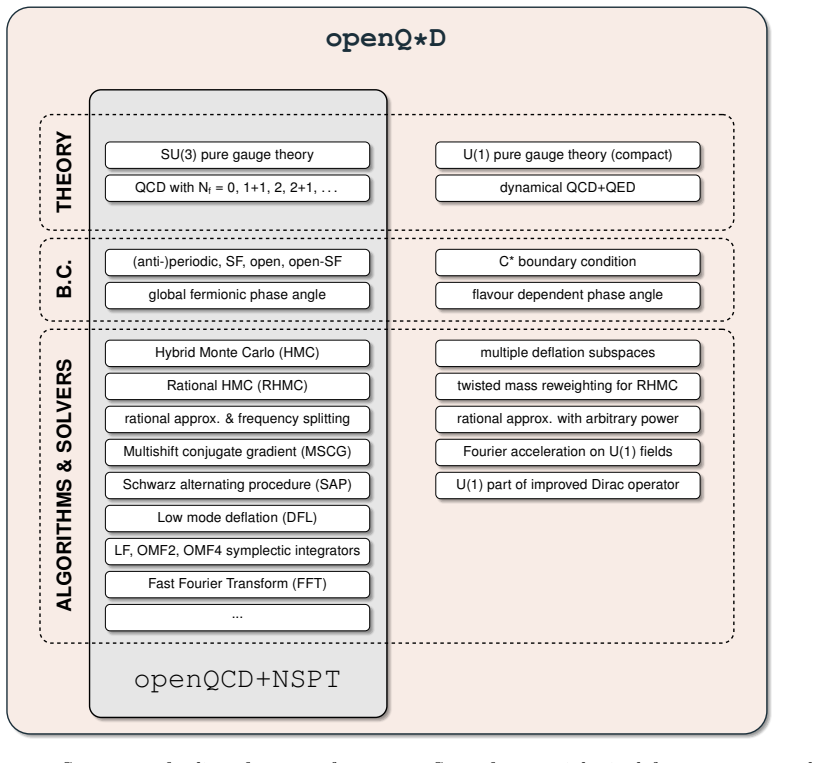
The load-bearing mechanism is the C* orbifold: spatial directions are closed by C-parity boundary conditions, implemented by allocating a doubled lattice and mapping the mirror copy through shifted boundary conditions, which turns the fermion determinant into a Pfaffian and makes charged states accessible without non-local gauge fixing. Around this sit three algorithmic pieces: the rational hybrid Monte Carlo (RHMC) with a rational approximation of fractional powers of the Dirac operator and twisted-mass reweighting; multiple deflation subspaces so that quarks with different electric charges each receive their own low-mode subspace; and Fourier acceleration of the U(1) molecular-dynamics update, where the kinetic term uses an inverse Laplacian preconditioning. The package also provides O(a) improvement terms (Sheikholeslami-Wohlert) and a choice of SU(3) gauge actions.
What would settle it
Compute the average sign of the Pfaffian on the Q*D1 ensemble, or at lighter pseudoscalar masses, by evaluating $\mathrm{pf}(C T D)$ on a sample of configurations; if the average sign departs from +1 by more than a few percent, or fluctuates strongly, the ensembles require sign reweighting and the code's stated assumption of a mild sign problem would fail at those parameters.
Extended reading notes
Core claim
The central claim is that a single open-source program, openQ*D-1.0, can simulate QCD, QED, and QCD+QED with O(a)-improved Wilson fermions under periodic or C* boundary conditions, and that the implementation of the C* orbifold, the rational hybrid Monte Carlo with reweighting, multiple deflation subspaces, and Fourier acceleration for the U(1) field is correct and efficient. With C* boundary conditions, fields obey a charge-conjugation relation across the spatial boundary, implemented by simulating a doubled lattice; this yields the Pfaffian target distribution and provides a local gauge-invariant framework in which electrically charged hadrons can be studied on a finite volume. The paper reports that the dynamical test run Q*D1 is stable, and that the reweighting factors stay close to one, supporting the practical viability of the approach.
Load-bearing premise
The load-bearing premise is that the sign of the fermion determinant and Pfaffian is mild enough to be ignored at the simulated parameters; if that sign is not negligible, the generated ensembles would not represent the target QCD+QED path integral.
Editorial extensions
If this is right
- Radiative corrections to hadronic observables can be computed from first principles on the lattice without non-local QED actions, because C* boundary conditions provide a local, gauge-invariant framework for charged states.
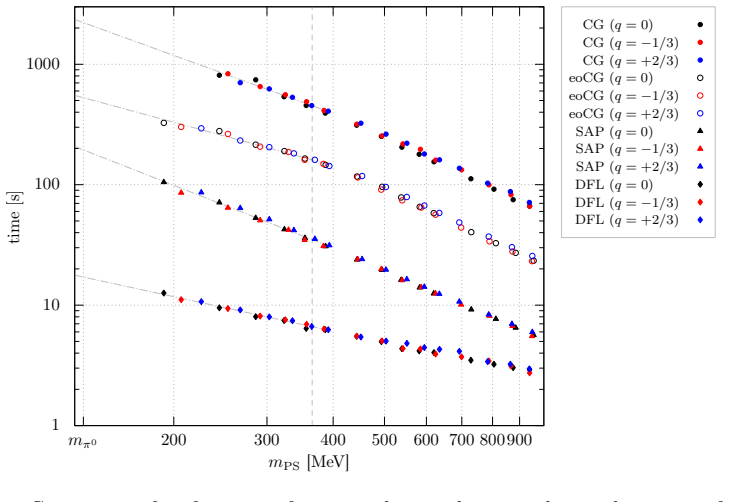
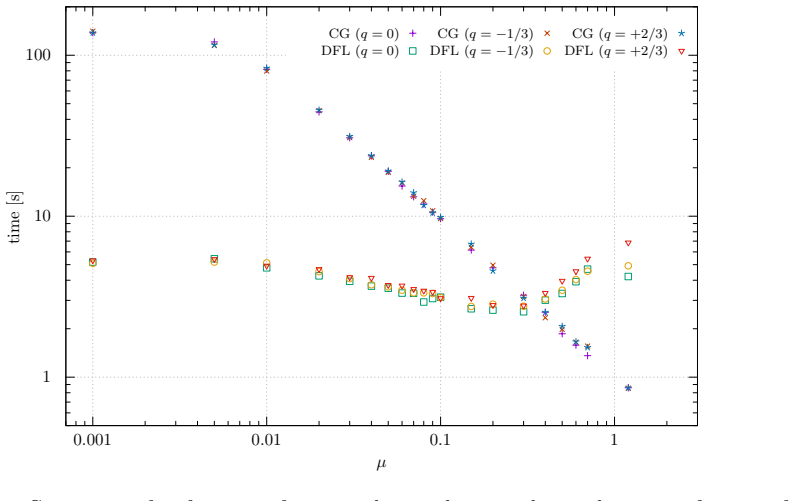
- The code makes it practical to simulate QCD+QED with up- and down-type quarks of different electric charge, since each flavour can have its own deflation subspace and the solver performance stays charge-insensitive.
- The demonstrated stability of the dynamical run Q*D1 and the smallness of the reweighting factors indicate that production ensembles at moderate quark masses are within reach.
- Users can pick periodic, Schrödinger-functional, open, or open-SF boundary conditions in time, so the package can support scale-setting and step-scaling studies in addition to spectrum calculations.
Reading between the lines
- A direct test of the sign assumption would be to evaluate the Pfaffian sign on the Q*D1 ensembles and at lighter quark masses; a non-negligible average sign would require reweighting and would refine the paper's statement about the mildness of the sign problem.
- The modular design, with the Dirac operator taking the electric charge as a parameter and the U(1) action kept separate, suggests the code could be extended to non-compact QED or arbitrary charge assignments without changing the core solver machinery.
- If ensembles like Q*D1 are pushed to the physical point, the C*-boundary setup could become a standard first-principles route to isospin-breaking corrections, complementing methods that treat QED perturbatively.
Signed reviews
Editorial analysis
A structured set of objections, weighed in public.
Referee Report
Summary. This paper presents openQ*D-1.0, an open-source lattice QCD+QED simulation package built on openQCD-1.6 and NSPT-1.4. The code supports SU(3), U(1), and SU(3)×U(1) theories with O(a) improved Wilson fermions, periodic or C* spatial boundary conditions, several temporal boundary conditions, RHMC with rational approximations and frequency splitting, multiple deflation subspaces, and Fourier acceleration for the U(1) field. The manuscript gives the theoretical background for the actions and algorithms, a user guide for the dynamical simulation program iso1, and a set of tests: low-level code checks, Hamiltonian conservation tests with and without Fourier acceleration, solver benchmarks in an electroquenched setup, and a stable dynamical test run labeled Q*D1. The central claim is that openQ*D-1.0 is a stable, well-tested package that can generate QCD+QED configurations with C* boundary conditions.
Significance. If the claims hold, this is a valuable software contribution: it is the first open-source package of its kind for dynamical QCD+QED with C* boundary conditions, and it makes the framework of ref. [18] concretely usable. The strengths of the paper are that the code is publicly released, the low-level test suite covers C* boundary conditions, Dirac operators with generic electric charge, rational approximations and forces, and the Hamiltonian-conservation test reproduces the expected integrator orders. The authors also report a stable dynamical test run, which is a nontrivial algorithmic milestone. The main caveat is that the sign of the fermion determinant/Pfaffian is dropped in the simulated distribution, so the paper's claims must be read as claims about the phase-quenched theory unless the sign is shown to be negligible; this is acknowledged in the text but not quantified.
major comments (2)
- [Sec. 2, Eq. (2.4); Sec. 4.5] The treatment of the determinant/Pfaffian sign is a load-bearing assumption for the paper's central claim. Equation (2.4) replaces det D_f and pf(CT D_f) by their absolute values, so the simulated distribution rho_sim in Eq. (2.6) is the phase-quenched theory rather than the target rho_tar of Eqs. (2.2)-(2.3). The text says that the sign problem is mild, citing ref. [18], and that it becomes irrelevant sufficiently close to the continuum, but no numerical evidence is given at the parameters of the Q*D1 run (alpha_0 = 0.05 ~ 7 alpha_phys, m_PS ~ 660 MeV, a ~ 0.074 fm). The tests in Sec. 4 do not probe the sign: Hamiltonian conservation (Fig. 4) tests the integrator, the solver benchmarks (Figs. 6-7) test linear algebra, and the reweighting factors W_q in Fig. 8 quantify only the rational-approximation error, not the sign. If the sign is non-negligible at these parameters, the Q*D1 ensemble is biased with respect to the QCD+QED path integral, and the statement that openQ*D can generate QCD+QED configurations is not demonstrated. I ask the authors either to provide a quantitative estimate of the sign, for example by computing the stochastic estimate of the sign on a subset of generated configurations, or to explicitly and consistently recast the claims as applying to the phase-quenched theory, with the sign reweighting identified as a necessary additional ingredient that is not yet implemented.
- [Sec. 4.5 and Summary] The Q*D1 run is presented as evidence that the code is stable for dynamical QCD+QED, but the run is explicitly an unphysical version of Nf=2+1 QCD+QED: the two down-type quarks are degenerate and the up-type quark is significantly heavier because the bare masses were taken equal. This is acknowledged in Sec. 4.5, and the run is described as sufficient to probe observables and performance. That is acceptable for a tools paper, but the wording of the abstract and Summary ('designed to perform lattice simulations of QCD+QED') should be qualified so that a reader does not infer that the package has been demonstrated to produce physical QCD+QED ensembles. The distinction between a code that can generate ensembles for the phase-quenched theory and a code that has been validated for the target QCD+QED distribution should be made prominent in the introduction or abstract.
minor comments (5)
- [Sec. 4.5, text near Fig. 8] There is a typo: 'better rational appriximation' should read 'better rational approximation'.
- [Sec. 4.4] The text uses 'Schwartz-Alternating-Procedure'; the standard spelling in lattice QCD is 'Schwarz' (as in Hermann Schwarz).
- [Fig. 3 and Sec. 4.1] The scaling plots have no error bars or repeated-run information, and the y-axis notation '16·t[16 cores]/t' is slightly ambiguous; a sentence stating how many runs were averaged and how representative the single-node baseline is would improve reproducibility.
- [Sec. 3.2.1] The instructions to modify 'lines 122-124 of main/Makefile' are tied to a specific line numbering that may change between versions; referencing the variable names (e.g., CFLAGS) would be more robust.
- [Eq. (2.5) and Sec. 2.3] The derivation of the small-determinant action S_sdet is only sketched; a short explanation of the identity det(D_f) = det(D_f,oo) det(hat D_f) in the text would help readers who are not already familiar with even-odd preconditioning.
Circularity Check
No circular derivation: openQ*D is a code/tools paper whose tests are internal consistency and benchmark checks; the main self-citations supply the theoretical C* framework and the sign-ignoring assumption, but no fitted input is renamed as a prediction.
full rationale
The paper does not derive a physical constant from fitted inputs, so the classic circularity patterns (self-definitional identities, fitted inputs called predictions, renaming known results) do not apply. The target distribution in Eqs. (2.2)-(2.3) and the simulated distribution in Eq. (2.6) are related by explicitly stated rational-approximation and reweighting factors, Eqs. (2.7)-(2.9), and the reweighting factors are computed rather than assumed to be unity. The phase-quenched replacement in Eq. (2.4), where det and Pfaffian are replaced by absolute values, is explicitly acknowledged as an approximation: the text states that the sign 'should be separately calculated and included in the evaluation of observables as a reweighting factor' and that it is a 'mild sign problem [18]' with future work planned. This is an admitted theoretical assumption and a correctness risk at the Q*D1 parameters, not a circular step. The tests in Section 4 are internal consistency checks: Hamiltonian-conservation scaling tests the integrator, solver benchmarks test linear algebra, and the displayed reweighting factors quantify rational-approximation accuracy; none are presented as predictions from fitted parameters. The self-citations to refs. [18] and [20] are load-bearing for the theoretical motivation of C* boundary conditions, the qel=1/6 normalization, and the sign mildness, but they are prior published theoretical results rather than the paper's own inputs re-identified as outputs, and the code implementation is additionally checked against gauge covariance, gamma5-hermiticity, zero-field analytic expressions, and other low-level properties. There is thus no constructed circularity; the modest score reflects the same-group citation dependence in the theoretical framing, not a circular derivation.
Assumptions & free parameters
assumptions (5)
- domain assumption C* boundary conditions give a local, gauge-invariant formulation of QCD+QED in finite volume and allow charged states via the Pfaffian of CT D.
- standard math The identity |pf(CT D)| = |det D|^(1/2) holds, justifying alpha_f = 1/4 in the pseudofermion action.
- domain assumption The sign of the Pfaffian and determinant is mild and can be ignored sufficiently close to the continuum.
- domain assumption The elementary charge qel must be 1/6 to construct gauge-invariant interpolating operators for charged hadrons under C* boundary conditions.
- domain assumption Wilson fermions with O(a) improvement and standard even-odd preconditioning behave as usual when the U(1) field is coupled through the integer charge qhat.
Cite this review
Pith. "Pith review of openQ*D code: a versatile tool for QCD+QED simulations." pith.science (2026). https://pith.science/paper/CHNE2TG6
@misc{pith2026190811673,
  author       = {Pith},
  title        = {Pith review of: openQ*D code: a versatile tool for QCD+QED simulations},
  year         = {2026},
  howpublished = {\url{https://pith.science/paper/CHNE2TG6}},
  note         = {Machine review of arXiv:1908.11673}
}
read the original abstract
We present the open-source package openQ*D-1.0, which has been primarily, but not uniquely, designed to perform lattice simulations of QCD+QED and QCD, with and without C* boundary conditions, and O(a) improved Wilson fermions. The use of C* boundary conditions in the spatial direction allows for a local and gauge-invariant formulation of QCD+QED in finite volume, and provides a theoretically clean setup to calculate isospin-breaking and radiative corrections to hadronic observables from first principles. The openQ*D code is based on openQCD-1.6 and NSPT-1.4. In particular it inherits from openQCD-1.6 several core features, e.g. the highly optimized Dirac operator, the locally deflated solver, the frequency splitting for the RHMC, or the 4th order OMF integrator.
Figures


Figures from the paper (5 more)



Forward citations
Cited by 4 Pith papers
-
Multigrid low-mode averaging
A multigrid extension of low-mode averaging keeps the number of Dirac low modes fixed while suppressing stochastic variance on increasingly large lattices.
-
Partially connected contributions to baryon masses in QCD+QED
A lattice QCD+QED proceedings paper derives the one-quark connected contribution to the Omega^- two-point function under C-periodic boundary conditions and proposes a point-plus-stochastic-source strategy to compute it.
-
$O(a)$-improved QCD+QED Wilson Dirac operator on GPUs
The authors ported openQxD's QCD+QED Dirac solver to GPUs via QUDA and measured a significant speed-up with good weak scaling on up to 512 GPUs.
-
Baryon masses with C-periodic boundary conditions
First numerical estimates of the C-periodic 1-q connected contributions to the Omega-minus two-point function, plus preliminary proton and Omega masses at m_pi ~ 400 MeV.
Reference graph
Works this paper leans on
- [18]
-
[20]
Gauge invariant determination of charged hadron masses
(RC*), M. Hansen, B. Lucini, A. Patella and N. Tantalo,Gauge invariant determination of charged hadron masses, JHEP 05 (2018) 146, [1802.05474]. 39
work page Pith review arXiv 2018
-
[1]
(RC*), I. Campos, P. Fritzsch, M. Hansen, M. Krstić Marinković, A. Patella, A. Ramos et al., “openQ*D.” GitLab:https://gitlab.com/rcstar/openQxD. CSIC: https: //dx.doi.org/10.20350/digitalCSIC/8591, https://hdl.handle.net/10261/173334
-
[2]
Simulation program for lattice QCD (openQCD code), https://cern.ch/luscher/openQCD, 2016
work page 2016
-
[3]
Numerical Stochastic Perturbation Theory (NSPT code), https://cern.ch/luscher/NSPT, 2017
work page 2017
-
[4]
Aoki et al.,FLAG Review 2019, 1902.08191
(Flavour Lattice A veraging Group), S. Aoki et al.,FLAG Review 2019, 1902.08191
arXiv 2019
-
[5]
V. Cirigliano, G. Ecker, H. Neufeld, A. Pich and J. Portoles,Kaon Decays in the Standard Model, Rev. Mod. Phys.84 (2012) 399, [1107.6001]
arXiv 2012
- [6]
Show all 58 references
-
[7]
Di Carlo, D
M. Di Carlo, D. Giusti, V. Lubicz, G. Martinelli, C. T. Sachrajda, F. Sanfilippo et al., Light-meson leptonic decay rates in lattice QCD+QED, 1904.08731
1904 arXiv
-
[8]
(HFLA V), Heavy Flavor Averaging Group,https://hflav.web.cern.ch
-
[9]
de Boer, T
S. de Boer, T. Kitahara and I. Nisandzic,Soft-Photon Corrections to ¯B→Dτ−¯ντRelative to ¯B→Dµ−¯νµ, Phys. Rev. Lett.120 (2018) 261804, [1803.05881]
2018 arXiv
-
[10]
S. Calí, S. Klaver, M. Rotondo and B. Sciascia,Impacts of radiative corrections on measurements of lepton flavour universality inB→D𝓁ν𝓁decays, 1905.02702
1905 arXiv
-
[11]
Borsanyi et al.,Ab initio calculation of the neutron-proton mass difference, Science 347 (2015) 1452–1455, [1406.4088]
S. Borsanyi et al.,Ab initio calculation of the neutron-proton mass difference, Science 347 (2015) 1452–1455, [1406.4088]
2015 arXiv
-
[12]
Horsley et al.,Isospin splittings of meson and baryon masses from three-flavor lattice QCD + QED, J
R. Horsley et al.,Isospin splittings of meson and baryon masses from three-flavor lattice QCD + QED, J. Phys.G43 (2016) 10LT02, [1508.06401]
2016 arXiv
-
[13]
Horsley et al.,QED effects in the pseudoscalar meson sector, JHEP 04 (2016) 093, [1509.00799]
R. Horsley et al.,QED effects in the pseudoscalar meson sector, JHEP 04 (2016) 093, [1509.00799]
2016 arXiv
-
[14]
Patella,QED Corrections to Hadronic Observables, PoS LATTICE2016(2017) 020, [1702.03857]
A. Patella,QED Corrections to Hadronic Observables, PoS LATTICE2016(2017) 020, [1702.03857]
2017 arXiv
-
[15]
Bernecker and H
D. Bernecker and H. B. Meyer,Vector Correlators in Lattice QCD: Methods and applications, Eur. Phys. J.A47 (2011) 148, [1107.4388]
2011 arXiv
-
[16]
T. Blum, N. Christ, M. Hayakawa, T. Izubuchi, L. Jin, C. Jung et al.,Using infinite volume, continuum QED and lattice QCD for the hadronic light-by-light contribution to the muon anomalous magnetic moment, Phys. Rev.D96 (2017) 034515, [1705.01067]
2017 arXiv
-
[17]
Feng and L
X. Feng and L. Jin,QED self energies from lattice QCD without power-law finite-volume errors, 1812.09817
-
[19]
P. A. M. Dirac,Gauge invariant formulation of quantum electrodynamics, Can. J. Phys.33 (1955) 650
1955
-
[21]
(RM123), G. M. de Divitiis, R. Frezzotti, V. Lubicz, G. Martinelli, R. Petronzio, G. C. Rossi et al.,Leading isospin breaking effects on the lattice, Phys. Rev.D87 (2013) 114505, [1303.4896]
2013 arXiv
-
[22]
Lüscher,Deflation acceleration of lattice QCD simulations, JHEP 12 (2007) 011, [0710.5417]
M. Lüscher,Deflation acceleration of lattice QCD simulations, JHEP 12 (2007) 011, [0710.5417]
2007 arXiv
-
[23]
G. G. Batrouni, G. R. Katz, A. S. Kronfeld, G. P. Lepage, B. Svetitsky and K. G. Wilson, Langevin Simulations of Lattice Field Theories, Phys. Rev.D32 (1985) 2736
1985
-
[24]
Duane and B
S. Duane and B. J. Pendleton,Gauge Invariant Fourier Acceleration, Phys. Lett.B206 (1988) 101–106
1988
-
[25]
Dalla Brida and M
M. Dalla Brida and M. Lüscher,SMD-based numerical stochastic perturbation theory, Eur. Phys. J.C77 (2017) 308, [1703.04396]
2017 arXiv
-
[27]
Lüscher, R
M. Lüscher, R. Narayanan, P. Weisz and U. Wolff,The Schrödinger functional: A Renormalizable probe for nonAbelian gauge theories, Nucl. Phys.B384 (1992) 168–228, [hep-lat/9207009]
1992 arXiv
-
[28]
Sint,On the Schrödinger functional in QCD, Nucl
S. Sint,On the Schrödinger functional in QCD, Nucl. Phys.B421 (1994) 135–158, [hep-lat/9312079]
1994 arXiv
-
[29]
Lüscher,Step scaling and the Yang-Mills gradient flow, JHEP 06 (2014) 105, [1404.5930]
M. Lüscher,Step scaling and the Yang-Mills gradient flow, JHEP 06 (2014) 105, [1404.5930]
2014 arXiv
-
[31]
Phys.B357 (1991) 521–533
Topological structure, Nucl. Phys.B357 (1991) 521–533
1991
-
[32]
A. S. Kronfeld and U. J. Wiese,SU(N) gauge theories with C periodic boundary conditions
-
[33]
Phys.B401 (1993) 190–205, [hep-lat/9210008]
Small volume dynamics, Nucl. Phys.B401 (1993) 190–205, [hep-lat/9210008]
1993 arXiv
-
[34]
U. J. Wiese,C periodic and G periodic QCD at finite temperature, Nucl. Phys.B375 (1992) 45–66
1992
-
[35]
Polley,Boundaries for SU(3)C×U(1)el lattice gauge theory with a chemical potential, Z
L. Polley,Boundaries for SU(3)C×U(1)el lattice gauge theory with a chemical potential, Z. Phys. C59 (1993) 105–108
1993
-
[36]
Montvay,Supersymmetric Yang-Mills theory on the lattice, Int
I. Montvay,Supersymmetric Yang-Mills theory on the lattice, Int. J. Mod. Phys.A17 (2002) 2377–2412, [hep-lat/0112007]
2002 arXiv
-
[37]
S. Ali, G. Bergner, H. Gerber, P. Giudice, I. Montvay, G. Münster et al.,The light bound states ofN = 1 supersymmetric SU(3) Yang-Mills theory on the lattice, JHEP 03 (2018) 113, [1801.08062]
2018 arXiv
-
[38]
T. A. DeGrand,A Conditioning Technique for Matrix Inversion for Wilson Fermions, Comput. Phys. Commun.52 (1988) 161–164
1988
-
[39]
A. D. Kennedy, I. Horvath and S. Sint,A New exact method for dynamical fermion computations with nonlocal actions, Nucl. Phys. Proc. Suppl.73 (1999) 834–836, [hep-lat/9809092]. [,834(1998)]
1999 arXiv
-
[40]
Lüscher and F
M. Lüscher and F. Palombi,Fluctuations and reweighting of the quark determinant on large lattices, PoS LATTICE2008(2008) 049, [0810.0946]
2008 arXiv
-
[41]
Lüscher and S
M. Lüscher and S. Schaefer,Lattice QCD with open boundary conditions and twisted-mass reweighting, Comput. Phys. Commun.184 (2013) 519–528, [1206.2809]. 40
2013 arXiv
-
[42]
J. C. Sexton and D. H. Weingarten,Hamiltonian evolution for the hybrid Monte Carlo algorithm, Nucl. Phys.B380 (1992) 665–677
1992
-
[43]
Omelyan, I
I. Omelyan, I. Mryglod and R. Folk,Symplectic analytically integrable decomposition algorithms: classification, derivation, and application to molecular dynamics, quantum and celestial mechanics simulations, Comp. Phys. Comm.151 (2003) 272–314
2003
-
[44]
Campos, P
I. Campos, P. Fritzsch, M. Hansen, M. K. Marinković, A. Patella, A. Ramos et al.,openQ*D simulation code for QCD+QED, EPJ Web Conf.175 (2018) 09005, [1710.08839]
2018 arXiv
-
[45]
openQ*D documentation, Gauge actions,doc/gauge_action.pdf
(RC*), “openQ*D documentation, Gauge actions,doc/gauge_action.pdf.”
-
[46]
openQ*D documentation, Dirac operator,doc/dirac.pdf
(RC*), “openQ*D documentation, Dirac operator,doc/dirac.pdf.”
-
[47]
Lüscher, S
M. Lüscher, S. Sint, R. Sommer and P. Weisz,Chiral symmetry and O(a) improvement in lattice QCD, Nucl. Phys.B478 (1996) 365–400, [hep-lat/9605038]
1996 arXiv
-
[48]
Lüscher,A portable high quality random number generator for lattice field theory simulations, Comput
M. Lüscher,A portable high quality random number generator for lattice field theory simulations, Comput. Phys. Commun.79 (1994) 100–110, [hep-lat/9309020]
1994 arXiv
-
[49]
Remes,Sur le calcul effectif des polynômes d’approximation de Tchebichef., C
E. Remes,Sur le calcul effectif des polynômes d’approximation de Tchebichef., C. R. Acad. Sci., Paris199 (1934) 337–340
1934
-
[50]
Ralston,Rational Chebyshev approximation by Remes’ algorithms, Numerische Mathematik 7 (Aug, 1965) 322–330
A. Ralston,Rational Chebyshev approximation by Remes’ algorithms, Numerische Mathematik 7 (Aug, 1965) 322–330
1965
-
[51]
Bulava and S
J. Bulava and S. Schaefer,Improvement ofNf = 3 lattice QCD with Wilson fermions and tree-level improved gauge action, Nucl. Phys.B874 (2013) 188–197, [1304.7093]
2013 arXiv
-
[52]
Jansen and R
(ALPHA), K. Jansen and R. Sommer,O(a) improvement of lattice QCD with two flavors of Wilson quarks, Nucl. Phys.B530 (1998) 185–203, [hep-lat/9803017]. [Erratum: Nucl. Phys.B643,517(2002)]
1998 arXiv
-
[53]
Fritzsch, F
P. Fritzsch, F. Knechtli, B. Leder, M. Marinkovic, S. Schaefer, R. Sommer et al.,The strange quark mass and Lambda parameter of two flavor QCD, Nucl. Phys.B865 (2012) 397–429, [1205.5380]
2012 arXiv
-
[54]
Bruno, T
M. Bruno, T. Korzec and S. Schaefer,Setting the scale for the CLS2 + 1flavor ensembles, Phys. Rev.D95 (2017) 074504, [1608.08900]
2017 arXiv
-
[55]
Lüscher,Local coherence and deflation of the low quark modes in lattice QCD, JHEP 07 (2007) 081, [0706.2298]
M. Lüscher,Local coherence and deflation of the low quark modes in lattice QCD, JHEP 07 (2007) 081, [0706.2298]
2007 arXiv
-
[56]
Frommer, K
A. Frommer, K. Kahl, S. Krieg, B. Leder and M. Rottmann,Adaptive Aggregation Based Domain Decomposition Multigrid for the Lattice Wilson Dirac Operator, SIAM J. Sci. Comput. 36 (2014) A1581–A1608, [1303.1377]
2014 arXiv
-
[57]
Hansen, B
M. Hansen, B. Lucini, A. Patella and N. Tantalo,Simulations of QCD and QED with C* boundary conditions, EPJ Web Conf.175 (2018) 09001, [1710.08838]
2018 arXiv
-
[58]
Bruno et al.,Simulation of QCD withNf = 2 + 1flavors of non-perturbatively improved Wilson fermions, JHEP 02 (2015) 043, [1411.3982]
M. Bruno et al.,Simulation of QCD withNf = 2 + 1flavors of non-perturbatively improved Wilson fermions, JHEP 02 (2015) 043, [1411.3982]
2015 arXiv
-
[59]
Lüscher,Properties and uses of the Wilson flow in lattice QCD, JHEP 08 (2010) 071, [1006.4518]
M. Lüscher,Properties and uses of the Wilson flow in lattice QCD, JHEP 08 (2010) 071, [1006.4518]. [Erratum: JHEP03,092(2014)]
2010 arXiv
-
[60]
Hasenbusch,Speeding up the hybrid Monte Carlo algorithm for dynamical fermions, Phys
M. Hasenbusch,Speeding up the hybrid Monte Carlo algorithm for dynamical fermions, Phys. Lett.B519 (2001) 177–182, [hep-lat/0107019]. 41
2001 arXiv
Reviewed August 14, 2026 · model on record in the stance chip above.
Discussion (0). Continue with ORCID to comment.