REVIEW 3 major objections 5 minor 111 references
Ionized Gas Outflows in the Galaxy And Mass Assembly (GAMA) Survey: Signatures of AGN Feedback in Low-Mass Galaxies
T0 review · 3 major / 5 minor · reviewed 2026-08-12 · deepseek-v4-flash
Pith's one-line read Black hole winds sweep through dwarf galaxies
desk verdict Useful new catalog of 398 outflow candidates in GAMA DR4, but the low-mass AGN feedback claim rests on 15 objects with no significance tests and heavily overlapping velocity distributions. read the letter →
The pith
A machine-rendered reading of the paper's core claim, the machinery that carries it, and where it could break.
The reading
What carries the argument
The central object is the [O III] $\lambda\lambda4959,5007$ doublet line profile, fitted with one- and two-Gaussian models. A second, broader Gaussian component is accepted as an outflow signature when it lowers the reduced chi-square by at least 20%, has a flux S/N $\ge$ 3, a peak at least 3$\sigma$ above the noise, and a width above instrumental resolution. Outflow speed is quantified by $W_{80}$, the velocity width containing 80% of the line flux, chosen for its lower sensitivity to dust and inclination, while the offset velocity $v_0$ between the narrow and broad components is measured separately. Host classification on the BPT diagram assigns each candidate to AGN, composite, or star-forming categories, and the AGN/composite distinction carries the paper's main comparison.
What would settle it
Spatially resolved IFU spectroscopy of the [O III] kinematics in the 45 low-mass hosts would settle whether the second components are winds: if the broad component tracks the rotation curve or vanishes beyond the nucleus, the outflow interpretation fails.
Extended reading notes
Core claim
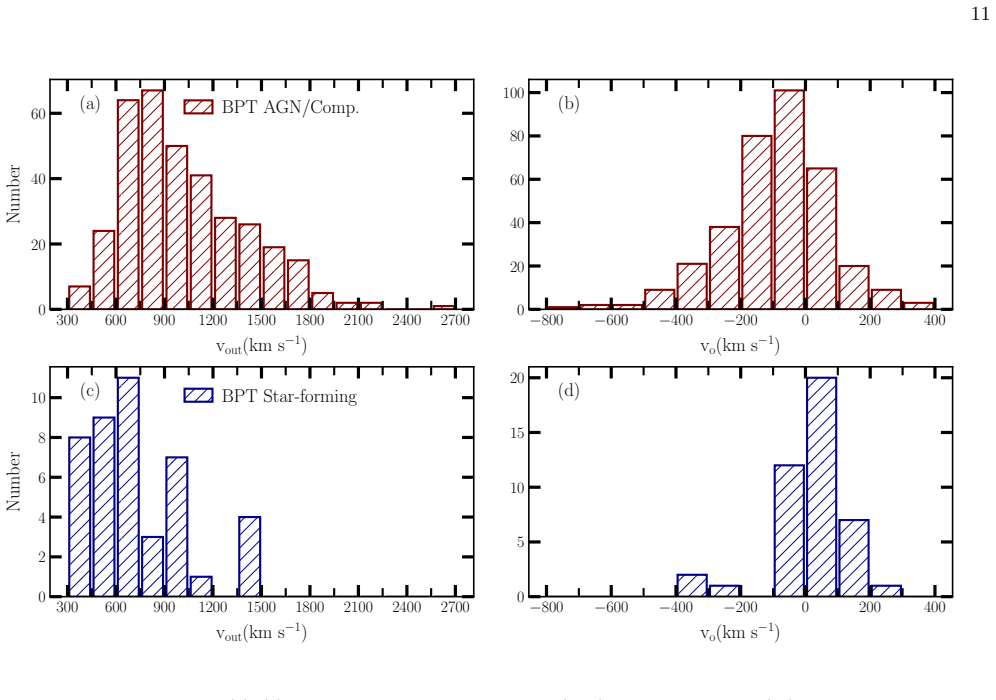
The paper reports a systematic search for a second velocity component in the [O III] $\lambda\lambda4959,5007$ doublet across 39,612 galaxies from the GAMA survey, yielding 398 reliable outflow candidates. Among these, 45 have stellar masses $M_*<10^{10}\,M_\odot$, and a third of those are classified as AGNs or composites on the BPT diagram. The outflows in low-mass AGN/composite hosts are faster, with median $W_{80}=777$ km/s versus 609 km/s in star-forming hosts, and more blueshifted, with median offset $v_0=-46$ km/s versus $+42$ km/s. This is presented as evidence that black hole outflows can affect low-mass host galaxies and that AGN feedback should be considered in galaxy evolution models for $M_*<10^{10}\,M_\odot$.
Load-bearing premise
The broad second component in [O III] is assumed to be an outflow rather than beam smearing, disk rotation, biconical geometry, or a merger-inflated line.
Editorial extensions
If this is right
- AGN feedback should be treated as a viable channel in galaxy evolution models for $M_*<10^{10}\,M_\odot$, not only in massive galaxies.
- The 398 outflow candidates, only eight of which have SDSS spectra, enlarge the census of ionized outflows in the GAMA fields and provide new targets for follow-up study.
- Because roughly 97% of AGN/composite outflows have $W_{80}>500$ km/s, the paper concludes these outflows carry enough energy to be AGN-driven rather than starburst-driven.
- The higher incidence of outflows among AGNs/composites, about 89% of the sample, supports earlier findings that AGN activity is a more common outflow driver than star formation.
Reading between the lines
- Because the low-mass AGN and star-forming outflow samples are not matched in stellar mass and redshift, a matched comparison is needed to confirm that the $W_{80}$ and $v_0$ differences trace AGN activity rather than host properties.
- The roughly 9% of candidates with double-peaked or similar-width components could be disk rotation or biconical geometry rather than winds; if so, excluding them would shift the median velocities, and spatially resolved follow-up could quantify the contamination.
- Detecting molecular or neutral-gas outflows in the same 45 low-mass galaxies would test whether the ionized outflows carry enough mass and energy to actually quench or enhance star formation in dwarfs.
Signed reviews
Editorial analysis
A structured set of objections, weighed in public.
Referee Report
Summary. This paper presents a systematic search for ionized-gas outflow signatures in the [O III] lambda-lambda 4959,5007 doublet in 39,612 GAMA DR4 galaxies with z<0.3, yielding 398 candidates after visual inspection, of which 45 have stellar masses below 10^10 M_sun. The authors fit one- and two-Gaussian models to the doublet, classify the hosts using BPT diagrams, measure W80 and offset velocities, estimate virial black hole masses from broad H-alpha detections, and compare outflow properties between AGN/composite and star-forming hosts, with particular attention to the low-mass regime. They report that low-mass AGN/composite outflows are faster and more blueshifted than those in low-mass star-forming galaxies and conclude that AGN feedback should be considered in galaxy evolution models for M*<10^10 M_sun.
Significance. The outflow catalog is a useful community resource: the parent-sample selection is transparent, every candidate is visually inspected, and the electronic tables provide per-object velocities, fluxes, and classifications. If the low-mass comparison is robust, the paper would supply needed evidence that AGN-driven ionized outflows exist in the M*<10^10 M_sun regime and should be incorporated into feedback models. However, the headline inference currently rests on 15 AGN/composite galaxies versus 29 star-forming galaxies, with overlapping velocity distributions and no significance tests, confidence intervals, or comparison of the mass and redshift distributions of the two groups; the claim is therefore not yet established at the strength stated in the abstract and conclusions.
major comments (3)
- [Section 4.5, Figure 10] The central claim that low-mass AGN/composite outflows are faster and more blueshifted than those in star-forming galaxies is not supported by a statistical test. The reported medians of W80 = 777 km/s (n=15) versus 609 km/s (n=29) and offset velocities of -46 versus +42 km/s are quoted without uncertainties, and Figures 10a and 10c show strongly overlapping distributions. A two-sample test such as the Mann-Whitney U or a permutation test, with bootstrap confidence intervals for the medians, should be reported for both quantities. If the differences are not significant, the conclusions in Sections 4.5 and 5 must be softened accordingly.
- [Section 4.5] The low-mass AGN/composite subsample is entirely drawn from the broad-line-selected Salehirad et al. (2022) sample, while the star-forming subsample is selected solely by BPT classification. The manuscript does not compare the stellar-mass or redshift distributions of the two low-mass groups, even though spectral resolution, signal-to-noise ratio, and host mass can all affect fitted W80 values. A matched analysis, or an explicit demonstration that the two groups have comparable mass and redshift distributions, is needed before the velocity difference can be attributed to AGN activity rather than to selection or resolution effects.
- [Sections 3.2 and 5] The interpretation of the second Gaussian component as an outflow is qualified by the paper's own statements that non-Gaussian profiles can result from beam smearing of velocity gradients and that about 9% of candidates are double-peaked lines possibly associated with NLR disk rotation, biconical outflows, or merging AGNs. Given the small size of the low-mass AGN sample, a sensitivity check that excludes the double-peaked candidates, or otherwise quantifies how much of the reported low-mass velocity difference survives removal of these ambiguous cases, is needed to ensure that the comparison cleanly measures outflows.
minor comments (5)
- [Section 3, first paragraph] The phrase 'beam-spearing' should read 'beam smearing'.
- [Section 3.4 and Table 2] The [O I] line is labeled lambda6003 in the text but lambda6300 in the table caption and elsewhere; the correct wavelength is 6300 Angstroms.
- [Abstract] The word 'F eedback' in the abstract should be 'Feedback'.
- [Figure 3 caption] Panel (e) is described both as a two-peak example and as a broad blueshifted example; the caption should be corrected so each of the six panels is described once and consistently.
- [Section 2.1] The statement that GAMA is 'two magnitudes deeper than the SDSS' would benefit from a citation or a quantitative definition of the magnitude limit comparison.
Circularity Check
No significant circularity: outflow velocities are direct fit outputs, AGN/SF classification uses external BPT demarcations, and the one self-citation is not load-bearing.
full rationale
The paper's central quantities are measured, not derived from the conclusions. Outflow candidates are selected by fitting one- and two-Gaussian models to [O III] and requiring a 20% reduced-chi-squared improvement, broader second component, S/N >= 3, and peak >= 3-sigma above noise (Section 3.2); W80 and offset velocity are then direct outputs of those fits (Sections 3.3 and 4.3). AGN/composite versus star-forming classification uses the external BPT demarcation lines of Kewley et al. (2006) and Kauffmann et al. (2003), not a parameter fitted in this paper. The 500 km/s threshold is attributed to Fabian (2012), an external benchmark. The low-mass comparison in Section 4.5 (median W80 777 versus 609 km/s, median offset -46 versus +42 km/s) compares independently measured quantities; no equation in the paper reduces one median to the other. The only self-citation is the statement in Section 4.5 that 'All the AGNs/composites are among the Salehirad et al. (2022) sample,' but the current AGN/composite labels come from the paper's own BPT analysis and the outflow velocities are measured here, so this citation is not load-bearing for the velocity comparison. The acknowledged possibility that some second components are rotation or double-peaked NLR structure is a modeling-interpretation caveat, not a circularity. Overall, the analysis is self-contained as an observational measurement study.
Assumptions & free parameters
free parameters (2)
- Two-Gaussian model selection threshold =
reduced chi2 improvement of at least 20%
- Minimum second-component S/N and peak significance =
S/N >= 3; peak >= 3 sigma above rms
assumptions (5)
- domain assumption A second Gaussian component in [O III] traces a distinct kinematic component, generally an outflow
- domain assumption BPT emission-line ratios separate AGN photoionization from star formation in this sample
- standard math The W80 to FWHM relation for a Gaussian (W80 = 1.09 FWHM)
- domain assumption GAMA stellar masses and redshifts are reliable
- domain assumption The 500 km/s W80 threshold indicates AGN-driven outflows
Cite this review
Pith. "Pith review of Ionized Gas Outflows in the Galaxy And Mass Assembly (GAMA) Survey: Signatures of AGN Feedback in Low-Mass Galaxies." pith.science (2026). https://pith.science/paper/CIWIAOSC
@misc{pith2026241200880,
  author       = {Pith},
  title        = {Pith review of: Ionized Gas Outflows in the Galaxy And Mass Assembly (GAMA) Survey: Signatures of AGN Feedback in Low-Mass Galaxies},
  year         = {2026},
  howpublished = {\url{https://pith.science/paper/CIWIAOSC}},
  note         = {Machine review of arXiv:2412.00880}
}
abstract
We present a sample of 398 galaxies with ionized gas outflow signatures in their spectra from the Galaxy and Mass Assembly (GAMA) Survey Data Release 4, including 45 low-mass galaxies with stellar masses $M_*<10^{10}$ $M_\odot$. We assemble our sample by systematically searching for the presence of a second velocity component in the [O III]$\lambda\lambda 4959, 5007$ doublet emission line in 39,612 galaxies with redshifts $z<0.3$. The host galaxies are classified using the BPT diagram, with $\sim$89% identified as AGNs and composites and 11% as star-forming (SF) galaxies. The outflows are typically faster in AGNs with a median velocity of 936 km s$^{-1}$ compared to 655 km s$^{-1}$ in the SF objects. Of particular interest are the 45 galaxies in the low-mass range, of which a third are classified as AGNs/composites. The outflows from the low-mass AGNs are also faster and more blueshifted compared to those in the low-mass SF galaxies. This indicates that black hole outflows can affect host galaxies in the low-mass range and that AGN feedback in galaxies with $M_*<10^{10}$ $ M_\odot$ should be considered in galaxy evolution models.
Figures


Figures from the paper (7 more)




Reference graph
Works this paper leans on
-
[1]
Alexander, D. M., Swinbank, A. M., Smail, I., McDermid, R., & Nesvadba, N. P. H. 2010, MNRAS, 402, 2211, doi: 10.1111/j.1365-2966.2009.16046.x Angl´ es-Alc´ azar, D., Faucher-Gigu` ere, C.-A., Quataert, E., et al. 2017, MNRAS, 472, L109, doi: 10.1093/mnrasl/slx161
arXiv 2010
-
[2]
2023, ApJ, 950, 33, doi: 10.3847/1538-4357/acca7c Astropy Collaboration, Robitaille, T
Aravindan, A., Liu, W., Canalizo, G., et al. 2023, ApJ, 950, 33, doi: 10.3847/1538-4357/acca7c Astropy Collaboration, Robitaille, T. P., Tollerud, E. J., et al. 2013, A&A, 558, A33, doi: 10.1051/0004-6361/201322068 Astropy Collaboration, Price-Whelan, A. M., Sip˝ ocz, B. M., et al. 2018, AJ, 156, 123, doi: 10.3847/1538-3881/aabc4f
-
[3]
2016, ApJ, 828, 97, doi: 10.3847/0004-637X/828/2/97
Bae, H.-J., & Woo, J.-H. 2016, ApJ, 828, 97, doi: 10.3847/0004-637X/828/2/97
-
[4]
Baldassare, V. F., Reines, A. E., Gallo, E., et al. 2016, ApJ, 829, 57, doi: 10.3847/0004-637X/829/1/57
-
[6]
Baldry, I. K., Liske, J., Brown, M. J. I., et al. 2018, MNRAS, 474, 3875, doi: 10.1093/mnras/stx3042
-
[7]
Baldwin, J. A., Phillips, M. M., & Terlevich, R. 1981, PASP, 93, 5, doi: 10.1086/130766
doi:10.1086/130766 1981
-
[8]
2016, A&A, 585, A148, doi: 10.1051/0004-6361/201526694
Balmaverde, B., Marconi, A., Brusa, M., et al. 2016, A&A, 585, A148, doi: 10.1051/0004-6361/201526694
-
[9]
Barai, P., & de Gouveia Dal Pino, E. M. 2019, MNRAS, 487, 5549, doi: 10.1093/mnras/stz1616
Show all 111 references
-
[10]
J., Greene, J
Barth, A. J., Greene, J. E., & Ho, L. C. 2008, AJ, 136, 1179, doi: 10.1088/0004-6256/136/3/1179
2008 doi
-
[11]
P., Robotham, A
Bellstedt, S., Driver, S. P., Robotham, A. S. G., et al. 2020, MNRAS, 496, 3235, doi: 10.1093/mnras/staa1466
2020 doi
-
[12]
J., Bower, R
Benson, A. J., Bower, R. G., Frenk, C. S., et al. 2003, ApJ, 599, 38, doi: 10.1086/379160
2003 doi
-
[13]
2022, MNRAS, 516, 3092, doi: 10.1093/mnras/stac2439
Bizyaev, D., Chen, Y.-M., Shi, Y., et al. 2022, MNRAS, 516, 3092, doi: 10.1093/mnras/stac2439
2022 doi
-
[15]
D., Geha, M
Bradford, J. D., Geha, M. C., Greene, J. E., Reines, A. E., & Dickey, C. M. 2018, ApJ, 861, 50, doi: 10.3847/1538-4357/aac88d
2018 doi
-
[16]
2003, MNRAS, 344, 1000, doi: 10.1046/j.1365-8711.2003.06897.x
Bruzual, G., & Charlot, S. 2003, MNRAS, 344, 1000, doi: 10.1046/j.1365-8711.2003.06897.x
2003
-
[17]
2017, MNRAS, 466, 798, doi: 10.1093/mnras/stw3020
Cappellari, M. 2017, MNRAS, 466, 798, doi: 10.1093/mnras/stw3020
2017 doi
-
[18]
2015, A&A, 580, A102, doi: 10.1051/0004-6361/201526557
Carniani, S., Marconi, A., Maiolino, R., et al. 2015, A&A, 580, A102, doi: 10.1051/0004-6361/201526557
2015 doi
-
[19]
2014, A&A, 569, A14, doi: 10.1051/0004-6361/201323296
Cazzoli, S., Arribas, S., Colina, L., et al. 2014, A&A, 569, A14, doi: 10.1051/0004-6361/201323296
2014 doi
-
[20]
2005, MNRAS, 363, L91, doi: 10.1111/j.1745-3933.2005.00093.x
Churazov, E., Sazonov, S., Sunyaev, R., et al. 2005, MNRAS, 363, L91, doi: 10.1111/j.1745-3933.2005.00093.x
2005
-
[21]
2018, Nature Astronomy, 2, 176, doi: 10.1038/s41550-018-0406-3
Cicone, C., Brusa, M., Ramos Almeida, C., et al. 2018, Nature Astronomy, 2, 176, doi: 10.1038/s41550-018-0406-3
2018 doi
-
[22]
2012, A&A, 543, A99, doi: 10.1051/0004-6361/201218793
Cicone, C., Feruglio, C., Maiolino, R., et al. 2012, A&A, 543, A99, doi: 10.1051/0004-6361/201218793
2012 doi
-
[23]
2014, A&A, 562, A21, doi: 10.1051/0004-6361/201322464
Cicone, C., Maiolino, R., Sturm, E., et al. 2014, A&A, 562, A21, doi: 10.1051/0004-6361/201322464
2014 doi
-
[24]
M., & Vestergaard, M
Collin, S., Kawaguchi, T., Peterson, B. M., & Vestergaard, M. 2006, A&A, 456, 75, doi: 10.1051/0004-6361:20064878
2006 doi
-
[25]
2017, A&A, 606, A36, doi: 10.1051/0004-6361/201629519
Concas, A., Popesso, P., Brusa, M., et al. 2017, A&A, 606, A36, doi: 10.1051/0004-6361/201629519
2017 doi
-
[26]
F., & Dunn, J
Mushotzky, R. F., & Dunn, J. P. 2010, ApJ, 708, 419, doi: 10.1088/0004-637X/708/1/419
2010 doi
-
[27]
2015, A&A, 582, A63, doi: 10.1051/0004-6361/201526581
Cresci, G., Marconi, A., Zibetti, S., et al. 2015, A&A, 582, A63, doi: 10.1051/0004-6361/201526581
2015 doi
-
[29]
2018, MNRAS, 473, 5698, doi: 10.1093/mnras/stx2716
Hartwig, T. 2018, MNRAS, 473, 5698, doi: 10.1093/mnras/stx2716
2018 doi
-
[30]
L., F¨ orster Schreiber, N
Davies, R. L., F¨ orster Schreiber, N. M.,¨Ubler, H., et al. 2019, ApJ, 873, 122, doi: 10.3847/1538-4357/ab06f1
2019 doi
-
[31]
P., Bellstedt, S., Robotham, A
Driver, S. P., Bellstedt, S., Robotham, A. S. G., et al. 2022, MNRAS, 513, 439, doi: 10.1093/mnras/stac472
2022 doi
-
[32]
2013, The Messenger, 154, 32
Edge, A., Sutherland, W., Kuijken, K., et al. 2013, The Messenger, 154, 32
2013
-
[33]
L., Wong, T., S´ anchez, S
Ellison, S. L., Wong, T., S´ anchez, S. F., et al. 2021, MNRAS, 505, L46, doi: 10.1093/mnrasl/slab047
2021 doi
-
[34]
Everett, J. E. 2005, ApJ, 631, 689, doi: 10.1086/432678
2005 doi
-
[35]
Fabian, A. C. 2012, ARA&A, 50, 455, doi: 10.1146/annurev-astro-081811-125521
2012 doi
-
[36]
2000, ApJL, 539, L9, doi: 10.1086/312838
Ferrarese, L., & Merritt, D. 2000, ApJL, 539, L9, doi: 10.1086/312838
2000 doi
-
[37]
2010, A&A, 518, L155, doi: 10.1051/0004-6361/201015164
Feruglio, C., Maiolino, R., Piconcelli, E., et al. 2010, A&A, 518, L155, doi: 10.1051/0004-6361/201015164
2010 doi
-
[38]
V., & Sargent, W
Filippenko, A. V., & Sargent, W. L. W. 1988, ApJ, 324, 134, doi: 10.1086/165886 —. 1989, ApJL, 342, L11, doi: 10.1086/185472
1988 doi
-
[39]
2021, MNRAS, 505, 5753, doi: 10.1093/mnras/stab1666
Fluetsch, A., Maiolino, R., Carniani, S., et al. 2021, MNRAS, 505, 5753, doi: 10.1093/mnras/stab1666
2021 doi
-
[40]
2023, MNRAS, 524, 5827, doi: 10.1093/mnras/stad2214 Garc ´ ıa-Lorenzo, B., M´ arquez, I., Barrera-Ballesteros, J
Fu, Y., Cappellari, M., Mao, S., et al. 2023, MNRAS, 524, 5827, doi: 10.1093/mnras/stad2214 Garc ´ ıa-Lorenzo, B., M´ arquez, I., Barrera-Ballesteros, J. K., et al. 2015, A&A, 573, A59, doi: 10.1051/0004-6361/201423485 17
2023 doi
-
[41]
E., Tremonti, C., Diamond-Stanic, A
Geach, J. E., Tremonti, C., Diamond-Stanic, A. M., et al. 2018, ApJL, 864, L1, doi: 10.3847/2041-8213/aad8b6
2018 doi
-
[42]
2000, ApJL, 539, L13, doi: 10.1086/312840
Gebhardt, K., Bender, R., Bower, G., et al. 2000, ApJL, 539, L13, doi: 10.1086/312840
2000 doi
-
[43]
A., Owers, M
Gordon, Y. A., Owers, M. S., Pimbblet, K. A., et al. 2017, MNRAS, 465, 2671, doi: 10.1093/mnras/stw2925
2017 doi
-
[44]
E., & Ho, L
Greene, J. E., & Ho, L. C. 2004, ApJ, 610, 722, doi: 10.1086/421719 —. 2005, ApJ, 627, 721, doi: 10.1086/430590
2004 doi
-
[46]
2021, MNRAS, 502, 3618, doi: 10.1093/mnras/stab245
Guolo-Pereira, M., Ruschel-Dutra, D., Storchi-Bergmann, T., et al. 2021, MNRAS, 502, 3618, doi: 10.1093/mnras/stab245
2021 doi
-
[47]
Swinbank, A. M. 2014, MNRAS, 441, 3306, doi: 10.1093/mnras/stu515
2014 doi
-
[49]
M., Alexander, D
Harrison, C. M., Alexander, D. M., Mullaney, J. R., et al. 2016, MNRAS, 456, 1195, doi: 10.1093/mnras/stv2727
2016 doi
-
[50]
Butcher, H. R. 1981, ApJ, 247, 403, doi: 10.1086/159050
1981 doi
- [51]
-
[52]
2012, MNRAS, 427, 146, doi: 10.1111/j.1365-2966.2012.21952.x
Heymans, C., Van Waerbeke, L., Miller, L., et al. 2012, MNRAS, 427, 146, doi: 10.1111/j.1365-2966.2012.21952.x
2012
-
[53]
J., & Zakamska, N
Hill, M. J., & Zakamska, N. L. 2014, MNRAS, 439, 2701, doi: 10.1093/mnras/stu123
2014 doi
-
[54]
C., Filippenko, A
Ho, L. C., Filippenko, A. V., & Sargent, W. L. W. 1997, ApJ, 487, 568, doi: 10.1086/304638
1997 doi
-
[55]
F., Hernquist, L., Cox, T
Hopkins, P. F., Hernquist, L., Cox, T. J., et al. 2006, ApJS, 163, 1, doi: 10.1086/499298
2006 doi
-
[56]
Hunter, J. D. 2007, Computing in Science Engineering, 9, 90, doi: 10.1109/MCSE.2007.55
2007 doi
-
[57]
M., Tremonti, C., et al
Kauffmann, G., Heckman, T. M., Tremonti, C., et al. 2003, MNRAS, 346, 1055, doi: 10.1111/j.1365-2966.2003.07154.x
2003
-
[58]
J., Dopita, M
Kewley, L. J., Dopita, M. A., Sutherland, R. S., Heisler, C. A., & Trevena, J. 2001, ApJ, 556, 121, doi: 10.1086/321545
2001 doi
-
[59]
J., Groves, B., Kauffmann, G., & Heckman, T
Kewley, L. J., Groves, B., Kauffmann, G., & Heckman, T. 2006, MNRAS, 372, 961, doi: 10.1111/j.1365-2966.2006.10859.x
2006
-
[60]
Kormendy, J., & Ho, L. C. 2013, ARA&A, 51, 511, doi: 10.1146/annurev-astro-082708-101811
2013 doi
-
[61]
1995, ARA&A, 33, 581, doi: 10.1146/annurev.aa.33.090195.003053
Kormendy, J., & Richstone, D. 1995, ARA&A, 33, 581, doi: 10.1146/annurev.aa.33.090195.003053
1995
-
[62]
A., & Sijacki, D
Koudmani, S., Henden, N. A., & Sijacki, D. 2021, MNRAS, 503, 3568, doi: 10.1093/mnras/stab677
2021 doi
-
[63]
A., & Smith, M
Koudmani, S., Sijacki, D., Bourne, M. A., & Smith, M. C. 2019, MNRAS, 484, 2047, doi: 10.1093/mnras/stz097
2019 doi
-
[64]
2019, A&A, 625, A2, doi: 10.1051/0004-6361/201834918
Kuijken, K., Heymans, C., Dvornik, A., et al. 2019, A&A, 625, A2, doi: 10.1051/0004-6361/201834918
2019 doi
-
[65]
K., Driver, S
Liske, J., Baldry, I. K., Driver, S. P., et al. 2015, MNRAS, 452, 2087, doi: 10.1093/mnras/stv1436
2015 doi
-
[66]
2020, ApJ, 905, 166, doi: 10.3847/1538-4357/abc269
Liu, W., Veilleux, S., Canalizo, G., et al. 2020, ApJ, 905, 166, doi: 10.3847/1538-4357/abc269
2020 doi
-
[67]
M., Canalizo, G., & Sales, L
Manzano-King, C. M., Canalizo, G., & Sales, L. V. 2019, ApJ, 884, 54, doi: 10.3847/1538-4357/ab4197
2019 doi
-
[68]
Marconi, A., & Hunt, L. K. 2003, ApJL, 589, L21, doi: 10.1086/375804
2003 doi
-
[69]
1998, ApJ, 504, 27, doi: 10.1086/306080 Mart ´ ın-Navarro, I., & Mezcua, M
Markevitch, M. 1998, ApJ, 504, 27, doi: 10.1086/306080 Mart ´ ın-Navarro, I., & Mezcua, M. 2018, ApJL, 855, L20, doi: 10.3847/2041-8213/aab103
1998 doi
-
[70]
L., et al
Matzko, W., Satyapal, S., Ellison, S. L., et al. 2022, MNRAS, 514, 4828, doi: 10.1093/mnras/stac1506
2022 doi
-
[71]
G., Schaye, J., Ponman, T
McCarthy, I. G., Schaye, J., Ponman, T. J., et al. 2010, MNRAS, 406, 822, doi: 10.1111/j.1365-2966.2010.16750.x
2010
-
[72]
J., & Ma, C.-P
McConnell, N. J., & Ma, C.-P. 2013, ApJ, 764, 184, doi: 10.1088/0004-637X/764/2/184
2013 doi
-
[73]
2010, in Proceedings of the 9th Python in Science Conference, Vol
McKinney, W., et al. 2010, in Proceedings of the 9th Python in Science Conference, Vol. 445, Austin, TX, 51–56
2010
-
[74]
2006, ApJ, 647, 753, doi: 10.1086/505528
Salimbeni, S. 2006, ApJ, 647, 753, doi: 10.1086/505528
2006 doi
-
[75]
2021, ApJ, 922, 155, doi: 10.3847/1538-4357/ac1ffa
Salehirad, S. 2021, ApJ, 922, 155, doi: 10.3847/1538-4357/ac1ffa
2021 doi
-
[76]
C., Shahinyan, K., Sugarman, H
Moran, E. C., Shahinyan, K., Sugarman, H. R., V´ elez, D. O., & Eracleous, M. 2014, AJ, 148, 136, doi: 10.1088/0004-6256/148/6/136
2014 doi
-
[77]
2017, Frontiers in Astronomy and Space Sciences, 4, 42, doi: 10.3389/fspas.2017.00042
Morganti, R. 2017, Frontiers in Astronomy and Space Sciences, 4, 42, doi: 10.3389/fspas.2017.00042
2017
-
[78]
R., Alexander, D
Mullaney, J. R., Alexander, D. M., Fine, S., et al. 2013, MNRAS, 433, 622, doi: 10.1093/mnras/stt751 M¨ uller-S´ anchez, F., Comerford, J. M., Nevin, R., et al. 2015, ApJ, 813, 103, doi: 10.1088/0004-637X/813/2/103
2013 doi
-
[79]
1995, ApJL, 454, L105, doi: 10.1086/309775 18
Murray, N., & Chiang, J. 1995, ApJL, 454, L105, doi: 10.1086/309775 18
1995 doi
-
[80]
M., M¨ uller-S´ anchez, F., Barrows, R., & Cooper, M
Nevin, R., Comerford, J. M., M¨ uller-S´ anchez, F., Barrows, R., & Cooper, M. C. 2018, MNRAS, 473, 2160, doi: 10.1093/mnras/stx2433
2018 doi
-
[81]
B., & Ingargiola, A
Newville, M., Stensitzki, T., Allen, D. B., & Ingargiola, A. 2014, LMFIT: Non-Linear Least-Square Minimization and Curve-Fitting for Python, 0.8.0, Zenodo, doi: 10.5281/zenodo.11813
2014 doi
-
[82]
J., Masters, K
Penny, S. J., Masters, K. L., Smethurst, R., et al. 2018, MNRAS, 476, 979, doi: 10.1093/mnras/sty202
2018 doi
-
[83]
2018, A&A, 616, A171, doi: 10.1051/0004-6361/201833089
Pereira-Santaella, M., Colina, L., Garc ´ ıa-Burillo, S., et al. 2018, A&A, 616, A171, doi: 10.1051/0004-6361/201833089
2018 doi
-
[84]
Pogge, R. W. 1989, ApJ, 345, 730, doi: 10.1086/167945
1989 doi
-
[85]
2007, ApJ, 661, 693, doi: 10.1086/515389
Proga, D. 2007, ApJ, 661, 693, doi: 10.1086/515389
2007 doi
-
[86]
Reines, A. E. 2022, Nature Astronomy, 6, 26, doi: 10.1038/s41550-021-01556-0
2022 doi
-
[87]
E., Greene, J
Reines, A. E., Greene, J. E., & Geha, M. 2013, ApJ, 775, 116, doi: 10.1088/0004-637X/775/2/116
2013 doi
-
[88]
J., McGurk, R
Rosario, D. J., McGurk, R. C., Max, C. E., et al. 2011, ApJ, 739, 44, doi: 10.1088/0004-637X/739/1/44
2011 doi
-
[89]
2018, Galaxies, 6, 138, doi: 10.3390/galaxies6040138
Rupke, D. 2018, Galaxies, 6, 138, doi: 10.3390/galaxies6040138
2018 doi
-
[90]
S., Veilleux, S., & Sanders, D
Rupke, D. S., Veilleux, S., & Sanders, D. B. 2002, ApJ, 570, 588, doi: 10.1086/339789 —. 2005, ApJS, 160, 115, doi: 10.1086/432889
2002 doi
-
[91]
Rupke, D. S. N., & Veilleux, S. 2011, ApJL, 729, L27, doi: 10.1088/2041-8205/729/2/L27 —. 2013, ApJ, 768, 75, doi: 10.1088/0004-637X/768/1/75
2011 doi
-
[92]
E., & Molina, M
Salehirad, S., Reines, A. E., & Molina, M. 2022, ApJ, 937, 7, doi: 10.3847/1538-4357/ac8876
2022 doi
-
[93]
F., Schawinski, K., Treister, E., et al
Sartori, L. F., Schawinski, K., Treister, E., et al. 2015, MNRAS, 454, 3722, doi: 10.1093/mnras/stv2238
2015 doi
-
[94]
2004, in Society of Photo-Optical Instrumentation Engineers (SPIE) Conference Series, Vol
Saunders, W., Bridges, T., Gillingham, P., et al. 2004, in Society of Photo-Optical Instrumentation Engineers (SPIE) Conference Series, Vol. 5492, Ground-based Instrumentation for Astronomy, ed. A. F. M. Moorwood & M. Iye, 389–400, doi: 10.1117/12.550871
2004 doi
-
[95]
A., Bower, R
Schaye, J., Crain, R. A., Bower, R. G., et al. 2015, MNRAS, 446, 521, doi: 10.1093/mnras/stu2058
2015 doi
-
[96]
Schutte, Z., & Reines, A. E. 2022, Nature, 601, 329, doi: 10.1038/s41586-021-04215-6
2022 doi
-
[97]
S., Brooks, A
Sharma, R. S., Brooks, A. M., Somerville, R. S., et al. 2020, ApJ, 897, 103, doi: 10.3847/1538-4357/ab960e
2020 doi
-
[98]
2006, in Society of Photo-Optical Instrumentation Engineers (SPIE) Conference Series, Vol
Sharp, R., Saunders, W., Smith, G., et al. 2006, in Society of Photo-Optical Instrumentation Engineers (SPIE) Conference Series, Vol. 6269, Society of Photo-Optical Instrumentation Engineers (SPIE) Conference Series, ed. I. S. McLean & M. Iye, 62690G, doi: 10.1117/12.671022
2006 doi
-
[99]
E., & Strauss, M
Shen, Y., Liu, X., Greene, J. E., & Strauss, M. A. 2011, ApJ, 735, 48, doi: 10.1088/0004-637X/735/1/48
2011 doi
-
[100]
2013, ApJ, 772, 112, doi: 10.1088/0004-637X/772/2/112
Silk, J. 2013, ApJ, 772, 112, doi: 10.1088/0004-637X/772/2/112
2013 doi
- [101]
-
[102]
2004, in Society of Photo-Optical Instrumentation Engineers (SPIE) Conference Series, Vol
Smith, G., Brzeski, J., Miziarski, S., et al. 2004, in Society of Photo-Optical Instrumentation Engineers (SPIE) Conference Series, Vol. 5495, Astronomical Structures and Mechanisms Technology, ed. J. Antebi & D. Lemke, 348–359, doi: 10.1117/12.551004
2004 doi
-
[103]
S., Hopkins, P
Somerville, R. S., Hopkins, P. F., Cox, T. J., Robertson, B. E., & Hernquist, L. 2008, MNRAS, 391, 481, doi: 10.1111/j.1365-2966.2008.13805.x
2008
-
[104]
2005, MNRAS, 361, 776, doi: 10.1111/j.1365-2966.2005.09238.x
Springel, V., Di Matteo, T., & Hernquist, L. 2005, MNRAS, 361, 776, doi: 10.1111/j.1365-2966.2005.09238.x
2005
-
[105]
1976, ApJL, 205, L113, doi: 10.1086/182102
Stockton, A. 1976, ApJL, 205, L113, doi: 10.1086/182102
1976 doi
-
[106]
N., Hopkins, A
Taylor, E. N., Hopkins, A. M., Baldry, I. K., et al. 2011, MNRAS, 418, 1587, doi: 10.1111/j.1365-2966.2011.19536.x
2011
-
[107]
2018, MNRAS, 478, 5607, doi: 10.1093/mnras/sty1406
Trebitsch, M., Volonteri, M., Dubois, Y., & Madau, P. 2018, MNRAS, 478, 5607, doi: 10.1093/mnras/sty1406
2018 doi
-
[108]
2002, ApJ, 574, 740, doi: 10.1086/341002
Tremaine, S., Gebhardt, K., Bender, R., et al. 2002, ApJ, 574, 740, doi: 10.1086/341002
2002 doi
-
[109]
2005, ARA&A, 43, 769, doi: 10.1146/annurev.astro.43.072103.150610
Veilleux, S., Cecil, G., & Bland-Hawthorn, J. 2005, ARA&A, 43, 769, doi: 10.1146/annurev.astro.43.072103.150610
2005 arXiv
-
[110]
D., & Aalto, S
Veilleux, S., Maiolino, R., Bolatto, A. D., & Aalto, S. 2020, A&A Rv, 28, 2, doi: 10.1007/s00159-019-0121-9
2020 doi
-
[111]
Veilleux, S., & Osterbrock, D. E. 1987, ApJS, 63, 295, doi: 10.1086/191166
1987 doi
-
[112]
Vestergaard, M., & Peterson, B. M. 2006, ApJ, 641, 689, doi: 10.1086/500572
2006 doi
-
[113]
2014, MNRAS, 444, 1518, doi: 10.1093/mnras/stu1536
Vogelsberger, M., Genel, S., Springel, V., et al. 2014, MNRAS, 444, 1518, doi: 10.1093/mnras/stu1536
2014 doi
-
[114]
2018, Nature Astronomy, 2, 181, doi: 10.1038/s41550-018-0409-0
Wylezalek, D., & Morganti, R. 2018, Nature Astronomy, 2, 181, doi: 10.1038/s41550-018-0409-0
2018 doi
-
[115]
L., & Greene, J
Zakamska, N. L., & Greene, J. E. 2014, MNRAS, 442, 784, doi: 10.1093/mnras/stu842
2014 doi
-
[116]
2013, MNRAS, 433, 3079, doi: 10.1093/mnras/stt952
Zubovas, K., Nayakshin, S., King, A., & Wilkinson, M. 2013, MNRAS, 433, 3079, doi: 10.1093/mnras/stt952
2013 doi
Reviewed August 12, 2026 · model on record in the stance chip above.
Discussion (0). Continue with ORCID to comment.