The Value of Adaptivity in LSM Bloom-Filter Tuning: A Log-Law and a Two-Clock Frontier
Pith reviewed 2026-06-26 21:50 UTC · model grok-4.3
The pith
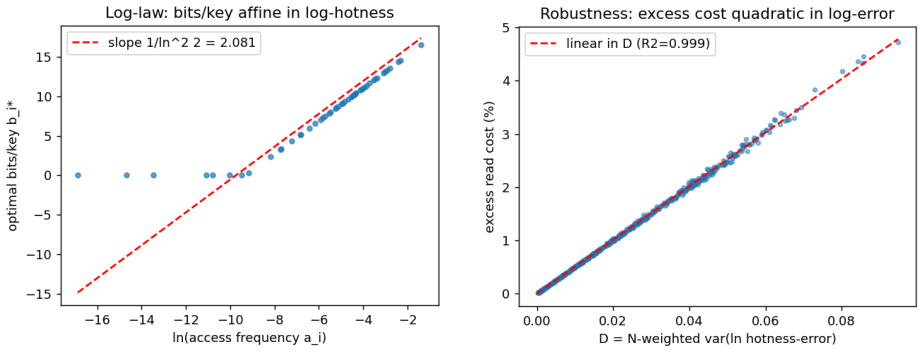
Optimal LSM Bloom-filter bits-per-key follow an affine log-law in access frequency, so compaction-time reallocation captures nearly all adaptivity benefit.
A machine-rendered reading of the paper's core claim, the machinery that carries it, and where it could break.
Core claim
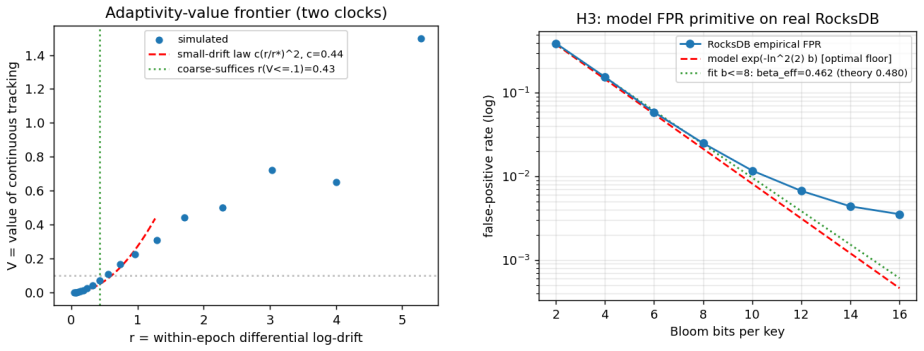
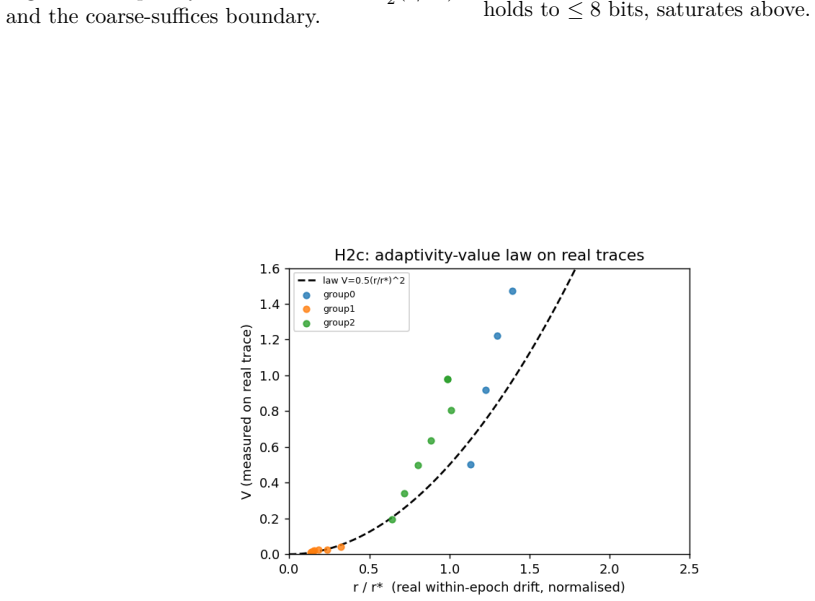
The optimal bits-per-key allocation is affine in the logarithm of access frequency at a fixed slope. The excess read cost from a hotness misestimate equals half the size-weighted variance of the log error. The value of continuous tracking over an allocation recomputed only at compaction grows quadratically in the within-epoch drift with a closed-form scale. Reallocating only at compaction captures 96-99 percent of the benefit of continuous tracking on real traces.
What carries the argument
The log-law relating optimal bits-per-key to log(access frequency) together with the two-clock frontier that compares the compaction clock against a continuous tracking clock.
If this is right
- Because the workload enters only logarithmically, coarse estimates lose little value.
- A common-factor misestimate is absorbed by the budget multiplier.
- More skew makes fine tracking matter less.
- Reallocating only at compaction captures 96-99% of tracking's benefit.
- This yields a three-regime policy: coarse-at-compaction suffices, then track, then fall back to uniform at extreme drift.
Where Pith is reading between the lines
- The result suggests that LSM implementations can avoid the overhead of online frequency tracking in most cases by tying allocation changes to existing compaction events.
- Workloads with high within-epoch drift would still benefit from continuous tracking, but the quadratic scaling gives a clear threshold for when to switch.
- Similar log-law arguments may apply to other resource allocation problems in storage systems where cost depends logarithmically on parameters.
Load-bearing premise
Compaction rebuilds the filters for free on its own clock while access frequencies stay fixed within each epoch.
What would settle it
A measurement on production traces where the performance gap between compaction-only reallocation and continuous tracking is substantially larger than the quadratic prediction for the observed drift.
Figures
read the original abstract
Log-structured merge (LSM) trees attach an approximate-membership filter to every run and must split a fixed memory budget across them. The static optimum is known (Monkey); a large systems literature then makes the allocation adaptive, tracking shifting hotness online. We ask a prior question: when is that adaptivity worth its machinery? We give three analytical answers and validate them on synthetic sweeps, real Twitter production cache traces, and a real RocksDB engine. First, a log-law: optimal bits-per-key is affine in the logarithm of access frequency, at a fixed slope. Second, a robustness law: because the workload enters only logarithmically, the excess read cost from a hotness misestimate is half the size-weighted variance of the log error, and a common-factor misestimate is absorbed by the budget multiplier, so coarse estimates lose little. Third, an adaptivity-value frontier: since compaction rebuilds filters for free on its own clock, the value of continuous tracking over an allocation recomputed only at compaction grows quadratically in the within-epoch drift, with a closed-form scale. This yields a three-regime policy (coarse-at-compaction suffices, then track, then at extreme drift fall back to uniform) and predicts that more skew makes fine tracking matter less. On a real cluster, reallocating only at compaction captures 96-99% of tracking's benefit; on RocksDB the false-positive primitive holds within four percent to eight bits per key. The contribution is a characterization of when adaptive tuning pays; we add no new filter and no engine fork. Code and pre-registration are public.
Editorial analysis
A structured set of objections, weighed in public.
Referee Report
Summary. The manuscript analytically characterizes Bloom-filter tuning in LSM trees under a fixed memory budget. It derives three results: a log-law in which optimal bits-per-key is affine in the logarithm of access frequency at fixed slope; a robustness law stating that excess read cost from hotness misestimate equals half the size-weighted variance of the log-error (with common-factor errors absorbed by the budget multiplier); and a two-clock adaptivity frontier in which the value of continuous tracking over compaction-time allocation grows quadratically in within-epoch drift with closed-form scale, producing a three-regime policy. These are validated on synthetic sweeps, Twitter production traces, and a RocksDB integration, with the claim that compaction-time reallocation captures 96-99% of continuous-tracking benefit.
Significance. If the derivations hold, the work supplies closed-form guidance on when adaptive tuning is worthwhile in LSM stores, explaining the limited returns to fine-grained tracking via logarithmic dependence and quadratic scaling. Strengths include the analytical (rather than fitted) character of the three laws, the use of real production traces and an unmodified engine for validation, and the public code plus pre-registration. The robustness law in particular offers a practical explanation for why coarse estimates often suffice.
major comments (1)
- [Two-clock frontier derivation] Two-clock frontier derivation (abstract and corresponding section): the quadratic growth of adaptivity value in within-epoch drift is derived under the modeling choice that access frequencies remain constant inside each epoch (with drift introduced as a separate parameter). If frequencies instead evolve continuously, the excess-read-cost integral changes and the quadratic dependence need not survive; this assumption is load-bearing for the closed-form scale, the three-regime policy, and the auxiliary claim that more skew reduces the value of fine tracking. A concrete test is to recompute the frontier under a continuous-evolution model and compare the resulting functional form and numerical predictions to the fixed-epoch case.
minor comments (1)
- [Abstract] Abstract: the statement that 'the false-positive primitive holds within four percent to eight bits per key' is ambiguous; specify the exact metric (e.g., relative FPR difference) and the range of bits-per-key over which the bound applies.
Simulated Author's Rebuttal
We thank the referee for the careful reading and the substantive comment on the two-clock frontier. We respond point-by-point below.
read point-by-point responses
-
Referee: Two-clock frontier derivation (abstract and corresponding section): the quadratic growth of adaptivity value in within-epoch drift is derived under the modeling choice that access frequencies remain constant inside each epoch (with drift introduced as a separate parameter). If frequencies instead evolve continuously, the excess-read-cost integral changes and the quadratic dependence need not survive; this assumption is load-bearing for the closed-form scale, the three-regime policy, and the auxiliary claim that more skew reduces the value of fine tracking. A concrete test is to recompute the frontier under a continuous-evolution model and compare the resulting functional form and numerical predictions to the fixed-epoch case.
Authors: The derivation is performed under the stated piecewise-constant frequency model within epochs, with drift introduced as an exogenous parameter at epoch boundaries. This modeling choice is deliberate: it matches the stable intervals visible in the production traces and permits a closed-form integral for excess read cost. The quadratic dependence follows directly from the log-law (optimal bpk affine in log-frequency) combined with the robustness law (excess cost proportional to size-weighted variance of log-error); integrating a linear-in-time deviation over a fixed epoch length produces a quadratic term in the drift magnitude. We acknowledge that a continuous-evolution model would require an auxiliary stochastic process for frequency trajectories and would alter the exact integral. Because the cost remains quadratic in the instantaneous log-error, however, the leading-order scaling with total drift is expected to persist. We will revise the manuscript to (i) restate the piecewise-constant assumption more explicitly in the two-clock section, (ii) add a short paragraph discussing the modeling choice and its relation to observed trace behavior, and (iii) note that continuous-drift extensions are left for future work. We therefore treat the revision as partial: the assumption is clarified and its implications are discussed, but a full recomputation under a continuous model is not performed. revision: partial
Circularity Check
No significant circularity; all three laws are derived analytically from explicit workload models.
full rationale
The paper states it gives three analytical answers (log-law, robustness law, adaptivity-value frontier) derived from workload models rather than data fits. The quadratic frontier follows mathematically once frequencies are modeled as constant inside an epoch (with drift as an independent parameter), but this is an explicit modeling assumption whose consequence is then derived in closed form; it does not reduce the claimed result to a tautology or to a fitted quantity renamed as a prediction. No self-citations are invoked as load-bearing uniqueness theorems, no parameters are fitted on a subset and then called predictions, and the 96-99% empirical capture is presented as validation separate from the derivation. The derivation chain is therefore self-contained against the stated models.
Axiom & Free-Parameter Ledger
Reference graph
Works this paper leans on
-
[1]
Optimal Bloom Filters and Adaptive Merging for
Dayan, Niv and Athanassoulis, Manos and Idreos, Stratos , journal=. Optimal Bloom Filters and Adaptive Merging for. 2018 , publisher=
2018
-
[2]
Proceedings of the 2017 ACM International Conference on Management of Data (SIGMOD) , pages=
Monkey: Optimal Navigable Key-Value Store , author=. Proceedings of the 2017 ACM International Conference on Management of Data (SIGMOD) , pages=. 2017 , doi=
2017
-
[3]
Li, Yongkun and Tian, Chengjin and Guo, Fan and Li, Cheng and Xu, Yinlong , booktitle=
-
[4]
Mnemosyne: Dynamic Workload-Aware
Zhu, Zichen and Wei, Yanpeng and Mun, Ju Hyoung and Athanassoulis, Manos , journal=. Mnemosyne: Dynamic Workload-Aware. 2025 , doi=
2025
-
[5]
Endure: A Robust Tuning Paradigm for
Huynh, Andy and Chaudhari, Harshal A and Terzi, Evimaria and Athanassoulis, Manos , journal=. Endure: A Robust Tuning Paradigm for. 2022 , doi=
2022
-
[6]
Ribbon Filter: Practically Smaller than
Dillinger, Peter C and Walzer, Stefan , journal=. Ribbon Filter: Practically Smaller than
-
[7]
2018 IEEE 59th Annual Symposium on Foundations of Computer Science (FOCS) , pages=
Bloom Filters, Adaptivity, and the Dictionary Problem , author=. 2018 IEEE 59th Annual Symposium on Foundations of Computer Science (FOCS) , pages=. 2018 , doi=
2018
-
[8]
A Large-scale Analysis of Hundreds of In-memory Cache Clusters at
Yang, Juncheng and Yue, Yao and Rashmi, K V , booktitle=. A Large-scale Analysis of Hundreds of In-memory Cache Clusters at
-
[9]
Breaking Down Memory Walls: Adaptive Memory Management in
Luo, Chen and Carey, Michael J , journal=. Breaking Down Memory Walls: Adaptive Memory Management in. 2020 , doi=
2020
-
[10]
2024 , note=
Yu, Weiping and Luo, Siqiang and others , journal=. 2024 , note=
2024
-
[11]
Communications of the ACM , volume=
Space/Time Trade-offs in Hash Coding with Allowable Errors , author=. Communications of the ACM , volume=. 1970 , doi=
1970
-
[12]
The Log-Structured Merge-Tree (
O'Neil, Patrick and Cheng, Edward and Gawlick, Dieter and O'Neil, Elizabeth , journal=. The Log-Structured Merge-Tree (
discussion (0)
Sign in with ORCID, Apple, or X to comment. Anyone can read and Pith papers without signing in.