REVIEW 3 major objections 4 minor 18 references
Missing Physics Discovery through Fully Differentiable Finite Element-Based Machine Learning
T0 review · 3 major / 4 minor · reviewed 2026-08-06 · deepseek-v4-flash
Pith's one-line read This paper claims that missing physics inside a PDE can be learned as a portable operator from indirect measurements alone, and demonstrates zero-shot transfer across geometries and discretisations.
desk verdict Solid framework paper with a serious abstract/content mismatch: the advertised real-data, plastic-hardening, ductile-damage, and symbolic-regression results are absent from the full text, and all validation is closed-loop synthetic. read the letter →
The pith
A machine-rendered reading of the paper's core claim, the machinery that carries it, and where it could break.
The reading
What carries the argument
The load-bearing object is the structure-preserving operator network (SPON), an encode-process-decode architecture $G_\theta = D \circ P_\theta \circ E$ that maps between finite element spaces $U_h$ and $V_h$. The encoder extracts the degrees of freedom of an input finite element function, the processor $P_\theta$ is a trainable neural network, and the decoder reconstructs a function in $V_h$, so the operator preserves continuous properties at the discrete level, can be evaluated at arbitrary points, and inherits zero-shot cross-discretisation behaviour from the finite element representation. End-to-end differentiability of the combined solver-plus-operator system is what makes training from indirect observables possible, because loss gradients pass through the PDE solve into the network parameters. In the solid mechanics examples the constitutive operator is additionally constrained by construction to satisfy objectivity and stress symmetry, parameterised by two scalar elastic moduli $\lambda(I_1)$ and $\mu(I_1)$ that depend on the first strain invariant $I_1$, which reduces the hypothesis space and gives a closed-form tangent.
What would settle it
Generate two different constitutive laws that produce identical force-displacement or displacement-field responses on the training protocol but diverge on a held-out loading path; if FEML trains to the same loss for both and cannot discriminate them, then the learned operator is not the unique missing physics. The same test can be run directly from the thermal experiment by comparing the symbolically regressed conductivity to the ground-truth law, which should match within the injected noise if recovery is exact.
Extended reading notes
Core claim
Central to the paper is the claim that unknown physics inside a PDE can be identified as a learnable operator, not as a configuration-specific solution map. FEML keeps the known physics in finite element weak form and represents the missing relationship as $G_\theta$, a structure-preserving operator network acting on the degrees of freedom of finite element spaces; the whole system is differentiated end-to-end so that gradients of a loss on measurable quantities flow through the PDE solve into the network parameters. Because $G_\theta$ maps finite element functions to finite element functions, its output is evaluable at any point and on any mesh, which is what enables zero-shot reuse across discretisations and geometries. The paper reports recovery of a nonlinear stress-strain softening law from as few as six noisy force-displacement pairs, a more richly identified constitutive model from full-field displacement data, zero-shot transfer to a 3D plate-with-hole torsion problem with relative error around $10^{-3}$ in the maximum displacement, and recovery of a temperature-dependent conductivity from noisy transient temperature fields. The paper's conclusion is that FEML yields data-efficient, interpretable operators that can be ported across problems while preserving known physics.
Load-bearing premise
The method rests on the assumption that the measured data, together with the parts of the physics assumed known, single out one true missing law; if several different operators reproduce the same observations, the trained network is just one fitted representative, not the discovered physics.
Editorial extensions
If this is right
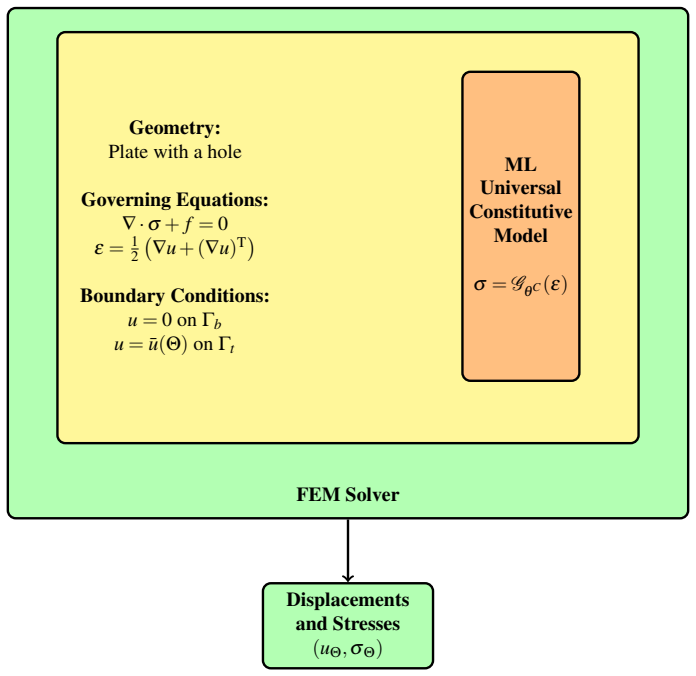
- A constitutive law trained on a simplified 2D laboratory test can be inserted, without retraining, into a 3D simulation with different geometry and loading; the paper reports agreement with the reference solution at a relative error around $10^{-3}$ in maximum displacement.
- Missing laws can be learned from quantities that are experimentally accessible even when the law's own input-output pair is unmeasurable, such as inferring a stress-strain relation from global force or full-field displacement data.
- Because the learned operator is a map between finite element functions, it transfers across mesh resolutions and finite element discretisations without re-simulation or additional training.
- The approach extends from quasi-static solid mechanics to transient multi-component thermal problems, recovering a temperature-dependent conductivity from noisy temperature fields and generalising to a different experiment with different boundary conditions.
- Learned operators can be inspected by symbolic regression to extract closed-form physical laws, giving a route from black-box fit to a human-readable expression.
Reading between the lines
- The identifiability limit the paper concedes—force-displacement data alone do not fix a unique constitutive law—implies that practical deployment should pair the method with experiment design that favours full-field measurements or multiple loading paths, otherwise the 'discovered' law is one representative of an equivalence class rather than the true law.
- Because the operator is decoupled from mesh and geometry, one could pre-train a library of material and transport operators across many experiments and later compose them in multiphysics simulations; the paper gestures at foundation models but does not develop a systematic multi-experiment training scheme.
- The differentiable-FEM recipe should transfer to other hidden operators, such as reaction rates, permeabilities, or damage evolution, provided the forward PDE is differentiable and the observable is sensitive to the operator; nothing in the machinery is specific to elasticity or heat conduction.
- A natural stress test is whether operators trained on one material class extrapolate beyond the strain or temperature range seen in training; zero-shot transfer across geometry is demonstrated, but extrapolation to unvisited regimes is not, and this is where the configuration-agnostic claim would be strained.
Editorial analysis
A structured set of objections, weighed in public.
Referee Report
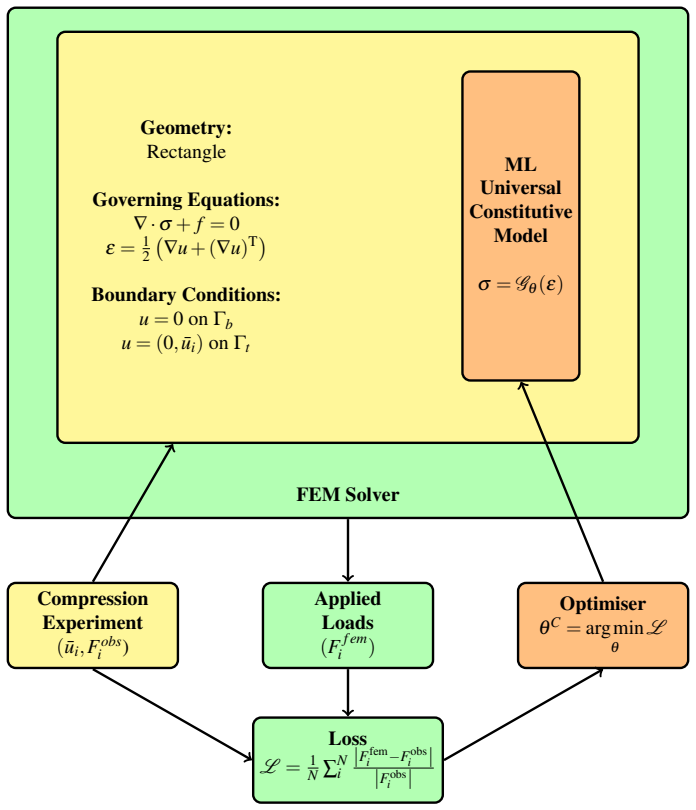
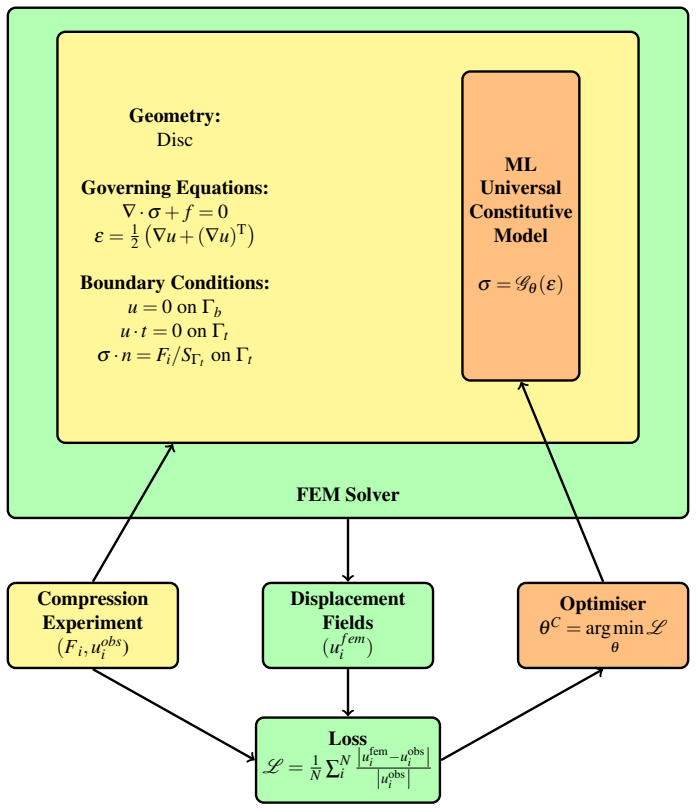
Summary. The paper introduces FEML, a framework that couples finite element PDE solvers with trainable neural operators representing missing physics, such as constitutive laws or temperature-dependent conductivity. The operator is embedded in the variational form of the PDE and trained end-to-end by differentiating through the solver, using losses based on observable quantities (loads, displacements, temperatures). The authors demonstrate the method on three synthetic problems: displacement-controlled uniaxial compression, load-controlled Brazilian disc tests, and transient heat conduction, plus a zero-shot transfer of a learned constitutive operator to a 3D torsion problem. The central claims are that FEML identifies internal operators from indirect data, that the learned operators transfer zero-shot across geometries, boundary conditions, and discretisations, and that the operators can be inspected via symbolic regression. The manuscript also cites a companion repository for code.
Significance. If the central claims hold, FEML would be a useful contribution to scientific machine learning: it goes beyond solution-surrogate learning by attempting to recover the unknown operator itself, and it leverages mature FEM infrastructure with end-to-end differentiability. The use of structure-preserving operator networks (SPONs) with an approximation guarantee (Eq. 5) and the symmetry-preserving constitutive parameterisation (Section 3.1.2) are thoughtful design choices that give the framework theoretical and architectural substance. The demonstration of zero-shot transfer from a 2D disc test to a 3D torsion problem, if supported by a direct operator-level validation, would be a strong result. However, the paper's evidence is entirely synthetic and closed-loop: training and validation data are generated by solving the same PDE with the same ground-truth law (Eqs. 12–13, 16). The discovery claim therefore rests on an identifiability assumption that the paper itself concedes is not established for the force-based loss (Section 1.2.1) and only asserts, without proof, for the displacement-based loss (Section 1.2.2).
major comments (3)
- [Section 1.2.1 and Discussion] The central claim that FEML 'discovers' the missing physics requires that the observable data single out the true operator, but the paper explicitly concedes in Section 1.2.1 that the force-displacement loss (Eq. 6) does not univocally define the constitutive model and that a Poisson's ratio of 0.3 is assumed. For the Brazilian disc case (Section 1.2.2), the paper asserts that full-field displacements allow univocal identification, but no identifiability proof, sensitivity analysis, or experiment demonstrating uniqueness is provided. Since all training and validation data are generated by solving the same PDE with the same ground-truth law, the reported agreement with the ground truth is the optimization target rather than an independent check. I request a concrete identifiability analysis, or at least a comparison of the learned operator G_theta to the ground-truth law on strain states that were not seen during training, before the discovery claim can be accepted.
- [Abstract and Full Text] The abstract states that 'Moving to real data, we learn coupled plastic-hardening and ductile-damage laws from a benchmark shear-coupon test' and that symbolic regression is applied to extract a closed-form law matching the ground truth. The full text contains no corresponding section, method description, or results for a shear-coupon experiment, real data, plastic hardening, ductile damage, or symbolic regression. These are not minor omissions: they are central to the paper's advertised scope and to the inference that the framework works beyond synthetic data. Please either include the missing experiments and methods or revise the abstract and claims to match what is actually presented.
- [Section 1.2.3 and Figure 10] The zero-shot transfer validation is insufficient to support the claim that the learned operator generalises. Figure 10 reports only the displacement and mean stress fields, with a relative displacement error of about 0.1%, but it does not compare the learned operator G_theta to the ground-truth constitutive law on the strain states encountered in the torsion problem. Because the training data come from the same ground-truth law used to generate the reference solution, a wrong operator that reproduces the training observables could still pass this single transfer test. I ask for a direct operator-level comparison on the new problem's strain states, or for multiple transfer scenarios with different geometries and loading regimes to establish that the transferred operator is the identified physics rather than an overfitted representative.
minor comments (4)
- [Section 1.1.1] The text contains several typographical and formatting errors, including 'extbfZero-shot super resolution' (missing LaTeX command), 'single ligne' (should be 'single line'), and 'This relation is crucial' where 'property' seems intended.
- [Section 1.2.1] Typos include 'consititutive' (should be 'constitutive'), 'therfore' (should be 'therefore'), and 'univocally' is used repeatedly where 'uniquely' or 'identifiably' would be clearer.
- [Section 1.2.2] The caption and text use 'contnuous' for 'continuous' and 'triangurlar' for 'triangular'; please proofread the manuscript thoroughly.
- [Section 1.3] The description of the square plate's 'irregular rughness' should be 'irregular roughness', and the sentence 'which significantly influences heat transfer processes' appears to have a word missing ('varies' or 'changes').
Circularity Check
No significant circularity: the paper trains operators on indirect observables and evaluates them on held-out configurations; the self-admitted identifiability caveat is a correctness limitation, not a circular reduction.
full rationale
The paper's derivation chain is a standard PDE-constrained inverse problem: minimize L(u_theta, u_obs) subject to F(u_theta, G_theta(u_theta); v)=0, where G_theta is the unknown operator. Synthetic data are generated from a known G* with the same forward PDE, and the learned G_theta is then compared with G* or deployed on a different geometry/loading. This is not circular: the training loss never contains G* directly, and the 3D torsion example evaluates the operator on a configuration absent from training, so the reported displacement/stress agreement is an independent transfer check conditional on identifiability. The paper explicitly concedes the non-uniqueness of the force-displacement loss in Section 1.2.1 ('the consititutive model is not univocally defined') and in the Discussion ('identifiability issues can arise when multiple operators or parameters produce similar observables'); this is an acknowledged identifiability caveat, and the full-field displacement example is offered as a remedy, but no circular reduction is made. The SPON approximation bound (eq. 5) is cited to the authors' prior arXiv preprint [10]; this is a self-citation, but it is a supporting approximation guarantee and the paper's empirical claims are backed by the numerical experiments rather than by that theorem, so it is not load-bearing circularity. The abstract promises symbolic regression that does not appear in the body; that is a missing-support issue, not circularity. No equation in the paper equates a predicted quantity to its fitting target by construction.
Assumptions & free parameters
free parameters (5)
- Neural network parameters theta for constitutive and conductivity operators =
not reported; trained by gradient descent
- MLP architecture hyperparameters =
3x30 ReLU/SoftPlus for solid mechanics; 2x30 ReLU/Sigmoid for thermal
- Poisson's ratio nu in the displacement-controlled experiment =
0.3
- Synthetic noise levels =
1% for mechanics, 2% for thermal
- Training hyperparameters (optimizer, learning rate) =
not reported; epoch counts 200/100/150 mentioned
assumptions (5)
- domain assumption The known PDE, boundary conditions, and initial conditions are complete and exact; only the target operator is missing.
- domain assumption The missing constitutive law is isotropic, hyperelastic, and depends only on the first strain invariant I1 through two Lame-like moduli lambda(I1), mu(I1).
- domain assumption The observational data are informative enough to uniquely identify the hidden operator (identifiability).
- standard math SPON approximation guarantees from Ref. 10 apply to the embedded training setting.
- ad hoc to paper Synthetic data generated with the same PDE and ground-truth law are representative of real experimental conditions.
Cite this review
Pith. "Pith review of Missing Physics Discovery through Fully Differentiable Finite Element-Based Machine Learning." pith.science (2026). https://pith.science/paper/CK6JDCS2
@misc{pith2026250715787,
  author       = {Pith},
  title        = {Pith review of: Missing Physics Discovery through Fully Differentiable Finite Element-Based Machine Learning},
  year         = {2026},
  howpublished = {\url{https://pith.science/paper/CK6JDCS2}},
  note         = {Machine review of arXiv:2507.15787}
}
read the original abstract
Modelling physical systems with partial differential equations (PDEs) is central to science and engineering, yet in most real applications the PDE model is incomplete: relationships such as constitutive or thermal laws are unknown. Existing surrogate approaches close this gap by learning the PDE solution from data, but remain tied to a specific configuration (geometry, boundary conditions, discretisation) and recover the solution rather than the missing physics itself. We introduce FEML, an end-to-end differentiable framework that couples the known PDE with a machine-learned operator for the missing physics. Embedding the PDE solver into training lets this operator be learned directly from the PDE solution, even when its own output cannot be measured - for example, stress in constitutive laws. Because the operator is independent of the system configuration, a law learned in one setting transfers zero-shot to new geometries, boundary conditions, and discretisations, and can be inspected by domain specialists. FEML represents the operator with structure-preserving operator networks (SPONs), which retain key continuous properties at the discrete level. We demonstrate FEML across solid mechanics and thermal transport. From synthetic data we progressively discover an elastoplastic law - the nonlinear elastic response, then the plastic hardening law - and compose them into a foundation constitutive model that transfers zero-shot to a 3D torsion problem. Moving to real data, we learn coupled plastic-hardening and ductile-damage laws from a benchmark shear-coupon test, reproducing the measured response, including post-peak softening, to within the experimental scatter. Finally, we recover a temperature-dependent conductivity from transient heat-flow data and apply symbolic regression to the learned operator to extract a closed-form law matching the ground truth.
Figures


Figures from the paper (14 more)






Reference graph
Works this paper leans on
-
[2]
Bouziani, N., Ham, D. A. & Farsi, A. Differentiable programming across the PDE and Machine Learning barrier.arXiv preprint arXiv:2409.06085(2024)
arXiv 2024
-
[3]
Quarteroni, A., Gervasio, P. & Regazzoni, F. Combining physics-based and data-driven models: advancing the frontiers of research with scientific machine learning.Math. Model. Methods Appl. Sci.35, 905–1071, DOI: 10.1142/S0218202525500125 (2025). https://doi.org/10.1142/S0218202525500125. 21/22
-
[4]
Belbute-Peres, F. d. A., Economon, T. D. & Kolter, J. Z. Combining Differentiable PDE Solvers and Graph Neural Networks for Fluid Flow Prediction, DOI: 10.48550/arXiv.2007.04439 (2020). ArXiv:2007.04439 [physics, stat]
work page Pith review arXiv doi:10.48550/arxiv.2007.04439 2020
-
[5]
Bouziani, N. & Ham, D. A. Physics-driven machine learning models coupling PyTorch and Firedrake. InICLR Workshop on Physics for Machine Learning, DOI: 10.48550/arXiv.2303.06871 (2023)
-
[6]
Crilly, A., Duhig, B. & Bouziani, N. Learning closure relations using differentiable programming: An example in radiation transport.J. Quant. Spectrosc. Radiat. Transf.108941 (2024)
work page 2024
-
[7]
InInternational Conference on Learning Representations(2021)
Li, Z.et al.Fourier Neural Operator for Parametric Partial Differential Equations. InInternational Conference on Learning Representations(2021)
work page 2021
-
[8]
Li, Z.et al.Physics-Informed Neural Operator for Learning Partial Differential Equations, DOI: 10.48550/arXiv.2111.03794 (2023). ArXiv:2111.03794 [cs, math]
-
[9]
In Thirty-seventh Conference on Neural Information Processing Systems(2023)
Bartolucci, F.et al.Representation Equivalent Neural Operators: a Framework for Alias-free Operator Learning. In Thirty-seventh Conference on Neural Information Processing Systems(2023). 10.Bouziani, N. & Boullé, N. Structure-preserving operator learning.arXiv preprint arXiv:2410.01065(2024)
arXiv 2023
Show all 18 references
-
[11]
Ham, D. A.et al. Firedrake User Manual. Imperial College London and University of Oxford and Baylor University and University of Washington, first edition edn., DOI: 10.25561/104839 (2023)
2023 doi
- [12]
-
[13]
InAdvances in Neural Information Processing Systems, vol
Paszke, A.et al.PyTorch: An Imperative Style, High-Performance Deep Learning Library. InAdvances in Neural Information Processing Systems, vol. 32 (Curran Associates, Inc., 2019)
2019
-
[14]
http://github.com/google/jax (2018)
Bradbury, J.et al.JAX: composable transformations of Python+NumPy programs. http://github.com/google/jax (2018). Version 0.3.13
2018
-
[15]
& Salehipour, H
Ataei, M. & Salehipour, H. XLB: A differentiable massively parallel lattice Boltzmann library in Python.Comput. Phys. Commun.300, 109187, DOI: 10.1016/j.cpc.2024.109187 (2024). ArXiv:2311.16080 [physics]
2024
- [16]
-
[17]
Joglekar, A. S. & Thomas, A. G. R. Machine learning of hidden variables in multiscale fluid simulation.Mach. Learn. Sci. Technol.4, 035049, DOI: 10.1088/2632-2153/acf81a (2023). Publisher: IOP Publishing
2023 doi
- [18]
-
[19]
Brenner, S. C. & Scott, L. R.The Mathematical Theory of Finite Element Methods, vol. 15 ofTexts in Applied Mathematics (Springer New York, New York, NY , 2008), 3 edn
2008
-
[20]
Reports7, 46190, DOI: 10.1038/srep46190 (2017)
Farsi, A.et al.Full deflection profile calculation and young’s modulus optimisation for engineered high performance materials.Sci. Reports7, 46190, DOI: 10.1038/srep46190 (2017). 22/22
2017 doi
Reviewed August 6, 2026 · model on record in the stance chip above.
Discussion (0). Continue with ORCID to comment.